Finished viewing? Save it for later —
Download CBSE Class 10 Sample Paper 2023 Solutions for Maths Basic (PDF · 9 pages)About CBSE Class 10 Sample Paper 2023 Solutions for Maths Basic
CBSE Class 10 Sample Paper 2023 Solutions for Maths Basic is available here for free download. Published by CBSE for Class 10, this solution can be viewed online or downloaded as a PDF (9 pages). Candidates preparing for Class 10 can use CBSE Class 10 Sample Paper 2023 Solutions for Maths Basic to understand the exam pattern, the type of questions asked, and the overall difficulty level.
Frequently Asked Questions
How can I download CBSE Class 10 Sample Paper 2023 Solutions for Maths Basic?
Open this page and click the Download button to save CBSE Class 10 Sample Paper 2023 Solutions for Maths Basic as a PDF. It is completely free on AglaSem Docs.
Is CBSE Class 10 Sample Paper 2023 Solutions for Maths Basic free to download?
Yes. CBSE Class 10 Sample Paper 2023 Solutions for Maths Basic can be viewed online and downloaded as a PDF free of cost on AglaSem Docs.
How many pages does CBSE Class 10 Sample Paper 2023 Solutions for Maths Basic have?
CBSE Class 10 Sample Paper 2023 Solutions for Maths Basic contains 9 pages, which you can read online or download together as a single PDF.
Where can I find more Class 10 study material?
You can find more Class 10 question papers, sample papers, syllabus, and answer keys on AglaSem Docs.
CBSE Class 10 Sample Paper 2023 Solutions for Maths Basic – Text
Read the full text of this solution below — useful to quickly search, copy and reference the content online without downloading the PDF.
📄 View text version (9 pages)
Page 1
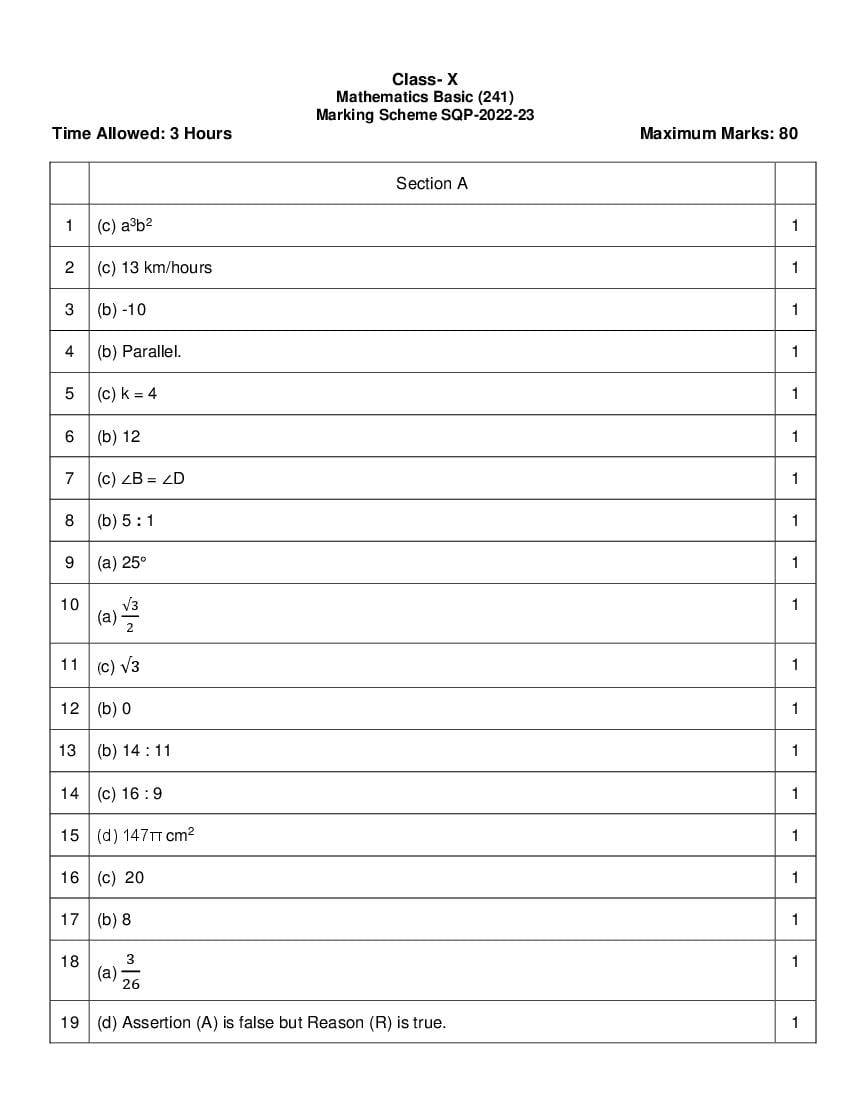
Mathematics Basic (241)
Marking Scheme SQP-2022-23
Time Allowed: 3 Hours Maximum Marks: 80
Section A
1 (c) a3b2 1
2 (c) 13 km/hours 1
3 (b) -10 1
4 (b) Parallel. 1
5 (c) k = 4 1
6 (b) 12 1
7 (c) ∠B = ∠D 1
8 (b) 5 : 1 1
9 (a) 25° 1
10 √3 1
(a)
2
11 (c) √3 1
12 (b) 0 1
13 (b) 14 : 11 1
14 (c) 16 : 9 1
15 (d) 147π cm2 1
16 (c) 20 1
17 (b) 8 1
18 3 1
(a)
26
19 (d) Assertion (A) is false but Reason (R) is true. 1
Page 2
of Assertion (A).
Section B
For a pair of linear equations to have infinitely many solutions :
21 a1 b1 c1 k 3 k−3 ½
= = ⇒ = =
a2 b2 c2 12 k k
𝑘 3
= ⇒ k2 = 36 ⇒ k = ± 6 ½
12 𝑘
3 𝑘−3
Also, = ⇒ k2 – 6k = 0 ⇒ k = 0, 6. ½
𝑘 𝑘
Therefore, the value of k, that satisfies both the conditions, is k = 6. ½
(i) In ΔABD and ΔCBE
22
∠ADB = ∠CEB = 90º ½
∠ABD = ∠CBE (Common angle)
⇒ ΔABD ~ ΔCBE (AA criterion) ½
(ii) In ΔPDC and ΔBEC
∠PDC = ∠BEC = 90º ½
∠PCD = ∠BCE (Common angle)
⇒ ΔPDC ~ ΔBEC (AA criterion) ½
In ΔABC, DE || AC
BD/AD = BE/EC .........(i) (Using BPT) ½
In ΔABE, DF || AE
BD/AD = BF/FE ........(ii) (Using BPT) ½
From (i) and (ii)
BD/AD = BE/EC = BF/FE ½
BF BE
Thus, FE = EC ½
Let O be the centre of the concentric circle of radii 5 cm
23 and 3 cm respectively. Let AB be a chord of the larger circle
touching the smaller circle at P
Then AP = PB and OP⊥AB ½
Applying Pythagoras theorem in △OPA, we have
OA2=OP2+AP2 ⇒ 25 = 9 + AP2 ½
⇒ AP2 = 16 ⇒ AP = 4 cm ½
∴ AB = 2AP = 8 cm ½
24 (1 + sinθ)(1 − sinθ) (1 – sin2 θ) ½
Now, = (1
(1 + cosθ)(1 − cosθ) – cos2 θ)
cos2 θ cosθ 2
= =( ) ½
sin2 θ sinθ
½
= cot 2 θ
7 2 49
=( ) = ½
8 64
Page 3
Perimeter of quadrant = 2r + 4 × 2 π r ½
1 22
⇒ Perimeter = 2 × 14 + 2 × 7 × 14 ½
⇒ Perimeter = 28 + 22 =28+22 = 50 cm 1
Area of the circle = Area of first circle + Area of second circle
⇒ πR2 = π (r1)2 + π (r1)2 ½
⇒ πR2 = π (24)2 + π (7)2 ⇒ πR2 = 576π +49π ½
⇒ πR2 = 625π ⇒ R2 = 625 ⇒ R = 25 Thus, diameter of the circle = 2R = 50 cm. 1
Section C
26 Let us assume to the contrary, that √5 is rational. Then we can find a and b ( ≠ 0) such
𝑎
that √5 = (assuming that a and b are co-primes).
𝑏 1
So, a = √5 b ⇒ a2 = 5b2
Here 5 is a prime number that divides a2 then 5 divides a also
(Using the theorem, if a is a prime number and if a divides p2, then a divides p, where a is ½
a positive integer)
Thus 5 is a factor of a
Since 5 is a factor of a, we can write a = 5c (where c is a constant). Substituting a = 5c
½
We get (5c)2 = 5b2 ⇒ 5c2 = b2
This means 5 divides b2 so 5 divides b also (Using the theorem, if a is a prime number and
if a divides p2, then a divides p, where a is a positive integer).
Hence a and b have at least 5 as a common factor. ½
But this contradicts the fact that a and b are coprime. This is the contradiction to our
assumption that p and q are co-primes.
So, √5 is not a rational number. Therefore, the √5 is irrational. ½
6x2 – 7x – 3 = 0 ⇒ 6x2 – 9x + 2x – 3 = 0
27
⇒ 3x(2x – 3) + 1(2x – 3) = 0 ⇒ (2x – 3)(3x + 1) = 0 ½
⇒ 2x – 3 = 0 & 3x + 1 = 0
x = 3/2 & x = -1/3 Hence, the zeros of the quadratic polynomials are 3/2 and -1/3. ½
For verification
– coefficient of x 1
Sum of zeros = ⇒ 3/2 + (-1/3) = – (-7) / 6 ⇒ 7/6 = 7/6
coefficient of x2
constant
Product of roots = ⇒ 3/2 x (-1/3) = (-3) / 6 ⇒ -1/2 = -1/2 1
coefficient of x2
Therefore, the relationship between zeros and their coefficients is verified.
Let the fixed charge by Rs x and additional charge by Rs y per day
28 Number of days for Latika = 6 = 2 + 4
Hence, Charge x + 4y = 22
x = 22 – 4y ………(1) ½
Number of days for Anand = 4 = 2 + 2
Hence, Charge x + 2y = 16
x = 16 – 2y ……. (2) ½
On comparing equation (1) and (2), we get,
Page 4
Substituting y = 3 in equation (1), we get,
x = 22 – 4 (3) ⇒ x = 22 – 12 ⇒ x = 10
Therefore, fixed charge = Rs 10 and additional charge = Rs 3 per day 1
AB = 100 km. We know that, Distance = Speed × Time.
AP – BP = 100 ⇒ 5x − 5y = 100 ⇒ x−y=20.....(i) ½
AQ + BQ = 100 ⇒ x + y = 100….(ii) ½
Adding equations (i) and (ii), we get,
x − y + x + y = 20 +100 ⇒ 2x = 120 ⇒ x = 60 1
Substituting x = 60 in equation (ii), we get, 60 + y = 100 ⇒ y = 40
1
Therefore, the speed of the first car is 60 km/hr and the speed of the second car
is 40 km/hr.
29 Since OT is perpendicular bisector of PQ.
Therefore, PR=RQ=4 cm ½
Now, OR = √𝐎𝐏 𝟐 − 𝐏𝐑𝟐 = √𝟓𝟐 − 𝟒𝟐 =3cm ½
Now, ∠TPR + ∠RPO = 90° (∵TPO=90°)
& ∠TPR + ∠PTR = 90° (∵TRP=90∘)
So, ∠RPO = ∠PTR ½
So, ⍙TRP ~ ⍙PRO [By A-A Rule of similar triangles] ½
TP RP
So, PO = RG
. ½
TP 4 20
⇒ 5 = 3 ⇒ TP = 3 cm ½
1
30 tan θ cot θ tan θ ½
LHS = + = 1 + tan θ
1−cot θ 1−tan θ 1− 1−tan θ
tan θ
tan2 θ 1
= +
tan θ−1 tan θ (1−tan θ)
½
tan3 θ−1
=
tan θ (tan θ−1)
(tanθ −1) (tan3 θ + tanθ+1 )
=
tan θ (tan θ−1) ½
(tan3 θ + tanθ+1 )
=
tan θ
= tanθ + 1 + sec = 1 + tanθ + secθ
½
sin θ cos θ
= 1+ +
cos θ sin θ
sin2 θ+ cos2 θ ½
=1+
sin θ cos θ
Page 5
= 1 + sin θ cos θ = 1 + sec θ cosec θ
½
sin θ + cos θ = √3 ⇒ (sin θ + cos θ)2 = 3
½
⇒ sin2 θ + cos2 θ + 2sin θ cos θ = 3
⇒ 1 + 2sin θ cos θ = 3 ⇒ 1 sin θ cos θ = 1 ½
sin θ cos θ ½
Now tanθ + cotθ = +
cos θ isn θ
sin2 θ+ cos2 θ ½
=
sin θ cos θ
½
1 1
= = 1 =1
sin θ cos θ ½
31 5 1
(i) P(8 ) =
36
0 1
(ii) P(13 ) = =0
36
(iii) P(less than or equal to 12) = 1 1
Section D
Let the average speed of passenger train = x km/h.
32
and the average speed of express train = (x + 11) km/h
½
As per given data, time taken by the express train to cover 132 km is 1 hour less than the
passenger train to cover the same distance. Therefore,
132 132 1
− =1
𝑥 𝑥+11
132 (𝑥+11−𝑥) 132 𝑥 11
⇒ =1⇒ =1 ½
𝑥 (𝑥+11) 𝑥 (𝑥+11)
⇒ 132 × 11 = x(x + 11) ⇒ x2 + 11x – 1452 = 0
⇒ x2 + 44x -33x -1452 = 0 1
⇒ x (x + 44) -33(x + 44) = 0 ⇒ (x + 44)(x – 33) = 0 1
⇒ x = – 44, 33 ½
As the speed cannot be negative, the speed of the passenger train will be 33 km/h and the ½
speed of the express train will be 33 + 11 = 44 km/h.
Let the speed of the stream be x km/hr ½
So, the speed of the boat in upstream = (18 - x) km/hr
& the speed of the boat in downstream = (18 + x) km/hr ½
distance distance
ATQ, - =1
upstream speed downstream speed
24 24
⇒ − =1 1
18 − 𝑥 18 + 𝑥
Page 6
⇒ 24 [ − ] = 1 ⇒ 24 [(18 ]=1
18 − 𝑥 18 + 𝑥 − 𝑥).(18 + 𝑥) 1
2𝑥 2𝑥
⇒ 24 [ ] = 1 ⇒ 24 [(18 ]=1
(18 − 𝑥).(18 + 𝑥) − 𝑥).(18 + 𝑥)
⇒ 48x = 324 - x2 ⇒ x2 + 48x - 324 = 0 1
⇒ (x + 54)(x - 6) = 0 ⇒ x = -54 or 6 ½
As speed to stream can never be negative, the speed of the stream is 6 km/hr. ½
Figure ½
33 Given, To prove, constructions 1½
Proof 2
Application ---- 1
1
34 Volume of one conical depression = 3 x π r 2 h ½
1 22 1½
= 3 x 7 x 0.52 x 1.4 cm3 = 0.366 cm3
Volume of 4 conical depression = 4 x 0.366 cm3
= 1.464 cm3 ½
Volume of cuboidal box = L x B x H ½
= 15 x 10 x 3.5 cm3 = 525 cm3 1½
Remaining volume of box = Volume of cuboidal box –
Volume of 4 conical depressions
½
= 525 cm3 − 1.464 cm3 = 523.5 cm3
1
Let h be height of the cylinder, and r the common radius of
the cylinder and hemisphere.
Then, the total surface area = CSA of cylinder + CSA of ½
hemisphere
= 2𝜋rh + 2𝜋r2 = 2𝜋 r (h + r) 2
22
= 2 x 7 x 30 (145 + 30) cm2 1
22
= 2x x 30 x 175 cm2 ½
7
= 33000 cm2 = 3.3 m2 1
35 Class Interval Number of policy holders (f) Cumulative Frequency (cf)
Below 20 2 2
20-25 4 6
25-30 18 24
30-35 21 45
35-40 33 78
40-45 11 89
45-50 3 92
50-55 6 98
1
55-60 2 100
Page 7
Class size, h = 5, Lower limit of median class, l = 35,
frequency f = 33, cumulative frequency cf = 45
n
− cf
⇒Median = l + [ 2
]×h ½
f
50 − 45
⇒Median = 35 + [ ]×5 1½
33 1
25
= 35 + = 35 + 0.76
33
= 35.76 Therefore, median age is 35.76 years 1
Section E
1 Since the production increases uniformly by a fixed number every year, the
36
number of Cars manufactured in 1st, 2nd, 3rd, . . .,years will form an AP.
So, a + 3d = 1800 & a + 7d = 2600 ½
So d = 200 & a = 1200 ½
2 t12 = a + 11d ⇒ t30 = 1200 + 11 x 200 ½
⇒ t12 = 3400 ½
𝑛 10
3 Sn = 2 [2𝑎 + (𝑛 − 1)𝑑] ⇒ S10 = 2 [2 𝑥 1200 + (10 − 1) 200] ½
13
⇒ S10 = 2 [2 𝑥 1200 + 9 x 200] ½
⇒ S10 = 5 x [2400 + 1800 ] ½
⇒ S10 = 5 x 4200= 21000 ½
Let in n years the production will reach to 31200
𝑛 𝑛
Sn = [2𝑎 + (𝑛 − 1)𝑑] = 31200 ⇒ [2 𝑥 1200 + (𝑛 − 1)200] = 31200 ½
2 2
𝑛
⇒ 2 [2 x 1200 + (𝑛 − 1)200] = 31200 ⇒ 𝑛 [ 12 + (𝑛 − 1) ] = 312
½
⇒ n2 + 11n -312 = 0
⇒ n2 + 24n - 13n -312 = 0 ½
⇒ (n +24)(n -13) = 0
⇒ n = 13 or – 24. As n can’t be negative. So n = 13 ½
Case Study – 2
37
Page 8
1 LB = √ (𝑥2 − 𝑥1 )2 + (𝑦2 − 𝑦1 )2 ⇒ LB = √ (0 − 5)2 + (7 − 10)2 ½
LB = √ (5)2 + (3)2 ⇒ LB = √25 + 9 LB = √34
Hence the distance is 150 √34 km ½
2 3 x 5 + 2 x 0 3 x 7 + 2 x 10
Coordinate of Kota (K) is ( , ) ½
3+2 3+2
15+0 21+20 41
½
=( , )= (3, 5 )
5 5
3 L(5, 10), N(2,6), P(8,6)
½
LN = √ (2 − 5)2 + (6 − 10)2 = √ (3)2 + (4)2 = √9 + 16 = √25 = 5 ½
NP = √ (8 − 2)2 + (6 − 6)2 = √ (4)2 + (0)2 = 4 ½
PL = √ (8 − 5)2 + (6 − 10)2 = √ (3)2 + (4)2 ⇒ LB = √9 + 16 = √25 = 5
as LN = PL ≠ NP, so ∆ LNP is an isosceles triangle. ½
Page 9
⇒ √ (5 − 0)2 + (10 − b)2 = √ (8 − 0)2 + (6 − b)2 ½
⇒ (5)2 + (10 − b)2 = (8)2 + (6 − b)2 ½
25
⇒ 25 + 100 − 20𝑏 + b2 = 64 + 36 − 12𝑏 + b2 ⇒ 8b = 25 ⇒ b = 8 ½
25 ½
So, the coordinate on y axis is (0, 8 )
Case Study – 3
38
1 PC ½
sin 60° =
PA
√3 18
⇒ = ⇒ PA = 12 √3 m ½
2 PA
2 PC ½
sin 30° =
PB
1 18
⇒ = ⇒ PB = 36 m ½
2 PB
PC 18
3 tan 60° = AC ⇒ √3 = AC ⇒ AC = 6 √3 m 1
PC 1 18
tan 30° = ⇒ = ⇒ CB = 18 √3 m
CB √3 CB ½
Width AB = AC + CB = 6 √3 + 18 √3 = 24 √3 m ½
RB = PC =18 m & PR = CB = 18 √3 m ½
QR 1 QR
tan 30° = ⇒ = ⇒ QR = 18 m 1
PR √3 18 √3
QB = QR + RB = 18 + 18 = 36m. Hence height BQ is 36m
½
Document Details
| Board / Org | CBSE |
| Exam | Class 10 |
| Type | Solution |
| Pages | 9 |
| Updated | 30 Apr 2026 |