Karnataka 1st PUC Chemistry Some Basic Concepts of Chemistry MCQ with Answers
Finished viewing? Save it for later —
Download Karnataka 1st PUC Chemistry Some Basic Concepts of Chemistry MCQ with Answers (PDF · 10 pages)About Karnataka 1st PUC Chemistry Some Basic Concepts of Chemistry MCQ with Answers
Karnataka 1st PUC Chemistry Some Basic Concepts of Chemistry MCQ with Answers is available here for free download. Published by Karnataka Board for Class 11, this question bank can be viewed online or downloaded as a PDF (10 pages). Candidates preparing for Class 11 can use Karnataka 1st PUC Chemistry Some Basic Concepts of Chemistry MCQ with Answers to understand the exam pattern, the type of questions asked, and the overall difficulty level.
Frequently Asked Questions
How can I download Karnataka 1st PUC Chemistry Some Basic Concepts of Chemistry MCQ with Answers?
Open this page and click the Download button to save Karnataka 1st PUC Chemistry Some Basic Concepts of Chemistry MCQ with Answers as a PDF. It is completely free on AglaSem Docs.
Is Karnataka 1st PUC Chemistry Some Basic Concepts of Chemistry MCQ with Answers free to download?
Yes. Karnataka 1st PUC Chemistry Some Basic Concepts of Chemistry MCQ with Answers can be viewed online and downloaded as a PDF free of cost on AglaSem Docs.
How many pages does Karnataka 1st PUC Chemistry Some Basic Concepts of Chemistry MCQ with Answers have?
Karnataka 1st PUC Chemistry Some Basic Concepts of Chemistry MCQ with Answers contains 10 pages, which you can read online or download together as a single PDF.
Where can I find more Class 11 study material?
You can find more Class 11 question papers, sample papers, syllabus, and answer keys on AglaSem Docs.
Karnataka 1st PUC Chemistry Some Basic Concepts of Chemistry MCQ with Answers – Text
Read the full text of this question bank below — useful to quickly search, copy and reference the content online without downloading the PDF.
📄 View text version (10 pages)
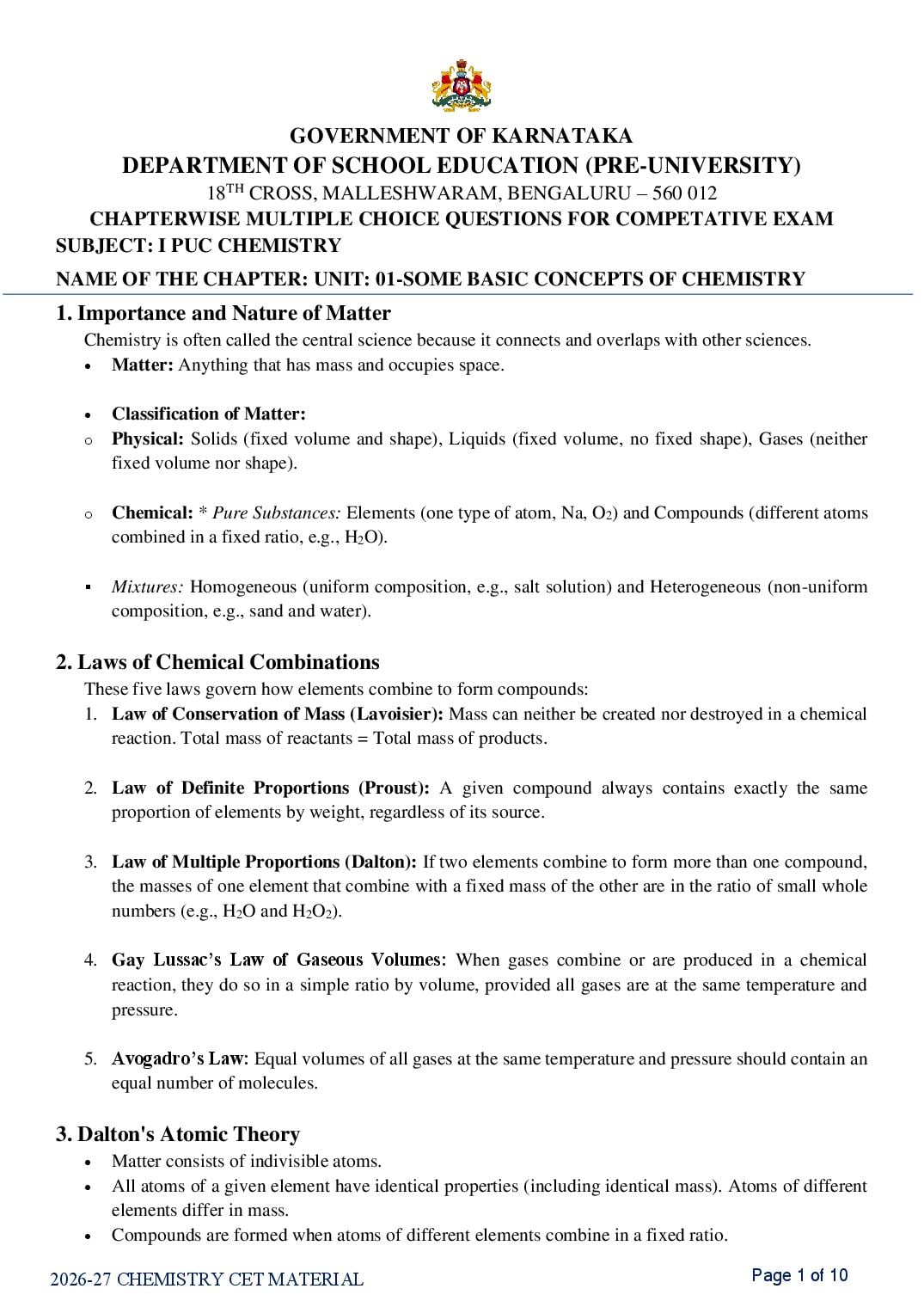
Page 1
DEPARTMENT OF SCHOOL EDUCATION (PRE-UNIVERSITY)
18TH CROSS, MALLESHWARAM, BENGALURU – 560 012
CHAPTERWISE MULTIPLE CHOICE QUESTIONS FOR COMPETATIVE EXAM
SUBJECT: I PUC CHEMISTRY
NAME OF THE CHAPTER: UNIT: 01-SOME BASIC CONCEPTS OF CHEMISTRY
1. Importance and Nature of Matter
Chemistry is often called the central science because it connects and overlaps with other sciences.
• Matter: Anything that has mass and occupies space.
• Classification of Matter:
o Physical: Solids (fixed volume and shape), Liquids (fixed volume, no fixed shape), Gases (neither
fixed volume nor shape).
o Chemical: * Pure Substances: Elements (one type of atom, Na, O2) and Compounds (different atoms
combined in a fixed ratio, e.g., H2O).
▪ Mixtures: Homogeneous (uniform composition, e.g., salt solution) and Heterogeneous (non-uniform
composition, e.g., sand and water).
2. Laws of Chemical Combinations
These five laws govern how elements combine to form compounds:
1. Law of Conservation of Mass (Lavoisier): Mass can neither be created nor destroyed in a chemical
reaction. Total mass of reactants = Total mass of products.
2. Law of Definite Proportions (Proust): A given compound always contains exactly the same
proportion of elements by weight, regardless of its source.
3. Law of Multiple Proportions (Dalton): If two elements combine to form more than one compound,
the masses of one element that combine with a fixed mass of the other are in the ratio of small whole
numbers (e.g., H2O and H2O2).
4. Gay Lussac’s Law of Gaseous Volumes: When gases combine or are produced in a chemical
reaction, they do so in a simple ratio by volume, provided all gases are at the same temperature and
pressure.
5. Avogadro’s Law: Equal volumes of all gases at the same temperature and pressure should contain an
equal number of molecules.
3. Dalton's Atomic Theory
• Matter consists of indivisible atoms.
• All atoms of a given element have identical properties (including identical mass). Atoms of different
elements differ in mass.
• Compounds are formed when atoms of different elements combine in a fixed ratio.
2026-27 CHEMISTRY CET MATERIAL Page 1 of 10
Page 2
4. Atomic and Molecular Masses
• Atomic Mass Unit (amu) / Unified Mass (u): Defined as a mass exactly equal to 1/12th of the mass
of one carbon-12 atom. 1 u 1.66056 10−24 g.
• Average Atomic Mass: Calculated by taking into account the natural abundance of an element's
isotopes.
Average Atomic Mass = (Abundance Isotopic Mass)
• Molecular Mass: The sum of atomic masses of the elements present in a molecule.
• Formula Mass: Used for ionic compounds (like NaCl) instead of molecular mass, as they form 3D
crystal lattices rather than discrete molecules.
5. The Mole Concept and Molar Mass
The mole is the SI unit for the amount of a substance.
• One Mole (1mol): Contains exactly 6.02214076 10 elementary entities. This number is called
23
Avogadro’s Constant ( N A ).
• Molar Mass: The mass of one mole of a substance in grams. It is numerically equal to
atomic/molecular mass in u.
Core Formulae:
Given Mass (g)
Number of moles (n) =
Molar Mass (g/mol)
Number of particles
Number of moles (n) =
6.022 1023
Volume of gas in Litres
Number of moles (for gases at STP) =
22.7 L
(or 22.4 L depending on standard pressure bar vs atm)
6. Percentage Composition and Empirical/Molecular Formulae
• Mass % of an element:
Mass of that element in the compound 100
Mass% =
Molar mass of the compound
• Empirical Formula: Represents the simplest whole-number ratio of various atoms present in a
compound.
• Molecular Formula: Represents the actual number of atoms of various elements present in a
molecule.
Molecular Formula = n Empirical Formula
Molar Mass
where n =
Empirical Formula Mass
2026-27 CHEMISTRY CET MATERIAL Page 2 of 10
Page 3
Stoichiometry deals with the calculation of masses (and sometimes volumes) of reactants and products
involved in a chemical reaction.
• Limiting Reagent: The reactant that is completely consumed first in a chemical reaction. It limits the
amount of product formed.
• Tip to find Limiting Reagent: Divide the given moles of each reactant by their respective stoichiometric
coefficients. The one with the lowest value is the limiting reagent.
8. Reactions in Solutions (Concentration Terms)
The concentration of a solution can be expressed in several ways:
Concentration Term Formula Key Note
Mass of solute
Mass Percent (%) 100 Independent of temperature
Mass of solution
nA
Mole Fraction ( A ) A = Sum of all mole fractions ( A + B ) =1
nA + nB
Moles of solute Temperature dependent (changes
Molarity (M) M=
Volume of solution in Litres with volume)
Moles of solute Independent of temperature (mass
Molality (m) m=
Mass of solvent in kg doesn't change)
Concept 1: Importance and Scope of Chemistry & Nature of Matter
1. Which of the following is a homogeneous mixture?
(a) Mixture of soil and water (b) Sugar dissolved in water
(c) Mixture of iron filings and sand (d) Wood
2. Which of the following statements best describes a chemical compound?
(a) It can be separated into its constituent elements by physical methods.
(b) It retains the physical properties of its constituent elements.
(c) It contains constituent elements combined in a fixed ratio by mass.
(d) It is always gaseous in nature.
3. Which of the following is classified as a pure substance?
(a) Clean Air (b) Sea water
(c) Distilled water (d) Brass
4. Which of the following is an example of a heterogeneous mixture?
(a) Iodine in alcohol (Tincture of Iodine) (b) Sodium chloride in water
(c) Petrol and water (d) Carbon dioxide in water (Soda water)
5. The fundamental distinct characteristic of an element is that:
(a) It can be broken down into simpler substances by chemical reactions.
2026-27 CHEMISTRY CET MATERIAL Page 3 of 10
Page 4
(c) It must always exist as monoatomic species.
(d) It has a variable composition depending on its source.
6. The primary difference between a compound and a mixture is
(a) Compounds are always solid, while mixtures are liquids.
(b) Elements in a compound lose their individual identities, whereas components of a mixture retain
them.
(c) Mixtures have sharp, fixed melting points.
(d) Compounds can be formed with any arbitrary proportion of elements.
7. Which of the following is very effective in the cancer therapy?
(a) Azidothymidine (b) Cisplatin
(c) Benzene (d) Naphthalene
8. The chemical responsible for ozone depletion in the stratosphere is
(a) oxygen (b) chloroflurocarbons
(c) carbondioxide (d) water
Properties of Matter and Their Measurement & SI Units
9. The SI unit of luminous intensity is:
(a) Ampere (b) Candela
(c) Kelvin (d) Mole
10. A temperature of 95°F is equivalent to what value in Celsius?
(a) 45°C (b) 35°C
(c) 53°C (d) 25°C
11. The prefix 'pico' corresponds to which multiplier?
(a) 10−9 (b) 10−12
(c) 10−15 (d) 10− 6
12. Which of the following is NOT an SI base unit?
(a) Kilogram (b) Second
(c) Celsius (d) Meter
13. The unit of density in the SI system is:
(a) g/cm³ (b) kg/m³
(c) g/L (d) kg/dm³
14. Which of the following states of matter, the particles do not have much freedom of movement?
(a) Gases (b) Liquid
(c) Fluids (d) Solid
15. Which of the following have neither definite volume nor definite shape?
(a) Pure water at 269K (b) Steam
2026-27 CHEMISTRY CET MATERIAL Page 4 of 10
Page 5
16. Read the following statements and select the correct answer from the given choices:
Statement-I: Liquids on heating changes to the gaseous state.
Statement-II: Three states of matter are interconvertible by changing the temperature and pressure.
(a) statement –I is correct, statement –II is incorrect
(b) statement –I is incorrect, statement –II is correct
(c) both the statements I and II are correct.
(d) both the statements I and II are incorrect.
17. Pick the true statement in the following.
(a) a homogeneous substance has uniform composition and identical properties throughout.
(b) vapour represents gaseous state of a substance which is a liquid at room temperature.
(c) homogeneous substances are also called solutions
(d) all the above answers are correct.
18. Which of the following is NOT a correct match with respect to the type mentioned with it?
(a) element: I2 (b) mixture: sugar solution
(c) compound: water (d) homogeneous mixture: sand in water
19. The number of base units in SI system is
(a) 4 (b) 3
(c) 8 (d) 7
20. Match the following given in List I with List II:
List - I List- II
(multiples) (prefix)
A) 10-9 i) centi
B) 10-6 ii) nano
C) 10-1 iii) micro
D) 10-2 iv) deci
(a) A-ii, B-iii, C- iv, D- i (b) A-iii, B-ii, C- i, D- iv
(c) A-i, B-ii, C- iii, D- iv (d) A-ii, B-iv, C- iii, D- i
21. Identify the CORRECT information from the following:
(a) Mass is the amount of matter present in a substance.
(b) Weight of a substance is constant at all the places.
(c) SI unit of mass is gram.
(d) Mass is the force exerted by gravity on an object.
22. The Fahrenheit scale is represented between
(a) 0o and 100o (b) 2o and 12o
(c) 32o and 1100o (d) 32o and 212o
2026-27 CHEMISTRY CET MATERIAL Page 5 of 10
Page 6
23. Select the INCORRECT statement/s from the following:
(i) 22 books have infinite significant figures.
(ii) In the answer of calculation 2.5×1.25 has four significant figures.
(iii) Zero's preceding to first non-zero digit are significant.
(iv) In the answer of calculation has three significant figures.
(a) ii, iii and iv (b) ii and iii only
(c) ii and iv only (d) i and ii only (KCET-2025)
24. How many significant figures are there in 0.00450?
(a) 5 (b) 2
(c) 3 (d) 4
25. The number 6.022 x 10⁻²³ has how many significant figures?
(a) 24 (b) 23
(c) 4 (d) Infinate
26. Round off 2.845 to three significant figures:
(a) 2.85 (b) 2.84
(c) 2.80 (d) 2.83
27. A student measures a sample three times and obtains 2.01 g, 2.02 g, and 2.01 g. The actual mass is 3.50
g. These measurements are:
(a) Accurate and precise (b) Accurate but not precise
(c) Precise but not accurate (d) Neither precise nor accurate
28. The scientific notation of the number 0.0000342 is expressed as:
(a) 3.42 10−5 (b) 34.2 10− 6
(c) 0.342 10− 4 (d) 3.42 105
29. Identify the CORRECT statement in the following:
(a) in the determination of number of significant figures, zeros preceding to first non-zero digit are
significant
(b) accuracy refers to the closeness of various measurements for the same quantity
(c) the number 18.2 has three significant figures.
(d) in the number 0.0052, all the zeros are significant
Concept 4: Laws of Chemical Combination
30. Which law states that 'a chemical compound always contains exactly the same proportion of elements by
mass'?
(a) Law of Conservation of Mass (b) Law of Definite Proportions
(c) Law of Multiple Proportions (d) Avogadro's Law
2026-27 CHEMISTRY CET MATERIAL Page 6 of 10
Page 7
a fixed mass of carbon are in the ratio 1:2. This illustrates which law?
(a) Law of Reciprocal Proportions (b) Law of Conservation of Mass
(c) Law of Multiple Proportions (d) Gay Lussac's Law
32. Hydrogen and Oxygen combine in a 1:8 mass ratio to form water. What mass of oxygen gas is required
to react completely with 4.0 g of hydrogen gas?
(a) 8.0 g (b) 16.0 g
(c) 32.0 g (d) 4.0 g
33. Gay Lussac's Law of Gaseous Volumes is applicable only to reactions involving:
(a) Solids and Liquids
(b) Gaseous reactants and products
(c) Homogeneous solid mixtures
(d) Any state of matter provided mass is constant
34. Equal volumes of all gases under identical conditions of temperature and pressure contain equal number
of molecules. This is known as:
(a) Dalton's Law (b) Avogadro's Law
(c) Gay Lussac's Law (d) Boyle's Law
35. 1.70 g of silver nitrate was mixed with 0.585g of sodium chloride in solution form. It produced 1.435g of
silver chloride and 0.85g of sodium nitrate. This illustrates,
(a) law of conservation of mass (b) law of constant composition
(c) law of multiple proportions (d) Gay Lussac’s law of combining volumes.
36. In one experiment, 2.16g of copper was treated with nitric acid and later ignited to get 2.7g of copper
oxide. In another experiment, 1.15g of copper oxide on reduction produced 0.92g of copper. This
illustrates,
(a) law of conservation of mass (b) law of constant composition
(c) law of multiple proportions (d) Gay Lussac’s law of combining volumes
Concept 5: Dalton's Atomic Theory & Atomic, Molecular, and Average Masses
37. Which postulate of Dalton's atomic theory explains the law of conservation of mass?
(a) Atoms of different elements have different masses.
(b) Atoms are indivisible particles, which cannot be created or destroyed in a chemical reaction.
(c) Atoms combine in simple whole-number ratios to form compounds.
(d) All atoms of a given element are identical in property.
38. The atomic mass unit (amu) or unified mass (u) is defined relative to:
(a) 1/12th the mass of an atom of Carbon-12 (b) The mass of a Hydrogen-1 atom
(c) 1/16th the mass of an Oxygen-16 atom (d) The mass of an isolated proton
39. The molecular mass of Glucose (C6H12O6) is
2026-27 CHEMISTRY CET MATERIAL Page 7 of 10
Page 8
(c) 90 u (d) 120 u
40. The concept of average atomic mass arises because:
(a) Mass of atoms changes during chemical reactions.
(b) Most elements occur naturally as a mixture of multiple isotopes with distinct masses.
(c) Subatomic particles have variable masses.
(d) Measurements are inherently imprecise.
Concept 6: The Mole Concept & Avogadro's Number
41. One mole of any substance contains exactly how many elementary entities?
(a) 6.022 10− 23 (b) 6.022 1023
(c) 1.66 10− 24 (d) 3.14 10−23
42. The total number of atoms present in 4.4 grams of CO2 gas is
(a) 6.023 1023 (b) 6.023 1022
(c) 6.023 1024 (d) 1.806 1023
43. Which of the following contains the highest number of molecules?
(a) 1 g of H2 gas (b) 1 g of O2 gas
(c) 1 g of N2 gas (d) 1 g of CO2 gas
Concept 7: Percentage Composition, Empirical & Molecular Formulas
44. A pure compound contains 2.4 g of C, 1.2×10²³ atoms of H, 0.2 moles of oxygen atoms. Its empirical
formula is
(a) C2HO (b) C2H2O2
(c) CH2O (d) CHO (KCET-2021)
45. 0.4 g of dihydrogen is made to react with 7.4 g of dichlorine to form hydrogen chloride. The volume of
hydrogen chloride formed at 273 K and 1 bar pressure is
(a) 9.08 L (b) 4.67 L
(c) 90.8 L (d) 45.4 L (KCET-2020)
46. If the empirical formula of a compound is CH2 and its molecular mass is 42 g/mol, what is its molecular
formula?
(a) C2H4 (b) C3H6
(c) C4H8 (d) C5H10
47. The empirical formula of Benzene (C6H6) is:
(a) CH (b) CH2
(c) C3H3 (d) C6H6
48. Which of the following pairs of compounds have the exact same empirical formula?
(a) CO2 and CO (b) C2H2 and C6H6
2026-27 CHEMISTRY CET MATERIAL Page 8 of 10
Page 9
49. A hydrocarbon contains 80% carbon by mass. Its empirical formula is:
(a) CH (b) CH2
(c) CH3 (d) CH4
Concept 8: Stoichiometry & Stoichiometric Calculations
50. 0.48 g of an organic compound on complete combustion produced 0.22 g of CO2. The percentage of C in
the given organic compound is
(a) 25 (b) 50
(c) 12.5 (d) 87.5 (KCET-2024)
51. The maximum number of molecules are present in
(a) 10g of dioxygen (b) 10g of dinitrogen
(c) 10g of dihydrogen (d) 10g of methane
52. What mass of oxygen is consumed during the complete combustion of 6.0 g of Carbon?
(a) 32.0 g (b) 16.0 g
(c) 8.0 g (d) 12.0 g
53. The reactant which gets completely consumed first in a chemical reaction and limits the amount of product
formed is called:
(a) Excess reagent (b) Limiting reagent
(c) Catalytic reagent (d) Stoichiometric agent
54. A solution is prepared by adding 2 g of a substance A to 18 g of water. The mass per cent of the solute is
(a) 10% (b) 2%
(c) 5% (d) 8%
Concept 9: Expressing Concentration of Solutions (Molarity, Molality, Mole Fraction, Mass %)
55. Which of the following methods of expressing concentration are unitless?
(a) Mole fraction and Mass percent (W/W) (b) Molality and Mole fraction
(c) Mass percent (W/W) and Molality (d) Molality and Molarity (KCET-2025)
56. An aqueous solution of alcohol contains 18 g of water and 414g of ethyl alcohol. The mole fraction of
water is
(a) 0.4 (b) 0.7
(c) 0.9 (d) 0.1 (KCET-2022)
57. A gas mixture contains 25% He and 75% CH4 by volume at a given temperature and pressure. The
percentage by mass of methane in the mixture is approximately _________.
(a) 75% (b) 25%
(c) 92% (d) 8% (KCET-2020)
58. What is the molarity of a solution containing 4.0 grams of NaOH dissolved in 500 mL of solution?
(a) 0.1 M (b) 0.2 M
2026-27 CHEMISTRY CET MATERIAL Page 9 of 10
Page 10
59. The molality of a solution where 0.5 moles of solute is dissolved in 250 grams of pure water is
(a) 1.0 m (b) 2.0 m
(c) 0.5 m (d) 4.0 m
60. A solution is prepared by dissolving 10 g of solute in 90 g of water. The mass percentage of the solute is:
(a) 10% (b) 11.1%
(c) 9% (d) 20%
61. A molar solution (1 M) contains 1 mole of solute dissolved in:
(a) 1000 g of solvent (b) 1 Liter of solution
(c) 1 Liter of solvent (d) 22.4 Liters of solution
62. What volume of 10 M HCl is required to prepare 2.0 Liters of 0.5 M HCl solution?
(a) 100 mL (b) 200 mL
(c) 50 mL (d) 500 mL
Answer Key:
1. 2. 3. 4. 5. 6. 7. 8. 9. 10.
b c c c b b b b b b
11. 12. 13. 14. 15. 16. 17. 18. 19. 20.
a c b d b c d d d a
21. 22. 23. 24. 25. 26. 27. 28. 29. 30.
a d a c c b c a c b
31. 32. 33. 34. 35. 36. 37. 38. 39. 40.
c c b b a b b a a b
41. 42. 43. 44. 45. 46. 47. 48. 49. 50.
b b a d b b a b c c
51. 52. 53. 54. 55. 56. 57. 58. 59. 60.
c b b a a d c b b a
61. 62.
b a
**************
2026-27 CHEMISTRY CET MATERIAL Page 10 of 10
Document Details
| Board / Org | Karnataka Board |
| Exam | Class 11 |
| Type | Question Bank |
| Pages | 10 |
| Updated | 24 Sep 2026 |