Karnataka 1st PUC Mathematics Conic Sections MCQ with Answers
Finished viewing? Save it for later —
Download Karnataka 1st PUC Mathematics Conic Sections MCQ with Answers (PDF · 15 pages)About Karnataka 1st PUC Mathematics Conic Sections MCQ with Answers
Karnataka 1st PUC Mathematics Conic Sections MCQ with Answers is available here for free download. Published by Karnataka Board for Class 11, this question bank can be viewed online or downloaded as a PDF (15 pages). Candidates preparing for Class 11 can use Karnataka 1st PUC Mathematics Conic Sections MCQ with Answers to understand the exam pattern, the type of questions asked, and the overall difficulty level.
Frequently Asked Questions
How can I download Karnataka 1st PUC Mathematics Conic Sections MCQ with Answers?
Open this page and click the Download button to save Karnataka 1st PUC Mathematics Conic Sections MCQ with Answers as a PDF. It is completely free on AglaSem Docs.
Is Karnataka 1st PUC Mathematics Conic Sections MCQ with Answers free to download?
Yes. Karnataka 1st PUC Mathematics Conic Sections MCQ with Answers can be viewed online and downloaded as a PDF free of cost on AglaSem Docs.
How many pages does Karnataka 1st PUC Mathematics Conic Sections MCQ with Answers have?
Karnataka 1st PUC Mathematics Conic Sections MCQ with Answers contains 15 pages, which you can read online or download together as a single PDF.
Where can I find more Class 11 study material?
You can find more Class 11 question papers, sample papers, syllabus, and answer keys on AglaSem Docs.
Karnataka 1st PUC Mathematics Conic Sections MCQ with Answers – Text
Read the full text of this question bank below — useful to quickly search, copy and reference the content online without downloading the PDF.
📄 View text version (15 pages)
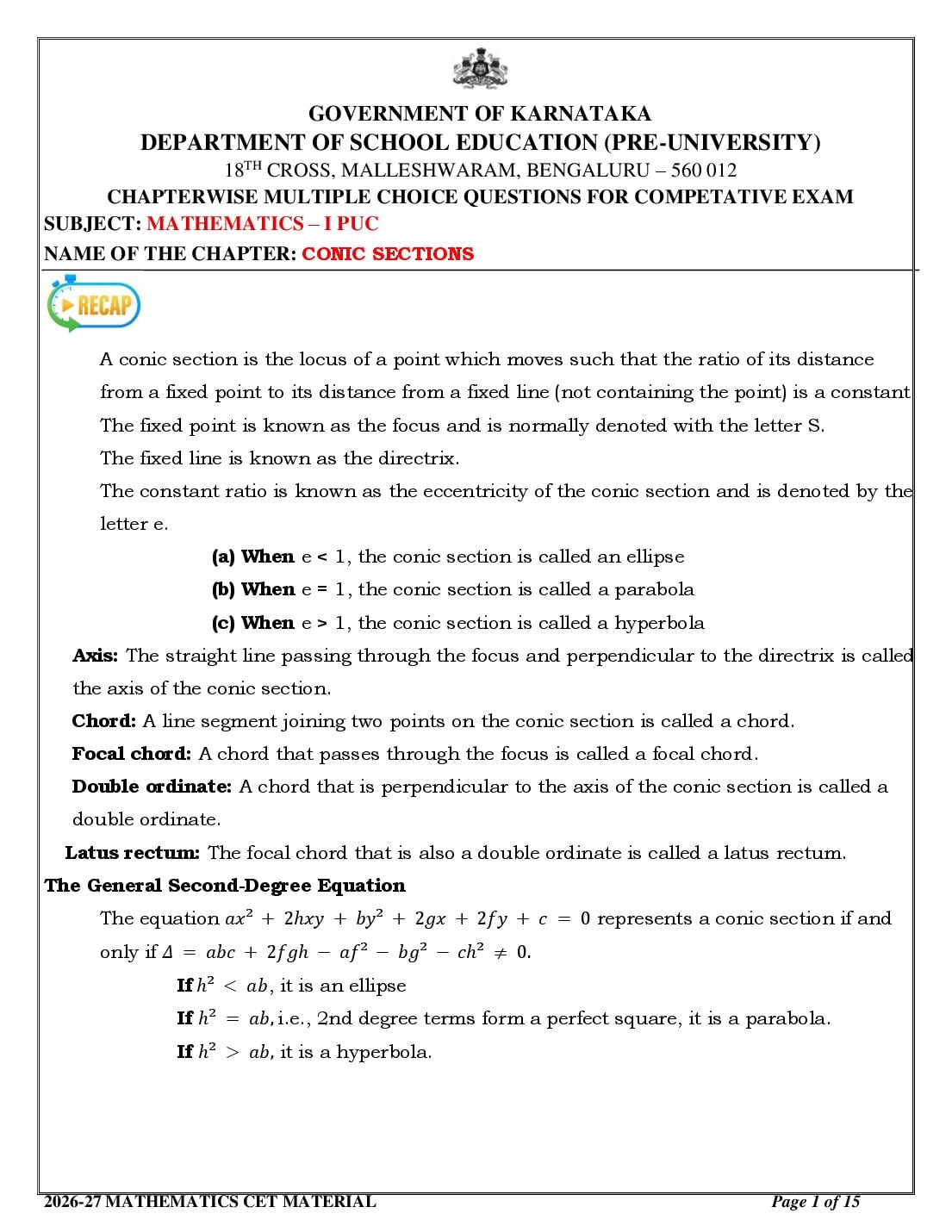
Page 1
DEPARTMENT OF SCHOOL EDUCATION (PRE-UNIVERSITY)
18TH CROSS, MALLESHWARAM, BENGALURU – 560 012
CHAPTERWISE MULTIPLE CHOICE QUESTIONS FOR COMPETATIVE EXAM
SUBJECT: MATHEMATICS – I PUC
NAME OF THE CHAPTER: CONIC SECTIONS
A conic section is the locus of a point which moves such that the ratio of its distance
from a fixed point to its distance from a fixed line (not containing the point) is a constant.
The fixed point is known as the focus and is normally denoted with the letter S.
The fixed line is known as the directrix.
The constant ratio is known as the eccentricity of the conic section and is denoted by the
letter e.
(a) When e < 1, the conic section is called an ellipse
(b) When e = 1, the conic section is called a parabola
(c) When e > 1, the conic section is called a hyperbola
Axis: The straight line passing through the focus and perpendicular to the directrix is called
the axis of the conic section.
Chord: A line segment joining two points on the conic section is called a chord.
Focal chord: A chord that passes through the focus is called a focal chord.
Double ordinate: A chord that is perpendicular to the axis of the conic section is called a
double ordinate.
Latus rectum: The focal chord that is also a double ordinate is called a latus rectum.
The General Second-Degree Equation
The equation 𝑎𝑥² + 2ℎ𝑥𝑦 + 𝑏𝑦² + 2𝑔𝑥 + 2𝑓𝑦 + 𝑐 = 0 represents a conic section if and
only if 𝛥 = 𝑎𝑏𝑐 + 2𝑓𝑔ℎ − 𝑎𝑓² − 𝑏𝑔² − 𝑐ℎ² ≠ 0.
If ℎ² < 𝑎𝑏, it is an ellipse
If ℎ² = 𝑎𝑏, i.e., 2nd degree terms form a perfect square, it is a parabola.
If ℎ² > 𝑎𝑏, it is a hyperbola.
2026-27 MATHEMATICS CET MATERIAL Page 1 of 15
Page 2
A circle is the locus of a point, which moves such that its distance from a fixed point,
called the centre, is equal to a given distance, called the radius. Equations of circle:
Centre at origin, radius a: 𝑥² + 𝑦² = 𝑎²
Centre at (h, k), radius a: (𝑥 − ℎ)² + (𝑦 − 𝑘)² = 𝑎²
Diameter form: (𝑥 − 𝑥₁)(𝑥 − 𝑥₂) + (𝑦 − 𝑦₁)(𝑦 − 𝑦₂) = 0
Parametric form: 𝑥 = 𝑥₁ + 𝑟 𝑐𝑜𝑠𝜃, 𝑦 = 𝑦₁ + 𝑟 𝑠𝑖𝑛𝜃
General form: 𝑥² + 𝑦² + 2𝑔𝑥 + 2𝑓𝑦 + 𝑐 = 0
Centre at (−𝑔, −𝑓) and Radius is √(𝑔² + 𝑓² − 𝑐)
If 𝑔² + 𝑓² > 𝑐 ⇒ Circle is real, if 𝑔² + 𝑓² = 𝑐 ⇒ Circle is a point circle and if
𝑔² + 𝑓² < 𝑐 ⇒ Circle is imaginary
Intercept with x-axis = 2√(𝑔² − 𝑐), Intercept with y-axis = 2√(𝑓² − 𝑐) .
Time saving results
The equation of the circles with centre (a, b) and
Touching x-axis: 𝑥² + 𝑦² + 2𝑔𝑥 + 2𝑓𝑦 + 𝑔² = 0
Circle touching y-axis: 𝑥² + 𝑦² + 2𝑔𝑥 + 2𝑓𝑦 + 𝑓² = 0
Circle touching both axes: 𝑥² + 𝑦² + 2𝑔𝑥 + 2𝑔𝑦 + 𝑔² = 0
Circle through origin: 𝑥² + 𝑦² + 2𝑔𝑥 + 2𝑓𝑦 = 0
Circle with centre on x-axis: 𝑥² + 𝑦² + 2𝑔𝑥 + 𝑐 = 0
Circle with centre on y-axis: 𝑥² + 𝑦² + 2𝑓𝑦 + 𝑐 = 0
If (𝑥₁, 𝑦₁) is one end of the diameter of the circle 𝑥² + 𝑦² + 2𝑔𝑥 + 2𝑓𝑦 + 𝑐 = 0 then the
other end is (−2𝑔 − 𝑥₁, −2𝑓 − 𝑦₁).
Equation of the circle passing through points (0,0), (a,0) and (0,b) is
𝑥² + 𝑦² − 𝑎𝑥 − 𝑏𝑦 = 0
Equation of the point circle with centre at (a, b) is
𝑥² + 𝑦² − 2𝑎𝑥 − 2𝑏𝑦 + (𝑎² + 𝑏²) = 0.
The equation of the circum-circle of the triangle formed by line
𝑎𝑥 + 𝑏𝑦 + 𝑐 = 0 (𝑐 ≠ 0) with co-ordinate axes is 𝑎𝑏(𝑥 2 + 𝑦 2 ) + 𝑐(𝑏𝑥 + 𝑎𝑦) = 0.
2026-27 MATHEMATICS CET MATERIAL Page 2 of 15
Page 3
The equation of parabola in standard form is
𝑦² = 4𝑎𝑥, 𝑥² = 4𝑎𝑦, 𝑦² = −4𝑎𝑥 and 𝑥² = −4𝑎𝑦.
𝒚² = ±𝟒𝒂𝒙 x² = ±4ay
The focus is (±a, 0) The focus is (0, ±𝑎)
The directrix is x ± a = 0 The directrix is 𝑦 ± 𝑎 = 0
The latus rectum is x ∓ a = 0 The latus rectum is 𝑦 ∓ 𝑎 = 0
The length of the latus rectum is 4a The length of the latus rectum is 4a
The extremities of the latus rectum are The extremities of the latus rectum are
(±a, 2a) and (±a, -2a) (2𝑎, ±𝑎) and (−2𝑎, ±𝑎)
Time Saving Results :
Distance of a point P(x₁, y₁) on the parabola 𝑦² = 4𝑎𝑥 from the focus S is called focal-
distance and is given by 𝑥₁ + 𝑎.
The area of triangle inscribed in a parabola 𝑦² = 4𝑎𝑥 is
(1 / 8𝑎)|(𝑦₁ − 𝑦₂)(𝑦₂ − 𝑦₃)(𝑦₃ − 𝑦₁)|.
If PQ is a focal chord of the parabola y² = 4ax with focus at S then
(2 · 𝑆𝐿 · 𝑆𝐿′ ) / (𝑆𝐿 + 𝑆𝐿′ ) = 2𝑎 i.e., 1/𝑆𝐿 + 1/𝑆𝐿′ = 1/𝑎
If PQ is a focal chord of the parabola 𝑦² = 48𝑥 with focus at S then
(2 · 𝑆𝐿 · 𝑆𝐿′ ) / (𝑆𝐿 + 𝑆𝐿′ ) = 2𝑎
2026-27 MATHEMATICS CET MATERIAL Page 3 of 15
Page 4
The equation of ellipse in standard form is 𝑥²/𝑎² + 𝑦²/𝑏² = 1, (𝑎 > 𝑏)
If the center of the ellipse is (h, k), then the equation is (𝑥 − ℎ)²/𝑎² + (𝑦 − 𝑘)²/𝑏² = 1
𝒙²/𝒂² + 𝒚²/𝒃² = 𝟏, (𝒂 > 𝒃) 𝒙²/𝒂² + 𝒚²/𝒃² = 𝟏, (𝒃 > 𝒂)
(horizontal ellipse) (vertical ellipse)
The eccentricity is 𝑒 = √(1 − 𝑏²/𝑎²) The eccentricity is 𝑒 = √(1 − 𝑎²/𝑏²)
The major axis is 𝑦 = 0 The major axis is 𝑥 = 0
The length of the major axis is 2𝑎 The length of the major axis is 2𝑏
The minor axis is𝑥 = 0 The minor axis is 𝑦 = 0
The length of the minor axis is 2𝑏 The length of the minor axis is 2𝑎
The foci are (±𝑎𝑒, 0) The foci are (0, ±𝑏𝑒)
The directrices are 𝑥 = ±𝑎/𝑒 The directrices are𝑦 = ±𝑏/𝑒
The latus recta are 𝑥 = ±𝑎𝑒 The latus recta are 𝑦 = ±𝑏𝑒
The length of the latus rectum is 2𝑏²/𝑎 The length of the latus rectum is 2𝑎²/𝑏
Time saving results
Distance between the foci of the ellipse 𝑥²/𝑎² + 𝑦²/𝑏² = 1 when 𝑎 > 𝑏 is given by
2√(𝑎² − 𝑏²) and when 𝑏 > 𝑎 is given by 2√(𝑏² − 𝑎²).
Distance between directrices for ellipse 𝑥²/𝑎² + 𝑦²/𝑏² = 1 when 𝑎 > 𝑏 is
2𝑎²/√(𝑎² − 𝑏²) and when 𝑏 > 𝑎 is 2𝑎²/√(𝑏² − 𝑎²).
Area of the greatest rectangle that can be inscribed in the ellipse 𝑥²/𝑎² + 𝑦²/𝑏² = 1 is
given by 2𝑎𝑏.
2026-27 MATHEMATICS CET MATERIAL Page 4 of 15
Page 5
𝒙²/𝒂² − 𝒚²/𝒃² = 𝟏 𝒙²/𝒂² − 𝒚²/𝒃² = −𝟏
(horizontal hyperbola) (vertical hyperbola):
The eccentricity is 𝑒 = √(1 + 𝑏²/𝑎²) The eccentricity is 𝑒 = √(1 + 𝑎²/𝑏²)
The transverse axis is 𝑦 = 0 The transverse axis is𝑦 = 0
The length of the transverse axis is 2𝑎 The length of the transverse axis is 2𝑏
The conjugate axis is𝑥 = 0 The conjugate axis is 𝑥 = 0
The length of the conjugate axis is 2𝑏 The length of the conjugate axis is 2𝑎
The foci are (±𝑎𝑒, 0) The foci are (0, ±𝑏𝑒)
The directrices are 𝑥 = ±𝑎/𝑒 The directrices are 𝑦 = ±𝑏/𝑒
The latus recta are 𝑥 = ±𝑎𝑒 The latus recta are𝑦 = ±𝑏𝑒
The length of the latus recta is 2𝑏²/𝑎 The length of the latus recta is 2𝑎²/𝑏
Let S and S' be the foci and P is any point on the hyperbola, then |𝑃𝑆 − 𝑃𝑆′| = 2𝑎.
Time Saving Results
o Distance between the foci of the hyperbola x²/a² - y²/b² = 1 or x²/a² - y²/b² = -1 is
given by 2√(a² + b²).
o Distance between directrices for x²/a² - y²/b² = 1 is 2a²/√(a² + b²) &
o for x²/a² - y²/b² = -1 is 2b²/√(a² + b²).
o Equations of directrices for 𝑥²/𝑎² − 𝑦²/𝑏² = 1 are 𝑥 = ±𝑎²/√(𝑎² + 𝑏²) &
o for 𝑥²/𝑎² − 𝑦²/𝑏² = −1 are 𝑦 = ±𝑏²/√(𝑎² + 𝑏²).
2026-27 MATHEMATICS CET MATERIAL Page 5 of 15
Page 6
1. The equation of the circle with center (𝟏, −𝟐) and radius √𝟏𝟑.
(A) 𝑥² + 𝑦² + 4𝑥 − 2𝑦 = 8 (B) 𝑥² + 𝑦² − 2𝑥 + 4𝑦 = 8
(C) 𝑥² + 𝑦² − 2𝑥 + 4𝑦 = 13 (D) 𝑥² + 𝑦² − 4𝑥 − 2𝑦 = 13
2. Find the center and radius of the circle (𝒙 − 𝟑)² + (𝒚 + 𝟐)² = 𝟏𝟔.
(A) (3, −2), 𝑟 = 4 (B) (−3, 2), 𝑟 = 4
(C) (3, −2), 𝑟 = 16 (D) (−3, 2), 𝑟 = 16
3. The equation of the 𝒙² + 𝒚² − 𝟒𝒙 + 𝟔𝒚 − 𝟏𝟐 = 𝟎 represents a circle. Its center is:
(A) (2, -3) (B) (-2, 3) (C) (4, -6) (D) (-4, 6)
4. What is the radius of the circle 𝒙² + 𝒚² − 𝟒𝒙 + 𝟔𝒚 − 𝟏𝟐 = 𝟎?
(A) 3 (B) 4 (C) 5 (D) 25
5. The equation of a circle in the first quadrant and touching each coordinate axis at
distance of one unit from the origin is
(A) 𝑥² + 𝑦² − 2𝑥 − 2𝑦 + 1 = 0 (B) 𝑥² + 𝑦² − 2𝑥 − 2𝑦 − 1 = 0
(C) 𝑥² + 𝑦² − 2𝑥 − 2𝑦 = 0 (D) 𝑥² + 𝑦² − 2𝑥 + 2𝑦 − 1 = 0
6. Equation of circle with centre(−𝒂, −𝒃) and radius √𝒂𝟐 − 𝒃𝟐 is
(A) 𝑥 2 + 𝑦 2 − 2𝑎𝑥 − 2𝑏𝑦 − 2𝑏 2 = 0 (B) 𝑥 2 + 𝑦 2 + 2𝑎𝑥 + 2𝑏𝑦 + 2𝑏 2 = 0
(C)𝑥 2 + 𝑦 2 − 2𝑎𝑥 − 2𝑏𝑦 + 2𝑏 2 = 0 (D) 𝑥 2 + 𝑦 2 − 2𝑎𝑥 + 2𝑏𝑦 + 2𝑏 2 = 0
7. Find the equation of the circle passing through the points (0,0), (a,0), and (0,b).
(A) 𝑥² + 𝑦² − 2 𝑎𝑥 − 2 𝑏𝑦 = 0 (B) 𝑥² + 𝑦² + 𝑎𝑥 + 𝑏𝑦 = 0
(C) 𝑥² + 𝑦² − 𝑎𝑥 − 𝑏𝑦 = 0 (D) 𝑥² + 𝑦² + 2𝑎𝑥 + 2𝑏𝑦 = 0
8. The equation of a circle having endpoints of a diameter at (1, 2) and (3, 4) is:
(A) 𝑥² + 𝑦² − 4𝑥 − 6𝑦 + 11 = 0 (B) 𝑥² + 𝑦² + 4𝑥 + 6𝑦 + 11 = 0
(C) 𝑥² + 𝑦² − 4𝑥 − 6𝑦 − 11 = 0 (D) 𝑥² + 𝑦² − 2𝑥 − 3𝑦 + 5 = 0
9. If a circle whose centre is (𝟏, −𝟑) touches the line 𝟑𝒙 − 𝟒𝒚 − 𝟓 = 𝟎, then the radius
of the circle is
(A)8 (B) 4 (C) 6 (D) 2
10. If the equation 𝒙² + 𝒚² + 𝟐𝒈𝒙 + 𝟐𝒇𝒚 + 𝒄 = 𝟎 represents a point circle, then its
radius is:
(A) 1 (B) 0 (C) -1 (D) Undefined
11. The circle x² + y² + 2gx + 2fy + c = 0 touches the x-axis if:
(A) 𝑔² = 𝑐 (B) 𝑓² = 𝑐 (C) 𝑔² + 𝑓² = 𝑐 (D) 𝑔² = 𝑓²
12. The circle 𝒙² + 𝒚² + 𝟐𝒈𝒙 + 𝟐𝒇𝒚 + 𝒄 = 𝟎 touches the y-axis if:
(A) 𝑔² = 𝑐 (B) 𝑓² = 𝑐 (C) 𝑔² + 𝑓² = 𝑐 (D) 𝑔² = 𝑓²
2026-27 MATHEMATICS CET MATERIAL Page 6 of 15
Page 7
(A) 25π (B) 5π (C) 10π (D) 50π
14. If the point (1, 2) lies inside the circle 𝒙² + 𝒚² − 𝟒𝒙 + 𝟐𝒚 + 𝒌 = 𝟎, then k must
satisfy:
(A) k< -3 (B) k >3 (C) k < 3 (D) k > -3
15. If the point (2, 3) lies on the circle 𝒙² + 𝒚² − 𝟒𝒙 − 𝟔𝒚 + 𝒄 = 𝟎, then c is
(A) 13 (B) -13 (C) 0 (D) 9
16. The length of the intercept made by the circle 𝒙² + 𝒚² − 𝟔𝒙 + 𝟒𝒚 − 𝟏𝟐 = 𝟎 on
the x-axis is
(A) 2√21 (B) √21 (C) 10 (D) 5
17. The length of the intercept made by the circle 𝒙² + 𝒚² − 𝟔𝒙 + 𝟒𝒚 − 𝟏𝟐 = 𝟎 on
the y-axis is
(A) 8 (B) 4 (C) 2√16 (D) 10
18. The lines 𝟐𝒙 − 𝟑𝒚 = 𝟓 and 𝟑𝒙 − 𝟒𝒚 = 𝟕 are the diameters of a circle of area 154
square units. The equation of the circle is
(A) 𝑥 2 + 𝑦 2 + 2𝑥 − 2𝑦 = 62 (B) 𝑥 2 + 𝑦 2 − 2𝑥 + 2𝑦 = 47
(C)𝑥 2 + 𝑦 2 + 2𝑥 − 2𝑦 = 47 (D) 𝑥 2 + 𝑦 2 − 2𝑥 + 2𝑦 = 62
19. The equation of the circle with center (2, -1) and touching the line𝟑𝒙 − 𝟒𝒚 + 𝟓 = 𝟎is:
(A) (𝑥 − 2)² + (𝑦 + 1)² = 9 (B) (𝑥 − 2)² + (𝑦 + 1)² = 25
(C) (𝑥 + 2)² + (𝑦 − 1)² = 9 (D) (𝑥 − 2)² + (𝑦 + 1)² = 3
20. The parametric equations of the circle 𝒙² + 𝒚² = 𝑹² are:
(A) 𝑥 = 𝑅 𝑐𝑜𝑠 𝜃, 𝑦 = 𝑅 𝑠𝑖𝑛 𝜃 (B) 𝑥 = 𝑅 𝑠𝑒𝑐 𝜃, 𝑦 = 𝑅 𝑡𝑎𝑛 𝜃
(C) 𝑥 = 𝑅 𝑡𝑎𝑛 𝜃, 𝑦 = 𝑅 𝑠𝑒𝑐 𝜃 (D) 𝑥 = 𝑅 𝑠𝑖𝑛 𝜃, 𝑦 = 𝑅 𝑐𝑜𝑠 𝜃
21. The equation 𝒂𝒙𝟐 + 𝒃𝒚𝟐 + 𝟐𝒉𝒙𝒚 + 𝟐𝒈𝒙 + 𝟐𝒇𝒚 + 𝒄 = 𝟎 will represent a circle, if
(A) 𝑎 = 𝑏 = 0and𝑐 = 0 (B) 𝑓 = 𝑔 and ℎ = 0
(C) 𝑎 = 𝑏 ≠ 0 and ℎ = 0 (D) 𝑓 = 𝑔 and 𝑐 = 0
22. If a circle touches both axes and has radius 3 in the first quadrant, its equation
is:
(A) 𝑥² + 𝑦² − 6𝑥 − 6𝑦 + 9 = 0 (B) 𝑥² + 𝑦² + 6𝑥 + 6𝑦 + 9 = 0
(C) 𝑥² + 𝑦² − 3𝑥 − 3𝑦 + 9 = 0 (D) 𝑥² + 𝑦² − 6𝑥 − 6𝑦 + 18 = 0
23. The equation of the circle concentric with the circle 𝒙𝟐 + 𝒚𝟐 − 𝟒𝒙 − 𝟔𝒚 − 𝟑 = 𝟎 and
touching 𝒚 axis is:
(A) 𝑥 2 + 𝑦 2 − 4𝑥 − 6𝑦 − 9 = 0 (B) 𝑥 2 + 𝑦 2 − 4𝑥 − 6𝑦 + 9 = 0
(C) 𝑥 2 + 𝑦 2 − 4𝑥 − 6𝑦 + 3 = 0 (D) None of these
2026-27 MATHEMATICS CET MATERIAL Page 7 of 15
Page 8
(A) Inside the circle (B) Outside the circle
(C) On the circle (D) At the center
25. Find the equation of the circle passing through (0,0) and having intercepts 4
and 6 on positive x and y axes respectively.
(A) 𝑥² + 𝑦² − 4𝑥 − 6𝑦 = 0 (B) 𝑥² + 𝑦² + 4𝑥 + 6𝑦 = 0
(C) 𝑥² + 𝑦² − 6𝑥 − 4𝑦 = 0 (D) 𝑥² + 𝑦² − 8𝑥 − 12𝑦 = 0
Parabolas:
26. If the focus of the parabola is (𝟎, −𝟑) and its directrix is 𝒚 = 𝟑, then the equation
is
(A) 𝑥² = 12𝑦 (B) 𝑥² = −12𝑦 (C) 𝑦² = −12𝑥 (D) 𝑦² = 12𝑥
27. The equation of the directrix of the parabola 𝒚² = 𝟏𝟐𝒙.
(A) 𝑥 = −3 (B) 𝑥 = 3 (C) 𝑦 = −3 (D) 𝑦 = 3
28. The length of the latus rectum of the parabola 𝒚² = −𝟏𝟔𝒙.
(A) -16 (B) 16 (C) 4 (D) 8
29. The coordinates of the focus of the parabola 𝒙² = 𝟖𝒚.
(A) (0, 2) (B) (2, 0) (C) (0, -2) (D) (-2, 0)
30. The focal distance of a point on the parabola 𝒚𝟐 = 𝟏𝟔𝒙 whose ordinate is twice
the abscissa, is
(A) 6 (B) 8 (C) 1 (D) 12
31. If the parabola 𝒚² = 𝟒𝒂𝒙 passes through the point (3,-2),then the length of its
latus rectum is
2 4 1
(A) 3 (B) 3 (C) 3 (D) 4
32. Find the equation of the parabola with vertex at (0,0) and focus at (5, 0).
(A) 𝑦² = 20𝑥 (B) 𝑦² = −20𝑥 (C) 𝑥² = 20𝑦 (D) 𝑥² = −20𝑦
33. Find the equation of the parabola with vertex (0,0), axis along x-axis, and passing
through (2, 3).
(A) 2𝑦² = 9𝑥 (B) 𝑦² = 9𝑥 (C) 𝑦² = 4.5𝑥 (D) 𝑥² = 4.5𝑦
34. Find the axis of symmetry for the parabola 𝒙² = −𝟖𝒚.
(A) 𝑦 − 𝑎𝑥𝑖𝑠 (𝑥 = 0) (B) 𝑥 − 𝑎𝑥𝑖𝑠 (𝑦 = 0) (C) 𝑥 = 2 (D) 𝑦 = −2
35. The length of latus rectum of the parabola 𝟒𝒚𝟐 + 𝟑𝒙 + 𝟑𝒚 + 𝟏 = 𝟎 is: (KCET 2016)
4 3
(A) 3 (B) 7 (C) 12 (D)4
2026-27 MATHEMATICS CET MATERIAL Page 8 of 15
Page 9
𝒙𝟐 = 𝟏𝟐𝒚 to the ends of its latus rectum is
(A) 12 𝑠𝑞. 𝑢𝑛𝑖𝑡𝑠 (B)16 𝑠𝑞. 𝑢𝑛𝑖𝑡𝑠 (C) 18 𝑠𝑞. 𝑢𝑛𝑖𝑡𝑠 (D) 24 𝑠𝑞. 𝑢𝑛𝑖𝑡𝑠
37. Find the focal distance of the point (4, 4) on the parabola 𝒚² = 𝟒𝒙.
(A) 5 (B) 4 (C) 3 (D) 6
38. The axis of the parabola 𝒚² + 𝟒𝒙 + 𝟐𝒚 − 𝟑 = 𝟎 is parallel to
(A) 𝑥 − 𝑎𝑥𝑖𝑠 (B) 𝑦 − 𝑎𝑥𝑖𝑠 (C) line 𝑦 = 𝑥 (D) line 𝑦 = −𝑥
39. The vertex of the parabola 𝟑𝒙 − 𝟐𝒚𝟐 − 𝟒𝒚 + 𝟕 = 𝟎 is
(A) (3, 1) (B) (−3, −1) (C) (−3, 1) (D) none of these
40. Find the focus of the parabola (𝒚 − 𝟐)² = 𝟖(𝒙 + 𝟑).
(A) (-1, 2) (B) (-3, 2) (C) (1, 2) (D) (-5, 2)
41. The equation of the directrix of the parabola (𝒙 − 𝟏)² = 𝟏𝟐(𝒚 + 𝟐) is:
(A) y = -5 (B) y = 1 (C) y = -2 (D) x = -2
42. Which of the following points lies on the parabola?𝒚² = 𝟖𝒙.
(A) (2, 4) (B) (2, 2) (C) (4, 2) (D) (1, 4)
43. The parametric equations of the parabola 𝒚² = 𝟒𝒂𝒙 are:
(A) 𝑥 = 𝑎𝑡², 𝑦 = 2𝑎𝑡 (B) 𝑥 = 2𝑎𝑡, 𝑦 = 𝑎𝑡²
(C) 𝑥 = 𝑎 𝑐𝑜𝑠 𝑡, 𝑦 = 𝑎 𝑠𝑖𝑛 𝑡 (D) 𝑥 = 𝑎 𝑠𝑒𝑐 𝑡, 𝑦 = 𝑎 𝑡𝑎𝑛 𝑡
44. The end points of the latus rectum of parabola 𝒚² = 𝟒𝒂𝒙 are:
(A) (a, 2a) and (a, -2a) (B) (-a, 2a) and (-a, -2a)
(C) (2a, a) and (-2a, a) (D) (a, a) and (a, -a)
45. The length of latus rectum of parabola 𝒚² = 𝟒𝒂𝒙 in terms of semi-latus rectum
'𝒍' is:
(A) 2𝑙 (B) 𝑙 (C) 4𝑙 (D) 𝑙/2
46. If the parabola 𝒙𝟐 = 𝟒𝒂𝒚 passes through the point (2, 1), then the length of the
latus rectum is (KCET 2020)
(A) 8 (B)1 (C) 4 (D) 2
47. The eccentricity of any parabola is always equal to:
(A) Less than 1 (B) Greater than 1 (C) 0 (D) 1
48. The equation of parabola whose focus is (𝟔, 𝟎) and directrix is 𝒙 = −𝟔is(KCET2024)
(A) 𝑦² = 24𝑥 (B) 𝑦² = −24𝑥 (C) 𝑥² = 24𝑦 (D) 𝑥² = −24𝑦
49. The line 𝒚 = 𝒎𝒙 + 𝒄 is tangent to parabola 𝒚² = 𝟒𝒂𝒙 if c is equal to:
(A) 𝑎 / 𝑚 (B) 𝑎 𝑚 (C) 𝑎 / 𝑚² (D) −𝑎 / 𝑚
2026-27 MATHEMATICS CET MATERIAL Page 9 of 15
Page 10
ends of its latusrectum is:
(A) 𝑎² (B) 2𝑎² (C) 4𝑎² (D) 𝑎²/2
Ellipses
51. Find the length of major and minor axes of the ellipse 𝒙²/𝟐𝟓 + 𝒚²/𝟗 = 𝟏.
(A) Major = 10, Minor = 6 (B) Major = 25, Minor = 9
(C) Major = 5, Minor = 3 (D) Major = 12, Minor = 8
52. Find the coordinates of the foci of the ellipse 𝟗𝒙² + 𝟐𝟓 𝒚² = 𝟐𝟐𝟓.
(A) (±5, 0) (B) (0, ±5) (C) (±3, 0) (D) (±4, 0)
53. The eccentricity of the ellipse 𝟗𝒙𝟐 + 𝟐𝟓𝒚𝟐 = 𝟐𝟐𝟓 is
(A) 4/5 (B) 3/5 (C) 3/4 (D) 5/4
54. Find the length of the latus rectum of the ellipse 𝒙²/𝟐𝟓 + 𝒚²/𝟗 = 𝟏.
(A) 18/5 (B) 9/5 (C) 8/5 (D) 25/9
55. Find the vertices of the ellipse 𝒙²/𝟏𝟔 + 𝒚²/𝟐𝟓 = 𝟏.
(A) (0, ±5) (B) (±4, 0) (C) (0, ±4) (D) (±5, 0)
56. Find the foci of the ellipse 𝒙²/𝟏𝟔 + 𝒚²/𝟐𝟓 = 𝟏.
(A) (0, ±3) (B) (±3, 0) (C) (0, ±5) (D) (±4, 0)
57. If the latus rectum of an ellipse be equal to half of its minor axis, then its
eccentricity is.
(A) 3/2 (B) √3/2 (C) 2/3 (D) √2/3
58. If the foci and vertices of an ellipse be (±𝟏, 𝟎)and (±𝟐, 𝟎), then the minor axis of
the ellipse is.
(A) 2√5 (B) 2 (C) 2√3 (D) 4
59. Find the equation of the ellipse with vertices (±6, 0) and foci (±4, 0).
(A) 𝑥²/36 + 𝑦²/20 = 1 (B) 𝑥²/36 + 𝑦²/16 = 1
(C) 𝑥²/20 + 𝑦²/36 = 1 (D) 𝑥²/16 + 𝑦²/36 = 1
60. The eccentricity of an ellipse is 2/3, latus rectum is 5 and centre is (0, 0). The
equation of the ellipse is
(A) 𝑥²/45 + 𝑦²/81 = 1 (B) 𝑥²/81 + 𝑦²/45 = 1
(C) 𝑥²/25 + 𝑦²/169 = 1 (D) 𝑥²/169 + 𝑦²/25 = 1
61. Find the equation of the ellipse with length of major axis 20 and foci (0, ±5).
(A) 𝑥²/75 + 𝑦²/25 = 1 (B) 𝑥²/100 + 𝑦²/75 = 1
(C) 𝑥²/25 + 𝑦²/100 = 1 (D) 𝑥²/75 + 𝑦²/100 = 1
2026-27 MATHEMATICS CET MATERIAL Page 10 of 15
Page 11
is equal to:
(A) a (B) 2a (C) b (D) 2b
63. The distance between the foci of the ellipse 𝒙²/𝒂² + 𝒚²/𝒃² = 𝟏 is:
(A) ae (B) a/e (C) 2a/e (D) 2ae
64. The distance between the directrices of the ellipse 𝒙²/𝒂² + 𝒚²/𝒃² = 𝟏 (𝒂 > 𝒃) is:
(A) a/e (B) 2ae (C) 2a/e (D) ae
65. The eccentricity of the ellipse if its latus rectum is equal to half of its major axis
is
(A) 1/2 (B) 1/√2 (C) √3/2 (D) 1/4
66. The eccentricity of the ellipse if its latus rectum is equal to half of its minor axis
is
(A) 1/2 (B) √3/2 (C) 1/√2 (D) 3/4
67. The equation of the ellipse centered at origin, major axis on x-axis, passing
through (4, 3) and (-1, 4).
(A) 7𝑥² + 15𝑦² = 247 (B) 𝑥² + 𝑦² = 25
(C) 15𝑥² + 7𝑦² = 247 (D) 𝑥²/16 + 𝑦²/9 = 1
68. If the centre, one of the foci and semi-major axis of an ellipse be (𝟎, 𝟎), (𝟎, 𝟑) and 5
then its equation is
𝑥2 𝑦2 𝑥2 𝑦2 𝑥2 𝑦2 𝑥2 𝑦2
(A) 16 + 25 = 1 (B) 25 + 16 = 1 (C) 9 + 25 = 1 (D) 25 + 9 = 1
69. If the length of the major axis of an ellipse is three times the length of its minor
axis, then its eccentricity is
(A) 1/3 (B) 1/√3 (C) 1/√2 (D) 2√2/3
70. Find the center of the ellipse 𝟗𝒙² + 𝟒𝒚² − 𝟏𝟖𝒙 + 𝟏𝟔𝒚 − 𝟏𝟏 = 𝟎.
(A) (1, -2) (B) (-1, 2) (C) (2,1) (D) (-2, 1)
𝒙𝟐 𝒚𝟐
71. The equation 𝟐−𝒓 + 𝒓−𝟓 + 𝟏 = 𝟎 represents an ellipse, if
(A) 𝑟 > 2 (B) 2 < 𝑟 < 5 (C) 𝑟 > 5 (D) None of these
72. 𝑷is any point on the ellipse 𝟗𝒙𝟐 + 𝟑𝟔𝒚𝟐 = 𝟑𝟐𝟒, whose foci are 𝑺 and 𝑺′ . Then
𝑺𝑷 + 𝑺′ 𝑷 equals
(A) 3 (B) 12 (C) 36 (D) 324
73. The length of the latus rectum of 𝒙𝟐 + 𝟑𝒚𝟐 = 12 is (KCET2025)
1 4 2
(A) 3 𝑢𝑛𝑖𝑡𝑠 (B) 𝑢𝑛𝑖𝑡𝑠 (C) 24𝑢𝑛𝑖𝑡𝑠 (D) 3 𝑢𝑛𝑖𝑡𝑠
√3
2026-27 MATHEMATICS CET MATERIAL Page 11 of 15
Page 12
(A) 𝜋 𝑎𝑏 (B) 2𝜋 𝑎𝑏 (C) 𝜋(𝑎² + 𝑏²) (D) 4𝜋 𝑎𝑏
75. In the figure (KCET2026)
Statement I: When 𝛼 > 𝛽 ≥ 0, the section is hyperbola
Statement II: When 𝛽 > 𝟗𝟎∘ , the section is ellipse
Which of the following is correct?
(A) Statement I is true, Statement II is false
(B) Statement I is false, Statement II is true
(C) Both the Statements are true
(D) Both the Statements are false
Hyperbolas
76. Find the vertices of the hyperbola 𝒙²/𝟗 − 𝒚²/𝟒 = 𝟏.
(A) (±3, 0) (B) (0, ±3) (C) (±2, 0) (D) (0, ±2)
77. Find the foci of the hyperbola 𝒙²/𝟏𝟔 − 𝒚²/𝟗 = 𝟏.
(A) (±4, 0) (B) (0, ±4) (C) (±5, 0) (D) (±3, 0)
78. Find the eccentricity of the hyperbola 𝒙²/𝟔𝟒 − 𝒚²/𝟑𝟔 = 𝟏.
(A) 5/3 (B) 4/5 (C) 5/4 (D) 3/5
79. Find the length of the latus rectum of the hyperbola 𝒙²/𝟏𝟔 − 𝒚²/𝟗 = 𝟏.
(A) 9/2 (B) 9/4 (C) 18/5 (D) 8/3
80. The length of the transverse axis along x-axis with centre at the origin of a
hyperbola is 𝟕 and it passes through the point (𝟓, −𝟐). The equation of hyperbola is
4𝑥² 196𝑦² 49𝑥² 51𝑦²
(A) 16 − = 1 (B) 4 − 196 = 1
51
4𝑥² 51𝑦²
(C) 49 − 196 = 1 (D) None of these
2026-27 MATHEMATICS CET MATERIAL Page 12 of 15
Page 13
equation is
𝑥² 𝑦²
(A) 𝑥² − 𝑦 2 = 32 (B) 4 − 9 = 1 (C) 2𝑥² − 3𝑦 2 = 7 (D) None of these
82. The eccentricity of the hyperbola whose latus rectum is 𝟖 and conjugate axis is
equal to half of the distance between the foci is
4 4 2
(A) 3 (B) (C) (D) None of these
√3 √3
𝟑
83. The equation of the hyperbola with eccentricity 𝟐 and foci at (±𝟐, 𝟎) is
𝑥² 𝑦² 4 𝑥² 𝑦² 4 𝑥² 𝑦²
(A) 4 − 5 = 9 (B) 9 − 9 = 9 (C) 4 − 9 = 1 (D) None of these
84. The equation of the hyperbola with foci (±5, 0) and transverse axis of length 8, is
(A) 𝑥²/9 − 𝑦²/16 = 1 (B) 𝑥²/16 − 𝑦²/9 = 1
(C) 𝑦²/16 − 𝑥²/9 = 1 (D) 𝑥²/25 − 𝑦²/16 = 1
85. Find the equation of the hyperbola with foci (0, ±13) and conjugate axis of
length 24.
(A) 𝑦²/144 − 𝑥²/25 = 1 (B) 𝑥²/25 − 𝑦²/144 = 1
(C) 𝑦²/25 − 𝑥²/144 = 1 (D) 𝑥²/144 − 𝑦²/25 = 1
86. The eccentricity of a rectangular hyperbola is always:
(A) 1 (B) 2 (C) √2 (D) 1/√2
87. The equation 𝒙² − 𝒚² = 𝒂² represents a:
(A)Parabola (B) Rectangular hyperbola (C) Ellipse (D) Circle
88. The difference of focal distances of any point on a hyperbola is equal to:
(A) 2a (length of transverse axis) (B) 2b (length of conjugate axis)
(C) 2c (D) a + b
89. Find the distance between the foci of the hyperbola 𝒙²/𝟗 − 𝒚²/𝟏𝟔 = 𝟏.
(A) 5 (B) 6 (C) 8 (D) 10
90. Find the distance between directrices of the hyperbola 𝒙²/𝟏𝟔 − 𝒚²/𝟗 = 𝟏.
(A) 32 / 5 (B) 16 / 5 (C) 8 / 5 (D) 25 / 4
𝒙𝟐 𝒚𝟐
91. A point on the curve 𝑨𝟐 − 𝑩𝟐 = 𝟏 is
(A) ( 𝐴cos 𝜃, 𝐵sin 𝜃) (B) (𝐴 sec 𝜃 , 𝐵 tan 𝜃)
(C) (𝐴cos2 𝜃, 𝐵sin2 𝜃) (D) None of these
92. If e₁ and e₂ are the eccentricities of a hyperbola and its conjugate hyperbola,
then𝟏/𝒆₁² + 𝟏/𝒆₂² =:
(A) 0 (B) 1 (C) 2 (D) 1/2
2026-27 MATHEMATICS CET MATERIAL Page 13 of 15
Page 14
(A) 𝑦 = ± (𝑎/𝑏) 𝑥 (B) 𝑦 = ± (𝑏/𝑎) 𝑥 (C) 𝑦 = ± 𝑥 (D) 𝑦 = ± (𝑏²/𝑎) 𝑥
94. If the length of the transverse and conjugate axes of a hyperbola be 8 and 6
respectively, then the difference of focal distances of any point of the hyperbola will
be
(A) 2 (B) 6 (C) 8 (D) 14
95. The equation of hyperbola with vertices (±𝟐, 𝟎) and foci (±𝟑, 𝟎).
(A) 𝑥²/4 − 𝑦²/5 = 1 (B) 𝑥²/4 − 𝑦²/9 = 1
(C) 𝑥²/5 − 𝑦²/4 = 1 (D) 𝑥²/9 − 𝑦²/4 = 1
96. Find the length of transverse axis for the hyperbola 9x² - 16y² = 144.
(A) 6 (B) 8 (C) 10 (D) 12
97. Find the center of the hyperbola 𝟗𝒙² − 𝟏𝟔𝒚² − 𝟏𝟖𝒙 + 𝟑𝟐𝒚 − 𝟏𝟓𝟏 = 𝟎.
(A) (1, 1) (B) (-1, 1) (C) (1, -1) (D) (-1, -1)
98. The conic section represented by xy = c² (c ≠ 0) is a:
(A) Circle (B) Parabola (C) Ellipse (D) Rectangular Hyperbola
99. If the distance betweenthe two foci of hyperbola is 𝟐𝒄 and the distance of its two
vertices is 2a, then
Statement I: The length of transverse axis is 2a
Statement II : The length of conjugate axis is 2𝑏, where 𝑏 = √𝑐 2 + 𝑎2
Which of the following is correct?
(A) Statement I is true, Statement II is false
(B) Statement I is false, Statement II is true
(C) Both the Statements are true
(D) Both the Statements are false
100. For the hyperbola𝟗(𝒙 − 𝟏)² − 𝟏𝟔(𝒚 − 𝟏)² = 𝟏𝟒𝟒, the length of latus rectum is:
(A) 9/2 (B) 9/4 (C) 18/5 (D) 8/3
2026-27 MATHEMATICS CET MATERIAL Page 14 of 15
Page 15
1 2 3 4 5 6 7 8 9 10
B A A C A B C A D B
11 12 13 14 15 16 17 18 19 20
A B B C A A A A A A
21 22 23 24 25 26 27 28 29 30
C A B A A B A B A B
31 32 33 34 35 36 37 38 39 40
B A A A D C A A B A
41 42 43 44 45 46 47 48 49 50
A A A A A B D A A B
51 52 53 54 55 56 57 58 59 60
A D B A A A C D A B
61 62 63 64 65 66 67 68 69 70
D B D C B B A A D A
71 72 73 74 75 76 77 78 79 80
B C B A A A C C A C
81 82 83 84 85 86 87 88 89 90
A C A B C C B A D A
91 92 93 94 95 96 97 98 99 100
A B B C A B A D A A
2026-27 MATHEMATICS CET MATERIAL Page 15 of 15
Document Details
| Board / Org | Karnataka Board |
| Exam | Class 11 |
| Type | Question Bank |
| Pages | 15 |
| Updated | 24 Sep 2026 |