Karnataka 1st PUC Mathematics Linear Inequalities MCQ with Answers
Finished viewing? Save it for later —
Download Karnataka 1st PUC Mathematics Linear Inequalities MCQ with Answers (PDF · 15 pages)About Karnataka 1st PUC Mathematics Linear Inequalities MCQ with Answers
Karnataka 1st PUC Mathematics Linear Inequalities MCQ with Answers is available here for free download. Published by Karnataka Board for Class 11, this question bank can be viewed online or downloaded as a PDF (15 pages). Candidates preparing for Class 11 can use Karnataka 1st PUC Mathematics Linear Inequalities MCQ with Answers to understand the exam pattern, the type of questions asked, and the overall difficulty level.
Frequently Asked Questions
How can I download Karnataka 1st PUC Mathematics Linear Inequalities MCQ with Answers?
Open this page and click the Download button to save Karnataka 1st PUC Mathematics Linear Inequalities MCQ with Answers as a PDF. It is completely free on AglaSem Docs.
Is Karnataka 1st PUC Mathematics Linear Inequalities MCQ with Answers free to download?
Yes. Karnataka 1st PUC Mathematics Linear Inequalities MCQ with Answers can be viewed online and downloaded as a PDF free of cost on AglaSem Docs.
How many pages does Karnataka 1st PUC Mathematics Linear Inequalities MCQ with Answers have?
Karnataka 1st PUC Mathematics Linear Inequalities MCQ with Answers contains 15 pages, which you can read online or download together as a single PDF.
Where can I find more Class 11 study material?
You can find more Class 11 question papers, sample papers, syllabus, and answer keys on AglaSem Docs.
Karnataka 1st PUC Mathematics Linear Inequalities MCQ with Answers – Text
Read the full text of this question bank below — useful to quickly search, copy and reference the content online without downloading the PDF.
📄 View text version (15 pages)
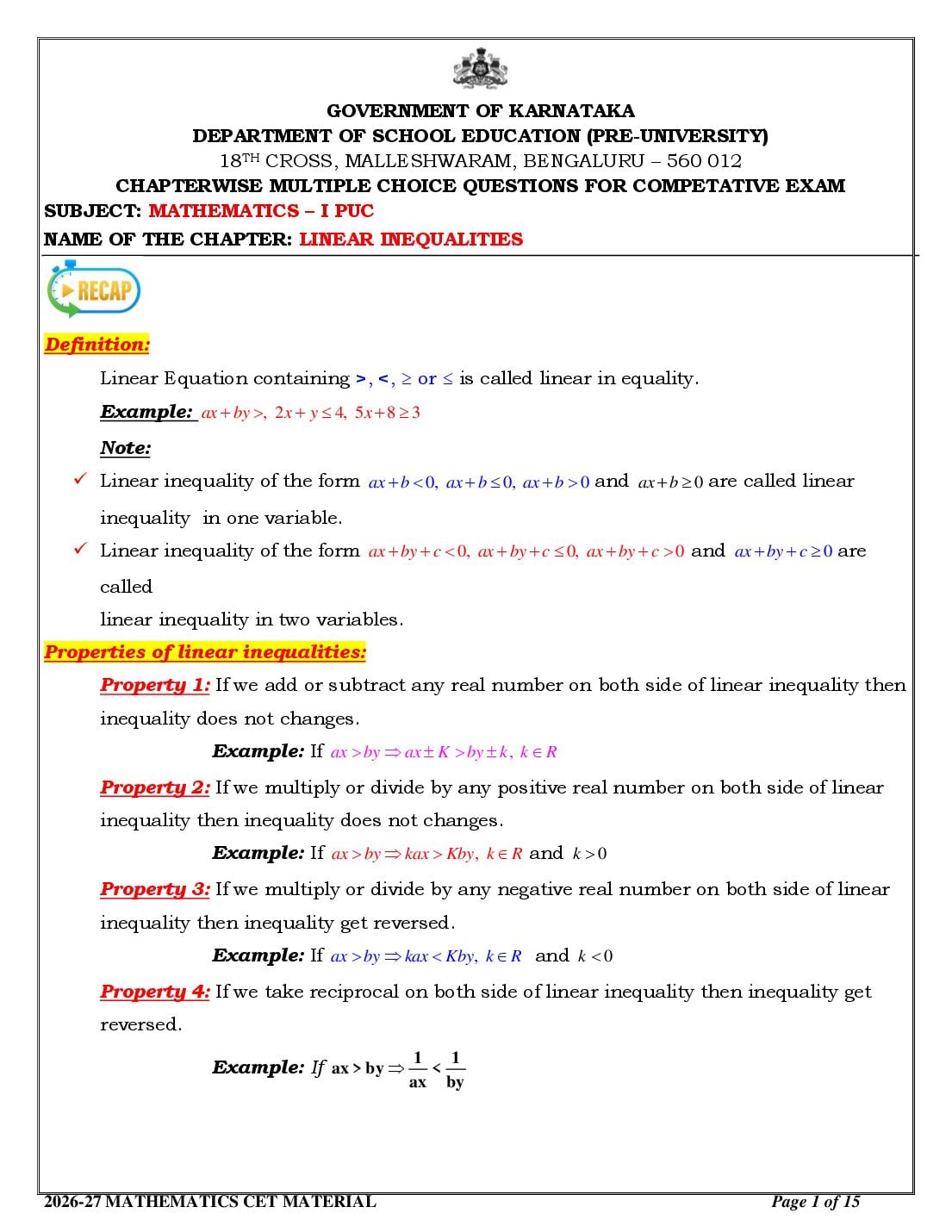
Page 1
DEPARTMENT OF SCHOOL EDUCATION (PRE-UNIVERSITY)
18TH CROSS, MALLESHWARAM, BENGALURU – 560 012
CHAPTERWISE MULTIPLE CHOICE QUESTIONS FOR COMPETATIVE EXAM
SUBJECT: MATHEMATICS – I PUC
NAME OF THE CHAPTER: LINEAR INEQUALITIES
Definition:
Linear Equation containing >, <, or is called linear in equality.
Example: ax by , 2 x y 4, 5x 8 3
Note:
Linear inequality of the form ax b 0, ax b 0, ax b 0 and ax b 0 are called linear
inequality in one variable.
Linear inequality of the form ax by c 0, ax by c 0, ax by c 0 and ax by c 0 are
called
linear inequality in two variables.
Properties of linear inequalities:
Property 1: If we add or subtract any real number on both side of linear inequality then
inequality does not changes.
Example: If ax by ax K by k , k R
Property 2: If we multiply or divide by any positive real number on both side of linear
inequality then inequality does not changes.
Example: If ax by kax Kby, k R and k 0
Property 3: If we multiply or divide by any negative real number on both side of linear
inequality then inequality get reversed.
Example: If ax by kax Kby, k R and k 0
Property 4: If we take reciprocal on both side of linear inequality then inequality get
reversed.
1 1
Example: If ax > by <
ax by
2026-27 MATHEMATICS CET MATERIAL Page 1 of 15
Page 2
1. Inequality exists only between two real numbers (not complex numbers).
2. If a be any real number then one and only one of these hold. a 0, a 0, a 0
3. If a, b 0 then a b 0, ab 0.
(i) a b if a b 0
(ii) a b if b a (Switching sides and changing the orientation of the inequality sign).
(iii) a b if neither a b or a b
(iv) a b if neither a b or a b
4. In a given inequality, terms / coefficients from one side to other side can be transferred as
in the case of an equality.
5. On can add/subtract the same real number on both sides of an inequality, the direction of
inequality does not change.
6. Two is equalities with same direction can be added (always) and multiplied (if both sides of
the inequality are positive). But they can never be subtracted or divided.
7. Both sides of an inequality can be multiplied by same positive quantity without changing
the direction of inequality.
8. The direction of inequality changes if it is multiplied both sides by a negative number.
9. If a b then ac bc if a, b, c 0.
10. If a c and b c then b c a or b a. Also if a b and b c then a c.
1 1
11. (i) If a b 0 then
b a
a b
(ii) If a b 0 and c d 0 then . The equality sign holds iff a b and c d .
d d
Rules in Brief:
A “solution of an inequality is a number which when substituted for the variable makes
the inequality a true statement.
Rule 1: Adding/subtracting the same number on both sides.
Rule 2: Switching sides and changing the orientation of the inequality sign.
Rule 3: (a) Multiplying/dividing by the same POSITIVE number on both sides.
(b) Multiplying/dividing by the same NEGATIVE number on both sides AND
changing the orientation of the inequality sing.
2026-27 MATHEMATICS CET MATERIAL Page 2 of 15
Page 3
x > a → open circle at a, shade right side.
x ≥ a → closed circle at a, shade right side.
x < a → open circle at a, shade left side.
x ≤ a → closed circle at a, shade left side.
Example:
Solve 2x + 1 ≥- 3.
2x ≥ -4 → x ≥ -2.
Graph: closed circle at -2, shading rightwards.
What Is the Wavy Curve Method?
The Wavy Curve Method (also called the Method of Intervals, or the Line Rule) is a quick, visual way to
solve inequalities that are written as a product or quotient of simple linear factors, such as
F x = x - a1 1 x - a 2 2 ..... x - a n-1 n-1 x - a n n
k k k k
Instead of testing every region by substituting numbers, we mark the critical points on a number line,
draw one continuous wavy curve through them, and read the signs directly off the curve — this is much
faster and far less error-prone.
Why "wavy"?
The curve we draw genuinely looks like a wave: it goes above the line (positive), dips below (negative),
rises again, and so on — one smooth stroke passing through every critical point, left to right.
Generalised Method of Intervals for Solving Inequalities by Wavy Curve Method (Line
Rule)
Let F x = x - a1 1 x - a 2 2 ..... x - a n-1 n-1 x - a n n where, k1, k2, …, kn ∈Z and a1, a2, …, an are
k k k k
fixed real numbers satisfying the condition a1 a2 a3 .... an 1 an
For solving F (x) > 0 or F(x) < 0, consider the following algorithm:
1. Mark all the critical points a₁, a₂, …, aₙ on the number line, in increasing order.
2. Start with a PLUS (+) sign in the right-most interval — the region to the right of the largest point, aₙ.
This is always true, however F(x) is built.
2026-27 MATHEMATICS CET MATERIAL Page 3 of 15
Page 4
or stays the same, using the ODD / EVEN rule below.
4. Draw a smooth curve that starts from the top right, and dips below the line whenever the sign is
negative, and rises above it whenever the sign is positive — crossing the axis at odd-power points,
and just touching it at even-power points.
5. Read off the answer: for F(x) > 0, take the union of all "+" (above-line) intervals; for F(x) < 0, take the
union of all "−" (below-line) intervals.
The Odd / Even Sign Rule
Power of factor (x − a)ᵏ At x = a What the curve does
Sign Curve crosses the number line — like an ordinary
k is ODD (1, 3, 5, …)
CHANGES root
Sign STAYS Curve only touches the line and bounces back (no
k is EVEN (2, 4, 6, …)
SAME crossing)
Solution of Rational Algebraic Inequation
If P(x) and Q(x) are polynomial in x, then the inequation
P x P x P x P x
0, 0, 0, and 0 are known as rational algebraic inequations.
Q x Q x Q x Q x
Simple polynomial inequality When the inequality involves a fraction P(x)/Q(x), the same wavy
curve idea applies — but the points that make the denominator zero can never be part of the answer
(division by zero is undefined), so they are always marked with an OPEN (hollow) circle.
Step-by-step algorithm
1. Write down P(x) and Q(x), and factorise both completely into linear factors.
2. Make the coefficient of x in every factor positive (e.g. rewrite (2 − x) as −(x − 2)).
3. Find all critical points by setting every factor equal to zero.
4. Plot all critical points on the number line. n critical points create n + 1 regions.
5. Put a + sign in the right-most region, then move leftward applying the odd/even rule at each point.
6. Use a solid (closed) dot for points where the ORIGINAL inequality is allowed to be equal to zero (i.e.
roots of P(x) with ≥ or ≤), and an open (hollow) dot for points that must always be excluded — every
root of Q(x), because the denominator can never be zero.
2026-27 MATHEMATICS CET MATERIAL Page 4 of 15
Page 5
Solve: (x − 1)(x − 2)(x − 3) > 0
● Critical points: x = 1, 2, 3 — each appears to power 1 (odd), so the curve crosses the line at
every point.
● Start with + on the right of x = 3, then alternate: −, +, − , + moving leftward.
Figure 1: Signs alternate at every point because all three roots are simple (odd power).
Answer
x ∈ (1, 2) ∪ (3, ∞)
Example 2 — Rational inequality (open vs closed points)
Solve: (x + 2)(x − 1) / (x − 3) ≤ 0
● Critical points: x = −2, 1 (from the numerator, allowed to equal zero — closed dots) and x =
3 (from the denominator, never allowed — open dot).
● All three factors are simple (power 1, odd), so the sign alternates at every point, starting
with + on the far right.
Figure 2: x = 3 is an open circle because the expression is undefined there.
Answer
x ∈ (−∞, −2] ∪ [1, 3)
2026-27 MATHEMATICS CET MATERIAL Page 5 of 15
Page 6
Solve: (x − 1)²(x − 2) ≥ 0
● Critical points: x = 1 (power 2 — EVEN) and x = 2 (power 1 — ODD).
● Start with + to the right of x = 2. Crossing x = 2 (odd), the sign changes to −. Crossing x = 1
(even), the sign does NOT change — it stays −.
Figure 3: at x = 1 the curve only touches the axis and bounces back — no sign change.
Answer
x = 1 or x ∈ [2, ∞)
(x = 1 is included separately because the inequality allows equality, even though the curve
stays negative around it.)
Modular (Absolute Value) Inequalities
Modulus inequalities are converted into ordinary inequalities first, using two standard rules,
and then solved by the very same wavy curve method.
Standard modulus rules (for a > 0)
|x| < a ⟺ −a < x < a
|x| > a ⟺ x < −a or x > a
|x| ≤ a ⟺ −a ≤ x ≤ a |x| ≥ a ⟺ x ≤ −a or x ≥ a
Example 4 — Direct modulus inequality
Solve: |x − 2| < 3
● This means: the distance of x from 2 is less than 3.
● Using the rule |A| < a ⟺ −a < A < a, we get: −3 < x − 2 < 3.
● Add 2 throughout: −1 < x < 5.
Figure 4: a plain shaded interval — both end points are open because the inequality is strict.
Answer: x ∈ (−1, 5)
2026-27 MATHEMATICS CET MATERIAL Page 6 of 15
Page 7
Solve: |x − 1| / (x + 2) ≥ 0
● Since |x − 1| is never negative, the sign of the whole expression is decided only by the
denominator — except that the numerator becomes exactly 0 at x = 1, which is allowed
since the inequality is ≥ 0.
● So treat it exactly like (x − 1)²(x + 2)⁻¹ for sign purposes: x = 1 behaves like an EVEN power
(touch, no crossing) and x = −2 is an open point (denominator zero).
Figure 5: x = −2 is excluded (open circle); x = 1 only touches the axis and is included because
equality is allowed.
Answer
x ∈ (−2, ∞)
(x = 1 is already inside this interval, and the expression genuinely equals 0 there, so
nothing extra needs to be added.)
Key Points to Remember
Golden rules
Always start with a + sign in the right-most interval — this never changes, no matter what
the inequality looks like.
ODD power ⇒ curve CROSSES the line (sign changes). EVEN power ⇒ curve only
TOUCHES the line (sign unchanged).
Before marking critical points, make sure the coefficient of x in every factor is POSITIVE —
factor out a minus sign if needed.
Points that make a denominator zero are ALWAYS open circles and are never part of the
answer, even if the inequality has ≥ or ≤.
For strict inequalities (>, <), every boundary point from the numerator is also an open
circle.
For modulus inequalities, first remove the modulus using the standard rules, then apply
the same wavy curve method.
2026-27 MATHEMATICS CET MATERIAL Page 7 of 15
Page 8
1. The solution set for −𝟏𝟐𝒙 > 𝟑𝟖, where 𝒙 is a natural number, is (Easy)
a) {1,2,3} b) {1,2} c) {1} d) empty set
2. The solution set of the inequality 𝟔(𝟐𝒙 + 𝟑) + 𝒙 > 𝟓𝟑 − 𝟐𝒙 is (Easy)
7 7 7 7
a) (3 , ∞) b) (−∞, 3) c) (3 , 2) d) (−2, 3)
3. The set of all 𝒙 satisfying the inequality 𝟖 + 𝟑𝒙 > 𝟒(𝒙 − 𝟑) + 𝟐 is (Easy)
a) (18, ∞) b) (20, ∞) c) (−∞, 18) d) (−∞, 20)
4. If |𝒙 − 𝟐| ≤ 𝟒, then 𝒙 lies in the interval (Average)
a) (−∞, −2) b) (−∞, 0) c) [−2,6] d) [−2, ∞)
𝟏 −𝟑𝒙
5. If 𝒙 satisfies the inequality −𝟑 < 𝟐 + 𝟐 ≤ 𝟔, then 𝒙 lies in the interval (Easy)
−11 7 −11 7 7 11 −10 7
a) [ 3 , 3) b) ( 3 , 3] c) (3 , 3 ] d) [ 3 , 3)
6. The solution of the inequality |𝟑𝒙 − 𝟒| ≤ 𝟓 is (Average)
1
a) [− 3 , 3] b) [−1,4] c) [1, ∞) d) [−1,1]
7. If |𝟐𝒙 − 𝟑| < 𝟓, 𝒙 ∈ ℝ, then 𝒙 lies in the interval (Average)
a) [−1,1] b) [−1,4] c) (−1,4) d) (−2,4)
𝒙 𝒙
8. Let 𝒙 be a real number such that 𝒙 + 𝟒 + 𝟑 < 𝟏𝟑. Then the solution set is (Easy)
156 156 154 154
a) (−∞, 19 ) b) ( 19 , ∞) c) ( 19 , ∞) d) (−∞, 17 )
𝟐−𝟑𝒙
9. The solution set for the inequalities −𝟓 ≤ ≤ 𝟗 is (Average)
𝟒
−34 −22 22 34 34 22
a) ( 2 , 3 ) b) ( 2 , 3 ) c) , d) (−34, −22)
3 3
10. The set of all 𝒙 satisfying the inequalities −𝟒 ≤ 𝟐 − 𝟑𝒙 < 𝟕 is (Average)
5 5 −11 5
a) (2, 3) b) [2, 3) c) [ 3 , 2] d) , 2
3
11. Let 𝒙 be a real number such that 𝟓 < |𝒙 − 𝟏| < 𝟏𝟓. Then (Average)
a) −18 < 𝑥 < −3 or 3 < 𝑥 < 19 b) −14 < 𝑥 < −3 or 6 < 𝑥 < 17
c) −16 < 𝑥 < −2 or 6 < 𝑥 < 20 d) −14 < 𝑥 < −4 or 6 < 𝑥 < 16
12. If 𝟏𝟎 < |𝒙 + 𝟏𝟎| ≤ 𝟐𝟓, then 𝒙 lies in (Average)
a) [−45, −20) ∪ (0,15] b) [−35, −25) ∪ (0,15]
c) [−35, −20) ∪ (0,15] d) [−35, −20) ∪ (0,25]
13. −𝟓 < 𝒙 ≤ −𝟏 implies −𝟐𝟏 < 𝟓𝒙 + 𝟒 ≤ 𝐛, the least value of 𝒃 is (Average)
a) 5 b) -5 c) -4 d) 4
2026-27 MATHEMATICS CET MATERIAL Page 8 of 15
Page 9
7 −7
a) [−2,7] b) [−2, 2] c) [−7,2] d) [ 2 , 2]
𝟐𝒙−𝟐𝟏
15. If 𝒙 ≠ 𝟏𝟏 satisfies the inequality 𝒙−𝟏𝟏 ≥ 𝟑, then x lies in the interval (Easy)
a) (−∞, 11) b) (11, 12] c) (11,12) d) (11, ∞)
16. The solution set of inequality |𝒙 + 𝟐| < 𝟑 is (Average)
a) −1 < 𝑥 < 5 b) −5 < 𝑥 < 1 c) −1 < 𝑥 < 3 d) 1 < 𝑥 < 3
17. Let 𝒙 be a real number such that 𝟕𝒙 + 𝟒 < 𝟗𝒙 + 𝟖. Then the solution set of the
inequality is (Easy)
a) (−∞, −2) b) (−∞, −4) c) (−2, ∞) d) [−2, ∞)
18. The number line represents which of the interval? (Easy)
a) (–, 100) b) (–, 100] c) (0, 100) d) (100, )
19. The solution set of (Easy)
a) (−∞, 0]. b) [ −∞, 3) c) (−4, 3 ) d) (−∞, 3).
20. For the figure given below, consider the following statements 1,2 and 3
Statement 1: The solution of the inequality 2 ≤ 𝑥 < 6 for real x.
Statement 2: solution of the inequality 2 ≤ 𝑥 < ∞ for real x.
Statement 3: solution of the inequality - ∞ < 𝑥 ≤ 6 for real x. (Average)
a) Statement 1 is true and Statement 2 and 3 are false
b) Statement 1 and 3 are true but Statement 2 is false
c) Statement 2 and 3 are true but Statement 1 is false
d) All the Statements 1 ,2 and 3 are true.
2026-27 MATHEMATICS CET MATERIAL Page 9 of 15
Page 10
22. For the graph given below solution set for the real line (Easy)
a) (−5, ∞) b) [ −5, ∞) c) (−∞, −5 ) d) (−5,1).
23. For the graph given below solution set for the real line (Easy)
a) (−∞, 5) b) [ −∞, 5) c) (−5, 5 ) d) (−∞, −5).
24. The solution set of −𝟖 ≤ 𝟓𝒙 − 𝟑 < 𝟕 𝒊𝒔 (Easy)
a) -1 ≤ x < 2 b) -1 < x < 2 c) -1 ≤ x ≤ 2 d) -1 < x ≤ 2
25. The number of pairs of consecutive odd natural numbers, both of which are Larger
than 10, such that their sum is less than 40 (Easy)
a) 1 b) 2 c) 3 d) 4
26. The number of pairs of consecutive even positive integers, both of which are larger
than 5 such that their sum is less than 23. (Easy)
a) 1 b) 2 c) 3 d) 4.
27. Ravi obtained 70 and 75 marks in first two unit test. Find the minimum marks he
should get in the third test to have an average of at least 60 marks. (Easy)
a) 30 b) 35 c) 40 d) 45.
𝟑(𝒙+𝟑) 𝟔(𝒙−𝟏)
28. Let x be a real number such that ≤ Then the solution set of the
𝟕 𝟓
inequality is (Average)
29 29 29
a) (−∞, 9 ) b) ( 9 , ∞) c) [ 9 , ∞) d) (−∞, ∞)
29. Let A and P be the area and perimeter of a rectangle respectively. The length and
breadth of the rectangle are (𝐱 + 𝟐)𝐜𝐦 and (𝐱 − 𝟐)𝐜𝐦. If 𝑨 ≤ 𝟏𝟒𝟎 𝐜𝐦𝟐 and
𝑷 ≥ 𝟐𝟎 𝐜𝐦, then the range of possible values of 𝒙 is (Average)
a) [5,12] b) [2,12] c) [5,10] d) [2,6]
2026-27 MATHEMATICS CET MATERIAL Page 10 of 15
Page 11
a) 15 2t + 1 20 b) 8 t < 12
c) 8 t + 1 13 d) 21 3t 24
a a
31. Suppose a, b and c are real numbers such that 1 and 0 Which one of the
b c
following is true? (Average)
a) a + b – c > 0 b) a > b
c) (a – c) (b – c) > 0 d) a + b + c > 0
32. Solutions of the inequalities comprising a system in variable x are represented on
number lines as given below, then (Average)
-4 3 -3 1
a) x , 3 3, b) x 3,1
c) x , 4 3, d) x 4,3
33. If 𝟎 ≤ 𝒙 ≤ 𝟓, then the greatest value of 𝜶 and the least value of 𝜷 satisfying the
inequalities 𝜶 ≤ 𝟑𝒙 + 𝟓 ≤ 𝜷 are, respectively, (Average)
a) 0,5 b) 10,15 c) 5,10 d) 5,20
𝒙−𝒂
34. If 2 is a solution of the inequality 𝒂−𝟐𝒙 < −𝟑, then 𝒂 must lie in the interval(Average)
a) (4,5) b) (2,5) c) (4,10) d) (2,10)
𝟐𝒙−𝟐𝟏
35. If 𝒙 ≠ 𝟏𝟏 satisfies the inequality 𝒙−𝟏𝟏 ≥ 𝟑, then x lies in the interval (Average)
a) (−∞, 11) b) (11, 12] c) (11,12) d) (11, ∞)
𝒙+𝟏
36. If 𝒙−𝟏 < 𝟐, then 𝒙 lies in the interval (Average)
a) (−∞, −3) ∪ (1, ∞) b) (−∞, −1) ∪ (3, ∞)
c) (−∞, 1) ∪ (3, ∞) d) (−3, −1)
𝒙−𝟑
37. If x satisfies the inequality 𝒙−𝟓 > 𝟑 then 𝒙 lies in the interval (Average)
a) (3,8) b) (0,5) c) (5,6) d) (−∞, 3)
𝟏
38. The solution set of the inequation |𝒙 − 𝟐| < 𝟒 is (Difficult)
−1 1 −1
a) (−∞, 2 ) ∪ (6 , ∞) b) (−∞, 2 )
1 1 1
c) (6 , ∞) d) (−∞, 6) ∪ (2 , ∞)
2026-27 MATHEMATICS CET MATERIAL Page 11 of 15
Page 12
𝟑𝒂 + 𝟏 and 𝑨𝑫 = 𝟑𝒂. If the perimeter of the trapezium is greater than 56 but less
than 92, then the range of possible values of 𝒂, is (Difficult)
11 7
a) 4 < 𝑎 < 2 b) 2 < 𝑎 < 5
9
c) 3 < 𝑎 < 2 d) 3 < 𝑎 < 5
𝒙−𝟑
40. Let 𝒙 be a real number such that 𝒙−𝟐 ≥ 𝟏. Then the solution set of the inequality is
(Average)
a) (−∞, 3) b) (−∞, 2) c) [0, ∞) d) (−9, ∞)
𝟐𝒙−𝟏𝟎
41. If ≥ 𝒙 − 𝟓 then 𝒙 lies in (Average)
𝒙+𝟐
a) (−∞, −1) ∪ [0,6] b) (−∞, −2) ∪ [−1,5]
c) (−∞, −2) ∪ [0,10] d) (−∞, −2) ∪ [0,5]
42. If (𝒙 − 𝟏)(𝒙𝟐 − 𝟓𝒙 + 𝟕) < (𝒙 − 𝟏), then 𝒙 belongs to (Average)
a) (−∞, −1) ∪ (2,3) b) (−∞, −1] ∪ [2,3]
c) (−∞, 1) ∪ (2,3) d) (−∞, 1) ∪ [2,3)
𝟏
43. The solution set of |𝒙 + 𝒙| > 𝟐 is (Difficult)
a) ℝ b) ℝ − {0} c) ℝ − {1, −1} d) ℝ − {−1,0,1}
𝟐𝟏𝒙−𝟔 𝒙−𝟏
44. If − 𝟗 ≤ 𝟎 and + 𝟏 ≥ 𝟎, 𝒙 ∈ ℝ, then 𝒙 lies in the interval (Difficult)
𝟒 𝟑
a) [−2,1] b) [−2,2] c) [−1,2] d) [2,4]
𝑥−1
45. Statement 1: The solution set of ≥ 3, for real x is [ 13, ∞)
4
Statement 2: If 𝑎 ≤ 𝑏, then 𝑎𝑘 ≤ 𝑏𝑘 𝑖𝑓 𝑘 > 0 (Average)
a) Statement 1 is true and Statement 2 is false.
b) Statement 1 is true and Statement 2 is true, Statement 2 is correct explanation for
Statement 1
c) Statement 1 is true and Statement 2 is true, Statement 2 is not a correct explanation
for Statement 1
d) Statement 1 is false and Statement 2 is false.
46. Assertion (A): Solution set of the system of inequalities 4x - 12 ≥ 0 and 2x - 7 ≤ 5 is [3,6].
Reason (R): If 4x - 12 ≥ 0 and 2x - 7 ≤ 5, then x ≥ 3 and x ≤ 6. (Average)
a) A is false but R is true b) A is false and R is false
c) A is true but R is false d) A is true and R is true
2026-27 MATHEMATICS CET MATERIAL Page 12 of 15
Page 13
Statement 2: If 𝑎 ≤ 𝑏, then 𝑎𝑘 ≥ 𝑏𝑘 𝑖𝑓 𝑘 < 0 (Average)
a) Statement 1 is true, and Statement 2 is false.
b) Statement 1 is false, and Statement 2 is true.
c) Statement 1 is true, and Statement 2 is true
d) Statement 1 is false, and Statement 2 is false
x 1
48. The solution set of the inequation is (Average)
x2 x
a) 2, 1 0, 2 b) 2, 1 0, 2
c) 2, 1 0, 2 d) 2, 1 0, 2
5x 8
49. The solution set of the inequation 2 (Average)
4 x
a) (–, 0] (4, ) b) [0, 4) c) (–, 4) d) [0, )
13 1
50. The solution set of in equation x 4 x 6 is (Average)
25 3
a) 120, b) ,120 c) 0,120 d) 120, 0
x 1
51. If 0 , then lies to the interval (Difficult)
x 2
a) 1, 2 b) 2, 2 c) 2, 1 1, 2 d) 1,1
x 2 + 6x - 7
52. The solution set of the in-equation <0 (Average) [2015-KCET]
x+4
a) 7,1 b) 7, 4 c) 7, 4 4,1 d) 7, 4 4,1
53. If x 2 1 , then (Easy) [2017-KCET]
a) x 1,3 b) x 1,3 c) x 1,3 d) x 1,3
54. If x 5 10 , then (Easy) [2018-KCET]
a) x 15,5 b) x 5,5 c) x , 15 5, d) x , 15 5,
55. If 3x 5 2 , then (Easy) [2019-KCET]
9 9 7 7
a) 1 x b) 1 x c) 1 x d) 1 x
3 3 3 3
56. Given that a, b and x are real numbers and a b, x 0 then (Easy) [2023-KCET]
a b a b a b a b
a) b) c) d)
x x x x x x x x
2026-27 MATHEMATICS CET MATERIAL Page 13 of 15
Page 14
Statement-I: The set of all solutions of the linear inequalities
3x + 8 < 17 and 2x + 8 ≥ 12 are x < 3 and x ≥ 2 respectively.
Statement-II: The common set of solutions of linear inequalities
3x + 8 < 17 and 2x + 8 ≥ 12 is (2, 3)
Which of the following is true?
a) Statement-I is true but statement-II is false
b) Statement-I is false but statement-II is true
c) Both the statements are true
d) Both the statements are false
58. The solution of x 1 2 x 3 is (Easy) [2026-KCET]
a) x 5 b) x 5 c) x 5 d) x 5
59. The solution for the following system of inequalities 3x 7 5 x and 11 5x 1 on a
real number line is (Average)
60. The number of solutions of the inequation x 2 x 2 4 (Average)
a) 1 b) 2 c) 3 d) 0
61. If x 1 x 3 8 , then the values of x lie in the interval (Average)
a) 2 b) 2.6 c) 3, 7 d) 6,
x 3
62. If 0 , then (Average)
x 3
a) x 3, b) x 3, c) x 1, d) x 1,
2026-27 MATHEMATICS CET MATERIAL Page 14 of 15
Page 15
1 2 3 4 5 6 7 8 9 10
d a c c a a c a c d
11 12 13 14 15 16 17 18 19 20
d c d b b b c b d a
21 22 23 24 25 26 27 28 29 30
b a c a d c b c a c
31 32 33 34 35 36 37 38 39 40
c c d a b c c a d b
41 42 43 44 45 46 47 48 49 50
d c d b b d b d a b
51 52 53 54 55 56 57 58 59 60
c c a d c c c d a d
61 62
b b
2026-27 MATHEMATICS CET MATERIAL Page 15 of 15
Document Details
| Board / Org | Karnataka Board |
| Exam | Class 11 |
| Type | Question Bank |
| Pages | 15 |
| Updated | 24 Sep 2026 |