Karnataka 1st PUC Mathematics Probability MCQ with Answers
Finished viewing? Save it for later —
Download Karnataka 1st PUC Mathematics Probability MCQ with Answers (PDF · 19 pages)About Karnataka 1st PUC Mathematics Probability MCQ with Answers
Karnataka 1st PUC Mathematics Probability MCQ with Answers is available here for free download. Published by Karnataka Board for Class 11, this question bank can be viewed online or downloaded as a PDF (19 pages). Candidates preparing for Class 11 can use Karnataka 1st PUC Mathematics Probability MCQ with Answers to understand the exam pattern, the type of questions asked, and the overall difficulty level.
Frequently Asked Questions
How can I download Karnataka 1st PUC Mathematics Probability MCQ with Answers?
Open this page and click the Download button to save Karnataka 1st PUC Mathematics Probability MCQ with Answers as a PDF. It is completely free on AglaSem Docs.
Is Karnataka 1st PUC Mathematics Probability MCQ with Answers free to download?
Yes. Karnataka 1st PUC Mathematics Probability MCQ with Answers can be viewed online and downloaded as a PDF free of cost on AglaSem Docs.
How many pages does Karnataka 1st PUC Mathematics Probability MCQ with Answers have?
Karnataka 1st PUC Mathematics Probability MCQ with Answers contains 19 pages, which you can read online or download together as a single PDF.
Where can I find more Class 11 study material?
You can find more Class 11 question papers, sample papers, syllabus, and answer keys on AglaSem Docs.
Karnataka 1st PUC Mathematics Probability MCQ with Answers – Text
Read the full text of this question bank below — useful to quickly search, copy and reference the content online without downloading the PDF.
📄 View text version (19 pages)
Page 1
DEPARTMENT OF SCHOOL EDUCATION (PRE-UNIVERSITY)
18TH CROSS, MALLESHWARAM, BENGALURU – 560 012
CHAPTERWISE MULTIPLE CHOICE QUESTIONS FOR COMPETATIVE EXAM
SUBJECT: MATHEMATICS – I PUC
NAME OF THE CHAPTER: PROBABILITY
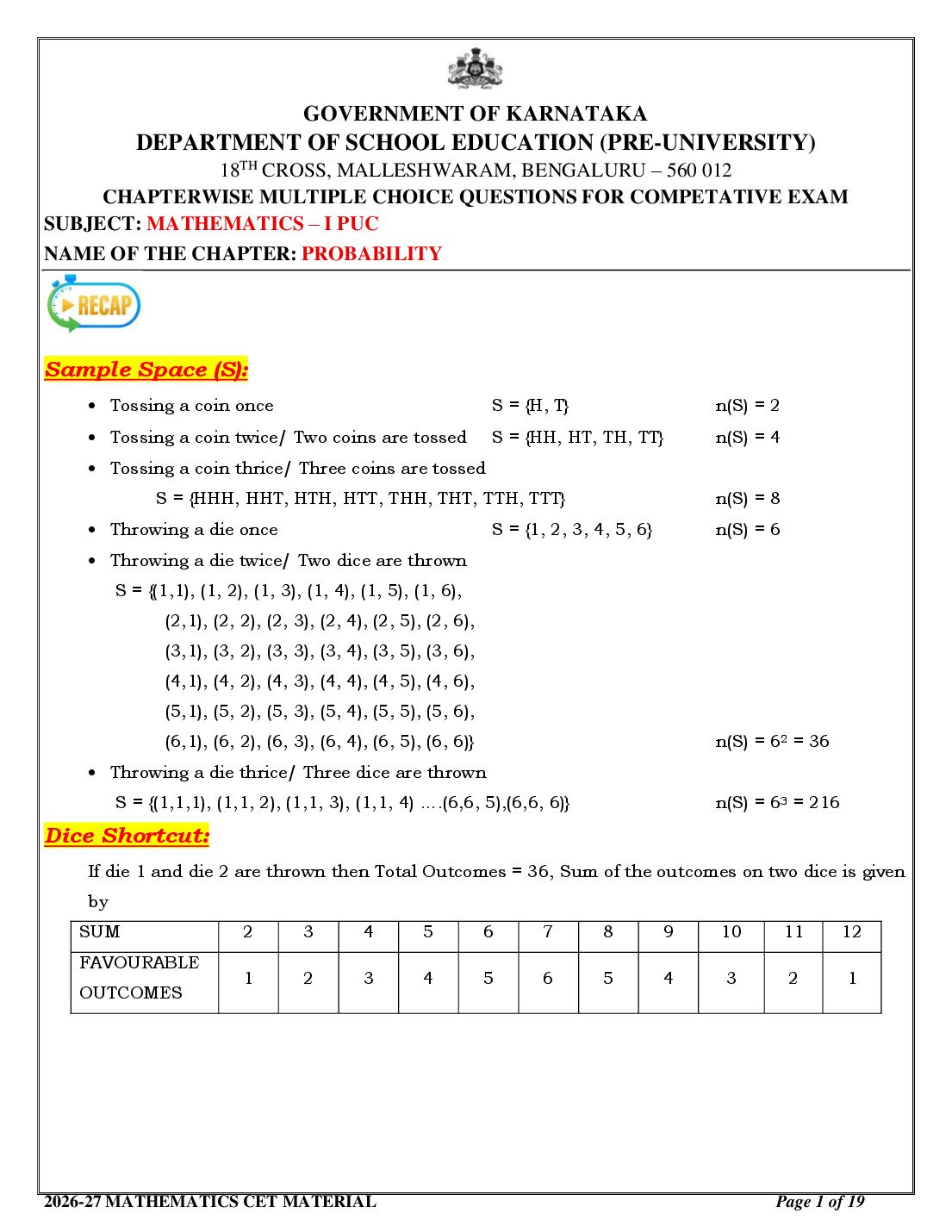
Sample Space (S):
Tossing a coin once S = {H, T} n(S) = 2
Tossing a coin twice/ Two coins are tossed S = {HH, HT, TH, TT} n(S) = 4
Tossing a coin thrice/ Three coins are tossed
S = {HHH, HHT, HTH, HTT, THH, THT, TTH, TTT} n(S) = 8
Throwing a die once S = {1, 2, 3, 4, 5, 6} n(S) = 6
Throwing a die twice/ Two dice are thrown
S = {(1,1), (1, 2), (1, 3), (1, 4), (1, 5), (1, 6),
(2,1), (2, 2), (2, 3), (2, 4), (2, 5), (2, 6),
(3,1), (3, 2), (3, 3), (3, 4), (3, 5), (3, 6),
(4,1), (4, 2), (4, 3), (4, 4), (4, 5), (4, 6),
(5,1), (5, 2), (5, 3), (5, 4), (5, 5), (5, 6),
(6,1), (6, 2), (6, 3), (6, 4), (6, 5), (6, 6)} n(S) = 62 = 36
Throwing a die thrice/ Three dice are thrown
S = {(1,1,1), (1,1, 2), (1,1, 3), (1,1, 4) ….(6,6, 5),(6,6, 6)} n(S) = 63 = 216
Dice Shortcut:
If die 1 and die 2 are thrown then Total Outcomes = 36, Sum of the outcomes on two dice is given
by
SUM 2 3 4 5 6 7 8 9 10 11 12
FAVOURABLE
1 2 3 4 5 6 5 4 3 2 1
OUTCOMES
2026-27 MATHEMATICS CET MATERIAL Page 1 of 19
Page 2
Total Cards = 52
Red Cards = 26
Black Cards = 26
Queen = 4, King = 4, Jack = 4, Aces = 4
Hearts = 4, Clubs = 4, Spades = 4, Diamonds= 4
Face Cards = 12 (4 Queen, 4 King, 4 Jack)
Probability:
𝑛(𝐴)
P(A) = 𝑛(𝑆)
P(Not A) = P(A’) = 1 − 𝑃(𝐴)
P(A or B) = P(A ∪ B) = P(A) + P(B) – P(A ∩ B)
𝐴 ⊆ 𝐵 ⇒ 𝑃(𝐴) ≤ 𝑃(𝐵)
𝑃(𝐴 ∩ 𝐵) ≤ 𝑃(𝐴)𝑃(𝐵) ≤ 𝑃(𝐴 ∪ 𝐵) ≤ 𝑃(𝐴) + 𝑃(𝐵)
P(Atleast one of A occur) = P(A∪B) = 1 – P(A’) P(B’)
𝑃(𝐴 𝑜𝑛𝑙𝑦) = 𝑃(𝐴 ∩ 𝐵′ ) = 𝑃(𝐴) − 𝑃(𝐴 ∩ 𝐵) = 𝑃(𝐴 − 𝐵)
𝑃(𝐵 𝑜𝑛𝑙𝑦) = 𝑃(𝐴′ ∩ 𝐵) = 𝑃(𝐵) − 𝑃(𝐴 ∩ 𝐵) = 𝑃(𝐵 − 𝐴)
P(Neither A nor B) = 𝑃(𝐴′ ∩ 𝐵′) = 1 − 𝑃(𝐴 ∪ 𝐵) = 1 - P(A) - P(B) + P(A ∩ B)
P(Atleast one of A or B does not occur) = 𝑃(𝐴′ ∪ 𝐵′ ) = 1 − 𝑃(𝐴 ∩ 𝐵) = 1 − 𝑃(𝐴) − 𝑃(𝐵) + 𝑃(𝐴 ∪ 𝐵)
P(A∩A′) = 0
P(A∪B) = P(A∩B′) + P(A′∩B) + P(A∩B)
P(Exactly one event) = 𝑃(𝐴′ ∩ 𝐵) + 𝑃(𝐴 ∩ 𝐵′)
𝑃(𝑁𝑜𝑛𝑒) = 1 − 𝑃(𝐴𝑡𝑙𝑒𝑎𝑠𝑡 𝑜𝑛𝑒)
When events are mutually exclusive, 𝑛(𝐴 ∩ 𝐵) = 0 ⇒ 𝑃(𝐴 ∩ 𝐵) = 0, 𝑃(𝐴 ∪ 𝐵) = 𝑃(𝐴) + 𝑃(𝐵)
When events are mutually exhaustive,
𝑛(𝐸1 ∪ 𝐸2 ∪ 𝐸3 … .∪ 𝐸𝑛 ) = 𝑛(𝑆) ⇒ 𝑃(𝐸1 ∪ 𝐸2 ∪ 𝐸3 … .∪ 𝐸𝑛 ) = 1
2026-27 MATHEMATICS CET MATERIAL Page 2 of 19
Page 3
Probability regarding 𝒏 letters and their envelopes :
If 𝒏 letters corresponding to n envelopes are placed in the envelopes at random, then
Total arrangements of n letters = n!
1
Probability that all letters are in right envelopes =
𝑛!
1 !𝑛
Probability that all letters are not in right envelopes = 1 − 𝑛! = 𝑛!
1 1 1 (−1)𝑛
Derangements of n letters ! 𝑛 = 𝑛! (1 − 1! + 2! − 3! + ⋯ + 𝑛!
)
𝑛𝐶𝑟 !(𝑛−𝑟)
Probability that exactly r letters are correctly placed = 𝑛!
EVENTS
1. Two coins are tossed once. The number of possible outcomes. (Easy, Event)
A) 2 B) 4 C) 8 D) 6
2. If E is an event “Number of tails is at least one” associated with a sample space “two
coins are tossed once”. The number of outcomes in E is (Easy, Event)
A) 4 B) 3 C) 2 D) 1
3. If E is an event “Second toss is not head” associated with a sample space “two coins are
tossed once”. The number of outcomes in E is (Easy, Event)
A) 4 B) 3 C) 2 D) 1
4. If E is an event “Number of tails is at most two” associated with a sample space “two
coins are tossed once”. The event E is (Easy, Event)
A) {TT} B) {HT, TH, TT} C) {HH, HT, TH, TT} D) φ
5. The number of simple events corresponding to the sample space “two coins are tossed
once” is (Easy, Event)
A) 1 B) 2 C) 3 D) 4
6. Which of the following event is simple event when a die is rolled (Easy, Event)
A) a number less than 7 B) a number greater than 7
C) an even number greater than 4 D) a number not less than 3.
7. If A, B, C are three mutually exclusive and exhaustive events of an experiment such that
3P(A)=2P(B)=P(C), then P(A) is equal to (Difficult, Mutually Exclusive & Exhaustive events)
1 2 5 6
A) B) C) D)
11 11 11 11
8. Which of the following is incorrect (Difficult, Mutually Exclusive & Exhaustive events)
A) An event which has one sample points of a sample space is called impossible event.
B) An event which has all sample point of a sample space is called sure event.
C) Let two events A and B associated with sample space S is said to be mutually exclusive
events if 𝐴 ∩ 𝐵 = 𝜙.
D) Events 𝐸1 , 𝐸2 , . . . . .. 𝐸𝑛 are said to Mutually exhaustive events
if 𝐸1 ∪ 𝐸2 ∪ . . . . ∪ 𝐸𝑛 = 𝑆 , where 𝑆 is the sample space.
2026-27 MATHEMATICS CET MATERIAL Page 3 of 19
Page 4
9. A and B are events such that 𝑷(𝑨) = 𝟐 , 𝑷(𝑨 ∪ 𝑩) = 𝟓 , 𝑷(𝑩) = 𝒒, then the value of q if A and B
are mutually exclusive (Average, Mutually Exclusive & Exhaustive events)
3 1 1 7
A) B) C) D)
10 10 5 10
10. If A and B are mutually exclusive events, then
(Difficult, Mutually Exclusive & Exhaustive events)
A) P( A ) ≤ P(̅̅̅
B) B) P( A ) ≥ P(̅̅̅
B) C) P( A ) < P(̅̅̅
B) D) P(A) = P(B)
11. If sample space 𝑺 = {𝟏, 𝟐, 𝟑, 𝟒, 𝟓, 𝟔} and events 𝑨 = {𝟐, 𝟒, 𝟔}𝒂𝒏𝒅 𝑩 = {𝟏, 𝟑, 𝟓}, 𝒕𝒉𝒆𝒏 events A and B
are (Easy, Mutually Exclusive & Exhaustive events)
A) Mutually exhaustive but not exclusive events
B) Mutually exclusive but not exhaustive events
C) Mutually exclusive and exhaustive events
D) Neither mutually exclusive nor exhaustive events
12. A die is rolled. Let E be the event “die shows 4” and F be the event “die shows even
number”, then E and F are (Average, Mutually Exclusive & Exhaustive events)
A) Mutually exhaustive but not exclusive events
B) Mutually exclusive but not exhaustive events
C) Mutually exclusive and exhaustive events
D) Neither mutually exclusive nor exhaustive events
13. A and B are events such that 𝑷(𝑨) = 𝟎. 𝟒, 𝑷(𝑩) = 𝟎. 𝟑 and 𝑷(𝑨′ ∪ 𝑩) = 𝟎. 𝟓. Then 𝑷(𝑩′ ∩ 𝑨) equals
(Exemplar, Average, Algebra of Events)
2 1 3 1
A) 3 B) 2 C) 10 D) 5
14. Which of the following is incorrect (Difficult, Algebra of events)
A) Complementary event ‘not A’: The set 𝐴′ or S – A. B) Event A or B: The set A ∪ B
C) Event A and B: The set A ∩ B D) Event A and not B: The set B – A
15. The probability of obtaining an even prime number on each die, when a pair of dice is rolled
is (Easy, Operations on Events)
1 1 1
A) 0 B) 3 C) 12 D) 36
16. If A and B are any two events such that P(A) + P((B) – P(A and B) = P(A), then
(Easy, Operations on Events)
A) P(B|A) = 1 B) P(A|B) = 1 C) P(B|A) = 0 D) P(A|B) = 0
𝟏 𝟐
17. If A and B are any two events having P(AUB) = 𝟐 and P(𝐀̅ ) = 𝟑 , then the probability of
̅ ∩ 𝐁 is
𝐀 (Average, Operations on Events)
1 2 1 1
A) B) C) D)
2 3 6 3
18. If P(AUB)=P(A∩B) for any two events A and B, then (Difficult, Operations on Events)
A) P(A) = P(B) B) P(A) > P(B) C) P(A) < P(B) D) P(A) ≠ P(B)
2026-27 MATHEMATICS CET MATERIAL Page 4 of 19
Page 5
is a vowel is (Average, Operations on Events)
1 4 2 3
A) 3 B) 11 C) 11 D) 11
20. If the probabilities for A to fail in an examination is 0.2 and that of B is 0.3, then the
probability that either A or B fails is (Difficult, Operations on Events)
A) > 0.5 B) 0.5 C) ≤ 0.5 D) 0
21. The probability that at least one of the events A and B occurs is 0.6. If A and B occur
̅ )+P( 𝐁
simultaneously with probability 0.2 then P( 𝐀 ̅ ) is (Average, Operations on Events)
A)0.4 B) 0.8 C) 1.2 D) 1.6
22. If M and N are any two events, the probability of at least one of them occurs is
(Easy, Operations on Events)
A) P(M)+P(N)-2P(M∩N) B) P(M)+P(N)-P(M∩N)
C)P(M)+P(N)+P(M∩N) D) P(M)+P(N)+2P(M∩N)
23. Two events A and B occurs with probabilities 0.25 and 0.50. The probability that they
occur simultaneously is 0.14. What is the probability that neither of them occurs?
(Average, Operations on Events)
A)0.39 B) 0.36 C) 0.61 D) 0.16
24. A die is thrown. Let A be the event that the number obtained is greater than 3. Let B be
the event that the number obtained is less than 5. Then P(AUB) is
(Easy, Operations on Events)
A) 0 B)0.5 C)0.75 D) 1
25. The probability that a home team will win an upcoming football game is 0.77, the
probability that it will tie the game is 0.08, then the probability that it will lose the game
is (Average, Operations on Events)
A)0.22 B)0.12 C)0.15 D)0.25
26. If A and B are any two events in a sample space S then P(A⋃ 𝑩) is
(Easy, Operations on Events)
A) ≥ P(A)+P(B) B) P(A)+ P(B) C) ≤ P(A)+P(B) D) P(A⋂ 𝐵)
𝟔 𝟓 𝟕
27. If 𝑷(𝑨) = 𝟏𝟏 , 𝑷(𝑩) = 𝟏𝟏 𝒂𝒏𝒅 𝑷 (𝑨 ∪ 𝑩) = 𝟏𝟏 then 𝑷(𝑨 ∩ 𝑩) is (Easy, Operations on Events)
2 4 4 4
A) 11 B)11 C)5 D)6 .
28. If A and B are two independent events then the probability of occurrence of
at least one of A and B is (Easy, Operations on Events)
A) 1 + 𝑃(𝐴′ )𝑃(𝐵′ ) B) 1 − 𝑃(𝐴) − 𝑃(𝐵) C) 1 − 𝑃(𝐴′ )𝑃(𝐵′ ) D) 1 − (𝑃(𝐴) + 𝑃(𝐵))
2026-27 MATHEMATICS CET MATERIAL Page 5 of 19
Page 6
29. Let E and F be two events such that 𝑷(𝑬) = 𝟓 , 𝑷(𝑭) = 𝟏𝟎 and 𝑷(𝑬 ∩ 𝑭) = 𝟓.
then E and F are (Easy, Operations on Events)
A) dependent events B) independent events
C) mutually exclusive events D) 𝑒𝑥ℎ𝑎𝑢𝑠𝑡𝑖𝑣𝑒 𝑒𝑣𝑒𝑛𝑡𝑠.
30. If A and B are independent events with 𝑷(𝑨) = 𝟎. 𝟑, 𝑷(𝑩) = 𝟎. 𝟒 then 𝑷(𝑨 𝒂𝒏𝒅 𝑩)
(Easy, Operations on Events)
A) 0.3 B) 0.4 C)0.12 D)0.7
31. If A and B are independent events with 𝑷(𝑨) = 𝟎. 𝟑, 𝑷(𝑩) = 𝟎. 𝟒 then 𝑷(𝑨 𝒐𝒓 𝑩)
(Easy, Operations on Events)
A) 0.3 B) 0.42 C)0.12 D) 0.58.
32. If A and B are independent events with 𝑷(𝑨) = 𝟎. 𝟑, 𝑷(𝑩) = 𝟎. 𝟒 then 𝑷(𝐧𝐞𝐢𝐭𝐡𝐞𝐫 𝐀 𝐧𝐨𝐫 𝐁)
(Easy, Operations on Events)
A) 0.3 B) 0.42 C)0.12 D) 0.58
𝟏 𝟏 𝟏
33. If A and B are two events such that P (A) = 𝟐, P (B) = 𝟒 and P(𝑨 ∩ 𝑩) = 𝟖 , then
P (not A and not B) (Average, Operations on Events)
1 3 7 1
A) 3 B)8 C)8 D)2
𝟏 𝟕 𝟏
34. If 𝑷(𝑨) = 𝟐 , 𝑷(𝑩) = 𝟏𝟐 𝒂𝒏𝒅 𝑷(𝒏𝒐𝒕 𝑨 𝒐𝒓 𝒏𝒐𝒕 𝑩) = 𝟒 then A and B are.
(Average, Operations on Events)
A) dependent events B) independent events
C) mutually exclusive events D) 𝑒𝑥ℎ𝑎𝑢𝑠𝑡𝑖𝑣𝑒 𝑒𝑣𝑒𝑛𝑡𝑠.
35. If A and B are independent events such that 𝑷(𝑨) = 𝟎. 𝟑 𝒂𝒏𝒅 𝑷(𝑩) = 𝟎. 𝟔, then
P(A and not B) is (Average, Operations on Events)
A) 0.12 B)0.18 C)0.28 D)0.42
36. If A and B are independent events such that 𝑷(𝑨) = 𝟎. 𝟑 𝒂𝒏𝒅 𝑷(𝑩) = 𝟎. 𝟔, then
P (neither A nor B) is (Average, Operations on Events)
A) 0.12 B)0.18 C)0.28 D)0.42
37. An electronic assembly consists of two subsystems say A and B. From previous testing
procedures, the following probabilities are assumed to be known, P(A fails) = 0.2,
P(B fails alone) = 0.15 and P(A and B fail) = 0.15, then P(A fails alone)
(Difficult, Operations on Events)
A) 0.15 B) 0.5 C) 0.05 D) 0.75
38. The probability of obtaining an even prime number on each die, when a pair of
dice is rolled is (Average, Operations on Events)
1 1 1 1
A) 36 B)6 C) 18 D)4.
2026-27 MATHEMATICS CET MATERIAL Page 6 of 19
Page 7
(Easy, Operations on Events)
1 1 3 7
A) 8 B)4 C) 4 D)8
40. Three letters are randomly placed into three addressed envelopes. Let A: The first letter is
placed in the correct envelope and B: The second letter is placed in the correct envelope.
The value of P(A∪B) is (Average, Operations on Events)
2 5 1 1
A) 3 B)6 C) 2 D)3.
EVENTS
1 2 3 4 5 6 7 8 9 10
B B C C A C B A B A
11 12 13 14 15 16 17 18 19 20
C D B D D B C A B C
21 22 23 24 25 26 27 28 29 30
C B A D C C B C A C
31 32 33 34 35 36 37 38 39 40
D B B A A C C A D C
AXIOMATIC APPROACH OF PROBABILITY
1. In a leap year the probability of having 53 Sundays or 53 Mondays is
(Difficult, Axiomatic Approach of probability)
2 3 4 5
A) 7 B) 7 C) 7 D) 7
2. In a non-leap year, the probability of having 53 Tuesdays or 53 Wednesdays is
(Difficult, Axiomatic Approach of probability)
1 2 3 5
A) B) C) D)
7 7 7 7
3. Three digit numbers are formed using the digits 0, 2, 4, 6, 8. A number chosen at random
out of these numbers. What is the probability that this number has same digits?
(Difficult, Axiomatic Approach of probability)
1 16 1 1
A) 16 B) 25 C) 645 D) 25
4. Three numbers are chosen from 1 to 20. Find the probability that they are not
consecutive (Difficult, Axiomatic Approach of probability)
186 187 188 18
A) 190 B) 190 C) 190 D) 20𝐶
3
5. Three squares of chess board are selected at random. The probability of getting 2 squares
of one colour and other of a different colour is
(Difficult, Axiomatic Approach of probability)
16 8 3 3
A) 21 B) 21 C) 32 D) 8
2026-27 MATHEMATICS CET MATERIAL Page 7 of 19
Page 8
A = {1, 2, 3,…,n} into itself. The probability that the mapping selected is one to one is
(Difficult, Axiomatic Approach of probability)
1 1 (n−1)!
A) nn B) n! C) nn−1 D) n!
7. Seven persons are to be seated in a row. The probability that two particular persons sit
next to each other is (Average, Axiomatic Approach of probability)
1 1 2 1
A) 3 B) 6 C) 7 D) 2
8. Without the repetition of the numbers, four digit numbers are formed with the numbers
0,2,3,5. The probability of such a number is divisible by 5 is
(Average, Axiomatic Approach of probability)
1 4 1 5
A) B) C) (D)
5 5 30 9
9. 6 boys and 6 girls sit in a row at random. The probability that all the girls sit together is
(Average, Axiomatic Approach of probability)
1 12 1 12
A)432 B) 431 C) 132 D) 132
10. One ticket is selected at random from 50 tickets numbered 00, 01, 02, …, 49. Then the
probability that the sum of the digits on the selected ticket is 8, given that the product of
these digits is zero, equals (Difficult, Axiomatic Approach of probability)
1 1 1 1
A) B) C) D)
15 14 13 12
11. Three houses are available in a locality. Three persons apply for the houses. Each applies
for one house without consulting the others. The probability that all the three apply for
the same house is (Average, Axiomatic Approach of probability)
1 1 1 1
A) B) C) D)
3 9 27 12
12. On her vacations Veena visits four cities (A, B, C and D) in a random order. The
probability that she visits A first and B last is
(Average, Axiomatic Approach of probability)
1 1 1 1
A) B) C) D)
12 8 6 4
13. Three dice are rolled. The probability that the same number will appear on each of them
is (Easy, Axiomatic Approach of probability)
1 1 1 1
A) 6 B) 12 C) 36 D) 18
14. The probability that in a random arrangement of the letters of the word ASSASSINATION
the three A are together is (Average, Axiomatic Approach of probability)
1 1 1 1
A) 36 B) 26 C) 39 D) 29
2026-27 MATHEMATICS CET MATERIAL Page 8 of 19
Page 9
(Average, Axiomatic Approach of probability)
1 1 1 1
A) 6 B) 3 C) 4 D) 2
16. A bag contains 5 black and 4 white balls. Two balls are drawn from the bag. The
probability that both balls are of same color is
(Average, Axiomatic Approach of probability)
8 9 10 11
A) B) C) D)
18 18 18 18
17. Fifteen coupons are numbered 1, 2, 3, …,15 respectively. Seven coupons are selected at
random one at a time with replacement. If p is the ‘probability of the largest number
appearing on a selected coupon is 9’ then value of p is
(Difficult, Axiomatic Approach of probability)
1 7 3 7 6 7 9 7
A) ( ) B) ( ) C) ( ) D) ( )
15 15 15 15
18. Three of the six vertices of a regular hexagon are chosen at random.
What is the probability that the triangle with these vertices is
equilateral? (Difficult, Axiomatic Approach of probability)
3 3 1 1
A) 10 B) 20 C) 20 D) 10
19. A man’s pocket contains 5 fifty paise coins, 4 twenty five paise coins and 4 ten paise
coins. A boy is asked to draw two coins at random. What is the probability of the boy
drawing maximum possible amount. (Difficult, Axiomatic Approach of probability)
5𝐶 5𝐶 4𝐶 3𝐶
A) 13 1 B) 13 2 C) 13 2 D) 13 2
𝐶2 𝐶2 𝐶2 𝐶2
20. When a perfect die is rolled the probability of getting a face with 4 points upwards
(Difficult, Axiomatic Approach of probability)
4 3 2 1
A) 6 B) 6 C) 6 D) 6
21. When a die is rolled the probability of getting a face with even number of points upward is
(Easy, Axiomatic Approach of probability)
1 1 1 1
A) 4 B) 3 C) 2 D) 8
22. Two symmetrical dice are thrown the probability of getting a sum of 6 points is
(Easy, Axiomatic Approach of probability)
4 5 6 1
A) 36 B) 36 C) 36 D) 36
23. In a throw with a pair of symmetrical dice the probability of obtaining doublet is
(Average, Axiomatic Approach of probability)
1 2 1 1
A) B) C) D)
6 3 4 2
2026-27 MATHEMATICS CET MATERIAL Page 9 of 19
Page 10
simultaneously is (Easy, Axiomatic Approach of probability)
7 29 1 5
A) B) C) D)
36 36 6 6
25. 3 fair dice are rolled the probability of getting sum 18 is
(Easy, Axiomatic Approach of probability)
1 2 3 4
A) B) C) D)
216 216 216 216
26. 3 fair dice are rolled the probability of getting sum 3 is
(Easy, Axiomatic Approach of probability)
2 3 4 1
A) B) C) D)
216 216 216 216
27. The probability that a leap year will have only 52 Sundays is
(Difficult, Axiomatic Approach of probability)
4 5 6 1
A) 7 B) 7 C) 7 D) 7
28. The probability that a leap year will have 53 Sundays and 53 Mondays is
(Difficult, Axiomatic Approach of probability)
3 2 1 4
A) B) C) D)
7 7 7 7
29. A card is drawn at random from a well shuffled pack of 52 playing cards the probability
that the card is either a face card or a six is (Average, Axiomatic Approach of probability)
4 3 2 6
A) 13 B) 13 C) 13 D) 13
30. The probability of drawing a card which is a spade or a king from a well shuffled pack of
playing cards. (Average, Axiomatic Approach of probability)
2 3 4 5
A) B) C) D)
13 13 13 13
𝟏 𝟏 𝟏
31. Three men A, B & C hit target with respective probability 𝟑, 𝟒 and 𝟓 each one of them shots
once at the target the probability that target being hit is
(Average, Axiomatic Approach of probability)
3 2 4 1
A) 5 B) 5 C) 5 D) 5
𝟏 𝟐 𝟏 𝟏
32. The probabilities that students A, B, C and D solve a problem are 𝟑, 𝟓, 𝟓, & 𝟒 respectively. If
all of the them try to solve the problem. The probability that the problem is solved is
(Average, Axiomatic Approach to Probability)
20 21 19 18
A) 25 B) 25 C) 25 D) 25
33. A problem in mathematics is given to three student A, B and C and their respective
𝟏 𝟏 𝟏
probability of solving the problem is , and . The probability that the problem is solved.
𝟐 𝟑 𝟒
(Average, Axiomatic Approach to Probability)
3 1 2 1
A) 4 B) 2 C) 3 D) 3
2026-27 MATHEMATICS CET MATERIAL Page 10 of 19
Page 11
function whose domain is (Easy, Axiomatic Approach to Probability)
A) Set of real number B) [0,1] C) Power set of S D) Set of integers.
35. Let S be the sample space of a random experiment. The probability P is a real valued
function whose range is (Easy, Axiomatic Approach to Probability)
A) Set of real number B) [0, 1] C) Power set of S D) Set of integers.
36. Which of the following cannot be valid assignment of probabilities for outcomes of
sample spaces S = {𝝎𝟏 , 𝝎𝟐 , 𝝎𝟑 , 𝝎𝟒 , 𝝎𝟓 , 𝝎𝟔 } (Easy, Axiomatic Approach to Probability)
Assignment 𝜔1 𝜔2 𝜔3 𝜔4 𝜔5 𝜔6
1 1 1 1 1 1
A)
6 6 6 6 6 6
1 2 1 1 1 1
B) − −
8 3 3 3 4 3
1 1 1 1 1 3
C)
12 12 6 6 6 2
D) 0.1 0.2 0.3 0.4 0.5 0.6
37. Statement 1: A die has two faces each with number ‘1’, three faces each with number ‘3’ and
1
one face with number ‘5’. If die is rolled once, then P(3) is .
2
Statement 2: Number of outcomes favorable is 3 and total possible outcomes is 6.
(Easy, Axiomatic Approach to Probability)
A) Both statements are true B) Statement 1 is true and statement 2 is false
C) Statement 1 is false and statement 2 is true D) Both statements are false
38. Statement 1: A card is drawn from a well shuffled deck of 52 playing cards. The probability
1
that the card drawn is an ace of hearts is .
52
Statement 2: Out of 52 playing cards there are 4 ace cards.
(Average, Axiomatic Approach to Probability)
A) Both statements 1 and 2 are true B) Statement 1 is true and statement 2 is false
C) Statement 1 is false and statement 2 is true D) Both statements1 and 2 are false
39. Assertion (A): The probability of drawing a red or a card with a face from a deck of 52 cards is
8
13
Reason(R): The total favorable cards: 26 (red cards) + 12 (face cards) – 6 (red face cards) = 32
favorable cards.
(Difficult, Axiomatic Approach to Probability)
A) Both Assertion (A) and Reason (R) are true.
B) Both Assertion (A) and Reason (R) are false.
C) Assertion (A) is true and Reason (R) is false.
D) Assertion (A) is false and Reason (R) is true.
2026-27 MATHEMATICS CET MATERIAL Page 11 of 19
Page 12
5
C2 3 C2
1. The probability that both are of the same colour = 8
C2
5
C2 3 C2
2. The probability that both are of the different colours = 8
C2
3. Number of ways in which 2 balls can be picked = 𝟖𝑪𝟐
Which of the above statements are correct?
(Difficult, Axiomatic Approach to Probability)
A) 1 and 2 only B) 2 and 3 only C) 1 and 3 only D) 1, 2 and 3
41. Statement 1: The limit of probability is −1 𝑡𝑜 1
Statement 2: A number is selected from numbers 1 to 25. The probability that it is a prime
9
number is 25 (Difficult, Axiomatic Approach to Probability)
A) Statement 1 is true and Statement 2 is false.
B) Statement 1 is false and Statement 2 is false.
C) Statement 1 is true and Statement 2 is true, Statement 2 is a correct explanation for
Statement 1
D) Statement 1 is false and Statement 2 is true, Statement 2 is not a correct explanation for
Statement 1
42. Ravi visits three cities (A, B, and C) in a random order. Match Column I and Column II
Column I Column II
a) Probability that A first and B last? i)
1
2
b) Probability that A before B ii)
2
3
c) Probability that A either first or second iii)
1
6
Choose the correct answer from the options given below:
(Difficult, Axiomatic Approach to Probability)
A) a-iii ,b-i, c-ii B) a-ii, b-iii, c-i C) a-ii, b-i, c-iii D) a-i, b-ii, c-iii.
43. A die is thrown. Match Column I and Column II
Column I Column II
a) Probability that number more than 6 will appear i) 1
b) Probability that number less than 6 will appear ii) 0
c) Probability that prime number will appear iii) 2
1
Choose the correct answer from the options given below:
(Easy, Axiomatic Approach to Probability)
A) a-iii, b-i, c-ii B) a-ii, b-iii, c-i C) a-ii, b-i, c-iii D) a-i, b-ii, c-iii.
2026-27 MATHEMATICS CET MATERIAL Page 12 of 19
Page 13
Column I Column II
a) P(𝐴/ ) i) 𝑃(𝑆)
b) P(𝐴/ ∪ A) ii) 1 − 𝑃(𝐴)
c) P(𝐴/ ∩ A) iii) 𝑃(∅)
Choose the correct answer from the options given below:
(Average, Axiomatic Approach to Probability)
A) a-iii, b-i, c-ii B) a-ii, b-iii, c-i C) a-ii, b-i, c-iii D) a-i, b-ii, c-iii.
45. For the figure given below.
3 1 1
1. P(𝑈𝑛𝑙𝑖𝑘𝑒𝑙𝑦 ) = 4 2. 𝑃(𝐸𝑞𝑢𝑎𝑙𝑙𝑦 𝑙𝑖𝑘𝑒𝑙𝑦 ) = 2 3. 𝑃(𝐿𝑖𝑘𝑒𝑙𝑦 ) = 4
Which of the above statements are correct?
(Average, Axiomatic Approach to Probability)
A) 2 only B) 2 and 3 only C) 1 and 3 only D) 1, 2 and 3
46. Eight coins are tossed together. The probability of getting exactly 3 heads is
(Exemplar, Average, Axiomatic Approach of Probability)
1 7 5 3
A) 256 B) 32 C) 32 D) 32
47. A box contains 3 orange balls, 3 green balls and 2 blue balls. Three balls are drawn at
random from the box without replacement. The probability of drawing 2 green balls and
one blue ball is (Exemplar, Difficult, Axiomatic Approach of Probability)
3 2 1 167
A) 28 B) 21 C) 28 D) 168
48. Assume that in a family, each child is equally likely to be a boy or a girl. A family with
three children is chosen at random. The probability that the eldest child is a girl given
that the family has at least one girl is
(Exemplar, Average, Axiomatic Approach of Probability)
1 1 2 4
A) 2 B) 3 C) 3 D) 7
49. A bag contains 5 red and 3 blue balls. If 3 balls are drawn at random without replacement
the probability of getting exactly one red ball is
(Exemplar, Average, Axiomatic Approach of Probability)
45 135 15 15
A) 196 B) 392 C) 56 D) 29
2026-27 MATHEMATICS CET MATERIAL Page 13 of 19
Page 14
individual entries of the determinant are chosen independently, each value being
𝟏
assumed with probability . If the value of the determinant is positive then its probability
𝟐
is (Difficult, Axiomatic Approach of Probability)
3 3 3 3
A) 11 B) 14 C) 17 D) 16.
AXIOMATIC APPROACH OF PROBABILITY
1 2 3 4 5 6 7 8 9 10
B B D B A C C D C B
11 12 13 14 15 16 17 18 19 20
B A C B B A D D B D
21 22 23 24 25 26 27 28 29 30
C B A C A D B C A C
31 32 33 34 35 36 37 38 39 40
A C A C B A A A A C
41 42 43 44 45 46 47 48 49 50
D A C A A B A D C D
PROBABILITY OF EVENTS
1. Which of the following is incorrect (Average, Probability of event ‘not A’)
A) If 𝐴 𝑎𝑛𝑑 𝐵 𝑎𝑟𝑒 𝑎𝑛𝑦 𝑡𝑤𝑜 𝑒𝑣𝑒𝑛𝑡𝑠 𝑡ℎ𝑒𝑛 𝑃(𝐴 ∪ 𝐵) = 𝑃(𝐴) + 𝑃(𝐵) − 𝑃(𝐴 ∩ 𝐵)
B) 𝑃(𝐴′ ) = 1 − 𝑃(𝐴)
C) 𝑃(𝐴 ∩ 𝐵′ ) = 𝑃(𝐴) − 𝑃(𝐴 ∩ 𝐵)
D) 𝑃(𝐴′ ∩ 𝐵′ ) = 1 + 𝑃(𝐴 ∪ 𝐵)
𝟑 𝟏
2. Given P(A)= 𝟓 and P(B) = 𝟓. Then P(A or B), if A and B are mutually exclusive events.
(Easy, Probability of the event ‘A or B’)
2 3 4 1
A) 5 B) 5 C) 5 D) 5.
𝟏 𝟏 𝟏
3. If P(A) = 𝟒 , P(B) = 𝟐 and P(A 𝒂𝒏𝒅 B) = 𝟖, then P(A or B) is
(Easy, Probability of the event ‘A or B’)
3 7 5 1
A) 4 B) 8 C) 8 D) 4
4. A and B are events such that P(A) = 0.42, P(B) = 0.48 and P(A and B) = 0.16,
then P(A or B) is (Easy, Probability of the event ‘A or B’)
A) 0.74 B) 0.90 C) 1.6 D) 0.64.
5. A and B are two events such that P(A) = 0.54, P(B) = 0.69 and P (A ∩ B) = 0.35, then
P (A but not B) is (Average, Probability of Event ‘A but not B’)
A) 0.34 B) 0.19 C) 0.88 D) 1.13
2026-27 MATHEMATICS CET MATERIAL Page 14 of 19
Page 15
but not A) is (Average, Probability of Event ‘A but not B’)
A) 0.34 B) 0.19 C) 0.88 D) 1.13
7. Events E and F are such that P (not E or not F) = 0.25, then P (E and F) is
(Easy, Probability of the event ‘A and B’)
A) 0 B) 1 C) 0.75 D) 0.25
8. One card is drawn from a well shuffled deck of 52 cards. If each outcome is
equally likely, then the probability that the card will be a diamond
(Easy, Probabilities of equally likely outcomes)
1 1 1 12
A) 4 B) 13
C) 52 D) 13
9. One card is drawn from a well shuffled deck of 52 cards. If each outcome is
equally likely, then the probability that the card will be a non ace
(Easy, Probabilities of equally likely outcomes)
1 1 1 12
A) B) C) D)
4 13 52 13
10. One card is drawn from a well shuffled deck of 52 cards. If each outcome is
equally likely, then the probability that the card will be not a black card
(Easy, Probabilities of equally likely outcomes)
1 1 1 12
A) 4
B) 13 C) 2 D) 13.
11. One card is drawn from a well shuffled deck of 52 cards. If each outcome is
equally likely, then the probability that the card will be not a diamond
(Easy, Probabilities of equally likely outcomes)
1 1 1 3
A) 4
B) 13 C) 2 D) 4.
12. A bag contains 9 discs of which 4 are red, 3 are blue and 2 are yellow. The discs are
similar in shape and size. A disc is drawn at random from the bag. Then the probability
that it will be either red or blue. (Difficult, Probabilities of equally likely outcomes)
7 4 2 3
A) 9
B) 9 C) 9 D) 9.
13. A bag contains 9 discs of which 4 are red, 3 are blue and 2 are yellow. The discs are
similar in shape and size. A disc is drawn at random from the bag. Then the probability
that it will be not blue. (Easy, Probabilities of equally likely outcomes)
4 2 2 3
A) 9
B) 9 C) 3 D) 4.
2026-27 MATHEMATICS CET MATERIAL Page 15 of 19
Page 16
14. Statement 1: The probability of getting a king or ace from the deck of 52 cards is 13
𝑇𝑜𝑡𝑎𝑙 𝑛𝑢𝑚𝑏𝑒𝑟 𝑜𝑓 𝑘𝑖𝑛𝑔 𝑜𝑟
𝑎𝑐𝑒 from the deck of 𝑐𝑎𝑟𝑑𝑠
Statement 2: The probability of getting a king or ace =
𝑇𝑜𝑡𝑎𝑙 𝑛𝑢𝑚𝑏𝑒𝑟 𝑜𝑓 𝑐𝑎𝑟𝑑𝑠
(Average, Probabilities of equally likely outcomes)
A) Statement 1 is true and Statement 2 is false.
B) Statement 1 is false and Statement 2 is false.
C) Statement 1 is true and Statement 2 is true, Statement 2 is a correct explanation for
Statement 1
D) Statement 1 is true and Statement 2 is true, Statement 2 is not a correct explanation for
Statement 1
𝟏 𝟏 𝟏
15. If P(A) = 𝟑 , P(B) = 𝟓 and P (A 𝒂𝒏𝒅B) = 𝟏𝟓, then P (A or B) is
(Easy, Probability of the event ‘A or B’)
3 7 5 1
A) 4
B) 15 C) 8 D) 4
16. If P(A) = 𝟎. 𝟑𝟓 , P(A∩B) = 𝟎. 𝟐𝟓 and P(A ∪B) = 𝟎. 𝟔, then P(B) is
(Easy, Probability of the event ‘A or B’)
A) 0.75 B) 0.5 C) 0.46 D) 0.65
17. If P(A) = 𝟎. 𝟓 , P(B) = 𝟎. 𝟑𝟓 and P (A 𝒐𝒓 B) = 𝟎. 𝟕, then P (A and B) is
(Easy, Probability of the event ‘A or B’)
A) 0.3 B) 0.85 C) 0.15 D) 0.3
18. A and B are two events such that P(A) = 0.54, P(B) = 0.69 and P(A ∩ B) = 0.35
Match Column I and Column II
Column I Column II
23
a) P(𝐴/ ) i) 50
b) P(A ∪ B) ii) 25
22
13
c) P(𝐴 ∩ 𝐵)/ iii)
20
Choose the correct answer from the options given below:
(Average, Probability of the event ‘A or B’)
A) a-iii, b-i, c-ii B) a-ii, b-iii, c-i C) a-ii, b-i, c-iii D) a-i, b-ii, c-iii.
2026-27 MATHEMATICS CET MATERIAL Page 16 of 19
Page 17
Statement 1: From figure 1, 𝑃(𝐴 ∪ 𝐵) = 𝑃(𝐴) + 𝑃(𝐵) − 𝑃(𝐴 ∩ 𝐵)
Statement 2: From figure 2, A and 𝐵 are mutually exclusive events
(Average, Probability of the event ‘A or B’)
A) Statement 1 is true and Statement 2 is false
B) Statement 1 is false and Statement 2 is true
C) Both Statement 1and 2 are true
D) Both Statement 1 and 2 are false
𝟏 𝟑
20. A and B are events such that 𝑷(𝑨) = 𝟐 , 𝑷(𝑨 ∪ 𝑩) = 𝟓 , 𝑷(𝑩) = 𝒒, then the value of q if A and
B are independent (Average, Probability of the event A and B)
3 1 1 7
A) 10 B)10 C)5 D)10
PROBABILITY OF EVENTS
1 2 3 4 5 6 7 8 9 10
D C C A B A C A D C
11 12 13 14 15 16 17 18 19 20
D A C C D B C D C C
KCET PYQS
1. Probability of obtaining an even prime number on each die when a pair of dice is rolled is
(KCET 2026, Average, Events)
1 1 1
A) 0 B) 6 C) 12 D) 36
𝟏 𝟑
2. Probability of occurrence of an event A is 𝟐 and that of B is 𝟏𝟎. If A and B are mutually
exclusive, then the probability of occurrence of neither A nor B is
(KCET 2026, Average, Operation on Events)
4 3 2 1
A) 5 B) 5 C) 5 D) 5
3. Probability of at least one of the events A and B occur is 0.6. If A and B occur
̅ ) + 𝑷(𝑩
simultaneously with probability 0.2, then 𝑷(𝑨 ̅ ) is
(KCET 2026, Average, Operation on Events)
A) 1 B) 0.8 C) 0.3 D) 1.2
2026-27 MATHEMATICS CET MATERIAL Page 17 of 19
Page 18
𝟏 𝟏
occurrence of the outcomes 𝒘𝟏 , 𝒘𝟐 , 𝒘𝟑 , 𝒘𝟒 and 𝒘𝟓 are respectively , 𝒂, 𝒃 and such that
𝟔 𝟏𝟐
𝟏𝟐𝒂 + 𝟏𝟐𝒃 − 𝟏 = 𝟎. Then the probabilities of occurrence of the outcome 𝒘𝟑 is
(KCET 2025, Average, Occurrence of outcomes)
2 1 1 1
A) 3 B) 3 C) 6 D) 12
5. A die has two face each with number ' 1 ', three faces each with number ' 2 ' and one face
with number ' 3 '. If the die is rolled once, then 𝑷(𝟏 or 3) is
(KCET 2025, Average, Operation on Events)
2 1 1 1
A) 3 B) 2 C) 3 D) 6
6. Consider the following statements.
Statement (I): If E and F are two independent events, then 𝐸 ′ and 𝐹 ′ are also independent.
Statement (II): Two mutually exclusive events with non-zero probabilities of occurrence cannot
be independent.
Which of the following is correct? (KCET 2025, Average, Operations on Events)
A) Statement (I) is true and statement (II) is false
B) Statement (I) is false and statement (II) is true
C) Both the statements are true
D) Both the statements are false
7. Two dice are thrown. If it is known that the sum of numbers on the dice was less than 6
the probability of getting a sum as 3 is (KCET 2021, Average, Operations on events)
1 5 1 2
A) 18 B) 18 C) 5 D) 5
8. If 𝑷(𝑨) = 𝟎. 𝟓𝟗, 𝑷(𝑩) = 𝟎. 𝟑𝟎 and 𝑷(𝑨 ∩ 𝑩) = 𝟎. 𝟐𝟏 then 𝑷(𝑨′ ∩ 𝑩′ ) =
(KCET 2021, Average, Operations on events)
A) 0.11 B) 0.38 C) 0.32 D) 0.35
𝟏 𝟏 𝟏
9. The probability of solving a problem by three persons 𝐀, 𝐁 and C independently is 𝟐 , 𝟒 and 𝟑
respectively. Then the probability of the problem is solved by any two of them is
(KCET 2020, Average, Operations on events)
1 1 1 1
A) 8 B) 12 C) 4 D) 24
10. If A, B, C are three mutually exclusive and exhaustive events of an experiment such that
𝑷(𝑨) = 𝟐𝑷(𝑩) = 𝟑𝑷(𝑪), then 𝑷(𝑩) is equal to (KCET 2020, Average, Types of events)
4 1 2 3
A) 11 B) 11 C) 11 D) 11
2026-27 MATHEMATICS CET MATERIAL Page 18 of 19
Page 19
is vowel and the other is consonant is:
(KCET 2019, Average, Axiomatic Approach of Probability)
3 8 5 4
A) 9 B) 9 C) 9 D) 9
12. The probability of happening of an event 𝑨 is 0.5 and that of 𝑩 is 0.3. If 𝑨 and 𝑩 are
mutually exclusive events, then the probability of neither 𝑨 nor 𝑩 is:
(KCET 2018, Average, Operation on events)
A) 0.4 B) 0.5 C) 0.2 D) 0.9
13. In a simultaneous throw of a pair of dice, the probability of getting a total more than 7 is
(KCET 2018, Average, Axiomatic Approach of Probability)
7 5 5 7
A) 12 B) 36 C) 12 D) 36
𝟑 𝟏
14. If 𝑨 and 𝑩 are mutually exclusive events, given that 𝐏(𝑨) = 𝟓 , 𝑷(𝑩) = 𝟓, then 𝑷(𝑨 or 𝑩) is
(KCET 2018, Average, Types of events)
A) 0.8 B) 0.6 C) 0.4 D) 0.2
15. Two cards are drawn at random from a pack of 52 cards. The probability of these two
being Aces is: (KCET 2016, Average, Multiplication Theorem)
1 1 1 1
A) 26 B) 221 C) 2 D) 13
16. If two dice are thrown simultaneously, then the probability that the sum of the numbers
which come up on the dice to be more than 5 is:
(KCET 2015, Average, Axiomatic Approach of Probability)
5 1 5 13
A) 36 B) 6 C) 18 D) 18
17. Two dice are thrown simultaneously. The probability of obtaining a total score of 5 is:
(KCET 2014, Average, Axiomatic Approach of Probability)
1 1 1 1
A) 18 B) 12 C) 9 D) 36
KCET PYQS
1 2 3 4 5 6 7 8 9 10
D D D A B C C C C D
11 12 13 14 15 16 17
C C C A C D C
2026-27 MATHEMATICS CET MATERIAL Page 19 of 19
Document Details
| Board / Org | Karnataka Board |
| Exam | Class 11 |
| Type | Question Bank |
| Pages | 19 |
| Updated | 24 Sep 2026 |