Karnataka 1st PUC Physics Laws of Motion MCQ with Answers
Finished viewing? Save it for later —
Download Karnataka 1st PUC Physics Laws of Motion MCQ with Answers (PDF · 15 pages)About Karnataka 1st PUC Physics Laws of Motion MCQ with Answers
Karnataka 1st PUC Physics Laws of Motion MCQ with Answers is available here for free download. Published by Karnataka Board for Class 11, this question bank can be viewed online or downloaded as a PDF (15 pages). Candidates preparing for Class 11 can use Karnataka 1st PUC Physics Laws of Motion MCQ with Answers to understand the exam pattern, the type of questions asked, and the overall difficulty level.
Frequently Asked Questions
How can I download Karnataka 1st PUC Physics Laws of Motion MCQ with Answers?
Open this page and click the Download button to save Karnataka 1st PUC Physics Laws of Motion MCQ with Answers as a PDF. It is completely free on AglaSem Docs.
Is Karnataka 1st PUC Physics Laws of Motion MCQ with Answers free to download?
Yes. Karnataka 1st PUC Physics Laws of Motion MCQ with Answers can be viewed online and downloaded as a PDF free of cost on AglaSem Docs.
How many pages does Karnataka 1st PUC Physics Laws of Motion MCQ with Answers have?
Karnataka 1st PUC Physics Laws of Motion MCQ with Answers contains 15 pages, which you can read online or download together as a single PDF.
Where can I find more Class 11 study material?
You can find more Class 11 question papers, sample papers, syllabus, and answer keys on AglaSem Docs.
Karnataka 1st PUC Physics Laws of Motion MCQ with Answers – Text
Read the full text of this question bank below — useful to quickly search, copy and reference the content online without downloading the PDF.
📄 View text version (15 pages)
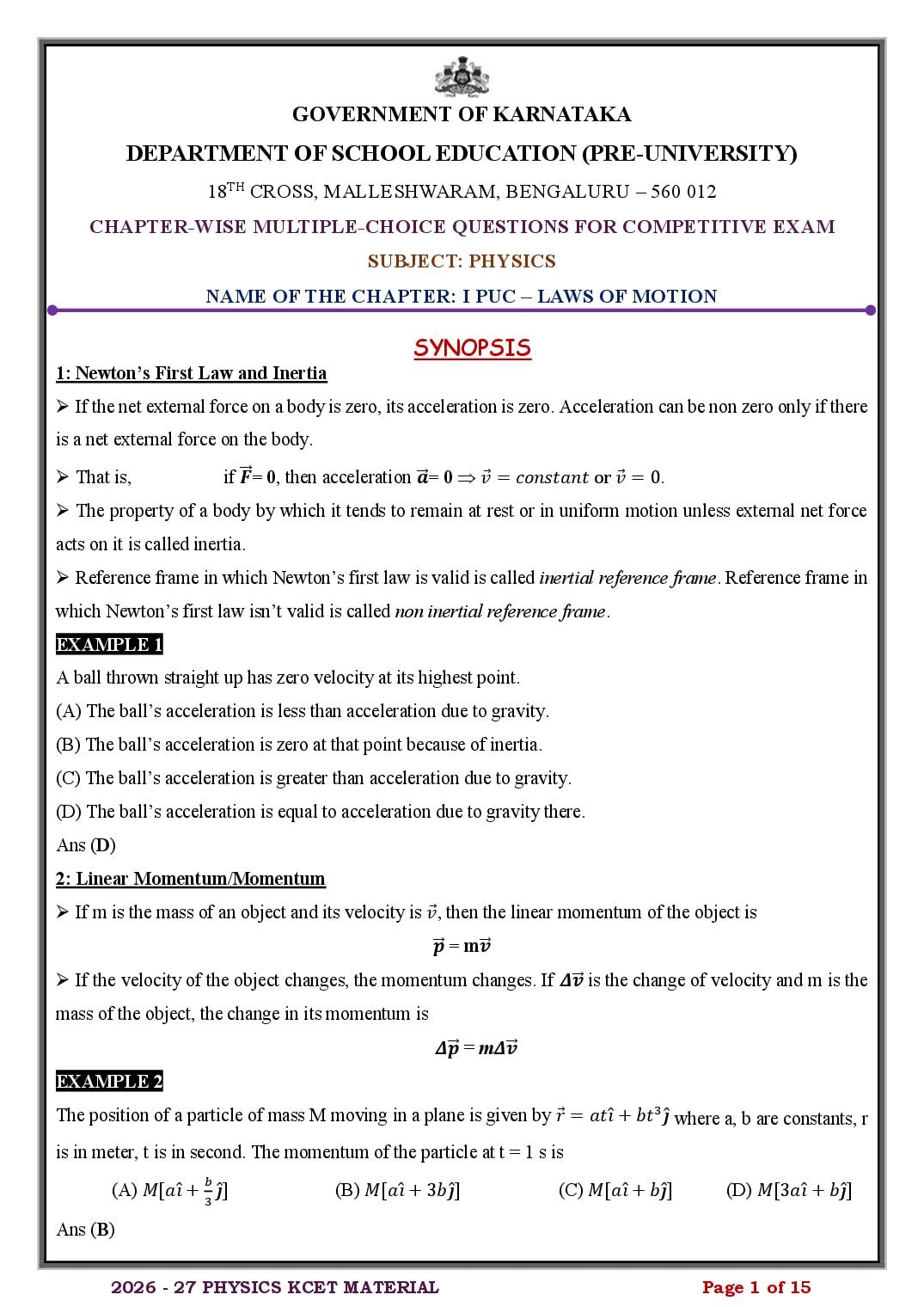
Page 1
DEPARTMENT OF SCHOOL EDUCATION (PRE-UNIVERSITY)
18TH CROSS, MALLESHWARAM, BENGALURU – 560 012
CHAPTER-WISE MULTIPLE-CHOICE QUESTIONS FOR COMPETITIVE EXAM
SUBJECT: PHYSICS
NAME OF THE CHAPTER: I PUC – LAWS OF MOTION
SYNOPSIS
1: Newton’s First Law and Inertia
➢ If the net external force on a body is zero, its acceleration is zero. Acceleration can be non zero only if there
is a net external force on the body.
➢ That is, if 𝑭 ⃗ = 0 𝑣 = 𝑐𝑜𝑛𝑠𝑡𝑎𝑛𝑡 or 𝑣 = 0.
⃗ = 0, then acceleration 𝒂
➢ The property of a body by which it tends to remain at rest or in uniform motion unless external net force
acts on it is called inertia.
➢ Reference frame in which Newton’s first law is valid is called inertial reference frame. Reference frame in
which Newton’s first law isn’t valid is called non inertial reference frame.
EXAMPLE 1
A ball thrown straight up has zero velocity at its highest point.
(A) The ball’s acceleration is less than acceleration due to gravity.
(B) The ball’s acceleration is zero at that point because of inertia.
(C) The ball’s acceleration is greater than acceleration due to gravity.
(D) The ball’s acceleration is equal to acceleration due to gravity there.
Ans (D)
2: Linear Momentum/Momentum
➢ If m is the mass of an object and its velocity is 𝑣, then the linear momentum of the object is
⃗ = m𝒗
𝒑 ⃗
➢ If the velocity of the object changes, the momentum changes. If 𝜟𝒗
⃗ is the change of velocity and m is the
mass of the object, the change in its momentum is
⃗ = m𝜟𝒗
𝜟𝒑 ⃗
EXAMPLE 2
The position of a particle of mass M moving in a plane is given by 𝑟 = 𝑎𝑡𝑖̂ + 𝑏𝑡 3 𝑗̂ where a, b are constants, r
is in meter, t is in second. The momentum of the particle at t = 1 s is
𝑏
(A) 𝑀[𝑎𝑖̂ + 3 𝑗̂] (B) 𝑀[𝑎𝑖̂ + 3𝑏𝑗̂] (C) 𝑀[𝑎𝑖̂ + 𝑏𝑗̂] (D) 𝑀[3𝑎𝑖̂ + 𝑏𝑗̂]
Ans (B)
2026 - 27 PHYSICS KCET MATERIAL Page 1 of 15
Page 2
𝑑𝑟 𝑑
The velocity of the particle is the first time derivative of 𝑟 : 𝑣 = 𝑑𝑡 = 𝑑𝑡 [𝑎𝑡𝑖̂ + 𝑏𝑡 3 𝑗̂]
Or : 𝑣 = 𝑎𝑖̂ + 3𝑏𝑡 2 𝑗̂
The momentum of the particle at any time instant is : 𝑝 = 𝑀𝑣 = 𝑀[𝑎𝑖̂ + 3𝑏𝑡 2 𝑗̂]
At t = 1 s, : 𝑝 = 𝑀[𝑎𝑖̂ + 3𝑏(1)2 𝑗̂]
That is, : 𝑝 = 𝑀[𝑎𝑖̂ + 3𝑏𝑗̂]
3: Newton’s Second Law
➢ The net force acting on an object is directly proportional to the rate of change of its momentum. The change
in momentum is always directed along the applied net force.
That is ⃗ = 𝒅𝒑⃗ = 𝒎𝒂
𝑭 ⃗
𝒅𝒕
𝒅𝒑 𝒅𝒑𝒚 𝒅𝒑
➢ Component wise, this law can be rewritten as 𝑭𝒙 = 𝒅𝒕𝒙 = 𝒎𝒂𝒙 , 𝑭𝒚 = 𝒅𝒕 = 𝒎𝒂𝒚 and 𝑭𝒛 = 𝒅𝒕𝒁 = 𝒎𝒂𝒁
EXAMPLE 3
An object of certain mass is projected into air. If air resistance force is taken into account, the rate of change
of momentum of the object is directed
(A) always vertically downwards. (B) always opposite to projectile motion.
(C) always 45 to the horizontal. (D) along continuously varying directions.
Ans (D)
EXAMPLE 4
An object of mass 1 kg is tied to a string and pulled along the horizontal frictionless surface. The string makes
an angle of 60 to the line of motion. If it starts from rest, gaining speed of 3 m/s after 2 m displacement, the
force acting along the string has a magnitude
(A) 2 N (B) 4.5 N (C) 6 N (D) 8 N
Ans (B)
Example Solved:
The acceleration of the object is found by applying equation of motion: 𝑣 2 = 𝑣02 + 2𝑎𝑠
That is : 32 = 02 + 2𝑎(2)
So, : 𝑎 = 2.25 m𝑠 −2
The force on the object is found through : 𝐹𝑥 = 𝑚𝑎𝑥
Or : 𝐹 cos 𝜃 = 𝑚𝑎
𝑚𝑎
Alternatively : 𝐹 = cos 𝜃
(1)(2.25)
Substituting 𝑚 = 1 𝑘𝑔 and 𝜃 = 60°, : 𝐹 = cos 60° = 4.5 𝑁
4: Impulsive Forces and Impulse of a Force
➢ Large forces acting for a short time intervals are called impulsive forces.
➢ If 𝐹𝑎𝑣 is the average impulsive force acting for a short time interval t, the impulse of the force is given by
𝑱 = ⃗𝑭𝒂𝒗 𝚫𝒕
➢ The area under the impulsive force vs time graph gives the impulse of that force.
Hence ⃗ 𝒂𝒗 𝒅𝒕
𝑱 = ∫𝑭
2026 - 27 PHYSICS KCET MATERIAL Page 2 of 15
Page 3
impulse - momentum theorem,
we may write ⃗ = 𝒎𝒗
: 𝑱 = 𝚫𝒑 ⃗ − 𝒎𝒗
⃗𝟎
In terms of components : 𝑱𝒙 = 𝚫𝒑𝒙 = 𝒎𝒗𝒙 − 𝒎𝒗𝟎𝒙 , 𝑱𝒚 = 𝚫𝒑𝒚 = 𝒎𝒗𝒚 − 𝒎𝒗𝟎𝒚
and 𝑱𝒛 = 𝜟𝒑𝒛 = 𝒎𝒗𝒛 − 𝒎𝒗𝟎𝒛
EXAMPLE 5
A ball of mass m moving with a same speed u along 30 to the vertical rebounds from a vertical wall without
changing its speed at the same angle with the vertical. The impulse of the force imparted to the wall has a
magnitude of
(A) √3mu (B) mu (C) 2 mu (D) mu/2
Ans (B)
Example Solved:
The impulse equals the change in momentum : 𝐽𝑥 = Δ𝑝𝑥 = 𝑚𝑣𝑥 − 𝑚𝑣0𝑥
That is : 𝐽𝑥 = 𝑚𝑢 sin 30° − 𝑚[−𝑢 sin 30°]
Or : 𝐽𝑥 = 𝑚𝑢
5: Newton’s Third Law
➢ 𝐹𝐵𝐴 When a body A exerts a force 𝐹𝐴𝐵 on another body B, then the body B exerts an equal but opposite
force 𝐹𝐵𝐴 on A.
➢ If 𝐹𝐴𝐵 is called action force, 𝐹𝐵𝐴 is called a reaction force.
➢ Hence we say, every action has equal but opposite reaction.
EXAMPLE 6
Identify the correct statement: according to Newton’s third law,
(A) the reaction force always acts after the action force is applied.
(B) the action and reaction forces always act along the same straight line in opposite directions.
(C) the action and reaction forces always act on the same body.
(D) the reaction force sometimes has a slightly larger magnitude than the action force.
Ans (B)
6: Law of Conservation of Momentum
➢ When external net force is absent, the total momentum of an isolated system is constant or conserved.
/ /
➢ Hence when ⃗𝑭𝒆𝒙𝒕 = 𝟎, we can write ⃗ 𝟏+𝒑
𝒑 ⃗𝟐=𝒑 ⃗ 𝟐.
⃗ 𝟏+𝒑
➢ When the motion before and after the event happens along a straight line, p1 + p2 = p1/ + p2/.
➢ If m1 and m2 are the masses of two objects v01 and v02 are the initial velocities and v1 and v2 are their
respective final velocities, according to law of conservation of momentum,
m1v01 + m2v02 = m1v1 + m2v2
2026 - 27 PHYSICS KCET MATERIAL Page 3 of 15
Page 4
A 3 kg object moving to the right on a frictionless, horizontal surface with a speed of 2 m/s collides head-on
and sticks to a 2-kg object that is initially moving to the left with a speed of 4 m/s. After the collision, the
speed of the compound object is
(A) 2.8 m/s to the right (B) 2.8 m/s to the left (C) 0.4 m/s to the right (D) 0.4 m/s to the left
Ans (A)
Example Solved:
By the law of conservation of momentum : 𝑚1 𝑣01 + 𝑚2 𝑣02 = 𝑚1 𝑣1 + 𝑚2 𝑣2
That is : 3 × 2 + 2 × (−4) = 3𝑣 + 2𝑣
2
Or : 𝑣 = − 5 = 0.4 𝑚/𝑠 left
7: Equilibrium of a Particle
When a particle is in equilibrium, (a) its acceleration must be zero 𝑎 = 0
Hence the ⃗ 𝒏𝒆𝒕 = 𝟎.
(b) net force on it must also be zero ⇒ 𝑭
In terms of components (c) 𝑭𝒏𝒆𝒕,𝒙 = 𝟎, 𝑭𝒏𝒆𝒕,𝒚 = 0 and 𝑭𝒏𝒆𝒕,𝒛 = 𝟎
EXAMPLE 8
In the figure, the whole system is in equilibrium. If the weight of B is 20 N and = 37,
the tension force pulling A (in N) is
15
(A) 15√3 (B)
√3
(C) 15 (D) 20
Ans (C)
Example Solved:
Resolving T2 into components and equating them with T1 and W T1 T2
𝑇2 cos 𝜃 = 𝑊 and 𝑇2 sin 𝜃 = 𝑇1 W
𝑇2 sin 𝜃 𝑇1
Dividing the two, = 𝑊 → 𝑇1 = 𝑊 tan 𝜃 = 20 × tan 37° = 15 𝑁
𝑇2 cos 𝜃
8: Common Contact Forces in Mechanics
➢ (1) Normal forces: Contact forces between two object which always perpendicular to the common surfaces
of contact are called Normal forces (N). N2
N1 N
N
➢ (2) Tension forces: Contact forces acting along threads, ropes, cords and cables when they are taut is called
Tension (T). T
T1 T2
O
T T3
2026 - 27 PHYSICS KCET MATERIAL Page 4 of 15
Page 5
position, a restoring force acting always opposite to the deformation is called spring Fs
force.
Fs x
➢ If Fs is the spring force, x is the displacement of the free end of the spring from x
its mean position, then the spring force is given by Fs = - kx
where k is called the force constant of the spring.
➢ (4) Weight (W): The force of gravity on an object that pulls it always in the vertically downward direction
is called weight.
➢ If m is the mass of the object and g is the acceleration due to gravity, then W = mg
EXAMPLE 9
In the figure, the object has a mass 1 kg. The spring has force constant of 20 N/m. The weighing machine
shows a reading of 0.8 kg. The extension in the spring is ( g = 10 m/s2)
(A) 0.1 m (B) 0.2 m (C) 0.05 m (D) 0.125 m
Ans (A)
Example Solved:
The spring force is : 𝐹𝑠 = 𝑊𝑟𝑒𝑎𝑙 − 𝑊𝑎𝑝𝑝𝑎𝑟𝑒𝑛𝑡
That is : 𝑘𝑥𝑒𝑥𝑝 = 𝑚𝑔 − 𝑊𝑎𝑝𝑝𝑎𝑟𝑒𝑛𝑡
Or : 20𝑥𝑒𝑥𝑝 = 1 × 10 − 0.8 × 10
Or : 20𝑥𝑒𝑥𝑝 = 2 → 𝑥𝑒𝑥𝑝 = 0.1 m
9: Friction
➢ The force which resists the relative motion between the two surfaces which are at rest relative to each other
and the two surfaces tend to rub over each other is called static friction fs.
➢ The force which resists the relative motion between the two surfaces which are moving relative to each
other is called kinetic friction fk.
➢ The maximum value of static friction is called limiting friction fsmax.
➢ It is always found that the limiting friction and kinetic friction are proportional to the normal reaction
between the two surfaces. fsmax = sN and fk = kN
where s and k are the co efficient of static and kinetic frictions between the two surfaces in contact.
➢ It is also known that fk fsmax k s.
➢ The force of friction is almost independent of the relative velocity of the two bodies.
➢ Rolling friction is always lesser than the static and kinetic frictions : froll < fk fsmax.
➢ When a body is placed on an inclined plane making an angle with the horizontal, and as is gradually
increased, at a particular value crit, the body just begins to slide on the plane. When this happens,
= tancrit
➢ If < tan-1 , the body does not slide.
➢ If > tan-1 , the body slides.
2026 - 27 PHYSICS KCET MATERIAL Page 5 of 15
Page 6
A block of wood is placed on an inclined plane making an angle of 30 with the horizontal. The coefficient of
friction between the plane and the block is 0.6. Then the acceleration of the block is
(A) zero (B) 1 m/s2 (C) 0.87 m/s2 (D) 1.72 m/s2
Ans (A)
Example Solved:
Test if < tan-1 or > tan-1 : 𝜃 = 30° and tan−1 𝜇 = tan−1(0.6) = 30.96°
Since : < tan-1 , no sliding occurs and hence a = 0.
EXAMPLE 11
In the figure, two objects A and B have coefficient of friction between them and the
B mB = 1
2
ground is frictionless. When the body A is given an acceleration of 2 m/s , the body B A kgmA = 4
kg
is just about to slip on A. The value of is
(A) zero (B) 0.2 (C) 0.5 (D) 1
Ans (B)
Example Solved:
𝑎 2
The force of friction on B is : 𝑓𝐵 = 𝑚𝑎 → 𝜇𝑚𝑔 = 𝑚𝑎 → 𝜇 = 𝑔 = 10 = 0.2
10: Maximum Speed of a Vehicle Negotiating an Unbanked and Banked Curved Road
➢ When a vehicle of mass negotiates a curved unbanked road having radius of curvature R, the maximum
speed with which it can move (see Fig (a)) is given by 𝑣√𝜇𝑅𝑔𝑚𝑎𝑥 .
vmax
Where is the coefficient of friction between the tires of the vehicle and the road.
R
(a)
➢ When a vehicle of mass m negotiates a curved banked road of radius of curvature
R, the maximum speed with which the vehicle moves safely is given by vmax
R
𝝁+𝒕𝒂𝒏 𝜽 (b)
𝒗𝒎𝒂𝒙 = √𝑹𝒈 (𝟏−𝝁 𝒕𝒂𝒏 𝜽) N
N
where is called the angle of banking.
fsmax (c)
➢ For a banked road, the maximum safe speed is found using = 0 in the above
mg
relation. Hence 𝒗𝒎𝒂𝒙 = √𝑹𝒈 𝒕𝒂𝒏 𝜽.
ILLUSTRATION 12
A truck of mass 10,000 kg is moving at a maximum safe speed of 108 km/h along an unbanked curved road
having radius of curvature 250 m. If g = 10 m/s2, the coefficient of friction between the tires of the truck and
the frictional force on it are respectively
(A) 0.36, 100 kN (B) 0.36, 36 kN (C) 4.7, 36 kN (D) 4.7, 100 kN
Ans (A)
2026 - 27 PHYSICS KCET MATERIAL Page 6 of 15
Page 7
The maximum speed with which the vehicle moves safely on an unbanked road is given by
𝑣𝑚𝑎𝑥 = √𝜇𝑅𝑔
𝑣2 302 900
From this, 𝜇 = 𝑚𝑎𝑥 = (250)(10) = 2500 = 0.36
𝑅𝑔
𝑣2 302
The frictional force is 𝑓 = 𝑚 𝑚𝑎𝑥 = 10,000 × 250 = 36 kN
𝑅
********************************************************************************
2026 - 27 PHYSICS KCET MATERIAL Page 7 of 15
Page 8
1. Which one of the following options is correct according to Aristotle's Fallacy?
(A) An external force is necessary to keep a body in uniform motion.
(B) The state of rest and the state of motion with constant velocity are equivalent in the absence of external forces .
(C) A force is not necessary to counter the opposing force of friction.
(D) To keep a body in uniform motion, no external force is needed.
2. A passenger getting down from a moving bus falls in the direction of the motion of the bus. This is an
example for
(A) inertia of rest (B) inertia of motion
(C) second law of motion (D) third law of motion
3. Which one of the following is not a force?
(A) Tension (B) Weight (C) Impulse (D) Thrust
1
4. The motion of mass m is given by 𝑦 = 𝑣0 𝑡 + 2 𝑔𝑡 2 . The force acting on the particle is
𝑚𝑣0 2𝑚𝑣0
(A) (B) (C) 𝑚𝑔 (D) 2𝑚𝑔
𝑡 𝑡
5. A box of mass m = 5 kg moves along a straight path. Its velocity-time graph is plotted below. The net
force acting on the box during the interval t = 0 s to t = 4 s is
(A) 30 N (B) 15 N (C) 10 N (D) 20 N
6. A force is applied to a 3 kg body for duration of 2 seconds. As a result, the momentum of the body changes
from 10 kg-m/s to 50 kg-m/s. What is the magnitude of the applied force?
(A) 40 N (B) 60 N (C) 20 N (D) 30 N
7. A 4 kg block is hanging in a lift accelerating upward with acceleration 3 m s-2. The
4 kg
-2
3 ms-2
tension in the string is (assuming string is light, inextensible and g = 10 m s )
(A) 26 N (B) 52 N (C) 40 N (D) 120 N
8. Two masses m1 = 5 kg and m2 = 10 kg are connected by a light, inextensible string passing over a
frictionless, massless pulley. The acceleration of the system in terms of acceleration due to gravity (g) is
𝑔 𝑔 𝑔 2𝑔
(A) 4 (B) 3 (C) 2 (D) 3
2026 - 27 PHYSICS KCET MATERIAL Page 8 of 15
Page 9
force.
Reason: In case of impulsive force the time of action of the force is very short.
(A) Both assertion and reason are true and reason is the correct explanation of assertion.
(B) Both assertion and reason are true but reason is not the correct explanation of assertion.
(C) Assertion is true but reason is false.
(D) Both assertion and reason are false.
10. A ball of mass m strikes a rigid wall with speed u and rebounds with the same speed. The impulse imparted
to the ball by the wall is (take direction of incidence as positive).
(A) 2mu (B) mu (C) 0 (D) – 2mu
11. A stationary object of mass m = 2 kg is acted upon by a time-varying net force as shown below. The final
velocity of the object at t = 0.2 s is
(A) 3 m s-1 (B) 4 m s-1 (C) 2 m s-1 (D) 5 m s-1
12. Which of the following statements correctly describes Newton's third law in the situation shown below?
(A) F is the action force and the force of A on B is the reaction force.
(B) FA on B and FB on A form an action–reaction pair.
(C) F and FB on A form an action–reaction pair.
(D) F is the reaction force to FA on B
13. Statement I: Newton's third law applies to objects at rest as well as in motion.
Statement II: Action and reaction forces never cancel each other because they act on different bodies.
Choose the correct option:
(A) Both Statement I and II are correct (B) Both Statement I and II are incorrect
(C) Statement I is correct, II is incorrect (D) Statement I is incorrect, II is correct
2026 - 27 PHYSICS KCET MATERIAL Page 9 of 15
Page 10
to the force the crate exerts on me. Therefore, these two forces cancel each other out, making it impossible
to move the crate.” Which of the following statements correctly identifies the flaw in the student's
reasoning?
(A) Newton's Third Law only applies to moving objects, not to objects at rest.
(B) The two forces do not cancel out because they act on two different objects.
(C) The force exerted by the student is actually greater than the force exerted by the crate.
(D) The forces cancel out horizontally, but the vertical normal force overcomes this cancellation.
15. A ball of mass 10 g moving perpendicular to the plane of the wall strikes it and rebounds in the same line
with its initial speed. If the impulse imparted to the wall is 0.4 Ns, the velocity of the ball is
(A) 20 m/s (B) 40 m/s
(C) 2 m/s (D) 4 m/s
16. The graph below illustrates the variation of force with time acting on an F(N)
object. The net change in momentum of the object during the given time 40
interval is
(A) 0.25 Ns (B) 50 Ns
10 t(s)
(C) 4 Ns (D) 400 Ns
17. A body of mass 2 kg moving at 10 m/s collides with another body of mass 3 kg at rest. After the collision
If they stick together and move, their final velocity will be:
(A) 2 m/s (B) 4 m/s (C) 5 m/s (D) 6 m/s
18. A machine gun fires 20 bullets per second into a target. Each bullet has a mass of 150 g and a speed of
800 m/s. The force exerted on the target is:
(A) 1200 N (B) 2400 N (C) 2000 N (D) 24000 N
19. An explosion breaks a rock into three parts in a horizontal plane. Two of them go off at right angles to
each other. The first part of mass 1 kg moves with a speed of 12 ms-1 and the second part of mass 2 kg
moves with speed 8 ms-1. If the third part flies off with 4 ms-1, then its mass is
(A) 5 kg (B) 7 kg (C) 17 kg (D) 3 kg
20. A person of mass 60 kg is inside a lift of mass 940 kg and presses the button on control panel. The lift
starts to move up with uniform acceleration of 1.0 ms-2. The tension in the supporting cable is (Take g =
10 m s-2)
(A) 11000 N (B) 600 N (C) 10000 N (D) 9680 N
21. A 60 kg wt is hung from two ropes as shown in the figure. The tension in
the horizontal rope is (in kg wt)
(A) 104 kgwt (B) 120 kgwt
(C) 164 kgwt (D) 0
2026 - 27 PHYSICS KCET MATERIAL Page 10 of 15
Page 11
supporting wires as shown in figure. Tension in each wire is approximately
(g = 10 ms –2)
(A) 30 N (B) 20 N
(C) 10 N (D) 5 N
23. A rope which can withstand a maximum tension of 380 N is hanging from a
tree. If a monkey of mass 30 kg climbs on the rope, then in which of the
following cases will the rope break (Take g = 10 m/s2). Neglect the mass of the rope.
(A) The monkey climbs up with a uniform speed of 5 m/s
(B) The monkey climbs up with a uniform acceleration of 2 m/s2
(C) The monkey climbs up with a uniform acceleration of 5 m/s2
(D) The monkey climbs down with a uniform acceleration of 5 m/s2
24. Three blocks of masses m1, m2 and m3 are connected by
T1 T2 T3
massless string as shown on a frictionless table. They are m m m
pulled with a force T3 = 40 N. If m1 = 10 kg, m2 = 6 kg
and m3 = 4 kg, the tension T2 will be:
(A) 20 N (B) 40 N (C) 10 N (D) 32 N
25. Three equal weights A, B and C of mass 2 kg each are hanging on a string passing over
a fixed pulley which is frictionless are shown in figure. The tension in the string
connecting weight B and C is:
(A) zero (B) 13 N
(C) 3.3 N (D) 19.6 N
26. Three Forces F1, F2 and F3 together keep a body in equilibrium. If F1 = 3 N along the positive x- axis, F2
= 4 N along the positive y-axis, then the third force F3 is
(A) 5 N -making an angle θ = tan⁻¹(3/4) with negative y -axis
(B) 5 N - making an angle θ = tan⁻¹(4/3) with negative y -axis
(C) 7 N - making an angle θ = tan⁻¹(3/4) with negative y -axis
(D) 7 N - making an angle θ = tan⁻¹(4/3) with negative y-axis
27. Two blocks of mass 4 kg and 6 kg are placed in contact with each other on a
6 kg
frictionless horizontal surface. If we apply a push of 5 N on the heavier mass, 5 N 4 kg
the acceleration of the lighter mass will be
5 5
(A) 0.5𝑚𝑠 −2 (B) 4 𝑚𝑠 −2 (C) 6 𝑚𝑠 −2 (D) 5.0𝑚𝑠 −2
28. A mass M is suspended by a rope from a rigid support at P as shown in the figure. P
Another rope is tied at the end Q, and it is pulled horizontally with a force F. If the
rope PQ makes angle with the vertical then the tension in the string PQ is Q F
(A) 𝐹 𝑠𝑖𝑛 𝜃 (B) 𝐹/ 𝑠𝑖𝑛 𝜃
M
(C) 𝐹 𝑐𝑜𝑠 𝜃 (D) 𝐹/ 𝑐𝑜𝑠 𝜃
2026 - 27 PHYSICS KCET MATERIAL Page 11 of 15
Page 12
smooth pulley. When 𝑚1 = 10𝑘𝑔, 𝑚2 = 6𝑘𝑔, the acceleration of masses is (take
𝑔 = 10𝑚/𝑠 2 )
m2 6 kg
(A) 20𝑚/𝑠 2 (B) 5𝑚/𝑠 2
10 kg m1
(C) 2.5𝑚/𝑠 2 (D) 10𝑚/𝑠 2
30. Two masses M1 and M2 are attached to the ends of a string which passes over a pulley attached
to the top of an inclined plane. The angle of inclination of the plane is . Take g = 10
M1
ms–2. If M1 = 10 kg, M2 = 5 kg, = 30o, what is the acceleration of mass M2 ? M2
−2 −2
(A) 10𝑚𝑠 (B) 5𝑚𝑠
2
(C) 3 𝑚𝑠 −2 (D) Zero
31. Which one of the following statement is incorrect?
(A) Frictional force opposes the relative motion.
(B) Limiting value of static friction is directly proportional to normal reaction.
(C) Rolling friction is smaller than sliding friction.
(D) Coefficient of sliding friction has dimensions of length
32. Match the Column I (type of friction) with Column II (value of 𝜇)and select the correct answer from the
codes given below.
Column - I Column - II
(a) Static Friction 1. μ is highest
(b) rolling friction 2. μ moderate
(c) kinetic friction 3. μ is lowest
(A) a-3, b-2, c-1 (B) a-1, b-2, c-3 (C) a-1, b-3, c-2 (D) a-2, b-3, c-1
33. A man of weight 80 kg is standing in an elevator which is moving with an acceleration of 6 m / s 2 in upward
direction. The apparent weight of the man will be (g = 10 m / s 2 )
(A) 1480 N (B)1280 N (C)1380 N (D) None of these
34. A rope of length 𝑙 and mass M is hanging from a rigid support. The tension in the rope at a distance 𝑥 from
the rigid support is
𝑀𝑔 (𝑙−𝑥) 𝑀𝑔 𝑙 𝑥
(A) 𝑀𝑔 (B) (C) (𝑙−𝑥) (D) 𝑙 𝑚𝑔
𝑙
35. A body is projected along a rough horizontal surface with a velocity 6 𝑚/𝑠. If the body comes to rest after
travelling 9 m, then coefficient of sliding friction, is: ( 𝑔 = 10 𝑚𝑠 −2 )
(A) 0.5 (B) 0.4 (C) 0.6 (D) 0.2
36. A mass M is hung with a light inextensible string as shown in the figure. Find the tension of the horizontal
string
(A) √2𝑀𝑔
(B) √3𝑀𝑔
(C) 2𝑀𝑔
(D) 3𝑀𝑔
2026 - 27 PHYSICS KCET MATERIAL Page 12 of 15
Page 13
shown in the figure. The wedge is given acceleration towards the right. The relation
between 𝑎 and 𝜃 for the block to remain stationary on the wedge is
𝑔 𝑔
(A) 𝑎 = 𝑔 cos 𝜃 (B) 𝑎 = sin 𝜃 (C) 𝑎 = cosec 𝜃 (D) 𝑎 = 𝑔 tan 𝜃
38. Two bodies A and B of masses 5 kg and 10 kg in contact with each other rest
on a table against a rigid partition. The coefficient of friction between the
bodies and the table is 0.15. A force of 200 N is applied horizontally at A.
The force exerted on the rigid partition is: (𝑔 = 10 𝑚𝑠 −2 )
(A) 170 𝑁 (B) 204 𝑁 (C) 177.5 N (D) 174 N
39. Ten one-rupee coins are put on top of each other on a table. Each coin has mass 𝑚. The magnitude (in𝑚𝑔𝑁)
of the force on the 7 𝑡ℎ coin (counted from the bottom due to all the coins on its top)
(A) 3 (B) 4 (C) 7 (D)10
40. In the figure, 8 kg and 6 kg are hanging stationary from a rough pulley and are about to
move. They are stationary due to roughness of the pulley. Which of the following
statement(s) is/are correct?
I. The force of friction on the rope is 20 N.
II. The force of friction on the rope is 30 N.
(A) Only I (B) Only II
(C) Neither I nor II (D) None of these
41. Given figure is the part of a horizontally stretched structure. Section AB is
stretched with a force of 10 N. The tension in the sections BC and BF, are
(A) 10 N, 11 N
(B) 10 N, 6 N
(C) 10 N, 10 N
(D) Cannot be calculated due to insufficient data
KEY ANSWERS
1 2 3 4 5 6 7 8 9 10 11
A B C C B C B B A D C
12 13 14 15 16 17 18 19 20 21 22
B A B A D B B A A A B
23 24 25 26 27 28 29 30 31 32 33
C D B A A B C D D C B
34 35 36 37 38 39 40 41
B D B D C A A C
2026 - 27 PHYSICS KCET MATERIAL Page 13 of 15
Page 14
1. One end of a string of length l is connected to a particle of mass m and the other to a small peg on a smooth
horizontal table. If the particle moves in a circle with speed ‘v’, the net force on the particle (directed
towards the centre) is : (T is the tension in the string) [KCET-2020]
𝑚𝑣 2 𝑚𝑣 2
(A) 𝑇 − (B) 𝑇 + (C) 0 (D) 𝑇
𝑙 𝑙
2. A coin placed on a rotating turn table slips if it is placed at a distance of 4 cm from the centre. if the angular
velocity of the turn table is doubled it will just slip at a distance of [KCET-2021]
(A) 1 cm (B) 2 cm (C) 4 cm (D) 8 cm
3. Two masses of 5 kg and 3 kg are suspended with the help of massless inextensible strings
as shown in figure, when whole system is going upwards with acceleration 2 𝑚/𝑠 2 , the
value of 𝑇1 is : (use 𝑔 = 9.8 𝑚/𝑠 2 ) [KCET-2022]
(A) 23.6 𝑁 (B) 59 𝑁 (C) 94.4 𝑁 (D) 35.4 𝑁
4. A body of mass 10 kg is kept on a horizontal surface. The coefficient of kinetic friction between the body
and the surface is 0.5. A horizontal force of 60 N is applied on the body. The resulting acceleration of the
body is about [KCET-2023]
(A) 5 𝑚 𝑠 −2 (B) 6 𝑚 𝑠 −2 (C) 𝑧𝑒𝑟𝑜 (D) 1 𝑚 𝑠 −2
5. A block of certain mass is placed on a rough inclined plane. The angle between the
plane and the horizontal is 30°. The coefficients of static and kinetic frictions
between the block and the inclined plane are 0.6 and 0.5 respectively. Then the
magnitude of the acceleration of the block is [Take 𝑔 = 10 𝑚 𝑠 −2] [2024]
(A) 2 𝑚 𝑠 −2 (B) 𝑧𝑒𝑟𝑜 (C) 0.196 𝑚 𝑠 −2 (D) 0.67 𝑚 𝑠 −2
6. A wooden block of mass M lies on a rough floor. Another wooden block of the
same mass is hanging from the point O through strings as shown in the figure. To
achieve equilibrium, the co-efficient of static friction between the block and the
floor with the floor itself is [KCET-2025]
(A) 𝜇 = cos 𝜃 (B) 𝜇 = cot 𝜃 (C) 𝜇 = sin 𝜃 (D) 𝜇 = tan 𝜃
7. A block of certain mass is placed on a rough floor. The coefficients of static and
kinetic friction between the block and the floor are 0.4 and 0.25 respectively. A
constant horizontal force 20 N acts on it so that the velocity of the block varies
with time according to the following graph. The mass of the block is nearly
(Take 𝑔 = 10 𝑚 𝑠 −2)
(A) 2.2 𝑘𝑔 (B) 4.4 𝑘𝑔 (C) 1.2 𝑘𝑔 (D) 1.0 𝑘𝑔
8. A weighs 80 kg. He stands on a weighing scale in a lift which is moving upwards with a uniform
acceleration of 6 𝑚/𝑠 2 . What would be his weight in kg? (𝑔 = 10 𝑚/𝑠 2 ) [KCET-2026]
(A) zero (B) 48 kg (C) 120 kg (D) 128 kg
2026 - 27 PHYSICS KCET MATERIAL Page 14 of 15
Page 15
of the horizontal string. [KCET-2026]
(A) √2𝑀𝑔 (B) √3𝑀𝑔
(C) 𝑀𝑔 (D) 3𝑀𝑔
KEY ANSWERS
1 2 3 4 5 6 7 8 9
D A C D B B A D C
2026 - 27 PHYSICS KCET MATERIAL Page 15 of 15
Document Details
| Board / Org | Karnataka Board |
| Exam | Class 11 |
| Type | Question Bank |
| Pages | 15 |
| Updated | 24 Sep 2026 |