Karnataka 1st PUC Physics Motion in a Plane MCQ with Answers
Finished viewing? Save it for later —
Download Karnataka 1st PUC Physics Motion in a Plane MCQ with Answers (PDF · 16 pages)About Karnataka 1st PUC Physics Motion in a Plane MCQ with Answers
Karnataka 1st PUC Physics Motion in a Plane MCQ with Answers is available here for free download. Published by Karnataka Board for Class 11, this question bank can be viewed online or downloaded as a PDF (16 pages). Candidates preparing for Class 11 can use Karnataka 1st PUC Physics Motion in a Plane MCQ with Answers to understand the exam pattern, the type of questions asked, and the overall difficulty level.
Frequently Asked Questions
How can I download Karnataka 1st PUC Physics Motion in a Plane MCQ with Answers?
Open this page and click the Download button to save Karnataka 1st PUC Physics Motion in a Plane MCQ with Answers as a PDF. It is completely free on AglaSem Docs.
Is Karnataka 1st PUC Physics Motion in a Plane MCQ with Answers free to download?
Yes. Karnataka 1st PUC Physics Motion in a Plane MCQ with Answers can be viewed online and downloaded as a PDF free of cost on AglaSem Docs.
How many pages does Karnataka 1st PUC Physics Motion in a Plane MCQ with Answers have?
Karnataka 1st PUC Physics Motion in a Plane MCQ with Answers contains 16 pages, which you can read online or download together as a single PDF.
Where can I find more Class 11 study material?
You can find more Class 11 question papers, sample papers, syllabus, and answer keys on AglaSem Docs.
Karnataka 1st PUC Physics Motion in a Plane MCQ with Answers – Text
Read the full text of this question bank below — useful to quickly search, copy and reference the content online without downloading the PDF.
📄 View text version (16 pages)
Page 1
DEPARTMENT OF SCHOOL EDUCATION (PRE-UNIVERSITY)
18TH CROSS, MALLESHWARAM, BENGALURU – 560 012
CHAPTER-WISE MULTIPLE-CHOICE QUESTIONS FOR COMPETITIVE EXAM
SUBJECT: PHYSICS
NAME OF THE CHAPTER: I PUC - MOTION IN A PLANE
SYNOPSIS
1: Scalars and Vectors
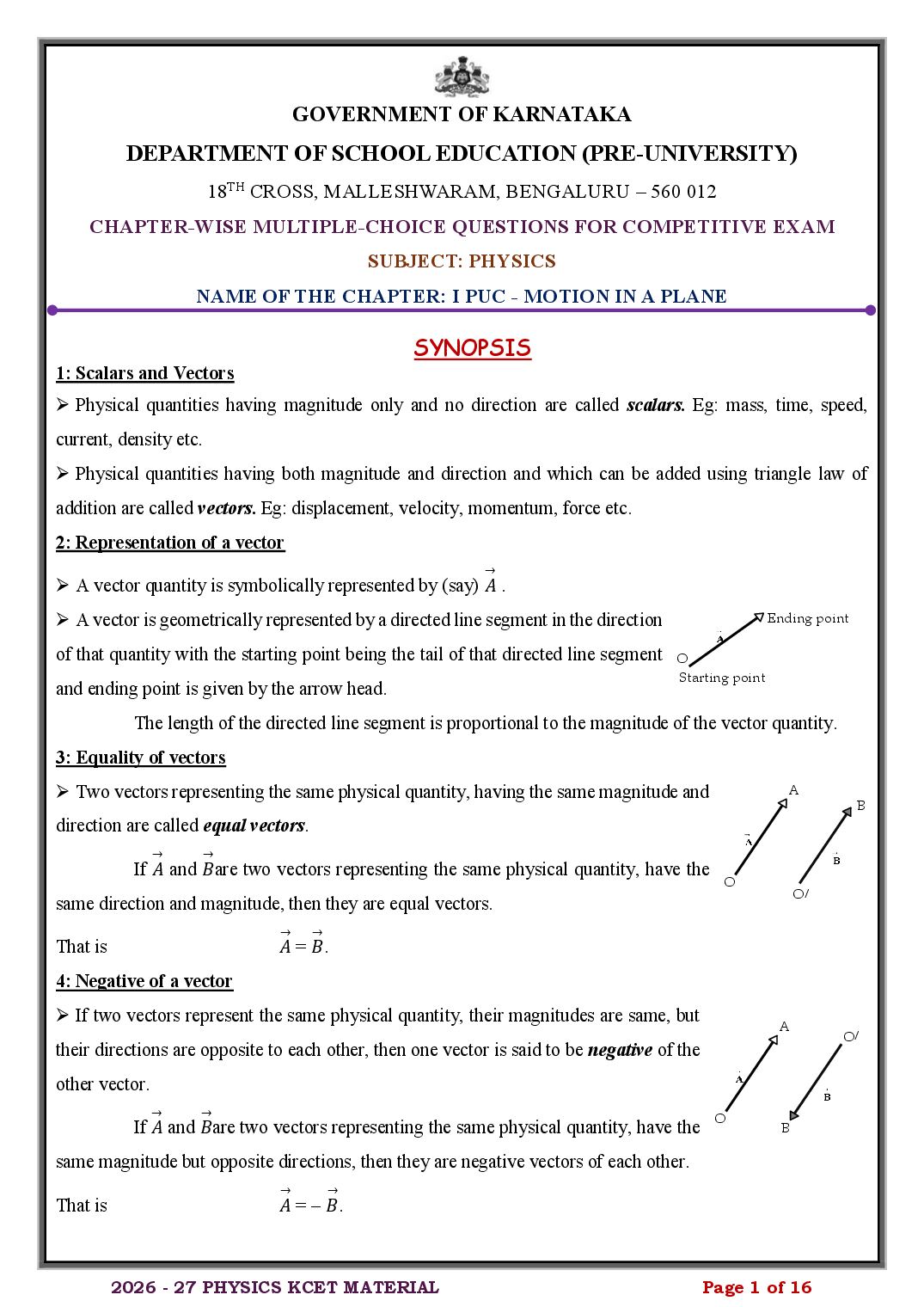
➢ Physical quantities having magnitude only and no direction are called scalars. Eg: mass, time, speed,
current, density etc.
➢ Physical quantities having both magnitude and direction and which can be added using triangle law of
addition are called vectors. Eg: displacement, velocity, momentum, force etc.
2: Representation of a vector
→
➢ A vector quantity is symbolically represented by (say) 𝐴 .
➢ A vector is geometrically represented by a directed line segment in the direction Ending point
of that quantity with the starting point being the tail of that directed line segment O
Starting point
and ending point is given by the arrow head.
The length of the directed line segment is proportional to the magnitude of the vector quantity.
3: Equality of vectors
➢ Two vectors representing the same physical quantity, having the same magnitude and A
B
direction are called equal vectors.
→ →
If 𝐴 and 𝐵are two vectors representing the same physical quantity, have the
O
O/
same direction and magnitude, then they are equal vectors.
→ →
That is 𝐴 = 𝐵.
4: Negative of a vector
➢ If two vectors represent the same physical quantity, their magnitudes are same, but A
O/
their directions are opposite to each other, then one vector is said to be negative of the
other vector.
→ → O
If 𝐴 and 𝐵are two vectors representing the same physical quantity, have the B
same magnitude but opposite directions, then they are negative vectors of each other.
→ →
That is 𝐴 = − 𝐵.
2026 - 27 PHYSICS KCET MATERIAL Page 1 of 16
Page 2
A car is moving with constant speed in a circle as shown. At A and B, the velocity north
vectors are A
(A) equal (B) negative vectors of each other
east
(C) unequal vectors (D) not comparable.
Ans (B)
B
5: Multiplication of a vector by a scalar
→ →
➢ If a vector 𝐴 is multiplied by a scalar λ, it produces a new vector 𝐵 such that
→ →
𝐵 = λ𝐴
→ → → →
Where the magnitude of 𝐵is λ times the magnitude of 𝐴, while the directions of 𝐴 and 𝐵are same if λ is
→ →
positive and 𝐴 and 𝐵are opposite to each other if λ is negative.
That is 𝐵 =|λ|𝐴.
EXAMPLE 2
Identify the correct statement.
(A) Electric current is a vector because it has direction.
(B) Acceleration vector of 5 m/s2 in the horizontal direction is equal to the force vector of 5 N in the
same direction.
(C) When a vector is multiplied by a scalar, the new vector produced does not represent the same
physical quantity as initial vector.
(D) A physical quantity is a vector if it has only magnitude and direction.
Ans (C)
6: Addition and Subtraction of vectors
➢ Vectors can be added/ subtracted using two laws (i) triangle law and (ii) parallelogram law.
→ →
Consider two vectors 𝐴 and 𝐵as shown in the figure (a). They are added using the triangle law as shown in
Figure (b).
→ → →
Hence we can write 𝑹= 𝑨 + 𝑩
⃗ from 𝐴 we add the negative vector of 𝐵
➢ To subtract a vector 𝐵 ⃗ to get the resultant vector 𝐷
⃗.
→ → → → →
Hence we can write 𝑫 = 𝑨 − 𝑩 = 𝑨 + (−𝑩) .
➢ Vector addition obeys (a) commutative and associative laws. Vector subtraction neither obeys commutative
nor associative laws.
2026 - 27 PHYSICS KCET MATERIAL Page 2 of 16
Page 3
➢ The two vectors 𝐴 and 𝐵shown in the Fig(a) can be added using parallelogram law as shown in Fig (b)
→ → → →
➢ If the angle between vectors 𝐴 and 𝐵 is , the angle between the resultant 𝐶 and the vector 𝐴 is , then
𝑪 = √𝑨𝟐 + 𝑩𝟐 + 𝟐𝑨𝑩 𝒄𝒐𝒔 𝜽
𝑩 𝒔𝒊𝒏 𝜽
and tan = 𝑨+𝑩 𝒄𝒐𝒔 𝜽.
EXAMPLE 3
→ →
A vector 𝑃1 is of magnitude 10 units in the eastward direction. Another vector 𝑃2 is of magnitude 20 units 60
→ →
to the east. Then the magnitude of the vector 𝑃1 − 𝑃2 is
(A) 10 units (B) 20 units (C) 10√3 𝑢𝑛𝑖𝑡𝑠 (D) 10√7 𝑢𝑛𝑖𝑡𝑠
Ans (C)
Example Solved:
→ →
The angle between the vectors 𝑃1 and −𝑃2 is 180° − 60° = 1200 .
Hence 𝐷 = √𝑃12 + 𝑃22 + 2𝑃1 𝑃2 𝑐𝑜𝑠 𝜃
Substitute 𝑃1 = 10 𝑢𝑛𝑖𝑡, 𝑃2 = 20 𝑢𝑛𝑖𝑡 and 𝜃 = 1200
So, 𝐷 = √102 + 202 + 2(10)(20) cos 1200 = 10√3 𝑢𝑛𝑖𝑡
7: Resolution of a vector
➢ If a vector 𝐴 is randomly oriented, it can be decomposed into two or three mutually perpendicular
components as shown.
→
➢ The vector 𝐴 can be rewritten as
→
𝑨 = 𝑨𝒙 𝒊̂ + 𝑨𝒚 𝒋̂
Where Ax and Ay are called the x and y components of 𝐴respectively.
Also, we may write Ax = A cos
and Ay = A sin
While A = √𝑨𝟐𝒙 + 𝑨𝟐𝒚
𝑨𝒚
and tan = 𝑨𝒙 .
EXAMPLE 4
A vector having magnitude 20 units makes an angle of 30 to the y axis. Then the vector can be expressed as
(A) 10𝑖̂ − 10√3𝑗̂ (B) 10√3𝑖̂ + 10𝑗̂ (C) 10𝑖̂ + 10√3𝑗̂ (D) 10𝑖̂ + 10𝑗̂
Ans (A)
2026 - 27 PHYSICS KCET MATERIAL Page 3 of 16
Page 4
The angle made by the vector with the +x axis is : 𝜃 = 90° − 30° = 600 .
So, the x and y components of the given vector is : 𝐴𝑥 = 𝐴 cos 𝜃 = 20 cos 600 = 10 unit
0
and : 𝐴𝑦 = 𝐴 sin 𝜃 = 20 sin 60 = 10 √3unit
→ →
Since any vector is expressed as 𝐴 = 𝐴𝑥 𝑖̂ + 𝐴𝑦 𝑗̂ : 𝐴 = 10𝑖̂ + 10 √3𝑗̂
8: Displacement, average velocity and instantaneous velocity
➢ When a particle moving in a plane moves from a point A (at time instant t1) to B (at time instant t2) on a
curved path, its displacement is given by
⃗ =𝒓
𝚫𝒓 ⃗𝟐−𝒓
⃗𝟏
➢ Its average velocity is given by
⃗
𝜟𝒓 ⃗ −𝒓
𝒓 ⃗
⃗ 𝒂𝒗 = = 𝟐 𝟏
𝒗 𝜟𝒕 𝒕 −𝒕 𝟐 𝟏
The direction of avg velocity is along the direction of displacement itself.
⃗
𝒅𝒓
➢ The instantaneous velocity is the rate of change of position: 𝒗
⃗ = .
𝒅𝒕
The direction of the instantaneous velocity is along the tangent drawn to the path of the particle (see the figure
at point P)
➢ The magnitude of the velocity is called its speed.
EXAMPLE 5
A car moves from a point in the west to a point in the east in a semicircular path of radius 100 m. The
displacement of the car and distance travelled (in m) by it are respectively
(A) 100, 100 π (B) 100 π, 200 (C) 200, 100 π (D) 100, 100
Ans (B)
Example Solved:
The displacement is the least distance between the initial and final points : |∆𝑟| = 2𝑅 = 200 𝑚
The distance is the path length of the journey : 𝐷 = 𝜋𝑅 = 100 𝜋 𝑚
EXAMPLE 6
y
A body moves in semicircular path from A to C with constant speed. The distance
between A and B is 10√2𝑚. If it takes a time of 2.5 π seconds for the body to reach C A C
from A, the average velocity between A and C and instantaneous velocity at C (in m/s) B x
O
are respectively
8 8 8
(A) 𝜋 along +x axis, 4 along +y axis (B) 𝜋 along +x axis, 𝜋 along +y axis
8
(C) 4 along +x axis , 4 along +x axis (D) 𝜋 along +x axis, 8 along +y axis
Ans (D)
2026 - 27 PHYSICS KCET MATERIAL Page 4 of 16
Page 5
The radius of the path is : 𝑅 = 10 𝑚
The displacement and distance travelled are : |∆𝑟| = 2𝑅 = 20 𝑚 and 𝐷 = 𝜋𝑅 = 10 𝜋 𝑚
|∆𝑟 | 20 8
The average velocity is : |𝑣𝑎𝑣 | = ∆𝑡 = 2.5𝜋 = 𝜋 m/s
The direction of this velocity : Along the displacement i.e., along the +x direction
𝐷 20𝜋
The average speed is : |𝑠𝑎𝑣 | = ∆𝑡 = 2.5𝜋 = 8 m/s
Since the speed is constant, : |𝑣| = |𝑠𝑎𝑣 | = 8 m/s
Since the direction of the motion is : along the tangent to the path at C
That is : Direction is along + y axis.
9: Average acceleration and instantaneous acceleration
➢ If a body moving in a plane changes its velocity from 𝑣1 to 𝑣2 in time t, then the change of velocity is
𝛥𝑣 = 𝑣1 − 𝑣2
Δv
a av = =
Thus the average acceleration is Δt 𝑣⃗2 −𝑣⃗1.
𝑡2 −𝑡1
⃗
𝑑𝑣
➢ The instantaneous acceleration is 𝑎 = 𝑑𝑡 .
10: Projectile motion
y v0
v0y = v0 sin0
➢ The initial velocity components of the projectile are
v0x = v0 cos 0 and v0y = v0 sin 0 P(x,y) 0
v v0x = v0 cos0
vx
➢ The horizontal velocity component is always constant: vy
v0 vx H
That is vx = v0x = v0 cos 0
0
The vertical component changes with time and position as x
0
R
v
vy = v0 sin 0 – gt
and vy2 = v02 sin2 0 – 2gy
➢ The trajectory of the projectile is a parabola given by the equation
𝐠
y = (tan 0) x - 𝟐𝐯𝟐 𝐜𝐨𝐬𝟐 𝛉 x2
𝟎 𝟎
𝟐𝒗𝟎 𝒔𝒊𝒏 𝜽𝟎 y
➢ The time of flight of the projectile is 𝑻= . 45
𝒈
line
𝒗𝟐𝟎 𝒔𝒊𝒏𝟐 𝜽𝟎
➢ The maximum height of the projectile is given by 𝑯 = . 45 −
𝟐𝒈 x
𝒗𝟐𝟎 𝒔𝒊𝒏 𝟐𝜽𝟎
➢ The range of the projectile is given by 𝑹= .
𝒈
➢ The range is maximum for angle of projection = 45.
➢ For two angles 45 − and 45 + , the range is same provided the initial speed is constant.
2026 - 27 PHYSICS KCET MATERIAL Page 5 of 16
Page 6
A ball is thrown into air at a speed of 20 m/s so as to have maximum range. The time of flight (in s) of the
projectile is
(A) 2√2 (B) 20√2 (C) 2 (D) √2
Ans (A)
Example Solved:
2𝑣0 𝑠𝑖𝑛 450 √2𝑣0
The time of flight for maximum range is :𝑇= =
𝑔 𝑔
√2×20
Substituting 𝑣0 = 20 m/s and 𝑔 = 10 m/s2 :𝑇 = = 2√2 𝑠
10
EXAMPLE 8
A projectile fired into air at 30 to the horizontal has a range of 20√3 m. The speed (in m/s) of the projectile
at its maximum height is
(A) 10 (B) 10√3 (C) 20√3 (D) 401
Ans (B)
Example Solved:
sin 2𝜃0 𝑅𝑔 𝑅𝑔
The initial speed of the projectile is found using : 𝑅 = 𝑣02 → 𝑣02 = sin 2𝜃 → 𝑣0 = √sin 2𝜃
𝑔 0 0
20√3×10
With 𝜃0 = 30, 𝑔 = 10 m/s 2 and R = 20√3 m, : 𝑣0 = √sin 2(30) = 20 m/s
Hence the speed of the projectile
at the highest point is : 𝑣𝑥 = 𝑣0 cos 𝜃0 = 20 × cos 30 = 10√3 m/s
EXAMPLE 9
1
The equation for a projectile trajectory is 𝑦 = 𝑥 − 90 𝑥 2 . Then the initial speed (in m/s) and the angle of
projection of the projectile are respectively
(A) 30, 30 (B) 60, 45 (C) 900, 30 (D) 30, 45
Ans (D)
Example Solved:
Comparing the given equation with the
1 𝑔
standard equation : 𝑦 = 𝑥 − 90 𝑥 2 ↔ 𝑦 =(tan 𝜃0 ) 𝑥 − 2𝑔 𝑐𝑜𝑠2 𝜃 𝑥 2
0
𝑔 1
Hence : tan 𝜃0 = 1 → 𝜃0 = 45° and 2𝑣2 𝑐𝑜𝑠2 𝜃 = 90
0 0
10 1
Or : 2𝑣2 𝑐𝑜𝑠245° = 90 → 𝑣0 = 30 m/s
0
11: Uniform Circular Motion
➢ When a particle moves in a circular path of radius r with uniform speed, its angular speed is given by
𝑣
𝜔 = 𝑟.
➢ The centripetal acceleration of the same particle is given in terms of speed v and radius r as
𝑣2
𝑎= 𝑟.
➢ The centripetal acceleration in terms of angular speed and radius r is given by
𝑎 = 𝜔2 𝑟.
2026 - 27 PHYSICS KCET MATERIAL Page 6 of 16
Page 7
A vehicle is moving in a circular road with a constant speed v. Its acceleration at B is 8 m/s 2. If v B
AB = 100 m, the speed v (in m/s) and angular speed (in rad/s) of the car are respectively
v
(A) 10, 0.4 (B) 20√2, 0.4√2 (C) 20, 0.4 (D) 0.4, 20 A
Ans (D)
Example Solved:
𝐴𝐵 100
The radius of the circular path of the vehicle is : 𝑅 = 2 = 2 = 50 𝑚
𝑣2
The speed v of the vehicle is found using : 𝑎 = 𝑅 → 𝑣 = √𝑎𝑟 = √8 × 50 = 20 m/s
𝑣 20
and the angular speed is : 𝜔 = 𝑅 = 50 = 0.4 rad/s
***************************************************
2026 - 27 PHYSICS KCET MATERIAL Page 7 of 16
Page 8
1. Which of the following is a vector?
(A) Pressure (B) Surface tension
(C) Moment of inertia (D) Gravitational potential
2. Statement I: The difference of two vectors can be treated as sum of two vectors.
Statement II: Subtraction of vectors can be defined in terms of addition of vectors.
(A) Both the statements are true and statement II is the correct explanation for statement I.
(B) Both the statements are true but statement II is not correct explanation for statement I.
(C) Statement I is true but statement II is false.
(D) Both the statements are false.
3. The vector that must be added to the vector ˆi − 3ˆj + 2kˆ and 3ˆi + 6 ˆj − 7kˆ so that the resultant vector is a unit
vector along the y-axis is
(A) − 4ˆi − 2ˆj + 5kˆ (B) 4ˆi + 2ˆj + 5 kˆ (C) 3ˆi + 4 ˆj + 5kˆ (D) Null vector
4. Statement I: Vector addition is commutative.
Statement II: Two vectors may be added graphically using triangle law of vector addition.
(A) Both the statements are true and statement II is the correct explanation for statement I.
(B) Both the statements are true but statement II is not correct explanation for statement I.
(C) Statement I is true but statement II is false.
(D) Both the statements are false.
5. If A = 4iˆ − 3jˆ and B = 6iˆ + 8jˆ then magnitude and direction (wrt positive X-axis) of A + B are
respectively
(A) 5, tan −1(3/ 4) (B) 5 5, tan −1(1/ 2) (C) 25, tan −1(3/ 4) (D) 10, tan −1 (5)
6. How many minimum number of coplanar vectors having different magnitudes should be added to give
zero resultant?
(A) 2 (B) 3 (C) 4 (D) 5
7. If P = Q then, which of the following is NOT correct?
(A) P̂ = Qˆ (B) |P| = |Q| ˆ = QPˆ
(C) PQ ˆ
(D) P + Q = Pˆ + Q
8. The unit vector along ˆi + ˆj + kˆ is
ˆ ˆ ˆ ˆ ˆ ˆ
(A) ˆi − ˆj − kˆ (B) ˆi + ˆj + kˆ (C) i + j + k (D) i + j + k
3 3
9. The angle made by the vector A = ˆi + ˆj with x-axis is
(A) 30o (B) 45o (C) 60o (D) 90o
10. A unit vector is represented by 0.5iˆ + 0.8jˆ + ckˆ , then the value of ‘c’ is
(A) 1 (B)− 0.3 (C) 0.11 (D) 0.11
11. Unit vector parallel to the resultant of vectors A = 4iˆ − 3jˆ and B = 8iˆ + 8jˆ will be
ˆ ˆ 12iˆ − 5jˆ 6iˆ + 5jˆ ˆ ˆ
(A) 12i + 5j (B) (C) (D) 6i − 5j
13 13 13 13
2026 - 27 PHYSICS KCET MATERIAL Page 8 of 16
Page 9
(A) 1 (B) 3 (C) 1 (D) 5
2
13. For the resultant of the two vectors to be maximum, what must be the angle between them?
(A) 0° (B) 60° (C) 90° (D) 180°
14. A particle is simultaneously acted by two forces 4 N and 3 N. The net force on the particle must be
(A) 7 N (B) 5 N (C) 1 N (D) between 1 N and 7 N
15. Two forces, each of magnitude F have a resultant of the same magnitude F. The angle between the two
forces is
(A) 45° (B) 120° (C) 150° (D) 90°
16. The sum of the magnitudes of two forces acting at a point is 16 N. If the resultant force is 8 N and its
direction is perpendicular to smaller force, then the forces are
(A) 2 N and 14 N (B) 4 N and 12 N (C) 6 N and 10 N (D) 8 N and 8 N
17. The resultant of two vectors A and B is perpendicular to the vector A and its magnitude is equal to half
the magnitude of vector B . The angle between A and B is
(A) 90° (B) 120° (C)135° (D) 150°
18. If A = 3iˆ + 4jˆ and B = 7iˆ + 24j,
ˆ the vector having the same magnitude as B and parallel to A is
(A) 5iˆ + 20jˆ (B) 15iˆ + 10jˆ (C) 20iˆ + 15jˆ (D) 15iˆ + 20jˆ
19. A force of 10 N acts on a particle along a direction making an angle of 60° with horizontal direction. Its
vertical component is
(A) 6 N (B) 8 N (C) 8.66 N (D) 10 N
20. For the figure given below, which one of the following relations is correct?
(A) A + B = C
(B) B + C = A
(C) C + A = B
(D) A + B + C = O
21. Two forces 3 N and 2 N are acting at an angle such that their resultant is R. The first force is now
increased to 6 N and the resultant become 2R. The value of is
(A) 30° (B) 60° (C) 90° (D) 120°
22. Maximum and minimum values of the resultant of two forces acting at a point are 7 N and 3 N respectively.
Then smaller force is equal to
(A) 2 N (B) 4 N (C) 5 N (D) 1 N
23. Two forces of the same magnitude act at a point. The square of their resultant is 3 times the product of
their magnitudes. The angle between them is
(A) 0° (B)30° (C) 60° (D) 90°
24. Two forces, F1 and F2 are acting on a body. One force is double in magnitude than that of the other force
and the resultant is equal to the greater force. Then the angle between the two forces is
(A) cos−1 (1 / 2) (B) cos −1 (−1 / 2) (C) cos−1 (−1 / 4 ) (D) cos−1 (1 / 4 )
2026 - 27 PHYSICS KCET MATERIAL Page 9 of 16
Page 10
(A) ˆi + ˆj + 10kˆ (B) ˆi + ˆj + 5kˆ (C) 3iˆ + 4jˆ + 10kˆ (D) 5iˆ + 7jˆ + 15kˆ
26. The position vector of a particle is determined by the expression r = 3t 2ˆi + 4 t 2ˆj + 7kˆ metre
The displacement of the particle in first 10 second is
(A) 500 m (B) 300 m (C) 150 m (D) 100 m
( )
27. What displacement must be added to the displacement 25iˆ − 6jˆ m to give a displacement of 7.0 m
pointing in the x- direction?
( )
(A) 18iˆ − 6jˆ m (
(B) 32iˆ − 13jˆ m ) (
(C) −18iˆ + 6jˆ m ) (
(D) −25iˆ + 13jˆ m )
28. A boy walks uniformly along the sides of a rectangular park of size 400 m × 300 m, starting from one
corner to the other corner diagonally opposite. Which of the following statement is incorrect?
(A) He has travelled a distance of 700 m (B) His displacement is 700 m
(C) His displacement is 500 m (D) His velocity is not uniform throughout the walk.
29. The position vector of a particle is r = (a cos t)iˆ + (asin t)jˆ . The velocity of the particle is
(A) Parallel to the position vector (B) Perpendicular to the position vector
(C) Directed towards the origin (D) Directed away from the origin
30. If the resultant of the two forces has a magnitude smaller than the magnitude of larger force, the two forces
must be
(A) Different both in magnitude and direction. (B) Mutually perpendicular to one another.
(C) Possess extremely small magnitude. (D) Act in opposite directions.
31. A particle is projected with a velocity 𝑣 so that its horizontal range twice the greatest height attained. The
horizontal range is
𝑣2 𝑣2 2𝑣 2 4𝑣 2
(A) 𝑔 (B) 2𝑔 (C) 3𝑔 (D) 5𝑔
32. The range of a projectile fired at an angle of 15° is 50 m. If it is fired with the same speed at an angle of
45°, its range will be
(A) 25 m (B) 37 m (C) 50 m (D) 100 m
33. A projectile is projected with an initial velocity (𝑖̂ + 2𝑗̂)𝑚/𝑠. The equation of trajectory of the projectile
is
(A) 𝑦 = 𝑥 − 5𝑥 2 (B) 𝑦 = 2𝑥 − 5𝑥 2 (C) 4𝑦 = 2𝑥 − 5𝑥 2 (D) 4𝑦 = 2𝑥 − 25𝑥 2
34. A projectile is projected at 10 m/s by making at an angle 60° to the horizontal. After some time its velocity
makes an angle of 30° to the horizontal. Its speed (in m/s) at this instant is:
10 5
(A) (B) 10√3 (C) (D) 5√3
√3 √3
2𝑥 2
35. The trajectory of a projectile projected from origin is given by the equation 𝑦 = 𝑥 − 5 . The initial
velocity of the projectile is …………. 𝑚/𝑠
(A) 5 (B) 2.5 (C) 0.4 (D) 25
2026 - 27 PHYSICS KCET MATERIAL Page 10 of 16
Page 11
highest point of its trajectory will be ………… 𝑚/𝑠
(A) 10 (B) zero (C) 5√3 (D) 5
37. A man on a moving cart, facing the direction of motion, throws a ball straight up with respect to himself.
(A) The ball will always return to him.
(B) The ball will never return to him.
(C) The ball will return to him if the cart moves with a constant acceleration.
(D) The ball will fall behind him if the cart moves with some acceleration
38. A projectile fired from the ground follows a parabolic path. Which of the following is not correct at the
top of its path?
(A) The speed is minimum.
(B) The velocity is perpendicular to the acceleration.
(C) The kinetic energy is minimum.
(D) The velocity is zero but acceleration is non-zero
39. A particle is projected at t = 0 with velocity 20 𝑚/𝑠 at angle 300 with horizontal. The velocity of the
particle at 𝑡 = 𝑡0 is perpendicular to its initial velocity. Then 𝑡0 =……s
(A) 2 (B) 3 (C) 4 (D) 1
40. A shell is fired from a fixed artillery gun with an initial speed u such that it hits the target on the ground at
a distance R from it. If t1 and t2 are the values of the time taken by it to hit the target in two possible
ways, the product t1t2 is
𝑅 𝑅 𝑅 2𝑅
(A) 4𝑔 (B) 𝑔 (C) 2𝑔 (D) 𝑔
41. The ceiling of a long hall is 20 m high. The maximum horizontal distance that a ball thrown with a speed
of 40 𝑚/𝑠 can go without hitting the ceiling of the hall is
(A) 120 m (B) 60 m (C) 138 m (D) 69 m
42. Two seconds after projection, a projectile is travelling in a direction inclined at 300 to the horizontal. After
one more second, it is travelling horizontally. Angle of projection of the projectile is ………degree
above the horizontal
(A) 30 (B) 45 (C) 60 (D) 15
43. A projectile is projected at an angle 600 to the horizontal. If range of the projectile is 30√3m, the maximum
height reached by the projectile is
(A) 15√3m (B) 60√3m (C) 50 m (D) 22.5 m
44. The ranges and heights for two projectiles projected with the same initial velocity at angles 420 and 480
with the horizontal are 𝑅1 , 𝑅2 and 𝐻1 , 𝐻2 respectively. Choose the correct option.
(A) 𝑅1 > 𝑅2 and 𝐻1 = 𝐻2 (B) 𝑅1 = 𝑅2 and 𝐻1 < 𝐻2
(C) 𝑅1 < 𝑅2 and 𝐻1 < 𝐻2 (D) 𝑅1 = 𝑅2 and 𝐻1 = 𝐻2
45. A projectile is projected with a velocity of 𝑣 = 10√3𝑖̂ + 30𝑗̂. The angle between the velocity of the
projectile and the x-axis at 2s is
(A) 450 (B) 600 (C) 300 (D) 00
2026 - 27 PHYSICS KCET MATERIAL Page 11 of 16
Page 12
is
3
(A) 450 (B) 300 (C) 600 (D) tan−1 4
2
47. The speed of a projectile when it is at its greatest height is √5 times its speed at half the maximum height.
The angle of projection is
3
(A) 450 (B) 300 (C) 600 (D) tan−1 4
48. The path of a projectile in the absence of air drag is shown in the figure by a dotted line. The path of the
same projectile in the presence of air resistance is given by
(A) 3 (B) 4 (C) 2 (D) 1
49. A projectile is projected with a kinetic energy K such that its horizontal range is equal to the maximum
height. The kinetic energy of the projectile at the highest point is
𝐾 𝐾 𝐾
(A) zero (B) 2 (C) 4 (D) 17
50. A ball rolls horizontally off the top of a stairway with a speed of 1.5 𝑚𝑠 −1. The steps are 20 cm high and
20 cm wide. Which step does the ball hit first? (𝑔 = 10 𝑚𝑠 −2 )
(A) Fourth step (B) Third step (C) Fifth step (D) Second step
51. Uniform circular motion is an example of motion with
(A) constant speed and velocity (B) variable speed and variable velocity
(C) variable speed and constant velocity (D) constant speed and variable velocity
52. For a particle performing uniform circular motion, choose the WRONG statement from the following:
(A) Magnitude of particle velocity (speed) remains constant.
(B) Particle velocity remains directed perpendicular to radius vector.
(C) Direction of acceleration keeps changing as particle moves.
(D) Angular momentum is constant in magnitude but direction keeps changing.
53. A particle is in uniform circular motion. Related to one complete revolution of the particle, which among
the statements is incorrect?
(A) Displacement of the particle is zero. (B) Average speed of the particle is zero.
(C) Average velocity of the particle is zero. (D) Average acceleration of the particle is zero.
54. A body is revolving with a constant speed along a circular path. If the direction of its velocity is reversed,
keeping speed unchanged, then
(A) the centripetal acceleration suffer change in magnitude.
(B) the centripetal acceleration does not suffer any change in direction.
(C) the centripetal acceleration will have its direction reversed.
(D) the magnitude of centripetal acceleration is doubled.
2026 - 27 PHYSICS KCET MATERIAL Page 12 of 16
Page 13
revolution?
(A) 0.2 s (B) 0.1 s (C) 0.4 s (D) 0.3 s
56. A particle is moving uniformly in a circular path of radius r. When it moves through an angular
displacement q, then the magnitude of the corresponding linear displacement will be
𝜃 𝜃 𝜃 𝜃
(A) 2𝑟 sin ( 2) (B) 2𝑟 cot ( 2) (C) 2𝑟 tan ( 2) (D) 2𝑟 cos ( 2)
57. A particle is moving in a circle of radius 100 m with a constant speed of 31.4 ms−1. What is its average
speed for one complete revolution?
(A) Zero (B) 31.4 ms−1 (C) 3.14 ms−1 (D) √2 × 31.4 ms−1
58. The angular speed of a flywheel making 120 revolutions/minute is
(A) 4π rad/s (B) 4π2 rad/s (C) 2π2 rad/s (D) 2π rad/s
59. The ratio of angular speed of a second-hand to the hour-hand of a watch is
(A) 3600:1 (B) 72:1 (C) 720:1 (D) 60:1
60. The angle between velocity and acceleration of a particle describing uniform circular motion is
(A) 1800 (B) 450 (C) 900 (D) 600
61. Two particles A and B are moving in uniform circular motion in concentric circles of radii rA and rB with
speed vA and vB respectively. Their time period of rotation is the same. The ratio of angular speed of
A to that of B will be
(A) 1 : 1 (B) rA : rB (C) vA : vB (D) rB : rA
62. A particle moves in a circle of radius 5 cm with constant speed and time period 0.2π s. The acceleration
of the particle is
(A) 15 m/s2 (B) 25 m/s2 (C) 36 m/s2 (D) 5 m/s2
63. A body is whirled in a horizontal circle of radius 20 cm. It has an angular velocity of 10 rad/s. What is its
linear velocity at any point on circular path?
(A) 20 m/s (B) 2 m/s (C) 10 m/s (D) 2 m/s
64. Different quantities related to uniform circular motion are in the first column and expressions
corresponding to them are in the second column. Choose the correct match: (Symbols have their usual
meaning) PHYSICAL QUANTITY MATHEMATICAL EXPRESSION
𝑣2
(i) Period of revolution (p) 𝑅
2𝜋𝑅
(ii) Frequency of revolution (q)
𝑣
𝜔
(iii) Angular Velocity (r) 2𝜋
𝑎
(iv) Centripetal acceleration (s) √𝑅
(A) (i) → (r); (ii) → (q); (iii) → (p); (iv) → (s) (B) (i) → (q); (ii) → (r); (iii) → (p); (iv) → (s)
(C) (i) → (q); (ii) → (r); (iii) → (s); (iv) → (p) (D) (i) → (q); (ii) → (s); (iii) → (r); (iv) → (p)
65. A particle is in uniform circular motion. The equation of its trajectory is given by (𝑥−2)2 + 𝑦2 = 25, where
𝑥 and 𝑦 are in meter. The speed of the particle is 2 𝑚𝑠−1. When the particle attains the lowest
𝑌 co-ordinate, the acceleration of the particle is (in 𝑚𝑠−2)
(A) 0.4 𝑖̂ (B) 0.4 𝑗̂ (C) 0.8 𝑖̂ (D) 0.8 𝑗̂
2026 - 27 PHYSICS KCET MATERIAL Page 13 of 16
Page 14
the path OPRQO as shown in figure. If he maintains constant speed of 10 ms–1,
his acceleration at point R in magnitude is
(A) 0.1 ms-2 (B) 0.01 ms-2
(C) 1.0 ms-2 (D) 0.001 ms-2
67. An electric fan has blades of length 30 cm measured from the axis of rotation. If the fan is rotating at
120 rpm, the acceleration of a point on the tip of the blade is
(A) 1600 ms–2 (B) 47.4 ms–2 (C) 23.7 ms–2 (D) 50.55 ms–2
68. A stone tied to one end of spring 0.8 m long is whirled in a horizontal circle with a constant speed. If stone
makes 14 revolutions in 25 s, the magnitude of acceleration of stone is
(A) 8.50 ms−2 (B) 9.92 ms−2 (C) 7.20 ms−2 (D) 6.50 ms−2
69. Earth can be thought of as a sphere of radius 6400 km. Any object is performing circular motion around
the axis of earth due to earth’s rotation (period 1 day). The acceleration of object on the surface of the
earth (at equator) towards its centre is
(A) 0.043 ms-2 (B) 0.054 ms-2 (C) 0.34 ms-2 (D) 0.034 ms-2
70. The graph of the magnitude of centripetal acceleration (aC) v/s radius of circular path (R) in case of
uniform circular motion for constant angular velocity is best represented by
KEY ANSWERS
1 2 3 4 5 6 7 8 9 10 11 12 13 14
B A A B B B D C B D A B A D
15 16 17 18 19 20 21 22 23 24 25 26 27 28
B C D D C C D A C C B A C B
29 30 31 32 33 34 35 36 37 38 39 40 41 42
B A D D B A A C D D C D C C
43 44 45 46 47 48 49 50 51 52 53 54 55 56
D B C B C C D B D D B B B A
57 58 59 60 61 62 63 64 65 66 67 68 69 70
B A C C A D B C B A B B D A
2026 - 27 PHYSICS KCET MATERIAL Page 14 of 16
Page 15
1. Rain is falling vertically with a speed of 12 𝑚 𝑠 −1. A woman rides a bicycle with a speed of 12 𝑚 𝑠 −1 in
east to west direction. What is the direction in which she should hold her umbrella? [KCET-2020]
(A) 45° towards East (B) 30° towards West
(C) 45° towards West (D) 30° towards East
2. The maximum range of a gun on horizontal plane is 16 km. If 𝑔 = 10 𝑚 𝑠 −2 , then the muzzle velocity of
a shell is [KCET-2021]
(A) 160 𝑚 𝑠 −1 (B) 200√2 𝑚 𝑠 −1 (C) 400 𝑚 𝑠 −1 (D) 800 𝑚 𝑠 −1
3. The trajectory of a projectile is [KCET-2021]
(A) semicircle (B) an ellipse
(C) a parabola always (D) a parabola in the absence of air resistance
4. For a projectile motion, the angle between the velocity and acceleration is minimum and acute at [2021]
(A) only one point (B) two pints (C) three points (D) four points
5. A particle starts from the origin at 𝑡 = 0 𝑠 with a velocity of 10 𝑗̂ 𝑚 𝑠 −1 and moves in the x-y plane with
a constant acceleration of (8𝑖 + 2𝑗̂) 𝑚 𝑠 −2 . At an instant when the x-coordinate of the particle is 16 m,
y-coordinate of the particle is [KCET-2021]
(A) 16 m (B) 28 m (C) 36 m (D) 24 m
6. Two objects are projected at an angle of θ° and (90 − 𝜃)°, to the horizontal with the same speed. The ratio
of their maximum vertical heights is [KCET-2022]
(A) 1: tan 𝜃 (B) tan 𝜃 2 : 1 (C) 1: 1 (D) tan 𝜃 : 1
7. A particle is in uniform circular motion. Related to one complete revolution of the particle, which among
the statements is incorrect? [KCET-2023]
(A) displacement of the particle is zero (B) average speed of the particle is zero
(C) average velocity of the particle is zero (D) average acceleration of the particle is zero
8. Among the given pair of vectors, the resultant of two vectors can never be 3 units. The vectors are [2024]
(A) 1 unit and 2 units (B) 2 units and 5 units
(C) 3 units and 6 units (D) 4 units and 8 units
9. In the projectile motion of a particle on a level ground, which of the following remains constant with
reference to time and position? [KCET-2025]
(A) vertical component of the velocity of the particle
(B) average velocity between any two points on the path
(C) horizontal component of the velocity of the particle
(D) angle between the instantaneous velocity with the horizontal
10. A particle is in uniform circular motion. The equation of trajectory is given by (𝑥 − 2)2 + 𝑦 2 = 25, where
x and y are in metre. The speed of the particle is 2 𝑚 𝑠 −1 . When the particle attains the lowest y co-
ordinate, the acceleration of the particle is (𝑖𝑛 𝑚 𝑠 −2 ) [KCET-2025]
(A) 0.4 𝑖̂ (B) 0.4 𝑗̂ (C) 0.8 𝑖̂ (D) 0.8 𝑗̂
2026 - 27 PHYSICS KCET MATERIAL Page 15 of 16
Page 16
to the horizontal, then the ratio of maximum heights attained is [KCET-2026]
(A) 3: 1 (B) 1: 2 (C) 4: 1 (D) 1: 3
KEY ANSWERS
1 2 3 4 5 6 7 8 9 10 11
A C D A D B B D C D B
2026 - 27 PHYSICS KCET MATERIAL Page 16 of 16
Document Details
| Board / Org | Karnataka Board |
| Exam | Class 11 |
| Type | Question Bank |
| Pages | 16 |
| Updated | 24 Sep 2026 |