Karnataka 1st PUC Physics Motion in a Straight Line MCQ with Answers
Finished viewing? Save it for later —
Download Karnataka 1st PUC Physics Motion in a Straight Line MCQ with Answers (PDF · 15 pages)About Karnataka 1st PUC Physics Motion in a Straight Line MCQ with Answers
Karnataka 1st PUC Physics Motion in a Straight Line MCQ with Answers is available here for free download. Published by Karnataka Board for Class 11, this question bank can be viewed online or downloaded as a PDF (15 pages). Candidates preparing for Class 11 can use Karnataka 1st PUC Physics Motion in a Straight Line MCQ with Answers to understand the exam pattern, the type of questions asked, and the overall difficulty level.
Frequently Asked Questions
How can I download Karnataka 1st PUC Physics Motion in a Straight Line MCQ with Answers?
Open this page and click the Download button to save Karnataka 1st PUC Physics Motion in a Straight Line MCQ with Answers as a PDF. It is completely free on AglaSem Docs.
Is Karnataka 1st PUC Physics Motion in a Straight Line MCQ with Answers free to download?
Yes. Karnataka 1st PUC Physics Motion in a Straight Line MCQ with Answers can be viewed online and downloaded as a PDF free of cost on AglaSem Docs.
How many pages does Karnataka 1st PUC Physics Motion in a Straight Line MCQ with Answers have?
Karnataka 1st PUC Physics Motion in a Straight Line MCQ with Answers contains 15 pages, which you can read online or download together as a single PDF.
Where can I find more Class 11 study material?
You can find more Class 11 question papers, sample papers, syllabus, and answer keys on AglaSem Docs.
Karnataka 1st PUC Physics Motion in a Straight Line MCQ with Answers – Text
Read the full text of this question bank below — useful to quickly search, copy and reference the content online without downloading the PDF.
📄 View text version (15 pages)
Page 1
DEPARTMENT OF SCHOOL EDUCATION (PRE-UNIVERSITY)
18TH CROSS, MALLESHWARAM, BENGALURU – 560 012
CHAPTER-WISE MULTIPLE-CHOICE QUESTIONS FOR COMPETITIVE EXAM
SUBJECT: PHYSICS
NAME OF THE CHAPTER: I PUC - MOTION IN A STRAIGHT LINE
SYNOPSIS
1: Classification of motion in straight line
➢ Motion of bodies or particles occurring in a straight line is called rectilinear motion.
➢ Motion in a straight line that repeats itself at regular intervals is called periodic motion.
2: Particle and reference frame
➢ A point object equivalent of an enlarged object having mass but no extension is called particle.
➢ A coordinate axes system, an observer, a clock and a body/particle/object in motion constitute a
reference frame.
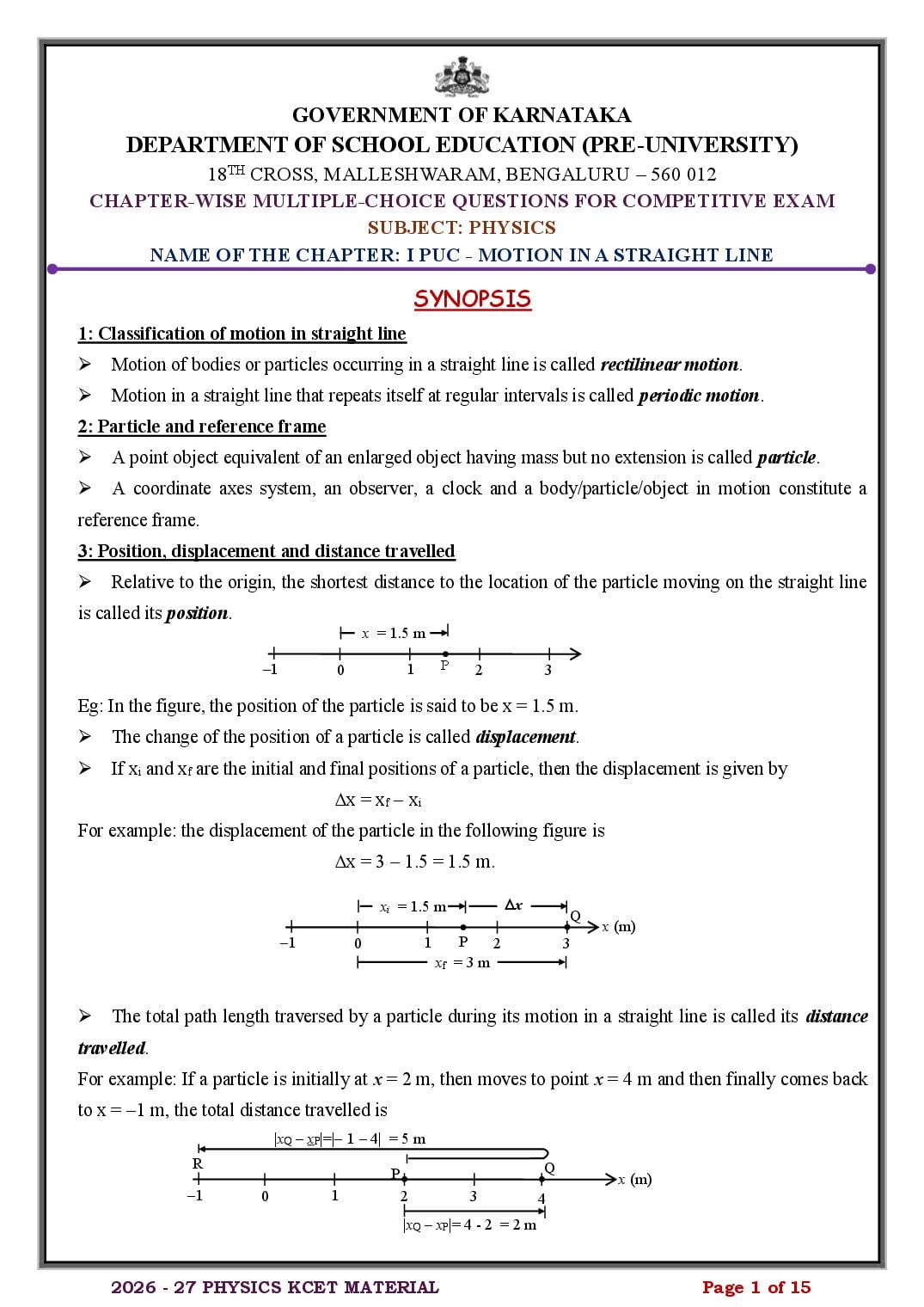
3: Position, displacement and distance travelled
➢ Relative to the origin, the shortest distance to the location of the particle moving on the straight line
is called its position.
x = 1.5 m
−1 0 1 P 2 3
Eg: In the figure, the position of the particle is said to be x = 1.5 m.
➢ The change of the position of a particle is called displacement.
➢ If xi and xf are the initial and final positions of a particle, then the displacement is given by
x = xf − xi
For example: the displacement of the particle in the following figure is
x = 3 − 1.5 = 1.5 m.
xi = 1.5 m x
Q
x (m)
−1 0 1 P 2 3
xf = 3 m
➢ The total path length traversed by a particle during its motion in a straight line is called its distance
travelled.
For example: If a particle is initially at x = 2 m, then moves to point x = 4 m and then finally comes back
to x = −1 m, the total distance travelled is
|xQ – xP|=|− 1 – 4| = 5 m
R Q
P x (m)
−1 0 1 2 3 4
|xQ – xP|= 4 - 2 = 2 m
2026 - 27 PHYSICS KCET MATERIAL Page 1 of 15
Page 2
Or = |4 – 2| + |−1 – 4| = 7 m.
The displacement in the previous example is : x = − 1 − 2 = − 3 m.
The negative sign refers to the leftward direction of the displacement.
EXAMPLE 1
A car moving along an east – west straight road is initially spotted 200 m to the east, moving westward
relative to a bus stop. It is then driven to a place 100 m to the west of the bus stop. The displacement and
the distance travelled (in metre) by the car are respectively
(A) − 100, 100 (B) – 200, 200 (C) – 300, 300 (D) 300, 300
Ans (C)
Example Solved:
The displacement of the car is x = −200 − 100 = − 300 m
The distance travelled by the car is D = |x| = 300 m
4: Average velocity and average speed
➢ If x is the displacement of a particle occurring in time t, the average velocity of the particle is
𝚫𝒙
𝒗𝒂𝒗 =
𝚫𝒕
➢ The direction of the average velocity is always along the displacement.
➢ If D is the total distance travelled by a particle in time t, then average speed is
𝑫
𝒗̄ =
𝚫𝒕
➢ The average speed however, does not have any direction.
EXAMPLE 2
A cyclist rides on his bicycle from a place A to B along a straight line at a constant speed of 10 m/s for
the first half of the distance and at 15 m/s during next half of the distance. If the cyclist finally comes
back to the midpoint of A and B at a speed of 9 m/s, the average speed and average velocity of the cyclist
for the entire journey are respectively
(A) 10.8 m/s, 3.6 m/s (B) 10.8 m/s, 10.8 m/s (C) 3.6 m/s, 3.6 m/s (D) 10.8 m/s, 0
Ans (A)
Example Solved:
Here, the total journey is divided into three equal parts of the distance:
So, the average speed of the journey is
𝑡𝑜𝑡 𝑑𝑖𝑠𝑡𝑎𝑛𝑐𝑒 𝑠+𝑠+𝑠 3𝑠 3𝑣1 𝑣2 𝑣3
𝑣̅ = = = 𝑠 𝑠 𝑠 =
𝑡𝑜𝑡𝑎𝑙 𝑡𝑖𝑚𝑒 𝑡1 + 𝑡2 + 𝑡3 + + 𝑣1 𝑣2 + 𝑣2 𝑣3 + 𝑣1 𝑣3
𝑣1 𝑣2 𝑣3
3 × 10 × 15 × 9 𝐦
→ 𝑣̅ = = 𝟏𝟎. 𝟖
10 × 15 + 15 × 9 + 10 × 9 𝐬
The average velocity of the journey is
𝑡𝑜𝑡 𝑑𝑖𝑠𝑝𝑙𝑎𝑐𝑒𝑚𝑒𝑛𝑡 𝑠 𝑠 𝑣1 𝑣2 𝑣3
𝑣𝑎𝑣 = = = 𝑠 𝑠 𝑠 =
𝑡𝑜𝑡𝑎𝑙 𝑡𝑖𝑚𝑒 𝑡1 + 𝑡2 + 𝑡3 + + 𝑣1 𝑣2 + 𝑣2 𝑣3 + 𝑣1 𝑣3
𝑣1 𝑣2 𝑣3
10 × 15 × 9 𝐦
→ 𝑣𝑎𝑣 = 𝑠̅ = = 𝟑. 𝟔
10 × 15 + 15 × 9 + 10 × 9 𝐬
2026 - 27 PHYSICS KCET MATERIAL Page 2 of 15
Page 3
➢ The time rate of change of the position of a particle is called its instantaneous velocity / velocity.
𝒅𝒙
That is 𝒗 = 𝒅𝒕
The magnitude of this velocity is called instantaneous speed.
𝒅𝒙 𝒅
NOTE: If x = 𝑡 𝑛 , then 𝒅𝒕 = 𝒅𝒕 (𝒕𝒏 ) = 𝒏𝒕𝒏−𝟏
EXAMPLE 3
A body moving along the x axis changes its positions with time according to x = 3 – 2t3; where x is in
metre and t is in seconds. The instantaneous velocity and instantaneous speeds at t = 1 s are respectively
(A) 1 m/s, 1 m/s (B) 6 m/s, 6 m/s (C) − 6 m/s, 6 m/s (D) 6 m/s, − 6 m/s
Ans (C)
Example Solved:
The instantaneous velocity at any time t is the first time derivative of x
𝑑𝑥 𝑑 𝑑 𝑑
𝑣= = (3 − 2𝑡 3 ) = (3) − (2𝑡 3 )
𝑑𝑡 𝑑𝑡 𝑑𝑡 𝑑𝑡
𝑑 𝑑
Or 𝑣 = 3 𝑑𝑡 (1) − 2 𝑑𝑡 (𝑡 3 ) = 3 × 0 − 2 × 3𝑡 2
Thus 𝑣 = −6𝑡 2
𝒎
At t = 1 s, 𝑣 = −6(1)2 = −𝟔 𝒔
The instantaneous speed is the magnitude of this velocity
𝒎
|𝑣 | = 𝟔
𝒔
6: Average acceleration and instantaneous acceleration
➢ If the velocities of a particle at initial time instant t i and final time instant tf are vi and vf respectively
then the average acceleration of the particle is given by
𝒗𝒇 −𝒗𝒊 𝚫𝒗
𝒂̄ = 𝒕 −𝒕 = 𝚫𝒕
𝒇 𝒊
➢ The rate of change of velocity is called acceleration or instantaneous acceleration.
𝑑𝑣
That is 𝑎 = 𝑑𝑡
EXAMPLE 4
The velocity of a particle moving along a straight line varies with time according to v = 3t2; where v is in
metre/second and t is in seconds. The average acceleration between t = 2 s and t = 3 s and instantaneous
acceleration of the particle (both in m/s2) at t = 2 s are respectively
(A) 15, 15 (B) 12, 15 (C) 15, 15 (D) 15, 12
Ans (C)
Example Solved:
The average acceleration between two time instants is
𝑣𝑓𝑖𝑛 −𝑣𝑖𝑛 3(3)2−3(2)2
𝑎𝑎𝑣 = 𝑡 = = 𝟏𝟓 𝒎𝒔−𝟐
𝑓𝑖𝑛 −𝑡𝑖𝑛 3−2
The instantaneous acceleration at any time instant is the first time derivative of the instantaneous velocity
𝑑𝑣 𝑑 𝑑
𝑎 = 𝑑𝑡 = 𝑑𝑡 (3𝑡 2 ) = 3 𝑑𝑡 (𝑡 2 ) = 3 × 2𝑡 = 6𝑡
Thus, at t = 2 s, 𝑎 = 6(2) = 𝟏𝟐 𝒎𝒔−𝟐
2026 - 27 PHYSICS KCET MATERIAL Page 3 of 15
Page 4
➢ If the acceleration of the particle moving in a straight line is constant/uniform, then
(i) a = constant.
If v0 is the initial velocity, x is the displacement and v is the final velocity of a particle moving along a
straight line with uniform acceleration a,
➢ its velocity after time t is (ii) v = v0 + at
➢ its displacement after time t is (iii) x = v0t + ½ at2
➢ its velocity after displacement x is (iv) v2 = v02 + 2ax
➢ its acceleration for two successive
displacements x1 and x2 in identical
𝑥 −𝑥
intervals t is (v) 𝑎 = 2𝑡 2 1
𝑎
➢ its displacement in nth second is (vi) 𝑥𝑛 = 𝑣0 + 2 (2𝑛 − 1)
and finally
𝑣 +𝑣
its average velocity is (vii) 𝑣̄ = 02
EXAMPLE 6
A body starting with 10 m/s moves along a straight line with a constant acceleration. If its average
velocity over the interval of first 5 s is 15 m/s, its velocity (in m/s) after 10 s from the start is
(A) 20 (B) 30 (C) 40 (D) 60
Ans (B)
Example Solved:
𝑣 +𝑣
From the average velocity of the body 𝑣̄ = 02 , we have
10+𝑣 m
15 = → 𝑣 = 20 s
2
𝑣−𝑣0 20−10
The acceleration of the body is 𝑎= 2
= 5
= 2 𝑚𝑠 −2 .
𝒎
So, the velocity after t = 10 s from the start is 𝑣 = 𝑣0 + 𝑎𝑡 → 𝑣 = 10 + (2)(10) = 𝟑𝟎 𝒔
EXAMPLE 7
A body moving along a straight line undergoes displacements 10 m and 18 m in the successive 2 s
intervals. If the body starts from rest, its velocity (in m/s) after 5 s from the start is
(A) 2 (B) 5 (C) 10 (D) 20
Ans (C)
Example Solved:
𝑠 −𝑠 18−10
The acceleration of the body is found using the formula 𝑎 = 2𝑡 2 1 = = 2 𝑚𝑠 −2
22
𝒎
The velocity after 5 s from the start is 𝑣 = 𝑣0 + 𝑎𝑡 → 𝑣 = 0 + (2)(5) = 𝟏𝟎 𝒔
EXAMPLE 8
A body starting from rest and moving along a straight line undergoes a displacement s in its n th second of
motion. Its average velocity after a time t is
𝑠𝑡 𝑠𝑡 2𝑠𝑡 𝑠𝑡
(A) 2𝑛−1 (B) 2𝑛+1 (C) 2𝑛−1 (D) 4𝑛−1
Ans (A)
2026 - 27 PHYSICS KCET MATERIAL Page 4 of 15
Page 5
The acceleration of the body is found using the formula
𝑎 𝑎 2𝑠
𝑠𝑛 = 𝑣0 + (2𝑛 − 1) → 𝑠 = 0 + (2𝑛 − 1) → 𝑎 =
2 2 2𝑛 − 1
2𝑠 2𝑠𝑡
Velocity after time t, 𝑣 = 𝑣0 + 𝑎𝑡 = 0 + (2𝑛−1) 𝑡 = 2𝑛−1
The average velocity in the first t second is
𝑣0 + 𝑣 1 2𝑠𝑡 𝒔𝒕
𝑣̄ = = (0 + )=
2 2 2𝑛 − 1 𝟐𝒏 − 𝟏
8: Motion under gravity
➢ If a body falls under gravity near the surface of Earth, its acceleration
(i) a = − g = constant. (g = 9.8 m/s2 ≈ 10 m/s2)
If v0 is the initial velocity, y is the displacement and v is the final velocity of a body falling under gravity
along a straight line,
➢ its velocity after time t is (ii) v = v0 − gt
➢ its displacement after time t is (iii) y = v0t − ½ gt2
➢ its velocity after displacement x is (iv) v2 = v02 − 2gy
𝑔
➢ its displacement in nth second is (vi) 𝑦𝑛 = 𝑣0 − 2 (2𝑛 − 1)
EXAMPLE 9
A ball thrown from the top of a building of height H reaches its foot in time T. Then its initial velocity is
𝑔𝑇 𝐻 𝑔𝑇 𝐻 𝐻 𝑔𝑇 𝑔𝑇 2 𝐻
(A) 2 − 𝑇 (B) 2 + 𝑇 (C) 𝑇 − 2 (D) − 𝑇2
2
Ans (A)
Example Solved:
The initial velocity of the ball is found using the formula
1 1
𝑠 = 𝑣𝑜 𝑡 − 2 𝑔𝑡 2 → −𝐻 = 𝑣𝑜 𝑇 − 2 𝑔𝑇 2
𝐻 1 𝒈𝑻 𝑯
Or − 𝑇 = 𝑣𝑜 − 2 𝑔𝑇 → 𝒗𝒐 = 𝟐 − 𝑻
EXAMPLE 10
A cricket ball is hit so that it travels vertically upwards after being struck by the bat. A man observes that
it takes 3 s for the ball to reach its maximum height. The maximum height it reaches is
(A) 15 m (B) 45 m (C) 135 m (D) 180 m
Ans (B)
Example Solved:
The initial velocity of the ball is found using the formula
𝑣 = 𝑣0 − 𝑔𝑡 → 0 = 𝑣0 − (10)(3) → 𝑣0 = 30 m/s
The maximum height is found using
𝑣 +𝑣 30+0
𝑠 = 𝑣𝑎𝑣 𝑡 = ( 02 ) 𝑡 → 𝑠 = ( 2 ) (3) = 𝟒𝟓 𝒎
2026 - 27 PHYSICS KCET MATERIAL Page 5 of 15
Page 6
➢ If time t is plotted along the horizontal axis, position x of a particle is drawn along vertical axis, the
resulting graph is said to be position time graph or x – t graph.
➢ Some typical x – t graphs are as shown:
➢ If time t is plotted along the horizontal axis, velocity v of a particle is drawn along vertical axis, the
resulting graph is said to be velocity time graph or v – t graph.
➢ Some typical v – t graphs are as shown:
➢ The slope of tangent of x – t graph at a given time instant t, gives the velocity of that body at that
instant.
➢ The area under the v – t graph between time instants t 1 ≤ t ≤ t2 gives the displacement of the body
during that interval.
➢ The slope of v – t graph at a given time instant t, gives the instantaneous acceleration at that instant.
➢ The area under the acceleration time graph between the time instants t 1 ≤ t ≤ t2 gives the change of
velocity of the body during that interval.
EXAMPLE 11
v (m/s)
The velocity time graph of a body is as shown in the figure. The 10
acceleration of the body and its displacement in first 4 s are
respectively
5
(A) +1.875 m/s2, 25 m (B) –1.875 m/s2, 15 m
(C) 12.5 m/s2 and 1.25 m (D) – 1.25 m/s2, 1.25 m
t (s)
Ans (B) 2 4
Example Solved:
The acceleration of the body is the slope of the v – t graph:
7.5
𝑎 = 𝑠𝑙𝑜𝑝𝑒 = − 4 = −𝟏. 𝟖𝟖 𝒎𝒔−𝟐
The displacement in the first 4 s is
1
𝑠 = 𝑎𝑟𝑒𝑎 = 2 × 4 × 7.5 = 𝟏𝟓 𝒎
2026 - 27 PHYSICS KCET MATERIAL Page 6 of 15
Page 7
1. Identify the WRONG statement from the following.
(A) Average velocity of a body is defined as the ratio of displacement (Δx) of the body to the time
interval (Δt) in which the displacement occurs.
(B) Average speed of a body is defined as the ratio of total length of the path travelled by it to the total
time taken for the motion.
(C) Magnitude of the average velocity is always less than or equal to average speed.
(D) Average speed can be positive, negative or zero for a particle in motion.
2. A cyclist starts from the centre O of a circular park of radius one kilometre,
reaches the edge P of a park, then cycles along the circumference and returns
to the centre along QO as shown in figure. If the round trip takes ten
minutes, the net displacement and average speed of the cyclist (in metre and
kilometre per hour) is
𝜋+4 𝜋+4
(A) 21.4, 2
(B) 0, 21.4 (C) 0, 1 (D) 2
,0
3. If a particle moves from Q to P and then to O on a straight path coinciding with X-axis as shown in the
diagram in a time interval 0 to 6s, then its average velocity and average speed in the given time interval
are respectively
(A) – 4 m s-1 and 8 m s-1 (B) – 6 m s-1 and 8 m s-1
(C) + 6 m s-1 and 8 m s-1 (D) – 4 m s-1 and 6 m s-1
4. The position – time graphs of two particles M and N are (i) and (ii) respectively. Then
(i) (ii)
(A) M is moving uniformly along positive X-axis and N is at rest on positive X- axis.
(B) M is moving non-uniformly along positive X-axis and N is at rest on positive X- axis.
(C) M is at rest on positive X- axis and N is moving uniformly along positive X-axis.
(D) M is at rest on positive X- axis and N is moving non-uniformly along positive X-axis.
2026 - 27 PHYSICS KCET MATERIAL Page 7 of 15
Page 8
X- axis.
Statement I : The slope of the line joining two different points of the graph over a time interval gives
the average velocity of the particle in that interval.
Statement II : The slope of the tangent drawn to the graph at a point corresponding to an instant gives
the instantaneous velocity of the particle at that instant.
Choose the correct option from the following.
(A) Both the statements are wrong. (B) Statement I is correct but the statement II is wrong.
(C) Both the statements are correct. (D)Statement I is wrong but the statement II is correct.
6. According to the given position-time graph, the average
velocity of the body between t = 5 s to t = 7 s is
(A) 3.9 ms-1
(B) 8.7 ms-1
(C) 18.7 ms-1
(D) 5.3 ms-1
7. vA, vB and vC are the instantaneous velocities
corresponding to the points A, B and C of the given position – time graph
of a particle respectively. Then the correct option relating their values is
(A) vA < vB = vC (B) vA < vB < vC
(C) vA > vB > vC (D) vA > vB = vC
8. The position of an object moving along X-axis varies with time according to the equation x = 10 + 5t2
where, x is in ‘m’ and t is in ‘s’. The velocity at t = 0 s and t = 4 s are
(A) 0 and 50 m s-1 (B) 0 and 40 m s-1
(C) 10 and 50 m s-1 (D) 5 and 40 m s-1
9. The position of an object moving along X-axis is varying with time according to the equation
x= 10 + 5t2 where, x is in ‘m’ and t is in ‘s’. Average velocity in the time interval t = 1 s to t = 3 s is
(A) 20 m s-1 (B) 10 m s-1 (C) 35 m s-1 (D) 17.5 m s-1
10. The position of an object moving along X-axis is varying with time according to the equation x= 5 + 2t3
where, x is in ‘m’ and t is in ‘s’. Acceleration of the object at t = 1 s is
(A) 10 m s-2 (B) 6 m s-2 (C) 5 m s-2 (D) 12 m s-2
11. The positions of objects A, B and C moving along X axis are varying with time according to the
equations xA = 10 + 5t2, xB = 3 + 5t and xC = 4 + 2t3 respectively where, x is in ‘m’ and t is in ‘s’. Then
the objects A, B and C are moving with _____________ respectively.
(A) uniform acceleration, non-uniform velocity and non-uniform acceleration
(B) uniform acceleration, uniform velocity and non-uniform acceleration
(C) non-uniform acceleration, uniform velocity and uniform acceleration
(D) uniform negative acceleration, uniform velocity and non-uniform acceleration
2026 - 27 PHYSICS KCET MATERIAL Page 8 of 15
Page 9
the market closed, he instantly turns and walks back home with a speed of 6 kmph. The magnitude of
average velocity and average speed of the man over the interval of time 0 to 50 min are
(A) 0 and 2.4 kmph (B) 4.8 kmph and 4.8 kmph
(C) 0 and 5.0 kmph (D) 0 and 4.8 kmph
13. Three different position – time graphs are given below. The graphs correspond to bodies having ______
accelerations respectively.
(i) (ii) (iii)
(A) positive, zero and negative (B) zero, positive and negative
(C) positive, negative and zero (D) negative, positive and zero
14. Among the four graphs, there is only one graph for which average velocity over the time interval (0, T)
can vanish for a suitably chosen T. Which one is it?
(A) (B)
(C) (D)
15. In one-dimensional motion, instantaneous speed v satisfies 0 ≤ v < v 0.
(A) The displacement in time T must always take non-negative values.
(B) The displacement x in time T satisfies – vo T < x <vo T.
(C) The acceleration is always a non-negative number.
(D) The motion has no turning points.
16. A vehicle travels half the distance L with speed V 1 and the other half with speed V2, then its average
speed is
𝑉 +𝑉 2𝑉 +𝑉 2𝑉 𝑉 𝐿(𝑉1 +𝑉2 )
(A) 1 2 2 (B) 𝑉 1+𝑉 2 (C) 𝑉 +𝑉
1 2
(D) 𝑉1 𝑉2
1 2 1 2
17. The displacement of a particle is given by x = (t – 2)2 where x is in metres and t in seconds. The distance
covered by the particle in first 4 seconds is
(A) 4 m (B) 8 m (C) 12 m (D) 16 m
2026 - 27 PHYSICS KCET MATERIAL Page 9 of 15
Page 10
having______________ accelerations respectively.
(i) (ii) (iii)
(A) positive, zero and negative (B) zero, positive and negative
(C) positive, negative and zero (D) negative, positive and zero
19. If aA, aB and aC are the instantaneous accelerations corresponding to the points
A, B and C of the given velocity – time graph respectively. Then the correct
option relating the their values is
(A) aA < aB = aC (B) aA < aB < aC
(C) aA > aB > aC (D) aA > aB = aC
20. If velocity v of a particle moving on a straight line as a function of time t is given as v = 5 – t (m s-1),
then the distance covered by the particle in first 5 second is
(A) 25 m (B) 12.5 m (C) 15 m (D) 17 m
21. The velocity – time graph for two bodies A and B are shown. Then the
acceleration of A and B are in the ratio
tan 25 COS 25
(A) tan 40 (B) COS 50
tan 25 sin 25
(C) tan 50 (D) sin 50
22. For a body moving with uniform acceleration along straight line with initial velocity zero, variation of its
velocity(v)with position (x) is best represented by
23. Velocity-time(v-t) graph for a moving object is shown in figure. Total
displacement of the object during the time interval when there is non-
zero acceleration and retardation is
(A) 60 m (B) 50 m
(C) 30 m (D) 40 m
2026 - 27 PHYSICS KCET MATERIAL Page 10 of 15
Page 11
maximum acceleration is
(A) 1 cm/s2
(B) 2 cm/s2
(C) 3 cm/s2
(D) 6 cm/s2
25. A particle starts moving from rest on a straight line its acceleration (a) versus time (t)
is shown in the figure. Possible speed-time graph for the particle is
26. A lift is coming from 8th floor and is just about to stop at 4th floor. Taking ground floor as origin and
positive direction upwards for all quantities, which one of the following is correct?
(A) x < 0, v < 0, a > 0 (B) x > 0, v < 0, a < 0
(C) x > 0, v < 0, a > 0 (D) x > 0, v > 0, a < 0
27. At a metro station, a girl walks up a stationary escalator in time t 1. If she remains stationary on the
escalator, then the escalator takes her up in time t2. The time taken by her to walk up on the moving
escalator will be
𝑡 +𝑡 𝑡 𝑡 𝑡 𝑡
(A) 1 2 2 (B) 𝑡 1− 2𝑡 (C) 𝑡 1+ 2𝑡 (D) 𝑡1 − 𝑡2
2 1 2 1
28. The acceleration ‘a’ in m s-2 of a particle is given by a = 3t2 + 2t + 1, where t is the time. If the particle
starts with a velocity v = 2 m s−1 at t = 0 then velocity at the end of 2 sec is
(A)12 m s−1 (B)16 m s−1 (C) 27 m s−1 (D)18 m s−1
29. The acceleration – time (a –t) graph of a particle moving in a straight line is
as shown in the figure. The velocity – time graph of the particle would be
(A) a straight line (B) a circle
(C) a parabola (D) an ellipse
30. The acceleration – time graph, velocity – time graph and displacement – time
graph of a body are as shown. The three graphs correspond to
(A) a body thrown vertically up. (B) a body falling freely under gravity.
(C) a body thrown in horizontal direction. (D) a body thrown vertically down.
2026 - 27 PHYSICS KCET MATERIAL Page 11 of 15
Page 12
200 m. The magnitude of the acceleration of the car is:
(A) 79.38 m s-2 (B) 30.6 m s-2 (C) 3.06 m s-2 (D) zero
32. When the brake of a car is applied, the car stops after travelling 100 m. If speed of car is halved and
brakes produce same retarding acceleration, it stops after travelling a distance of:
(A) 25 m (B) 50 m (C) 75 m (D) 100 m
33. A body moving along a straight line with a speed of 5 m/s acquires a speed of 15 m/s in 6 s. Assuming
constant acceleration, the distance travelled by the body is 6 s is:
(A) 120 m (B) 30 m (C) 90 m (D) 60 m
34. A body covers 16m in first 4 s and 32 m in the next 4 seconds while moving with constant acceleration.
The velocity of the body at the end of 10 s is:
(A) 14 m/s (B) 12 m/s (C) 10 m/s (D) 8 m/s
35. A bike moving with an initial velocity of 4 m/s accelerates at a constant rate of 2 m/s 2. What is the
distance travelled by the bike during the 5th second of its motion?
(A) 9 m (B) 13 m (C) 14 m (D) 45 m
36. If an object covers 10 m in the 4th second and 30 m in the 8th second of motion, the acceleration of the
object is:
(A) 2.5 m/s² (B) 2.67 m/s² (C) 4 m/s² (D) 5 m/s²
37. Moving with uniform acceleration, a body crosses a point A with a velocity 1 m/s and another point B
with a velocity 7 m/s. The velocity of the object at the mid-point of AB is:
(A) 3.5 m/s (B) 4 m/s (C) 5 m/s (D) 6 m/s
38. When a bullet hits a plank with a certain speed and emerges out, it loses 10% of its speed. How many
planks are needed to stop the bullet?
(A) 6 (B) 5 (C) 11 (D) 10
39. A car accelerates from rest at a constant rate α from some time, after which it decelerates at a constant
rate β and comes to rest. If the total time elapsed is t, then the maximum velocity acquired by the car is:
𝛼 2 +𝛽2 𝛼 2 −𝛽2 𝛼𝛽 1 𝛼𝛽
(A) 𝑡 (B) 𝑡 (C) 𝛼+𝛽 𝑡 (D) 2 (𝛼+𝛽) 𝑡 2
𝛼𝛽 𝛼𝛽
40. A particle starts with a velocity of 2 m s-1 and moves in a straight line with a retardation of 0.1 m s-2. The
time at which the particle is 15 m from the initial position is:
(A) 10 s only (B) 30 s only (C) 20 s (D) both 10 s and 30 s
41. The velocity of an object moving along a straight-line varies with time as 𝑣 = 5𝑡 + 4 m/s. The
displacement of the object in first two seconds is (g = 10 m/s2):
(A) 20 m (B) 18 m (C) 14 m (D) 13 m
2026 - 27 PHYSICS KCET MATERIAL Page 12 of 15
Page 13
window 20 m below the top. Both the stones reach the bottom simultaneously. The value of h is (Take g
= 10 m/s2):
(A) 31.25 m (B) 100 m (C) 120 m (D) 130 m
43. When dropped from a height h, a stone travels 35 m in the last second of its motion. The value of h is
(take g = 10 m/s2):
(A) 140 m (B) 80 m (C) 45 m (D) 120 m
44. From the top of a 400 m high cliff, a stone is dropped. Simultaneously another stone is thrown vertically
up from the base with a speed of 50 m/s towards the first stone. The distance from the base where they
would meet is (g = 10 m/s2):
(A) 100 m (B) 320 m (C) 80 m (D) 240 m
45. A body is dropped from rest under the action of gravity. The distances covered by the body in the 1st,
2nd, and 3rd seconds are in the ratio of:
(A) 1:3:5 (B) 1:4:9 (C) 1:2:3 (D) 1:1:1
46. An object is thrown vertically upwards from the roof of a building with an initial speed of 10 m/s. It hits
the ground exactly 3 seconds later. Taking the upward direction as positive and the roof as the reference
point, the displacement and the total distance travelled by the object are, respectively:
(A) – 15 m and 15 m (B) – 45 m and 75 m (C) 15 m and 25 m (D) – 15 m and 25 m
47. Vertically thrown upwards from the ground, an object travels 5 m during the 3 rd second of its upward
motion. The total time of its motion is:
(A) 3 seconds (B) 5 seconds (C) 6 seconds (D) 7 seconds
48. For a body thrown vertically upwards, the average velocity becomes zero in 3 seconds. The average
speed of the body over the journey is:
(A) 0 m/s (B) 7.5 m/s (C) 15 m/s (D) 30 m/s
49. An astronaut drops a small tool from a height of 5 metres on Earth, and it takes t seconds to hit the
ground. If the same tool is dropped from the exact same height on Mars, where the gravitational pull is
weaker 4 m/s2 compared to Earth's 10 m/s2), how long will the fall take on Mars expressed in terms of t?
(A) 1.6t (B) 0.4t (C) 2.5t (D) 0.625t
50. Imagine dropping your smartphone from a height of 2 metres on Earth and doing the exact same thing
inside a habitat on Mars. Knowing that Mars exerts a much weaker gravitational pull than Earth, how
will the phone's drop on Mars compare?
(A) It crashes down faster and hits harder. (B) It floats down slower and hits with less impact.
(C) It falls at the same rate but hits harder. (D) It falls faster but hits softer.
51. A professional archer shoots an arrow straight up into the air with a launch speed of 25 m/s. Due to
gravity, the acceleration is10 m/s2. How many seconds pass from the moment of launch until the falling
arrow reaches a downward speed of 5 m/s?
(A) 1 s (B) 2 s (C) 3 s (D) 4 s
2026 - 27 PHYSICS KCET MATERIAL Page 13 of 15
Page 14
flight from the moment it leaves the racket until right before it is caught, which of the following
statements is true about its motion?
(A) The ball's velocity and acceleration vectors point in the same direction during the climb.
(B) At the very peak of its flight, both the ball's velocity and acceleration drop to zero.
(C) The downward gravitational acceleration remains constantly active at all points of the flight.
(D) The ball maintains a non-zero velocity through every single moment of its trajectory.
53. A drone is climbing straight up at a steady rate of 15 m/s. At an altitude of 20 m, a loose bolt detaches
from the drone and falls to the earth. Neglecting air resistance, find the final impact velocity of the bolt.
(A) 15 m/s (B) 20 m/s (C) 25 m/s (D) 30 m/s
54. A race-track is straight. Two vehicles begin the race simultaneously from the same spot. Vehicle A has an
initial velocity u1 and a uniform acceleration a1. Vehicle B has an initial velocity u2 and a uniform
acceleration a2. If both vehicles tie at the finish line, the duration of the race is:
𝑢2 −𝑢1 1 𝑢 −𝑢1 𝑢2 +𝑢1 𝑢 −𝑢1
(A) (B) ( 2 ) (C) (D) 2 ( 2 )
𝑎1 −𝑎2 2 𝑎1 −𝑎2 𝑎1 +𝑎2 𝑎1 −𝑎2
55. When an object is thrown upwards, it is at the same height at times t1 and t2. The maximum height
reached by the object is:
1 1 1 1
(A) 2 𝑔(𝑡12 + 𝑡22 ) (B) 8 𝑔(𝑡1 + 𝑡2 )2 (C) 8 𝑔(𝑡12 + 𝑡22 ) (D) 2 𝑔(𝑡1 + 𝑡2 )2
KEY ANSWERS
1 2 3 4 5 6 7 8 9 10 11
D B A C C B B B A D B
12 13 14 15 16 17 18 19 20 21 22
D C B B C B B C B C C
23 24 25 26 27 28 29 30 31 32 33
B D B C C B C B C A D
34 35 36 37 38 39 40 41 42 43 44
B B D C A C D B A B C
45 46 47 48 49 50 51 52 53 54 55
A D C B A B C C C D B
2026 - 27 PHYSICS KCET MATERIAL Page 14 of 15
Page 15
1. At a metro station, a girl walks up a stationary escalator in 20 s. If she remains stationary on the
escalator, then the escalator takes her up in 30 s. The time taken by her to walk up on the moving
escalator will be [KCET-2020]
(A) 60 s (B) 12 s (C) 10 s (D) 25 s
2. Rain is falling vertically with a speed of 12 m s . A woman rides a bicycle with a speed of 12 m s −1 in
−1
east to west direction. What is the direction in which she should hold her umbrella? [KCET-2020]
(A) 45° towards East (B) 30° towards West
(C) 45° towards West (D) 30° towards East
3. For a body moving along a straight line, the following v-t graph is
obtained. According to the graph, the displacement during [KCET-2021]
(A) uniform acceleration is greater than that during uniform motion
(B) uniform acceleration is less than that during uniform motion
(C) uniform acceleration is equal to that during uniform motion
(D) uniform motion is zero
4. A particle stars from rest. Its acceleration ‘a’ versus time ‘t’ is shown in the
figure. The maximum speed of the particle will be [KCET-2021]
−1
(A) 80 m s
(B) 40 m s −1
(C) 18 m s −1
(D) 2 m s −1
5. The displacement X (in metre) of a particle of mass m (in kg) moving in one dimension under the action
of a force, is related to time ‘t’ (in second) by, 𝑡 = √𝑋 + 3. The displacement of the particle when its
velocity is zero, will be [KCET-2022]
(A) 6 𝑚 (B) 2 (C) 4 𝑚 (D) 0 𝑚
6. A body is moving along a straight line with initial velocity 𝑣0 . Its acceleration a is constant. After t
seconds, its velocity becomes 𝑣. The average velocity of the body over the given time interval is
[KCET-2023]
𝑣 2 +𝑣0 2 𝑣 2 +𝑣02 𝑣 2 −𝑣02 𝑣 2 −𝑣0 2
(A) 𝑣 = (B) 𝑣 = (C) 𝑣 = (D) 𝑣 =
2𝑎𝑡 𝑎𝑡 2𝑎𝑡 𝑎𝑡
7. An athlete runs along a circular track of diameter 80 m. The distance travelled and the magnitude of
displacement of the athlete when he covers ¾th of circle is (in m) [KCET-2024]
(A) 60𝜋, 40√2 (B) 40𝜋, 60√2 (C) 120𝜋, 80√2 (D) 80𝜋, 120√2
8. Two stones begin to fall from rest from the same height, with the second stone starting to fall '∆t'
seconds after the first falls from rest. The distance of separation between the two stones becomes 'H', '𝑡0 '
seconds after the first stone starts its motion. Then 𝑡0 is equal to [KCET-2025]
𝐻 𝐻 ∆𝑡 𝐻 ∆𝑡 𝐻 ∆𝑡
(A) 𝑔∆𝑡 (B) ∆𝑡 + 2𝑔 (C) 𝑔∆𝑡 − 2 (D) 𝑔∆𝑡 + 2
9. A car covers the first half of the distance between two places at 40 km/h and another half at 50 km/h.
The average speed of the car is [KCET-2026]
(A) 45.00 km/h (B) 44.44 km/h (C) 43.14 km/h (D) 42.04 km/h
**********
KEY ANSWERS
1 2 3 4 5 6 7 8 9
B A B B D C A D B
2026 - 27 PHYSICS KCET MATERIAL Page 15 of 15
Document Details
| Board / Org | Karnataka Board |
| Exam | Class 11 |
| Type | Question Bank |
| Pages | 15 |
| Updated | 24 Sep 2026 |