Karnataka 1st PUC Physics System of Particles and Rotational Motion MCQ with Answers
Finished viewing? Save it for later —
Download Karnataka 1st PUC Physics System of Particles and Rotational Motion MCQ with Answers (PDF · 21 pages)About Karnataka 1st PUC Physics System of Particles and Rotational Motion MCQ with Answers
Karnataka 1st PUC Physics System of Particles and Rotational Motion MCQ with Answers is available here for free download. Published by Karnataka Board for Class 11, this question bank can be viewed online or downloaded as a PDF (21 pages). Candidates preparing for Class 11 can use Karnataka 1st PUC Physics System of Particles and Rotational Motion MCQ with Answers to understand the exam pattern, the type of questions asked, and the overall difficulty level.
Frequently Asked Questions
How can I download Karnataka 1st PUC Physics System of Particles and Rotational Motion MCQ with Answers?
Open this page and click the Download button to save Karnataka 1st PUC Physics System of Particles and Rotational Motion MCQ with Answers as a PDF. It is completely free on AglaSem Docs.
Is Karnataka 1st PUC Physics System of Particles and Rotational Motion MCQ with Answers free to download?
Yes. Karnataka 1st PUC Physics System of Particles and Rotational Motion MCQ with Answers can be viewed online and downloaded as a PDF free of cost on AglaSem Docs.
How many pages does Karnataka 1st PUC Physics System of Particles and Rotational Motion MCQ with Answers have?
Karnataka 1st PUC Physics System of Particles and Rotational Motion MCQ with Answers contains 21 pages, which you can read online or download together as a single PDF.
Where can I find more Class 11 study material?
You can find more Class 11 question papers, sample papers, syllabus, and answer keys on AglaSem Docs.
Karnataka 1st PUC Physics System of Particles and Rotational Motion MCQ with Answers – Text
Read the full text of this question bank below — useful to quickly search, copy and reference the content online without downloading the PDF.
📄 View text version (21 pages)
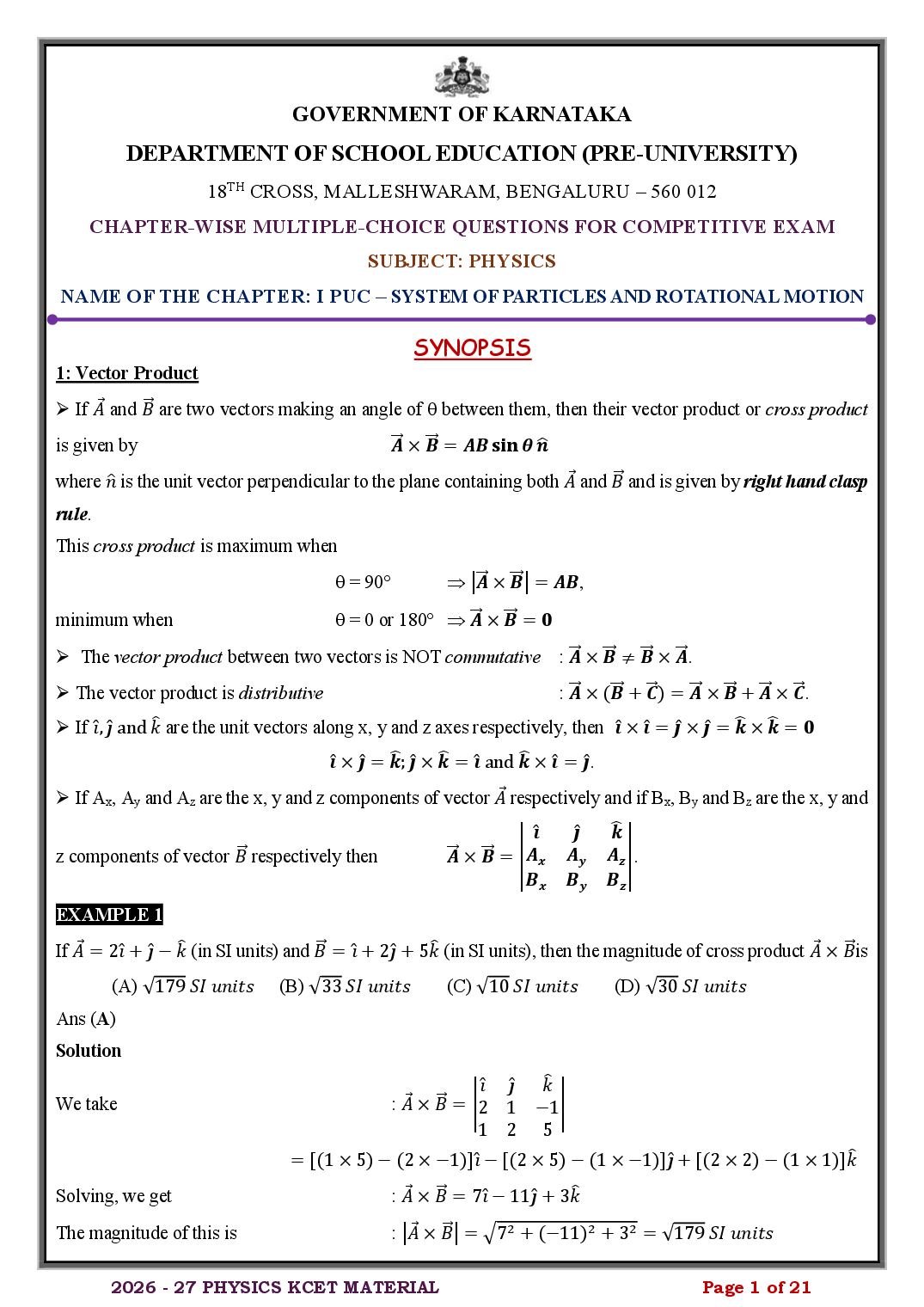
Page 1
DEPARTMENT OF SCHOOL EDUCATION (PRE-UNIVERSITY)
18TH CROSS, MALLESHWARAM, BENGALURU – 560 012
CHAPTER-WISE MULTIPLE-CHOICE QUESTIONS FOR COMPETITIVE EXAM
SUBJECT: PHYSICS
NAME OF THE CHAPTER: I PUC – SYSTEM OF PARTICLES AND ROTATIONAL MOTION
SYNOPSIS
1: Vector Product
⃗⃗ are two vectors making an angle of between them, then their vector product or cross product
➢ If 𝐴⃗ and 𝐵
is given by ⃗⃗⃗ × 𝑩
𝑨 ⃗⃗⃗ = 𝑨𝑩 𝐬𝐢𝐧 𝜽 𝒏
̂
where 𝑛̂ is the unit vector perpendicular to the plane containing both 𝐴⃗ and 𝐵
⃗⃗ and is given by right hand clasp
rule.
This cross product is maximum when
= 90 |𝑨
⃗⃗ × 𝑩
⃗⃗⃗| = 𝑨𝑩,
minimum when = 0 or 180 𝑨
⃗⃗⃗ × 𝑩
⃗⃗⃗ = 𝟎
⃗⃗⃗ × 𝑩
➢ The vector product between two vectors is NOT commutative : 𝑨 ⃗⃗⃗ ≠ 𝑩
⃗⃗⃗ × 𝑨
⃗⃗.
➢ The vector product is distributive ⃗⃗⃗ × (𝑩
:𝑨 ⃗⃗⃗ + 𝑪
⃗⃗) = 𝑨
⃗⃗ × 𝑩
⃗⃗⃗ + 𝑨
⃗⃗ × 𝑪
⃗⃗.
➢ If 𝑖̂, 𝑗̂ and 𝑘̂ are the unit vectors along x, y and z axes respectively, then 𝒊̂ × 𝒊̂ = 𝒋̂ × 𝒋̂ = 𝒌
̂×𝒌
̂=𝟎
̂ ; 𝒋̂ × 𝒌
𝒊̂ × 𝒋̂ = 𝒌 ̂ = 𝒊̂ and 𝒌
̂ × 𝒊̂ = 𝒋̂.
➢ If Ax, Ay and Az are the x, y and z components of vector 𝐴⃗ respectively and if Bx, By and Bz are the x, y and
𝒊̂ 𝒋̂ ̂
𝒌
⃗⃗ respectively then
z components of vector 𝐵 ⃗⃗ × 𝑩
𝑨 ⃗⃗⃗ = | 𝑨𝒙 𝑨𝒚 𝑨𝒛 |.
𝑩𝒙 𝑩𝒚 𝑩𝒛
EXAMPLE 1
If 𝐴⃗ = 2𝑖̂ + 𝑗̂ − 𝑘̂ (in SI units) and 𝐵
⃗⃗ = 𝑖̂ + 2𝑗̂ + 5𝑘̂ (in SI units), then the magnitude of cross product 𝐴⃗ × 𝐵
⃗⃗is
(A) √179 𝑆𝐼 𝑢𝑛𝑖𝑡𝑠 (B) √33 𝑆𝐼 𝑢𝑛𝑖𝑡𝑠 (C) √10 𝑆𝐼 𝑢𝑛𝑖𝑡𝑠 (D) √30 𝑆𝐼 𝑢𝑛𝑖𝑡𝑠
Ans (A)
Solution
𝑖̂ 𝑗̂ 𝑘̂
We take : 𝐴⃗ × 𝐵
⃗⃗ = |2 1 −1|
1 2 5
= [(1 × 5) − (2 × −1)]𝑖̂ − [(2 × 5) − (1 × −1)]𝑗̂ + [(2 × 2) − (1 × 1)]𝑘̂
Solving, we get ⃗⃗ = 7𝑖̂ − 11𝑗̂ + 3𝑘̂
: 𝐴⃗ × 𝐵
The magnitude of this is : |𝐴⃗ × 𝐵
⃗⃗ | = √72 + (−11)2 + 32 = √179 𝑆𝐼 𝑢𝑛𝑖𝑡𝑠
2026 - 27 PHYSICS KCET MATERIAL Page 1 of 21
Page 2
In the previous question, the angle between 𝐴⃗ and 𝐵
⃗⃗ is nearly
(A)10 (B) 25 (C) 60 (D) 85
Ans (D)
Solution
The magnitudes of vectors 𝐴⃗ and 𝐵
⃗⃗ are : 𝐴 = √22 + 12 + (−1)2 = √6 𝑆 𝐼 𝑢𝑛𝑖𝑡𝑠
and : 𝐵 = √12 + 22 + (5)2 = √30 𝑆𝐼 𝑢𝑛𝑖𝑡𝑠
|𝐴⃗×𝐵
⃗⃗|
Hence from : |𝐴⃗ × 𝐵
⃗⃗ | = 𝐴𝐵 𝑠𝑖𝑛 𝜃 ⇒ 𝑠𝑖𝑛 𝜃 =
𝐴𝐵
√179
⇒ 𝑠𝑖𝑛 𝜃 = ⇒ 𝜃 ≈ 85°
√6 × √30
2: Center of Mass
➢ If m1 and m2 are the masses of two particles lying on the x axis at co ordinates x1 and y
X
x2 respectively, then their center of mass (COM) co ordinate is given by m1 COM m2
x
𝒎𝟏 𝒙𝟏 +𝒎𝟐 𝒙𝟐 x1
𝑿= .
𝒎𝟏 +𝒎𝟐
x2
𝒙𝟏 +𝒙𝟐
➢ If m1 = m2 = m, then the COM co ordinate is given by 𝑿= .
𝟐
➢ If m2 > > m1, then X is very close to x2 : i.e., 𝑿 ≈ 𝒙𝟐 .
➢ In general for particles of masses m1, m2, m3, ………, mn etc fixed on the x axis at co ordinates x1, x2,
…..,xn then the COM co ordinate is given by
𝒎𝟏 𝒙𝟏 +𝒎𝟐 𝒙𝟐 +...........+𝒎𝒏 𝒙𝒏 𝒎𝒙
𝑿= = ∑𝒏𝒊=𝟏 𝒎𝒊 𝒊.
𝒎𝟏 +𝒎𝟐 +.........+𝒎𝒏 𝒊
➢ For mass distribution in a plane (say, x – y plane) then the center of mass x and y y
m2
co ordinates are COM
𝒏 𝒏
m (X, Y)
𝒎𝒊 𝒙𝒊 𝒎 𝒊 𝒚𝒊 1
mn
𝑿=∑ and 𝒀 = ∑ mi(x ,y )
𝒎𝒊 𝒎𝒊 i i
𝒊=𝟏 𝒊=𝟏 x
➢ For symmetric mass distributions, the center of mass is at their geometric centers.
➢ For example: the COM of a uniform circular disk, uniform
COM COM COM COM
sphere, a uniform spherical shell, a uniform cylinder etc is at their
Disk Sphere Spherical
respective geometric centers.
shell
EXAMPLE 3
Three point objects of masses 1 kg, 2 kg and m are located at x = 1 m, x = 2 m and x = 5 m respectively. If
the center of mass of the three objects is at x = 3 m, the value of m is
(A) 0.1 kg (B) 1 kg (C) 3 kg (D) 10 kg
Ans (B)
Solution
𝑚1 𝑥1 +𝑚2 𝑥2 +𝑚3 𝑥3 (1)(1)+(2)(2)+𝑚×(5)
The COM co ordinate is given by :𝑋 = ⇒3=
𝑚1 +𝑚2 +𝑚3 1+2+𝑚
Solving for m, we get : 9 + 𝑚 = 5 + 5𝑚 ⇒ 𝑚 = 1 𝑘𝑔
2026 - 27 PHYSICS KCET MATERIAL Page 2 of 21
Page 3
Three uniform squares of sides 2 m each have masses as indicated in the figures. The x and y
y co ordinates of the center of mass of the three squares are respectively
1 kg 3 kg
(A) (2.3 m, 3.7 m) (B) (3.7 m, 2.3 m) 2 kg
x
(C) (2.3 m, 0) (D) (0, 2.3 m)
Ans (B)
Solution y
The x and y co ordinates of the three (1,3) (5,3)
squares are given by : (x1, y1) = (1 m , 3 m), (x2, y2) = (3 m , 1 m) and 2m
(3,1)
x
(x3, y3) = (5 m , 3 m), 2m
𝑚1 𝑥1 +𝑚2 𝑥2 +𝑚3 𝑥3
The COM x co ordinate is given by : 𝑋 =
𝑚1 +𝑚2 +𝑚3
(1)(1) + (2)(2) + (3)(5)
⇒3= = 3.7𝑚
1+2+3
𝑚1 𝑦1 +𝑚2 𝑦2 +𝑚3 𝑦3 (1)(3)+(2)(1)+(3)(3)
and the COM y co ordinate is given by: 𝑌 = ⇒3= = 2.3𝑚
𝑚1 +𝑚2 +𝑚3 1+2+3
3: Motion of the Center of Mass
➢ If m1 and m2 are the masses of the two particles having velocities 𝑣⃗1 and 𝑣⃗2 respectively, their center of mass
velocity is given by
⃗⃗ = 𝒎𝟏 𝒗⃗⃗𝟏 +𝒎𝟐 𝒗⃗⃗𝟐.
⃗𝑽
𝒎 +𝒎 𝟏 𝟐
➢ In general we write ⃗𝑽⃗ = 𝒎𝟏 𝒗⃗⃗𝟏 +𝒎𝟐 𝒗⃗⃗𝟐+......+𝒎𝒏 𝒗⃗⃗𝒏 = ∑𝒏𝒊=𝟏 𝒎𝒊 𝒗⃗⃗𝒊.
𝒎 +𝒎 +........+𝒎
𝟏 𝟐 𝒏 𝒎 𝒊
➢ The total momentum of the system of particle is ⃗𝑷
⃗⃗ = 𝑴𝑽
⃗⃗
where M = ∑𝒏𝒊=𝟏 𝒎𝒊 is the total mass of all the particles of a system.
➢ If m1 and m2 are the masses of the two particles having velocities 𝑎⃗1 and 𝑎⃗2 respectively, their center of
mass acceleration is given by
⃗⃗ = 𝒎𝟏 𝒂⃗⃗𝟏 +𝒎𝟐 𝒂⃗⃗𝟐.
⃗𝑨
𝒎 +𝒎 𝟏 𝟐
➢ In general we write ⃗⃗ = 𝒎𝟏 𝒂⃗⃗𝟏 +𝒎𝟐 𝒂⃗⃗𝟐 +......+𝒎𝒏𝒂⃗⃗𝒏 = ∑𝒏𝒊=𝟏 𝒎𝒊 𝒂⃗⃗𝒊.
𝑨 𝒎 +𝒎 +........+𝒎
𝟏 𝟐 𝒏 𝒎 𝒊
➢ The total external force on the system of particle is ⃗𝑭⃗𝒆𝒙𝒕 = 𝑴𝑨
⃗⃗⃗
where M = ∑𝒏𝒊=𝟏 𝒎𝒊 is the total mass of all the particles of a system.
EXAMPLE 5
Two particles having masses m and 2m are moving with speeds of 2 m/s and 1 m/s along + x direction and –
x direction respectively. At that instant, they are acted upon only by their mutual repulsion force. The center
of mass velocity and center of mass acceleration of the two particles are respectively
m
(A) 0, −𝑖̂ + 2𝑗̂ 𝑚/𝑠 2 (B) 0, 0 (C) −𝑖̂ 𝑚/𝑠, 0 (D) 𝑖̂ 𝑠 𝑎𝑛𝑑 2𝑗̂ 𝑚/𝑠 2
Ans (B)
2026 - 27 PHYSICS KCET MATERIAL Page 3 of 21
Page 4
The velocities of m kg and 2m kg are : 𝑣⃗1 = 2𝑖̂ 𝑎𝑛𝑑 𝑣⃗2 = −𝑖̂ in meter per second.
⃗⃗1 +𝑚2 𝑣
𝑚1 𝑣 ⃗⃗2 𝑚(2𝑖̂)+2𝑚(−𝑖̂)
Hence the COM velocity is ⃗⃗ =
:𝑉 = =0
𝑚1 +𝑚2 𝑚+2𝑚
Since : the force between them is mutual repulsion,
there exists only : internal force.
the : external force is zero 𝐹⃗𝑒𝑥𝑡 = 0
𝐹⃗ 0
From : 𝐹⃗𝑒𝑥𝑡 = 𝑀𝐴⃗ ⇒ 𝐴⃗ = 𝑚+2𝑚
𝑒𝑥𝑡
= 3𝑚 = 0
EXAMPLE 6
Two particles of masses M and 1.5 M are moving along +x axis at speeds u and 2u respectively. A third
particle is moving with a velocity v3 along the x axis. The total momentum of the system is 3Mu, then the
velocity v3 is
(A) 0.5u along the +x axis (B) u along - x axis
(C) 0.5u along – x axis (D) u along +x axis
Ans (C)
Solution
𝑚1 𝑣1𝑥 +𝑚2 𝑣2𝑥 +𝑚3 𝑣3𝑥
From the expression : 𝑃⃗⃗ = 𝑀𝑉
⃗⃗ ⇒ 𝑃𝑥 = 𝑀𝑉𝑥 ⇒ 𝑃𝑥 = 𝑀 ×
𝑀
Or : 𝑃𝑥 = 𝑚1 𝑣1𝑥 + 𝑚2 𝑣2𝑥 + 𝑚3 𝑣3𝑥 ⇒ 3𝑀𝑢 = 𝑀𝑢 + 1.5𝑀 × 2𝑢 + 2𝑀𝑣3
Solving for v3 : 𝑣3 = − 0.5u
Hence : 𝑣3 = 0.5 m/s along − x axis.
EXAMPLE 7
A grenade is fired from the ground at certain initial velocity and at a certain initial angle with the horizontal.
It explodes at point P into several fragments. The path of the center of mass after the explosion is correctly
shown in which of the following four figures?
y y y y Q
P P P P
x x x x
O Q O Q O Q O
(A) (B) (C) (D)
Ans (C)
Solution
Before the explosion (OP), the only force acting on the COM of the grenade : is gravitational force.
After the explosion (PQ), the only force acting on the COM : is also gravitational force.
If before the explosion, the COM moved along the : path OP.
Hence after the explosion also, the COM must move along : path PQ as in choice (3)
2026 - 27 PHYSICS KCET MATERIAL Page 4 of 21
Page 5
➢ A body whose two particles will maintain fixed separation when forces are applied on it
P
is called a rigid body. Eg: a fan’s blade, a flywheel, a CD disk, a roller cylinder, shot put
sphere etc.
s
axi
➢ When a rigid body rotates, its particles along a specific line always remain stationary. This
line is called axis of rotation.
5: Angular Position, Angular displacement, Average Angular velocity and Angular Velocity
➢ The angle between the line joining the particle of the rigid body to the axis and the
reference line OX is called the angular position ().
P
➢ The change of angular position is called angular displacement.
O X
Therefore = 2 − 1 (measured in radians)
➢ The ratio of angular displacement to the time taken for that displacement is called
average angular velocity.
𝚫𝜽
𝝎̄ =
𝚫𝒕 P
➢ The rate of change of angular position is called angular velocity. 2 1
O X
𝒅𝜽
𝝎=
𝒅𝒕
➢ The direction of the angular velocity is given by the right hand clasp rule as shown:
➢ The relation between the distance travelled and angular displacement is s = r .
➢ The speed of the particle in rotational motion and angular speed are related by v = r.
➢ In terms of vectors, we can write ⃗𝒗⃗ = ⃗𝝎
⃗⃗⃗ × ⃗𝒓⃗.
EXAMPLE 8
The angle made by the line joining the axis to a particle of the rotating fan varies with time according to =
2t3 where is in radian and t is in second. The average angular velocity between t = 0 to t = 2 s and the angular
velocity of the particle at t = 2 s are respectively (expressed in SI units)
(A) 8, 8 (B) 32, 8 (C) 8, 32 (D) 32, 32
Ans (C)
Solution
The angular positions at t = 0 and t = 2 s are : 1 = 2(0)3 = 0 and 2 = 2(2)3 = 16 rad.
𝛥𝜃 16−0
Hence the average angular velocity is : 𝜔̄ = 𝛥𝑡 = 2−0 = 8 𝑟𝑎𝑑/𝑠.
𝑑𝜃 𝑑(2𝑡 3 )
The instantaneous angular velocity : 𝜔 = 𝑑𝑡 ⇒ 𝜔 = = 8𝑡 2 ⇒ 𝜔(2) = 8(2)2 = 32 𝑟𝑎𝑑/𝑠
𝑑𝑡
6: Average Angular Acceleration and Angular Acceleration
➢ If the angular velocity change is occurring in time interval t, the average angular acceleration is given
𝚫𝝎
by 𝜶̄ = 𝚫𝒕 .
2026 - 27 PHYSICS KCET MATERIAL Page 5 of 21
Page 6
➢ The angular acceleration is given by the rate of change of angular velocity: 𝜶 = 𝒅𝒕 .
➢ The angular acceleration and the tangential acceleration are related by 𝒂 = 𝒓𝜶.
EXAMPLE 9
The angular velocity of the blade of a ceiling fan changes with time according to = 4t2. Where is in rad/s
and t is in second. The average acceleration in the first 2 s and angular acceleration at t = 1 s are respectively
(in SI units)
(A) 8, 8 (B) 32, 8 (C) 8, 32 (D) 32, 32
Ans (A)
Solution
The angular velocities at t = 0 and t = 2 s are : 1 = 4(0)2 = 0 and 2 = 4(2)2 = 16 rad/s.
𝛥𝜔 16−0
Hence the average angular acceleration is : 𝛼̄ = 𝛥𝑡 = 2−0 = 8𝑟𝑎𝑑/𝑠 2
𝑑𝜔 𝑑(4𝑡 2 )
and the angular acceleration is : 𝛼 = 𝑑𝑡 = = 8𝑡 ⇒ 𝛼(1) = 8(1) = 8𝑟𝑎𝑑/𝑠 2
𝑑𝑡
7: Rotation with Uniform Angular Acceleration
➢ If 0 is the initial angular velocity, is the angular velocity of a rigid body after a time t and is the
uniform angular acceleration, then
𝝎 = 𝝎𝟎 + 𝜶𝒕.
If is the angular displacement in this time t, then
𝟏
𝜽 = 𝝎𝟎 𝒕 + 𝜶𝒕𝟐 .
𝟐
Also we may write 𝝎 𝟐
= 𝝎𝟐𝟎 + 𝟐𝜶𝜽.
𝝎𝒐 +𝝎
The average angular velocity is 𝝎̄ = .
𝟐
EXAMPLE 10
A flywheel of radius R, starting from rest rotates about a fixed axis passing through its center at a constant
angular acceleration. The total acceleration of a point on its rim after a time t is
(A) 𝑎𝑡 = 𝑅√(𝛼 2 𝑡 4 + 1) (B) 𝑎𝑡 = 𝑅𝛼√(𝛼 2 𝑡 4 + 1)
𝛼√(𝛼2 𝑡 4 +1)
(C) 𝑎𝑡 = (D) 𝑎𝑡 = 𝑅𝛼√(𝛼 2 𝑡 2 + 1)
𝑅
Ans (B)
Solution
The angular speed after a time t is : 𝜔 = 𝜔0 + 𝛼𝑡 ⇒ 𝜔 = 0 + 𝛼𝑡 ⇒ 𝜔 = 𝛼𝑡
R
Hence the radial accn of a point on the rim is : 𝑎𝑟 = 𝜔2 𝑅 = 𝛼 2 𝑅𝑡 2
at
ar
The tangential acceleration of the point is : 𝑎𝑡𝑎𝑛
2
Thus the total acceleration is : 𝑎𝑡 = √𝑎𝑟2 + 𝑎𝑡𝑎𝑛 = √(𝛼 2 𝑅𝑡 2 )2 + (𝑅𝛼)2
Or : 𝑎𝑡 = 𝑅𝛼√(𝛼 2 𝑡 4 + 1)
2026 - 27 PHYSICS KCET MATERIAL Page 6 of 21
Page 7
A wheel rotates about a fixed axle at a uniform angular acceleration of 2 rad/s2 starting from rest. If its radius
is 0.1 m, the distance moved by a point on its edge in the first 2 s is
(A) 10 m (B) 20 m (C) 10 cm (D) 20 cm
Ans (D)
Solution
The angle rotated by the point on the edge is : = 0t + ½ t2 = (0)(2) + ½ (2)(2)2 = 2 rad.
The distance moved by the point in the said time : s = r s = (0.1)(2) = 0.2 m = 20 cm.
EXAMPLE 12
A cylinder is rotating about its central axis at a constant angular speed of 3 rad/s. five rotations later, it
uniformly comes to stop. If its radius is r, the tangential acceleration of a point on it at a distance r/2 from the
axis is
40𝑟 9𝑟 9𝑟 9𝑟
(A) 9𝜋 (B) 40 (C) 40𝜋 (D) 20
Ans (C)
Solution
𝜔 2 −𝜔02 02 −32 9
The angular speed after angle rotated is is : 2
=02 + 2 𝛼 = 2𝜃
⇒ 𝛼 = 2(5×2𝜋) = − 20𝜋
𝑟 9𝑟
Hence the tangential accn of the said point is : |𝑎𝑡 | = 2 𝛼 = 40𝜋
8: Moment of Inertia
➢ If m is the mass of a particle in rotation about a fixed axis, r is its
perpendicular distance from the axis r
m1
of rotation, then moment of inertia (see fig a) (MI) is given by
I = mr2 (measured in kg.m2).
r m2
m mn
➢ If m1, m2, ...., mn are the masses of particles having perpendicular
distances from axis of rotations r1, r2, ......, rn respectively, then the total
MI of the system of particles is Fig a Fig b
I = m1r12 + m2r22 + ............. + mnrn2 = ∑𝒏𝒊=𝟏 𝒎𝒊 𝒓𝟐𝒊
➢ For continuous mass distributions, 𝑰 = ∫ 𝒓𝟐 𝒅𝒎.
➢ MI of certain uniform, symmetrical objects about the axes shown:
Rod of length L
Hoop/Ring Disk Solid Sphere Spherical shell Cylinder
2
I = mL /12
I = mr2 I = mr2/2 I = 2mr2/5 I = 2mr2/3 I = mr2/2
2026 - 27 PHYSICS KCET MATERIAL Page 7 of 21
Page 8
through the COM, I is the MI about any other parallel axis such that the two axes are at perpendicular distance
h away from each other [Fig (a)] then I = I0 + Mh2
I0 z
I
M Iz
COM y
h Ix
x
Fig (a) Fig (b)
➢ Perpendicular axis theorem (NOT REQUIRED FOR KCET): If Ix, Iy and Iz are the MIs of a plane lamina
about x, y and z axes respectively (See [Fig (b)], then Iz = Ix + Iy.
𝑰
➢ The radius of gyration of a rigid body of mass M, having MI about a fixed axis as I is given by 𝒌 = √𝑴.
1
𝑀𝐿2 𝐿
➢ For example, for rod about central axis: 𝑘𝑟𝑜𝑑 = √12𝑀 = 2√3 and for hollow sphere about its central axis,
2 2
𝑀𝑅 2
𝑘𝑠𝑝ℎ = √5 𝑀 = √3 𝑅 etc.
EXAMPLE 13
Two particles of masses 1 kg and 2 kg are connected to a vertical massless rod by two identical but
perpendicular thin, light rods each of length 1 m. The three rods are mutually perpendicular to each other. The
moment of inertia (in kg.m2) of the two particles about the vertical rod is
(A) 1 (B) 2 (C) 3 (D) 4
Ans (C)
Solution
The MI of the system is : 𝐼 = 𝑚1 𝑟12 + 𝑚2 𝑟22 = (1)(1)2 + (2)(1)2 = 3𝑘𝑔𝑚2
EXAMPLE 14
The MI of a uniform hollow sphere of mass M and radius R about an axis passing through its surface (as
shown) is
(A)(2/3)MR2 (B) (3/7)MR2 (C) (5/3)MR2 (D) (5/9)MR2
Ans (C)
Solution
2
The MI of the hollow sphere about COM axis : 𝐼0 = 3 𝑀𝑅 2
and :h=R
From : parallel axis theorem, I = I0 + mh2
we can write : I = (2/3)MR2 + R2 = (5/3)MR2
2026 - 27 PHYSICS KCET MATERIAL Page 8 of 21
Page 9
➢ If a force 𝐹⃗ acts at a point having a position vector 𝑟⃗, then the torque of the force is given by ⃗⃗.
⃗⃗ × 𝑭
⃗⃗ = 𝒓
𝝉
➢ The magnitude of this torque is called the moment of force which is given by 𝝉 = rF sin .
➢ This torque is zero, when = 0 or 180, and is maximum max = rF when = 90.
➢ The direction of the torque is given by the right hand clasp rule.
➢ If a particle is moving along the circular path of radius R, due to a tangential force of F, then the torque on
it is given by = FR.
➢ If is the angular acceleration of the particle, then = I.
Where I is the MI of the particle about the axis of rotation.
➢ If is the angular speed of a particle of mass m rotating about a fixed axis in radius R, then the kinetic
energy (KE) is given by Krot = ½ I2.
𝒅𝑲𝒓𝒐𝒕
➢ The rate of change of KE is called the power P= = 𝝉𝝎.
𝒅𝒕
EXAMPLE 15
A force of (2𝑖̂ + 𝑗̂)𝑁acts on a particle having a position vector of (𝑗̂− 3𝑘̂)𝑚. The magnitude of the torque on
the particle is
(A) 2 Nm (B) 4 Nm (C) 5 Nm (D) 7 Nm
Ans (D)
Solution
The torque acting on the particle is given by : 𝜏⃗ = 𝑟⃗ × 𝐹⃗
𝑖̂ 𝑗̂ 𝑘̂
So that : 𝜏⃗ = |2 1 0|
0 1 −3
Solving, it we get : 𝜏⃗ = (1 × 3 − 1 × 0)𝑖̂ − (2 × −3 − 0 × 0)𝑗̂ + (2 × 1 − 0 × 1)𝑘̂
or : 𝜏⃗ = 3𝑖̂ + 6𝑗̂ + 2𝑘̂ ⇒ |𝜏⃗| = √32 + 62 + 22 = 7𝑁𝑚
EXAMPLE 16
A uniform wheel of mass m fixed at its axle is initially rotating at an angular velocity of 0. It is uniformly
brought to rest by applying a tangential retarding force of F at its edge in time t. The radius of the wheel is
2𝐹𝑡 𝐹𝑡 2𝐹𝑡 𝐹𝑡
(A) 𝑚𝜔 (B) 2𝑚𝜔 (C) 3𝑚𝜔 (D) 𝑚𝜔
0 0 0 0
Ans (A)
Solution
𝑅⃗⃗ The torque of the force is : = RF
𝜔−𝜔𝑜 0−𝜔𝑜 𝜔
Also the angular acceleration magnitude is : |𝛼| = | | ⇒ |𝛼| = | | = 𝑡𝑜
𝑡 𝑡
1 1 𝜔
Since : 𝜏 = 𝐼|𝛼| = 2 𝑚𝑅 2 |𝛼| = 2 𝑚𝑅 2 𝑡𝑜
1 𝜔 2𝐹𝑡
Finally : 𝑅𝐹 = 2 𝑚𝑅 2 𝑡𝑜 ⇒ 𝑅 = 𝑚𝜔
0
2026 - 27 PHYSICS KCET MATERIAL Page 9 of 21
Page 10
A fan starting from rest accelerates uniformly at 2 rad/s2. If its moment of inertial about the axis of rotation is
0.4 kg.m2, the average power consumed in 10 s is
(A) 16 W (B) 10 W (C) 8 W (D) 4 W
Ans (C)
Solution
The angular velocity gained is : = 0 + t = 0 + (2)(10) = 20 rad/s
The total work done is the change in rotational KE : W = K = ½ I2 - ½ I02
W = ½ (0.4)(20)2 - ½ (0.4)(0)2
Or : W = 80 J.
𝑊 80
The average power : 𝑃̄ = 𝑡 = 10 = 8 𝑊
10: Couple and Moment of Couple
➢ If a body is acted upon by two equal but opposite forces at its ends, producing rotation about its center,
these forces constitute a couple.
➢ The moment of couple is the product of any one of the forces of the couple and the perpendicular distance
between them. Moment of Couple = F 2D.
10: Angular Momentum of a Particle
➢ If a particle having mass m moving with a velocity 𝑣⃗located at point has a position vector 𝑟⃗, then the angular
momentum of the particle is given by 𝒍⃗ = 𝒓
⃗⃗ × 𝒎𝒗
⃗⃗
➢ The magnitude of this angular momentum is given by l = mvr sin .
➢ This angular momentum is zero, when = 0 or 180, and is maximum lmax = mvr when = 90.
➢ The direction of the angular momentum is given by the right hand clasp rule.
𝑑𝑙⃗
➢ When a torque 𝜏⃗ acts on the particle its angular momentum changes at a rate of 𝑑𝑡 given by
𝒅𝒍⃗
⃗⃗ = 𝒅𝒕.
𝝉
EXAMPLE 17
A particle of mass m moving in a circle of radius r undergoes a constant angular acceleration of . If it starts
from rest, the angular momentum of the particle after a time t is
(A) 0.5 mr2t (B) mr2t (C) mr2t (D) mr/t
Ans (2)
Solution
The angular velocity after time t : = 0 + t = t
Hence linear velocity after time t : v = r = rt
Angular momentum : l = m v r sin 90 = m (rt)r = mr2t
2026 - 27 PHYSICS KCET MATERIAL Page 10 of 21
Page 11
The angular momentum of a particle about a certain axis varies with time 2
according to the graph shown. The torque acting on the particle about the axis L (J.s)
1
is
(A) 0.5 Nm (B) 1 Nm t (s)
0 4 8
(C) 2 Nm (D) 4 Nm
Ans (A)
Solution L (J.s) a
𝑑𝑙 2
The torque and angular momentum are related by : 𝜏 = 𝑑𝑡 ⇒ 𝜏 = 𝑠𝑙𝑜𝑝𝑒 𝑜𝑓 𝑙 𝑣𝑠 𝑡𝑔𝑟𝑎𝑝ℎ
1
𝑎𝑏 2−0 b
Hence : 𝜏 = 𝑜𝑏 = 4−0 ⇒ 𝜏 = 0.5 𝑁𝑚 0 4 8
t (s)
12: Angular Momentum of a Rigid Body about a Fixed Axis
➢ If a rigid body having moment of inertia I rotating about a fixed axis with angular velocity 𝜔
⃗⃗ then the
angular momentum of the rigid body is given by ⃗𝑳⃗ = 𝑰𝝎
⃗⃗⃗⃗
⃗⃗
𝑑𝐿
➢ When a torque 𝜏⃗ acts on the rigid body its angular momentum changes at a rate of 𝑑𝑡 given by
⃗⃗
𝒅𝑳
⃗⃗ = 𝒅𝒕 .
𝝉
13: Law of Conservation of Angular Momentum
➢ If the total external torque acting on a system of rotating rigid bodies is zero, the angular momentum of the
system is constant or conserved.
𝚫𝑳 ⃗⃗
➢ That is if ⃗⃗ = constant ⇒ 𝐿𝑖 = 𝐿𝑓 ⇒ 𝑰𝒊 𝝎𝒊 = 𝑰𝒇 𝝎𝒇
𝜏⃗ = 0 ⇒ 𝚫𝒕 = 𝟎 ⇒ 𝐿
➢ Examples of Law of Conservation of Angular Momentum:
(1) Skater rotating about her foot, (2) a person in a rotating stool and (3) a spring board diver.
I large small I small large I large small I small large
EXAMPLE 19.
A skater holding his arms outstretched has an MI of 4 kg.m2. He is spinning about his toes at an angular speed
of 2 rad/s. He pulls his arms close to his chest. Now he spins at an angular speed of 3 rad/s. His new moment
of inertia (in kg.m2) about the same axis is
(A) 3 (B) 2 (C) 8/3 (D) 3/8
Ans (B)
2026 - 27 PHYSICS KCET MATERIAL Page 11 of 21
Page 12
𝜔 (2) 8
By conservation of angular momentum : 𝐼𝑓 𝜔𝑓 = 𝐼𝑖 𝜔𝑖 ⇒ 𝐼𝑓 = 𝐼𝑖 𝜔 𝑖 ⇒ 𝐼𝑓 = (4) (3) = 3 𝑘𝑔. 𝑚2
𝑓
EXAMPLE 20
A spherical star having radius of R is spinning about its axis at an angular speed of 1. Now, its radius suddenly
shrinks to R/4. The new angular speed of spinning of the star is
(A) 21 (B) 41 (C) 81 (D) 161
Ans (D)
Solution
2
𝐼 𝑚𝑅 2
By conservation of angular momentum : 𝐼𝑓 𝜔𝑓 = 𝐼𝑖 𝜔𝑖 ⇒ 𝜔𝑓 = 𝐼 𝑖 𝜔𝑖 ⇒ 𝜔𝑓 = 25 𝑅 𝜔1 = 16𝜔1
𝑓 𝑚( )2
5 4
14: Equilibrium of a Rigid Body
➢ When a rigid body is in equilibrium, the total force on it is zero
⃗𝑭⃗ = 𝟎 ⇒ 𝑭𝒙 = 𝟎, 𝑭𝒚 = 𝟎 and 𝑭𝒛 = 𝟎.
➢ When a rigid body is in equilibrium, the total torque about any axis is zero ⃗⃗ = 𝟎.
𝝉
EXAMPLE 21
A uniform beam of length 8 m and weight 500 N is carried by two workers,
Santhosh Johar
Santhosh and Johar, as shown in the figure. The force that Santhosh exerts on the
beam (in N) is
(A) 100 (B) 200 1m 2m
8m
(C) 300 (D) 400
Ans (B)
F1 F2
Solution
The beam is in : equilibrium a c b
Hence the net force acting on it : F = 0 F1 + F2 – 500 = 0
500 N
F1 + F2 = 500 ..(1)
1m 2m
88 m
m
The net torque acting about
any point is zero : about c is zero
or : - F1 ac + F2 cb = 0
- F1 3 + F2 2 = 0 F2 = 1.5 F1….(2)
Hence from Eqs (1) and (2), : 2.5 F1 = 500 F1 = 200 N
*********************************************
2026 - 27 PHYSICS KCET MATERIAL Page 12 of 21
Page 13
1. Which of the following points is the likely position of the centre of mass
of the system shown in Figure?
(A) B
(B) D
(C) A
(D) C
2. Two balls are thrown simultaneously in air. The acceleration of the centre of mass of the two balls while
in air
(A) depends on the direction of the motion of the balls
(B) depends on the masses of the two balls
(C) depends on the speeds of the two balls
(D) is equal to g.
3. Two blocks of masses 10 kg and 30 kg are placed along a vertical line. The first block is raised through
a height of 7 cm. By what distance should the second mass be moved to raise the centre of mass by 1
cm?
(A) 1 cm upward (B) 1 cm downward (C) 2 cm upward (D) 2 cm downward
4. The density of a non-uniform rod of length 1 m is given by 𝜌(𝑥) = 𝑎 (1 + 𝑏𝑥 2 ) where a and b are
constants and 0 < 𝑥 ≤ 1. The centre of mass of the rod will be at
3(2+𝑏) 4(2+𝑏) 3(3+𝑏) 4(3+𝑏)
(A) 4(3+𝑏) (B) 3(3+𝑏) (C) 4(2+𝑏) (D) 3(2+𝑏)
5. Two-point masses of 0.3 kg and 0.7 kg are fixed at the ends of a rod of length 1.4 m and of negligible
mass. The position of centre of mass of the system from 0.3 kg mass is
(A) 0.98 m (B) 0.70 m (C) 0.42 m (D) 1 m
6. Two objects of mass 1 kg and 2 kg are connected by a light string that goes over a frictionless light pulley.
The acceleration of the centre of mass of the blocks is
𝑔 𝑔 𝑔 𝑔
(A) 3 downward (B) 9 downward (C) 9 upward (D) 3 upward
7. A ball is dropped off a high tower while, simultaneously, an identical ball is launched directly upward
into the air. The center of mass of the two balls
(A) stays in the same place
(B) initially rises, then falls, but begins to fall before the cannonball launched into the air starts falling
(C) initially rises, then falls, but begins to fall lit the same time as the cannonball launched upward begins
to fall
(D) Initially rises, then falls, but begins to fall after the cannonball launched upward begins to fall.
8. The coordinates of centre of mass of a uniform L-
shaped lamina (a thin flat plate) of mass 3 kg with
dimensions as shown are
5 5
(A) ( 6 𝑚 , 6 𝑚 )
5 5
(B) ( 3 𝑚 , 6 𝑚 )
1 1
(C) (2 𝑚 , 2 𝑚 )
1 1
(D) ( 3 𝑚 , 3 𝑚 )
2026 - 27 PHYSICS KCET MATERIAL Page 13 of 21
Page 14
from the centre of the original disc. The centre of mass of the resulting flat body is at
(A) at 𝑅/2 from the center of original disc opposite to the center of cut portion
(B) at 𝑅/6 from the center of original disc opposite to the center of cut portion
(C) at 𝑅/3 from the center of original disc opposite to the center of cut portion
(D) at the centre of original disc
10. Two particles of equal mass have velocities 4 𝑖̂ 𝑚𝑠 −1 and 4 𝑗̂ 𝑚𝑠 −1. First particle has an acceleration
(5 𝑖̂ + 5 𝑗̂ )𝑚𝑠 −2 and acceleration of second particle is zero. The trajectory of centre of mass of the
system is:
(A) a straight line (B) a parabola (C) a circle (D) an ellipse
11. A metre stick is balanced on a knife edge at its centre. When two coins, each of mass 5 g are put one on
top of the other at the 12.0 cm mark, the stick is found to be balanced at 45.0 cm. The mass of the metre
stick is
(A) 33 g (B) 66 g (C) 20 g (D) 40 g
12. A body is in pure rotation. The linear speed v of a particle, the distance r of the particle from the axis and
v
the angular velocity co of the body are related as: ω = r . Thus
1
(A) ω ∝ r (B) ω ∝ r
(C) ω is independent of r (D) ω = 0
13. A rigid body rotates with constant angular velocity 𝜔 ⃗⃗ = 𝜔𝑘̂ . Four particles are located at:
P (3,4,0) , Q (4,3,0), R (0,5,0) and S (0,0,5). Which particle has zero linear velocity?
(A) P (B) Q (C) R (D) S
14. A particle moves with a constant velocity parallel to the X-axis. Its angular momentum with respect to
the origin
(A) is zero (B) remains constant (C) goes on increasing (D) goes on decreasing
15. Which of the following is incorrect for a particle moving on a straight line with a uniform velocity.
(A) Its angular momentum is always zero
(B) Its angular momentum is zero about a point on the straight line
(C) Its angular momentum is not zero about a point away from the straight line
(D) Its angular momentum about any given point remains constant.
16. Angular momentum of a single particle in uniform circular motion about the centre of the circle
(A) changes in magnitude but remains same in the direction
(B) remains same in magnitude and direction
(C) remains same in magnitude but changes in the direction
(D) is zero
17. A particle of mass 100 g is projected at time t = 0 from a point P with a speed 20 𝑚/𝑠 at an angle of 30°
to the horizontal. The magnitude of the angular momentum of the particle about the point P at time t =
1s will be
(A) 10 √3 Js (B) 20 Js (C) 5 √3 Js (D) zero
18. A particle of mass 20 g is released with an initial velocity 5
m/s along the curve from the point A, as shown in the
figure. The point A is at height h from point B. The particle
slides along the frictionless surface. When the particle
reaches point B, its angular momentum about O will be
______ J s.
(A) 8 (B) 3
(C) 2 (D) 6
2026 - 27 PHYSICS KCET MATERIAL Page 14 of 21
Page 15
of angular momentum of the object about the point of projection during its flight as a function of time is
correctly shown in
(A) (B)
(C) (D)
20. The net torque on the wheel in figure about the axle through O, is: ( a = 10cm and b = 25cm)
(A) 3.55 Nm out of the page (B) 3.5 Nm into the page
(C) 12 Nm out of the page (D) zero
21. Consider the following statements:
Statement I: If the effort arm is longer than the load arm, less effort is required to lift the load.
Statement II: This follows from the principle of moments.
(A) Both statements are true.
(B) Statement I is true, but Statement II is false.
(C) Statement I is false, but Statement II is true.
(D) Both statements are false.
22. A metal bar 70 cm long and 4.00 kg in mass supported on two knife-edges placed 10 cm from each
end. A 6.00 kg weight is suspended at 30 cm from one end. The reactions at the knife-edge 𝐾1 is:
(Assume the bar to be of uniform cross section and homogeneous.)
(A) 56 N (B) 50 N (C) 44 N (D) 25 N
2026 - 27 PHYSICS KCET MATERIAL Page 15 of 21
Page 16
strings tied to its ends and attached to the ceiling. The rod is of mass m and has another weight of mass
2 m hung at a distance of 75 cm from A. The tension in the string at A is
(A) 1 mg (B) 2 mg (C) 0.5 mg (D) 0.75 mg
24. A table has a heavy circular top of radius 1 m and mass 20 kg placed on four light (considered massless)
legs placed symmetrically on its circumference. The maximum mass that can be kept anywhere on the
table without toppling it is close to
(A) 20 kg (B) 34 kg (C) 47 kg (D) 59 kg
25. In Figure, suppose the length L of the uniform bar is 3.00 m and its weight is 200 N. Also, let the block’s
weight W = 300 N and the angle 𝜃 = 300 . The wire can withstand a maximum tension of 500 N. The
maximum possible distance x before the wire breaks will be
(A) 2 m (B) 1.5 m (C) 1.25 m (D) 1 m
26. Two uniform discs have equal mass M. The radius of disc A is twice that of disc B. If both rotate about
their central axes with the same angular speed, the ratio of their rotational kinetic energies is
(A) 1 : 1 (B) 2 : 1 (C) 4 : 1 (D) 8 : 1
27. A uniform disc of mass 𝑀and radius 𝑅rotates about an axis passing through its centre and perpendicular
to its plane. Another identical disc rotates with the same angular speed about one of its diameters. The
ratio of their rotational kinetic energies is
(A) 1: 1 (B) 2: 1 (C) 4: 1 (D) 1: 2
28. A disc has moment of inertia 𝐼about an axis perpendicular to its plane through its centre. The moment of
inertia about any diameter through the centre is
𝐼 𝐼
(A) 𝐼 (B) 2 (C) 2𝐼 (D) 4
29. A thin ring and a solid disc have equal mass and equal radius. They are acted upon by equal torques about
their respective central axes. The ratio of their angular accelerations is
(A) 1 : 2 (B) 2 : 1 (C) 1 : 1 (D) 4 : 1
2026 - 27 PHYSICS KCET MATERIAL Page 16 of 21
Page 17
axis. Choose the correct option.
(A) Only 1 (B) Only 1 and 2 (C) Only 2 and 3 (D) All three
31. A rod of length 𝐿rotates about one end. If its length is doubled while keeping the mass constant, its
moment of inertia becomes
(A) unchanged (B) doubled (C) four times (D) eight times
32. Statement I: A hollow cylinder rolls down an incline more slowly than a solid cylinder.
Statement II: A hollow cylinder has a larger moment of inertia.
Choose the correct option
(A) Both statements I and II are true and Statement II is the correct explanation to the Statement I.
(B) Both statements I and II are true but Statement II is not the correct explanation to the Statement I.
(C) Statements I is false
(D) Both Statement I and II are false
33. Two bodies have the same mass but different distributions of mass about their respective axes of rotation.
Choose the correct option
(A) Both must have the same moment of inertia.
(B) The body with mass distributed farther from the axis has a greater moment of inertia.
(C) The body with smaller radius always has a greater moment of inertia.
(D) Moment of inertia depends only on the angular velocity.
34. A particle of mass 2 kg moves in a circle of radius 0.5 m. Its moment of inertia about the centre is
(A) 0.25 kgm² (B) 0.5 kgm² (C) 1 kgm² (D) 2 kgm²
35. A body is free to rotate about two different parallel axes. Which quantity remains unchanged?
(A) Moment of inertia (B) Radius of gyration
(C) Mass (D) Angular acceleration
36. Two bodies have equal masses but moments of inertia 𝐼1 and 𝐼2 (𝐼2 > 𝐼1 ). If equal rotational kinetic
energies are given to them, then
(A) 𝜔1 = 𝜔2 (B) 𝜔1 > 𝜔2 (C) 𝜔1 < 𝜔2 (D) Cannot be determined
37. A uniform disc is rotating about its central axis perpendicular to its plane with angular speed 𝜔. If it is
made to rotate about one of its diameters while keeping its rotational kinetic energy unchanged, the new
angular speed will be
𝜔
(A) 𝜔 (B) √2 𝜔 (C) 2𝜔 (D)
√2
38. The radius of gyration of a body is doubled while its mass remains unchanged. Its moment of inertia
becomes
(A) Double (B) Four times (C) Eight times (D) Unchanged
39. The moment of inertia of a body is 18 kg m2 . If its mass is 2 kg, its radius of gyration is
(A) 2 m (B) 3 m (C) 4 m (D) 9 m
2026 - 27 PHYSICS KCET MATERIAL Page 17 of 21
Page 18
its shape. Which quantity must also double?
(A) Radius (B) Mass
(C) Moment of inertia (D) Angular acceleration
41. A solid cylinder of mass 4 kgand radius 0.20 mrotates about its axis with an angular speed of 20 rad s−1 .
Its rotational kinetic energy is
(A) 8 J (B) 16 J (C) 32 J (D) 64 J
42. A rigid body rotating about a fixed axis has rotational kinetic energy 𝐾. If its angular speed becomes
three times while its moment of inertia remains unchanged, the rotational kinetic energy becomes
(A) 3𝐾 (B) 6𝐾 (C) 9𝐾 (D) 27𝐾
43. Which of the following quantities is the rotational analogue of linear momentum?
(A) Torque (B) Angular displacement
(C) Angular momentum (D) Angular velocity
44. For a body rotating about a fixed axis, torque is the rotational analogue of
(A) Mass (B) Force (C) Momentum (D) Work
45. Two identical discs rotate with the same angular speed. Disc A has twice the moment of inertia of Disc
B. The ratio of their angular momenta is
(A) 1: 2 (B) 2: 1 (C) 1: 1 (D) 4: 1
46. uniform disc is rotating about its central axis with angular speed 𝜔. Another identical disc is rotating
about one of its diameters with angular speed 2𝜔.
Which of the following quantities is the same for the two discs?
(A) Angular momentum (B) Rotational kinetic energy
(C) Angular acceleration (D) Moment of inertia
47. A skater rotating with outstretched arms suddenly pulls her arms inward. Which quantity definitely
increases?
(A) Moment of inertia (B) Angular momentum
(C) Angular speed (D) External torque
48. A body rotates under the action of a constant torque. Which of the following quantities remains constant?
(A) Angular velocity (B) Angular momentum
(C) Angular acceleration (D) Rotational kinetic energy
49. A rotating body has moment of inertia 5 kg m2 and Angular velocity 4 rad s−1 . Its angular momentum
is
(A) 10 kg m²/s (B) 15 kg m²/s (C) 20 kg m²/s (D) 25 kg m²/s
50. A constant torque acts on a rigid body about a fixed axis. Which graph correctly represents angular
velocity versus time?
(A) Horizontal straight line (B) Straight line with positive slope
(C) Parabola opening upward (D) Hyperbola
2026 - 27 PHYSICS KCET MATERIAL Page 18 of 21
Page 19
identical torques about their respective symmetry axes. Which statement is correct?
(A) Both acquire the same angular speed after the same time.
(B) The ring acquires greater angular speed.
(C) The disc acquires greater angular speed.
(D) Their angular speeds cannot be compared.
52. A constant torque of 10 N macts on a body having moment of inertia 5 kg m2 . The angular acceleration
produced is
(A) 0.5 rad s−2 (B) 2 rad s−2 (C) 5 rad s−2 (D) 50 rad s−2
53. A rigid body rotating with angular speed 𝜔 possesses rotational kinetic energy 𝐾. If its angular
momentum is doubled while the moment of inertia remains unchanged, the new rotational kinetic energy
becomes
(A) 2𝐾 (B) 4𝐾 (C) 8𝐾 (D) 16𝐾
54. A wheel has moment of inertia 8 kg m2 and angular acceleration 3 rad s−2 . The torque acting on it is
(A) 11 Nm (B) 16 Nm (C) 24 Nm (D) 32 Nm
55. A machine delivers a constant torque of 150 N mto maintain a shaft rotating at 40 rad s−1 . The power
supplied is
(A) 3 Kw (B) 4 kW (C) 6 kW (D) 8 kW
56. Three rotating bodies have equal angular momentum. Their moments of inertia satisfy 𝐼1 < 𝐼2 < 𝐼3 .
Which statement is correct?
(A) 𝜔1 = 𝜔2 = 𝜔3 (B) 𝜔1 > 𝜔2 > 𝜔3
(C) 𝜔1 < 𝜔2 < 𝜔3 (D) Their rotational kinetic energies are equal.
57. A rotating body has moment of inertia 4 kg m2and angular velocity 5 rad s−1 . If no external torque acts
on it and its moment of inertia becomes 2 kg m2, its new angular velocity is
(A) 5 rad s−1 (B) 7.5 rad s−1 (C) 10 rad s−1 (D) 20 rad s−1
58. Which of the following changes when a rotating skater pulls her arms inward?
(1)Angular speed (2)Moment of inertia (3)Angular momentum
(A) 1 only (B) 1 and 2 only
(C) 2 and 3 only (D) 1, 2 and 3
59. A body rotates with angular momentum 𝐿. If both its moment of inertia and angular velocity become half
their original values simultaneously, the new angular momentum is
𝐿 𝐿
(A) 𝐿 (B) 2 (C) 4 (D) 2𝐿
60. A rotating body has angular momentum 𝐿and rotational kinetic energy 𝐾. If its angular velocity is
doubled while its moment of inertia remains unchanged, the ratio of the new kinetic energy to the new
angular momentum is
𝐾 𝐾 1𝐾 𝐾
(A) 𝐿 (B) 2 𝐿 (C) 2 𝐿 (D) 4 𝐿
2026 - 27 PHYSICS KCET MATERIAL Page 19 of 21
Page 20
rest. Its final angular velocity is
(A) 10 rad s−1 (B) 15 rad s−1 (C) 20 rad s−1 (D) 25 rad s−1
62. A uniform solid cylinder and a uniform ring have equal masses 𝑀and equal radii 𝑅. They are initially at
rest. Equal constant torques are applied for the same duration 𝑡.
The ratio of their rotational kinetic energies after time 𝑡is
(A) 1 : 1 (B) 2 : 1 (C) 1 : 2 (D) 4 : 1
63. A constant torque acts on a body. During the fourth second its angular displacement is 70rad. If it started
from rest, its angular acceleration is
(A) 10 rad s⁻² (B) 16 rad s⁻² (C) 20 rad s⁻² (D) 24 rad s⁻²
64. A wheel having a moment of inertia of 2 kg m2 about its vertical axis rotates at 60 rpm. The constant
torque required to bring the wheel to rest in 1 minute is:
𝜋 2𝜋 𝜋 𝜋
(A) 18 N m (B) 15 N m (C) 12 N m (D) 15 N m
65. The moment of inertia of a uniform circular disc is maximum about an axis perpendicular to the disc and
passing through
(A) B (B) C (C) D (D) A
KEY ANSWERS
1 2 3 4 5 6 7 8 9 10 11 12 13
D D B A A B B A B A B C D
14 15 16 17 18 19 20 21 22 23 24 25 26
B A B C D C B A A A C B C
27 28 29 30 31 32 33 34 35 36 37 38 39
B B B D C A B B C C B B B
40 41 42 43 44 45 46 47 48 49 50 51 52
C B C C B B A C C C B C B
53 54 55 56 57 58 59 60 61 62 63 64 65
B C C B C B C B C B C A B
2026 - 27 PHYSICS KCET MATERIAL Page 20 of 21
Page 21
1. The angular speed of a motor wheel is increased from 1200 𝑟𝑝𝑚 to 3120 𝑟𝑝𝑚 in 16 seconds. The angular
acceleration of the motor wheel is: (2022)
(A) 6𝜋 𝑟𝑎𝑑/𝑠2 (B) 2𝜋 𝑟𝑎𝑑/𝑠2 (C) 8𝜋 𝑟𝑎𝑑/𝑠2 (D) 4𝜋 𝑟𝑎𝑑/𝑠2
2. The centre of mass of an extended body on the surface of the earth and its centre of gravity: (2022)
(A) can never be at the same point
(B) are always at the same point for any size of the body
(C) centre of mass coincides with the centre of gravity of a body if the size of the body is negligible as
compared to the size (or radius) of the earth
(D) are always at the same point only for spherical bodies.
3. A ceiling fan is rotating around a fixed axle as shown. The direction of angular velocity is along _____
direction. (2024)
(A) + 𝐽̂ (B) − 𝐽̂ (C) + 𝑘̂ (D) − 𝑘̂
4. A body of mass 1 𝑘𝑔 is suspended by a weightless string which passes over a frictionless pulley of mass
2 𝑘𝑔 as shown in the figure. The mass is released from a height of 1.6 𝑚 from the ground. With what
velocity does it strike the ground?
(A) 16 𝑚𝑠−1 (B) 8 𝑚𝑠−1 (C) 4√2 𝑚𝑠−1 (D) 4 𝑚𝑠−1
5. Three particles of mass 1 𝑘𝑔, 2 𝑘𝑔 and 3 𝑘𝑔 are placed at the vertices 𝐴, 𝐵 and 𝐶 respectively of any
equilateral triangle 𝐴𝐵𝐶 of side 1 𝑚. The centre of mass of the system from vertex 𝐴 (located at origin)
is:
7 3√3 9 3√3 7 6+3√3
(A) (0,0) (B) (12 , 12 ) (C) (12 , 12 ) (D) (12 , )
12
6. If the Earth were to suddenly contract to half of its present radius, what would be the duration of the day?
(A) 24 hours (B) 12 hours (C) 6 hours (D) 3 hours [2026]
7. The angular momentum of a moving body remains constant if: [2026]
(A) net external force is applied (B) net external force is zero
(C) net external torque is zero (D) net external torque is applied
KEY ANSWERS
1 2 3 4 5 6 7
D C D D B C C
2026 - 27 PHYSICS KCET MATERIAL Page 21 of 21
Document Details
| Board / Org | Karnataka Board |
| Exam | Class 11 |
| Type | Question Bank |
| Pages | 21 |
| Updated | 24 Sep 2026 |