Karnataka 1st PUC Physics Units and Measurement MCQ with Answers
Finished viewing? Save it for later —
Download Karnataka 1st PUC Physics Units and Measurement MCQ with Answers (PDF · 14 pages)About Karnataka 1st PUC Physics Units and Measurement MCQ with Answers
Karnataka 1st PUC Physics Units and Measurement MCQ with Answers is available here for free download. Published by Karnataka Board for Class 11, this question bank can be viewed online or downloaded as a PDF (14 pages). Candidates preparing for Class 11 can use Karnataka 1st PUC Physics Units and Measurement MCQ with Answers to understand the exam pattern, the type of questions asked, and the overall difficulty level.
Frequently Asked Questions
How can I download Karnataka 1st PUC Physics Units and Measurement MCQ with Answers?
Open this page and click the Download button to save Karnataka 1st PUC Physics Units and Measurement MCQ with Answers as a PDF. It is completely free on AglaSem Docs.
Is Karnataka 1st PUC Physics Units and Measurement MCQ with Answers free to download?
Yes. Karnataka 1st PUC Physics Units and Measurement MCQ with Answers can be viewed online and downloaded as a PDF free of cost on AglaSem Docs.
How many pages does Karnataka 1st PUC Physics Units and Measurement MCQ with Answers have?
Karnataka 1st PUC Physics Units and Measurement MCQ with Answers contains 14 pages, which you can read online or download together as a single PDF.
Where can I find more Class 11 study material?
You can find more Class 11 question papers, sample papers, syllabus, and answer keys on AglaSem Docs.
Karnataka 1st PUC Physics Units and Measurement MCQ with Answers – Text
Read the full text of this question bank below — useful to quickly search, copy and reference the content online without downloading the PDF.
📄 View text version (14 pages)
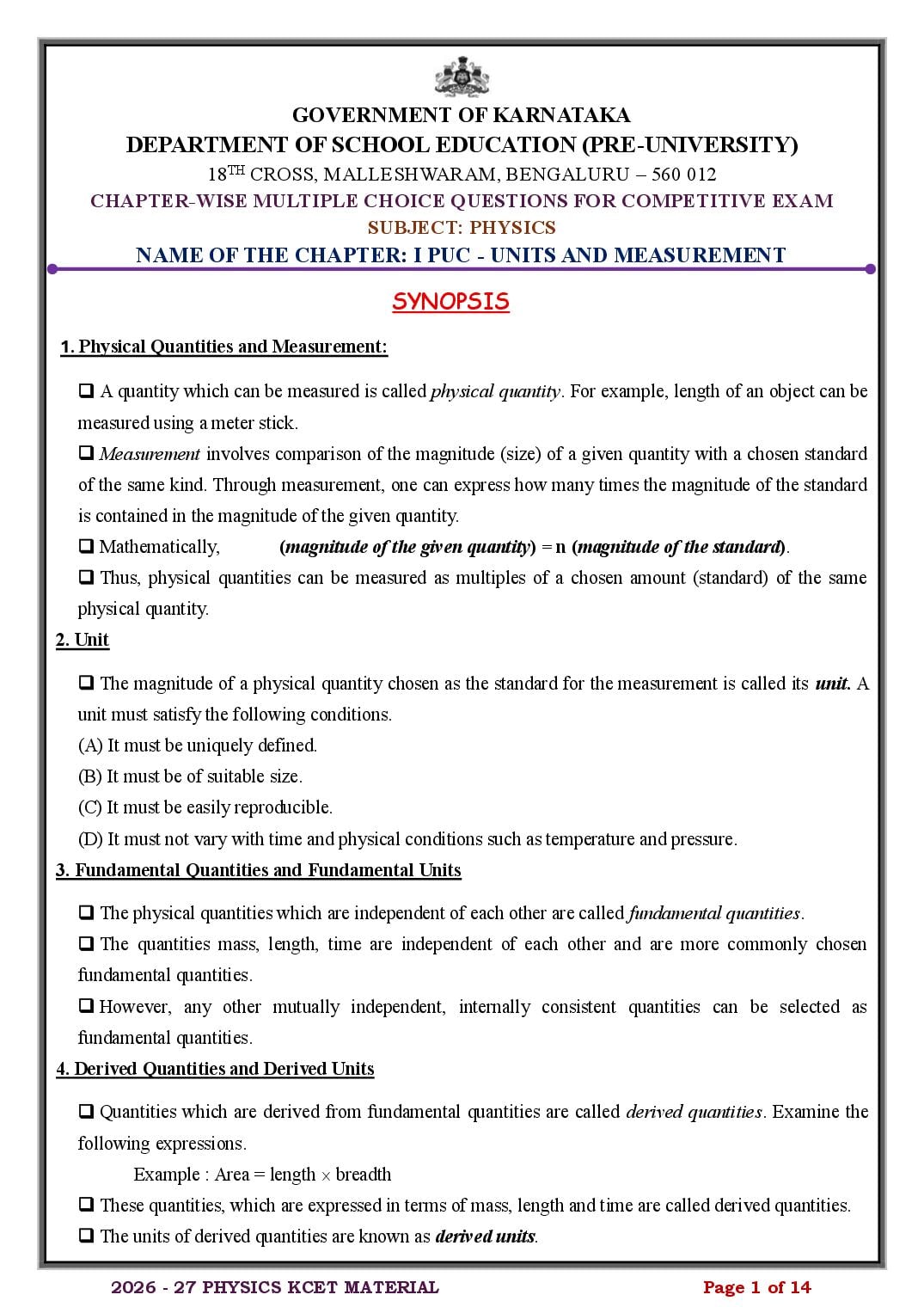
Page 1
DEPARTMENT OF SCHOOL EDUCATION (PRE-UNIVERSITY)
18TH CROSS, MALLESHWARAM, BENGALURU – 560 012
CHAPTER-WISE MULTIPLE CHOICE QUESTIONS FOR COMPETITIVE EXAM
SUBJECT: PHYSICS
NAME OF THE CHAPTER: I PUC - UNITS AND MEASUREMENT
SYNOPSIS
1. Physical Quantities and Measurement:
❑ A quantity which can be measured is called physical quantity. For example, length of an object can be
measured using a meter stick.
❑ Measurement involves comparison of the magnitude (size) of a given quantity with a chosen standard
of the same kind. Through measurement, one can express how many times the magnitude of the standard
is contained in the magnitude of the given quantity.
❑ Mathematically, (magnitude of the given quantity) = n (magnitude of the standard).
❑ Thus, physical quantities can be measured as multiples of a chosen amount (standard) of the same
physical quantity.
2. Unit
❑ The magnitude of a physical quantity chosen as the standard for the measurement is called its unit. A
unit must satisfy the following conditions.
(A) It must be uniquely defined.
(B) It must be of suitable size.
(C) It must be easily reproducible.
(D) It must not vary with time and physical conditions such as temperature and pressure.
3. Fundamental Quantities and Fundamental Units
❑ The physical quantities which are independent of each other are called fundamental quantities.
❑ The quantities mass, length, time are independent of each other and are more commonly chosen
fundamental quantities.
❑ However, any other mutually independent, internally consistent quantities can be selected as
fundamental quantities.
4. Derived Quantities and Derived Units
❑ Quantities which are derived from fundamental quantities are called derived quantities. Examine the
following expressions.
Example : Area = length breadth
❑ These quantities, which are expressed in terms of mass, length and time are called derived quantities.
❑ The units of derived quantities are known as derived units.
2026 - 27 PHYSICS KCET MATERIAL Page 1 of 14
Page 2
and time. Therefore, a set of these three fundamental quantities is enough to study mechanics.
❑ But, the physical quantities such as electric field cannot be expressed using mass, length and time only.
❑ So a quantity in electricity is to be selected as fundamental. To meet such requirements, electric current,
thermodynamic temperature, amount of substance and luminous intensity are also recognized as
fundamental quantities.
❑ However, this choice is not unique and hence different systems of units are evolved.
Example 1
Referring to the following definitions and taking metre (m), kilogram (kg) and second (s) as fundamental
units obtain units of force, work and power.
(A) Acceleration is change in velocity per unit time.
(B) Force is equal to the product of the mass and acceleration.
(C) Work is product of force and displacement.
(D) Power is work done per unit time.
Example Solved:
𝑈𝑛𝑖𝑡 𝑜𝑓 𝑑𝑖𝑠𝑝𝑙𝑎𝑐𝑒𝑚𝑒𝑛𝑡
Unit of velocity = = 𝑚𝑠 −1
𝑈𝑛𝑖𝑡 𝑜𝑓 𝑡𝑖𝑚𝑒
𝑈𝑛𝑖𝑡 𝑜𝑓 𝑣𝑒𝑙𝑜𝑐𝑖𝑡𝑦 𝑚𝑠 −1
Unit of acceleration = = = 𝑚𝑠 −2
𝑈𝑛𝑖𝑡 𝑜𝑓 𝑡𝑖𝑚𝑒 𝑠
Unit of force = (Unit of mass) (Unit of acceleration) = kg m s−2 = kg m s−2
Unit of work = (Unit of force) (Unit of displacement) = kg m s−2 m = kg m2 s−2
𝑈𝑛𝑖𝑡 𝑜𝑓 𝑤𝑜𝑟𝑘 𝑘𝑔𝑚2 𝑠−2
Unit of power = 𝑈𝑛𝑖𝑡 𝑜𝑓 𝑡𝑖𝑚𝑒 = = 𝑘𝑔𝑚2 𝑠 −3
𝑠
5. Systems of Units
❑ Different systems of units were introduced over a time, to meet the requirement of understanding new
branches of physics. Following are the few examples of such systems of units.
(a) FPS (British) system: In this system, foot, pound and second are the units of length, mass and time
respectively.
(b) CGS system: This system was established in France. In this system, centimetre, gram and second
are units of length, mass and time respectively.
(c) MKS system: It was also established in France. In this system, metre, kilogram and second are the
units of length, mass and time respectively.
(d) SI Units: This is the most widely used system in all scientific measurements and is internationally
accepted. This system is discussed in greater detail.
2026 - 27 PHYSICS KCET MATERIAL Page 2 of 14
Page 3
❑ International System of Units (SI) was adopted in 1971 at the general conference on weights and measures.
❑ It is abbreviated as SI from the French name ‘Le Systeme International de Unites’. This system is well
accepted and has its own advantages which are listed later in this chapter.
❑ In SI, there are seven fundamental units (also called base units) and two supplementary units.
❑ Advantages of SI system of units
(a) Unlike FPS system, it is a metric system. Multiples and submultiples of a unit in this system can be
expressed as suitable powers of 10.
(b) Same unit with proper prefixes can be used for a wide range of magnitudes of a physical quantity.
(c) In this system, only one unit is used for each physical quantity. Hence, it is a rationalized system of units .
(d) Derived units in SI can be expressed in terms of fundamental units without numerical factors. Thus it
is a coherent system of units.
7. Dimensions
❑ Derived physical quantities can be expressed as the product or quotient of the fundamental quantities
raised to some exponents. The exponents of the fundamental quantities appearing in the expression are
called dimensions.
❑ Density can be expressed in terms of mass and length.
❑ Further, it is directly related to first power of mass and inversely related to third power of length.
Therefore, dimensions of density are 1 in mass and −3 in length.
𝐶ℎ𝑎𝑛𝑔𝑒 𝑖𝑛 𝑣𝑒𝑙𝑜𝑐𝑖𝑡𝑦 𝐷𝑖𝑠𝑝𝑙𝑎𝑐𝑒𝑚𝑒𝑛𝑡⁄𝑇𝑖𝑚𝑒 𝐿𝑒𝑛𝑔𝑡ℎ
Acceleration = = = 𝑇𝑖𝑚𝑒2 = 𝐿𝑇 −2
𝑇𝑖𝑚𝑒 𝑇𝑖𝑚𝑒
❑ Therefore, dimensions of acceleration are 1 in length and −2 in time.
❑ The dimensions of a derived quantity may be defined as the powers to which the fundamental
quantities are to be raised to represent it.
8. Dimensional Formulae and Equations
❑ Dimensional formula is an expression showing how and which of the fundamental units enter into the
unit of physical quantity.
❑ In dimensional formulae, mass is denoted by M, length by L, time by T and electric current by I.
Likewise thermodynamic temperature, amount of substance, and luminous intensity are denoted by the
symbols of their units k, mol, and cd respectively.
❑ Thus, dimensional formula of density can be written as ML −3 and that of acceleration as LT−2.
❑ A physical relationship in which all the physical quantities are replaced by their respective dimensional
formula is called dimensional equation.
Example 2
Among of the following quantities which one has zero dimension in time?
(A) Density (B) Force (C) Work (D) Angular momentum.
Answer (A)
2026 - 27 PHYSICS KCET MATERIAL Page 3 of 14
Page 4
Density = ML–3 Force = MLT–2
Work = ML2 T–2 Angular momentum = ML2T–1
9. Dimensional Analysis
❑ The process of careful examination of dimensions of the various physical quantities involved in a
relation is called dimensional analysis. The dimensional analysis is of great help in study of physics and
is mainly used to
(a) check the correctness of a given equation,
(b) deduce relations among physical quantities and
(c) convert a unit from one system to another.
❑ The dimensional analysis is based on the principle of homogeneity of dimensions. This principle is the
mere fact that physical quantities or similar nature can be compared, added or subtracted from one another,
but, not the dissimilar physical quantities. The principle can be stated as follows.
❑ In a physical relation dimensions of all the terms are equal.
To check the correctness of the equation
❑ From the principle of homogeneity of dimensions, it is clear that any given equation should be
dimensionally consistent. Thus, to check the correctness of the equation one can follow the procedure given
here.
1. Write the given equation.
2. Write the corresponding dimensional equation. (Replace each quantity appearing there in by its
dimensional formula).
3. Simplify each term separately.
4. Compare the dimensions of all the terms.
5. If dimensions of all the terms are equal conclude that the equation is dimensionally correct otherwise
it is incorrect.
To deduce a relation between different physical quantities
❑ The principle of homogeneity of dimensions also helps to derive an equation for a physical quantity if
the quantities on which the given physical quantity depends are known.
❑ The equation obtained is acceptable if it remains true irrespective of system of units employed.
❑ Since, the principle homogeneity verifies physical nature of each term regardless of units used; it can be
used to derive equations.
❑ To derive equation one can adopt the following procedure.
1. Write an arbitrary equation.
2. Write the corresponding dimensional equation.
3. Simplify the equation using theory of indices.
4. Equate the exponents of the fundamental quantities from both sides.
5. Solve these equations for unknown exponents.
6. Substitute these values in the arbitrary equation written in step 1.
2026 - 27 PHYSICS KCET MATERIAL Page 4 of 14
Page 5
❑ It is seen that magnitude of a physical quantity is expressed in terms of a number and the corresponding
unit.
❑ The magnitude of the physical quantity is the same regardless of the system of units employed to
measure it. This fact affords an easy method of changing over from one system of units to another.
❑ If n1 and n2 are the numerical values of a physical quantities corresponding to the units u 1 and u2, then
n1u1 = n2u2
10. Limitations of Dimensional Analysis
1. Correctness of the constants appearing in an equation cannot be verified.
2. While deriving equation, constant of proportionality cannot be obtained through this method.
3. Equations involving trigonometric and exponential functions cannot be verified or derived.
4. An equation can be derived only if it is of product type.
5. If the number of quantities on which the given quantity depends is more than the number of
fundamental quantities involved, the equation cannot be derived.
6. If a dimensional constant enters the relation, its nature must be clearly known.
11. Significant figures (digits)
Significant figures are those digits in a measurement that are known reliably plus the first digit which is
uncertain.
All digits which are obtained through a measurement are significant.
Following are the rules for determining the number of significant digits.
(i) All non-zero digits as well as the zeros between the non-zero digits are significant.
For example x = 4321 has four significant digits and y = 43021 has five significant digits.
(ii) Zeros to the left of a non-zero digit are not significant.
(iii) Zeros to the right of a non-zero digit are significant.
For example x = 180 has three significant figures.
(iv) All zeros to the right of a decimal point and to the left of a non-zero digit are not significant provided
there is only a zero to the left of a decimal point.
For example: x = 00063 has two significant digits and y = 10063 has five significant digits.
(v) The powers of 10 are not significant.
In the final result of an experiment, only the significant digits are to be retained. The number of digits that
are to be retained in the final result is determined by the estimated percentage error. The number of
significant figures is equal to number of digits in the percentage error. Larger number of significant figures
implies higher accuracy.
**************************
2026 - 27 PHYSICS KCET MATERIAL Page 5 of 14
Page 6
1. What is the unit of mass in FPS system?
(A) foot (B) kilogram (C) pound (D) gram
2. Which physical quantity has the same unit in all three systems of units?
(A) mass (B) length (C) second (D) time
3. The number of significant figures in 0.0069, 3.10 ×10⁴ and 2.300 are respectively
(A) 5, 5, 2 (B) 2, 3, 4 (C) 5, 3, 4 (D) 2, 2, 2
4. The sum of the numbers 436.32, 227.2 and 0.301 in appropriate significant figures is
(A) 663.821 (B) 663.82 (C) 663.8 (D) 664
5. The mass and volume of a body are 6.375 g and 1.5 cm 3, respectively. The density of the material of the
body in correct significant figures is
(A) 4.250 g/cm3 (B) 4.25 g/cm3 (C) 4.2 g/cm3 (D) 4.3 g/cm3
6. The length, breadth and thickness of a rectangular sheet of metal are 4.2 m, 1.001 m, and 2.10 cm
respectively. The volume of the sheet to correct significant figures is
(A) 0.0882882 m3 (B) 0.08829 m3 (C) 0.0883 m3 (D) 0.088 m3
7. The solid angle subtended by the periphery of an area of 1 cm2 at a point situated symmetrically at a
distance of 5 cm from the area is
(A) 0.04 sr (B) 0.05 sr (C) 0.2 sr (D) 25 sr
8. Assuming the radius of atom to be of the order of 1 Å and radius of nucleus of the order of fermi, how
many magnitudes higher is the volume of atom as compared to the volume of a nucleus?
(A) 5 (B) 105 (C) 1010 (D) 1015
9. The distance of the star Proxima Centauri is nearly 4 1016 m. The order of magnitude of time taken by
light to reach us from it is (speed of light in vacuum, c = 3 × 10⁸ m/s)
(A) 108 s (B) 109 s (C) 1010 s (D) 107 s
10. If P, Q, R are physical quantities, having different units, which of the following combinations can never
be a meaningful quantity?
(A) PQR (B) PQ/R (C) (R + Q)/P (D) (PR – Q2)/R
11. Young’s modulus of steel is 1.9 × 10¹¹ N/m2. Its value in CGS units (dynes/cm2) is equal to
(A) 1.9 × 10¹² (B) 1.9 × 10¹¹ (C) 1.9 × 10¹⁰ (D) 1.9 × 10⁹
12. If the unit of force is 100 N, unit of length is 10 m and unit of time is 100 s, what is the unit of mass in this
system of units?
(A)103 kg (B) 104 kg (C) 105 kg (D) 106 kg
13. A physical quantity is measured and its value is found to be “nu”, where n = numerical value and
u = unit. Which of the following relations is true?
1
(A) n u (B) n u2 (C) 𝑛 ∝ √𝑢 (D) 𝑛 ∝ 𝑢
2026 - 27 PHYSICS KCET MATERIAL Page 6 of 14
Page 7
Reason : Smaller the unit of measurement smaller is its numerical value.
(A) Both assertion and reason are true and the reason is the correct explanation of the assertion.
(B) Both assertion and reason are true and the reason is not the correct explanation of the assertion
(C) The assertion is true but reason is false.
(D) The assertion and reason both are false.
15. If the unit of length and force be increased four times, then the unit of energy is
(A) increased 4 times (B) increased 8 times
(C) increased 16 times (D) decreased 16 times
16. The density of a material in C.G.S. system is 8 g cm −3. In a system of units in which unit of length is 5 cm
and unit of mass is 20 g, the density of the material will be
(A) 1/80 units (B) 80 units (C) 1/50 units (D) 50 units
17. Match the following:
Column-1 Column-2
(A) i – a, ii – c, iii – b, iv – d
i) ampere a) joule/coulomb
(B) i – c, ii – a, iii – d, iv – b ii) volt b) joule/second
(C) i – d, ii – a, iii – b, iv – c iii) watt c) coulomb/volt
(D) i – b, ii – a, iii – d, iv – c iv) farad d) coulomb/second
18. Which one of the following is not a unit of electric field?
(A) N C–1 (B) V m–1 (C) J C–1 (D) J C–1 m–1
𝑎
19. The Van der Waals state equation for one mole of a real gas is given by (𝑃 + 𝑉 2 ) (𝑉 − 𝑏) = 𝑅𝑇, where P
– pressure, V – volume, R – Universal gas constant and T – absolute temperature. The units of a and b are
(A) N/m2 and m3 (B) Nm4 and m3
(C) Nm4 and m2 (D) N/m4 and m3
20. Which one among the following is different from others by units?
(A) Reynold’s number (B) Young’s modulus
(C) Refractive index (D) Poisson's ratio
21. Which of the following pairs is wrong?
(A) Pressure – Barometer (B) Mass – Spring balance
(C) Temperature – Thermometer (D) Potential difference – Voltmeter
22. Match List-1 with List-2 and select the correct answer by using the codes given below:
CODES List-1 List-2
a b c d a) Inter-atomic distance in a solid i) microns
(A) iii iv i ii b) Size of the nucleus ii) millimetre
(B) ii iv iii i c) Wavelength of infrared light iii) angstroms
(C) iv iii i ii d) Least count of ordinary ruler iv) fermi
(D) iv iii ii I
23. The temperature of a body on Kelvin scale is found to be X K. When it is measured by a Fahrenheit
thermometer, it is found to be Xo F. Then X is
(A) 301.25 (B) 574.25 (C) 313 (D) 40
2026 - 27 PHYSICS KCET MATERIAL Page 7 of 14
Page 8
𝐸 𝐿2
the SI unit of 𝑚4 𝐺 2 is
(A) metre (B) kilogram (C) second (D) radian
25. The pair of physical quantities that have no unit is
(A) Plane angle and solid angle.
(B) Acceleration due to gravity and gravitational constant.
(C) Dielectric constant and dielectric strength.
(D) Strain and coefficient of friction
26. The displacement y of a particle undergoing a certain periodic motion:
(a) y = a sin (2π t/T) (b) y = a sin (vt)
(c) y = (a/T) sin (t/a) (d) y = 2 a[sin (2πt/T) + cos (2πt/T)]
(where a = maximum displacement of the particle, v = speed of the particle. T = time-period of
motion).
Wrong formulas on dimensional grounds are
(A) (a) and (c) (B) (b) and (c) (C) (a) and (d) (D) (c) and (d)
0 2 –2
27. The dimensional formula [M L T ] stands for
(A) Torque (B) Angular momentum
(C) Latent heat (D) Coefficient of thermal conductivity
28. Which of the following are dimensionally correct?
(a) Pressure = Energy per unit area.
(b) Pressure = Energy per unit volume.
(c) Pressure = Force per unit area.
(d) Pressure = Momentum per unit volume per unit time
(A) (a) and (c) (B) (b) and (c) (C) (a) and (d) (D) (c) and (d)
29. The dimensions of "time constant" L during growth and decay of current in an inductive circuit is same
R
as that of
(A) Charge (B) Resistance (C) Current (D) Time
30. The dimensions of universal gravitational constant are
(A) [M–1 L2 T–2] (B) [M–1 L3 T–2] (C) [M L–3T2] (D) [ML2T–3]
31. The ratio of the dimensions of Planck's constant and that of moment of inertia is the dimension of
(A) frequency (B) velocity
(C) angular momentum (D) time
𝑏
32. The velocity v of a particle is given in terms of time t by the equation, v = a t + c + t.
The dimensions of a, b, c are respectively
(A) [L2], [T], [LT2] (B) [LT2], [LT], [T] (C) [LT−2], [L], [T] (D) [L], [LT], [T2]
𝑋
33. The dimensions of physical quantity X in the equation, force = density is given by
(A) [M L4 T–2] (B) [M2 L–2 T–1] (C) [M2 L–2 T–2] (D) [M1 L–2 T–1]
2026 - 27 PHYSICS KCET MATERIAL Page 8 of 14
Page 9
muscle?
(A) [MLT–2] (B) [ML2 T–2] (C) [ML T2] (D) [L]
35. A force F is given by the equation, F = a t + bt2, where t is time. What are the dimensions of a and b?
(A) [M L T–3] and [M L T–4] (B) [M L2T–2] and [M L2T–3]
(C) [M L T–2] and [M L T–3] (D) [M L T–1] and [M L T0]
36. Match the following:
Quantity Dimensions
(A) i – a, ii – c, iii – b, iv – d
i) Resistance a) [M L3 T–3A–2]
(B) i – c, ii – a, iii – d, iv – b
ii) Resistivity b) [M L2 T–3A–1]
(C) i – d, ii – a, iii – c, iv – b
iii) Mobility c) [M L2 T–3A–2]
(D) i – b, ii – a, iii – d, iv – c
iv) Electromotive force d) [M–1 L0 T2A]
37. Which pair has the same dimensions?
(A) Energy density and pressure (B) Density and relative density.
(C) Potential energy & modulus of elasticity. (D) Stress and strain.
38. Identify the pair which has different dimensions.
(A) Work and torque. (B) Tension and surface tension.
(C) Impulse and linear momentum (D) Angular momentum and Planck’s constant.
39. The fundamental physical quantities that have same dimensions in the dimensional formulae of torque and
angular momentum are
(A) Mass, time (B) Time, length (C) Mass, length (D) Time, mole
40. Which one of the following group has different dimensions?
(A) Potential difference, EMF, voltage. (B) Pressure, stress, Young's modulus.
(C) Torque, energy, Work. (D) Dipole moment, electric flux, electric field
41. Out of following four-dimensional quantities, which one quantity is to be called a dimensional constant?
(A) Acceleration due to gravity (B) Surface tension of water
(C) Weight of a standard kilogram mass (D)The velocity of light in vacuum
42. If momentum (P), area (A) and time (T) are taken to be fundamental quantities, then dimensional formula
of energy is
(A) [P1 A–1 T1] (B) [P1 A½ T–1] (C) [P1 A–½ T1] (D) [P2 A1 T1]
43. If Planck’s constant (h) and speed of light in vacuum (c) are taken as two fundamental quantities, which
one of the following can, in addition, be taken to express length, mass and time in terms of the three chosen
fundamental quantities?
(A) Boltzmann constant (B) Charge of electron
(C) Universal gas constant (D) Universal gravitational constant
44. If R and L represent respectively resistance and self-inductance, which of the following combinations has
the dimensions of frequency?
𝐿 𝑅 𝑅 𝐿
(A) 𝑅 (B) 𝐿 (C) √ 𝐿 (D) √𝑅
2026 - 27 PHYSICS KCET MATERIAL Page 9 of 14
Page 10
represents speed of light, then non-zero integers x, y and z such that PxQycz is dimensionless, are
(A) x = 1, y = 1, z = 1 (B) x = 1, y = 1, z = –1
(C) x = –1 , y = 1, z = 1 (D) x = 1, y = –1, z = 1
46. Assertion : Force cannot be added to pressure.
Reason : Two physical quantities with different dimensions cannot be added.
(A) Both assertion and reason are true and the reason is the correct explanation of the assertion.
(B) Both assertion and reason are true and the reason is not the correct explanation of the assertion.
(C) The assertion is true but reason is false.
(D) The assertion and reason both are false.
47. Assertion : L/R and CR both have same dimensions
Reason : L/R and CR both have dimension of time.
(A) Both assertion and reason are true and the reason is the correct explanation of the assertion.
(B) Both assertion and reason are true and the reason is not the correct explanation of the assertion.
(C) The assertion is true but reason is false.
(D) the assertion and reason both are false.
48. Let [0] denote the dimensional formula of the permittivity of vacuum and [μ0] that of the permeability of
vacuum, then which of the following is correct?
(A) [0] = [M–1L–3 T2A] and [μ0] = [M L T–2A–2]
(B) [0] = [M–1L–3 T4A2] and [μ0] = [M L T–2A–2]
(C) [0] = [M–1L–3 T–2A] and [μ0] = [M L T–2A–2]
(D) [0] = [M–1L–3 T–2A–2] and [μ0] = [M L T–2A–2]
49. Which one of the following is WRONG?
1
(A) The quantity is dimensionally equal to velocity.
00
(B) The dimensions of 0E2 is same as that of energy density, where E is electric field.
1
(C) The quantity is dimensionally equal to frequency, where L is inductance, C is capacitance.
√𝐿𝐶
(D) The quantity LI2 is dimensionally equal to energy, L is inductance and I is current.
50. The frequency of vibration f of a mass m suspended from a spring of spring constant K is given by a
relation of this type f = Cmx K y ; where C is a dimensionless quantity. The value of x and y are
(A) x = ½ , y = ½ (B) x = ½ , y = –½ (C) x = –½ , y = –½ (D) x = – ½ , y = ½
𝜀 𝐿𝑉
51. The quantity 𝑋 = 0𝑡 : 0 is the permittivity of free space, L is length, V is potential difference and t is
time. The dimensions of X are same as that of
(A) Resistance (B) Charge (C) Voltage (D) Electric Current
52. Given that v is speed, R is the radius and g is the acceleration due to gravity. Which of the following is
dimensionless?
𝑣2 𝑣2 𝑅 𝑣2𝑔
(A) 𝑅𝑔 (B) 𝑔 (C) 𝑅 (D) v2Rg
2026 - 27 PHYSICS KCET MATERIAL Page 10 of 14
Page 11
53. Let L be inductance, R be resistance, C be capacitance and V be potential, The dimensions of is
𝑅𝐶𝑉
(A) [A] (B) [A2] (C) [A–1] (D) [A–2]
54. A physical quantity x depends on quantities y and z as follows: x = Ay + B tan(Cz), where A, B and C are
constants having dimensions. Which of the following do not have the same dimensions?
(A) x and B (B) C and z–1 (C) y and B/A (D) x and A
55. If the time period (T) of vibration of a liquid drop depends on surface tension (S), radius (r) of the drop
and density () of the liquid, then the expression of T is (k-constant of proportionality)
1
ρ r3 𝜌2 r 3 ρ r3 𝜌2 𝑟3
(A) T=k√ 𝑆 (B) T=k√ 𝑆 (C) T=k√ 1 (D) 𝑇 = 𝑘 √ 𝑆 1/2
𝑆2
56. The time period of a body under SHM is represented by T = Pa DbSc ; where P is pressure, D is density and
S is surface tension. The value of a, b and c are respectively
1 1 3 1 3 1
(A) 1,2, 3 (B) –1 , –2 , 3 (C) 2 , − 2 , − 2 (D) − 2 , 2 , 1
57. A small steel ball of radius r is allowed to fall under gravity through a column of a viscous liquid of
coefficient of viscosity η. After some time, the velocity of the ball attains a constant value known as
terminal velocity vt . The terminal velocity depends on the mass of the ball m, coefficient of viscosity η,
radius r and acceleration due to gravity g. Which of the following relations is dimensionally correct?
Let k be the constant of proportionality.
𝑚𝑔 𝜂𝑟 𝑚𝑔𝑟
(A) 𝑣𝑡 = 𝑘 𝜂 𝑟 (B) 𝑣𝑡 = 𝑘 𝑚 𝑔 (C) 𝑣𝑡 = 𝑘 𝜂 𝑟 𝑚 𝑔 (D) 𝑣𝑡 = 𝑘 𝜂
58. The Martians use force (F), acceleration (A) and time (T) as their fundamental physical quantities. The
dimensions of length and mass on Martians system respectively are
(A) [A2T] and [FA–1](B) [AT] and [FA–1] (C) [AT–2] and [FA] (D) [AT2] and [FA–1]
59. If L, C and R denote the inductance, capacitance and resistance respectively, the dimensional formula of
C2LR is
(A) [ML–2T–1] (B) [M0L0T3] (C) [M–1L–2T6A2] (D) [M0L0T2]
60. If the velocity of light in vacuum (c), gravitational constant (G) and Planck's constant (h) are chosen as
fundamental units, then the dimensions of mass in new system is
(A) c½ G½ h½ (B) c½ G½ h–½ (C) c½ G–½ h½ (D) c–½ G½ h½
61. Which of the following are not a unit of time?
(a) second (b) Parsec (c) Year (d) Light year
(A) only (d) (B) (a) and (b) (C) (b) and (d) (D) (c) and (d)
62. A dimensionless quantity
(A) never has a unit (B) always has a unit (C) may have a unit (D) does not exist.
63. Choose the incorrect statement.
(A) A dimensionally correct equation may be correct.
(B) A dimensionally correct equation may be incorrect.
(C) A dimensionally incorrect equation may be correct.
(D) A dimensionally incorrect equation may be incorrect
2026 - 27 PHYSICS KCET MATERIAL Page 11 of 14
Page 12
64. If 𝑍 = ; then
𝐴+𝐵
(A) The dimensions of Z and A are the same (B) The dimensions of Z and B are the same
(C) Z is dimensionless quantity (D) A, B and Z have the same dimension
65. If momentum P, area A and time T are taken to be the fundamental quantities, then the dimensional formula
for moment of couple is
1 1
(A) [𝑃2 𝐴 𝑇 −2 ] (B) [𝑃𝐴−1 𝑇 −2 ] (C) [𝑃 𝐴2 𝑇 −1 ] (D) [𝑃2 𝐴 𝑇 −1 ]
66. Out of the following pairs, which does not have identical dimensions?
(A) Angular momentum and Planck’s constant (B) Impulse and momentum
(C) Moment of inertia and moment of force (D) Work and torque
67. A, B, C and D are four different physical quantities having different dimensions. None of them is
dimensionless. But we know that the equation AD = C ln (BD) holds true. Then which of the combination
is not a meaningful quantity?
𝐴𝐷−𝐶 𝐴 𝐶 𝐴𝐷2
(A) 𝐴2 − 𝐵2 𝐶 2 (B) (C) 𝐵 − 𝐶 (D) 𝐵𝐷 − 𝐶
𝐷
68. If velocity, time and force were chosen as basic quantities, the dimensions of mass is:
(A) [FTV] (B) [FT −1 V −1 ] (C) [FTV−1 ] (D) [F −1 TV]
69. Amount of solar energy received on the earth’s surface per unit area per unit time is defined as solar
constant. Dimensional formula of solar constant is
(A) [𝑀𝐿𝑇 −2 ] (B) [𝑀𝐿0 𝑇 −3 ] (C) [𝑀2 𝐿0 𝑇 −1 ] (D) [𝑀𝐿2 𝑇 −2 ]
𝐸
70. If E and G respectively denote energy and gravitational constant, then 𝐺 has the dimensions of:
(A) [𝑀𝐿−1 𝑇 −1 ] (B) [𝑀𝐿0 𝑇 0 ] (C) [𝑀2 𝐿−2 𝑇 −1 ] (D) [𝑀2 𝐿−1 𝑇 0 ]
1 𝐸 𝑙
71. The quantities 𝑥 = , 𝑦 = 𝐵 and 𝑧 = 𝑅𝐶 are defined, where C is capacitance, R is resistance, 𝑙 is
√𝜇 0 𝜀 0
length, E is electric field, B is magnetic field. Then,
(A) x, y and z have the same dimension (B) Only x and z have the same dimension
(C) Only x and y have the same dimension (D) Only y and z have the same dimension
2
72. The time dependence of physical quantity p is given by 𝑝 = 𝑝0 𝑒 −𝛼𝑡 , where 𝛼 is a constant and t is the
time. The constant 𝛼 is
(A) dimensionless (B) has dimensions [𝑇 −2 ]
(C) has dimensions [𝑇 2 ] (D) has dimensions 𝑝
73. If L, C and R are the self-inductance, capacitance and resistance respectively, which one of the following
does not have the dimension of time?
𝐿 𝐿
(A) RC (B) 𝑅 (C) √𝐿𝐶 (D) 𝐶
74. The force is given in terms of time t and displacement x by the equation: 𝐹 = 𝐴 cos 𝐵𝑥 + 𝐶 sin 𝐷𝑡. The
𝐴𝐷
dimensional formula of is
𝐵
(A) [𝑀𝐿𝑇 −2 ] (B) [𝑀2 𝐿2 𝑇 −3 ] (C) [𝑀0 𝐿𝑇 −1 ] (D) [𝑀𝐿2 𝑇 −3 ]
75. If velocity of light C, Planck’s constant h and gravitational constant G are taken as fundamental quantities
then length in terms of dimensions of these quantities is equal to
𝐺ℎ 𝐺ℎ 𝐺ℎ 𝑐ℎ
(A) √ 𝑐 3 (B) √ 𝑐 5 (C) 𝑐 3 (D) √ 𝐺
*******
2026 - 27 PHYSICS KCET MATERIAL Page 12 of 14
Page 13
1 2 3 4 5 6 7 8 9 10 11 12 13 14 15
C D B C C D A D A C A C D C C
16 17 18 19 20 21 22 23 24 25 26 27 28 29 30
D C C B B B A B B D B C B D B
31 32 33 34 35 36 37 38 39 40 41 42 43 44 45
A C C A A B A B C D D B D B D
46 47 48 49 50 51 52 53 54 55 56 57 58 59 60
A A B A D D A C D A D A D B C
61 62 63 64 65 66 67 68 69 70 71 72 73 74 75
C C C C C C D C B D A B D D A
2026 - 27 PHYSICS KCET MATERIAL Page 13 of 14
Page 14
1. A cylindrical wire has a mass (0.3 ± 0.003) 𝑔, radius (6 ± 0.06) 𝑐𝑚. The maximum percentage error in
the measurement of its density is [KCET-2020]
(A) 2 (B) 3 (C) 4 (D) 1
−1
2. The physical quantity which is measured in the unit of 𝑊𝑏 𝐴 is [KCET-2021]
(A) self-inductance (B) self-inductance
(C) magnetic flux (D) both (A) and (B)
3. The vernier scale of a travelling microscope has 50 divisions which coincide with 49 main scale divisions.
If each main scale division is 0.5 mm, then the least count of the microscope is [KCET-2022]
(A) 0.01 𝑚𝑚 (B) 0.5 𝑐𝑚 (C) 0.01 𝑐𝑚 (D) 0.5 𝑚𝑚
4. The true length of a wire is 3.678 cm. When the length of this wire is measured using instrument A, the
length of wire is 3.5 cm. When the length of the wire is measured using instrument B, it is found to
have length 3..8 cm. Then the [KCET-2023]
(A) measurement with A is more accurate while measurement with B is more precise
(B) measurement with B is more accurate and is precise
(C) measurement with A is more precise while measurement with B is more accurate
(D) measurement with A is more accurate and is precise
5. Dimensional formula for activity of a radioactive substance is [KCET-2024]
(A) [𝑀0 𝐿1 𝑇 −1 ] (B) [𝑀0 𝐿−1 𝑇 0 ] (C) [𝑀0 𝐿0 𝑇 −1 ] (D) [𝑀 −1 𝐿0 𝑇 0 ]
6. Which of the following expressions can be deduced on the basis of dimensional analysis? (All symbols
have their usual meanings) [KCET-2025]
1
(A) 𝑠 = 𝑢𝑡 + 2 𝑎𝑡 2 (B) 𝑥 = 𝐴 cos 𝜔𝑡 (C) 𝑁 = 𝑁0 𝑒 −𝜆𝑡 (D) 𝐹 = 6𝜋𝜂𝑟𝑣
7. Match the physical quantities given in the List-I with dimensions expressed in terms of mass (M), length
(L) time (T) and electric current (A) given in list-II. [KCET-2026]
List-I List-II
(a) Torque (i) [𝑀 −1 𝐿−2 𝑇 4 𝐴2 ]
(b) Gravitational constant (ii) [𝑀1 𝐿2 𝑇 −1 ]
(c) Capacitance (iii) [𝑀 −1 𝐿3 𝑇 −2 ]
(d) Planck’s constant (iv) [𝑀1 𝐿2 𝑇 −2 ]
(A) (a) – (iv) , (b) – (ii) , (c) – (iii) , (d) – (i) (B) (a) – (iv) , (b) – (iii) , (c) – (i) , (d) – (ii)
(C) (a) – (iv) , (b) – (i) , (c) – (iii) , (d) – (ii) (D) (a) – (ii) , (b) – (i) , (c) – (iii) , (d) – (iv)
KEY ANSWERS
1 2 3 4 5 6 7
B B B A C A B
2026 - 27 PHYSICS KCET MATERIAL Page 14 of 14
Document Details
| Board / Org | Karnataka Board |
| Exam | Class 11 |
| Type | Question Bank |
| Pages | 14 |
| Updated | 24 Sep 2026 |