HBSE Class 10 Sample Paper 2026 Answers Mathematics Standard
Finished viewing? Save it for later —
Download HBSE Class 10 Sample Paper 2026 Answers Mathematics Standard (PDF · 26 pages)About HBSE Class 10 Sample Paper 2026 Answers Mathematics Standard
HBSE Class 10 Sample Paper 2026 Answers Mathematics Standard is available here for free download. Published by Haryana Board for Class 10, this answer key can be viewed online or downloaded as a PDF (26 pages). Candidates preparing for Class 10 can use HBSE Class 10 Sample Paper 2026 Answers Mathematics Standard to understand the exam pattern, the type of questions asked, and the overall difficulty level.
Frequently Asked Questions
How can I download HBSE Class 10 Sample Paper 2026 Answers Mathematics Standard?
Open this page and click the Download button to save HBSE Class 10 Sample Paper 2026 Answers Mathematics Standard as a PDF. It is completely free on AglaSem Docs.
Is HBSE Class 10 Sample Paper 2026 Answers Mathematics Standard free to download?
Yes. HBSE Class 10 Sample Paper 2026 Answers Mathematics Standard can be viewed online and downloaded as a PDF free of cost on AglaSem Docs.
How many pages does HBSE Class 10 Sample Paper 2026 Answers Mathematics Standard have?
HBSE Class 10 Sample Paper 2026 Answers Mathematics Standard contains 26 pages, which you can read online or download together as a single PDF.
Where can I find more Class 10 study material?
You can find more Class 10 question papers, sample papers, syllabus, and answer keys on AglaSem Docs.
HBSE Class 10 Sample Paper 2026 Answers Mathematics Standard – Text
Read the full text of this answer key below — useful to quickly search, copy and reference the content online without downloading the PDF.
📄 View text version (26 pages)
Page 1
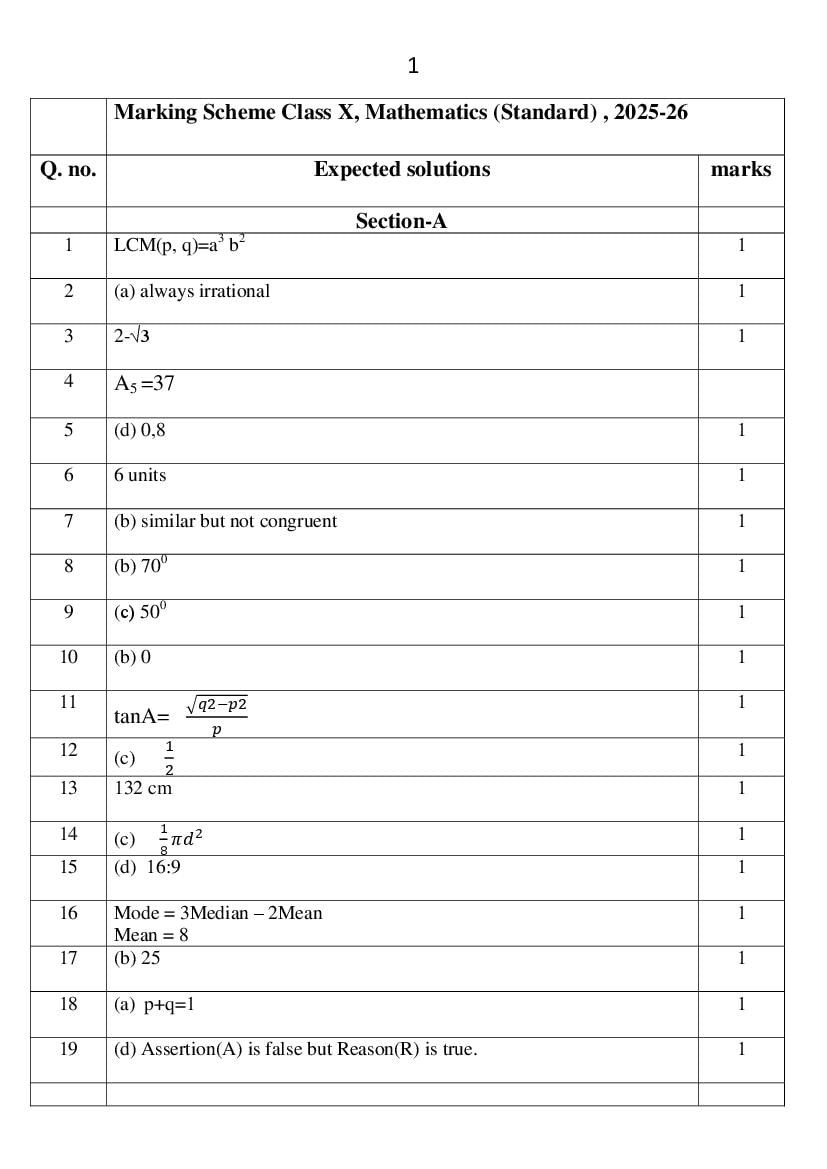
Marking Scheme Class X, Mathematics (Standard) , 2025-26
Q. no. Expected solutions marks
Section-A
3 2
1 LCM(p, q)=a b 1
2 (a) always irrational 1
3 2-√3 1
4 A5 =37 1
5 (d) 0,8 1
6 6 units 1
7 (b) similar but not congruent 1
8 (b) 700 1
9 (c) 500 1
10 (b) 0 1
11 √ 1
tanA=
12 (c) 1
13 132 cm 1
14 (c) 1
15 (d) 16:9 1
16 Mode = 3Median – 2Mean 1
Mean = 8
17 (b) 25 1
18 (a) p+q=1 1
19 (d) Assertion(A) is false but Reason(R) is true. 1
Page 2
20 (b) Both Assertion(A) and Reason (R) are true but Reason (R) is the not 1
correct explanation of Assertion(A).
Q. no. solution marks
Section-B
21 Solve the following pair of linear equations:
and
Solution:
.................(1)
½
bx - y = 4 b................(2)
----------------------------------------------------------------------------------------
Adding (1) and (2) 3bx=6 b ½
----------------------------------------------------------------------------------
x=2
½
---------------------------------------------------------------------------------------
Putting value of x = 2 in eq (1) , we get y= -2b ½
22(a) A vertical pole of length 6 m casts a shadow 4 m long on the ground
and at the same time a tower casts a shadow 28 m long. Find the
height of the tower.
Solution:
Let x be the height of the Tower ½
Page 3
Two Triangles are similar as at the same time
½
=
Or x = 42 m ½
OR
22(b) ½
In the fig., Prove that PQR is
an isosceles triangle.
Solution:
( Given )
So, ST QR (Converse of BPT)
-----------------------------------------------------------------------------------
½
.............(1) ( Corresponding Angles )
-----------------------------------------------------------------------------------
Also ...........(2) (Given) ½
[From (1) and (2) ]
---------------------------------------------------------------------------------------
½
So PQ = PR (sides opposite to equal angles)
Hence PQR is an isosceles Triangle
½
Page 4
23 Two concentric circles are of radii 5 cm and 3 cm. Find the length of
the chord of the larger circle which touches the smaller circle.
Solution:
1/2
OA=5cm,OP=3cm
-----------------------------------------------------------------------------------------
OT 1/2
---------------------------------------------------------------------------------------
1/2
Therefore AP =√ =√ =4
----------------------------------------------------------------------------------------
1/2
AB= 2AP
24 Evaluate the following: .
If 8cot evaluate
( )
Solution: =
1
---------------------------------------------------------------------------------
tan2
½
Page 5
---------------------------------------------------------------------------------
= =
½
25(a)
A chord of a circle of radius 15 cm subtends an angle of 600 at the
centre. Find the areas of the corresponding minor and major
segments of the circle.
(Use √ =1.73)
Solution:
Area of minor segment= - ½
---------------------------------------------------------------------------------------
= 3.14 -
√
= 3.14 225 6 - ½
----------------------------------------------------------------------------------------
=117.75 - 97.312
= 20.4375 cm2 ½
---------------------------------------------------------------------------------------
Area of major segment = Area of circle – Area of minor segment
= 3.14 x (15)2 – 20.4375
= 706.5- 20.4375
= 686.0625 cm2 ½
OR
Page 6
25(b) The minute hand of clock is 28 cm long. Find the area swept by the
minute hand in 15 minutes.
Solution:
In 60 minutes, minutes hand covers angle = 3600
In 15 minutes, minutes hand covers angle = 900 ½
------------------------------------------------------------------------------
½
----------------------------------------------------------------------------------
½
-------------------------------------------------------------------------------------
2
½
= 616 cm
Section-C
26. Prove that √ is irrational.
Solution:
Let, if possible, be a rational number ½
-----------------------------------------------------------------------------------------
√ = , where p and q are co-prime integers and q . ½
---------------------------------------------------------------------------------------
5=
p2 = 5 q2 ................................(i)
5 divides p2 5 divides p also. ½
----------------------------------------------------------------------------------------
Let p = 5m,................................(ii) where m is any integer.
p2 = 25m2................................(iii)
½
------------------------------------------------------------------------------------
From (i) and (iii)
5q2 = 25m2
Page 7
q2= 5m2
5 divides q2 5 divides q also. ½
q = 5n......................................(iv) where n is any integer
---------------------------------------------------------------------------------------
From (i) and (iv) , p and q have 5 as common factor.
p and q are not co-prime.
Hence our supposition is wrong.
√ is an irrational number. ½
27 If zeroes of the quadratic polynomial x2+(a+1)x+ b are 2 and -3,
then find the value of a and b.
Solution:
Sum of zeroes = = 2+ (-3) 1
-----------------------------------------------------------------------------------
- -1= -1 ½
--------------------------------------------------------------------------------------
Product of zeroes =
1
----------------------------------------------------------------------------------------
½
Find the value(s) of K for which the following pair of linear equations
28(a) have infinite number of solutions.
2x+3y-7=0 and (K+1)x + (2K-1)y =4K+1
Solution:
Page 8
linear equations have infinite number of solutions given
½
-----------------------------------------------------------------------------------
½
------------------------------------------------------------------------------------
From (i) and (ii) 2(2K-1)= 3(K+1) ½
------------------------------------------------------------------------------------
4K-2 = 3K+3
K=5
½
-----------------------------------------------------------------------------------
From (ii) and (iii)
½
3(4K+1)= 7(2K-1)
------------------------------------------------------------------------------------
12K+3= 14K-7 K=5
½
OR
Page 9
28(b)
The age of the father is twice the sum of the ages of his two children.
After 20 years , his age will be equal to the sum of the ages of his
children. Find the present ages of the father and each son.
Solution :
Let father’s present age be x years and his son’s ages be y years each.
1
A.T.Q x= 2(y + y) x- y ………………
-------------------------------------------------------------------------------------
After 20 years
x+ 20 = (y + 20+ y +20)
1
x – 2y = 20 ………….(2)
----------------------------------------------------------------------------------------
Subtracting equation (1) from (2), we get
x-2y –( x – 4y ) = 20
½
2y = 20
y = 10
----------------------------------------------------------------------------------------
Put y = 10 in eq. (1), we get
x - 4(10) = 0
x = 40
½
Thus, present age of father = x = 40 years and
present age of each son = y =10 years.
29 Prove that a parallelogram circumscribing a circle is a rhombus.
Solution:
½
Page 10
--------------------------------------------------------------------------------------
Given :- ABCD be a parallelogram circumscribing a circle with centre O. ½
To Prove :- ABCD is a rhombus.
---------------------------------------------------------------------------------------
Proof:- We know that the tangents drawn to a circle from an exterior
point are equal is length. ½
AP = AS, BP = BQ, CR = CQ and DR = DS.
----------------------------------------------------------------------------------------
AP+BP+CR+DR = AS+BQ+CQ+DS
½
(AP+BP) + (CR+DR) = (AS+DS) + (BQ+CQ)
AB+CD=AD+BC
----------------------------------------------------------------------------------------
or 2AB = 2AD (since AB = DC and AD=BC of parallelogram ABCD) ½
----------------------------------------------------------------------------------------
½
AB = BC = DC = AD
Therefore, ABCD is a rhombus.
30(a)
If sin θ + cos θ = √3, then prove that tan θ + cot θ = 1
Solution:
sin θ + cos θ = √3 squaring on both sides
(sin θ + cos θ)2 = 3
1/2
------------------------------------------------------------------------------
sin2 θ + cos2 θ + 2sin θ cos θ = 3 1/2
---------------------------------------------------------------------------
1 + 2sin θ cos θ = 3 ( sin2 θ + cos2 θ = 1 )
2sin θ cos θ = 3 - 1
Page 11
2sin θ cos θ = 2 1/2
Divide both sides by 2
--------------------------------------------------------------------------------------
sin θ cos θ = 1 = sin2 θ + cos2 θ 1/2
--------------------------------------------------------------------------------------
1 = (sin2 θ + cos2 θ)/ sin θ cos θ
1/2
--------------------------------------------------------------------------------------
= tan θ + cot θ = 1
1/2
OR
30(b) Prove that =
LHS=
Divide the numerator and denominator by sin A
=
------------------------------------------------------------------------------------------------ 1
= [ = ]
1
-------------------------------------------------------------------------------------------------
=
Taking (Cosec A + Cot A ) as common 1
Page 12
= Cosec A + Cot A = RHS Hence proved
31 A box contains 4 red marbles , 5 white marbles and 8 blue marbles.
One marble is taken out of the box at random. What is the
probability that the marble taken out will be
(i) blue ? (ii) not red ? (iii) white?
Solution:
Number of Red Marbles= 4
Number of White Marbles= 5
Number of Blue Marbles= 8
Total Number of Marbles= 4+5+8=17
P(E) =
1
(i) Probability of Blue Marble = P(Blue Marble) =
----------------------------------------------------------------------------------------
1
(ii) Probability of Not Red Marble = P(Not Red Marble) =
....................................................................................................................
(iii) Probability of White Marble = P(White Marble) =
1
SECTION-D
32(a)
A train travelling at a uniform speed for 360 km, would have taken 48
minutes less to travel same distance if its speed were 5 km/h more. Find
the original speed of the train.
Solution :
Let original speed of the train be x km/h.
1
Then, time taken to travel 360 km with speed x km/h = 360/x hours
Page 13
-----------------------------------------------------------------------------------------
New speed = (x + 5) km/hr
Time taken to travel 360 km with speed (x + 5) km/hr = 360/(x + 5) hours 1
--------------------------------------------------------------------------------------
ATQ =
1
=
---------------------------------------------------------------------------------
=
1
2
x + 5x - 2250 = 0
-------------------------------------------------------------------------------------
x2 + 50x – 45x- 2250 = 0
x(x+50) -45(x+50) = 0
(x+50)(x-45)=0
x = -50 or x = 45 1
As the speed cannot be negative, x = 45
Thus, the original speed of the train is 45 km/hr.
OR
32(b) A plane left 30 minutes later than the scheduled time and in order to
reach the destination 1500 km away in time, it has to increase the speed
by 250 km/h from the usual speed. Find its usual speed.
Solution
Let the usual speed of the plane be x km/h.
We know that time = distance/speed
Time taken by plane with speed x km/h = hours
Page 14
The increased speed of the plane = (x+250) km/h
Also, time taken by plane with speed (x+250) km/h = hours
1
--------------------------------------------------------------------------------------
ATQ
- =
- = 1
-----------------------------------------------------------------------------
=
x2 + 250x – 750000 = 0
1
-------------------------------------------------------------------------------------
x2 + 1000x -750x – 750000 = 0
X (x+1000) -750 (x+1000) = 0
(x+1000)(x-750)=0
x = -1000 or x = 750 1
Since x is the speed of the plane, it cannot be negative.
x = 750 gives the speed of the plane as 750 km/h.
33(a) Prove that if a line is drawn parallel to one side of a triangle
intersecting the other two sides in distinct points, then the other two
sides are divided in the same ratio.
Solution:
½
Given: In ΔABC, DE||BC
Page 15
½
½
To prove:
------------------------------------------------------------------------------------ ½
Construction : Draw EM AB and DN AC. Join B to E and C to D
----------------------------------------------------------------------------------------
Proof: In ΔADE and ΔBDE
½
= = --------------(i)
------------------------------------------------------------------------------------
In ΔADE and ΔCDE
½
= = -----------------(ii)
----------------------------------------------------------------------------------
Since, DE||BC [Given]
1
ar(ΔBDE) = ar(ΔCDE) --------------------------------------- (iii)
[Δs on the same base and between the same parallel sides are equal in
area]
--------------------------------------------------------------------------------------
Page 16
1
From eq. (i), (ii) and (iii)
: Hence proved.
-----------------------------------------------------------------------------------------
OR
33(b) D is a point on the side BC of a triangle ABC such that ADC
BAC. Show that CA CB CD.
Solution:
Given: In ΔABC , ADC= BAC
To Prove: CA2 = CB.
--------------------------------------------------------------------------------------------
Proof:
In ΔABC and ΔADC
BAC = ADC (Given)
ACB = ACD (Common)
ΔABC ∼ ΔADC (AA criterion)
--------------------------------------------------------------------------------------------
If two triangles are similar, then their corresponding sides are
proportional
Page 17
CA2 = CB × CD
Hence, proved.
34(a)
Solution:
Radius of the conical part, r= 5/2 cm.
Height of the conical part, h= 6 cm ½
Radius of the cylindrical part, R=3/2cm
Height of cylindrical part , H =(26 -6) cm
-----------------------------------------------------------------------------
Slant height of the conical part, ½
l= √ =√
=√ =√ =13/2cm
-----------------------------------------------------------------------------
Area to be painted orange
= curved suface area of the cone + base area of the cone - base
area of the cylinder 1
πrl + πr2 - πR2=π (rl + r 2- R2)
-----------------------------------------------------------------------------
=[3.14×(5/2×13/2+5/2×5/2-3/2×3/2)]cm2
Page 18
=[3.14×(65/4+25/4-9/4)]cm2=(3.14×81/4)cm2
=(3.14×20.25)cm2=63.585cm2 1
Area to the painted yellow
= curved surface area of the cylinder + base area of the cylinder 1
=2πRH+ πR2 =πR(2H+R)
-----------------------------------------------------------------------------
=[3.14×3/2×(2×20+3/2)]cm2
=(3.14×3/2×83/2)cm2=(781.864)cm2
=195.465cm2
OR 1
34(b).A juice seller was serving his customer using glasses as shown
in the figure. The inner diameter of the cylindrical glass was 5 cm but
bottom of the glass had a hemispherical raised portion which
reduced the capacity of the glass . If the height of the glass was
10cm, find the apparent and actual capacity of the glass.
[Use
Solution:
The inner radius of the glass = cm = 2.5 cm
Height of the glass = 10 cm ½
-------------------------------------------------------------------------------------
The apparent capacity of the glass =
=3.14×2.5×2.5×10 cm3=196.25 cm3
-------------------------------------------------------------------------------------
Volume of hemisphere = πr3= ×3.14×2.5×2.5×2.5 cm3=32.71 cm3
Page 19
----------------------------------------------------------------------------------------
The actual capacity of the glass = apparent capacity of glass - volume of
the hemisphere
=(196.25−32.71) cm3
=163.54 cm3
35(a)
Daily Pocket Number of (xi ) fi.ui
Allowance(Rs) children ui =
(fi )
mid values
11-13 7 12 -3 -21
1
13-15 6 14 -2 -12
15-17 9 16 -1 -9
17-19 13 18=a 0 0 1
19-21 f 20 1 f
21-23 5 22 2 10
23-25 4 24 3 12 1
∑fi= 44+f ∑ fi.ui = -20+f
-----------------------------------------------------------------------------------------
Mean= ̅=a+ Xh 1
-----------------------------------------------------------------------------------------
18=18 + x2
0= 2( -20 +f) f = 20 1
Page 20
OR
35(b) The median of the following data is 525.find the values of x and y, if
total frequency is 100.
Class Interval Frequency
वर्ग अंतराल बारं बारता
0-100 2
100-200 5
200-300 x
300-400 12
400-500 17
500-600 20
600-700 y
700-800 9
800-900 7
900-1000 4
Solution:
Class Interval Frequency Cummulative Frequency
वर्ग अंतराल बारं बारता
0-100 2 2
100-200 5 7
200-300 x 7+x
300-400 12 19 + x
400-500 17 36 + x
500-600 20 56 + x
600-700 y 56 + x + y 1
700-800 9 65 + x + y
800-900 7 72 + x + y
900-1000 4 76 + x + y
n = 100 50 1
So, 76 + x + y = 100 x + y = 24--------------------------(1)
---------------------------------------------------------------------------------------
Median = 525 Median class = 500 - 600
Page 21
1
So, l = 500, f = 20, c f = 36 + x, h = 100
--------------------------------------------------------------------------------------
Median = l + (
525 = 500 + ( × 100 1
-------------------------------------------------------------------------------------
525−500 = (14− x) × 5
25 = 70−5x
5x = 70−25 = 45 x=9
½
-----------------------------------------------------------------------------------
From (1), we get 9 + y = 24
y = 24 - 9= 15
½
SECTION-E
36 36. In April 2025, some new animals were added to a zoo. As a result the
number of visitors to the zoo, increased daily by 10. A total of 6150
people visited zoo during that month.
Based on the above information, answer the following questions:
(i) How many visitors visited the zoo on Ist April?
(ii) On which day of the month did 250 visitors visit the zoo?
(iii) How many persons visited the zoo in the last 5 days of the
month of April?
OR
How much collection (in rupees) from sale of tickets was done
in the zoo on 15th April, if each entry ticket costs Rs.50?
SOLUTION
(i) The number of visitors forms an A.P. where d=10, n=30 and
Page 22
S30=6150
Sn = [2a+(n−1)d]
1
6150 = [2a + (30−1)10]
410=2a + 290 a=60
(ii) an= 250 d= 10
an= a + (n-1) d
250= 60+ (n-1)10 n=20
250 visitors visited the zoo on 20th April.
1
----------------------------------------------------------------------------------
(iii) No. of visitors on the last 5 days of April = Total No. of visitors
in April- No. of visitors on first 25 days of April
1
= 6150 - [2x60 + (25−1)10]
1
=6150 – 25 x 180 = 6150- 4500
=1500
OR
1
No. of visitors on 15th April = 60 + ( 15- 1 )x10 =200
1
th
Collection from sale of tickets on 15 April = 200x50 = Rs. 10000
Page 23
37
Resident welfare Association (RWA) of a society put up three electric
poles A,B and C in a society’s park. Despite these three poles, some
parts of the park are still in dark. So, RWA decides to have one
more electric pole D in the park.
Based on the above information ,answer the following questions:
(i) Find the position of the pole C.
(ii) Find the distance of the pole B from corner O of the park.
(iii) Find the position of the fourth pole D so that four points A,B,C
and D form a parallelogram.
OR
Find the distance between poles A and C. 1
SOLUTION
(i) Position of point C(7,4)
---------------------------------------------------------------------------
1
(ii) Distance of pole B(4,9) from corner O(0,0)
=√ =√ units
--------------------------------------------------------------------------
1
(iii) A(1,5),B(4,9) ,C(7,4) are three vertices of parallelogram
ABCD and let D(x,y) be the fourth vertex
Mid-point of diagonal AC = Mid-point of BD
-----------------------------------------------------------------------
Page 24
( ( 1
x=4 ,y=0
D(4,0)
-------------------------------------------------------------------------
1
OR
Distance between Pole A and C = √
1
=√ =√
38. A group of students of class X visited India Gate on an educational
trip. The teacher and students had interest in history as well. The
teacher narrated that India Gate , official name Delhi Memorial,
originally called All-India War Memorial, monumental sandstone
arch in New Delhi,dedicated to the troops of British India who died
in wars fought between 1914 and 1919.The teacher also said that
India Gate ,which is located at the eastern end of the
Rajpath(formely called the Kingsway),is about 138 feet (42 metres) in
height.
Based on the above information answer the following questions:
(i)What is the angle of elevation if they are standing at a distance of
42 m away from the monument?
(ii) They want to see the tower at an angle of 600.So, they want to
know the distance where they should stand and hence find the
distance.
(iii)If the altitude of the Sun is at 600, then find the height of the
vertical tower that will cast a shadow of length 20m.
OR
The ratio of the length of a rod and its shadow is 1:1. Find the angle
of elevation of the Sun .
SOLUTION:
Page 25
1/2
(i) tan
------------------------------------------------------------------------------- 1/2
----------------------------------------------------------------------------------------
(ii)
½
tan
------------------------------------------------------------------
½
√ √ m
√
----------------------------------------------------------------------------------
(iii)
Page 26
1
tan
---------------------------------------------------------------------------------
1
√
OR
1
tan
------------------------------------------------------------------------------ 1
tan = 1
Document Details
| Board / Org | Haryana Board |
| Exam | Class 10 |
| Type | Sample Paper |
| Pages | 26 |
| Updated | 24 Sep 2026 |