Karnataka 2nd PUC Question Paper 2026 Chemistry
Finished viewing? Save it for later —
Download Karnataka 2nd PUC Question Paper 2026 Chemistry (PDF · 20 pages)About Karnataka 2nd PUC Question Paper 2026 Chemistry
Karnataka 2nd PUC Question Paper 2026 Chemistry is available here for free download. Published by Karnataka Board for Class 12, this question paper can be viewed online or downloaded as a PDF (20 pages). Candidates preparing for Class 12 can use Karnataka 2nd PUC Question Paper 2026 Chemistry to understand the exam pattern, the type of questions asked, and the overall difficulty level.
Frequently Asked Questions
How can I download Karnataka 2nd PUC Question Paper 2026 Chemistry?
Open this page and click the Download button to save Karnataka 2nd PUC Question Paper 2026 Chemistry as a PDF. It is completely free on AglaSem Docs.
Is Karnataka 2nd PUC Question Paper 2026 Chemistry free to download?
Yes. Karnataka 2nd PUC Question Paper 2026 Chemistry can be viewed online and downloaded as a PDF free of cost on AglaSem Docs.
How many pages does Karnataka 2nd PUC Question Paper 2026 Chemistry have?
Karnataka 2nd PUC Question Paper 2026 Chemistry contains 20 pages, which you can read online or download together as a single PDF.
Where can I find more Class 12 study material?
You can find more Class 12 question papers, sample papers, syllabus, and answer keys on AglaSem Docs.
Karnataka 2nd PUC Question Paper 2026 Chemistry – Text
Read the full text of this question paper below — useful to quickly search, copy and reference the content online without downloading the PDF.
📄 View text version (20 pages)
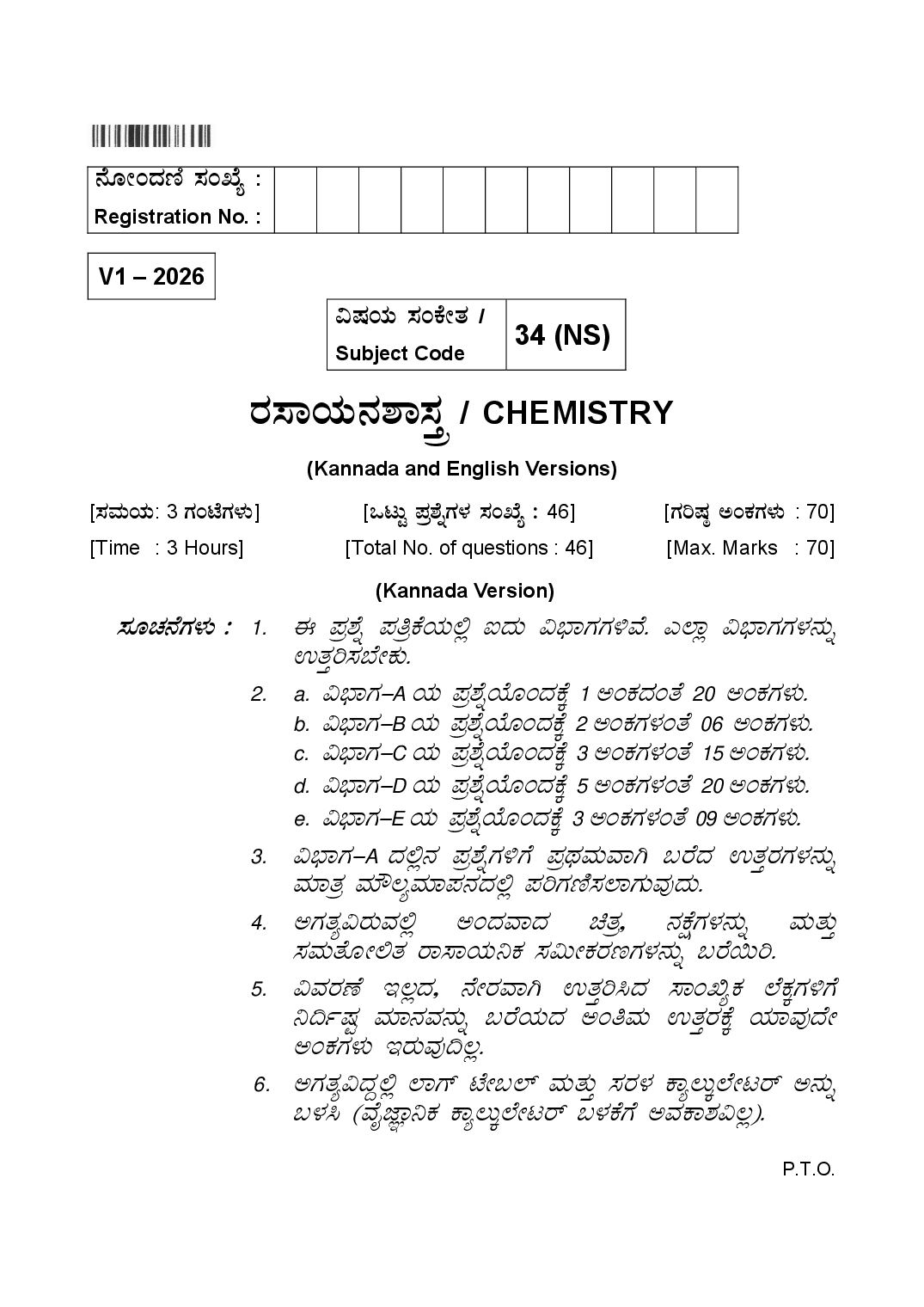
Page 1
Registration No. :
V1 – 2026
«µÀAiÀÄ ¸ÀAPÉÃvÀ /
34 (NS)
Subject Code
gÀ¸ÁAiÀÄ£À±Á¸ÀÛç / CHEMISTRY
(Kannada and English Versions)
[¸ÀªÀÄAiÀÄ: 3 UÀAmÉUÀ¼ÀÄ] [MlÄÖ ¥Àæ±ÉßUÀ¼À ¸ÀASÉå : 46] [UÀjµÀ× CAPÀUÀ¼ÀÄ : 70]
[Time : 3 Hours] [Total No. of questions : 46] [Max. Marks : 70]
(Kannada Version)
¸ÀÆZÀ£ÉUÀ¼ÀÄ : 1. F ¥Àæ±Éß ¥ÀwæPÉAiÀÄ°è LzÀÄ «¨sÁUÀUÀ½ªÉ. J¯Áè «¨sÁUÀUÀ¼À£ÀÄß
GvÀÛj¸À¨ÉÃPÀÄ.
2. a. «¨sÁUÀ-A AiÀÄ ¥Àæ±ÉßAiÉÆAzÀPÉÌ 1 CAPÀzÀAvÉ 20 CAPÀUÀ¼ÀÄ.
b. «¨sÁUÀ-B AiÀÄ ¥Àæ±ÉßAiÉÆAzÀPÉÌ 2 CAPÀUÀ¼ÀAvÉ 06 CAPÀUÀ¼ÀÄ.
c. «¨sÁUÀ-C AiÀÄ ¥Àæ±ÉßAiÉÆAzÀPÉÌ 3 CAPÀUÀ¼ÀAvÉ 15 CAPÀUÀ¼ÀÄ.
d. «¨sÁUÀ-D AiÀÄ ¥Àæ±ÉßAiÉÆAzÀPÉÌ 5 CAPÀUÀ¼ÀAvÉ 20 CAPÀUÀ¼ÀÄ.
e. «¨sÁUÀ-E AiÀÄ ¥Àæ±ÉßAiÉÆAzÀPÉÌ 3 CAPÀUÀ¼ÀAvÉ 09 CAPÀUÀ¼ÀÄ.
3. «¨sÁUÀ-A zÀ°è£À ¥Àæ±ÉßUÀ½UÉ ¥ÀæxÀªÀĪÁV §gÉzÀ GvÀÛgÀUÀ¼À£ÀÄß
ªÀiÁvÀæ ªÀiË®åªÀiÁ¥À£ÀzÀ°è ¥ÀjUÀt¸À¯ÁUÀĪÀÅzÀÄ.
4. CUÀvÀå«gÀĪÀ°è CAzÀªÁzÀ avÀæ, £ÀPÉëUÀ¼À£ÀÄß ªÀÄvÀÄÛ
¸ÀªÀÄvÉÆðvÀ gÁ¸ÁAiÀĤPÀ ¸À«ÄÃPÀgÀtUÀ¼À£ÀÄß §gɬÄj.
5. «ªÀgÀuÉ E®èzÀ, £ÉÃgÀªÁV GvÀÛj¹zÀ ¸ÁATåPÀ ¯ÉPÀÌUÀ½UÉ
¤¢ðµÀÖ ªÀiÁ£ÀªÀ£ÀÄß §gÉAiÀÄzÀ CAwªÀÄ GvÀÛgÀPÉÌ AiÀiÁªÀÅzÉÃ
CAPÀUÀ¼ÀÄ EgÀĪÀÅ¢®è.
6. CUÀvÀå«zÀÝ°è ¯ÁUï mÉç¯ï ªÀÄvÀÄÛ ¸ÀgÀ¼À PÁå®Ä̯ÉÃlgï C£ÀÄß
§¼À¹ (ªÉÊeÕÁ¤PÀ PÁå®Ä̯ÉÃlgï §¼ÀPÉUÉ CªÀPÁ±À«®è).
P.T.O.
Page 2
«¨sÁUÀ - A
I. PÉÆnÖgÀĪÀ DAiÉÄÌAiÀÄ°è ¸ÀjAiÀiÁzÀ GvÀÛgÀªÀ£ÀÄß Dj¹ §gɬÄj. (15 × 1 = 15)
1) F PɼÀV£À QæAiÉÄAiÀÄ°è GAmÁUÀĪÀ GvÀà£ÀߪÀÅ
H3C − CH2 − CH − CH3 Alc.KOH
| ⎯⎯ ⎯ ⎯ ⎯→
Δ
Br
a) 1-§Æånãï b) 2-§Æål£ÉÆïï
c) 1-¨ÉÆæêÉƧÆåmÉãï d) 2-§Æånãï
2) ºÉaÑ£À ¸ÀÆ̨Á qÉʪÀ¸ïð D¼ÀªÁzÀ qÉʪïUÀ¼À°è §¼À¸ÀĪÀ mÁåAPïUÀ¼À°è
vÀÄA©zÀ UÁ½AiÀÄ£ÀÄß ¸ÁgÀjPÀÛUÉƽ¸À®Ä vÀÄA§ÄªÀ »Ã°AiÀÄA£À
±ÉÃPÀqÁªÁgÀÄ
a) 32.1 b) 11.7
c) 74.2 d) 56.2
3) ¥ÀgÀªÀiÁtÄ ¸ÀASÉå 21 £ÀÄß ºÉÆA¢gÀĪÀ zsÁvÀĪÀÅ ¸ÁªÀiÁ£ÀåªÁV vÉÆÃgÀĪÀ
GvÀ̵Àðt ¹ÜwAiÀÄÄ
a) +3 b) +4
c) +5 d) +3 ªÀÄvÀÄÛ +5 JgÀqÀÆ
4) C¹nPï DªÀÄèzÀ ªÀÄÄRåªÁzÀ £ÉʸÀVðPÀ ªÀÄÆ®ªÀÅ
a) ºÁ®Ä b) «£ÉUÀgï
c) PÉA¥ÀÅ EgÀÄªÉ d) ¨ÉuÉÚ
Page 3
5) ¸Áå°¹°Pï DªÀÄèzÀ C¹mÉʯÉõÀ£ï¤AzÀ GvÀàwÛAiÀiÁUÀĪÀ ¸ÀAAiÀÄÄPÀÛªÀÅ
GjHvÀ¤ªÁgÀPÀ ªÀÄvÀÄÛ dégÀ¤ªÁgÀPÀ UÀÄtUÀ¼À£ÀÄß ºÉÆA¢zÉ.
F ¸ÀAAiÀÄÄPÀÛªÀÅ
a) ¨ÉÃPï¯ÉÊmï b) C¹nPï C£ïºÉÊqÉæ Êqï
c) ¥sÁªÀÄð°£ï d) D¹àj£ï
6) p-ºÉÊqÁæQìCgÉhÆèÉAfãï, ¦üãÁ¯ï£ÉÆA¢UÉ ¨ÉAfãï qÉÊCgÉhÆäAiÀÄA
PÉÆèÃgÉÊqï£À QæAiÉĬÄAzÀ gÀÆ¥ÀÅUÉƼÀÄîvÀÛzÉ.
a) E¯ÉPÁÖç£ï DPÁAQë DzÉñÀå QæAiÉÄ
b) £ÀÆåQèAiÉÆÃPÁAQë DzÉñÀå QæAiÉÄ
c) d®d¤ÃPÀgÀt QæAiÉÄ
d) ºÁå¯ÉÆÃd¤ÃPÀgÀt QæAiÉÄ
7) ªÉÊzÀågÀÄ 50 ªÀµÀðzÀ ªÀÄ»¼ÉUÉ ¸ÁPÀµÀÄÖ ¸ÀÆAiÀÄð£À ¨É¼ÀQUÉ MrØPÉƼÀÄîªÀAvÉ
ªÀÄvÀÄÛ DºÁgÀzÀ°è «ÄãÀÄ ªÀÄvÀÄÛ ªÉÆmÉÖAiÀÄ ºÀ¼À¢ ¯ÉÆüÉAiÀÄ£ÀÄß
¸Éë¸ÀĪÀAvÉ ¸À®ºÉ ¤ÃrzÀgÀÄ. ªÉÊzÀågÀÄ ¥ÀvÉÛºÀaÑzÀ AiÀiÁªÀ fêÀ¸ÀvÀézÀ
PÉÆgÀvɬÄAzÀ ¸ÀA¨sÁªÀå PÁ¬Ä¯ÉAiÀÄÄ §A¢zÉ ºÉ¸Àj¹.
a) fêÀ¸ÀvÀé D b) fêÀ¸ÀvÀé A
c) fêÀ¸ÀvÀé C d) fêÀ¸ÀvÀé B12
Page 4
8) gÁ¸ÁAiÀĤPÀ QæAiÉÄUÀ¼À QæAiÀiÁªÀUÀð ªÀÄvÀÄÛ CtÂéPÀvÉAiÀÄ §UÉÎ F PɼÀV£À
AiÀiÁªÀ ºÉýPÉ/UÀ¼ÀÄ vÀ¥ÁàVzÉ/ªÉ?
I. ªÀÄÆgÀÄ CtÄUÀ½VAvÀ ºÉZÁÑV KPÀPÁ®zÀ°è ¸ÀAWÀlÖ ªÀÄvÀÄÛ
¥ÀæwQæAiÉÄAiÀÄ ¸ÁzsÀåvÉUÀ¼ÀÄ §ºÀ¼À C®à.
II. QæAiÉÄAiÀÄ QæAiÀiÁªÀUÀðzÀ ªÀiË®åUÀ¼ÀÄ PÉêÀ® ªÀÄÆgÀÄ ªÀiÁvÀæ, CAzÀgÉ
±ÀÆ£Àå, ¥ÀæxÀªÀÄ ªÀÄvÀÄÛ JgÀqÀ£ÉAiÀÄzÀÄ.
III. QæAiÀiÁªÀUÀðªÀÅ QæAiÀiÁªÉÃUÀ ¸À«ÄÃPÀgÀtªÀ£ÀÄß CªÀ®A©¹gÀÄvÀÛzÉ. DzÀgÉ
CtÂéPÀvÉAiÀÄÄ M¼ÀUÉÆArgÀĪÀÅ¢®è.
IV. QæAiÀiÁªÀUÀðPÉÌ C£ÀAvÀ ¸ÀASÉåAiÀÄ ªÀiË®åUÀ¼ÀÄ EgÀ§ºÀÄzÀÄ.
a) I ªÀÄvÀÄÛ IV b) III ªÀiÁvÀæ
c) II ªÀÄvÀÄÛ IV d) II ªÀiÁvÀæ
9) F PɼÀV£À AiÀiÁªÀ UÀÄA¥ÀÅ ¥ÁågÁ ¸ÁÜ£ÀzÀ°ègÀĪÁUÀ C¤°Ã£ï£À
¥ÀævÁå«ÄèÃAiÀÄ ±ÀQÛAiÀÄ£ÀÄß ºÉaѸÀÄvÀÛzÉ?
a) –NO2 b) –Br
c) –NH2 d) –COOH
10) F PɼÀV£À PÉÆñÀUÀ¼À°è, C¥ÉÇïÉÆà ¨ÁºÁåPÁ±À PÁAiÀÄðPÀæªÀÄzÀ°è «zÀÄåvï
¥ÀÇgÉÊPÉUÁV G¥ÀAiÉÆÃV¹gÀĪÀ PÉÆñÀªÀÅ
a) SHE b) H2-O2 EAzsÀ£À PÉÆñÀ
c) qÉäAiÀįï PÉÆñÀ d) ¥ÁzÀgÀ¸ÀzÀ PÉÆñÀ
11) L¸ÉÆÃ¥ÉÆæ¥ÉÊ¯ï ªÉÄVßùAiÀĪÀiï ¨ÉÆæêÉÄÊqï ªÀÄvÀÄÛ J£ï-¥ÉÆæ¥Éʯï
ªÉÄVßùAiÀĪÀiï ¨ÉÆæêÉÄÊqï H2O £ÉÆA¢UÉ ¥ÀævÉåÃPÀªÁV ªÀwð¹ ¤ÃqÀĪÀ
¸ÁªÀAiÀĪÀ ¸ÀAAiÀÄÄPÀÛUÀ¼ÀÄ C£ÀÄPÀæªÀĪÁV
a) L¸ÉÆÃ¥ÉÆæ¥ÉÊ¯ï ¨ÉÆæêÉÄÊqï ªÀÄvÀÄÛ J£ï-¥ÉÆæ¥ÉÊ¯ï ¨ÉÆæêÉÄÊqï
b) L¸ÉÆÃ¥ÉÆæ¥Éʯï D¯ÉÆÌúÁ¯ï ªÀÄvÀÄÛ J£ï-¥ÉÆæ¥Éʯï D¯ÉÆÌúÁ¯ï
c) J£ï-¥ÉÆæ¥Éʯï D¯ÉÆÌúÁ¯ï ªÀÄvÀÄÛ L¸ÉÆÃ¥ÉÆæ¥Éʯï D¯ÉÆÌúÁ¯ï
d) ¥ÉÆæÃ¥ÉÃ£ï ªÀÄvÀÄÛ ¥ÉÆæÃ¥Éãï
Page 5
12) MAzÀÄ ¢éWÀlPÀ zÁæªÀtªÀÅ ‘A’ ªÀÄvÀÄÛ ‘B’ JgÀqÀÄ WÀlPÀUÀ¼À£ÀÄß ºÉÆA¢zÉ.
‘A’ £À ªÉÆÃ¯ï ©ü£ÁßA±ÀªÀÅ 0.5 DzÁUÀ zÁæªÀtzÀ°è ‘A’ ªÀÄvÀÄÛ ‘B’ WÀlPÀUÀ¼À
ªÉÆïïUÀ¼À ¸ÀASÉåAiÀÄÄ
a) nA > nB b) nA < nB
c) nA = nB d) ±ÀÆ£Àå
13) ¥ÀnÖ I gÀ°è ¤ÃqÀ¯ÁzÀ PɼÀV£ÀªÀÅUÀ¼À£ÀÄß ¥ÀnÖ II gÉÆA¢UÉ ºÉÆA¢¹.
¥ÀnÖ I ¥ÀnÖ II
(zsÁvÀÄUÀ¼ÀÄ) (CªÀÅUÀ¼À ºÉaÑ£À
GvÀ̵Àðt ¹Üw)
i) xÉÆÃjAiÀÄA (Th) a) +7
ii) ¥ÉÆæmÁQÖ¤AiÀÄA (Pa) b) +6
iii) ¯ÁgɤìAiÀÄA (Lr) c) +3
iv) AiÀÄÄgÉäAiÀÄA (U) d) +5
v) ¥ÀÄèmÉÆäAiÀÄA (Pu) e) +4
¸ÀjAiÀiÁzÀ DAiÉÄÌAiÀÄ£ÀÄß Dj¹.
a) i – e, ii – d, iii – a, iv – b, v – c
b) i – e, ii – d, iii – c, iv – b, v – a
c) i – b, ii – a, iii – c, iv – e, v – d
d) i – b, ii – e, iii – c, iv – d, v – a
14) [Co (NH3 )5 (NO2 )]Cl2 ¸ÀAQÃtðªÀÅ AiÀiÁªÁUÀ £ÉÊmÉæ Êmï °UÁåAqï£ÀÄß
DªÀÄèd£ÀPÀzÀ ªÀÄÆ®PÀ (–ONO) PÉÆèÁ¯ïÖUÉ §A¢ü¹zÁUÀ PÉA¥ÀÅ gÀÆ¥ÀªÁV
¥ÀqÉAiÀįÁUÀÄvÀÛzÉ ªÀÄvÀÄÛ AiÀiÁªÁUÀ £ÉÊmÉæ Êmï °UÁåAqï C£ÀÄß £ÉÊmÉÆæÃd£ï
(–NO2) ªÀÄÆ®PÀ “Co” UÉ §A¢ü¹zÁUÀ CzÀgÀ ¸ÀA§AzsÀ ¸ÀªÀiÁAUÀvÉAiÀÄ£ÀÄß
_____________ gÀÆ¥ÀªÁV ¥ÀqÉAiÀħºÀÄzÁVzÉ.
a) QvÀÛ¼É b) ¤Ã°
c) ©½ d) ºÀ¼À¢
Page 6
15) PɼÀUÉ JgÀqÀÄ ºÉýPÉUÀ¼À£ÀÄß ¤ÃqÀ¯ÁVzÉ :
ºÉýPÉ I : D¯ÉÆÌúÁ¯ïUÀ¼ÀÄ D«ÄèÃAiÀÄ ¸Àé¨sÁªÀªÀ£ÀÄß ºÉÆA¢zÉ;
D¯ÉÆÌúÁ¯ïUÀ¼À D«ÄèÃAiÀÄ UÀÄtªÀÅ CzÀgÀ°ègÀĪÀ O–H §AzsÀzÀ
zsÀÄæ«ÃAiÀÄ ¸Àé¨sÁªÀ¢AzÀ GAmÁUÀÄvÀÛzÉ.
ºÉýPÉ II : D¯ÉÆÌúÁ¯ïUÀ¼ÀÄ ¤ÃjVAvÀ zÀħð® DªÀÄèUÀ¼ÁVªÉ.
ªÉÄð£À ºÉýPÉUÀ¼À DzsÁgÀzÀ°è, PɼÀUÉ ¤ÃqÀ¯ÁzÀ DAiÉÄÌUÀ¼À°è ºÉZÀÄÑ
¸ÀÆPÀÛªÁzÀ GvÀÛgÀªÀ£ÀÄß Dj¹ :
a) ºÉýPÉ I vÀ¥ÁàVzÉ DzÀgÉ ºÉýPÉ II ¸ÀjAiÀiÁVzÉ
b) ºÉýPÉ I ªÀÄvÀÄÛ ºÉýPÉ II JgÀqÀÆ ¸ÀjAiÀiÁVªÉ
c) ºÉýPÉ I ªÀÄvÀÄÛ ºÉýPÉ II JgÀqÀÆ vÀ¥ÁàVzÉ
d) ºÉýPÉ I ¸ÀjAiÀiÁVzÉ DzÀgÉ ºÉýPÉ II vÀ¥ÁàVzÉ
II. DªÀgÀtzÀ°è PÉÆnÖgÀĪÀ ¥ÀzÀUÀ¼À°è ¸ÀÆPÀÛ ¥ÀzÀªÀ£ÀÄß DAiÉÄÌ ªÀiÁr ©nÖgÀĪÀ
¸ÀܼÀUÀ¼À£ÀÄß ¨sÀwð ªÀiÁr. (5 × 1 = 5)
[C¥ÀPÀµÀðt, ¸ÉÆ£Éß, ¸ÉÆÃrAiÀÄA D¯ÁÌPÉì Êqï, MAzÀÄ, ¸ÀÄUÀAzsÀ, WÁlÄ]
16) [Ni (CO)4 ] £À°è ‘Ni’ £À GvÀ̵Àðt ¹Üw ______________.
17) «°ÃAiÀĪÀÄì£ï FxÀgï£À ¸ÀA±ÉèõÀuÉAiÀÄ°è, D¯ÉÌ Ê¯ï ºÁå¯ÉÊqï
______________ £ÉÆA¢UÉ ¥ÀæwQæ¬Ä¸À®Ä C£ÀĪÀÅ ªÀiÁrPÉÆqÀ¯ÁVzÉ.
18) ¥sÉ°AUïì zÁæªÀt ªÀÄvÀÄÛ mÁ®£ÀߣÀ PÁgÀPÀªÀ£ÀÄß C¥ÀPÀ¶ð¸ÀĪÀ
PÁ¨ÉÆÃðºÉÊqÉæÃmïUÀ¼À£ÀÄß ______________ ¸ÀPÀÌgÉ J£ÀÄߪÀgÀÄ.
19) DgÀA©üPÀ D°ØºÉÊqïUÀ¼ÀÄ wÃPÀë÷ÚªÁzÀ ______________ ªÁ¸À£ÉAiÀÄ£ÀÄß
ºÉÆA¢gÀÄvÀÛªÉ.
20) zÁæªÀtzÀ°è «zÀÄå¢é±ÉõÀåªÀ®èzÀ zÀæªÀzÀ ªÁåAmï ºÁ¥sï CA±À (i) ªÀÅ
____________ DVgÀÄvÀÛzÉ.
Page 7
«¨sÁUÀ – B
III. F PɼÀV£À AiÀiÁªÀÅzÁzÀgÀÆ ªÀÄÆgÀÄ ¥Àæ±ÉßUÀ½UÉ GvÀÛj¹. ¥ÀæwAiÉÆAzÀÄ ¥Àæ±ÉßAiÀÄÄ
2 CAPÀUÀ¼À£ÀÄß ºÉÆA¢gÀÄvÀÛzÉ. (3 × 2 = 6)
21) ¸ÀAPÀæªÀÄt zsÁvÀÄUÀ¼ÀÄ JAzÀgÉãÀÄ? MAzÀÄ GzÁºÀgÀuÉ PÉÆr.
22) PÉÆèÃgÉÆëÄÃxÉãï C£ÀÄß «ÄxÉãÉÆïï DV ¥ÀjªÀvÀð£ÉAiÀÄ°è
M¼ÀUÉÆArgÀĪÀ SN 2 - QæAiÀiÁvÀAvÀæªÀ£ÀÄß §gɬÄj.
23) QæAiÉÄAiÉÆAzÀgÀ CzsÁðAiÀÄÄ JAzÀgÉãÀÄ? CzÀ£ÀÄß aºÉ߬ÄAzÀ ¥Àæw¤¢ü¹.
24) DNA ªÀÄvÀÄÛ RNA JgÀqÀgÀ®Æè ¸ÁªÀiÁ£ÀåªÁV PÀAqÀħgÀĪÀ AiÀiÁªÀÅzÁzÀgÀÆ
JgÀqÀÄ £ÉÊmÉÆæÃf£À¸ï ¥ÀævÁåªÀÄèUÀ¼À£ÀÄß ¥ÀnÖ ªÀiÁr.
25) C¤¸ÉÆïïªÀÅ FxÉãÉƬįï PÉÆèÃgÉÊqï£ÉÆA¢UÉ ¤dð°ÃAiÀÄ AlCl3
ªÉÃUÀªÀzsÀðPÀzÀ G¥À¹ÜwAiÀÄ°è ªÀwð¹zÁUÀ GAmÁUÀĪÀ GvÀà£ÀßUÀ¼À£ÀÄß
§gɬÄj.
«¨sÁUÀ – C
IV. F PɼÀV£À AiÀiÁªÀÅzÁzÀgÀÆ ªÀÄÆgÀÄ ¥Àæ±ÉßUÀ½UÉ GvÀÛj¹. ¥ÀæwAiÉÆAzÀÄ ¥Àæ±ÉßAiÀÄÄ
3 CAPÀUÀ¼À£ÀÄß ºÉÆA¢gÀÄvÀÛzÉ. (3 × 3 = 9)
26) ªÉïɣïì §AzsÀ ¹zÁÞAvÀzÀ (VBT) DzsÁgÀzÀ ªÉÄÃ¯É [Co (NH3 ) 6 ] 3 + £À
¸ÀAPÀgÀt, eÁå«Äw ªÀÄvÀÄÛ PÁAwÃAiÀÄ UÀÄtªÀ£ÀÄß «ªÀj¹.
[Co £À ¥ÀgÀªÀiÁtÄ ¸ÀASÉå = 27]
27) ¯ÁåAxÀ£ÉÊqï PÀÄUÀÄΫPÉ JAzÀgÉãÀÄ? CzÀgÀ JgÀqÀÄ ¥ÀjuÁªÀĪÀ£ÀÄß
G¯èÉÃT¹.
28) [MX2 (L − L)2 ] ¸ÀAQÃtðzÀ eÁå«ÄwÃAiÀÄ ¸ÀªÀiÁAVUÀ¼À£ÀÄß §gɬÄj, E°è
“M”, “X” ªÀÄvÀÄÛ “L–L” UÀ¼ÀÄ C£ÀÄPÀæªÀĪÁV PÉÃA¢æÃAiÀÄ ¯ÉÆúÀzÀ
¥ÀgÀªÀiÁtÄ/CAiÀiÁ£ÀÄ, KPÀzÀAwÃAiÀÄ °UÁåAqï ºÁUÀÆ ¢ézÀAwÃAiÀÄ
°UÁåAqïUÀ¼ÁVªÉ. EzÀgÀ zÀÄåw ¥ÀlÄvÀéªÀ£ÀÄß vÉÆÃj¸ÀzÀ gÀÆ¥ÀªÀ£ÀÄß
UÀÄgÀÄw¹.
Page 8
29) PɼÀV£À gÁ¸ÁAiÀĤPÀ ¸À«ÄÃPÀgÀtUÀ¼À£ÀÄß ¥ÀÇtðUÉƽ¹.
i) _________ + 8 Na2CO3 + 7 O2 ⎯⎯→ 8 Na2CrO4 + 2 Fe2O3 + 8 CO2
ii) 2 Na2CrO4 + ______ ⎯⎯⎯→ Na2Cr2O7 + 2 Na + + H2O
iii) Na2Cr2O7 + 2 KCl ⎯⎯⎯→ _________ +2 NaCl
30) [Co2 (CO)8 ] £À IUPAC ºÉ¸ÀgÀÄ ªÀÄvÀÄÛ gÀZÀ£ÉAiÀÄ£ÀÄß §gɬÄj. EzÀgÀ°è
¸ÉÃvÀÄ “CO” UÀÄA¥ÀÅUÀ¼À ¸ÀASÉåUÀ¼À£ÀÄß w½¹.
V. F PɼÀV£À AiÀiÁªÀÅzÁzÀgÀÆ JgÀqÀÄ ¥Àæ±ÉßUÀ½UÉ GvÀÛj¹. ¥ÀæwAiÉÆAzÀÄ ¥Àæ±ÉßAiÀÄÄ
3 CAPÀUÀ¼À£ÀÄß ºÉÆA¢gÀÄvÀÛzÉ. (2 × 3 = 6)
31) ¥ÀæxÀªÀÄ QæAiÀiÁªÀUÀðzÀ gÁ¸ÁAiÀĤPÀ QæAiÉÄAiÀÄ C£ÀÄPÀ°¹zÀ QæAiÀiÁªÉÃUÀ
¹ÜgÁAPÀ ¸À«ÄÃPÀgÀtªÀ£ÀÄß ¤µÀàwÛ¹.
32) ²µÀÖ ºÉÊqÉÆæÃd£ï «zÀÄåzÁUÀæzÀ (S.H.E.) ¨sÁUÀUÀ¼À£ÀÄß UÀÄgÀÄw¹zÀ avÀæ,
PÉÆñÀ ¥Àæw¤¢ü¸ÀÄ«PÉ ªÀÄvÀÄÛ CzsÀð-PÉÆñÀ QæAiÉÄAiÀÄ£ÀÄß §gɬÄj.
33) DzÀ±Àð zÁæªÀtUÀ¼ÉAzÀgÉãÀÄ? CzÀgÀ JgÀqÀÄ UÀÄt®PëÀtUÀ¼À£ÀÄß §gɬÄj.
34) «zÀÄå¢é¨sÀd£ÉAiÀÄ GvÀà£ÀßUÀ¼À£ÀÄß ¤zsÀðj¸ÀĪÀ AiÀiÁªÀÅzÁzÀgÀÆ ªÀÄÆgÀÄ
CA±ÀUÀ¼À£ÀÄß w½¹j.
«¨sÁUÀ – D
VI. F PɼÀV£ÀªÀÅUÀ¼À°è AiÀiÁªÀÅzÁzÀgÀÆ £Á®ÄÌ ¥Àæ±ÉßUÀ½UÉ GvÀÛj¹. ¥ÀæwAiÉÆAzÀÄ
¥Àæ±ÉßAiÀÄÄ 5 CAPÀUÀ¼À£ÀÄß ºÉÆA¢gÀÄvÀÛzÉ. (4 × 5 = 20)
35) a) ¯ÁåPÉÆÖøï C£ÀÄß d®«¨sÀd£ÉUÉ M¼À¥Àr¹zÁUÀ zÉÆgÉAiÀÄĪÀ JgÀqÀÄ
ªÉÆãÉÆøÀPÀgÉÊqïUÀ¼À£ÀÄß ºÉ¸Àj¹. (2)
b) C£ÀªÀ±ÀåPÀ CªÉÄÊ£ÉÆà DªÀÄèUÀ¼ÉAzÀgÉãÀÄ? zÀÄåw ¥ÀlÄvÀéªÀ£ÀÄß
ºÉÆA¢gÀzÀ α-CªÉÄÊ£ÉÆà DªÀÄèzÀ ºÉ¸ÀgÀ£ÀÄß G¯èÉÃT¹. (2)
c) ¨ÁºÀå ¥ÀæZÉÆÃzÀPÀUÀ½UÉ ¥ÀæwQæAiÉÄUÀ¼À ªÀÄzsÀå¹ÜPÉ ªÀ»¸ÀĪÀ
ºÁªÉÆÃð£ï£À ºÉ¸ÀgÀ£ÀÄß §gɬÄj. (1)
Page 9
36) a) D¯ÉÌ Ê¯ï PÉÆèÃgÉÊqï C£ÀÄß ±ÀĵÀÌ C¹mÉÆãï£À°è ¸ÉÆÃrAiÀÄA
CAiÉÆÃqÉÊqï£ÉÆA¢UÉ ªÀwð¹zÁUÀ D¯ÉÌ Ê¯ï CAiÉÆÃqÉÊqï
GvÀàwAiÀiÁUÀÄvÀÛzÉ. (3)
i) F QæAiÉÄAiÀÄ£ÀÄß ºÉ¸Àj¹.
ii) ¸ÁªÀiÁ£Àå ¸À«ÄÃPÀgÀtªÀ£ÀÄß §gɬÄj.
iii) ±ÀĵÀÌ C¹mÉÆãï£À ¥ÁvÀæªÀ£ÀÄß w½¹.
b) gɹ«ÄPï ¥ÀjªÀvÀð¤ÃPÀgÀt JAzÀgÉãÀÄ? ‘‘EªÀÅUÀ¼ÀÄ zÀÄåw ¥ÀlÄvÀéªÀ£ÀÄß
ºÉÆA¢gÀĪÀÅ¢®è’’ PÁgÀt PÉÆr. (2)
37) a) UÉéæAiÀįï xÁå°ªÉÄÊqï ¸ÀA±ÉèõÀuÉAiÀÄ ªÀÄÆ®PÀ «ÄÃxÀ£ÀªÉÄÊ£ï
vÀAiÀiÁjPÉAiÀÄ°è M¼ÀUÉÆArgÀĪÀ gÁ¸ÁAiÀĤPÀ ¸À«ÄÃPÀgÀtUÀ¼À£ÀÄß
§gɬÄj. (3)
b) PÁ¨ÉÊð¯ïCªÉÄÊ£ï QæAiÉÄAiÀÄ£ÀÄß ¸ÁªÀiÁ£Àå gÁ¸ÁAiÀĤPÀ
¸À«ÄÃPÀgÀtzÉÆA¢UÉ «ªÀj¹. (2)
38) a) FxÀ£ÉÆïï¤AzÀ FyãÀ£ÀÄß ¥ÀqÉAiÀÄĪÀ DªÀÄè ªÉÃUÀªÀzsÀðPÀ
¤dð°ÃPÀgÀt QæAiÀiÁvÀAvÀæzÀ ºÀAvÀUÀ¼À£ÀÄß §gɬÄj. (3)
b) F PɼÀV£À QæAiÉÄUÀ¼À£ÀÄß ¥ÀÇtðUÉƽ¹ : (2)
OH
Na2Cr2O7
i) –––––––––
H2SO4
OH
ii) + 3 Br2 ––––––––– + 3 HBr
Page 10
39) ¸À®ÆáöåjPï DªÀÄè ªÀÄvÀÄÛ ¥ÁzÀgÀ¸À (II) ¸À¯ÉáÃmïUÀ¼À G¥À¹ÜwAiÀÄ°è C3 H4
CtÂéPÀ ¸ÀÆvÀæªÀ£ÀÄß ºÉÆA¢gÀĪÀ ¸ÁªÀAiÀĪÀ ¸ÀAAiÀÄÄPÀÛPÉÌ H2O C£ÀÄß
¸ÉÃj¸ÀĪÀÅzÀjAzÀ “A” ¹UÀÄvÀÛzÉ. “A” C£ÀÄß ¸ÉÆÃrAiÀÄA
ºÉÊ¥ÉÇÃLAiÀÄqÉÊmï£ÉÆA¢UÉ GvÀ̵ÀðuÉUÉƽ¹zÁUÀ “B” ªÀÄvÀÄÛ “C” ¹UÀÄvÀÛzÉ.
“A” C£ÀÄß ¨ÉÃjAiÀÄA ºÉÊqÁæPÉì Êqï (ªÉÃUÀªÀzsÀðPÀ) £ÉÆA¢UÉ ©¹ ªÀiÁrzÁUÀ,
¤ÃgÀ£ÀÄß ¸ÀÄ®¨sÀªÁV PÀ¼ÉzÀÄPÉƼÀÄîªÀ ªÀÄÆ®PÀ “D” C£ÀÄß gÀƦ¸ÀÄvÀÛzÉ.
¸ÉÆÃrAiÀÄA ºÉÊqÁæPÉì Êqï ªÀÄvÀÄÛ PÁå°ìAiÀÄA DPÉìöÊqï 3 : 1 C£ÀÄ¥ÁvÀzÀ°è
“C” £ÉÆA¢UÉ ©¹ ªÀiÁrzÁUÀ ¸ÁªÀAiÀĪÀ ¸ÀAAiÀÄÄPÀÛ “E” ¹UÀÄvÀÛzÉ. “A”, “B”,
“C”, “D” ªÀÄvÀÄÛ “E” UÀ¼À gÀZÀ£ÉUÀ¼À£ÀÄß §gɬÄj.
40) a) ºÉ¯ï-ªÀǯÁíqïð-eÉ°¤ì Ì QæAiÉÄAiÀÄ£ÀÄß gÁ¸ÁAiÀĤPÀ ¸À«ÄÃPÀgÀtzÉÆA¢UÉ
«ªÀj¹. (2)
b) PÉÆæêÉÄʯï PÉÆèÃgÉÊqï C£ÀÄß §¼À¹PÉÆAqÀÄ mÁ°Ã£À£ÀÄß ¨ÉAeÁ°ØºÉÊqï
DV ¥ÀjªÀwð¸ÀĪÀ gÁ¸ÁAiÀĤPÀ QæAiÉÄAiÀÄ£ÀÄß §gɬÄj. F
QæAiÉÄAiÀÄ£ÀÄß ºÉ¸Àj¹. (2)
c) Ey°£ï UÉè ÊPÁ¯ï C£ÀÄß D°ØºÉÊqï ªÀÄvÀÄÛ QÃmÉÆãÉÆA¢UÉ
£ÀÆåQèAiÉÆæü°Pï ¸ÀAPÀ®£ÀªÀ£ÀÄß ¸ÀÄUÀªÀÄUÉƽ¸À®Ä §¼À¸ÀĪÀ
C¤®ªÀ£ÀÄß ºÉ¸Àj¹. (1)
«¨sÁUÀ – E
(¯ÉPÀÌUÀ¼ÀÄ)
VII. F PɼÀV£À AiÀiÁªÀÅzÁzÀgÀÆ ªÀÄÆgÀÄ ¥Àæ±ÉßUÀ½UÉ GvÀÛj¹. ¥ÀæwAiÉÆAzÀÄ ¥Àæ±ÉßAiÀÄÄ
3 CAPÀUÀ¼À£ÀÄß ºÉÆA¢zÉ. (3 × 3 = 9)
41) DPÉÖãï£À D« MvÀÛqÀªÀÅ 80% PÀrªÉÄ ªÀiÁqÀ®Ä EzÀgÀ 114 g £À°è
«°Ã£ÀUÉƽ¸À¨ÉÃPÁVgÀĪÀ D«²Ã®ªÀ®èzÀ zÀæªÀå MAzÀgÀ zÀæªÀågÁ² ¯ÉQ̹.
–1
[DPÉÖãï£À CtĸÀÆvÀæ C 8H18 , zÀæªÀåzÀ CtÄgÁ² 40 g mol ]
42) ¥ÀæxÀªÀÄ QæAiÀiÁªÀUÀð H2O 2 «¨sÀd£ÉUÉ QæAiÉÄAiÀÄ QæAiÀiÁªÉÃUÀ ¹ÜgÁAPÀªÀ£ÀÄß
F PɼÀV£À ¸À«ÄÃPÀgÀtzÀ°è PÉÆnÖzÉ.
log k = 14.34 − 1.25 × 10 4 K/T
F QæAiÉÄUÉ E a ¯ÉQ̹.
[R = 8.314 JK–1 mol–1]
Page 11
43) MAzÀÄ PÉÆñÀzÀ°è£À F PɼÀPÀAqÀ QæAiÉÄUÉ,
3+
2 Fe(aq) −
+ 2 I(aq) ⇌ 2 Fe(aq)
2+
+ I2(s) ;
298 K £À°è E cell = 0.230 V DVzÀÝgÉ, F PÉÆñÀzÀ log K c (K c = ¸ÀªÀĹÜw
¹ÜgÁAPÀ) ªÀ£ÀÄß ¯ÉPÀÌ ªÀiÁrj.
44) 50 g ¨ÉAfãï£À°è «°Ã£ÀUÉÆArgÀĪÀ 1.00 g C«zÀÄå¢é²èõÀåvÀ zÁæªÀåªÀÅ
¨ÉAfãï£À WÀ¤ÃPÀgÀt ©AzÀĪÀ£ÀÄß 0.40 K £ÀµÀÄÖ PÀrvÀUÉƽ¸ÀÄvÀÛzÉ.
¨ÉAfãï£À WÀ¤ÃPÀgÀt PÀĹvÀ ¹ÜgÁAPÀªÀÅ 5.12 K kg mol–1 zÁæªÀåzÀ
ªÉÆïÁgï zÀæªÀågÁ²AiÀÄ£ÀÄß PÀAqÀÄ»r¬Äj.
45) PÉÆnÖgÀĪÀ zÀvÀÛPÀªÀ£ÀÄß G¥ÀAiÉÆÃV¹PÉÆAqÀÄ Cl − CAiÀiÁ¤£À ¹Ã«ÄvÀ
ªÉÆïÁgï ªÁºÀPÀvÉAiÀÄ£ÀÄß ¯ÉPÀÌ ªÀiÁrj.
°
zÀvÀÛPÀ : λ Ca 2
2 + = 119.0 S cm mol
−1
ªÀÄvÀÄÛ Λ m° CaCl2 = 271.6 S cm 2 mol −1 .
46) ¥ÀæxÀªÀÄ QæAiÀiÁªÀUÀðzÀ QæAiÉÄAiÀÄÄ 30% £ÀµÀÄÖ «¨sÀd£ÉUÉƼÀî®Ä 40 ¤«ÄµÀ
vÉUÉzÀÄPÉƼÀÄîvÀÛzÉ. t 12 ¯ÉQ̹ (CzsÁðAiÀÄÄ CªÀ¢ü).
————————
Page 12
(English Version)
Instructions : 1. The question paper has five parts. All parts are compulsory.
2. a. PART-A carries 20 marks. Each question carries 1 mark.
b. PART-B carries 06 marks. Each question carries 2 marks.
c. PART-C carries 15 marks. Each question carries 3 marks.
d. PART-D carries 20 marks. Each question carries 5 marks.
e. PART-E carries 09 marks. Each question carries 3 marks.
3. For PART-A questions, only the first written answers will be
considered for evaluation.
4. Write balanced chemical equations and draw neat labelled
diagrams and graphs wherever necessary.
5. Direct answers to the numerical problems without detailed
step and specific unit for final answer will not carry any
marks.
6. Use log tables and simple calculator if necessary
[Use of scientific calculator is not allowed].
PART – A
I. Select the correct option from the given choices : (15 × 1 = 15)
1) The major product formed in the following reaction is
H3C − CH2 − CH − CH3 Alc.KOH
| ⎯⎯ ⎯ ⎯ ⎯→
Δ
Br
a) 1-butene b) 2-butanol
c) 1-bromobutane d) 2-butene
Page 13
2) The percentage of helium filled in the tanks used by most scuba divers to
dilute air in deep dives
a) 32.1 b) 11.7
c) 74.2 d) 56.2
3) The common oxidation state shown by the element with atomic number
21 is
a) +3 b) +4
c) +5 d) Both +3 and +5
4) The main natural source of acetic acid is
a) milk b) vinegar
c) red ant d) butter
5) Acetylation of salicylic acid produces a compound which has
anti-inflammatory and antipyretic property. The compound is
a) Bakelite b) Acetic anhydride
c) Formalin d) Aspirin
6) p-Hydroxyazobenzene is formed by the reaction of benzene diazonium
chloride with phenol. It is
a) an electrophilic substitution reaction
b) a nucleophilic substitution reaction
c) a hydrogenation reaction
d) a halogenation reaction
7) Doctor advised a 50 year old woman enough exposure to sunlight and
addition of fish and egg yolk to her diet. Name the vitamin deficiency for
the possible disease diagnosed by the doctor,
a) Vitamin D b) Vitamin A
c) Vitamin C d) Vitamin B12
Page 14
8) Which of the following statement/s is/are incorrect about order and
molecularity of a chemical reaction?
I. The probability that more than three molecules can collide and react
simultaneously is very small.
II. There can be only three values for the order of the reaction, that is
zero, first and second.
III. The order depends on rate equation while molecularity does not.
IV. There can be infinite number of values for order.
a) I and IV b) III only
c) II and IV d) II only
9) Which of the following groups when present at para position increases the
basic strength of aniline?
a) –NO2 b) –Br
c) –NH2 d) –COOH
10) Among the following cells, the cell used in the apollo space program for
providing electric power is
a) SHE b) H2-O2 fuel cell
c) Daniel cell d) Mercury cell
11) Isopropyl magnesium bromide and n-propyl magnesium bromide react
separately with H2O to yield the organic compounds, respectively are
a) Isopropyl bromide and n-propyl bromide
b) Isopropyl alcohol and n-propyl alcohol
c) n-propyl alcohol and Isopropyl alcohol
d) Propane and propane
12) A binary solution has two components ‘A’ and ‘B’. The mole fraction of
components ‘A’ is 0.5, then the number of moles of components ‘A’ and
‘B’ in the solution is
a) nA > nB b) nA < nB
c) nA = nB d) zero
Page 15
13) Match the following given in List I with List II.
List I List II
(Elements) (Their maximum
oxidation states)
i) Thorium (Th) a) +7
ii) Protactinium (Pa) b) +6
iii) Lawrencium (Lr) c) +3
iv) Uranium (U) d) +5
v) Plutonium (Pu) e) +4
Choose the correct option :
a) i – e, ii – d, iii – a, iv – b, v – c
b) i – e, ii – d, iii – c, iv – b, v – a
c) i – b, ii – a, iii – c, iv – e, v – d
d) i – b, ii – e, iii – c, iv – d, v – a
14) The complex [Co (NH3 )5 (NO2 )] Cl2 is obtained in the red form when
nitrite ligand is bound to cobalt through oxygen (–ONO) and its Linkage
isomer is obtained as a _________ form when nitrite ligand is bound to
“Co” through nitrogen (–NO2).
a) Orange b) Blue
c) White d) Yellow
15) Given below are two statements :
Statement I : Alcohols are acidic in nature; The acidic character of
alcohol is due to the polar nature of the O–H bond in it.
Statement II : Alcohols are weaker acids than water.
In the light of the above statements, choose the most appropriate answer
from the options given below :
a) Statement I is incorrect but Statement II is correct
b) Both Statement I and Statement II are correct
c) Both Statement I and Statement II are incorrect
d) Statement I is correct but Statement II is incorrect
Page 16
II. Fill in the blanks by choosing the appropriate word from those given in the
brackets : (5 × 1 = 5)
[reducing, zero, sodium alkoxide, one, pleasant, pungent]
16) Oxidation state of ‘Ni’ in [Ni (CO)4 ] is _________.
17) In Williamson ether synthesis, an alkyl halide is allowed to react with
_________.
18) The carbohydrates which reduce Fehling’s solution and Tollens’ reagent
are called as _________ sugars.
19) The lower aldehydes have sharp _________ odours.
20) Van’t Hoff factor (i) for a non-electrolyte in a solution is _________.
PART – B
III. Answer any three of the following. Each question carries 2 marks : (3 × 2 = 6)
21) What are transition elements? Give an example.
22) Write the SN 2 mechanism involved in the conversion of chloromethane to
methanol.
23) What is half-life of a reaction? Represent it symbolically.
24) List any two nitrogeneous bases commonly found in both DNA and RNA.
25) Write the products formed when anisole reacts with ethanoyl chloride in
the presence of anhydrous AlCl3 catalyst.
PART – C
IV. Answer any three of the following. Each question carries 3 marks : (3 × 3 = 9)
26) Using Valance Bond Theory : account for hybridisation, geometry and
magnetic property of [Co (NH3 ) 6 ] 3 + ion.
[Given : Atomic number of cobalt is 27]
27) What is lanthanoid contraction? Mention two consequence of it.
Page 17
28) Write the geometrical isomers of the complex [MX 2 ( L − L )2 ] , where
“M”, “X” and “L–L” are central metal atom/ion, monodentate ligand and
didentate ligand respectively. Identify the optically inactive form of it.
29) Complete the following chemical equations :
i) _________ + 8 Na2CO3 + 7 O2 ⎯⎯→ 8 Na2CrO4 + 2 Fe2O3 + 8 CO2
ii) 2 Na 2CrO 4 + ______ ⎯⎯⎯→ Na 2Cr2O7 + 2 Na + + H2O
iii) Na 2Cr2O 7 + 2 KCl ⎯⎯⎯→ ________ + 2 NaCl
30) Write the IUPAC name and structure of [Co2 (CO)8 ] and mention the
number of bridged “CO” groups.
V. Answer any two of the following. Each question carries 3 marks : (2 × 3 = 6)
31) Derive an integrate rate equation for the rate constant of a first order
reaction.
32) Write a neat labelled diagram, cell representation and half-cell reaction of
Standard Hydrogen Electrode (S.H.E.).
33) What are ideal solutions? Write two characteristics of it.
34) Mention any three factors which decides the products of electrolysis.
PART – D
VI. Answer any four of the following. Each question carries 5 marks : (4 × 5 = 20)
35) a) Name the two monosaccharides obtained when lactose is subjected
to hydrolysis. (2)
b) What are non-essential amino acids? Mention the name of α-amino
acid which is optically inactive. (2)
c) Name the hormone which mediates responses to external stimuli. (1)
Page 18
36) a) When an alkyl chloride reacts with sodium iodide in dry acetone
gives alkyl iodide. (3)
i) Name this reaction.
ii) Write the general equation.
iii) Mention the role of dry acetone.
b) What is meant by racemic modification? “They are optically inactive”.
Give reason. (2)
37) a) Write the chemical equations involved in the preparation of
methanamine through Gabriel Phthalimide synthesis. (3)
b) Illustrate the carbylamine reaction with general chemical equation.
(2)
38) a) Write the steps involved in the mechanism of acid catalysed
dehydration of ethanol to ethene. (3)
b) Complete the following reactions ; (2)
OH
Na2Cr2O7
i) ––––––––––
H2SO4
OH
ii) + 3 Br2 –––––––––– + 3 HBr
39) Addition of H2O to an organic compound with molecular formula C3 H4 in
the presence of Sulphuric acid and mercury (II) sulphate gives “A”.
“A” oxidised with sodium hypoiodite gives “B” and “C”. When “A” is heated
with barium hydroxide (catalyst) forms “D” by readily loss of water.
“C”, upon heating with sodium hydroxide and calcium oxide in the ratio of
3 : 1 gives an organic compound “E”. Write the structures of “A”, “B”, “C”,
“D” and “E”.
40) a) Explain Hell-Volhard-Zelinsky reaction with chemical equation. (2)
b) Write the chemical reaction for the conversion of toluene to
benzaldehyde using chromyl chloride. Name the reaction. (2)
c) Name the gas used to facilitate the nucleophilic addition of ethylene
glycol to aldehydes and ketones. (1)
Page 19
PART – E
(PROBLEMS)
VII. Answer any three of the following. Each question carries 3 marks : (3 × 3 = 9)
41) Calculate the mass of a non-volatile solute which should be dissolved in
114 g octane to reduce its vapour pressure to 80%.
[Given : Molecular formula of octane is C 8H18 , Molar mass of solute
–1
40 g mol ]
42) The rate constant for the first order decomposition of H2 O 2 is given by
the following equation :
log k = 14.34 − 1.25 × 10 4 K/T
Calculate E a for the reaction.
[Given : R = 8.314 JK–1 mol–1]
43) The cell in which the reaction occurs
3+
2 Fe (aq) −
+ 2 I(aq) ⇌ 2 Fe(aq)
2+
+ I2(s) ;
E cell = 0.230 V at 298 K. Calculate the value of log K c (K c = equilibrium
constant) of the cell reaction.
44) 1.00 g of a non-electrolyte solute dissolved in 50g of benzene lowered the
freezing point of benzene by 0.40 K. The freezing point depression
constant of benzene is 5.12 K kg mol–1. Find the molar mass of the
solute.
45) Calculate the limiting molar conductivity of Cl − ion by using the data :
λ ° 2 + = 119.0 S cm 2 mol −1 and Λ m
°
for CaCl 2 = 271.6 S cm 2 mol −1 .
Ca
46) A first order reaction takes 40 min for 30% decomposition. Calculate t 1
2
(half-life period).
————————
Page 20
Document Details
| Board / Org | Karnataka Board |
| Exam | Class 12 |
| Type | Question Paper |
| Pages | 20 |
| Language | english |
| Updated | 24 Sep 2026 |