HBSE Class 10 Sample Paper 2026 Answers Science
Finished viewing? Save it for later —
Download HBSE Class 10 Sample Paper 2026 Answers Science (PDF · 21 pages)About HBSE Class 10 Sample Paper 2026 Answers Science
HBSE Class 10 Sample Paper 2026 Answers Science is available here for free download. Published by Haryana Board for Class 10, this answer key can be viewed online or downloaded as a PDF (21 pages). Candidates preparing for Class 10 can use HBSE Class 10 Sample Paper 2026 Answers Science to understand the exam pattern, the type of questions asked, and the overall difficulty level.
Frequently Asked Questions
How can I download HBSE Class 10 Sample Paper 2026 Answers Science?
Open this page and click the Download button to save HBSE Class 10 Sample Paper 2026 Answers Science as a PDF. It is completely free on AglaSem Docs.
Is HBSE Class 10 Sample Paper 2026 Answers Science free to download?
Yes. HBSE Class 10 Sample Paper 2026 Answers Science can be viewed online and downloaded as a PDF free of cost on AglaSem Docs.
How many pages does HBSE Class 10 Sample Paper 2026 Answers Science have?
HBSE Class 10 Sample Paper 2026 Answers Science contains 21 pages, which you can read online or download together as a single PDF.
Where can I find more Class 10 study material?
You can find more Class 10 question papers, sample papers, syllabus, and answer keys on AglaSem Docs.
HBSE Class 10 Sample Paper 2026 Answers Science – Text
Read the full text of this answer key below — useful to quickly search, copy and reference the content online without downloading the PDF.
📄 View text version (21 pages)
Page 1
Subject -science
Answer key
session -2025-26
A1- Clay
उत्तर-(d) मिट्टी
A2- 3.6× 10⁶ J
उत्तर-3.6× 10⁶ J
A3- Ampere
उत्तर- ऐम्पियर (A)
A4- Retina
उत्तर- दृष्टिपटल (रेटिना)
A5- Both (A) and (R) are true and (R) is the correct explanation of (A)
उत्तर-(a) A व R दोनों सत्य हैं तथा R, A की सही व्याख्या है।
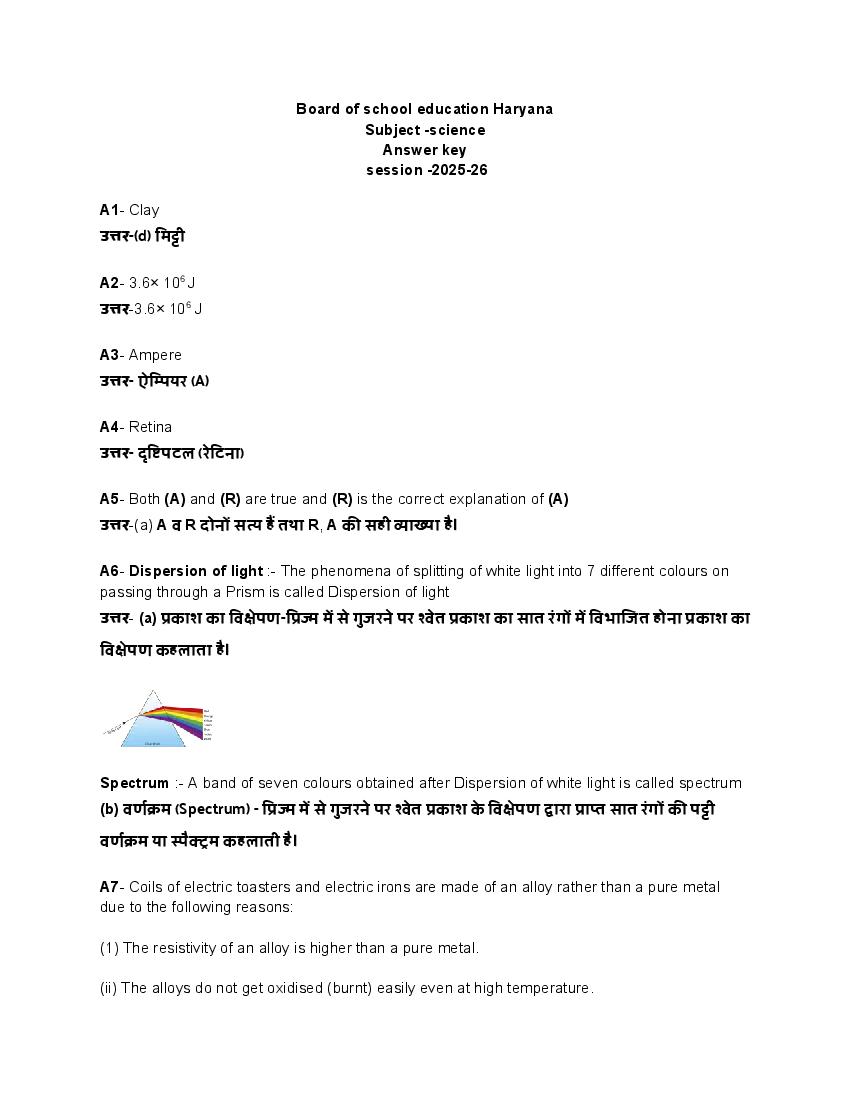
A6- Dispersion of light :- The phenomena of splitting of white light into 7 different colours on
passing through a Prism is called Dispersion of light
उत्तर- (a) प्रकाश का विक्षेपण-प्रिज्म में से गुजरने पर श्वेत प्रकाश का सात रंगों में विभाजित होना प्रकाश का
विक्षेपण कहलाता है।
Spectrum :- A band of seven colours obtained after Dispersion of white light is called spectrum
(b) वर्णक्रम (Spectrum) - प्रिज्म में से गुजरने पर श्वेत प्रकाश के विक्षेपण द्वारा प्राप्त सात रंगों की पट्टी
वर्णक्रम या स्पैक्ट्रम कहलाती है।
A7- Coils of electric toasters and electric irons are made of an alloy rather than a pure metal
due to the following reasons:
(1) The resistivity of an alloy is higher than a pure metal.
(ii) The alloys do not get oxidised (burnt) easily even at high temperature.
Page 2
उत्तर - विद्युत टोस्टरों तथा विद्युत इस्तरियों के तापन अवयव शुद्ध धातु के न बनाकर मिश्रातु के बनाए जाते
हैं, इसके निम्नलिखित कारण हैं-
(i) मिश्रातु की प्रतिरोधकता शुद्ध धातु से अधिक होती है।
(ii) उच्च ताप पर भी मिश्रातु का ऑक्सीकरण आसानी से नहीं होता है।
(iii) मिश्रातु का गलनांक भी अधिक होता है।
OR
Ans. Potential difference V = 220V
Electric current I = 5A
Time t = 2h
Electric power P = VI
P = 220 × 5
P=1100W
Energy consumed E = Pt
E = 1100W × 2h
E = 2200Wh
E = 2200/1000 kWh
E= 2.2kWh
विभवांतर, V = 220V
विद्युत धारा, I = 5A
समय, t = 2h
विद्युत शक्ति, P = VI
P = 220 × 5 P = 1100W P = 1100W
विद्युत ऊर्जा, E = Pt = 1100W × 2h = 2200Wh
= 2200/1000 kWh = 2.2kWh
प्रदत ऊर्जा = 2.2kWh
Page 3
resistance is directly proportional to the length of the conductor. But, resistivity will not be
affected if the length of the conductor is increased.
(b) Resistance will decrease on increasing the area of cross-section of a conductor as
resistance is directly proportional to the area of cross-section of conductor.
But resistivity does not depend on the area of cross-section of the conductor, hence it will not
change.
उत्तर- (1) चालक तार की ल
ं बाई बढ़ाने पर प्रतिरोध भी बढ़ जाएगा क्योंकि प्रतिरोध ल
ं बाई के
अनुक्रमानुपाती होता है। परन्तु चालक की प्रतिरोधकता पर ल
ं बाई बढ़ने से कोई प्रभाव नहीं पड़ेगा।
(ii) अनुप्रस्थ काट का क्षेत्रफल बढ़ाने पर चालक का प्रतिरोध कम हो जाएगा क्योंकि प्रतिरोध अनुप्रस्थ काट
के क्षेत्रफल के व्युत्क्रमानुपाती होता है।
परन्तु प्रतिरोधकता अनुप्रस्थ काट के क्षेत्रफल पर निर्भर नहीं करती इसलिए इसमें कोई परिवर्तन नहीं होगा।
A9- a) (i) Strength of electric current.
(ii) Strength of magnetic field.
(b) Electric Fuse: It is a small wire of an alloy of lead and tin whose melting point is low. An
electric fuse protects the circuit from overloading and short-circuiting.
An electric fuse is kept in a mace or plastic shell which is called a fuse-carrier.
Advantages of Electric Fuse:-
(i) It protects electrical appliances from damage.
(ii) We come to know about overloading in an electric circuit.
(iii) It protects from short-circuiting.
(iv) It provides safety against fire due to short-circuiting.
उत्तर- (a)(१) विद्युत धारा की प्रबलता तथा
(ii) चुंबकीय क्षेत्र की प्रबलता
(b) विद्युत फ्यूज़-यह सीसा व टिन की मिश्रधातु की तार होती है जिसका गलनांक कम होता है। फ्यूज परिपथ
की लघुपथन और अतिभारण से रक्षा करता है।
फ्यूज को चीनी मिट्टी या प्लास्टिक के खोल में रखते हैं, जिसे फ्यूज़ कैरियर कहते हैं।
विद्युत फ्यूज़ के लाभ-
Page 4
(ii) परिपथ में अतिभारण का पता लग जाता है।
(iii) लघुपथन से बचा जा सकता है।
(iv) परिपथ में लघुपथन के कारण उत्पन्न होने वाली आग से सुरक्षा दे ता है।
OR
Ans. When electric current is passed through a straight conductor, then it behaves like a magnet
and hence magnetic field develops around it and the magnetic field lines in form of concentric
circles are produced at every point of the conductor (wire).
A pattern of concentric circles indicating the field lines of a magnetic field around a
straight conducting wire. The arrows in the circles show the direction of the field lines
1) Take a rectangular cardboard and fix it horizontally with a stand and insert a thick copper wire
XY through the centre normal to the plane of the rectangular cardboard.
(ii) Connect the straight copper wire with a battery and a plug key.
(iii) Sprinkle some iron filings on the cardboard.
(iv) Plug the key and allow electric current to flow through the straight copper wire XY.
Observation: We observe that the iron filings align themselves showing a pattern of concentric
circles around the copper wire. They represent the magnetic field lines.
Conclusion: When an electric current flows through a straight conductor, then a magnetic field
is produced around it. The magnetic strength decreases as the distance from it increases.
Page 5
के चारों ओर एक चुंबकीय क्षेत्र उत्पन्न हो जाता है तथा तार के प्रत्येक बिंदु पर संकेद्री वृत्ताकार चुंबकीय क्षेत्र
रेखाए
ँ उत्पन्न होती है।
चित्र-किसी विद्युत धारावाही सीधे चालक तार के चारों ओर के चुंबकीय क्षेत्र की क्षेत्र रेखाओं को निरूपित
संकेंद्री वृत्तों का पैटर्न। वृत्तों पर अ
ं कित तीर क्षेत्र रेखाओं की दिशाओं को दर्शाते हैं।
(१) एक गत्ते के आयताकार टु कड़े को स्टैंड में क्षैतिज लगाए
ँ तथा इसके बीचों-बीच एक ताँबे की तार XY
गुजारें।
(ii) तार को एक बैटरी तथा एक क
ँ ु जी से जोड़ें।
(iii) गत्ते पर कुछ लौहचूर्ण डालें।
(iv) क
ं ु जी में प्लग लगाकर तार XY में से विद्युत धारा प्रवाहित करें।
प्रे क्षण-हम दे खते हैं कि विद्युत धारा प्रवाहित होने पर लौहचूर्ण के कण अपने आपको संकेन्द्री वृतों में
संयोजित कर लेते हैं।
निष्कर्ष इससे सिद्ध होता है किसी चालक तार में विद्युत धारा प्रवाहित करने पर उसके चारों ओर चुंबकीय
क्षेत्र उत्पन्न हो जाता है। धारावाही चालक से दूरी बढ़ने पर चुम्बकीय शक्ति कम होती चली जाती है।
A10- (a) The deviation of a ray of light from its path when it passes from one transparent
medium to another transparent medium is called refraction of light.
Page 6
(1) The incident ray, refracted ray and the normal at the point of incidence separating both
media, all lie in the same plane.
( ii) For a given colour of light and a given pair of media, the ratio of sine of angle of incidence to
the sine of angle of refraction is a constant. This law is also called Snell's law of refraction.
If i is angle of incidence and r is angle of refraction then,
sini/sinr= constant
This constant is called refractive index of the second medium w.r.t. first medium.
(b) A convex mirror is used as a rear-view mirror in vehicles due to the following reasons:
(1) The image formed is smaller than the size of the object.
(ii) The image formed by a convex mirror is virtual and erect.
(iii) A convex mirror gives a wide field of view of the traffic behind and this helps the driver in
safe driving.
उत्तर- (a) प्रकाश की किरण का एक पारदर्शक माध्यम से दूसरे पारदर्शक माध्यम में गुजरते हुए अपने पथ से
विचलित होना प्रकाश अपवर्तन कहलाता है।
प्रकाश-अपवर्तन के निम्नलिखित दो नियम हैं-
(1) आपतित किरण, अपवर्तित किरण तथा दोनों माध्यमों को पृथक् करने वाले पृष्ठ के आपतन बिंदु पर
अभिल
ं ब सभी एक ही तल में स्थित होते हैं।
(ii) प्रकाश के किसी निश्चित रंग तथा निश्चित माध्यमों के युग्म के लिए आपतन कोण की ज्या (sine) तथा
अपवर्तन कोण की ज्या (sine) का अनुपात एक स्थिरांक होता है। इस नियम को स्नेल का अपवर्तन का
नियम भी कहते हैं।
यदि । आपतन कोण हो तथा अपवर्तन कोण हो तब
sin i/ sin r = स्थिरांक
इस स्थिरांक के मान को दूसरे माध्यम का पहले माध्यम के सापेक्ष अपवर्तनांक (refractive index) कहते हैं।
Page 7
(1) इसमें प्रतिबिंब वस्तु से आकार में छोटा बनता है।
(ii) उत्तल दर्पण द्वारा बनाया प्रतिबिंब आभासी एवं सीधा बनता है।
(iii) इसका दृष्टि क्षेत्र भी बहुत अधिक होता है जिसके कारण पश्च दृश्य के बहुत बड़े भाग को दे खा जा सकता
है तथा ड्राइवर सुरक्षित रूप से वाहनों को चला सकते हैं।
OR
(a) A concave lens forms a virtual, erect image on the same side of the object.
Image distance, v = -10 cm
Focal length f = -15cm
Object distance,u = ?
Using lens formula 1/v-1/u= 1/f
1/u = 1/v - 1/f
1/u = 1/- 10 - 1/(- 15) = - 1/10 + 1/15
1/u = (- 3 + 2)/30 = 1/- 30
u = - 30 cm
Thus, the object distance is 30 cm Magnification:-
m = v/u
m = (- 10cm)/(- 30cm) = 1/3 = 0.33
(a) अवतल लेंस द्वारा सदै व ही आभासी, सीधा प्रतिबिंब उसी ओर बनता है जिस ओर बिंब रखा होता है।
लेंस से प्रतिबिंब की दूरी (v) = - 10 cm
लेंस की फोकस दूरी (f) = 15 cm
लेंस से बिंब की दूरी (u) = ?
लेंस सूत्र से = 1/v-1/u= 1/f
1/u = 1/v - 1/f
1/u = 1/- 10 - 1/(- 15) = - 1/10 + 1/15
1/u = (- 3 + 2)/30 = 1/- 30
u = - 30 cm
बिंब की दूरी 30 cm है।
Page 8
m = (- 10cm)/(- 30cm) = 1/3 = 0.33
A11- Slaked lime [Ca(OH)2]
उत्तर- (b) बुझा हुआ चूना [Ca(OH)2]
A12- Antacid
उत्तर-(c) ऐटैसिड
A13- Silver (Ag)
उत्तर- सिल्वर (चांदी)
A14- A homogenous mixture of a metal with another metal or a non metal is called an alloy
example:- bronze, brass
उत्तर- किसी धातु का किसी अन्य धातु अथवा अधातु के साथ सामांगी मिश्रण मिश्रातु कहलाता है;
जैस-े कांसा, पीतल।
A15- both A and R are true and R is the correct explanation of A
उत्तर- (a) A व R दोनों सत्य हैं तथा R, A की सही व्याख्या है।
A16- Magnesium (Mg) is a reactive metal. When exposed to air, it reacts with oxygen of air and
forms a white coloured layer of magnesium oxide on its surface. This layer prevents the burning
of magnesium. Therefore, magnesium ribbon is cleaned before burning in air.
2Mg+ 02—2MgO
उत्तर - मैग्नीशियम (Mg) एक क्रियाशील धातु है। वायु के संपर्क में आकर यह ऑक्सीजन के साथ क्रिया
करके सफेद रंग की मैग्नीशियम ऑक्साइड की परत बना लेती है। यह परत मैग्नीशियम के जलने में रूकावट
(अवरोध) उत्पन्न करती है जिसे हटाना आवश्यक होता है। अतः वायु में जलाने से पहले मैग्नीशियम रिबन को
साफ किया जाता है।
2Mg+ 02—2MgO
A17- HCl and HNO3 give H+ ions when dissolved in water. So, they show acidic characters in
aqueous solutions.
HCl(aq) → H+(aq) + Cl-(aq)
HNO3(aq) → H+(aq) + NO3(aq)
But alcohol and glucose do not ionise in aqueous solution and do not produce H+ ions. So, they
do not show acidic character.
Page 9
ु कर H⁺ आयन दे ते हैं। अतः ये जलीय विलयन में अम्लीय अभिलक्षण
प्रदर्शित करते हैं।
HCl(aq) → H+(aq) + Cl-(aq)
HNO3(aq) → H+(aq) + NO3(aq)
लेकिन ऐल्कोहॉल एवं ग्लक ू ोज जलीय विलयन में आयनीकरण नहीं करते तथा H⁺ आयन उत्पन्न नहीं करते।
इसलिए ये अम्लीय गण ु प्रदर्शित नहीं करते हैं।
A18-
Metal + H₂O → Metal hydroxide or oxide + H2
Metals react with water to produce metal hydroxide or metal oxide. In this process, hydrogen
gas is also evolved.
Example: (i) Highly reactive metals (K, Na etc) react even with cold water.
2Na(s) + 2H2O(l) → 2NaOH(aq) + H2(g)
(ii) Less reactive metals (Mg, Zn) react with hot water to form metal oxide and hydrogen gas
Mg(s) + H2O (l) —----> MgO(s) + H2(g)
(iii) Some still less reactive metals (Fe, Al) react with steam to form metal oxide and hydrogen
gas.
3Fe(s) + 4H2O (g) → Fe3O4(s) + 4H2(g)
(iv) The metals at the bottom in reactivity series (Cu, Hg, Ag, Au) etc. do not react with water.
उत्तर- धातु + H2O→ धातु हाइड्रॉक्साइड या धातु ऑक्साइड + H2
धातुए
ँ जल के साथ क्रिया करके धातु हाइड्रॉक्साइड या धातु ऑक्साइड बनाती हैं। इस प्रक्रम में हाइड्रोजन
गैस भी उत्पन्न होती है।
उदाहरण- (i) अधिक अभिक्रियाशील धातुएं (K, Na) ठंडे जल से भी क्रिया करती हैं
2Na(s) + 2H2O(l) → 2NaOH(aq) + H2(g)
(ii) कम क्रियाशील धातुए
ँ (Mg, Zn) गर्म जल के साथ क्रिया करके धातु ऑक्साइड बनाती हैं तथा हाइड्रोजन
गैस उत्पन्न करती हैं।
Mg(s) + H2O(l)----- MgO(s) + H2(g)
Page 10
ँ (Fe, Al) जिनकी क्रियाशीलता कम होती है, भाप के साथ क्रिया करके धातु ऑक्साइड
बनाती हैं एवं इस प्रक्रम में हाइड्रोजन गैस भी उत्पन्न होती है।
3Fe(s) + 4H2O(g) → Fe3O4(s) + 4H2(g)
A19- (i) Ductility: It is the property of a metal due to which it can be drawn into thin wires. For
example, silver, gold, copper etc. are highly ductile metals.
(ii) Conductors of heat and electricity: Metals are good conductors of heat and electricity
because they have free electrons to move and the heat energy can be transferred from one
particle to the next in metals. For example, silver, gold, copper etc. are good conductors of heat
and electricity.
(iii) Sonorous: Metals are sonorous because when they strike with a hard surface, they produce
ringing sound. For example, silver, aluminium etc. are sonorous.
उत्तर- (i)तन्यता-धातुओं का वह गुण जिसके कारण उनको खींचकर तार बनाए जा सकते हैं, तन्यता
कहलाता है। उदाहरण के लिए, सोना, चाँदी, तांबा आदि धातुए
ँ तन्य हैं।
(ii) ऊष्मा एवं विद्यु त के सु चालक-धातुए
ँ ऊष्मा एवं विद्युत की अच्छी चालक होती हैं क्योंकि इनके अन्दर
स्वतंत्र इलेक्ट्रॉन होते हैं तथा ऊष्मा का स्थानांतरण भी कणों के द्वारा एक बिंदु से दूसरे बिंदु तक हो सकता
है। उदाहरण के लिए, सोना, चाँदी एवं तांबा ऊष्मा एवं विद्युत के अच्छे चालक हैं।
(iii) ध्वानिक-धातुएं जब किसी कठोर तल से टकराती हैं तो घंटी की तरह आवाज उत्पन्न करती हैं। उदाहरण
के लिए, चांदी, एल्युमिनियम आदि धातुए
ँ , ध्वानिक हैं।
OR
The carbonate ore of zinc is ZnCO3.
Extraction of Zinc
(1) Calcination: ZnCO3, is heated in the absence of air or limited supply of air to convert it into
metal oxide. This process is called calcination.
ZnCO3(s)→ ZnO(s) + CO2(g)
(ii) Reduction: ZnO is heated with carbon to reduce it into zinc metal.
ZnO (s) + C(s) →Zn(s) + CO(g)
जिंक का कार्बोनेट अयस्क ZnCO₃ है ।
जिंक का निष्कर्षण
Page 11
में गर्म किया जाता है। इस क्रिया को निस्तापन कहते हैं।
ZnCO3(s)→ ZnO(s) + CO2(g)
ii) अपचयन- ZnO को ( कार्बन के साथ गर्म करके इसे जिंक धातु में अपचयित किया जाता है।
ZnO(s) + C(s) → Zn(s) + CO(g)
A20- . (a) The conversion of ethanol to ethanoic acid is an oxidation reaction because oxygen
adds to ethanol in this process.
C2H5OH + 2[O] in presence of (alk.KMnO4 + Heat or acidified K2Cr2O7 + Heat)
→ CH3COOH + H2O
This process takes place in the presence of an oxidising agents such as KMnO, or K2Cr2O7
(b) Homologous series: A series of carbon compounds in which the same functional group
substitute for hydrogen in a carbon chain is called homologous series. The successive members
of the series differ by -CH₂ group and all the members of it are represented by the same general
formula.
Example: Homologous series of alcohols.
General Formula: C,H21 +1 — OH, n = 1, 2, 3, 4........
उत्तर- (a) एथनॉल से एथेनॉइक अम्ल में परिवर्तन को ऑक्सीकरण अभिक्रिया कहते हैं क्योंकि इस प्रक्रम में
ऑक्सीजन एथनॉल के साथ संयोग कर लेती है।
C2H5OH + 2[O] क्षारीय KMnO4 KMnO4 + ऊष्मा
-————————————>
या अम्लीकृत K2C1207 + ऊष्मा
CH3COOH + H₂O
यह क्रिया KMnO4 अथवा K₂Cr₂O, जैसे ऑक्सीकारकों की उपस्थिति में संपन्न होती है ।
(b) समजातीय श्रेणी-कार्बन यौगिकों की ऐसी श्रखं ृ ला जिसमें कार्बन श्रख
ं ृ ला में स्थित हाइड्रोजन को एक ही प्रकार
का प्रकार्यात्मक समह
ू प्रतिस्थापित करता है , उसे समजातीय श्रेणी कहते हैं। इसके दो क्रमागत सदस्यों में - CH₂
ग्रप
ु का अंतर होता है तथा सभी सदस्यों को एक सामान्य सत्र ू द्वारा निरूपित किया जाता है ।
उदाहरण-ऐल्कोहॉल की समजातीय श्रेणी
Page 12
OR
(a)
(b) Carbon and its compounds are used as fuel for most applications due to the following
reasons:
(i) They produce a lot of heat and light when burn in oxygen.
(ii) They result in continuous combustion.
(iii) Their ignition temperature is neither too low nor too high.
(iv) They burn completely leaving behind no residue and or smoke.
(v) They are convenient to use and their calorific value is high.
(a)
Page 13
कारण हैं-
(i) ये ऑक्सीजन में जलने पर बहुत अधिक मात्रा में ऊष्मां, एवं प्रकाश उत्पन्न करते हैं।
(ii) इन्हें एक बार जलाने के बाद ये निरंतर जलते रहते हैं।
(iii) इनका ज्वलन ताप न तो बहुत कम होता है और न ही बहुत अधिक।
(iv) इनका पूर्ण रूप में दहन होता है तथा धुआँ एवं अवशेष नहीं छोड़ते।
(v) इनका प्रयोग करना सरल है तथा इनका कैलोरीमान उच्च होता है।
A21- Ultraviolet
उत्तर- (a) पराबैंगनी
A22- (c) Vas deferens
उत्तर-(c) शुक्रवाहिका
Page 14
उत्तर - रासायनिक।
A24- Insulin
उत्तर - इन्सुलिन
A25- both A and R are true and R is correct explanation of A
उत्तर- (a) A व R दोनों सत्य हैं तथा R, A की सही व्याख्या है।
A26- . The functional junction between two neurons is called a synapse. A chemical is filled in
this gap which is called
neurotransmitter. The information/message is transmitted in form of chemical signals through
this chemical. If two neurons are in direct physical contact then the impulse/information travels
only in form of electrical signals.
So, transmission of impulse takes place at the synapse.
उत्तर- दो न्यूरॉन के मध्य कार्यात्मक रिक्त स्थान को अ
ं तर्ग्रथन कहते है। इस रिक्त स्थान में एक रसायन
पदार्थ होता है जिसे न्यूरोट्रांसमीटर कहते हैं। इस रसायन में से सूचना रासायनिक संकेत के रूप में एक न्यूरॉन
से दूसरे न्यूरॉन में स्थानांतरित होता है। यदि न्यूरॉन एक-दूसरे के भौतिक संपर्क में हो तो सूचना केवल विद्युत
संकेत के रूप में गति करती है।
A27- Unisexual flowers: Those flowers which bear only one sex organ of male or female i.e.,
stamen or carpel are called unisexual flowers. For example, papaya, watermelon etc.
Bisexual flowers: Those flowers which bear both male and female sex organs are called
bisexual flowers.
For example, mustard, tomato, pea etc.
उत्तर -एकलिंगी पु ष्पः वे पुष्प जिनमें नर एवं मादा में से किसी एक के जनन अ
ं ग होते हैं अर्थात पुकेंसर
अथवा स्त्रीकेसर होते हैं, उन्हें एकलिंगी पुष्प कहते हैं। उदाहरण के लिए पपीता, तरबूज आदि।
द्विलिंगी पु ष्प-वे पुष्प जिनमें नर तथा मादा दोनों के जनन अ
ं ग होते हैं, उन्हें द्विलिंगी पुष्प कहते हैं। उदाहरण
के लिए सरसों, टमाटर, मटर, आदि।
A28- Various methods of contraception:
(1) Mechanical (physical) barriers.
(ii) Chemical method.
Page 15
(iv) Intrauterine contraceptive Device.
Importance of contraceptive methods for sexual health:
(1) If a woman is not mentally prepared to attain pregnancy even after the attainment of sexual
maturity then it has bad effect on her sexual health. So, it very important to adopt methods of
contraception.
ii) If methods of contraception are not used then it can cause various sexually transmitted
diseases like AIDS, syphilis, gonorrhoea etc. These diseases have an adverse effect on the
sexual health of human females. Hence, it is essential to adopt methods of contraceptions.
उत्तर - विभिन्न गर्भनिरोधक यु क्तियाँ
(1) रोधिका
(ii) रासायनिक विधि
(iii) शल्यक्रिया विधि
(iv) अतंरा गर्भाशय गर्भनिरोधक यंत्र
जनन स्वास्थ्य में गर्भनिरोधक यु क्तियों का महत्त्व:-
(1) यदि स्त्री लैंगिक परिपक्वता धारण करने के पश्चात भी मानसिक रूप से गर्भधारण करने के लिए तैयार
नहीं है तो इसका जनन स्वास्थ्य पर बहुत बुरा प्रभाव पड़ता है। इसलिए गर्भनिरोधक युक्ति अपनाना बहुत
आवश्यक है।
(ii) गर्भनिरोधक युक्तियाँ न अपनाने से यौन संबंधी रोग भी उत्पन्न हो सकते हैं जैसे AIDS, सिफिलिस,
गोनोरिया आदि। इन रोगों का स्त्री जनन स्वास्थ्य पर बहुत ही बुरा प्रभाव पड़ता है, अतः गर्भ निरोधक
युक्तियों को अपनाना बहुत ही आवश्यक है।
Page 16
Round seeds in plants is a dominant trait and wrinkled seeds is a recessive trait. So, when a
plant having round seeds is crossed with a plant having wrinkled seeds then
(i) All the plants in F₁ generation will have round seeds.
(ii) In F₂ generation, 75% plants will have round shaped seeds when plants of F₁ generation are
self-pollinated.
Therefore, (a) round seeds produced 3/4 x 100% = 75%
(b) Wrinkled seeds produced = 1/4 x 100% = 25%
Page 17
ु दार बीज वाले पौधों से करवाया जाता है जो F₁ पीढ़ी (प्रथम
संतति) के सभी पौधों के बीजों का आकार गोलाकार होगा।
(ii) F₂ पीढ़ी (द्वितीय संतति) में स्वपरागण द्वारा प्राप्त तीन-चौथाई बर्बीजों को आकार गोलाकार होगा।
3/4×100% = 75%
अतः पौधे में गोलाकार बीज प्रभावी लक्षण है तथा झुर्रीदार बीज अप्रभावी लक्षण है।
OR
The transmission of traits from parents to offspring is called heredity.
DNA act as genetic material in human beings. Each segment of DNA is called a gene. Genes
perform the function of transmission of parental traits to the offspring. One gene is inherited from
each parent for a trait. These genes carry instructions for production of particular protein. A
gene carries a code for production of a special protein which controls the expression of
characteristics.
In this way, gene is the basic unit of heredity.
पैतक
ृ गुणों का संतति में स्थानांतरण आनुवंशिकता कहलाता है।
Page 18
ं ड को जीन कहते हैं। जीन पैतक
ृ गुणों को संतति में
पहु
ँ चाने का कार्य करती हैं। प्रत्येक लक्षण के लिए एक जीन प्रत्येक जनक से वंशानुगत होती है। इन जीनों पर
एक प्रोटीन उत्पादन के संश्लेषण के लिए निर्देश होते हैं। एक जीन एक विशेष प्रोटीन के संश्लेषण का
संकेत दे ती है जो लक्षणों की अभिव्यक्ति को नियंत्रित करता है। इस प्रकार जीन आनुवंशिकता की
आधारभूत इकाई है।
A30-(a)
(b) Role of saliva in the digestion of food:
(i) The enzyme ptyalin present in the saliva digest starch and converts it into maltose.
Starch (in presence of Ptyalin) →Maltose (sugar)
(ii) Saliva keeps mouth cavity clean and moisten and softens food. This helps in easy chewing
and breaking food into small pieces.
(b) भोजन के पाचन में लार की भूमिकाः
(1) लार में विद्यमान टायलिन नामक एंजाइम स्टार्च का पाचन करके उसे माल्टोज में बदल दे ता है।
टाइलिन
Page 19
(जटिल अणु) (सरल अणु)
(ii) लार मुख के खोल (mouth cavity) को साफ रखती है तथा भोजन को चिकना (moisten) एवं मुलायम
(soften) बनाती है जिसमें भोजन को आसानी से चबाने तथा बड़े टु कड़ों को छोटे टु कड़ों में तोड़ने में सहायता
मिलती है।
OR
(a)
(b) Necessary conditions for autotrophic nutrition:
(1) Presence of chlorophyll in cells.
Page 20
(iii) Presence of sunlight.
(iv) Supply of carbon dioxide.
By-products of autotrophic nutrition: Oxygen
(b) स्वपोषी पोषण के लिए आवश्यक परिस्थितियाँः
Page 21
(ii) हरे पौधों अथवा पादप कोशिकाओं में जल की आपूर्ति होना।
(iii) सूर्य का प्रकाश
(iv) कार्बन डाई-ऑक्साइड की आपूर्ति होना।
Document Details
| Board / Org | Haryana Board |
| Exam | Class 10 |
| Type | Sample Paper |
| Pages | 21 |
| Updated | 24 Sep 2026 |