Edudel Syllabus Class 6 Science
Finished viewing? Save it for later —
Download Edudel Syllabus Class 6 Science (PDF · 5 pages)About Edudel Syllabus Class 6 Science
Edudel Syllabus Class 6 Science is available here for free download. Published by Delhi Board for Class 6, this syllabus can be viewed online or downloaded as a PDF (5 pages). Candidates preparing for Class 6 can use Edudel Syllabus Class 6 Science to understand the exam pattern, the type of questions asked, and the overall difficulty level.
Frequently Asked Questions
How can I download Edudel Syllabus Class 6 Science?
Open this page and click the Download button to save Edudel Syllabus Class 6 Science as a PDF. It is completely free on AglaSem Docs.
Is Edudel Syllabus Class 6 Science free to download?
Yes. Edudel Syllabus Class 6 Science can be viewed online and downloaded as a PDF free of cost on AglaSem Docs.
How many pages does Edudel Syllabus Class 6 Science have?
Edudel Syllabus Class 6 Science contains 5 pages, which you can read online or download together as a single PDF.
Where can I find more Class 6 study material?
You can find more Class 6 question papers, sample papers, syllabus, and answer keys on AglaSem Docs.
Edudel Syllabus Class 6 Science – Text
Read the full text of this syllabus below — useful to quickly search, copy and reference the content online without downloading the PDF.
📄 View text version (3 pages)
Page 1
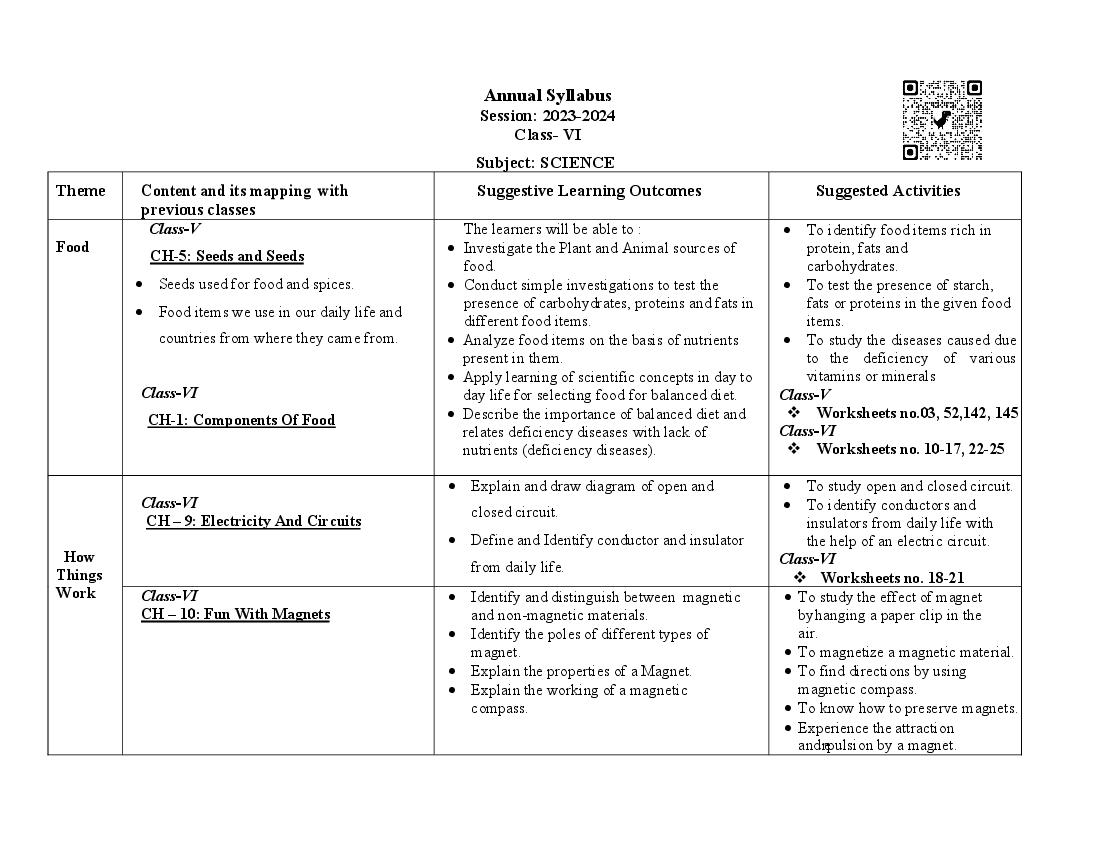
Session: 2023-2024
Class- VI
Subject: SCIENCE
Theme Content and its mapping with Suggestive Learning Outcomes Suggested Activities
previous classes
Class-V The learners will be able to : To identify food items rich in
Food Investigate the Plant and Animal sources of protein, fats and
CH-5: Seeds and Seeds
food. carbohydrates.
Seeds used for food and spices. Conduct simple investigations to test the To test the presence of starch,
presence of carbohydrates, proteins and fats in fats or proteins in the given food
Food items we use in our daily life and
different food items. items.
countries from where they came from. Analyze food items on the basis of nutrients To study the diseases caused due
present in them. to the deficiency of various
Apply learning of scientific concepts in day to vitamins or minerals
Class-VI day life for selecting food for balanced diet. Class-V
CH-1: Components Of Food Describe the importance of balanced diet and Worksheets no.03, 52,142, 145
relates deficiency diseases with lack of Class-VI
nutrients (deficiency diseases). Worksheets no. 10-17, 22-25
Explain and draw diagram of open and To study open and closed circuit.
Class-VI To identify conductors and
closed circuit.
CH – 9: Electricity And Circuits insulators from daily life with
Define and Identify conductor and insulator the help of an electric circuit.
How Class-VI
from daily life.
Things Worksheets no. 18-21
Work Class-VI Identify and distinguish between magnetic To study the effect of magnet
CH – 10: Fun With Magnets and non-magnetic materials. by hanging a paper clip in the
Identify the poles of different types of air.
magnet. To magnetize a magnetic material.
Explain the properties of a Magnet. To find directions by using
Explain the working of a magnetic magnetic compass.
compass. To know how to preserve magnets.
Experience the attraction
and repulsion by a magnet.
Page 2
Revision of syllabus for Mid Term Examination.
MID TERM EXAMINATION-2023
Theme Content and its mapping with previous Suggestive Learning Outcomes Suggested Activities
classes
Natural The learners: To study transparent, opaque and
Phenomenon Class-VI Relate process with reason by translucent objects with examples.
CH – 8: Light, Shadows And Reflections conducting simple activity to show that To make a model of pin hole
light travels in astraight line. camera.
Identify and classify transparent,
translucent and opaque objects on the Class-VI
basis of the passageof light through them. Worksheets no 32-38
Differentiate between an image and a
shadow.
The learners: To identify herbs ,shrubs and trees
The World Class-IV from your school garden.
Classify plants into herbs, shrubs and
of the CH- 4: The Story Of Amrita To study the venation in leaves of
trees.
Living Plants and animals found in the desert. different plants.
CH- 11: The valley of flowers Identify types of leaf venation in different
kinds of leaves.
Different flowers and their uses Class-IV
CH- 19 : Abdul In The Garden Differentiate between tap and fibrous roots by Worksheets no. 22,27,33,137,
• Roots- Types, functions. giving examples. 142,145
Describe the functions of stem, root and Class-V
Class-V leaf. Worksheets no.140
CH -5: Seeds And Seeds Identify different parts of a flower and draw its Class-VI
Different types of plants labeled diagram. Worksheets no. 26-31
CH–4: Getting To Know Plants
The Class-IV The learners: Germination of seed.
World of CH-16 : A Busy Month Differentiate between living and non To know about plants and animals
the Living • Birds, their food, teeth/ beaks, claws, their found in different surroundings
living things on the basis of
nests, material used to make the nests. like forests, desert, sea,
characteristics of life. To study different animals of
water and land.
Page 3
.Classify the biotic and
CH-1: Super Senses
abiotic component of a habitat.
Eyes and its significance for different
organisms.; Nose and its significance for Establish the relationship of plants
ants, dogs, mosquitoes and silkworm.; and animals with their habitats.
Significance of hearing, sleeping patternof
different animals.
Tiger and its features, Protected areas for Class-IV
animals. Worksheets no. 25,39,45,50
CH-13: A Shelter So High Class-V
Cold regions in India Worksheetsno.22,27,30,33, 117
Types of shelter in different areas. Class-VI
Things that vary from place to place like Worksheets no. 39-46
: Food habits. Living
conditions. Climate. Clothes. Languageetc.
CH – 6: The Living Organisms:
Characteristics And Habitats.
The learners: To prepare different types of
Natural CH – 11: Air Around Us Explain the properties of components of air Firkis. (fig.11.1)
Resources and their percentage. To show that O2 is present in air
Prove that water and soil have air in it. and helps in burning. (Fig 11.6)
To show that air is present
Explain the use of oxygen cylinder by everywhere. (fig.11.4)
mountaineers.
To show that air is dissolved in
Describe the causes of air pollution. water and soil. (fig.11.10 and
Apply learning of scientific concepts in day 11.11)
to day life for various activities like To show that nothing is empty.
prevention of air pollution etc. (fig.11.4)
*Figures mentioned here are of NCERT
book.
The whole syllabus must be completed by 31 January, 2024 ;
Annual examination will be based on entire annual syllabus.
Revision of entire syllabus for Annual Examination.
Annual Exam 2024
Note: The above said syllabus is for assessment purpose only and remaining topics/chapters may be taught as Subject Learning
Enrichment.
Document Details
| Board / Org | Delhi Board |
| Exam | Class 6 |
| Type | Syllabus |
| Pages | 5 |
| Updated | 22 Jul 2026 |