CBSE Class 10 Mathematics Standard Question Paper 2020 Set 30-4 Solutions
Finished viewing? Save it for later —
Download CBSE Class 10 Mathematics Standard Question Paper 2020 Set 30-4 Solutions (PDF · 46 pages)About CBSE Class 10 Mathematics Standard Question Paper 2020 Set 30-4 Solutions
CBSE Class 10 Mathematics Standard Question Paper 2020 Set 30-4 Solutions is available here for free download. Published by CBSE for Class 10, this solution can be viewed online or downloaded as a PDF (46 pages). Candidates preparing for Class 10 can use CBSE Class 10 Mathematics Standard Question Paper 2020 Set 30-4 Solutions to understand the exam pattern, the type of questions asked, and the overall difficulty level.
Frequently Asked Questions
How can I download CBSE Class 10 Mathematics Standard Question Paper 2020 Set 30-4 Solutions?
Open this page and click the Download button to save CBSE Class 10 Mathematics Standard Question Paper 2020 Set 30-4 Solutions as a PDF. It is completely free on AglaSem Docs.
Is CBSE Class 10 Mathematics Standard Question Paper 2020 Set 30-4 Solutions free to download?
Yes. CBSE Class 10 Mathematics Standard Question Paper 2020 Set 30-4 Solutions can be viewed online and downloaded as a PDF free of cost on AglaSem Docs.
How many pages does CBSE Class 10 Mathematics Standard Question Paper 2020 Set 30-4 Solutions have?
CBSE Class 10 Mathematics Standard Question Paper 2020 Set 30-4 Solutions contains 46 pages, which you can read online or download together as a single PDF.
Where can I find more Class 10 study material?
You can find more Class 10 question papers, sample papers, syllabus, and answer keys on AglaSem Docs.
CBSE Class 10 Mathematics Standard Question Paper 2020 Set 30-4 Solutions – Text
Read the full text of this solution below — useful to quickly search, copy and reference the content online without downloading the PDF.
📄 View text version (46 pages)
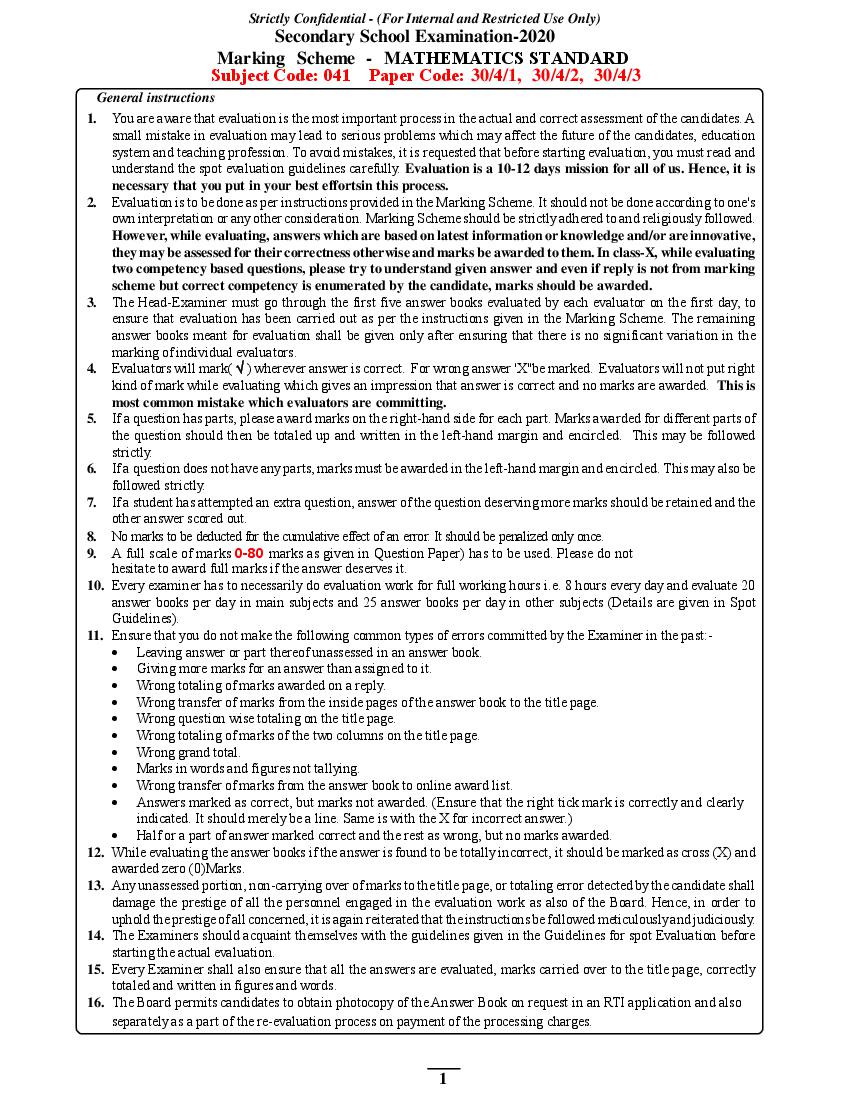
Page 1
Secondary School Examination-2020
Marking Scheme - MATHEMATICS STANDARD
Subject Code: 041 Paper Code: 30/4/1, 30/4/2, 30/4/3
General instructions
1. You are aware that evaluation is the most important process in the actual and correct assessment of the candidates. A
small mistake in evaluation may lead to serious problems which may affect the future of the candidates, education
system and teaching profession. To avoid mistakes, it is requested that before starting evaluation, you must read and
understand the spot evaluation guidelines carefully. Evaluation is a 10-12 days mission for all of us. Hence, it is
necessary that you put in your best effortsin this process.
2. Evaluation is to be done as per instructions provided in the Marking Scheme. It should not be done according to one's
own interpretation or any other consideration. Marking Scheme should be strictly adhered to and religiously followed.
However, while evaluating, answers which are based on latest information or knowledge and/or are innovative,
they may be assessed for their correctness otherwise and marks be awarded to them. In class-X, while evaluating
two competency based questions, please try to understand given answer and even if reply is not from marking
scheme but correct competency is enumerated by the candidate, marks should be awarded.
3. The Head-Examiner must go through the first five answer books evaluated by each evaluator on the first day, to
ensure that evaluation has been carried out as per the instructions given in the Marking Scheme. The remaining
answer books meant for evaluation shall be given only after ensuring that there is no significant variation in the
marking of individual evaluators.
4. Evaluators will mark( √ ) wherever answer is correct. For wrong answer 'X"be marked. Evaluators will not put right
kind of mark while evaluating which gives an impression that answer is correct and no marks are awarded. This is
most common mistake which evaluators are committing.
5. If a question has parts, please award marks on the right-hand side for each part. Marks awarded for different parts of
the question should then be totaled up and written in the left-hand margin and encircled. This may be followed
strictly.
6. If a question does not have any parts, marks must be awarded in the left-hand margin and encircled. This may also be
followed strictly.
7. If a student has attempted an extra question, answer of the question deserving more marks should be retained and the
other answer scored out.
8. No marks to be deducted for the cumulative effect of an error. It should be penalized only once.
9. A full scale of marks 0-80 marks as given in Question Paper) has to be used. Please do not
hesitate to award full marks if the answer deserves it.
10. Every examiner has to necessarily do evaluation work for full working hours i.e. 8 hours every day and evaluate 20
answer books per day in main subjects and 25 answer books per day in other subjects (Details are given in Spot
Guidelines).
11. Ensure that you do not make the following common types of errors committed by the Examiner in the past:-
• Leaving answer or part thereof unassessed in an answer book.
• Giving more marks for an answer than assigned to it.
• Wrong totaling of marks awarded on a reply.
• Wrong transfer of marks from the inside pages of the answer book to the title page.
• Wrong question wise totaling on the title page.
• Wrong totaling of marks of the two columns on the title page.
• Wrong grand total.
• Marks in words and figures not tallying.
• Wrong transfer of marks from the answer book to online award list.
• Answers marked as correct, but marks not awarded. (Ensure that the right tick mark is correctly and clearly
indicated. It should merely be a line. Same is with the X for incorrect answer.)
• Half or a part of answer marked correct and the rest as wrong, but no marks awarded.
12. While evaluating the answer books if the answer is found to be totally incorrect, it should be marked as cross (X) and
awarded zero (0)Marks.
13. Any unassessed portion, non-carrying over of marks to the title page, or totaling error detected by the candidate shall
damage the prestige of all the personnel engaged in the evaluation work as also of the Board. Hence, in order to
uphold the prestige of all concerned, it is again reiterated that the instructions be followed meticulously and judiciously.
14. The Examiners should acquaint themselves with the guidelines given in the Guidelines for spot Evaluation before
starting the actual evaluation.
15. Every Examiner shall also ensure that all the answers are evaluated, marks carried over to the title page, correctly
totaled and written in figures and words.
16. The Board permits candidates to obtain photocopy of the Answer Book on request in an RTI application and also
separately as a part of the re-evaluation process on payment of the processing charges.
1
Page 2
QUESTION PAPER CODE 30/4/1
EXPECTED ANSWER/VALUE POINTS
SECTION A
Question numers 1 to 20 carry 1 mark each.
Question numbers 1 to 10 are multiple choice questions. Choose the correct option.
1. The number of zeroes for a polynomial p(x) where graph of y = p(x) is given in Figure-1, is
(A) 3 (B) 4 (C) 0 (D) 5
y
y = p(x)
x
0
Fig. 1
Sol. (A) 3 1
2. The first term of an A.P. is 5 and the last term is 45. If the sum of all the terms is 400, the
number of terms is
(A) 20 (B) 8 (C) 10 (D) 16
Sol. (D) 16 1
OR
th
The 9 term of the A.P. – 15, –11, –7, ..., 49 is
(A) 32 (B) 0 (C) 17 (D) 13
Sol. (C) 17 1
3. It is being given that the points A(l, 2), B(0, 0) and C(a, b) are collinear. Which of the following
relations between a and b is true?
(A) a = 2b (B) 2a = b (C) a + b = 0 (D) a – b = 0
Sol. (B) 2a = b 1
4. In Figure-2, TP and TQ are tangents drawn to the circle with centre at O. If ∠POQ = 115° then
∠PTQ is
P T
115°
O
Q
Fig. 2
(A) 115° (B) 57.5° (C) 55° (D) 65°
Sol. (D) 65º 1
(3)
Page 3
OR
From an external point Q, the length of the tangent to a circle is 5 cm and the distance of Q
from the centre is 8 cm. The radius of the circle is
(A) 39 cm (B) 3 cm (C) 39 cm (D) 7 cm
Sol. (C) 39 cm 1
5. The value of θ for which cos (10° + θ) = sin 30°, is
(A) 50° (B) 40° (C) 80° (D) 20°
Sol. (A) 50° 1
6. A bag contains 3 red, 5 black and 7 white balls. A ball is drawn from the bag at random. The
probability that the drawn is not black, is
1 9 5 2
(A) (B) (C) (D)
3 15 10 3
Sol. (D) 2/3 1
7. The pair of linear equations y = 0 and y = –6 has
(A) a unique solution (B) no solution
(C) infinetly many solutions (D) only solution (0, 0)
Sol. (B) No solution 1
8. The mean and median of a distribution are 14 and 15 respectively. The value of mode is
(A) 16 (B) 17 (C) 18 (D) 13
Sol. (B) 17 1
9. The quadratic equation x2 – 4x + k = 0 has distinct real roots if
(A) k = 4 (B) k > 4 (C) k =16 (D) k < 4
Sol. (D) K < 4 1
⎛a ⎞
10. Point P ⎜ , 4 ⎟ is the mid-point of the line segment joining the points A(– 5, 2) and B(4, 6). The
⎝8 ⎠
value of ‘a’ is
(A) –4 (B) 4 (C) –8 (D) –2
Sol. (A) –4 1
(4)
Page 4
Fill in the blanks in question numbers 11 to 15.
⎛2+ 5 ⎞
11. ⎜ ⎟ is _______ number..
⎝ 3 ⎠
Sol. irrational 1
12. Let ΔABC ~ ΔDEF and their areas be respectively 81 cm2 and 144 cm2. If EF = 24 cm, then
length of side BC is _______ cm.
Sol. 18 1
13. The distance between the points (a, b) and (– a, – b) is _______.
Sol. 2 a 2 + b2 1
14. If tan A = 1, then 2 sin A cos A = _______.
Sol. 1 1
15. A spherical metal ball of radius 8 cm is melted to make 8 smaller identical balls. The radius of
each new ball is _______ cm.
Sol. 4 1
Answer the following question numbers 16 to 20.
16. Given that HCF (135, 225) = 45, find the LCM (135, 225).
135 × 225 1
Sol. LCM =
45 2
1
= 675
2
17. In Figure-3, a tightly stretched rope of length 20 m is tied from the top of a vertical pole to the
ground. Find the height of the pole if the angle made by the rope with the ground is 30°.
B
20 m
30°
C
A
Fig. 3
AB 1
Sol. sin 30° =
20 2
1
AB = 10 m
2
(5)
Page 5
18. Two dice are thrown simultaneously. What is the probability that the sum of the two numbers
appearing on the top is 13?
Sol. P(E) = 0 1
229
19. After how many decimal places will the decimal representation of the rational number
2 × 57
2
terminate?
Sol. After 7 decimal places 1
20. In Figure-4, AB and CD are common tangents to circle which touch each other at D. If AB =
8 cm, then find the length of CD.
B
C
A
D
Fig. 4
1
Sol. AC = CD = BC
2
1
CD = 4 cm
2
SECTION B
Question numbers 21 to 26 carry 2 marks each.
21. Solve for x:
6x2 + 11x + 3 = 0
Sol. 6x2 + 11x + 3 = 0
6x2 + 9x + 2x + 3 = 0 1
1
(2x + 3) (3x + 1) = 0
2
1
x = –3/2, x = –1/3
2
(6)
Page 6
22. The perimeters of two similar triangles are 30 cm and 20 cm respectively. If one side of the first
triangle is 9 cm long, find the length of the corresponding side of the second triangle.
Sol. Let the side of other triangle be x cm
1
Q Ratio of perimeters of two similar triangles is equal to ratio of their corresponding sides
2
9 30
∴ = 1
x 20
1
x = 6 cm
2
OR
In Figure-5, ΔPQR is right-angled at P. M is a point on QR such that PM is perpendicular to
QR. Show that PQ2 = QM × QR.
R
M
P Q
Fig. 5
Sol. ΔPQM ~ ΔRQP [By AA similarity] 1
PQ QM
∴ =
RQ PQ
⇒ PQ2 = QM × QR 1
23. Evaluate:
2 2
⎛ sin 47° ⎞ ⎛ cos 30° ⎞
⎟ +⎜ ⎟ − (sin 60° )
2
⎜
⎝ cos43° ⎠ ⎝ cot 30° ⎠
2 2 2
⎡ cos (90° – 47°) ⎤ ⎛ 3/2 ⎞ ⎛ 3 ⎞
Sol. ⎢⎣ cos 43° ⎥⎦ + ⎜ 3 ⎟ − ⎜⎝ 2 ⎟⎠ 1
⎝ ⎠
1 3 1
= 1+ − = 1
4 4 2
(7)
Page 7
24. Find the mode of the following distribution:
Classes: 10 – 20 20 – 40 40 – 60 60 – 80 80 – 100
Frequency: 10 8 12 16 4
1
Sol. Modal class = 60 – 80
2
⎛ f1 − f 0 ⎞ ⎛ 16 − 12 ⎞
Mode = l + ⎜ ⎟ × h = 60 + ⎜ ⎟ × 20 1
⎝ 2f1 − f 0 − f 2 ⎠ ⎝ 32 − 12 − 4 ⎠
1
= 65
2
OR
From the following distribution, find the median:
Classes: 500 – 600 600 – 700 700 – 800 800 –900 900 – 1000
Frequency: 36 32 32 20 30
1
Sol. Median class: 700 – 800
2
⎛N ⎞
⎜ − cf ⎟
⎝2 ⎠×h
Median = l +
f
75 − 68
= 700 + × 100 1
32
1
= 721.88
2
25. In Figure-6, a tent is in the shape of a cylinder surmounted by a conical top. The cylindrical part
is 2.1 m high and conical part has slant height 2.8 m. Both the parts have same radius 2 m. Find
22
the area of the canvas used to make the tent. (Use π = )
7
2.8 m
2.1 m
2m
Fig. 6
(8)
Page 8
Sol. Area of canvas = πr(2h + l)
22
= × 2 (2 × 2.1 + 2.8) 1
7
= 44 m2 1
26. Tree Plantation Drive
A group Housing Society has 600 members, who have their houses in the campus and decided
to hold a Tree Plantation Drive on the occasion of New Year. Each household was given he
choice of planting a sampling of its choice. The number of different types of sampings planted
were:
(i) Neem – 125
(ii) Peepal – 165
(iii) Creepers – 50
(iv) Fruit plants – 150
(v) Flowering plants – 110
On the opening ceremony, one of the plants is selected randomly for a prize. After reading the
above passage, answer the following questions.
What is the probability that the selected plant is
(i) A fruit plant or a flowering plant?
(ii) Either a Neem plant or a Peepal plant?
Sol. Total outcomes = 600
260 13
(i) P(Fruit plant or a flowering plant) = or 1
600 30
290 29
(ii) P(either neem plant or a peepal plant) = or 1
600 60
SECTION C
Question numbers 27 to 34 carry 3 marks each.
27. Prove that 5 is an irrational number..
Sol. Let 5 be a rational number
a 1
5= b≠0 HCF (a, b) = 1
b 2
(9)
Page 9
a2
⇒ 5= 2
, a 2 = 5b 2
b
5 divides a 1
Put a = 5c (for some integer c)
⇒ 25c2 = 5b2 ⇒ b2 = 5c2
1
then we get, 5 divides b
2
Contradiction arises as HCF (a, b) = 1
∴ Our assumption is wrong
∴ 5 is irrational number 1
28. The sum of the First 30 terms of an A.P. is 1920. If the fourth term is 18, find its 11th term.
30
Sol. [2a + 29d] = 1920
2
⇒ 2a + 29d = 128 ...(i) 1
1
Also, a4 = 18 ⇒ a + 3d = 18 ...(ii)
2
From equation (i) & (ii)
a=6 d=4 1
1
∴ a11 = a + 10d = 46
2
29. Find the co-ordinates of the points of trisection of the line segment joining the points (3, – 1)
and (6,8).
Sol. Case I: If C and D trisect AB
C D
A (3, –1) B (6, 8) 1
then C divides AB in the ratio 1 : 2
2
1× 6 + 2 × 3 1
Co-ordinates of C: x = =4
3 2
1 × 8 + 2 (–1) 1
and y = =2
3 2
∴ Co-ordinates of C(4, 2)
(10)
Page 10
1
Case II: Coordinates of D if D divides AB in the ratio 2 : 1
2
2 × 6 + 1× 3 1
Co-ordinates of D: x′ = =5
3 2
2 × 8 + 1 × (–1) 1
y′ = =5
3 2
Coordinates of D = (5, 5)
OR
Find the area of a quadrilateral ABCD having vertices at A(l, 2), B(l, 0), C(4, 0) and D(4, 4).
1
C (4, 0) ar (ΔABC) = [1(0 – 0) + 1(0 – 2) + 4(2 – 0)]
(4, 4) 2
D
1
= 3 sq. units 1
B (1, 0) 2
A (1, 2) 1
ar (ΔACD) = [1(0 – 4) + 4(4 – 2) + 4(2 – 0)]
2
= 6 sq. units 1
1
∴ Area of quadrialteral = 3 + 6 = 9 sq. units
2
30. In Figure-7, XY and MN are two parallel tangents to a circle with centre O and another tangent
AB with point of contact C intersecting XY at A and MN at B. Prove that ∠AOB = 90°.
X P A Y
O
C
M Q B N
Fig. 7
Sol. X P A Y Join OC (In given figure)
ΔAPO ≅ ΔACO [By RHS congruence] 1
O C
1
∴ ∠OAP = ∠OAC = x (let)
2
M Q B N
Similarily, ΔOQB ≅ ΔOCB
(11)
Page 11
∴ ∠OBC = ∠OBQ = y (let)
Q XY || MN
∴ ∠PAB + ∠ABQ = 180° 1
⇒ x + y = 90°
∴ ∠AOB = 180° – (x + y) = 90°
1
∴ ∠AOB = 90° 2
31. Solve the pair of equations:
2 3 5 4
+ = 11, − = –7
x y x y
Hence, find the value of 5x – 3y.
2 3
Sol. + = 11 ...(i)
x y
5 4
− =−7 ...(ii)
x y
On solving equation (i) & (ii)
x=1 1+1
⎫
& y = 1/3 ⎪
⎬
⎪
∴ 5x – 3y = 4 ⎭ 1
OR
Taxi charges in a city consist of fixed charges and the remainings charges depend upon the
distance travelled. For a journey of 10 km, the charge paid is ` 75 and for a journey of 15 km,
the charge paid is ` 110. Find the fixed charge and charges per km. Hence, find the charge of
covering a distance of 35 km.
1
Let fixed charge be ` x and charges per km be ` y
2
x + 10y = 75 ...(i) ⎫⎪
⎬
x + 15y = 110 ...(ii) ⎪ 1
⎭
Solve equation (i) & (ii)
x =5 ⎤ 1 1
& y = 7 ⎥⎦
+
2 2
1
∴ Total charge for 35 km = x + 35y = ` 250
2
(12)
Page 12
32. Prove that:
sin θ − cos θ + 1 1
=
cos θ + sin θ − 1 sec θ − tan θ
sin θ − cos θ + 1
Sol. L.H.S =
cos θ + sin θ − 1
Dividing Nr and Dr by cos θ
tan θ − 1 + sec θ
= 1
1 + tan θ − sec θ
tan θ + sec θ − 1
= 1
(sec θ − tan 2 θ) + tan θ − sec θ
2
tan θ + sec θ − 1
=
(sec θ − tan θ) (sec θ + tan θ − 1)
1
= = R.H.S 1
sec θ − tan θ
33. In Figure-8, find the area of the shaded region where a circular arc of radius 7 cm has been
22
drawn with vertex O of an equilateral traiangle OAB of side 14 cm as centre. (Use π = and
7
3 = 1.73)
O
m
7c
A 14 cm B
Fig. 8
π r 2θ 3 2
Sol. Area of shaded ragion = + a 1
360° 4
π × 7 2 × 300° 3
= + × 142 1
360° 4
= 213.1 cm2 1
(13)
Page 13
34. Construct a triangle with sides 5 cm, 6 cm and 7 cm. Now construct another triangle whose sides
2
are times the corresponding sides of the first triangle.
3
Sol. Correct construction of given triangle 1
Correct constriction of similar triangle with scale 2/3. 2
OR
Draw a pair of tangents to a circle of radius 3 cm which are inclined to each other at an angle
of 60°.
Sol. Correct construction of circle with radius 3 cm. 1
Correct constrcution of two tangents. 2
SECTION D
Question numbers 35 to 40 carry 4 marks each.
35. In a flight of 600 km, the speed of the aircraft was slowed down due to bad weather. The
average speed of the trip was decreased by 200 km/hr and thus the time of flight increased by
30 minutes. Find the average speed of the aircraft originally.
Sol. Let average speed of aircraft be x km/h
600 600 1
− = 2
x − 200 x 2
x2 – 200x – 240000 = 0 1
(x – 600) (x + 400) = 0
x = 600 km/h 1
∴ Original speed = 600 km/h
OR
` 9,000 were divided equally among a certain number of persons. Had there been 20 more
persons, each would have got ` 160 less. Find the original number of persons.
Let original number of persons be x
9000 9000
− = 160 2
x x + 20
x2 + 20x – 1125 = 0 1
(x + 45) (x – 25) = 0
x = 25
∴ Number of persons = 25 1
(14)
Page 14
36. Draw a 'more than' cumulative frequency curve for the following distribution. Also, find the
median from the graph.
Weight (in kg): 40 – 44 44 – 48 48 – 52 52 – 56 56 – 60 60 – 64 64 – 68
Number of 7 12 33 47 20 11 5
Students:
Sol. Points to be plotted for more than ogive are
(40, 135), (44, 128), (48, 116), (52, 83), (56, 36), (60, 16), (64, 5) 2
1
For drawing correct ogive 1
2
1
For correct median = 53.3 (Approx.)
2
37. If a line is drawn parallel to one side of a triangle to intersect the other two sides in distinct
points, then prove that the other two sides are divided in the same ratio.
1
Sol. For correct given, To prove, Construction and figure 4× =2
2
For correct proof 2
OR
In a right-angled triangle, prove that the square of the hypotenuse is equal to the sum of the
squares of the other two sides.
1
Sol. For correct given, To prove, construction & figure 4× =2
2
For correct proof 2
38. A straight highway leads to the foot of a tower. A man standing at the top of the tower observes
a car at an angle of depression of 30°, which is approaching the foot of the tower with a uniform
speed. After covering a distance of 50 m, the angle of depression of the car becomes 60°. Find
the height of the tower. (Use 3 = 1-73).
Sol. D Let height of tower be h m and BC = x m Correct figure 1
30°
60°
h
h tan 60° =
x
30° 60°
A 50 m B x C
⇒h= 3x ...(i) 1
h
tan 30° =
x + 50
x + 50 = 3h ...(ii) 1
(15)
Page 15
From equation (i) & (ii)
x = 25 m, h = 25 3 m
= 43.25 m 1
39. A bucket open at the top has top and bottom radii of circular ends as 40 cm and 20 cm
respectively. Find the volume of the bucket if its depth is 21 cm. Also find the area of the tin
22
sheet required for making the bucket. (Use π = )
7
πh 2 2
Sol. Volume = [R + r + Rr]
3
22 21 2
= × [40 + 202 + 40 × 20] 1
7 3
1
= 61600 cm3
2
l= h 2 + (R − r ) 2 = 29 cm 1
Area of tin = πl(R + r) + πr2
= π[29 × 60 + 400] 1
1
= 6725.7 cm2
2
40. Obtain other zeroes of the polynomial
f(x) = 2x4 + 3x3 – 5x2 – 9x – 3
if two of its zeroes are 3 and – 3
Sol. f(x) = 2x4 + 3x3 – 5x2 – 9x – 3
Q 3 and − 3 and zeroes of f(x)
1
∴ (x − 3) and (x + 3) are factors of f(x)
2
1
∴ x2 – 3 is a factor of f(x)
2
2x 4 + 3x 3 − 5x 2 − 9 x − 3
q(x) = 2
x2 − 3
= 2x2 + 3x + 1
(16)
Page 16
For zeroes q(x) = 0
∴ 2x2 + 3x + 1 = 0
1
(x + 1) (2x + 1) = 0
2
x = –1, –1/2
1
∴ Remaining zeroes are –1 & –1/2
2
OR
Without actually calculating the zeroes, form a quadratic polynomial whose zeroes are recipro-
cals of the zeroes of the polynomial 5x2 + 2x – 3.
Let zeroes of given quadratic polynomial be α and β
−2 ⎤
α+β= ⎥
5
⎥
−3 ⎥ 1
αβ =
5 ⎥⎦
Now,
−2
1 1 β+α 5 2
+ = = = 1
α β αβ −3 3
5
1 −5
= 1
αβ 3
Required Polynomial is
2 5
x2 − x− 1
3 3
or
3x2 – 2x – 5
(17)
Page 17
QUESTION PAPER CODE 30/4/2
EXPECTED ANSWER/VALUE POINTS
SECTION A
Question numers 1 to 20 carry 1 mark each.
Question numbers 1 to 10 are multiple choice questions. Choose the correct option.
1. It is being given that the points A(l, 2), B(0, 0) and C(a, b) are collinear. Which of the following
relations between a and b is true?
(A) a = 2b (B) 2a = b (C) a + b = 0 (D) a – b = 0
Sol. (B) 2a = b 1
2. In Figure-2, TP and TQ are tangents drawn to the circle with centre at O. If ∠POQ = 115° then
∠PTQ is
P T
115°
O
Q
Fig. 2
(A) 115° (B) 57.5° (C) 55° (D) 65°
Sol. (D) 65º 1
OR
From an external point Q, the length of the tangent to a circle is 5 cm and the distance of Q
from the centre is 8 cm. The radius of the circle is
(A) 39 cm (B) 3 cm (C) 39 cm (D) 7 cm
Sol. (C) 39 cm 1
3. The mean and median of a distribution are 14 and 15 respectively. The value of mode is
(A) 16 (B) 17 (C) 18 (D) 13
Sol. (B) 17 1
4. The equation x2 – 8x + k = 0 has real and distinct roots if
(A) k = 16 (B) k > 16 (C) k = 8 (D) k < 16
Sol. (D) k < 16 1
(18)
Page 18
5. The first term of an A.P. is 5 and the last term is 45. If the sum of all the terms is 400, the
number of terms is
(A) 20 (B) 8 (C) 10 (D) 16
Sol. (D) 16 1
OR
The 9th term of the A.P. – 15, –11, –7, ..., 49 is
(A) 32 (B) 0 (C) 17 (D) 13
Sol. (C) 17 1
6. The number of zeroes for a polynomial p(x) where graph of y = p(x) is tgiven in Figure-1, is
(A) 3 (B) 4 (C) 0 (D) 5
y
y = p(x)
x
0
Fig. 1
Sol. (A) 3 1
7. A bag contains 3 red, 5 black and 7 white balls. A ball is drawn from the bag at random. The
probability that the drawn is not black, is
1 9 5 2
(A) (B) (C) (D)
3 15 10 3
Sol. (D) 2/3 1
8. The value of θ for which cos (10° + θ) = sin 30°, is
(A) 50° (B) 40° (C) 80° (D) 20°
Sol. (A) 50° 1
⎛a ⎞
9. Point P ⎜ , 4 ⎟ is the mid-point of the line segment joining the points A(– 5, 2) and B(4, 6). The
⎝8 ⎠
value of ‘a’ is
(A) –4 (B) 4 (C) –8 (D) –2
Sol. (A) –4 1
(19)
Page 19
10. The pair of equations, x = 0 and x = –4 has
(A) a unique solution (B) no solution
(C) infinitely many solutions (D) only solution (0, 0)
Sol. (B) No solution 1
Fill in the blanks in question numbers 11 to 15.
11. The distance between the points (a, b) and (– a, – b) is _______.
Sol. 2 a 2 + b2 1
12. If tan A = 1, then 2 sin A cos A = _______.
Sol. 1 1
⎛2+ 5 ⎞
13. ⎜ ⎟ is _______ number..
⎝ 3 ⎠
Sol. irrational 1
14. A spherical metal ball of radius 8 cm is melted to make 8 smaller identical balls. The radius of
each new ball is _______ cm.
Sol. 4 1
15. Let ΔABC ~ ΔDEF and their areas be respectively 81 cm2 and 144 cm2. If EF = 24 cm, then
length of side BC is _______ cm.
Sol. 18 1
Answer the following question numbers 16 to 20.
229
16. After how many decimal places will the decimal representation of the rational number
2 × 57
2
terminate?
Sol. After 7 decimal places 1
17. Given that HCF (120, 160) = 40, find LCM (120, 160).
120 × 160 1
Sol. LCM =
40 2
1
= 480
2
(20)
Page 20
18. In Figure-4, AB and CD are common tangents to circle which touch each other at D. If AB =
8 cm, then find the length of CD.
B
C
A
D
Fig. 4
1
Sol. AC = CD = BC
2
1
CD = 4 cm
2
19. Two dice are thrown simultaneously. What is the probability that the sum of the two numbers
appearing on the top is 13?
Sol. P(E) = 0 1
20. In Figure-3, a tightly stretched rope of length 20 m is tied from the top of a vertical pole to the
ground. Find the height of the pole if the angle made by the rope with the ground is 30°.
B
20 m
30°
C
A
Fig. 3
AB 1
Sol. sin 30° =
20 2
1
AB = 10 m
2
SECTION B
Question numbers 21 to 26 carry 2 marks each.
21. Tree Plantation Drive
A group Housing Society has 600 members, who have their houses in the campus and decided
to hold a Tree Plantation Drive on the occasion of New Year. Each household was given he
choice of planting a sampling of its choice. The number of different types of sampings planted
were:
(21)
Page 21
(i) Neem – 125
(ii) Peepal – 165
(iii) Creepers – 50
(iv) Fruit plants – 150
(v) Flowering plants – 110
On the opening ceremony, one of the plants is selected randomly for a prize. After reading the
above passage, answer the following questions.
What is the probability that the selected plant is
(i) A fruit plant or a flowering plant?
(ii) Either a Neem plant or a Peepal plant?
Sol. Total outcomes = 600
260 13
(i) P(Fruit plant or a flowering plant) = or 1
600 30
290 29
(ii) P(either neem plant or a peepal plant) = or 1
600 60
22. Find the mode of the following distribution:
Classes: 10 – 20 20 – 40 40 – 60 60 – 80 80 – 100
Frequency: 10 8 12 16 4
1
Sol. Model class = 60 – 80
2
⎛ f1 − f 0 ⎞ ⎛ 16 − 12 ⎞
Mode = l + ⎜ ⎟ × h = 60 + ⎜ ⎟ × 20 1
⎝ 2f1 − f 0 − f 2 ⎠ ⎝ 32 − 12 − 4 ⎠
1
= 65
2
OR
From the following distribution, find the median:
Classes: 500 – 600 600 – 700 700 – 800 800 –900 900 – 1000
Frequency: 36 32 32 20 30
1
Median class: 700 – 800
2
(22)
Page 22
⎛N ⎞
⎜ − cf ⎟
Median = l + ⎝ 2 ⎠×h
f
75 − 68
= 700 + × 100 1
32
1
= 721.88
2
23. In Figure-6, a tent is in the shape of a cylinder surmounted by a conical top. The cylindrical part
is 2.1 m high and conical part has slant height 2.8 m. Both the parts have same radius 2 m. Find
22
the area of the canvas used to make the tent. (Use π = )
7
2.8 m
2.1 m
2m
Fig. 6
Sol. Area of canvas = πr(2h + l)
22
= × 2 (2 × 2.1 + 2.8) 1
7
= 44 m2 1
24. Solve for x:
8x2 – 2x – 3 = 0
Sol. 8x2 – 6x + 4x – 3 = 0 1
1
(4x – 3) (2x + 1) = 0
2
3 1 1
x= , x= −
4 2 2
(23)
Page 23
25. The perimeters of two similar triangles are 30 cm and 20 cm respectively. If one side of the first
triangle is 9 cm long, find the length of the corresponding side of the second triangle.
Sol. Let the side of other triangle be x cm
1
Q Ratio of perimeters of two similar triangles is equal to ratio of their corresponding sides
2
9 30
∴ = 1
x 20
1
x = 6 cm
2
OR
In Figure-5, ΔPQR is right-angled at P. M is a point on QR such that PM is perpendicular to
QR. Show that PQ2 = QM × QR.
R
M
P Q
Fig. 5
ΔPQM ~ ΔRQP [By AA similarity] 1
PQ QM
∴ =
RQ PQ
⇒ PQ2 = QM × QR 1
26. Evaluate:
cos 72° sin11°
+ – tan 15° tan 75°
sin 18° cos 79°
cos(90° − 18°) sin(90° − 79°) 1
Sol. + − tan(90° − 75°) . tan 75° 1
sin 18° cos 79° 2
sin 18° cos 79°
= + − cot 75° tan 75°
sin18° cos 79°
1
=1+1–1=1
2
(24)
Page 24
SECTION C
Question numbers 27 to 34 carry 3 marks each.
27. In Figure-7, two tangents PA and PB are drawn to a circle with centre O from an external point
P. Prove that ∠APB = 2 ∠OAP.
P . P r o v e t h a t
A
O P
B
Fig. 7
Sol. ∠AOB = 180° – ∠APB 1
In ΔAOB, ∠AOB + ∠OAB + ∠OBA = 180° 1
⇒ 180° – ∠APB + ∠OAB + ∠OBA = 180°
⇒ ∠APB = 2∠AOB 1
28. Solve the pair of equations:
2 3 5 4
+ = 11, − = –7
x y x y
Hence, find the value of 5x – 3y.
2 3
Sol. + = 11 ...(i)
x y
5 4
− =−7 ...(ii)
x y
On solving equation (i) & (ii)
x=1 ⎫
1+1
⎪
& y = 1/3 ⎬
⎪
∴ 5x – 3y = 4 ⎭ 1
OR
Taxi charges in a city consist of fixed charges and the remainings charges depend upon the
distance travelled. For a journey of 10 km, the charge paid is ` 75 and for a journey of 15 km,
the charge paid is ` 110. Find the fixed charge and charges per km. Hence, find the charge of
covering a distance of 35 km.
(25)
Page 25
1
Let fixed charge be ` x and charges per km be ` y
2
x + 10y = 75 ...(i) ⎫
⎪
⎬
x + 15y = 110 ...(ii) ⎪ 1
⎭
Solve equation (i) & (ii)
x =5 ⎤ 1 1
& y = 7 ⎥⎦
+
2 2
1
∴ Total charge for 35 km = x + 35y = ` 250
2
29. Construct a triangle with side 5 cm, 6 cm and 7 cm. Now construct another triangle whose side
2
are times the corresponding sides of the first triangle.
3
Sol. Correct construction of given triangle 1
Correct constriction of similar triangle with scale 2/3. 2
OR
Draw a pair of tangents to a circle of radius 3 cm which are inclined to each other at an angle
of 60°.
Sol. Correct construction of circle with radius 3 cm. 1
Correct constrcution of two tangents. 2
30. Prove that 5 is an irrational number..
Sol. Let 5 be a rational number
a 1
5= b≠0 HCF (a, b) = 1
b 2
a2
⇒ 5= 2
, a 2 = 5b 2
b
5 divides a 1
Put a = 5c (for some integer c)
⇒ 25c2 = 5b2 ⇒ b2 = 5c2
1
then we get, 5 divides b
2
Contradiction arises as HCF (a, b) = 1
(26)
Page 26
∴ Our assumption is wrong
∴ 5 is irrational number 1
31. If the sum of the first 6 terms of an A.P. is 36 and that of the first 16 terms is 256, find the sum
of the first 11 terms.
Sol. Let a be first term and d be common difference
Sum of first 6 terms = 36 ⇒ 2a = 12 – 5d 1
1
Sum of first 16 terms = 256 ⇒ 2a = 32 – 15d
2
Getting a = 1, d = 2 1
1
Getting the sum of first 11 terms = 121
2
32. Find the co-ordinates of the points of trisection of the line segment joining the points (3, – 1)
and (6,8).
Sol. Case I: If C and D trisect AB
C D 1
A (3, –1) B (6, 8) then C divides AB in the ratio 1 : 2
2
Co-ordinates of C: x = 1 × 6 + 2 × 3 = 4
1
3 2
1 × 8 + 2 (–1) 1
and y = =2
3 2
∴ Co-ordinates of C(4, 2)
1
Case II: Coordinates of D if D divides AB in the ratio 2 : 1
2
2 × 6 + 1× 3 1
Co-ordinates of D: x′ = =5
3 2
2 × 8 + 1 × (–1) 1
y′ = =5
3 2
Coordinates of D = (5, 5)
(27)
Page 27
OR
Find the area of a quadrilateral ABCD having vertices at A(l, 2), B(l, 0), C(4, 0) and D(4, 4).
1
ar (ΔABC) = [1(0 – 0) + 1(0 – 2) + 4(2 – 0)]
2
1
= 3 sq. units 1
2
1
ar (ΔACD) = [1(0 – 4) + 4(4 – 2) + 4(2 – 0)]
2
= 6 sq. units 1
1
∴ Area of quadrialteral = 3 + 6 = 9 sq. units
2
33. Prove that:
cos A − sin A + 1
= cosec A + cot A
cos A + sin A – 1
Sol. Dividing Nr & Dr by sin A in LHS
cot A − 1 + cosec A
= 1
cot A + 1 − cosec A
cot A + cosec A − ( cosec2 A − cot 2 A)
= 1
cot A + 1 − coscec A
= cosec A + cot A 1
34. In Figure-8, find the area of the shaded region where a circular arc of radius 7 cm has been
22
drawn with vertex O of an equilateral traiangle OAB of side 14 cm as centre. (Use π = and
7
3 = 1.73)
O
m
7c
A 14 cm B
Fig. 8
(28)
Page 28
πr 2θ 3 2
Sol. Area of shaded region = + a 1
360° 4
π × 7 2 × 300° 3
= + × 142 1
360° 4
= 213.1 cm2 1
SECTION D
Question numbers 35 to 40 carry 4 marks each.
35. If a line is drawn parallel to one side of a triangle to intersect the other two sides in distinct
points, then prove that the other two sides are divided in the same ratio.
1
Sol. For correct given, To prove, Construction and figure 4× =2
2
For correct proof 2
OR
In a right-angled triangle, prove that the square of the hypotenuse is equal to the sum of the
squares of the other two sides.
1
Sol. For correct given, To prove, construction & figure 4× =2
2
For correct proof 2
36. A bucket open at the top has top and bottom radii of ciecular ends as 40 cm and 20 cm
respectively. Find the volume of the bucket if its depth is 21 cm. Also find the area of the tin
22
sheet required for making the bucket. (Use π = )
7
πh 2 2
Sol. Volume = [R + r + Rr]
3
22 21 2
= × [40 + 202 + 40 × 20] 1
7 3
1
= 61600 cm3
2
l= h 2 + (R − r ) 2 = 29 cm 1
Area of tin = πl(R + r) + πr2
= π[29 × 60 + 400] 1
1
= 6725.7 cm2
2
(29)
Page 29
37. Obtain other zeroes of the polynomial
f(x) = 2x4 + 3x3 – 5x2 – 9x – 3
if two of its zeroes are 3 and – 3
Sol. f(x) = 2x4 + 3x3 – 5x2 – 9x – 3
Q 3 and − 3 and zeroes of f(x)
1
∴ (x − 3) and (x + 3) are factors of f(x)
2
1
∴ x2 – 3 is a factor of f(x)
2
2x 4 + 3x 3 − 5x 2 − 9 x − 3
q(x) = 2
x2 − 3
= 2x2 + 3x + 1
For zeroes q(x) = 0
∴ 2x2 + 3x + 1 = 0
1
(x + 1) (2x + 1) = 0
2
x = –1, –1/2
1
∴ Remaining zeroes are –1 & –1/2
2
OR
Without actually calculating the zeroes, form a quadratic polynomial whose zeroes are recipro-
cals of the zeroes of the polynomial 5x2 + 2x – 3.
Let zeroes of given quadratic polynomial be α and β
−2 ⎤
α+β= ⎥
5
⎥
−3 ⎥ 1
αβ =
5 ⎥⎦
Now,
−2
1 1 β+α 5 2
+ = = = 1
α β αβ −3 3
5
(30)
Page 30
1 −5
= 1
αβ 3
Required Polynomial is
2 5
x2 − x− 1
3 3
or
3x2 – 2x – 5
38. Draw a ‘less than ogive for the following distribution. Hence, find median from the graph.
Marks Number of Students
0 – 10 2
10 – 20 8
20 – 30 12
30 – 40 10
40 – 50 16
50 – 60 8
60 – 70 3
70 – 80 1
Sol. Plotting the points (10, 2), (20, 10), (30, 22)
(40, 32), (50, 48), (60, 56), (70, 59), (80, 60) 2
1
Drawing the correct Ogive 1
2
1
Finding correct Median = 38
2
39. In a flight of 600 km, the speed of the aircraft was slowed down due to bad weather. The
average speed of the trip was decreased by 200 km/hr and thus the time of flight increased by
30 minutes. Find the average speed of the aircraft originally.
Sol. Let average speed of aircraft be x km/h
600 600 1
− = 2
x − 200 x 2
x2 – 200x – 240000 = 0 1
(x – 600) (x + 400) = 0
x = 600 km/h 1
∴ Original speed = 600 km/h
(31)
Page 31
OR
` 9,000 were divided equally among a certain number of persons. Had there been 20 more
persons, each would have got ` 160 less. Find the original number of persons.
Let original number of persons be x
9000 9000
− = 160 2
x x + 20
x2 + 20x – 1125 = 0 1
(x + 45) (x – 25) = 0
x = 25
∴ Number of persons = 25 1
40. The angle of elevation of an airplane from point A on the ground is 60°. After a flight of 10
seconds, on the same height, the angle of elevation from point A becomes 30°. If the airplane
is flying at the speed of 720 km/hr, find the constant height at which the airplane is flying.
Sol. C E
Correct figure 1
h 1
60° h Distance travelled in 10 seconds = 2000 m
2
30°
A x B 2000 m D h
Getting x = (In ΔABC) 1
3
ED 1 h
In ΔEDA tan 30° = ⇒ = 1
AD 3 x + 2000
1
Getting correct value of h = 1000 3 m.
2
(32)
Page 32
QUESTION PAPER CODE 30/4/3
EXPECTED ANSWER/VALUE POINTS
SECTION A
Question numers 1 to 20 carry 1 mark each.
Question numbers 1 to 10 are multiple choice questions. Choose the correct option.
1. The mean and median of a distribution are 14 and 15 respectively. The value of mode is
(A) 16 (B) 17 (C) 18 (D) 13
Sol. (B) 17 1
2. The quadratic equation x2 – 4x + k = 0 has distinct real roots if
(A) k = 4 (B) k > 4 (C) k =16 (D) k < 4
Sol. (D) K < 4 1
3. The first term of an A.P. is 5 and the last term is 45. If the sum of all the terms is 400, the
number of terms is
(A) 20 (B) 8 (C) 10 (D) 16
Sol. (D) 16 1
OR
th
The 9 term of the A.P. – 15, –11, –7, ..., 49 is
(A) 32 (B) 0 (C) 17 (D) 13
Sol. (C) 17 1
⎛a ⎞
4. Point P ⎜ , 4 ⎟ is the mid-point of the line segment joining the points A(– 5, 2) and B(4, 6). The
⎝8 ⎠
value of ‘a’ is
(A) –4 (B) 4 (C) –8 (D) –2
Sol. (A) –4 1
5. The number of zeroes for a polynomial p(x) whose graph is given in Figure-1, is
y
y = p(x)
x
0
Fig. 1
(A) 4 (B) 3 (C) 5 (D) 1
Sol. (B) 3 1
(33)
Page 33
6. It is being given that the points A(l, 2), B(0, 0) and C(a, b) are collinear. Which of the following
relations between a and b is true?
(A) a = 2b (B) 2a = b (C) a + b = 0 (D) a – b = 0
Sol. (B) 2a = b 1
7. The value of θ for which sin (44° + θ) = cos 30°, is
(A) 46° (B) 60° (C) 16° (D) 90°
Sol. (C) 16° 1
8. The pair of linear equations y = 0 and y = –6 has
(A) a unique solution (B) no solution
(C) infinetly many solutions (D) only solution (0, 0)
Sol. (B) No solution 1
9. A bag contains 3 red, 5 black and 7 white balls. A ball is drawn from the bag at random. The
probability that the drawn is not black, is
1 9 5 2
(A) (B) (C) (D)
3 15 10 3
Sol. (D) 2/3 1
10. In Figure-2, TP and TQ are tangents drawn to the circle with centre at O. If ∠POQ = 115° then
∠PTQ is
P T
115°
O
Q
Fig. 2
(A) 115° (B) 57.5° (C) 55° (D) 65°
Sol. (D) 65º 1
OR
From an external point Q, the length of the tangent to a circle is 5 cm and the distance of Q
from the centre is 8 cm. The radius of the circle is
(A) 39 cm (B) 3 cm (C) 39 cm (D) 7 cm
Sol. (C) 39 cm 1
(34)
Page 34
Fill in the blanks in question numbers 11 to 15.
11. The distance between the points (a, b) and (– a, – b) is _______.
Sol. 2 a 2 + b2 1
12. A spherical metal ball of radius 8 cm is melted to make 8 smaller identical balls. The radius of
each new ball is _______ cm.
Sol. 4 1
⎛2+ 5 ⎞
13. ⎜ ⎟ is _______ number..
⎝ 3 ⎠
Sol. irrational 1
14. Let ΔABC ~ ΔDEF and their areas be respectively 81 cm2 and 144 cm2. If EF = 24 cm, then
length of side BC is _______ cm.
Sol. 18 1
15. If tan A = 1, then 2 sin A cos A = _______.
Sol. 1 1
Answer the following question numbers 16 to 20.
229
16. After how many decimal places will the decimal representation of the rational number
2 × 57
2
terminate?
Sol. After 7 decimal place 1
17. In Figure-4, AB and CD are common tangents to circle which touch each other at D. If AB =
8 cm, then find the length of CD.
B
C
A
D
Fig. 4
1
Sol. AC = CD = BC
2
1
CD = 4 cm
2
(35)
Page 35
18. Given that HCF (135, 225) = 45, find the LCM (135, 225).
135 × 225 1
Sol. LCM =
45 2
1
= 675
2
19. In Figure-3, a tightly stretched rope of length 20 m is tied from the top of a vertical pole to the
ground. Find the height of the pole if the angle made by the rope with the ground is 30°.
B
20 m
30°
C
A
Fig. 3
AB 1
Sol. sin 30° =
20 2
1
AB = 10 m
2
20. Two dice are thrown similtaneously. What is the probability that the product of the numbers
appearing on the top is 1?
1
Sol. Total outcomes = 36
2
Number of favourable outcomes = 1
1 1
Required probability =
36 2
SECTION B
Question numbers 21 to 26 carry 2 marks each.
21. Find the mode of the following distribution:
Classes: 10 – 20 20 – 40 40 – 60 60 – 80 80 – 100
Frequency: 10 8 12 16 4
1
Sol. Modal class = 60 – 80
2
⎛ f1 − f 0 ⎞ ⎛ 16 − 12 ⎞
Mode = l + ⎜ 2f − f − f ⎟ × h = 60 + ⎝⎜ 32 − 12 − 4 ⎠⎟ × 20 1
⎝ 1 0 2⎠
1
= 65
2
OR
(36)
Page 36
From the following distribution, find the median:
Classes: 500 – 600 600 – 700 700 – 800 800 –900 900 – 1000
Frequency: 36 32 32 20 30
1
Median class: 700 – 800
2
⎛N ⎞
⎜ − cf ⎟
Median = l + ⎝ 2 ⎠×h
f
75 − 68
= 700 + × 100 1
32
1
= 721.88
2
22. In Figure-6, a tent is in the shape of a cylinder surmounted by a conical top. The cylindrical part
is 2.1 m high and conical part has slant height 2.8 m. Both the parts have same radius 2 m. Find
22
the area of the canvas used to make the tent. (Use π = )
7
2.8 m
2.1 m
2m
Fig. 6
Sol. Area of canvas = πr(2h + l)
22
= × 2 (2 × 2.1 + 2.8) 1
7
= 44 m2 1
23. Sovle for x:
14x2 + 17x – 6 = 0
Sol. 14x2 + 21x – 4x – 6 = 0 1
1
⇒ (2x + 3) (7x – 2) = 0
2
−3 2 1
⇒ x= ,x=
2 7 2
(37)
Page 37
24. The perimeters of two similar triangles are 30 cm and 20 cm respectively. If one side of the first
triangle is 9 cm long, find the length of the corresponding side of the second triangle.
Sol. Let the side of other triangle be x cm
1
Q Ratio of perimeters of two similar triangles is equal to ratio of their corresponding sides
2
9 30
∴ = 1
x 20
1
x = 6 cm
2
OR
In Figure-5, ΔPQR is right-angled at P. M is a point on QR such that PM is perpendicular
to QR. Show that PQ22 = QM × QR.
t o Q R . S h o w t h a t P Q
R
M
P Q
Fig. 5
ΔPQM ~ ΔRQP [By AA similarity] 1
PQ QM
∴ =
RQ PQ
⇒ PQ2 = QM × QR 1
25. Tree Plantation Drive
A group Housing Society has 600 members, who have their houses in the campus and decided
to hold a Tree Plantation Drive on the occasion of New Year. Each household was given he
choice of planting a sampling of its choice. The number of different types of sampings planted
were:
(i) Neem – 125
(ii) Peepal – 165
(iii) Creepers – 50
(iv) Fruit plants – 150
(v) Flowering plants – 110
(38)
Page 38
On the opening ceremony, one of the plants is selected randomly for a prize. After reading the
above passage, answer the following questions.
What is the probability that the selected plant is
(i) A fruit plant or a flowering plant?
(ii) Either a Neem plant or a Peepal plant?
Sol. Total outcomes = 600
260 13
(i) P(Fruit plant or a flowering plant) = or 1
600 30
290 29
(ii) P(either neem plant or a peepal plant) = or 1
600 60
26. Evaluate:
2 sin 68° 2 cot 15°
− – 3 tan 40° tan 45° tan 50°
cos 22° tan 75°
2 sin(90° − 22°) 2 cot(90° − 75°) 1
Sol. − − 3 tan(90° − 50°) . tan 50° 1
cos 22° tan 75° 2
1
=–3
2
SECTION C
Question numbers 27 to 34 carry 3 marks each.
27. Solve the pair of equations:
2 3 5 4
+ = 11, − = –7
x y x y
Hence, find the value of 5x – 3y.
2 3
Sol. + = 11 ...(i)
x y
5 4
− =−7 ...(ii)
x y
On solving equation (i) & (ii)
x=1 ⎫ 1+1
⎪
& y = 1/3 ⎬
⎪
∴ 5x – 3y = 4 ⎭ 1
(39)
Page 39
OR
Taxi charges in a city consist of fixed charges and the remainings charges depend upon the
distance travelled. For a journey of 10 km, the charge paid is ` 75 and for a journey of 15 km,
the charge paid is ` 110. Find the fixed charge and charges per km. Hence, find the charge of
covering a distance of 35 km.
1
Let fixed charge be ` x and charges per km be ` y
2
x + 10y = 75 ...(i)
x + 15y = 110 ...(ii) 1
Solve equation (i) & (ii)
x =5 ⎤ 1 1
& y = 7 ⎥⎦
+
2 2
1
∴ Total charge for 35 km = x + 35y = ` 250
2
28. In Figure-7, AB is the diameter of a circle with centre O and AC is its chord such that ∠BAC
= 30°. If the tangent drawn at C intersects extended AB at D, then show that BC = BD.
C
30°
A O B D
Fig. 7
Sol. OA = OC
1
⇒ ∠OCA = 30°
2
∠OCB = ∠ACB – ∠ACO
= 90° – 30° = 60° 1
∠BCD = 90° – ∠OCB
1
= 90° – 60° = 30° ...(i)
2
In ΔACD,
∠ACD + ∠CAD + ∠CDA = 180°
90° + 30° + 30° + ∠CDA = 180°
(40)
Page 40
1
∠CDA = 30° ...(ii)
2
From (i) and (ii)
∠BCD = ∠CDA
1
⇒ BC = BD (In ΔCBD)
2
29. Prove that:
sin θ − cos θ + 1 1
=
cos θ + sin θ − 1 sec θ − tan θ
sin θ − cos θ + 1
Sol. L.H.S =
cos θ + sin θ − 1
Dividing Nr and Dr by cos θ
tan θ − 1 + sec θ
= 1
1 + tan θ − sec θ
tan θ + sec θ − 1
= 1
(sec θ − tan 2 θ) + tan θ − sec θ
2
tan θ + sec θ − 1
=
(sec θ − tan θ) (sec θ + tan θ − 1)
1
= = R.H.S 1
sec θ − tan θ
30. Construct a triangle with side 5 cm, 6 cm and 7 cm. Now construct another triangle whose side
2
are times the corresponding sides of the first triangle.
3
Sol. Correct construction of given triangle 1
Correct constriction of similar triangle with scale 2/3. 2
OR
Draw a pair of tangents to a circle of radius 3 cm which are inclined to each other at an angle
of 60°.
Sol. Correct construction of circle with radius 3 cm. 1
Correct constrcution of two tangents. 2
(41)
Page 41
31. Calculate the area of the shaded region common between two quadrants of circles of radius 7
cm each (as shown in Figure-8).
D C
P
7 cm
Q
A 7 cm B
Fig. 8
Sol. Area of Shaded Region
= 2 (Area of one sector ABPD) – Area of square ABCD 1
⎛ 90° × π × 7 2 ⎞ 1
2
= ⎜ ⎟ − 7×7 1
⎝ 360° ⎠ 2
1
= 28 cm2
2
32. Prove that 5 is an irrational number..
Sol. Let 5 be a rational number
a 1
5= b≠0 HCF (a, b) = 1
b 2
a2
⇒ 5= , a 2 = 5b 2
b2
5 divides a 1
Put a = 5c (for some integer c)
⇒ 25c2 = 5b2 ⇒ b2 = 5c2
1
then we get, 5 divides b
2
Contradiction arises as HCF (a, b) = 1
∴ Our assumption is wrong
∴ 5 is irrational number 1
(42)
Page 42
33. If 6 times the 6th term of an A.P. is equal of 9 times the 9th term, show that its 15th term is zero.
Sol. Let a be the first term and d be the common difference
1
6(a + 5d) = 9(a + 8d) 1
2
a = –14d 1
1
a + 14 d = 0 ⇒ 15th term = 0
2
34. Find the co-ordinates of the points of trisection of the line segment joining the points (3, – 1)
and (6,8).
Sol. C D Case I: If C and D trisect AB
A (3, –1) B (6, 8)
1
then C divides AB in the ratio 1 : 2
2
1× 6 + 2 × 3 1
Co-ordinates of C: x = =4
3 2
1 × 8 + 2 (–1) 1
and y = =2
3 2
∴ Co-ordinates of C(4, 2)
1
Case II: Co-ordinates of D if D divides AB in the ratio 2 : 1
2
2 × 6 + 1× 3 1
Co-ordinates of D: x′ = =5
3 2
2 × 8 + 1 × (–1) 1
y′ = =5
3 2
Co-ordinates of D = (5, 5)
OR
Find the area of a quadrilateral ABCD having vertices at A(l, 2), B(l, 0), C(4, 0) and D(4, 4).
C (4, 0) 1
(4, 4) ar (ΔABC) = [1(0 – 0) + 1(0 – 2) + 4(2 – 0)]
D 2
1
B (1, 0) = 3 sq. units 1
2
A (1, 2)
(43)
Page 43
1
ar (ΔACD) = [1(0 – 4) + 4(4 – 2) + 4(2 – 0)]
2
= 6 sq. units 1
1
∴ Area of quadrialteral = 3 + 6 = 9 sq. units
2
SECTION D
Question numbers 35 to 40 carry 4 marks each.
35. From the top of a 7 m building, the angle of elevation of the top of a cable tower is 60° and the
angle of depression of its foot is 45°. Determine the height of the tower. (Use 3 = 1.73)
Sol. D For correct figure 1
h–7 7
60° tan 45° = ⇒x=7 1
45° x E x
h
h−7
7m 7m tan 60° = 1
x
45°
C 1
7( 3 + 1) = h 2
1
h = 7 × 2.73 = 19.11 m
2
36. Obtain other zeroes of the polynomial
f(x) = 2x4 + 3x3 – 5x2 – 9x – 3
if two of its zeroes are 3 and – 3
Sol. f(x) = 2x4 + 3x3 – 5x2 – 9x – 3
Q 3 and − 3 and zeroes of f(x)
1
∴ (x − 3) and (x + 3) are factors of f(x)
2
1
∴ x2 – 3 is a factor of f(x)
2
2x 4 + 3x 3 − 5x 2 − 9 x − 3
q(x) =
x2 − 3
= 2x2 + 3x + 1 2
For zeroes q(x) = 0
∴ 2x2 + 3x + 1 = 0
(44)
Page 44
1
(x + 1) (2x + 1) = 0
2
x = –1, –1/2
1
∴ Remaining zeroes are –1 & –1/2
2
OR
Without actually calculating the zeroes, form a quadratic polynomial whose zeroes are recipro-
cals of the zeroes of the polynomial 5x2 + 2x – 3.
Let zeroes of given quadratic polynomial be α and β
−2 ⎤
α+β= ⎥
5
⎥
−3 ⎥ 1
αβ =
5 ⎥⎦
Now,
−2
1 1 β+α 5 2
+ = = = 1
α β αβ −3 3
5
1 −5
= 1
αβ 3
Required Polynomial is
2 5
x2 − x− 1
3 3
or
3x2 – 2x – 5
37. A bucket open at the top has top and bottom radii of circular ends as 40 cm and 20 cm
respectively. Find the volume of the bucket if its depth is 21 cm. Also find the area of the tin
22
sheet required for making the bucket. (Use π = )
7
πh 2 2
Sol. Volume = [R + r + Rr]
3
22 21 2
= × [40 + 202 + 40 × 20] 1
7 3
1
= 61600 cm3
2
(45)
Page 45
l= h 2 + (R − r ) 2 = 29 cm 1
Area of tin = πl(R + r) + πr2
= π[29 × 60 + 400] 1
1
= 6725.7 cm2
2
38. In a flight of 600 km, the speed of the aircraft was slowed down due to bad weather. The
average speed of the trip was decreased by 200 km/hr and thus the time of flight increased by
30 minutes. Find the average speed of the aircraft originally.
Sol. Let average speed of aircraft be x km/h
600 600 1
− = 2
x − 200 x 2
2
x – 200x – 240000 = 0 1
(x – 600) (x + 400) = 0
x = 600 km/h 1
∴ Original speed = 600 km/h
OR
` 9,000 were divided equally among a certain number of persons. Had there been 20 more
persons, each would have got ` 160 less. Find the original number of persons.
Sol. Let original number of persons be x
9000 9000
− = 160 2
x x + 20
x2 + 20x – 1125 = 0 1
(x + 45) (x – 25) = 0
x = 25
∴ Number of persons = 25 1
39. Change the following distribution into ‘less than’ type distribution and draw its ogive.
Hence find the median of the distribution.
Marks Number of Students
20 – 30 4
30 – 40 10
40 – 50 12
50 – 60 14
60 – 70 8
70 – 80 3
80 – 90 4
90 – 100 5
(46)
Page 46
Sol. Less than type distribution table is:
Marks fi cf
Less than 30 4 4
Less than 40 10 14
Less than 50 12 26
Less than 60 14 40 Correct Table 2
Less than 70 8 48
Less than 80 3 51
Less than 90 4 55
Less than 100 5 60
1
For Drawing the correct Ogive 1
2
1
Getting correct median = 52.86
2
40. If a line is drawn parallel to one side of a triangle to intersect the other two sides in distinct
points, then prove that the other two sides are divided in the same ratio.
1
Sol. For correct given, To prove, Construction and figure 4× =2
2
For correct proof 2
OR
In a right-angled triangle, prove that the square of the hypotenuse is equal to the sum of the
squares of the other two sides.
1
Sol. For correct given, To prove, construction & figure 4× =2
2
For correct proof 2
(47)
Document Details
| Board / Org | CBSE |
| Exam | Class 10 |
| Type | Solution |
| Pages | 46 |
| Updated | 22 Jul 2026 |