Finished viewing? Save it for later —
Download CBSE Class 12 KTPI Syllabus 2021-22 (PDF · 7 pages)About CBSE Class 12 KTPI Syllabus 2021-22
CBSE Class 12 KTPI Syllabus 2021-22 is available here for free download. Published by CBSE for Class 12, this syllabus can be viewed online or downloaded as a PDF (7 pages). Candidates preparing for Class 12 can use CBSE Class 12 KTPI Syllabus 2021-22 to understand the exam pattern, the type of questions asked, and the overall difficulty level.
Frequently Asked Questions
How can I download CBSE Class 12 KTPI Syllabus 2021-22?
Open this page and click the Download button to save CBSE Class 12 KTPI Syllabus 2021-22 as a PDF. It is completely free on AglaSem Docs.
Is CBSE Class 12 KTPI Syllabus 2021-22 free to download?
Yes. CBSE Class 12 KTPI Syllabus 2021-22 can be viewed online and downloaded as a PDF free of cost on AglaSem Docs.
How many pages does CBSE Class 12 KTPI Syllabus 2021-22 have?
CBSE Class 12 KTPI Syllabus 2021-22 contains 7 pages, which you can read online or download together as a single PDF.
Where can I find more Class 12 study material?
You can find more Class 12 question papers, sample papers, syllabus, and answer keys on AglaSem Docs.
CBSE Class 12 KTPI Syllabus 2021-22 – Text
Read the full text of this syllabus below — useful to quickly search, copy and reference the content online without downloading the PDF.
📄 View text version (7 pages)
Page 1
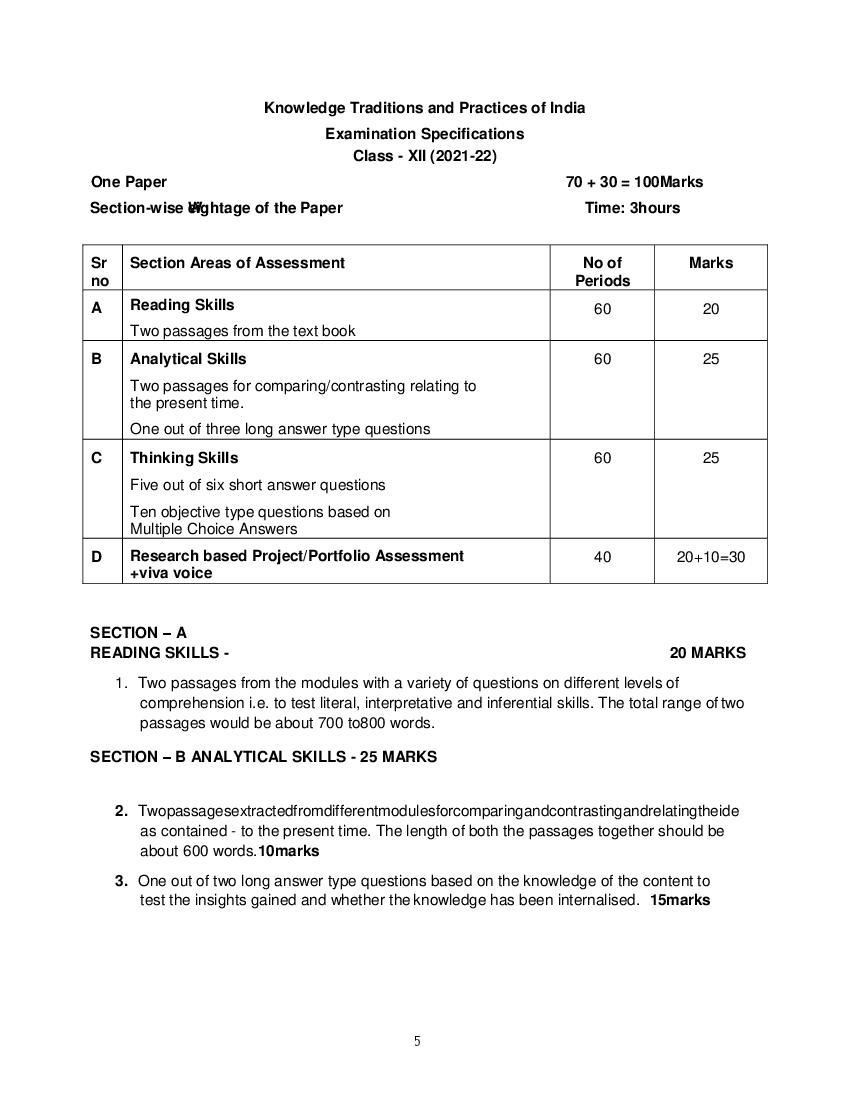
Examination Specifications
Class - XII (2021-22)
One Paper 70 + 30 = 100Marks
Section-wise W
eightage of the Paper Time: 3hours
Sr Section Areas of Assessment No of Marks
no Periods
A Reading Skills 60 20
Two passages from the text book
B Analytical Skills 60 25
Two passages for comparing/contrasting relating to
the present time.
One out of three long answer type questions
C Thinking Skills 60 25
Five out of six short answer questions
Ten objective type questions based on
Multiple Choice Answers
D Research based Project/Portfolio Assessment 40 20+10=30
+viva voice
SECTION – A
READING SKILLS - 20 MARKS
1. Two passages from the modules with a variety of questions on different levels of
comprehension i.e. to test literal, interpretative and inferential skills. The total range of two
passages would be about 700 to800 words.
SECTION – B ANALYTICAL SKILLS - 25 MARKS
2. Twopassagesextractedfromdifferentmodulesforcomparingandcontrastingandrelatingtheide
as contained - to the present time. The length of both the passages together should be
about 600 words.10marks
3. One out of two long answer type questions based on the knowledge of the content to
test the insights gained and whether the knowledge has been internalised. 15marks
5
Page 2
THINKING SKILLS 25 MARKS
4. Five out of six short answer type questions based on the survey sections in
the modules.
(W
word limit30-40words) 5 x 3 = 15marks
5. Ten objective type MCQs to test global and local understanding of the text. 10marks
SECTION – D
RESEARCH BASED PROJECT/PORTFOLIO ASSESSMENT - VIVA VOCE
20 marks + 10 marks = 30marks
The textbook has inbuilt suggestions and activities for the students to prepare a portfolio or
undertake work on a research based project. The purpose is to make students exhibit their efforts
and achievements in one or more areas. It is expected that schools organise visits to the
traditional seats of learning, historical places, cultural hubs and authentic areas. The project will
be assessed through a viva voice also which carries 10 marks out of30.
Students will be expected to compile and collect material for the project/portfolio which would be
assessed on the following points:
Presentation: efforts put in, meaningful material with aesthetic sense.
Variety of content: a wide variety of content in the form of audio visual media, extracts from
journals, art work, conference updates, photographs, writing samples, maps, charts, extracts
of interview and reading logs, etc.
Organisation of material collected has been presented with cogency and coherence
Clarity of understanding and good judgement to test internalization of knowledge.
Viva voce
Prescribed Books:
A textbook on Knowledge Traditions and Practices of India Part - II, by CBSE 2013-14.
SYLLABUS OUTLINE
Each module has a Survey Article, extracts from the Primary texts, exercises and activities.
All the modules are to be covered during one year of study.
.1 Astronomy in India 20Periods
The Beginnings of Indian Astronomy - The Early Historical Period-The Siddhāntic Era - The
Kerala School - Other Post-Siddhāntic Developments
Primary Texts
Āryabhaṭa, Varāhamihira, Brahmagupta, Vaṭeśvara, Bhāskara, Parameśvara, NīlakaṇṭhaSomayājī,
Jyeṣṭhadeva, ŚaṅkaraVarman
6
Page 3
Early Chemical Techniques, Atomism in Vaiśeṣika, Chemistry in Early Literature, The Classical
Age, Laboratory and Apparatus
Primary Texts
Vātsyāyana, Nāgārjuna, Al-Bīrūnī’, Vāgbhaṭa – qualities of a teacher, disciple, disqualification of a
disciple, location and building of the rushshala (laboratory), working arrangements of rushshala,
material and equipment, YaśodharaBhaṭṭa-process of distillation, apparatus, saranasamskara,
saranataila , Prafful Chandra Ray
.3 Indian Literatures Part I & II introduction of Indian Literature-an essentially an Oral
Indian Culture
30 Periods
Rājaśekhara-various phases of Indian Literature: Ancient Period- Vedic Period, Middle period,
Apabhransha, Modern Period
Primary Texts:
Bhakti Movement Āṇḍāl, Guru Gobind Singh, Guru NānakDev, Hāla,Iḷaṅgō, Kabīr, Kālidāsa,
Kṣetrayya, Mīrabai, MirzāGḥālib, ShāhHussain, Veda Vyāsa, ViśṇuŚarmā, Nārāyaṇa:
Pañchatantra / Hitopadeśa, Kaundinyas narrative
.4 Indian Philosophical Systems 20Periods
Mahātmā Buddha, ĀdiŚaṅkarācārya, ŚrīRāmānujācārya – concept and schools of Indian
Philosophy Sāṁkhya, Yoga, Vaiśeṣika, Nyāya, Mīmāṁsā, Vedānta, Sāṁkhya
Primary Text
The central question of Indian Philosophy: Vedic thought, Cārvāka Darśana, JainaDarśana,
BauddhaDarśana, Sāṁkhya Darśana, Yoga Darśana, NyāyaDarśana, VaiśeṣikaDarśana,
MīmāṁsāDarśana, VedāntaDarśana
.5 Indian Traditional Knowledge on Environmental Conservation 20periods
Nature, flora and fauna, Sacred groves, Reference in Manu Smriti: Vedic period and the cow,
Bishnois and conservation, Tradition of resistance
Primary Texts
Atharva-Veda, Mahābhārata, Lalitavistara: the birth of the Buddha, BhāgavataPurāṇa, Kautilya’s
Arthaśāstra
.6 LIFE SCIENCES (1): Ayurveda for Life, Health andW
ell-being
w 10 periods
Definition of Ayurveda, The Principles of Ayurvedic Healing, Treating diseases to restore health
Primary Texts
The oath of Caraka, Individualizing Diet
6. LIFE SCIENCES (2): The historical evolution of medical tradition in ancient
India 10Periods
Specialization into eight branches, The tradition of surgery, medical genetics in Ayurveda,
inoculation for smallpox, microbiology and parasitology, communicable diseases and epidemics,
7
Page 4
dynamic literary tradition, global resurgence of Ayurveda, contemporary status
Primary Texts
Dead body dissection, Rhinoplasty, Genetic basis of diseases, Communicable Diseases
6. LIFE SCIENCES (3): Plant and Animal Science in Ancient India 10periods
Antiquity and continuity, Sources, Scope, Validation, Current status, Animal Science in Ancient
India, Antiquity and continuity, Sources, Scope, Current status, Biodiversity and folk traditions
Primary Texts
Plants and their Diseases, Classification sources of animal meat
7. Mathematics in India 20Periods
First Steps, Early Historical Period, The Classical Period, The Classical Period, post-Āryabhaṭa,
The Kerala School of Mathematics, Features of Indian Mathematics
Primary Texts
Yajur-Veda, Rāmāyaṇa, Baudhāyana’sŚulbasūtras, Āryabhaṭa, Bhāskara, Severus Sebokht, Syria,
Brahmagupta, Bhāskarācārya, Jyeṣṭhadeva
8. Metallurgy in India 20Periods
Definition, Metallurgy before and during the Harappan Civilization, After the Harappans, iron
metallurgy, wootz steel, other iron pillars and beams, zinc, social context
Primary Texts
Rig-Veda, Arthaśāstra, Varāhamihira, Nāgārjuna, Vāgbhaṭa, Classification of metals:
Survarṇa(gold) and its different types, prosperities, Rajata(silver), Tām
ra (copper), Loha(iron),
Vaṅga(tin), Nāga / śīśa(lead), Pittala(brass)
9. Music in India 20Periods
Origin, classification accompanied instrument, Bharata’sNāṭyaśāstra, New era, Medieval period,
modern era, aesthetics of Indian classical music, forms of composition: Dhrupada, thum
ari, gazal,
tarana, tappa, folk music, film
m
usic
Primary Texts
aṇa, YājñavalkyaSm
TaittīriyaBrāhm ṛti, ViṣṇuPurāṇa, SkandaPurāṇa,
Sāraṅagadevasaṅgītaratnākara, Saṅgītajnam u (melody: Salagabhairavi), Ragasudharasa
10. Theatre and DramainIndia 20Periods
Its Beginnings, Classical Period, Major Indian Dramatists: Bhāsa, Kālidāsa, Bhavabhūti, Medieval
, Yakṣagāna, Bhavāī , Jātrā, Nautaṅkī, Swāṅg, Rām
Period, Kuṭiyaṭṭam āśā , Nāchā,
alīlā , Tam
Pāṇḍavānī, ModernEra
Primary Texts
Nātyaśāstra, Viṣṇudharm
ottarapurāṇa -Khaṇḍa III, Bhakti Movement, W
omen Bhakti Poets
8
Page 5
Syllabus and Outline
Class – XII-(2021-22)
.1 Agriculture: A Survey 10Periods
Agriculture in Prehistory and Proto history/ Textual Sources/ Types of Lands/ Rain-Fed and
Irrigated Crops/ Implements/ Seed and Sowing/ Manures/ Pests and Their Management/
Cattle Management/ Horticulture and Arboriculture/ Fishing/ Agriculture and Society
Agricultural Heritage: Excerpts from Primary Texts
Rigveda/ Kṛṣiparāśara (c. 400 BCE)/ Kauṭilya (3rd or 4th century BCE)/ Kaśyapiyakṛṣisukti
(800 CE)/ Vṛkṣāyurveda (c. 1000 CE)/ Kṛṣigītā (c. 1500 AD)
.2 Architecture: A Survey 10Periods
()1 Early and Classical Architecture
Temple Architecture/ Rock-Cut Structures/ Monolithic Temples/ Constructed Temples/ Public
and Private Architecture
Excerpts from Primary Texts
Viudharmottarapura_a/ Kautilya’sArthasastra/ Mayamata
Architecture: A Survey
()2 Medieval & Colonial Architecture
Fort and Palace Architecture/ Mosques/ Mausoleums/ Colonial Architecture
.3 Dance: A Survey
()1 Classical Dance Forms 20Periods
Classical Period/ Middle Period/ Modern Period/ Classical Dance Forms/ Bharatana yam/
Kathakali/ Kathak/ Kucipudi/ Manipuri/ O'issi/ Sattriya
Primary Texts on Dance in India: A Selection
Na_yasastra (tr. ManomohanGhosh)/ Na_yasastra/
Na_yasastra Dance: A Survey
()2 Folk Dance Forms 10Periods
Chau/ Bihu/ Rauf/ Padayani/ DolluKunitha/ Dandiya/ Ghumar/ Kalbelia/ Chau&fla/ Bhangra/
Giddha/ Garba/ Lava)i/ Bamboo Dance
.4 Education Systems and Practices: A Survey 30Periods
Goals of Indian Education/ Teaching and Learning/ the Teacher and the Student/ Centres of
Education/ Temples as First Schools/ Gurukulas/ Viharas and Universities/ Community-
Supported Education/ The Continuing System
Primary Texts on Education in India: A Selection
9
Page 6
The Link between Teacher and Pupil/ Teachers Invite Students to Come to Them/
Controlling the Mind and the Senses: the Goal of Indian Education/ Teacher’s Directives to
hat Is a Useful Life?/Hsüan-tsang’s (Xuanzang)
Students on their Completion of Study/ W
Impressions of Indian Education/ Hsüan-tsang’s (XuanZang) Description of Nalanda
University
Narratives of Indian Education in the 17th, 18th and 19th Centuries
An Italian Explorer’s Record of Indian Education in the 17th Century/ A Description of Indian
Education in the 18th Century/ The Teacher’s Subsistence/ Respect for the Teacher/
Physical Education and Sports/ Description of the University at Navadveep (Nuddeah) in
Bengal in 1791/ Love of Learning and Support for Education among Indians/ A W idespread
Pre-Colonial Network of Indigenous Schools
.5 Ethics: Individual and Social 20Periods
The Cosmic Order/ Buddhist Ethics/ Jain Ethics/ Sikh Ethics/ The Bhakti
Movement Primary Texts on Ethics: Individual and Social: A Selection
From Jain Granthas/ From Buddhist Granthas/ From Asoka’s Edicts/ From the Kural (tr.
P.S. Sundaram)
.6 Martial Arts Traditions: A Survey 20Periods
Texts/ Practice of Martial Arts/ Stick Combat/
Ka_arippayau Martial Arts Traditions: A Selection from
Primary Texts W
restling in the Mahabharata/
Mallapura_a/ Marmasastram
.7 Language and Grammar 20Periods
Languages of India/ Study of Language in India/ Disciplines of Language Studies in India/
Classification of Speech-Sounds/ Theory of Grammar
Primary Texts on Language: A Selection
Reflections on Language from Vedic Sources/ Phonetics: Pa_i_iyaSik_a, (tr. & ed.,
ManmohanGhosh)/ Nirukta (Etymology): The Nighau and the Nirukta of *riYaskacarya (tr. &
ed., LakshmanSarup)/ Patañjali’sMahabha_ya (adapted from S.N. Dasgupta’s translation)/
Grammar, Language and Knowledge: BhartChari’sVakyapadiya, Brahmaka_.a, tr. K.A.
SubramaniaIyer
.8 Other Technologies: A Survey 20Periods
Harappan Technologies/ Later pottery/ Glass/ W
ater Management/ Textile Technology/
W
riting Technology/ Pyrotechnics/ Cosmetics and Perfumes
Other Technologies: A Selection from Primary Texts
Gemmology/ W
ater Management/ Textiles and Garments/ Perfumes and Cosmetics
1
0
Page 7
Classical Texts/ Mural Painting/Miniature, Painting/Mughal Paintings/Tanjore and Mysore
Painting/Folk painting
Painting: Excerpts from Primary Texts
Eulogizing the art of painting for its functions and extraordinary qualities/ Preparation of the
principal colours/ Process of preparation of colours for base plaster/ Order followed by the
painter before he starts painting/ Preparation of base colours and qualities of a good
painting/ Four kinds of paintings/ Representation of various themes/ Nature of the Art of
Painting/ Eight Limbs of Painting
.0
1 Society State and Polity: A Survey 20Periods
Plurality of Indian Society/Underlying Principles of Indian Society/Family/Indian Society and
Reform/The Indian State/Goal of a State/ Polity/Bureaucracy/Legal System
Primary Texts on Society State and Polity: A Selection
A Ruler’s Dharma/ The Ideal King/ The Ideal of Government, and the Decay and Growth of
Civilization/ Conditions’ of the W
elfare of Societies/ Birth Is No Criterion of W
orth/ Dharma as
the Supreme Authority/ The Origin of Kingship/ The Science of Polity/ Duties of a King/ The
Seven Limbs of the State/ Society: Marriage/ Property of W omen/ Position of W omen/
Interreligious Harmony/ Islamic Society—the four-class division of society/ Four-class
Classification/ Ethics: The Kuralof Tiruvalluvar/ Uttaramerur Inscription
.1 Trade & Commerce: A Survey Test 20Periods
How Does Trade W ork?/Trade in Ancient India/ Different Countries, Many Goods/ Ports and
Sailors/ Land Routes/ India’s Dominance up to Precolonial Times/ By-Products of Trade/
Further Reading.
Excerpts from the Primary Text
SigalovadaSuttanta/ Jataka Tales/ Arthasastra/ Periplus Maris Erythraei (‘Voyage around the
Erythream Sea’)/ Tamil Literature/ An Inscription on Internal Trade.
1
Document Details
| Board / Org | CBSE |
| Exam | Class 12 |
| Type | Syllabus |
| Pages | 7 |
| Updated | 22 Jul 2026 |