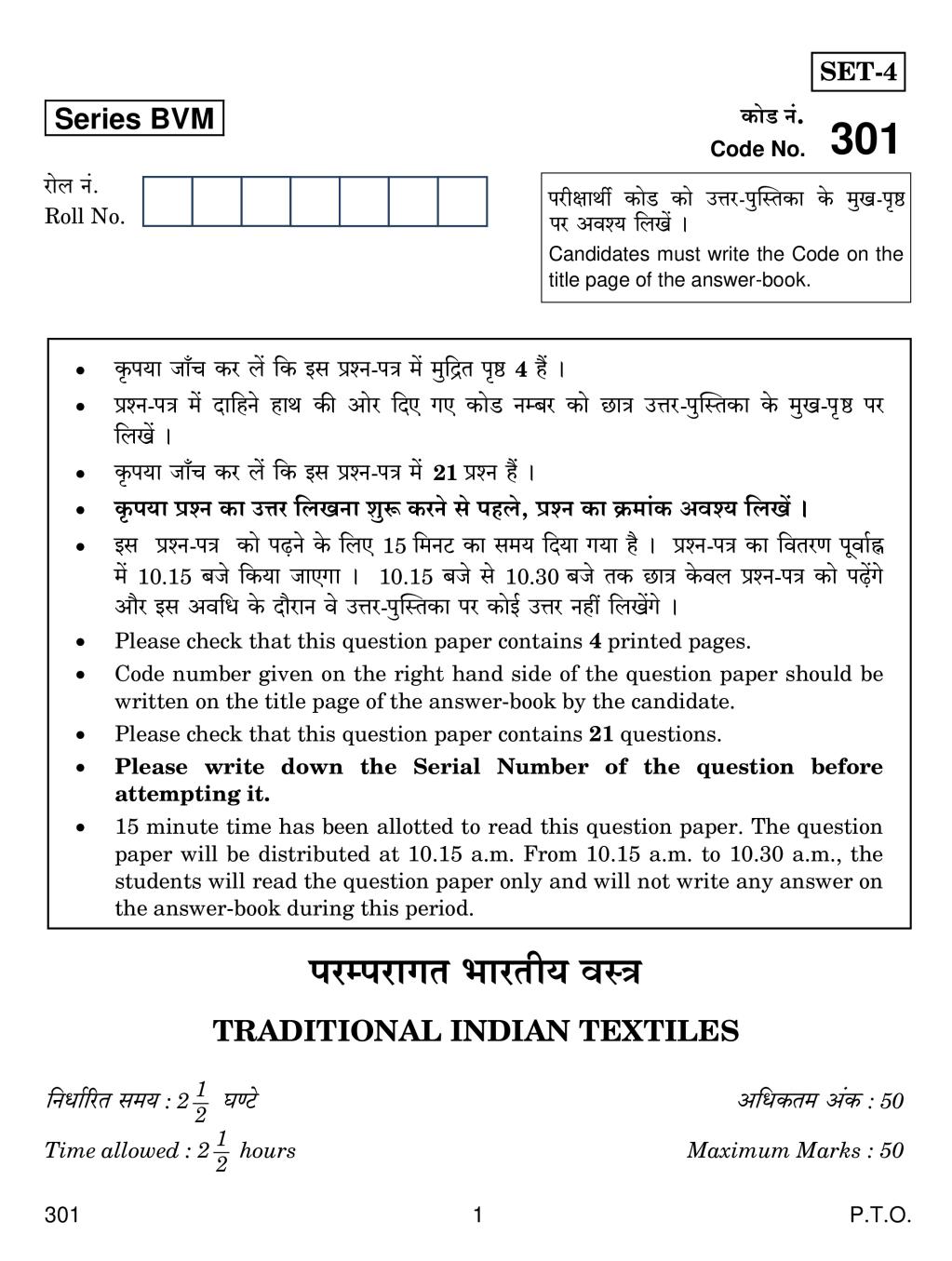
CBSE Class 12 Traditional Indian Textiles Question Paper 2019
Finished viewing? Save it for later —
Download CBSE Class 12 Traditional Indian Textiles Question Paper 2019 (PDF · 4 pages)About CBSE Class 12 Traditional Indian Textiles Question Paper 2019
CBSE Class 12 Traditional Indian Textiles Question Paper 2019 is available here for free download. Published by CBSE for Class 12, this question paper can be viewed online or downloaded as a PDF (4 pages). Candidates preparing for Class 12 can use CBSE Class 12 Traditional Indian Textiles Question Paper 2019 to understand the exam pattern, the type of questions asked, and the overall difficulty level.
Frequently Asked Questions
How can I download CBSE Class 12 Traditional Indian Textiles Question Paper 2019?
Open this page and click the Download button to save CBSE Class 12 Traditional Indian Textiles Question Paper 2019 as a PDF. It is completely free on AglaSem Docs.
Is CBSE Class 12 Traditional Indian Textiles Question Paper 2019 free to download?
Yes. CBSE Class 12 Traditional Indian Textiles Question Paper 2019 can be viewed online and downloaded as a PDF free of cost on AglaSem Docs.
How many pages does CBSE Class 12 Traditional Indian Textiles Question Paper 2019 have?
CBSE Class 12 Traditional Indian Textiles Question Paper 2019 contains 4 pages, which you can read online or download together as a single PDF.
Where can I find more Class 12 study material?
You can find more Class 12 question papers, sample papers, syllabus, and answer keys on AglaSem Docs.
CBSE Class 12 Traditional Indian Textiles Question Paper 2019 – Text
Read the full text of this question paper below — useful to quickly search, copy and reference the content online without downloading the PDF.
📄 View text version (4 pages)
Page 1
Series BVM H$moS> Z§.
Code No. 301
amob Z§. narjmWu H$moS >H$mo CÎma-nwpñVH$m Ho$ _wI-n¥ð
Roll No. >na Adí` {bIo§ &
Candidates must write the Code on the
title page of the answer-book.
H¥$n`m Om±M H$a b| {H$ Bg àíZ-nÌ _o§ _w{ÐV n¥ð> 4 h¢ &
àíZ-nÌ _| Xm{hZo hmW H$s Amoa {XE JE H$moS >Zå~a H$mo N>mÌ CÎma -nwpñVH$m Ho$ _wI-n¥>ð> na
{bI| &
H¥$n`m Om±M H$a b| {H$ Bg àíZ-nÌ _| >21 àíZ h¢ &
H¥$n`m àíZ H$m CÎma {bIZm ewê$ H$aZo go nhbo, àíZ H$m H«$_m§H$ Adí` {bI| &
Bg àíZ-nÌ H$mo n‹T>Zo Ho$ {bE 15 {_ZQ >H$m g_` {X`m J`m h¡ & àíZ-nÌ H$m {dVaU nydm©•
_| 10.15 ~Oo {H$`m OmEJm & 10.15 ~Oo go 10.30 ~Oo VH$ N>mÌ Ho$db àíZ-nÌ H$mo n‹T>|Jo
Am¡a Bg Ad{Y Ho$ Xm¡amZ do CÎma-nwpñVH$m na H$moB© CÎma Zht {bI|Jo &
Please check that this question paper contains 4 printed pages.
Code number given on the right hand side of the question paper should be
written on the title page of the answer-book by the candidate.
Please check that this question paper contains 21 questions.
Please write down the Serial Number of the question before
attempting it.
15 minute time has been allotted to read this question paper. The question
paper will be distributed at 10.15 a.m. From 10.15 a.m. to 10.30 a.m., the
students will read the question paper only and will not write any answer on
the answer-book during this period.
naånamJV ^maVr` dñÌ
TRADITIONAL INDIAN TEXTILES
{ZYm©[aV g_` : 2 12 KÊQ>o A{YH$V_ A§H$ : 50
1
Time allowed : 2 hours Maximum Marks : 50
2
301 1 P.T.O.
Page 2
(i) g^r IÊS> A{Zdm`© h¢ &
(ii) Ohm± gå^d hmo, {MÌm| H$m à`moJ H$s{OE &
General Instructions :
(i) All sections are compulsory.
(ii) Use diagrams wherever possible.
IÊS> A
SECTION A
1. {ZåZ{b{IV àË`oH$ eãX H$mo 1 – 2 dmŠ` _| g_PmBE & (H$moB© nm±M H$s{OE) 15=5
(H$) gmoµOZr (I) {bnmB©
(J) Xodm§J ~wZH$a (K) S>rgmB©qµOJ
(L>) ~mbwMar gm‹S>r (M>) qMQ²>µO
Explain the following terms in 1 – 2 sentence each. (Do any five)
(a) Sozni (b) Lipai
(c) Devang weavers (d) Desizing
(e) Baluchari saris (f) Chintz
2. [aŠV ñWmZ ^[aE & (H$moB© nm±M H$s{OE) 15=5
(H$) __________ ~Zmag H$s EH$ {deof ~wZmB© VH$ZrH$ h¡ {Og_| EH$ _mo{Q>\$ (àmê$n)
EH$ A{V[aº$ a§J Ho$ gmW ~wZm OmVm h¡, Omo AbJ {XIVm h¡ Am¡a JhZo H$s BZ¡_qbJ
O¡gm {XIVm h¡ &
(I) amOñWmZ _| ~Jê$ Am¡a ________ AnZo ãbm°H$ _w{ÐV dñÌm| Ho$ {bE OmZo OmVo h¢ &
(J) JwOamV H$s S>~b-BH$V ~wZmB© na§nam __________ H$hbmVr h¡ &
(K) __________ amOñWmZ Ho$ Q>mB©-S>mB© H$n‹S>o h¢ {OZ_| {VaN>r Am¡a {µOJµO¡J bmBZ| hmoVr
h¢ Omo a¡n-ao{gñQ> VH$ZrH$ Ûmam ~ZmB© OmVr h¢ &
(L>) {nnbr _|, EnbrH$ H$‹T>mB© H$m Aä`mg __________ H$marJam| Ûmam {H$`m OmVm h¡ &
(M>) __________ H$m {eën _wµJb AXmbVm| Ho$ g§ajU Ho$ VhV ~‹T> J`m Wm &
Fill in the blanks. (Do any five)
(a) ___________ is a special weaving technique from Banaras in which
a motif is woven with an additional colour, which stands out and
resembles the enameling in jewellery.
(b) Bagru and __________ in Rajasthan are known for their block
printed textiles.
301 2
Page 3
(d) ___________ are tie-dyed fabrics from Rajasthan with diagonal or
zigzag lines created by wrap-resist technique.
(e) In Pipli, the applique embroidery is practised by artisans called
__________ .
(f) The craft of ____________ flourished under the patronage of the
Mughal courts.
~hþV N>moQ>o CÎma {b{IE & (H$moB© nm±M H$s{OE) 25=10
Write very short answers. (Do any five)
3. "Jm_moMm' Š`m h¡ ? BgH$m _hÎd Š`m h¡ ?
What is ‘gamocha’ ? What is its significance ?
4. H$gyVr H$‹T>mB© Ho$ {bE {Z`mo{OV Mma _w»` Q>m±H$m| Ho$ Zm_ ~VmBE &
Name the four main stitches employed for Kasuti embroidery.
5. Q>mB©-S>mB© VH$ZrH$ H$mo n[a^m{fV H$s{OE & H$moB© ^r Xmo CXmhaU Xr{OE &
Define tie-dye technique. Give any two examples.
6. nQ>mobm Ho$ {eën H$m Aä`mg H$aZo dmbo H$marJam| H$s g§»`m _§o {JamdQ> H$m H$maU Š`m h¡ ?
What is the reason for decline in the number of artisans practising the
craft of Patola ?
7. H$b_H$mar H$aVo g_` H$b_ _| S>mB© H$m {Za§Va àdmh H¡$go ~ZmE aIm OmVm h¡ ?
How is a constant flow of dye maintained in the kalam while doing
kalamkari ?
8. JwOamV _| ~m§YZr Ho$ Mma à_wI H|$Ðm| Ho$ Zm_ Xr{OE &
Name the four major centres of Bandhani in Gujarat.
9. {nnbr EnbrH$ H$m H$m_ {d{^Þ Cn`moJm| _| {b`m Om ahm h¡ & CZHo$ Zm_ Xr{OE &
Pipli applique work is being put to various end uses. Name them.
N>moQ>o CÎma {b{IE & (H$moB© nm±M H$s{OE) 35=15
Write short answers. (Do any five)
10. \w$bH$mar ~ZmZo H$s VH$ZrH$ H$s ì`m»`m H$s{OE &
Explain the technique of producing a Phulkari.
11. CËnmXZ VH$ZrH$ Ho$ AmYma na BH$V H$mo VrZ lo{U`m| _| dJuH¥$V {H$`m Om gH$Vm h¡ & CZHo$
Zm_ Xr{OE Am¡a CÝh| g_PmBE &
Ikat can be classified into three categories on the basis of production
technique. Name and explain them.
301 3 P.T.O.
Page 4
Write a short note on the mud resist textiles of Bagru.
13. H$mZr em°b Ho$ {H$Ýht VrZ bo-AmCQ²>g H$s ì`m»`m H$s{OE &
Explain any three layouts of the Kani shawls.
14. hñV-Q>\${Q>S> H$mbrZ Š`m h¢ ? BZ H$mbrZm| _| BñVo_mb hmoZo dmbo gm_mÝ` _mo{Q>\$m| (àmê$nm|)
Ho$ Zm_ Xr{OE &
What are hand-tufted carpets ? Name the common motifs used in these
carpets.
15. n¡R>mZr gm‹S>r ~ZmZo H$s VH$ZrH$ H$m dU©Z H$s{OE &
Describe the technique of producing a Paithani sari.
16. M§~m é_mb _| à`wº$ _mo{Q>\$m| (àmê$nm|) H$m Am¡a BgHo$ {d{^Þ Cn`moJm| H$m dU©Z H$s{OE &
Describe the motifs used in Chamba Rumal and its various end uses.
IÊS> ~
SECTION B
{ZåZ{b{IV àíZm| Ho$ CÎma bJ^J 100 – 150 eãXm| (àË`oH$) _| Xr{OE & (H$moB© VrZ H$s{OE) 53=15
Answer the following questions in about 100 – 150 words each. (Do any three)
17. CÎma àXoe H$s {H$Ýht Xmo à_wI H$‹T>mB© H$s VH$ZrH|$, _mo{Q>\$ (àmê$nm|), H$‹T>mB© H$s e¡{b`m|
Am¡a Cn`moJ H$m dU©Z H$s{OE &
Elaborate upon any two major embroideries of Uttar Pradesh, describing
their technique, motifs, styles of embroidery and end use.
18. ~m§YZr H$n‹S>m ~ZmZo Ho$ _yb MaUm| H$s gyMr ~ZmBE &
List the basic steps of creating a Bandhani textile.
19. ãbm°H$ qàqQ>J H$mo n[a^m{fV H$s{OE & H$b_H$mar H$s _gw{bnÎmZ_ Am¡a lrH$bmhñVr e¡{b`m|
Ho$ ~rM A§Va ñnîQ> H$s{OE &
Define block printing. Differentiate between the Masulipatnam and
Srikalahasti schools of Kalamkari.
20. Amo{S>em Am¡a Am±Y« àXoe H$s ao{gñQ> S>mB© à{H«$`m Ûmam ~Zo dñÌm| H$s VH$ZrH|$, _mo{Q>\$
(àmê$nm|) Am¡a Cn`moJm| Ho$ ~mao _| {dñV¥V OmZH$mar Xr{OE &
Elaborate upon the resist dyed textiles of Odisha and Andhra Pradesh
given reference of their technique, motifs and end uses.
21. H$í_rar "H$mZr' em°b H$s ~wZmB© à{H«$`m H$s ì`m»`m H$s{OE &
Explain the process of Kashmiri ‘Kani’ shawl weaving.
301 4
Document Details
| Board / Org | CBSE |
| Exam | Class 12 |
| Type | Question Paper |
| Pages | 4 |
| Updated | 30 Apr 2026 |