CBSE Class 12 English Elective N Question Paper 2019
Finished viewing? Save it for later —
Download CBSE Class 12 English Elective N Question Paper 2019 (PDF · 11 pages)About CBSE Class 12 English Elective N Question Paper 2019
CBSE Class 12 English Elective N Question Paper 2019 is available here for free download. Published by CBSE for Class 12, this question paper can be viewed online or downloaded as a PDF (11 pages). Candidates preparing for Class 12 can use CBSE Class 12 English Elective N Question Paper 2019 to understand the exam pattern, the type of questions asked, and the overall difficulty level.
Frequently Asked Questions
How can I download CBSE Class 12 English Elective N Question Paper 2019?
Open this page and click the Download button to save CBSE Class 12 English Elective N Question Paper 2019 as a PDF. It is completely free on AglaSem Docs.
Is CBSE Class 12 English Elective N Question Paper 2019 free to download?
Yes. CBSE Class 12 English Elective N Question Paper 2019 can be viewed online and downloaded as a PDF free of cost on AglaSem Docs.
How many pages does CBSE Class 12 English Elective N Question Paper 2019 have?
CBSE Class 12 English Elective N Question Paper 2019 contains 11 pages, which you can read online or download together as a single PDF.
Where can I find more Class 12 study material?
You can find more Class 12 question papers, sample papers, syllabus, and answer keys on AglaSem Docs.
CBSE Class 12 English Elective N Question Paper 2019 – Text
Read the full text of this question paper below — useful to quickly search, copy and reference the content online without downloading the PDF.
📄 View text version (11 pages)
Page 1
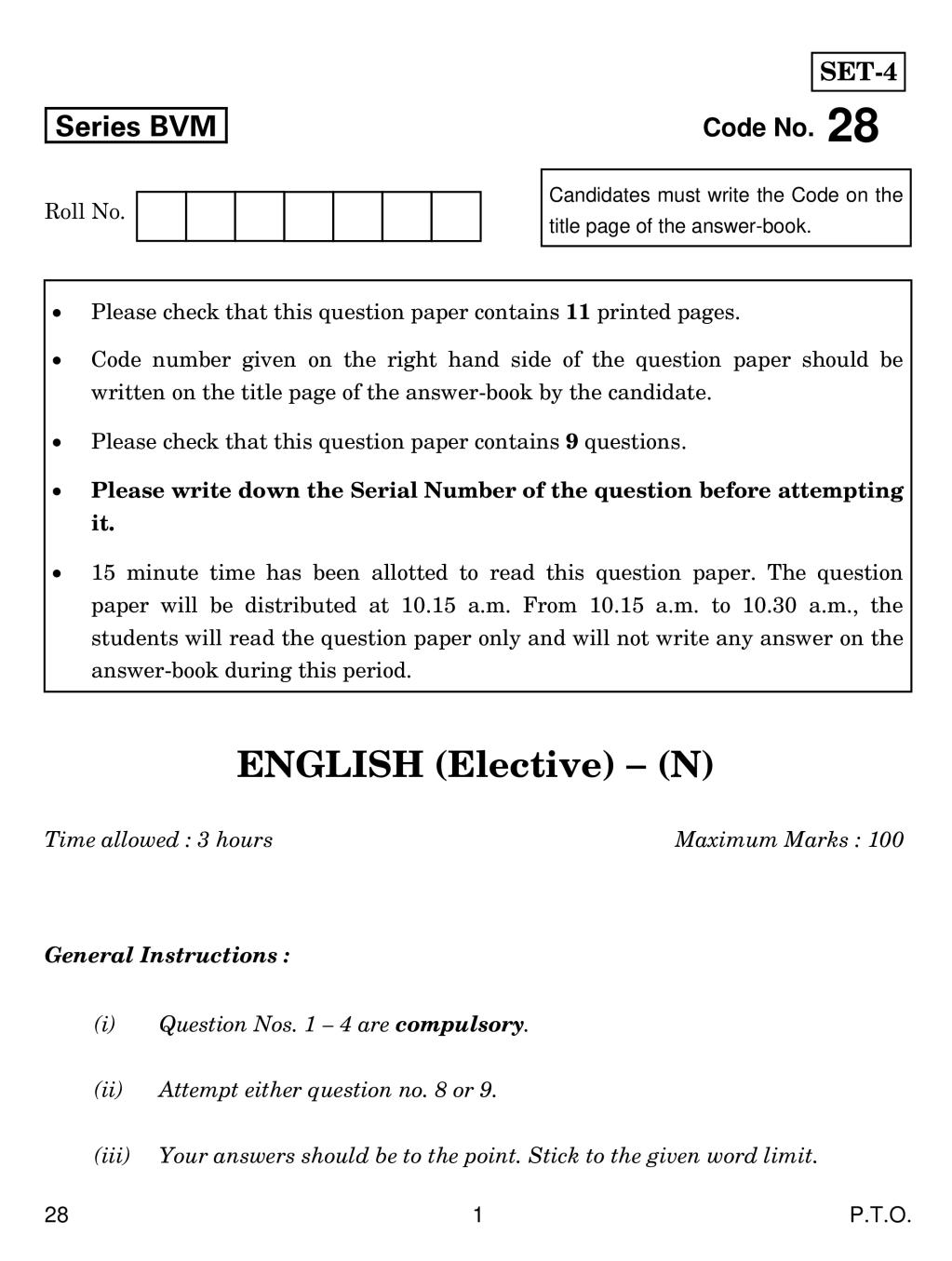
Series BVM Code No. 28
Candidates must write the Code on the
Roll No.
title page of the answer-book.
Please check that this question paper contains 11 printed pages.
Code number given on the right hand side of the question paper should be
written on the title page of the answer-book by the candidate.
Please check that this question paper contains 9 questions.
Please write down the Serial Number of the question before attempting
it.
15 minute time has been allotted to read this question paper. The question
paper will be distributed at 10.15 a.m. From 10.15 a.m. to 10.30 a.m., the
students will read the question paper only and will not write any answer on the
answer-book during this period.
ENGLISH (Elective) (N)
Time allowed : 3 hours Maximum Marks : 100
General Instructions :
(i) Question Nos. 1 – 4 are compulsory.
(ii) Attempt either question no. 8 or 9.
(iii) Your answers should be to the point. Stick to the given word limit.
28 1 P.T.O.
Page 2
1. (A) Read the passage given below and answer the questions that follow : 10
1 Mano Majra is a tiny place. It has only three brick buildings,
one of which is the home of the money-lender, Lala Ram Lal.
The other two are the Sikh temple and the mosque. The three
brick buildings enclose a triangular area with a large peepul
tree in the middle. The rest of the village is a group of
flat-roofed mud huts and low-walled courtyards, which open
into narrow lanes that spread out from the centre. Soon the
lanes turn into footpaths and get lost in the surrounding
fields. At the western end of the village there is a pond ringed
round by keekar trees. There are only about seventy families
in Mano Majra, and Lala Ram Lal’s is the only Hindu family.
The others are Sikhs or Muslims, about equal in number. The
Sikhs own all the land around the village; the Muslims are
tenants and share the tilling with the owners. There are a few
families of sweepers whose religion is uncertain. But there is
one object that all Mano Majrans — even Lal Ram Lal —
worship. This is a three-foot slab of sandstone that stands
upright under a keekar tree beside the pond. It is the local
deity, the ‘deo’ which all the villagers — Hindu, Sikh, Muslim
or pseudo-Christian — visit secretly, whenever they are in
special need of blessing.
28 2
Page 3
River, it is actually half a mile away from it. In India villages
cannot afford to be too close to the banks of rivers. Rivers
change their moods with seasons and later their course
without warning. The Sutlej is the largest river in the Punjab.
After the monsoon its waters rise and spread across its vast
sandy bed, touching high up the mud embankments on either
side. It becomes an expanse of muddy turbulence more than a
mile in breadth. When the flood subsides, the river breaks up
into a thousand shallow streams that wind sluggishly
between little marshy islands. About a mile north of Mano
Majra the Sutlej is spanned by a railroad bridge. On the
eastern end the embankment extends all the way to the
village railroad station.
3 Mano Majra has always been known for its railway station.
Since the bridge has only one track, the station has several
sidings where less important trains can wait, to make way for
the more important ones.
4 A small colony of shopkeepers and hawkers has grown up
around the station to supply travellers with food, betel leaves,
cigarettes, tea, biscuits and sweetmeats. This gives the
station an appearance of constant activity and its staff a
somewhat exaggerated sense of importance. Actually the
station-master himself sells tickets through the pigeon-hole in
28 3 P.T.O.
Page 4
and receives messages over the telegraph ticker on his table.
When there are people to notice him, he comes out on the
platform and waves a green flag for trains which do not stop.
His only assistant manipulates the levers in the glass cabin
on the platform, which control the signals on either side and
helps shunting engines by changing hand points on the tracks
to get them on to the sidings. In the evenings, he lights the
long line of lamps, on the platform. He takes heavy
aluminium lamps to the signals and sticks them in the clamps
behind the red and green glass. In the mornings, he brings
them back and puts out the lights on the platform.
5 Not many trains stops at Mano Majra. Express trains do not
stop at all. Of the many slow passenger trains, only two, one
from Delhi to Lahore in the mornings and the other from
Lahore to Delhi in the evenings, are scheduled to stop for a
few minutes. The others stop only when they are held up. The
only regular customers are the goods trains. Although Mano
Majra seldom has any goods to send or receive, its station
sidings are usually occupied by long rows of wagons. Each
passing goods train spends hours shedding wagons and
collecting others. After dark, when the countryside is steeped
in silence, the whistling and puffing of engines, the banging of
buffers, and the clanking of iron couplings can be heard all
through the night.
(slightly adapted )
28 4
Page 5
(b) Where are the keekar trees growing ? 1
(c) What type of trains stop at Mano Majra ? 1
(d) Which common object of worship is visited by all the
villagers ? 1
(e) Why did people not build their houses on the banks of the
rivers ? 1
(f) What do the shopkeepers around the railways station sell to
the travellers ? 1
(g) What additional job did the station master perform in
addition to selling tickets and sending and receiving messages
over the telegraph ticker ? 1
(h) What breaks the silence of the village at night ? 1
(i) Find the word from the passage which means the opposite of
‘broad’ (para 1). 1
(j) Find the word from the passage which means the same as
‘lazily’ (para 2). 1
(B) Read the extract given below and answer the questions that
follow : 10
(From ‘‘The Passing of Arthur’’; Alfred Lord Tennyson)
And slowly answer’d Arthur from the barge:
‘The old order changeth, yielding place to new,
And God fulfils Himself in many ways,
Lest one good custom should corrupt the world.
5 Comfort thyself: what comfort is in me ?
I have lived my life, and that which I have done
May He within himself make pure ! but thou,
28 5 P.T.O.
Page 6
Pray for my soul, More things are wrought by prayer
10 Than this world dreams of. Wherefore, let thy voice
Rise like a fountain for me night and day.
For what are men better than sheep or goats
That nourish a blind life within the brain,
If, knowing God, they lift not hands of prayer
15 Both for themselves and those who call them friend ?
For so the whole round earth is every way
Bound by gold chains about the feet of God.
18 But now farewell.
(a) What does the expression ‘The old order changeth, yielding
place to new’ signify ? 2
(b) What does the speaker ask the listener to do if he fails to
return ? 2
(c) Identify and name the figure of speech in lines 10 – 13. 2
(d) What makes human beings different from animals ? 2
(e) (i) Which word in the extract means the same as ‘giving’ ? 1
(ii) Which word in the extract means the opposite of ‘foe’ ? 1
28 6
Page 7
Creative Writing
2. (a) It is said that ‘well begun is half done’. Applying this to ‘Swachh
Bharat Mission’ we can safely assume that praiseworthy success has
been achieved under this Mission. But much more remains to be
done yet. Write a speech in 80 – 100 words on the need to intensify
this drive. You are Raunaq/Asmeeta, Secretary, Environment
Conservation Club in your school. 5
(b) Trees are the biggest source of oxygen. They help us control
pollution. We should not only not cut the trees but we should also
plant more and more trees in our neighbourhoods. Write an article
in 80 – 100 words on the topic, ‘Plant more Trees’ for your school
magazine. You are Promila/Primal. 5
3. You are Amrit/Amrita. You are participating in a debate. Write either for
or against the topic ‘In today’s world only wealthy people can afford to be
healthy.’ (150 – 200 words) 10
OR
One of the biggest problems of our society is frequent cases of missing
small children. Write an article on the topic, ‘The Rising Crime of Child
Lifting’ for a newspaper. You are Ankul/Avantika. (150 – 200 words)
Applied Grammar
4. (a) Read the following sentences carefully and then rewrite them as per
instructions given in the brackets : 15=5
(i) The teacher said, ‘‘The Earth rotates round the Sun.’’
(Change the narration)
(ii) Who broke the table ? (Change the voice)
(iii) As soon as I entered the room the alarm went off.
(No sooner ... than)
(iv) What a sweet voice ! (Assertive sentence)
(v) If you do not work hard, you will not clear the exam.
(Use lest ...)
28 7 P.T.O.
Page 8
follows : 15=5
Ram : Hello Shyam, where are you going ?
Shyam : To meet my uncle.
Ram : Where does your uncle live ?
Shyam : At Elgin Road.
Ram : You seem to be very excited.
Shyam : Yes, my uncle returned from the U.S. and he has
brought a few gifts for me.
Ram greeted Shyam and asked him (i) ___________ going. Shyam
replied that he was going to meet his uncle. At this Ram wanted to
know (ii) ___________ . Shyam’s answer was that he lived at Elgin
Road. Ram observed that Shyam (iii) __________ excited.
Shyam agreed and said that (iv) ___________ the U.S. and that
(v) ___________ for him.
SECTION C — (Literature Textbook : Kaleidoscope) 30
5. Choose any two of the extracts given below and answer the questions that
follow in 50 – 60 words each : 4 2=8
(a) ... Tao Ying takes out her own tape measure and insists on
measuring him again.
‘I don’t want to ! Everybody says I am tall enough except you. It’s
because you don’t want to buy me a ticket, don’t think I don’t know.
If you measure me I am bound to get shorter again. I don’t trust
you ! I don’t trust you !’
The yellow tape in Tao Ying’s hands has turned into a poisonous
viper.
(i) What prompts Tao Ying to measure the height of her son ? 2
(ii) What makes the son feel that the yellow tape in Tao Ying’s
hand has turned into a poisonous viper ? 2
28 8
Page 9
I was intrigued by the snake ring and its emerald eyes. I could not
find out, however, on which finger she wore it.
(i) Who is the woman being talked about ? Where and how had
the writer met her ? 2
(ii) What is special about the ring she wore ? 2
(c) Pity would be no more
If we did not make somebody Poor;
And Mercy no more could be
If all were as happy as we.
(i) What is the relationship between Pity and Poverty ? 2
(ii) What kind of society does the poet visualize in these lines ? 2
6. Answer any two of the following questions in 80 – 100 words each : 5 2=10
(a) Who was Raizel and how was she connected to Dr. Margolin ? Where
did she meet Dr. Margolin and in what form ?
(b) What are the ways in which individual freedom gets restricted ?
(c) What aspects of Indian society and history get highlighted in the
poem ‘‘Blood’’ by Kamala Das ?
7. Answer any two of the following questions in 120 – 150 words each : 6 2=12
(a) Does Amartya Sen see argumentation as a positive or a negative
value ? Give a reasoned answer.
(b) What is the role of Mother in Prakriti’s self-realisation ?
(c) Describe the conflict of emotions felt by Eveline on the day she had
decided to elope with Frank.
28 9 P.T.O.
Page 10
Note : Attempt either question no. 8 or 9.
8. (a) Answer any two of the following questions in 80 – 100 words each :
5 2=10
(i) Why did the villagers begin to guard their cattle ? Which
official did they approach for help ?
(ii) How did Captain learn how to run a circus ?
(iii) How did the Swamiji (Master) convince the crowd about his
plan to bring down the Headmaster from the loft ?
(b) Answer any one of the following questions in 150 – 200 words : 10
(i) How did Raja’s life change after he was captured ?
(ii) What was the reaction of the crowd when the Master emerged
from the school gate with the Tiger ?
(iii) What do you know about the previous life of the Master
(Swamiji) before he became a sanyasi ?
9. (a) Answer any two of the following questions in 80 – 10 words each :
5 2=10
(i) Under what circumstances did Margayya meet Dr. Pal ?
(ii) What takes Margayya to the Madman’s House at Madras ?
Describe his interview with him.
(iii) What is Margayya’s dream about his son ? What steps did he
take to realise it ?
28 10
Page 11
(i) Margayya is certainly guilty of employing unfair means to
become rich. Comment.
(ii) Who was responsible for Margayya’s ruin — Margayya
himself or/and Dr. Pal ?
(iii) Write a note on the character and the role of Margayya’s wife,
Meenakshi in the novel, ‘‘The Financial Expert’’.
28 11 P.T.O.
Document Details
| Board / Org | CBSE |
| Exam | Class 12 |
| Type | Question Paper |
| Pages | 11 |
| Updated | 30 Apr 2026 |