CBSE Class 12 Printed Textile Question Paper 2020
Finished viewing? Save it for later —
Download CBSE Class 12 Printed Textile Question Paper 2020 (PDF · 7 pages)About CBSE Class 12 Printed Textile Question Paper 2020
CBSE Class 12 Printed Textile Question Paper 2020 is available here for free download. Published by CBSE for Class 12, this question paper can be viewed online or downloaded as a PDF (7 pages). Candidates preparing for Class 12 can use CBSE Class 12 Printed Textile Question Paper 2020 to understand the exam pattern, the type of questions asked, and the overall difficulty level.
Frequently Asked Questions
How can I download CBSE Class 12 Printed Textile Question Paper 2020?
Open this page and click the Download button to save CBSE Class 12 Printed Textile Question Paper 2020 as a PDF. It is completely free on AglaSem Docs.
Is CBSE Class 12 Printed Textile Question Paper 2020 free to download?
Yes. CBSE Class 12 Printed Textile Question Paper 2020 can be viewed online and downloaded as a PDF free of cost on AglaSem Docs.
How many pages does CBSE Class 12 Printed Textile Question Paper 2020 have?
CBSE Class 12 Printed Textile Question Paper 2020 contains 7 pages, which you can read online or download together as a single PDF.
Where can I find more Class 12 study material?
You can find more Class 12 question papers, sample papers, syllabus, and answer keys on AglaSem Docs.
CBSE Class 12 Printed Textile Question Paper 2020 – Text
Read the full text of this question paper below — useful to quickly search, copy and reference the content online without downloading the PDF.
📄 View text version (7 pages)
Page 1
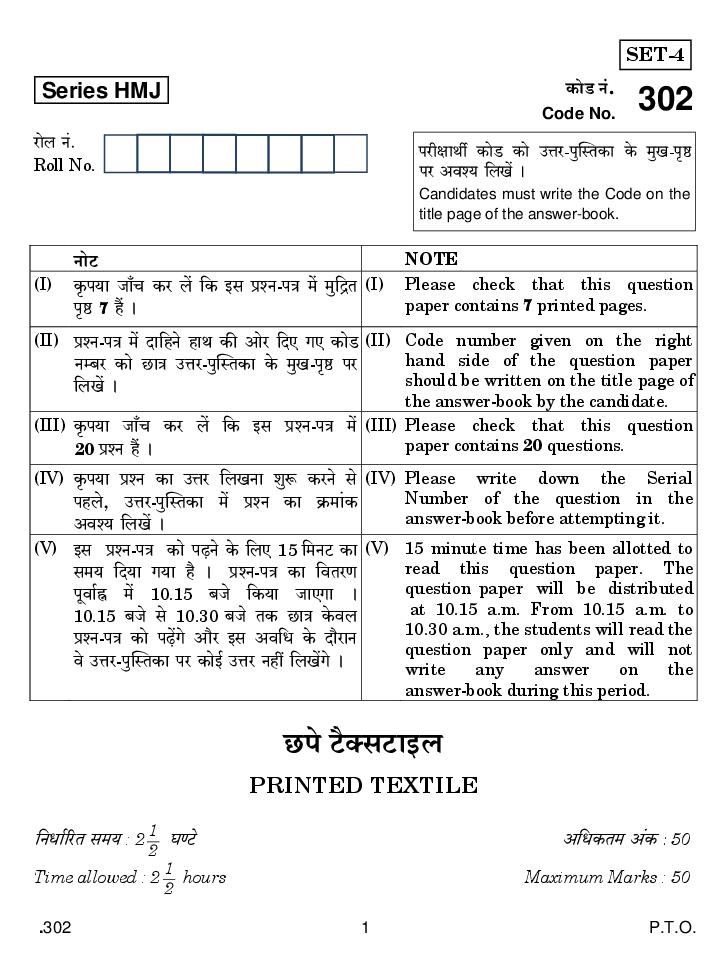
Series HMJ H$moS> Z§.
Code No.
302
amob Z§. narjmWu H$moS >H$mo CÎma-nwpñVH$m Ho$ _wI-n¥ð
Roll No. >na Adí` {bIo§ &
Candidates must write the Code on the
title page of the answer-book.
ZmoQ> NOTE
(I) H¥$n`m Om±M H$a b| {H$ Bg àíZ-nÌ _o§ _w{ÐV (I) Please check that this question
n¥ð> 7 h¢ & paper contains 7 printed pages.
(II) àíZ-nÌ _| Xm{hZo hmW H$s Amoa {XE JE H$moS (II) Code number given on the right
>Zå~a H$mo N>mÌ CÎma-nwpñVH$m Ho$ _wI-n¥ð> na hand side of the question paper
{bI| & should be written on the title page of
the answer-book by the candidate.
(III) H¥$n`m Om±M H$a b| {H$ Bg àíZ-nÌ _| (III) Please check that this question
>20 àíZ h¢ & paper contains 20 questions.
(IV) H¥$n`m àíZ H$m CÎma {bIZm ewê$ H$aZo go (IV) Please write down the Serial
nhbo, CÎma-nwpñVH$m _| àíZ H$m H«$_m§H$ Number of the question in the
Adí` {bI| & answer-book before attempting it.
(V) Bg àíZ-nÌ H$mo n‹T>Zo Ho$ {bE 15 {_ZQ >H$m (V) 15 minute time has been allotted to
g_` {X`m J`m h¡ & àíZ-nÌ H$m {dVaU read this question paper. The
nydm©• _| 10.15 ~Oo {H$`m OmEJm & question paper will be distributed
10.15 ~Oo go 10.30 ~Oo VH$ N>mÌ Ho$db at 10.15 a.m. From 10.15 a.m. to
10.30 a.m., the students will read the
àíZ-nÌ H$mo n‹T>|Jo Am¡a Bg Ad{Y Ho$ Xm¡amZ question paper only and will not
do CÎma-nwpñVH$m na H$moB© CÎma Zht {bI|Jo & write any answer on the
answer-book during this period.
N>no Q>¡ŠgQ>mBb
PRINTED TEXTILE
{ZYm©[aV g_` : 2 12 KÊQ>o A{YH$V_ A§H$ : 50
1
Time allowed : 2 hours Maximum Marks : 50
2
.302 1 P.T.O.
Page 2
(i) Bg àíZ-nÌ _| 20 àíZ em{_b h¢ &
(ii) àíZ-nÌ Xmo IÊS>m| _| {d^m{OV h¡ &
IÊS> H$
~hþ{dH$ënr` àíZ /[aº ñWmZ ^[aE /grYo àíZ : Hw$b 12 àíZ em{_b h¢ Omo
1 – 1 A§H$ Ho$ h¢ & BZ_| go {H$Ýht 10 àíZm| Ho$ CÎma Xr{OE &
A{V bKw CÎmar` àíZ : BZ_| Hw$b 7 àíZ em{_b h¢, àË`oH$ 2 A§H$ Ho$ h¢ & BZ_| go
{H$Ýht 5 àíZm| Ho$ CÎma Xr{OE &
bKw CÎmar` àíZ : BZ_| Hw$b 7 àíZ em{_b h¢, àË`oH$ 3 A§H$ Ho$ h¢ & BZ_| go
{H$Ýht 5 àíZm| Ho$ CÎma Xr{OE &
IÊS> I
XrK© CÎmar` /{Z~ÝYmË_H$ àíZ : BZ_| Hw$b 5 àíZ em{_b h¢, àË`oH$ 5 A§H$ Ho$ h¢ & BZ_|
go {H$Ýht 3 àíZm| Ho$ CÎma Xr{OE &
(iii) Ohm± gå^d hmo, AnZo CÎmam| H$mo {M{ÌV H$s{OE &
IÊS> H$
1. [aº$ ñWmZ ^[aE (H$moB© Xg ) : 1 10=10
(a) _______ EH$ gwà{gÕ Am{Q>©ñQ> h¡ {OÝhm|Zo N>no hþE Q>oŠgQ>mBëg H$mo {S>µOmBZ {H$`m h¡ & 1
(b) _______ do {\$pŠg¨J EO|Q> hmoVo h¢ {OZH$m à`moJ àmH¥${VH$ a§Jm| go S>mB© H$aVo g_`
{H$`m OmVm h¡ Vm{H$ S>mB© H$n‹S>o na {\$Šg hmo gHo$ & 1
(c) _______ qàQ²>g bJ^J h_go ~mV| H$aVo h¢ & 1
(d) à{gÕ Q>m°Bb S>o OwB© H$n‹S>o _______ _| OwB© H$ma˜mZo _| {S>µOmBZ Am¡a _w{ÐV {H$E JE
Wo & 1
(e) {b~Q>u qàQ²>g H$m Zm_ _______ go {b`m J`m, Omo EH$ A§J«oOr Q>oŠgQ>mBb H§$nZr
Wr, {OgH$s ñWmnZm 1875 _| hþB© Wr & 1
(f) gÌhdt eVmãXr _|, `yamonr` H§$n{Z`m| Zo ^maV go hmW go n|Q> {H$E JE {S>µOmBZm| H$m
ì`mnma ewê$ {H$`m Omo _______ H$hbmVo Wo & 1
(g) _______ qàQ²>g A{Zdm`© ê$n go Ý`yZVa Am¡a ~hþV-hr ~moëS> a§Jm| Ho$ g§`moOZ go
~ZVo h¢ & 1
.302 2
Page 3
(i) This question paper contains 20 questions.
(ii) The question paper is divided into two sections.
SECTION A
Multiple choice questions / Fill in the blanks/Direct questions :
contains total 12 questions of 1 mark each. Answer any 10 questions.
Very short answer type questions : contains total 7 questions of
2 marks each. Answer any 5 questions.
Short answer type questions : contains total 7 questions of 3 marks
each. Answer any 5 questions.
SECTION B
Long answer / Essay type questions : contains total 5 questions of 5 marks
each. Answer any 3 questions.
(iii) Illustrate your answers wherever possible.
SECTION A
1. Fill in the blanks (any ten) : 1 10=10
(a) ________ is a well known fine artist who has designed printed
textiles. 1
(b) ________ are fixing agents used while dyeing with natural dyes to
fix the dye onto the material. 1
(c) ________ prints nearly speak to us. 1
(d) The famous Toile de Jouy fabrics were designed and printed at the
factory at Jouy in ________. 1
(e) Liberty prints take their name from ________, an English textile
company that was founded in 1875. 1
(f) In the seventeenth century, European companies started trading
hand painted designs from India known as ________. 1
(g) ________ prints are essentially minimalistic and have very bold
colour combinations. 1
.302 3 P.T.O.
Page 4
(i) H$n‹S>m CÚmoJ _| _______ H$mo a§J {ZX}e Am¡a H$n‹S>o Ho$ n¡Q>Z© Ho$ {bE {d{^Þ a§J
{ZYm©[aV H$aZo Ho$ {bE {Z`mo{OV {H$`m OmVm h¡ & 1
(j) dbu qàQ> _______ qàQ> H$s loUr _| AmVo h¢ & 1
(k) e¡{b`m|, a§Jm|, {df`m| Am¡a VH$ZrH$m| _| ~Xbmd H$m gmW ~ZmE aIZo Ho$ {bE, àË`oH$
{S>µOmBZ N>mÌ H$mo {d{^Þ _______ Ho$ ~mao _| nVm hmoZm Mm{hE & 1
(l) J«m_rU {df` O¡go {H$ no‹S>, njr, OmZda, nmZr Am¡a ~mXb Ho$ gmW-gmW eha Ho$
Ñí` _______ qàQ> _| {M{ÌV {H$E OmVo h¢ & 1
{H$Ýht nm±M àíZm| (à. 2 8) Ho$ ~hþV g§{jßV CÎma {b{IE : 2 5=10
2. {S>µOmBZ Ho$ VÎd Š`m h¢ ? 2
3. \$m°`b N>nmB© _| n¡Q>Z© H¡$go CËnÞ hmoVm h¡ ? 2
4. Zm¡{Q>H$b qàQ²>g _| à`wŠV _mo{Q>\$m| H$s gyMr ~ZmBE & 2
5. ^{dî`dmX Am¡a àVrH$dmX Ho$ ~rM A§Va ñnîQ> H$s{OE & 2
6. ñH«$sZ qàqQ>J Ho$ bm^ ~VmBE & 2
7. H$n‹S>m n¡Q>{ZªJ _| ‘[anrQ>’ H$s ^y{_H$m Š`m h¡ ? 2
8. H$n‹S>m N>nmB© H$mo n[a^m{fV H$s{OE & 2
{H$Ýht nm±M àíZm| (à. 9 15) Ho$ àË`oH$ 50 – 70 eãXm| _| g§{jßV CÎma {b{IE & 3 5=15
9. boAmCQ> Ho$ {d{^Þ àH$ma Š`m h¢ ? {H$Ýht Xmo àH$ma Ho$ boAmCQ> ~ZmBE & 3
10. new qàQ> Š`m h¢ ? do g^r H$hm± bmJy hmoVo h¢ ? 3
11. amoba qàqQ>J Ho$ VrZ \$m`Xm| H$s gyMr ~ZmBE & 3
12. g§X^© gm_{J«`m| Ho$ _hÎd d òmoV g_PmBE & 3
13. a§JrZ {S>ñMmO© Š`m hmoVo h¢ Am¡a do H¡$go ~ZmE OmVo h¢ ? 3
14. _{hbmAm| Ho$ H$n‹S>m| Ho$ {bE {H$g Vah Ho$ qàQ> g~go Cn`wŠV h¢ ? CZ na EH$ g§{jßV
{Q>ßnUr {b{IE & 3
15. _wÐU Ho$ {d{^Þ VarH$m| H$s gyMr ~ZmBE & BZ_| go H$m¡Z-gm EH$ H$n‹S>m N>nmB© Ho$ {bE
ZdrZV_ {dH$mg h¡ ? BgHo$ Xmo \$m`Xo ~VmBE & 3
.302 4
Page 5
(i) In the textile industry ________ is employed to provide colour
directions and colour ways for the textile pattern. 1
(j) Warli prints come under the category of ________ prints. 1
(k) In order to keep up with the changes in styles, colours, themes and
techniques, every design student must be aware of various
________. 1
(l) Rural subjects such as trees, birds, animals, water and clouds as
well as cityscapes are illustrated in ________ prints. 1
Write very short answers for any five questions (Q. 2 8) : 2 5=10
2. What are elements of design ? 2
3. How is the pattern generated in foil printing ? 2
4. List down motifs used in nautical prints. 2
5. Differentiate between futurism and symbolism. 2
6. State the advantages of screen printing. 2
7. What is the role of ‘repeat’ in textile patterning ? 2
8. Define textile printing. 2
Write short answers for any five questions (Q. 915) in 50 – 70 words each. 3 5=15
9. What are the different types of layouts ? Draw any two types of layouts. 3
10. What are animal prints ? Where all are they applied ? 3
11. List the three advantages of roller printing. 3
12. Explain the importance and sources of reference materials. 3
13. What are coloured discharges and how are they produced ? 3
14. What kinds of prints are most suitable for women’s clothing ? Write a
short note on them. 3
15. List the different methods of printing. Which one of these is the latest
development in textile printing ? Give its two advantages. 3
.302 5 P.T.O.
Page 6
{H$Ýht VrZ àíZm| (à. 16 20) Ho$ àË`oH$ 100 – 150 eãXm| _| {dñV¥V CÎma {b{IE & 5 3=15
16. Á`m{_Vr` qàQ>m| Ho$ ~mao _| {dñVma go ~VmBE & 5
17. ãbm°H$ qàqQ>J {H$go H$hVo h¢ ? BgH$m CËnmXZ H¡$go {H$`m OmVm h¡ ? BgHo$ \$m`Xo Am¡a
ZwH$gmZ Š`m h¢ ? 5
18. _wÐU H$s à{VamoY (ao{µOñQ>) e¡br Ho$ ~mao _| {dñVma go ~VmBE & _wÐU H$s à{VamoY e¡br H$s
{H$Ýht Xmo VH$ZrH$m| Ho$ Zm_ Xr{OE & 5
19. Q>m°`b qàQ²>g Am¡a {dŠQ>mo[a`Z qàQ²>g Ho$ ~rM CZH$s àoaUm, ê$nm§H$Zm| (_mo{Q>\$) Am¡a
A§V-Cn`moJm| H$mo Ü`mZ _| aIH$a A§Va ~VmBE & 5
20. Q´>mÝg\$a qàqQ>J na CgHo$ \$m`Xo Am¡a ZwH$gmZ H$m C„oI H$aVo hþE EH$ {dñV¥V {Q>ßnUr
{b{IE & 5
.302 6
Page 7
Write descriptive answers for any three questions (Q. 16 20) in 100 – 150
words each. 5 3=15
16. Explain geometric prints in detail. 5
17. What is block printing ? How is it produced ? What are its advantages
and disadvantages ? 5
18. Explain in detail the Resist style of printing. Give names of any two
techniques of Resist style of printing. 5
19. Differentiate between Toile prints and Victorian prints with respect to
their inspiration, motifs and end uses. 5
20. Write a detailed note on Transfer printing, mentioning its advantages
and disadvantages. 5
.302 7 P.T.O.
Document Details
| Board / Org | CBSE |
| Exam | Class 12 |
| Type | Question Paper |
| Pages | 7 |
| Updated | 22 Jul 2026 |