Karnataka 1st PUC Question Bank for Economics
Finished viewing? Save it for later —
Download Karnataka 1st PUC Question Bank for Economics (PDF · 68 pages)About Karnataka 1st PUC Question Bank for Economics
Karnataka 1st PUC Question Bank for Economics is available here for free download. Published by Karnataka Board for Class 11, this question bank can be viewed online or downloaded as a PDF (68 pages). Candidates preparing for Class 11 can use Karnataka 1st PUC Question Bank for Economics to understand the exam pattern, the type of questions asked, and the overall difficulty level.
Frequently Asked Questions
How can I download Karnataka 1st PUC Question Bank for Economics?
Open this page and click the Download button to save Karnataka 1st PUC Question Bank for Economics as a PDF. It is completely free on AglaSem Docs.
Is Karnataka 1st PUC Question Bank for Economics free to download?
Yes. Karnataka 1st PUC Question Bank for Economics can be viewed online and downloaded as a PDF free of cost on AglaSem Docs.
How many pages does Karnataka 1st PUC Question Bank for Economics have?
Karnataka 1st PUC Question Bank for Economics contains 68 pages, which you can read online or download together as a single PDF.
Where can I find more Class 11 study material?
You can find more Class 11 question papers, sample papers, syllabus, and answer keys on AglaSem Docs.
Karnataka 1st PUC Question Bank for Economics – Text
Read the full text of this question bank below — useful to quickly search, copy and reference the content online without downloading the PDF.
📄 View text version (68 pages)
Page 1
Department of School Education
(Pre-University)
QUESTION BANK
Page 2
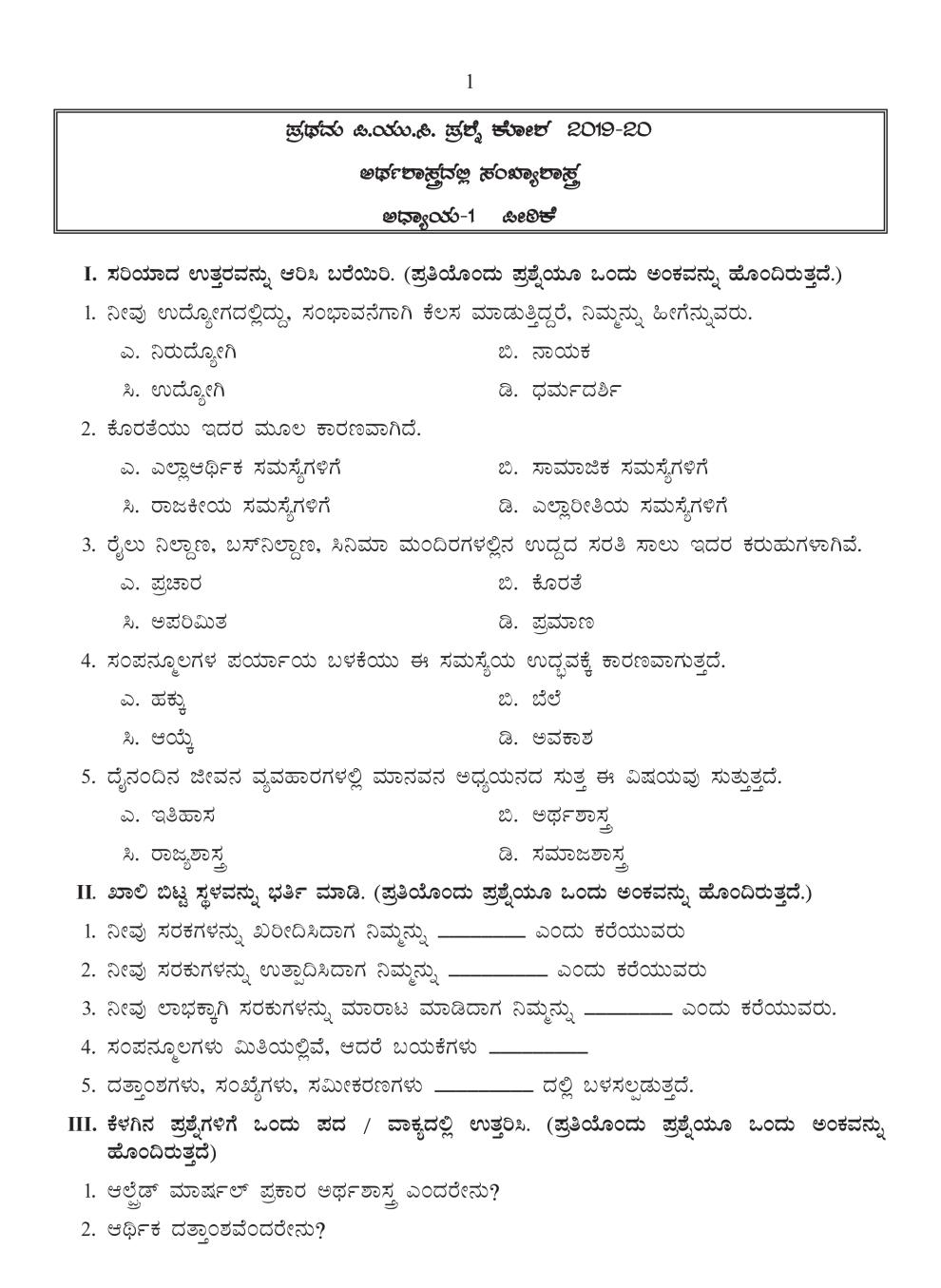
À è ¸ÀASÁå±Á¸ÀÛç
CzsÁåAiÀÄ-1: ¦ÃpPÉ
I. ¸ÀjAiÀiÁzÀ GvÀÛgÀªÀ£ÀÄß Dj¹ §gɬÄj. (¥ÀæwAiÉÆAzÀÄ ¥Àæ±ÉßUÉ 1 CAPÀ)
1. ¤ÃªÀÅ GzÉÆåÃUÀzÀ°èzÀÄÝ, ¸ÀA¨sÁªÀ£ÉUÁV PÉ®¸À ªÀiÁqÀÄwÛzÀÝgÉ, ¤ªÀÄä£ÀÄß »ÃUÉ£ÀÄߪÀgÀÄ.
J) ¤gÀÄzÉÆåÃV ©) GvÁàzPÀ À ¹) GzÉÆåÃV r) C£ÀĨsÉÆÃV
2. PÉÆgÀvÉAiÀÄÄ EzÀgÀ ªÀÄÆ® PÁgÀtªÁVzÉ.
J) J¯Áè DyðPÀ ¸ÀªÀĸÉåUÀ½UÉ ©) ¸ÁªÀiÁfPÀ ¸ÀªÀĸÉåUÀ½UÉ
¹) gÁdQÃAiÀÄ ¸ÀªÀĸÉåUÀ½UÉ r) J¯Áè ªÁå¥ÁgÀ ¸ÀªÀĸÉåUÀ½UÉ
3. gÉ樀 ¤¯ÁÝt, §¸ï ¤¯ÁÝt, ¹¤ªÀiÁ ªÀÄA¢gÀUÀ¼À°è£À GzÀÝzÀ ¸ÀgÀw ¸Á®Ä EzÀgÀ PÀÄgÀĺÀÄUÀ¼ÁVªÉ.
J) DyðPÀ »AdjPÉ ©) ¸ÀA¥À£ÀÆä®UÀ¼À PÉÆgÀvÉ ¹) ¸ÀA¥À£ÀÆä®UÀ¼À C¢üPÀå r) CyðPÀ ªÀÄÄUÀÎlÄÖ
4. ¸ÀA¥À£ÀÆä®UÀ¼À ¥ÀAiÀiÁðAiÀÄ §¼ÀPÉAiÀÄÄ F ¸ÀªÀĸÉåAiÀÄ GzÀãªÀPÉÌ PÁgÀtªÁUÀÄvÀÛzÉ.
J) ºÀPÀÄÌ ©) ¨É¯É ¹) DAiÉÄÌ r) CªÀPÁ±À
5. zÉÊ£ÀA¢£À fêÀ£À ªÀåªÀºÁgÀUÀ¼°À è ªÀiÁ£ÀªÀ£À CzsÀåAiÀÄ£ÀzÀ ¸ÀÄvÀÛ F «µÀAiÀĪÀÅ ¸ÀÄvÀÄÛvÀÛzÉ.
J) EwºÁ¸À ©) CxÀð±Á¸ÀÛç ¹) gÁdå±Á¸ÀÛç r) ¸ÀªÀiÁd±Á¸ÀÛç
II. SÁ° ©lÖ ¸ÀܼÀªÀ£ÄÀ ß ¨sÀwð ªÀiÁr. (¥ÀæwAiÉÆAzÀÄ ¥Àæ±ÉßUÉ 1 CAPÀ)
1. ¤ÃªÀÅ ¸ÀgÀPÀUÀ¼À£ÄÀ ß Rjâ¹zÁUÀ ¤ªÀÄä£ÀÄß ________ JAzÀÄ PÀgÉAiÀÄĪÀgÀÄ.
2. ¤ÃªÀÅ ¯Á¨sÀPÁÌV ¸ÀgPÀ ÄÀ UÀ¼À£ÄÀ ß ªÀiÁgÁl ªÀiÁrzÁUÀ ¤ªÀÄä£ÀÄß ________ JAzÀÄ PÀgÉAiÀÄĪÀgÀÄ.
3. ¸ÀA¥À£ÀÆä®UÀ¼ÀÄ «ÄwAiÀÄ°èªÉ, DzÀgÉ §AiÀÄPÉUÀ¼ÀÄ _________
4. gÁ¶ÖçÃAiÀÄ ªÀgÀªÀiÁ£ÀªÀ£ÄÀ ß PÀÆ°, ¯Á¨sÀ, UÉÃt ªÀÄvÀÄÛ §rØUÀ¼ÉAzÀÄ ¨sÁUÀ ªÀiÁqÀĪÀÅzÀ£ÀÄß _________ PÀgÉAiÀÄÄvÉÛêÉ.
5. zÀvÁÛA±ÀUÀ¼À ¸ÀAUÀæºÀuÉ, «±ÉèõÀuÉ, ªÁåSÁå£À ªÀÄvÀÄÛ ¤gÀÆ¥ÀuÉAiÉÆA¢UÉ ___________ ªÀåªÀºÀj¸ÀÄvÀÛzÉ.
III. PɼÀV£À ¥Àæ±ÉßUÀ½UÉ MAzÀÄ ªÁPÀå / ¥ÀzÀzÀ°è GvÀÛj¹. (¥ÀæwAiÉÆAzÀÄ ¥Àæ±ÉßUÉ 1 CAPÀ)
1. GvÁàzÀPÀ JAzÀgÉ AiÀiÁgÀÄ?
2. DºÁgÉÃvÀgÀ ¨É¼ÉUÉ MAzÀÄ GzÁºÀgÀuÉ ¤Ãr.
3. D¯Éàçqï ªÀiÁµÀð¯ï ¥ÀæPÁgÀ CxÀð±Á¸ÀÛç JAzÀgÉãÀÄ?
4. DyðPÀ zÀvÁÛA±ÀUÀ¼ÀÄ JAzÀgÉãÀÄ?
5. ¸ÀASÁå±Á¸ÀÛç JAzÀgÉãÀÄ?
6. DyðPÀ ¤ÃwAiÀÄ CxÀð ¤Ãr.
IV. PɼÀV£À ¥Àæ±ÉßUÀ½UÉ ¸ÀĪÀiÁgÀÄ 4 ªÁPÀåUÀ¼°
À è GvÀÛj¹. (¥ÀæwAiÉÆAzÀÄ ¥Àæ±ÉßUÉ 2 CAPÀUÀ¼ÀÄ)
1. GzÉÆåÃV ªÀÄvÀÄÛ GzÉÆåÃUÀzÁvÀgÀ £ÀqÀÄ«£À ªÀåvÁå¸ÀªÀ£ÀÄß §gɬÄj.
2. ¤ÃªÀÅ ¤vÀå fêÀ£ÀzÀ°è PÁtĪÀ JgÀqÀÄ PÉÆgÀvÉUÀ¼À£ÀÄß ºÉ¸Àj¹.
3. ¥ÀAiÀiÁðAiÀÄ G¥ÀAiÉÆÃUÀªÀżÀî AiÀiÁªÀÅzÁzÀgÀÆ JgÀqÀÄ ¸ÀA¥À£ÀÆä®UÀ¼À£ÀÄß w½¹.
4. CxÀð±Á¸ÀÛçªÀ£ÀÄß ¸ÁªÀiÁ£ÀåªÁV AiÀiÁªÀ ªÀÄÆgÀÄ ¨sÁUÀUÀ¼À°è ZÀað¸À¯ÁUÀÄvÀÛzÉ?
5. ¸ÀASÁå±Á¸ÀÛçªÀ£ÀÄß §¼À¸À®àqÀĪÀ AiÀiÁªÀÅzÁzÀgÀÆ JgÀqÀÄ «µÀAiÀÄUÀ¼À£ÀÄß ºÉ¸Àj¹.
6. AiÀiÁªÀÅzÁzÀgÀÆ JgÀqÀÄ DyðPÀ ¸ÀªÀĸÉåUÀ¼À£ÀÄß ºÉ¸Àj¹.
V. PɼÀV£À ¥Àæ±ÉßUÀ½UÉ ¸ÀĪÀiÁgÀÄ 12 ªÁPÀåUÀ¼À°è GvÀÛj¹. (¥ÀæwAiÉÆAzÀÄ ¥Àæ±ÉßUÉ 4 CAPÀUÀ¼ÄÀ )
1. “¤d fêÀ£ÀzÀ°è £ÁªÀÅ C¯Áè¢Ã£ï£ÀµÀÄÖ CzÀȵÀÖªÀAvÀgÁUÀ®Ä ¸ÁzsÀå«®è”. ¸ÀªÀÄyð¹.
2. ‘PÉÆgÀvÉAiÀÄÄ J¯Áè DyðPÀ ¸ÀªÀĸÉåUÀ½UÉ ªÀÄÆ® PÁgÀtªÁVzÉ’. «µÀ¢PÀj¹.
3. ¸ÀASÁå±Á¸ÀÛçªÀÅ CxÀð±Á¸ÀÛçzÀ CzsÀåAiÀÄ£ÀPÌÉ ºÉÃUÉ £ÉgÀªÁVzÉ JA§ÄzÀ£ÀÄß ¸ÀAQë¥ÀÛªÁV «ªÀj¹.
4. “¸ÀASÁåvÀäPÀ «zsÁ£ÀUÀ¼ÀÄ ¸ÁªÀiÁ£ÀåeÁÕ£ÀPÌÉ ¥ÀAiÀiÁðAiÀĪÀ®è” ! GzÁºÀgÀuÉAiÉÆA¢UÉ «ªÀj¹.
****
1
Page 3
I . ¸ÀjAiÀiÁzÀ GvÀÛgÀªÀ£ÀÄß Dj¹ §gɬÄj. (¥ÀæwAiÉÆAzÀÄ ¥Àæ±ÉßUÉ 1 CAPÀ)
1. ¥ÀæwQæAiÉÄAiÀÄ£ÀÄß £ÉÆÃqÀĪÀAvÀºÀ zÀvÁÛA±À ¸ÀAUÀæºÀuÉAiÀÄ «zsÁ£ÀªÉAzÀgÉ
J) zÀÆgÀªÁt ¸ÀAzÀ±Àð£À ©) CAZÉ ¥Àæ±ÁߪÀ½
¹) ªÉÊAiÀÄQÛPÀ ¸ÀAzÀ±Àð£À r) E-ªÉÄïï
2. PɼÀV£À AiÀiÁªÀ zÀvÁÛA±À ¸ÀAUÀº æ ÀuÉAiÀÄ «zsÁ£ÀªÀÅ PÀrªÉÄ ¸ÀªÀÄAiÀÄzÀ°è ¸ÀªÀÄAd¸ÀªÁzÀ ¤RgÀªÁzÀ ªÀiÁ»wAiÀÄ£ÀÄß ¤ÃqÀÄvÀÛzÉ?
J) ¥ÉÊ®mï ¸À«ÄÃPÉë ©) ªÀiÁzÀj ¸À«ÄÃPÉë ¹) CAZÉ ¥Àæ±ÁߪÀ½ r) ªÉÊAiÀÄQÛPÀ ¸ÀAzÀ±Àð£À
3. PɼÀV£À AiÀiÁªÀ zÉÆõÀUÀ¼ÄÀ ºÉZÀÄÑ UÀA©üÃgÀªÁzÀÄzÀÄ?
J) ªÀiÁzÀj DAiÉÄÌAiÀÄ zÉÆõÀUÀ¼ÀÄ ©) ªÀiÁzÀj DAiÉÄÌAiÀÄ®èzÀ zÉÆõÀUÀ¼ÀÄ
¹) zÀvÁÛA±ÀzÀ zÉÆõÀUÀ¼ÀÄ r) ¯ÉPÁÌZÁgÀzÀ°è£À zÉÆõÀUÀ¼ÀÄ.
4. DGCIS JAzÀgÉ
J) qÉÊgÀPÀÖgï d£ÀgÀ¯ï D¥sï PÀªÀĶðAiÀįï EAqÀ¹ÖçAiÀįï CAqï ¸ÁÖöån¹ÖPïì
©) qÉÊgÀPÉÆÖgÉÃmï d£ÀgÀ¯ï D¥sï PÀªÀĶðAiÀįï EAl°eÉ£ïì CAqï ¸ÁÖöån¹ÖPïì
¹) qÉÊgÀPÀÖgï d£ÀgÀ¯ï D¥sï PÀªÀÄÄå¤PÉõÀ£ï EAl°eÉ£ïì CAqï ¸ÁÖöån¹ÖPïì
r) qÉÊgÀPÀÖgï d£ÀgÀ¯ï D¥sï ¹«¯ï EAl°eÉ£ïì CAqï ¸ÁÖöån¹ÖPïì
5. ¸ÁévÀAvÀæöå £ÀAvÀgÀ ªÉÆzÀ® d£ÀUÀtw £ÀqÉzÀ ªÀµÀð
J) 1881 ©) 1947 ¹) 1951À r) 1961
II. SÁ° ©lÖ ¸ÀܼÀªÀ£ÄÀ ß ¨sÀwð ªÀiÁr. (¥ÀæwAiÉÆAzÀÄ ¥Àæ±ÉßUÉ 1 CAPÀ)
1. ±ÉÆÃzsÀP£À ÀÄ ¸ÀAUÀ滹zÀ zÀvÁÛA±ÀPÉÌ ______________JAzÀÄ ºÉ¸ÀgÄÀ .
2. ¸À«ÄÃPÉëAiÀÄ°è __________ AiÀÄÄ ¸ÀªÉÃð ¸ÁªÀiÁ£ÀåªÁV §¼À¸ÀĪÀ ¸ÁzsÀ£ª À ÁVzÉ.
3. C£ÀPÀëgÀ¸ÀÜgÀÄ G¥ÀAiÉÆÃV¸À®Ä ¸ÁzsÀå«®èzÀ zÀvÁÛA±À ¸ÀAUÀæºÀuÉAiÀÄ «zsÁ£À ___________
4. PÀrªÉÄ CªÀ¢üAiÀÄ°è ªÀiÁ»wAiÀÄ£ÀÄß ¸ÀAUÀ滸À§ºÀÄzÁzÀ ¸ÀAzÀ±Àð£À __________
5. ¨sÁgÀvÀzÀ d£ÀUÀUÀtwAiÀÄÄ ________ ªÀµÀðPÉÆ̪ÉÄä £ÀqÉAiÀÄÄvÀÛzÉ.
6. NSSO zÀ vÉæöʪÀiÁ¹PÀ ¥ÀwæPA
É iÀÄ£ÀÄß _________ JAzÀÄ PÀgÉAiÀÄÄvÁÛgÉ.
III. PɼÀV£ÀªÅÀ UÀ¼À£ÀÄß ºÉÆA¢¹ §gɬÄj. (¥ÀæwAiÉÆAzÀÄ ¥Àæ±ÉßUÉ 1 CAPÀ)
A B
1) ªÉåAiÀÄQÛPÀ ¸ÀAzÀ±Àð£À a) ¥ÀƪÀð¨sÁ« ¥Àæ±ÁߪÀ½
2) CAZÉ ¥Àæ±ÁߪÀ½ b) J¯Áè ªÀåQÛUÀ¼À£ÀÄß M¼ÀUÉÆArgÀÄvÀÛzÉ
3) zÀÆgÀªÁt ¸ÀAzÀ±Àð£À c) ¥Àæ±ÁߪÀ½ PÀ¼ÉzÀÄ ºÉÆÃUÀÄ«PÉ
4) ¥Éʯmï ¸À«ÄÃPÉë d) ¸Á¥ÉÃPÀëªÁV PÀrªÉÄ ªÉZÀÑ
5) d£ÀUÀtw e) C¢üPÀ ªÉZÑÀ
IV. PɼÀV£À ¥Àæ±ÉßUÀ½UÉ MAzÀÄ ªÁPÀå / ¥ÀzÀzÀ°è GvÀÛj¹. (¥ÀæwAiÉÆAzÀÄ ¥Àæ±ÉßUÉ 1 CAPÀ)
1. ZÀ®PÀ JAzÀgÉãÀÄ?
2. d£ÀUÀtwAiÀÄ CxÀð §gɬÄj.
3. ªÀiÁzÀj ¸À«ÄÃPÉë JAzÀgÉãÀÄ?
4. ªÀiÁzÀj DAiÉÄÌAiÀÄ zÉÆõÀzÀ CxÀð ¤Ãr.
5. NSSO - «¸ÀÛj¹.
6. CSO - «¸ÀÛj¹.
2
Page 4
1. zÀvÁÛA±ÀzÀ JgÀqÀÄ ªÀÄÆ®UÀ¼À£ÀÄß ºÉ¸Àj¹.
2. GvÀÛªÀÄ ¥Àæ±ÁߪÀ½AiÀÄ JgÀqÀÄ UÀÄt®PÀëtUÀ¼À£ÀÄß §gɬÄj.
3. ªÀÄÄaÑzÀ J¯ÉèAiÀÄ ªÀÄvÀÄÛ vÉgÉzÀ J¯ÉèAiÀÄ ¥Àæ±ÉßUÀ¼À £ÀqÀÄ«£À ªÀåvÁå¸ÀªÀ£ÄÀ ß UÀÄgÀÄw¹.
4. zÀvÁÛA±ÀUÀ¼À ¸ÀAUÀæºÀuÉAiÀÄ AiÀiÁªÀÅzÁzÀgÀÆ JgÀqÀÄ «zsÁ£ÀUÀ¼À£ÀÄß ºÉ¸Àj¹.
5. ¥ÉÊ®mï ¸À«ÄÃPÉëAiÀÄ CxÀð ¤Ãr.
6. d£ÀUÀtw ªÀÄvÀÄÛ ªÀiÁzÀj ¸À«ÄÃPÉëAiÀÄ ªÀåvÁå¸ÀUÀ¼À£ÀÄß §gɬÄj.
7. ¸ÀASÁå±Á¸ÀÛçzÀ°è£À d£À¸ÀASÉå ªÀÄvÀÄÛ ªÀiÁzÀjUÀ¼À CxÀðªÀ£ÀÄß ¤Ãr.
8. MAzÀÄ ºÀ½îAiÀÄ°è 200 gÉÊvÀjzÀÄÝ, ¨É¼É «zsÁ£ÀªÀ£ÀÄß PÀAqÀÄ»rAiÀÄĪÀ §UÉÎ MAzÀÄ CzsÀåAiÀÄ£À £ÀqɸÀ¯Á¬ÄvÀÄ. CªÀÅUÀ¼À°è 50
gÉÊvÀgÀ£ÀÄß ¸À«ÄÃPÉë ªÀiÁqÀ¯ÁV, 50% ªÀiÁvÀæ UÉÆâü ¨É¼ÉAiÀįÁVvÀÄÛ. d£À¸ÀASÉå ªÀÄvÀÄÛ ªÀiÁzÀjUÀ¼À UÁvÀæªÉãÀÄ?
9. ªÀiÁzÀj «zsÁ£ÀzÀ JgÀqÀÄ «zsÀUÀ¼À£ÀÄß ºÉ¸j À ¹.
10. AiÀiÁªÀÅzÁzÀgÀÆ JgÀqÀÄ ªÀiÁzÀj DAiÉÄÌAiÀÄ®èzÀ zÉÆõÀUÀ¼À£ÀÄß ºÉ¸Àj¹.
VI. PɼÀV£À ¥Àæ±ÉßUÀ½UÉ ¸ÀĪÀiÁgÀÄ 12 ªÁPÀåUÀ¼À°è GvÀÛj¹. (¥ÀæwAiÉÆAzÀÄ ¥Àæ±ÉßUÉ 4 CAPÀUÀ¼ÄÀ )
1. ¯Álj «zsÁ£ÀªÀÅ AiÀiÁªÁUÀ®Æ C¤²ÑvÀ (AiÀiÁzÀÈaÒPÀ) ªÀiÁzÀjAiÀÄ£ÀÄß ¤ÃqÀÄvÀÛzÉAiÉÄ? «ªÀj¹.
2. ªÀiÁzÀj DAiÉÄÌAiÀÄ zÉÆõÀUÀ¼À£ÀÄß ¸ÀAQë¥ÀÛªÁV «ªÀj¹.
3. d£ÀUÀtw ªÀÄvÀÄÛ NSSO PÀÄjvÀÄ §gɬÄj.
VII. PÁAiÀÄð¨sÁgÀ ªÀÄvÀÄÛ ¤AiÉÆÃd£É DzsÁjvÀ ¥Àæ±Éß. (5 CAPÀUÀ¼ÀÄ)
1. ¤ÃªÀÅ M§â ¸ÀA±ÉÆÃzsÀ£Á «zÁåyðAiÀiÁVzÀÄÝ, ¤ÃªÀÅ ±Á¯ÉUÀ¼° À è ‘ªÀÄzÁåºÀßzÀ ©¹AiÀÄÆl AiÉÆÃd£É’AiÀÄ ªÀiÁzÀj ¸À«ÄÃPÉë
ªÀiÁqÀ¨ÉÃPÁVzÉ JAzÀÄPÉƽî, ¤ªÀÄä ¸À«ÄÃPÉëUÉ ¸Àj ºÉÆAzÀĪÀ GvÀÛªÀĪÁzÀ ¥Àæ±ÁߪÀ½AiÀÄ£ÀÄß vÀAiÀiÁj¹.
****
3
Page 5
I . ¸ÀjAiÀiÁzÀ GvÀÛgÀªÀ£ÀÄß Dj¹ §gɬÄj. (¥ÀæwAiÉÆAzÀÄ ¥Àæ±ÉßUÉ 1 CAPÀ)
1. MAzÉà vÀgÀºÀzÀ ªÀ¸ÄÀ ÛUÀ¼À£ÀÄß PÉ®ªÀÅ ªÀiÁ£ÀzÀAqÀUÀ½UÉ C£ÀÄUÀÄtªÁV ªÀUÀðUÀ¼À°è eÉÆÃr¸ÀĪÀÅzÀÄ CxÀªÁ ¸ÀAWÀn¸ÀĪÀÅzÀ£ÄÀ ß
»ÃUÉ£ÀÄßvÉÛêÉ.
J) ¸Àà¶ÖÃPÀgÀt ©) ªÀVðÃPÀgÀt ¹) AiÀiÁzsÀÈaÒÃPÀgÀt r) ªÁåSÁå£À
2. MAzÀÄ ªÁå¦ÛAiÀÄ°è£À AiÀiÁªÀÅzÉà ¸ÁATåPÀ ªÀiË®åUÀ¼À£ÄÀ ß ºÉÆAzÀĪÀ ZÀ®PÀªÀ£ÄÀ ß »ÃUÉ PÀgÉAiÀÄÄvÁÛgÉ.
J) C¸ÀvÀvÀ ZÀ®PÀ ©) ¸ÀvÀvÀ ZÀ®PÀ ¹) ±ÀvÁAPÀUÀ¼ÀÄ r) ZÀvÀÄxÀðPÀUÀ¼ÀÄ
3. ªÀUÀð ªÀÄzsÀå©AzÀĪÀÅ EzÀPÌÉ ¸ÀªÀÄ£ÁVgÀÄvÀÛzÉ.
J) ªÀUÀðzÀ ªÉÄðäw ªÀÄvÀÄÛ PɼÀ«ÄwAiÀÄ ¸ÀgÁ¸Àj ©) ªÀUÀðzÀ ªÉÄðäw ªÀÄvÀÄÛ PɼÀ«ÄwAiÀÄ UÀÄt®§Þ
¹) ªÀUÀðzÀ ªÉÄðäw ªÀÄvÀÄÛ PɼÀ«ÄwAiÀÄ C£ÀÄ¥ÁvÀ r) ªÀUÀðzÀ ªÉÄðäw ªÀÄvÀÄÛ Pɼ« À ÄwAiÀÄ £ÀqÀÄ«£À ªÀåvÁå¸À
4. MAzÀÄ ªÀUÀðzÀ Pɼ« À ÄwAiÀÄÄ CzÀgÀ »A¢£À ªÀUÀðzÀ ªÉÄðäwUÉ ¸ÀªÀÄ£ÁVgÀĪÀ «zsÁ£ÀªÀ£ÀÄß »ÃUÉ£ÀÄßvÉÛêÉ.
J) M¼ÀUÉÆAqÀ ¥ÀzÀÞw ©) ºÉÆgÀvÁzÀ ¥ÀzÀÞw ¹) UÀtw ¥ÀzÀÞw r) ¸À«ÄÃPÁë ¥ÀzÀÞw
5. MAzÀÄ ZÀ®PÀzÀ Cw zÉÆqÀØ ªÀÄvÀÄÛ Cw aPÀÌ ¥Áæ¥ÁÛAPÀzÀ £ÀqÀÄ«£À ªÀåvÁå¸ÀªÀ£ÄÀ ß »ÃUÉ£ÀÄߪÀgÀÄ.
J) ªÀUÁðAvÀgÀ ©) ªÁå¦Û ¹) PɼÀ«Äw r) ªÉÄðäw
6. ªÀVÃðPÀÈvÀ zÀvÁÛA±ÀzÀ°è ¸ÀASÁåvÀäPÀ ¯ÉPÁÌZÁgÀªÀÅ EzÀ£ÀÄß DzsÀj¹zÉ.
J) ¥Áæ¥ÀÛAPÀUÀ¼À £ÉÊd ªÀiË®åUÀ¼ÀÄ ©) ªÀUÀðzÀ ªÉÄðäw ¹) ªÀUÀðzÀ Pɼ«
À Äw r) ªÀUÀð ªÀÄzsÀå©AzÀÄ
7. JgÀqÀÄ ZÀ®PÀUÀ¼À DªÀÈwÛ «vÀgÀuÉAiÀÄ£ÀÄß »ÃUÉ PÀgÉAiÀÄĪÀgÀÄ.
J) KPÀ ZÀ®PÀ «vÀgÀuÉ ©) ¢éZÀ®PÀ «vÀgÀuÉ ¹) §ºÀÄZÀ®PÀ «vÀgÀuÉ r) CªÀÈwÛ C£ÀÄ«£Áå¸À
II. SÁ° ©lÖ ¸ÀܼÀªÀ£ÄÀ ß ¨sÀwð ªÀiÁr. (¥ÀæwAiÉÆAzÀÄ ¥À±
æ ÉßUÉ 1 CAPÀ)
1. ¨sËUÉÆýPÀ ¥ÀæzÉñÀPÌÉ D£ÀÄUÀÄtªÁV ªÀVÃðPÀj¸À®àqÀĪÀ zÀvÁÛA±ÀªÀ£ÀÄß ___________ JAzÀÄ PÀgÉAiÀĪÀgÀÄ.
2. UÀÄt®PÀëtUÀ½UÉ C£ÀÄUÀÄtªÁV zÀvÁÛA±ÀUÀ¼À£ÄÀ ß ªÀVÃðPÀj¸ÀĪÀÅzÀPÌÉ __________ JAzÀÄ PÀgÉAiÀĪÀgÀÄ.
3. zÀvÁÛA±ÀUÀ¼À ªÀVÃðPÀgÀtzÀ ___________ «zsÁ£ÀzÀ°è ªÀUÀðzÀ ªÉÄðäwAiÀÄ£ÀÄß DAiÀiÁ ªÀUÀðzÀ°èAiÉÄà ¸ÉÃj¹PÉƼÀî¯ÁUÀÄvÀÛzÉ.
4. C¸ÀvÀvÀ zÀvÁÛA±ÀUÀ¼À DªÀÈwÛ «vÀgÀuÉAiÀÄ£ÀÄß _________ JAzÀÄ PÀgA É iÀĪÀgÄÀ .
5. MAzÀÄ ZÀ®PÀzÀ DªÀÈwÛ «vÀgÀuÉAiÀÄ£ÀÄß _____________ «vÀgÀuÉ J£ÀÄßvÁÛgÉ.
III. PɼÀV£À ¥Àæ±ÉßUÀ½UÉ MAzÀÄ ªÁPÀå / ¥ÀzÀzÀ°è GvÀÛj¹. (¥ÀæwAiÉÆAzÀÄ ¥Àæ±ÉßUÉ 1 CAPÀ)
1. PÀZÁÑ zÀvÁÛA±À JAzÀgÉãÀÄ?
2. zÀvÁÛA±ÀzÀ ¥ÀjªÀiÁuÁvÀäPÀ ªÀVÃðPÀgÀt JAzÀgÉãÀÄ?
3. zÀvÁÛA±ÀUÀ¼À PÁ¯Á£ÀÄPÀæªÀÄ ªÀVÃðPÀgÀtzÀ CxÀð ¤Ãr.
5. DªÀÈwÛ «vÀgÀuÉ JAzÀgÉãÀÄ?
5. ªÀUÀð«ÄwUÀ¼À CxÀðªÀ£ÄÀ ß ¤Ãr.
6. ªÀUÁðAvÀgÀ JAzÀgÉãÀÄ?
IV. PɼÀV£À ¥Àæ±ÉßUÀ½UÉ ¸ÀĪÀiÁgÀÄ 4 ªÁPÀåUÀ¼°
À è GvÀÛj¹. (¥ÀæwAiÉÆAzÀÄ ¥Àæ±ÉßUÉ 2 CAPÀUÀ¼ÀÄ)
1. ¸ÀvÀvÀ ZÀ®PÀUÀ½UÉ AiÀiÁªÀÅzÁzÀgÀÆ JgÀqÀÄ GzÁºÀgÀuÉ ¤Ãr.
2. DªÀÈwÛ JAzÀgÉãÀÄ?
3. ªÀÄzsÀå©AzÀĪÀ£ÀÄß PÀAqÀÄ »rAiÀÄĪÀ ¸ÀÆvÀæªÀ£ÀÄß w½¹.
4. ¤ÃrgÀĪÀ ªÀUÀð (30-40)gÀ°è ªÀUÁðAvÀgÀ ªÀÄvÀÄÛ ªÀUÀð ªÀÄzsÀå©AzÀĪÀ£ÄÀ ß PÀAqÀÄ»r¬Äj.
5. ºÉÆgÀvÁzÀ ªÀÄvÀÄÛ M¼ÀUÉÆAqÀ ¥ÀzÀÞwAiÀÄ £ÀqÀÄ«£À ªÀåvÁå¸À w½¹.
4
Page 6
1. zÀvÁÛA±ÀUÀ¼À ªÀVðÃPÀgÀtzÀ §UÉÎ §gɬÄj.
2. ¸ÀvÀvÀ ªÀÄvÀÄÛ C¸ÀvÀvÀ ZÀ®PÀUÀ¼À ªÀåvÁå¸ÀªÀ£ÀÄß UÀÄgÀÄw¹.
3. ªÀVðÃPÀÈvÀ zÀvÁÛA±ÀUÀ¼À°è ‘ªÀiÁ»w £À²¹ºÉÆÃUÀÄ«PÉ'AiÀÄ£ÀÄß «ªÀj¹.
VI. PɼÀV£À ¥Àæ±ÉßUÀ½UÉ ¸ÀĪÀiÁgÀÄ 20 ªÁPÀåUÀ¼À°è GvÀÛj¹. (¥ÀæwAiÉÆAzÀÄ ¥Àæ±ÉßUÉ 6 CAPÀUÀ¼ÀÄ)
1. DªÀÈwÛ «vÀgÀuÉAiÀÄ£ÀÄß vÀAiÀiÁj¸ÀĪÁUÀ GAmÁUÀĪÀ LzÀÄ ¥Àæ±ÉßUÀ¼À£ÀÄß ¥ÀnÖ ªÀiÁr. EªÀÅUÀ¼À°è AiÀiÁªÀÅzÁzÀgÀÆ JgÀqÀÄ ¥Àæ±Éß
UÀ¼À£ÀÄß ¸ÀAQë¥ÀÛªÁV «ªÀj¹.
2. CxÀð±Á¸ÀÛç «µÀAiÀÄzÀ°è 60 «zÁåyðUÀ¼ÀÄ UÀ½¹zÀ CAPÀUÀ½UÉ ªÀUÁðAvÀgÀ LzÀÄ JAzÀÄ ¥ÀjUÀt¹ vÁ¼É UÀÄgÀÄvÀÄUÀ¼À ¸ÀºÁAiÀÄ
¢AzÀ CªÀÈwÛ «vÀgÀuÁ ¥ÀnÖAiÀÄ£ÀÄß vÀAiÀiÁj¹.
28 17 15 22 29 21 23 27 18 12 7 2 9 4 1 8 3 10 5 20
16 12 8 4 33 27 21 15 3 36 27 21 15 3 37 16 28 9 2 4
6 32 31 29 18 14 13 15 11 9 7 1 5 37 32 23 24 20 19 25
VII. PÁAiÀÄð¨sÁgÀ ªÀÄvÀÄÛ ¤AiÉÆÃd£É DzsÁjvÀ ¥Àæ±Éß. (5 CAPÀUÀ¼ÀÄ)
1. DºÁgÀzÀ ªÉÄð£À PÀÄlÄA§UÀ¼À ªÀiÁ¹PÀ ªÉZÀÑ (gÀÆ.UÀ¼À°è)ªÀ£ÀÄß DzsÀj¹, 20 PÀÄlÄA§UÀ¼À£ÀÄß PɼÀV£ÀAvÉ ¤ÃqÀ¯ÁVzÉ, F
PɼÀV£À ¥Àæ±ÉßUÀ½UÉ GvÀÛj¹.
1904 1559 3473 1735
2760 1612 1753 1855
4439 5090 1085 1823
2346 1523 1211 1360
1110 2152 1183 1218
J) DºÁgÀzÀ ªÉÄð£À ªÉZÑz
À À UÀjµÀ× ªÀiË®åªÀ£ÀÄß UÀÄgÀÄw¹.
©) DºÁgÀzÀ ªÉÄð£À ªÉZÀÑzÀ PÀ¤µÀ× ªÀiË®åªÀ£ÀÄß UÀÄgÀÄw¹.
¹) DºÁgÀzÀ ªÉÄð£À PÀÄlÄA§UÀ¼À ªÀiÁ¹PÀ ªÉZÀÑzÀ ªÁå¦ÛAiÀÄ£ÀÄß PÀAqÀÄ»r¬Äj.
r) DºÁgÀzÀ ªÉÄÃ¯É gÀÆ. 1500 ªÀÄvÀÄÛ gÀÆ.2500 gÀ £ÀqÀÄªÉ ªÉZÀÑ ªÀiÁqÀĪÀ PÀÄlÄA§UÀ¼À ¸ÀASÉå JµÀÄÖ?
E) DºÁgÀzÀ ªÉÄÃ¯É gÀÆ. 3000 QÌAvÀ®Æ ºÉZÀÄÑ ªÉZÀÑ ªÀiÁqÀĪÀ PÀÄlÄA§UÀ¼À ¸ÀASÉå JµÀÄÖ?
****
5
Page 7
I. ¸ÀjAiÀiÁzÀ GvÀÛgÀªÀ£ÀÄß Dj¹ §gɬÄj. (¥ÀæwAiÉÆAzÀÄ ¥Àæ±ÉßUÉ 1 CAPÀ)
1. zÀvÁÛA±ÀUÀ¼À£ÄÀ ß ªÁPÀåUÀ¼À°è ¤gÀƦ¸ÀĪÀÅzÀ£ÀÄß »ÃUÉ£ÄÀ ߪÀgÀÄ.
J) PÉÆõÀ×PÀ ¤gÀÆ¥ÀuÉ ©) gÉÃSÁavÀæ ¤gÀÆ¥ÀuÉ ¹) ¥ÀoÀå ¤gÀÆ¥ÀuÉ r) vÁAwæPÀ ¤gÀÆ¥ÀuÉ
2. zÀvÁÛA±ÀUÀ¼À£ÄÀ ß CqÀظÁ®Ä ªÀÄvÀÄÛ PÀA§¸Á®ÄUÀ¼À°è ªÀåPÀÛ¥Àr¸ÀĪÀÅzÀ£ÄÀ ß »ÃUÉ£ÀÄßvÉÛêÉ.
J) ¥ÉÊ-£ÀPÉë ©) ¸ÀÛA¨sÀ gÉÃSÁavÀæ ¹) ¸ÀgÀ¼À gÉÃSÁavÀæ r) PÉÆõÀ×PÀ
3. CAPÀUÀtÂvÀ gÉÃSÁ£ÀPëA É iÀÄ ªÀÄÆ®PÀ zÀvÁÛA±ÀUÀ¼À ¤gÀÆ¥ÀuÉAiÀÄÄ EzÀ£ÀÄß CxÉÊð¹PÉƼÀî®Ä ¸ÀºÀPÀj¸ÀÄvÀÛzÉ.
J) zÀvÁÛA±ÀzÀ ¢ÃWÁðªÀ¢ü ¥ÀæªÀÈwÛ ©) zÀvÁÛA±ÀzÀ°è£À DªÀvÀðvÉ
¹) zÀvÁÛA±ÀzÀ°è£À IÄvÀĪÀiÁ£ÀvÉ r) zÀvÁÛA±ÀzÀ C¯ÁàªÀ¢ü ¥ÀæªÀÈwÛ
4. DAiÀÄvÀ avÀæªÀÅ
J) MAzÀÄ ¥ÀjªÀiÁtzÀ DPÀÈw ©) JgÀqÀÄ ¥ÀjªÀiÁtzÀ DPÀÈw
¹) ªÀÄÆgÀÄ ¥ÀjªÀiÁtzÀ DPÀÈw r) £Á®ÄÌ ¥ÀjªÀiÁtzÀ DPÀÈw
5. DªÀÈwÛ §ºÀĨsÀÄeÁPÀÈwAiÀÄ£ÀÄß F ¤gÀÆ¥ÀuÉAiÀÄ°è §¼À¸À¯ÁUÀÄvÀÛzÉ.
J) CªÀVÃðPÀÈvÀ zÀvÁÛA±À ©) ªÀVÃðPÀÈvÀ zÀvÁÛA±À
¹) PÀZÁÑ zÀvÁÛA±À r) ªÉÊAiÀÄQÛPÀ zÀvÁÛA±À
6. ZÀÆ¥ÀÄ ZÁªÀt gÉÃSÉAiÀÄÄ EzÀ£ÄÀ ß gÉÃSÁvÀäPÀªÁV ¤gÀƦ¸À®Ä ¸ÀºÁAiÀÄPÀªÁVªÉ.
J) §ºÀÄ®PÀ ©) CAPÀUÀtÂvÀ ¸ÀgÁ¸Àj ¹) ªÀÄzsÁåAPÀ r) ±ÀvÁAPÀUÀ¼ÀÄ
II. SÁ° ©lÖ ¸ÀܼÀªÀ£ÄÀ ß ¨sÀwð ªÀiÁr. (¥ÀæwAiÉÆAzÀÄ ¥À± æ ÉßUÉ 1 CAPÀ)
1. PÉÆõÀÖPzÀ À _______ ¨sÁUÀªÀÅ £ÉÊd zÀvÁÛA±ÀªÀ£ÀÄß M¼ÀUÉÆArgÀÄvÀÛzÉ.
2. WÀlPÀ ¸ÀÛA¨sÀ gÉÃSÁ avÀª æ À£ÄÀ ß ____________ JAzÀÆ PÀgÉAiÀÄĪÀgÀÄ.
3. ¸ÀÛA¨sÀ gÉÃSÁavÀæ ªÀÄvÀÄÛ ¥ÉÊ £ÀPÉëUÀ¼ÄÀ ____________ gÉÃSÁavÀæUÀ¼À ªÀUÀðzÀ°è §gÀÄvÀÛªÉ.
4. ZÀÆ¥ÀÄ ZÁªÀt gÉÃSÉAiÀÄ£ÀÄß ____________ DªÀÈwÛ gÉÃSÉ JAzÀÆ PÀgÉAiÀÄÄvÁÛgÉ.
5. CAPÀUÀtÂwÃAiÀÄ gÉÃSÁ £ÀPëÉAiÀÄ£ÀÄß _________ JAzÀÆ PÀgÉAiÀÄĪÀgÀÄ.
III. PɼÀV£À ¥Àæ±ÉßUÀ½UÉ MAzÀÄ ªÁPÀå / ¥Àzz
À À°è GvÀÛj¹. (¥ÀæwAiÉÆAzÀÄ ¥Àæ±ÉßUÉ 1 CAPÀ)
1. §ºÀĸÀÛA¨sÀ gÉÃSÁavÀæ JAzÀgÉãÀÄ?
2. ¥ÉÊ-£ÀPÉë JAzÀgÉãÀÄ?
3. §ºÀÄ®PÀzÀ ªÀiË®åªÀ£ÄÀ ß ¤ÃqÀĪÀ gÉÃSÁavÀæ AiÀiÁªÀÅzÀÄ?
4. DªÀÈwÛ §ºÀĨsÀÄeÁPÀÈwAiÀÄ£ÀÄß K£ÉAzÀÄ CxÉÊð¸ÀÄ«j?
5. AiÀiÁªÀ gÉÃSÁavÀæzÀ°è £ÁªÀÅ ªÀÄzsÁåAPÀzÀ ªÀiË®åªÀ£ÀÄß PÀAqÀÄ»rAiÀħºÀÄzÀÄ?
IV. PɼÀV£À ¥Àæ±ÉßUÀ½UÉ ¸ÀĪÀiÁgÀÄ 4 ªÁPÀåUÀ¼À°è GvÀÛj¹. (¥ÀæwAiÉÆAzÀÄ ¥Àæ±ÉßUÉ 2 CAPÀUÀ¼ÀÄ)
1. zÀvÁÛA±À ¤gÀÆ¥ÀuÉAiÀÄ AiÀiÁªÀÅzÁzÀgÀÆ JgÀqÀÄ «zsÁ£ÀUÀ¼À£ÄÀ ß ºÉ¸Àj¹.
2. PÉÆõÀÖQÃPÀgÀtzÀ £Á®ÄÌ «zsÀU¼ À À£ÀÄß ºÉ¸Àj¹.
3. ¸ÀÛA¨sÀ gÉÃSÁavÀæzÀ «zsÀUÀ¼ÁªÀŪÀÅ?
4. ¸ÀAWÀlPÀ ¸ÀÛA¨sÀ gÉÃSÁavÀæ JAzÀgÉãÀÄ? MAzÀÄ GzÁºÀgÀuÉ PÉÆr.
5. DªÀÈwÛ gÉÃSÁavÀæzÀ AiÀiÁªÀÅzÁzÀgÀÆ £Á®ÄÌ «zsÀUÀ¼À£ÄÀ ß w½¹.
6. ¸ÀÛA¨sÀ gÉÃSÁavÀæ ªÀÄvÀÄÛ DAiÀÄvÀavÀæzÀ £ÀqÀÄ«£À ªÀåvÁå¸À §gɬÄj.
7. DªÀÈwÛ gÉÃSÉAiÀÄ£ÀÄß ºÉÃUÉ ¥ÀqÉAiÀÄÄ«j?
8. F PɼÀV£ÀªÀÅUÀ¼À£ÀÄß ¤gÀƦ¸À®Ä AiÀiÁªÀ £ÀPëA É iÀÄÄ ºÉZÀÄÑ ¸ÀÆPÀÛªÁVzÉ?
J) MAzÀÄ ªÀµÀðzÀ°è£À ¥Àæw wAUÀ¼À ªÀļÉ
©) zɺÀ°AiÀÄ d£À¸ÀASÉåAiÀÄ zsÀªÀiÁð£ÀĸÁgÀ gÀZ£ À É
6
Page 8
1. MAzÀÄ PÉÆõÀÖPz À À £ÀªÀÄÆ£ÉAiÀÄ£ÀÄß §gÉzÀÄ, CzÀgÀ ¨sÁUÀUÀ¼À£ÀÄß UÀÄgÀÄw¹.
2. PɼÀV£À zÀvÁÛA±ÀzÀ ¸ÀºÁAiÀÄ¢AzÀ ¸ÀÛA¨sÀ gÉÃSÁavÀæ gÀa¹.
««zsÀ ªÀµÀðUÀ¼À°è MAzÀÄ
PÀA¥À¤AiÀÄ PÁgÀÄUÀ¼À GvÁàzÀ£É
ªÀµÀðUÀ¼ÀÄ PÁgÀÄUÀ¼À ¸ÀASÉå
2011 150
2012 250
2013 180
2014 90
2015 300
2016 350
3. PɼÀV£À zÀvÁÛA±ÀzÀ ¸ÀºÁAiÀÄ¢AzÀ DAiÀÄvÀavÀæªÀ£ÄÀ ß gÀa¹.
CxÀð±Á¸ÀÛçzÀ°è 50
«zÁåyðUÀ¼ÀÄ ¥ÀqÉzÀ CAPÀUÀ¼ÀÄ
«zÁåyðUÀ¼À
CAPÀUÀ¼ÀÄ
¸ÀASÉå
0-10 10
10-20 15
20-30 10
30-40 10
40-50 5
4. PɼÀV£À zÀvÁÛA±ÀzÀ ¸ÀºÁAiÀÄ¢AzÀ DªÀÈwÛ §ºÀĨsÀÄeÁPÀÈwAiÀÄ£ÀÄß gÀa¹.
ªÀUÀð DªÀÈwÛ
0-20 5
20-40 15
40-60 20
60-80 10
80-100 25
5. PɼÀV£À zÀvÁÛA±ÀzÀ ¸ÀºÁAiÀÄ¢AzÀ DªÀÈwÛgÉÃSÉAiÀÄ£ÀÄß gÀa¹.
CxÀð±Á¸ÀÛçzÀ°è 50
«zÁåyðUÀ¼ÀÄ ¥ÀqÉzÀ CAPÀUÀ¼ÀÄ
«zÁåyðUÀ¼À
CAPÀUÀ¼ÀÄ
¸ÀASÉå
0-10 5
10-20 20
20-30 15
30-40 5
40-50 5
7
Page 9
1. PÉÆõÀÖPz
À À ¨sÁUÀUÀ¼À£ÀÄß «ªÀj¹.
2. F PɼÀV£À PÉÆõÀÖPÀªÀÅ ©ºÁgÀzÀ MAzÀÄ f¯ÉèAiÀÄ°è 6-14 ªÀµÀðzÀ ªÀÄPÀ̼À °AUÁ£ÀĸÁgÀ zÁR¯ÁwAiÀÄ£ÀÄß vÉÆÃj¸ÀÄvÀÛzÉ.
F zÀvÁÛA±ÀUÀ¼À£ÀÄß DzsÀj¹ ¸ÀAWÀlPÀ ¸ÀÛA¨sÀ gÉÃSÁavÀæªÀ£ÀÄß gÀa¹.
zÁR¯ÁzÀªÀgÀÄ ºÉÆgÀUÀĽzÀªÀgÀÄ
°AUÀ
(% zÀ°è) (% zÀ°è)
¨Á®PÀgÀÄ 92 8
¨Á®QAiÀÄgÀÄ 59 41
MlÄÖ 78 22
3. ZÀÆ¥ÀÄ bÁªÀt gÉÃSÉAiÀÄ£ÀÄß F PɼÀV£À zÀvÁÛA±ÀUÀ¼À ¸ÀºÁAiÀÄ¢AzÀ gÀa¹.
CAPÀUÀ¼ÀÄ «zÁåyðUÀ¼À
(x) ¸ÀASÉå (f)
0-20 6
20-40 5
40-60 33
60-80 14
80-100 6
MlÄÖ 64
4. F PɼÀV£À zÀvÁÛA±ÀUÀ¼£
À ÀÄß §¼À¹ CAPÀUÀtÂwÃAiÀÄ gÉÃSÁavÀæªÀ£ÄÀ ß gÀa¹.
ªÀÀ®AiÀĪÁgÀÄ ªÁ¶ðPÀ ¨É¼ÀªÀtÂUÉ zÀgÀ (±ÉÃPÀqÀªÁgÀÄ)
¥ÁæxÀ«ÄPÀ ªÀiÁzsÀå«ÄPÀ ¸ÉêÁ
ªÀµÀð
ªÀ®AiÀÄ ªÀ®AiÀÄ ªÀ®AiÀÄ
2014-15 5 9 12
2015-16 2 10 13
2016-17 6 8 10
2017-18 2 7 9
2018-19 5 6 8
2019-20 3 5 14
VII. PÁAiÀÄð¨sÁgÀ ªÀÄvÀÄÛ ¤AiÉÆÃd£É DzsÁjvÀ ¥Àæ±Éß. (5 CAPÀUÀ¼ÀÄ)
1. PɼÀV£À zÀvÁÛA±ÀUÀ¼£
À ÀÄß ¥ÉÊ £ÀPÉëAiÀÄ°è ¤gÀƦ¹.
ªÉZÀÑzÀ RZÀÄð ªÀiÁrzÀ ªÉÆvÀÛ
¨Á§ÄÛUÀ¼ÀÄ (gÀÆ.‘00 UÀ¼À°è)
DºÁgÀ 70
§mÉÖ 20
EAzsÀ£À 40
ªÀÄ£É ¨ÁrUÉ 50
EvÀgÉ 20
****
8
Page 10
I. ¸ÀjAiÀiÁzÀ GvÀÛgÀªÀ£ÀÄß Dj¹ §gɬÄj. (¥ÀæwAiÉÆAzÀÄ ¥Àæ±ÉßUÉ 1 CAPÀ)
1. ¸ÁªÀiÁ£ÀåªÁV Cw ºÉZÀÄÑ §¼ÀPÉAiÀÄ PÉÃA¢æÃAiÀÄ ¥ÀæªÀÈwÛAiÀÄ ªÀiÁ¥À£ÀªÉAzÀgÉ
J) §ºÀÄ®PÀ ©) ªÀÄzsÁåAPÀ ¹) CAPÀUÀtÂvÀ ¸ÀgÁ¸Àj r) ±ÀvÁAPÀ
∑
2. x = JA§ÄzÀÄ EzÀPÉÌ ¸ÀA§A¢ü¹zÉ.
J) CAPÀUÀtÂvÀ ¸ÀgÁ¸Àj ©) §ºÀÄ®PÀ ¹) ªÀÄzsÁåAPÀ r) UÀÄuÉÆÃvÀÛgÀ ¸ÀgÁ¸Àj
3. LzÀÄ «zÁåyðUÀ¼ÀÄ ¥ÀqÉzÀ CAPÀUÀ¼ÀÄ PÀæªÀĪÁV 10, 20, 30, 40 ªÀÄvÀÄÛ 50 DVzÉ. CAPÀUÀtÂvÀ ¸ÀgÁ¸ÀjAiÀÄ ªÀiË®åªÉµÀÄÖ?
J) 35 ©) 30 ¹) 10 r) 40
4. C¸ÁzsÁgÀt ªÀiË®åUÀ½AzÀ CvÀåAvÀ ºÉZÁÑV ¥Àæ¨sÁªÀPÉÌ M¼À¥ÀqÀĪÀ ¸ÀgÁ¸Àj
J) CAPÀUÀtÂvÀ ¸ÀgÁ¸Àj ©) ªÀÄzsÁåAPÀ ¹) §ºÀÄ®PÀ r) ZÀvÀÄxÀðPÀUÀ¼ÀÄ
5. CAPÀUÀtÂvÀ ¸ÀgÁ¸Àj¬ÄAzÀ ¥ÀqÉzÀ zÀvÁÛA±ÀUÀ¼À «ZÀ®£ÉUÀ¼À ªÉÆvÀÛªÀÅ AiÀiÁªÁUÀ®Æ EzÀPÉÌ ¸ÀªÀĪÁVgÀÄvÀÛzÉ.
J) -1 ©) 0 ¹) 1 r) 2
6. ««zsÀ CA±ÀUÀ½UÉ CªÀÅUÀ¼À ªÀĺÀvÀézÀ£ÄÀ ¸ÁgÀ vÀÆPÀªÀ£ÄÀ ß ¤AiÉÆÃf¹zÁUÀ CzÀ£ÀÄß »ÃUÉ£ÀÄߪÀgÀÄ.
J) CAPÀUÀtÂvÀ ¸ÀgÁ¸Àj ©) ªÀÄzsÁåAPÀ
¹) vÀÆQvÀ CAPÀUÀtÂvÀ ¸ÀgÁ¸Àj r) §ºÀÄ®PÀ
7. F PɼÀV£ÀªÀÅUÀ¼À°è AiÀiÁªÀÅzÀÄ ªÀÄzsÁåAPÀªÀ£ÀÄß ¥Àæw¤¢ü¸ÀÄvÀÛzÉ?
J) Q1 ©) Q3 ¹) Q4 r) Q2
8. ZÀvÀÄxÀðPÀUÀ¼ÀÄ zÀvÁÛA±ÀªÀ£ÄÀ ß JµÀÄÖ ¸ÀªÀĨsÁUÀUÀ¼ÁV «AUÀr¸ÀÄvÀÛzÉ?
J) 2 ©) 4 ¹) 10 r) 3
9. ±ÀvÁAPÀUÀ¼ÀÄ «vÀgÀuÉAiÀÄ£ÀÄß JµÀÄÖ ¸ÀªÀĨsÁUÀUÀ¼ÁV «¨sÁV¸ÀÄvÀÛzÉ?
J) 100 ©) 75 ¹) 25 r) 50
10. ‘§ºÀÄ®PÀ’ JA§ ¥ÀzÀªÀ£ÀÄß F ¨sÁµÉ¬ÄAzÀ ¥ÀqÉAiÀįÁVzÉ.
J) VæÃPï ©) ¥sÉæAZï ¹) Ljµï r) EmÁ°AiÀÄ£ï
II. SÁ° ©lÖ ¸ÀܼÀªÀ£ÄÀ ß ¨sÀwð ªÀiÁr. (¥ÀæwAiÉÆAzÀÄ ¥À±
æ ÉßUÉ 1 CAPÀ)
1. __________ CAPÀUÀtÂvÀ ¸ÀgÁ¸ÀjAiÀÄÄ ¥ÀæwAiÉÆAzÀÄ CA±ÀUÀ½UÀÆ ¸Á¥ÉÃPÀë ªÀĺÀvÀéªÀ£ÀÄß ¤ÃqÀÄvÀÛzÉ.
2. MAzÀÄ ±ÉæÃtÂAiÀÄ°è ____________ ZÀvÀÄxÀðPÀUÀ¼ÀÄ EgÀÄvÀÛªÉ.
3. ªÀÄÆgÀ£Éà ZÀvÀÄxÀðPÀ ªÀÄvÀÄÛ __________ ±ÀvÁAPÀ MAzÉà DVªÉ.
4. ___________ CwjPÀÛ ªÀi˯ÁåAPÀUÀ½AzÀ ¥Àæ¨sÁªÀPÉÌ M¼ÀUÁUÀĪÀÅ¢®è.
5. «vÀgÀuÉAiÉÆAzÀÄ JgÀqÀQÌAvÀ ºÉZÀÄÑ §ºÀÄ®PÀUÀ¼À£ÀÄß ºÉÆA¢zÀÝgÉ CzÀ£ÀÄß ____________JAzÀÄ PÀgÉAiÀÄÄvÁÛgÉ.
III. PɼÀV£ÀªÅÀ UÀ¼À£ÀÄß ºÉÆA¢¹ §gɬÄj. (¥ÀæwAiÉÆAzÀÄ ¥Àæ±ÉßUÉ 1 CAPÀ)
A B
1) CAPÀUÀtÂvÀ ¸ÀgÁ¸Àj a) ¸ÁܤPÀ ªÀiË®åUÀ¼ÀÄ
2) ªÀÄzsÁåAPÀ b) X
3) ∑X c) ºÉZÀÄÑ ¨Áj ¥ÀÄ£ÁªÀwðvÀ ¥Áæ¥ÁÛAPÀ
4) Q1, Q2, P25, P50 d) ¥Áæ¥ÁÛAPÀUÀ¼À MlÄÖ ªÉÆvÀÛ
5) §ºÀÄ®PÀ e) «¨sd
À PÀ ªÀiË®åUÀ¼ÀÄ
IV. PɼÀV£À ¥Àæ±ÉßUÀ½UÉ MAzÀÄ ªÁPÀå / ¥ÀzÀzÀ°è GvÀÛj¹. (¥ÀæwAiÉÆAzÀÄ ¥Àæ±ÉßUÉ 1 CAPÀ)
1. PÉÃA¢æÃAiÀÄ ¥ÀæªÀÈwÛ JAzÀgÉãÀÄ?
2. CAPÀUÀtÂvÀ ¸ÀgÁ¸Àj CxÀðªÉãÀÄ?
9
Page 11
4. ªÀÄzsÁåAPÀªÀ£ÀÄß ªÁåSÁ夹.
5. F PɼÀV£À zÀvÁÛA±ÀUÀ½UÉ ªÀÄzsÁåAPÀªÀ£ÀÄß PÀAqÀÄ»r¬Äj. 15, 25, 35, 40, 48
6. ±ÀvÁAPÀUÀ¼À£ÀÄß K£ÉAzÀÄ CxÉÊð¸ÀÄ«j?
7. F PɼÀV£À zÀvÁÛA±ÀUÀ½AzÀ §ºÀÄ®PÀªÀ£ÀÄß PÀAqÀÄ»r¬Äj. 10, 8, 10, 6, 4, 12, 10, 8, 10, 18, 16, 10, 18, 16
V. PɼÀV£À ¥Àæ±ÉßUÀ½UÉ ¸ÀĪÀiÁgÀÄ 4 ªÁPÀåUÀ¼À°è GvÀÛj¹. (¥ÀæwAiÉÆAzÀÄ ¥Àæ±ÉßUÉ 2 CAPÀUÀ¼ÄÀ )
1. PÉÃA¢æÃAiÀÄ ¥ÀæªÀÈwÛ ªÀiÁ¥À£ÀUÀ¼À «zsÀU¼ À À£ÀÄß w½¹.
2. CAPÀUÀtÂvÀ ¸ÀgÁ¸ÀjAiÀÄ£ÀÄß PÀAqÀÄ»rAiÀÄĪÀ ªÀÄÆgÀÄ «zsÁ£ÀUÀ¼£ À ÀÄß ºÉ¸Àj¹.
3. F PɼÀV£À zÀvÁÛA±ÀUÀ½UÉ CAPÀUÀtÂvÀ ¸ÀgÁ¸ÀjAiÀÄ£ÀÄß PÀAqÀÄ»r¬Äj.
ºÀvÀÄÛ «zÁåyðUÀ¼ÀÄ ¥ÀqÉzÀÄPÉÆAqÀ CAPÀUÀ¼ÄÀ : 30, 62, 47, 25, 52, 39, 56, 66, 12, 24
4. CAPÀUÀtÂvÀ ¸ÀgÁ¸ÀjAiÀÄ AiÀiÁªÀÅzÁzÀgÀÆ JgÀqÀÄ avÁÛPµ À ÀðPÀ ®PÀëtUÀ¼À£ÀÄß §gɬÄj.
5. §ºÀÄ®PÀzÀ «zsÀUÀ¼À£ÀÄß ºÉ¸Àj¹.
6. ¸ÀvÀvÀ ±ÉæÃt zÀvÁÛA±ÀUÀ¼À §ºÀÄ®PÀªÀ£ÀÄß PÀAqÀÄ »rAiÀÄ®Ä §¼À¸ÀĪÀ ¸ÀÆvÀæªÀ£ÀÄß §gɬÄj.
7. CAPÀUÀtÂvÀ ¸ÀgÁ¸Àj, ªÀÄzsÁåAPÀ ªÀÄvÀÄÛ §ºÀÄ®PÀUÀ¼À ¸Á¥ÉÃPÀë ¸ÁÜ£ÀªÀ£ÄÀ ß §gɬÄj.
VI. PɼÀV£À ¥Àæ±ÉßUÀ½UÉ ¸ÀĪÀiÁgÀÄ 12 ªÁPÀåUÀ¼À°è GvÀÛj¹. (¥ÀæwAiÉÆAzÀÄ ¥Àæ±ÉßUÉ 4 CAPÀUÀ¼ÄÀ )
1. F PɼÀV£À «zsÁ£ÀUÀ¼À£ÄÀ ß §¼À¹ CAPÀUÀtÂvÀ ¸ÀgÁ¸ÀjAiÀÄ£ÀÄß PÀAqÀÄ»r¬Äj.
J) £ÉÃgÀ «zsÁ£À ©) HºÁvÀäPÀ ¸ÀgÁ¸Àj «zsÁ£À
X 5 10 15 20 25 30 35 40
f 5 7 9 10 8 6 5 2
2. vÀÆQvÀ CAPÀUÀtÂvÀ ¸ÀgÁ¸ÀjAiÀÄ£ÀÄß ªÁåSÁ夹. CzÀ£ÀÄß ºÉÃUÉ PÀAqÀÄ»rAiÀįÁUÀÄvÀÛzÉ «ªÀj¹.
3. F PɼÀV£À zÀvÁÛA±ÀUÀ½UÉ ªÀÄzsÁåAPÀªÀ£ÀÄß PÀAqÀÄ»r¬Äj.
vÀÆPÀ 40 50 60 70 80 90
ªÀåQÛUÀ¼À ¸ÀASÉå 3 17 24 16 8 2
4. ZÀvÀÄxÀðPÀUÀ¼ÀÄ ªÀÄvÀÄÛ ±ÀvÁAPÀUÀ¼À£ÀÄß «ªÀj¹.
5. F PɼÀV£À zÀvÁÛA±ÀUÀ½UÉ PɼÀV£À ZÀvÀÄxÀðPÀ (Q1) ªÀÄvÀÄÛ ªÉÄð£À ZÀvÀÄxÀðPÀ (Q3) UÀ¼À£ÀÄß PÀAqÀÄ»r¬Äj.
X: 22, 26, 14, 30, 18, 11, 35, 41, 12, 32
6. PɼÀV£À zÀvÁÛA±ÀUÀ½AzÀ §ºÀÄ®PÀªÀ£ÀÄß PÀAqÀÄ»r¬Äj.
CAPÀUÀ¼ÀÄ 0-10 10-20 20-30 30-40 40-50 50-60 60-70
«zÁåyðUÀ¼À ¸ÀASÉå 2 5 8 10 8 5 2
VII. PɼÀV£À ¥Àæ±ÉßUÀ½UÉ ¸ÀĪÀiÁgÀÄ 20 ªÁPÀåUÀ¼À°è GvÀÛj¹. (¥ÀæwAiÉÆAzÀÄ ¥Àæ±ÉßUÉ 6 CAPÀUÀ¼ÀÄ)
1. F PɼÀPÀAqÀ zÀvÁÛA±ÀUÀ½UÉ £ÉÃgÀ «zsÁ£À, HºÁvÀäPÀ ¸ÀgÁ¸Àj «zsÁ£À ªÀÄvÀÄÛ ºÀAvÀ «ZÀ®£Á «zsÁ£ÀUÀ¼À ªÀÄÆ®PÀ CAPÀUÀtÂvÀ
¸ÀgÁ¸ÀjAiÀÄ£ÀÄß ¯ÉPÀÌ ªÀiÁr. 40, 50, 55, 78, 58
2. F PɼÀPÀAqÀ zÀvÁÛA±ÀUÀ¼À£ÀÄß G¥ÀAiÉÆÃV¹PÉÆAqÀÄ «zÁåyðUÀ¼À ¸ÀgÁ¸Àj CAPÀUÀ¼À£ÀÄß ¯ÉPÀÌ ªÀiÁr.
J) £ÉÃgÀ «zsÁ£À ©) ºÀAvÀ «ZÀ®£Á «zsÁ£À
CAPÀUÀ¼ÀÄ (x) 0-10 10-20 20-30 30-40 40-50 50-60 60-70
«zÁåyðUÀ¼À ¸ÀASÉå (f) 5 12 15 8 8 3 2
3. F PɼÀV£À zÀvÁÛA±ÀUÀ½AzÀ ªÀÄzsÁåAPÀªÀ£ÀÄß PÀAqÀÄ»r¬Äj.
PÀÆ° zÀgÀUÀ¼ÀÄ 60-70 50-60 40-50 30-40 20-30
PÁ«ÄðPÀgÀ ¸ÀASÉå 7 21 11 6 5
10
Page 12
X : 22, 26, 14, 30, 18, 11, 35, 41, 12, 32
5. F PɼÀV£À zÀvÁÛA±ÀUÀ½AzÀ PÁ«ÄðPÀ PÀÄlÄA§UÀ¼À ªÀiÁ¹PÀ §ºÀÄ®PÀ DzÁAiÀĪÀ£ÀÄß PÀAqÀÄ»r¬Äj.
¥Àæw wAUÀ¼À DzÁAiÀÄ ¸ÀAavÀ
(gÀÆ.‘000 UÀ¼À°è) DªÀÈwÛ
50 QÌAvÀ PÀrªÉÄ 97
45 QÌAvÀ PÀrªÉÄ 95
40 QÌAvÀ PÀrªÉÄ 90
35 QÌAvÀ PÀrªÉÄ 80
30 QÌAvÀ PÀrªÉÄ 60
25 QÌAvÀ PÀrªÉÄ 30
20 QÌAvÀ PÀrªÉÄ 12
15 QÌAvÀ PÀrªÉÄ 4
VIII. PÁAiÀÄð¨sÁgÀ ªÀÄvÀÄÛ ¤AiÉÆÃd£É DzsÁjvÀ ¥Àæ±Éß. (5 CAPÀUÀ¼ÀÄ)
1. MAzÀÄ ¢£ÀzÀ°è ¥Àæwà JgÀqÀÄ vÁ¸ÀÄUÀ½UÉ MªÉÄä, ¨É½UÉÎ 6 jAzÀ ¸ÀAeÉ 6 gÀªÀgÉUÉ zÁR°¹zÀ vÁ¥ÀªÀiÁ£À¢AzÀ ¸ÀgÁ¸Àj
vÁ¥ÀªÀiÁ£À ªÀÄvÀÄÛ zÀvÁÛA±ÀUÀ¼À ªÁå¦ÛAiÀÄ£ÀÄß ¯ÉPÀÌ ªÀiÁr.
UÀAmÉ vÁ¥ÀªÀiÁ£À
6-8 17
8-10 23
10-12 26
12-14 29
14-16 30
16-18 25
****
11
Page 13
I. ¸ÀjAiÀiÁzÀ GvÀÛgÀªÀ£ÀÄß Dj¹ §gɬÄj. (¥ÀæwAiÉÆAzÀÄ ¥Àæ±ÉßUÉ 1 CAPÀ)
1. ¸ÀgÀ¼À ¸ÀºÀ¸ÀA§AzsÀ UÀÄuÁAPÀzÀ ªÁå¦ÛAiÀÄÄ EªÀÅUÀ¼À £ÀqÀÄªÉ EgÀÄvÀÛzÉ.
J) 0 ¬ÄAzÀ ∞ ©) 0 ¬ÄAzÀ 1 ¹) -1 jAzÀ ∞ r) -1 jAzÀ +1
2. rxy zsÀ£ÁvÀäPª
À ÁVzÀÝg,É X ªÀÄvÀÄÛ YUÀ¼À £ÀqÀÄ«£À ¸ÀA§AzsÀzª
À ÀÅ F ¥ÀæPÁgÀªÁVzÉ.
J) Y ºÉZÁÑzÁUÀ, X ºÉZÁÑUÀÄvÀÛzÉ ©) Y PÀrªÉÄAiÀiÁzÁUÀ, X ºÉZÁÑUÀÄvÀÛzÉ
¹) Y ºÉZÁÑzÁUÀ, X §zÀ¯ÁUÀĪÀÅ¢®è r) Y PÀrªÉÄAiÀiÁzÁUÀ, X §zÀ¯ÁUÀĪÀÅ¢®è
3. rxy = 0 DVzÀÝgÉ, X ªÀÄvÀÄÛ Y ZÀ®PÀUÀ¼À ¸ÀA§AzsÀªÀÅ
J) ¸ÀgÀ¼À gÉÃSÁvÀäPÀ ©) ¸ÀgÀ¼À gÉÃSÁvÀäPÀªÀ®èzÀ
¹) ¸ÀévÀAvÀæªÁVªÉ r) CªÀ®A©vÀªÁVªÉ
4. ±ÉæÃt ¸ÀºÀ¸ÀA§AzsÀªÀ£ÄÀ ß C©üªÀÈ¢Þ¥Àr¹zÀªÀgÀÄ
J) PÁ¯ïð¦AiÀÄgï¸À£ï ©) ¹. E. ¹àAiÀÄgïªÀÄ£ï ¹) eÁ£ï ¥sÉqÀjPï r) qÀ§Æèöå. ºÀµÉð¯ï
II. SÁ° ©lÖ ¸ÀܼÀªÀ£ÄÀ ß ¨sÀwð ªÀiÁr. (¥ÀæwAiÉÆAzÀÄ ¥À±
æ ÉßUÉ 1 CAPÀ)
1. ZÀ®PÀUÀ¼ÀÄ eÉÆvÉAiÀiÁV MAzÉà ¢QÌ£° À è ZÀ°¹zÁUÀ ¸ÀºÀ¸ÀA§AzsÀªÀÅ __________ DVgÀÄvÀÛzÉ.
2. ¸ÀA§AzsÀzÀ ¸ÀégÀÆ¥ÀªÀ£ÀÄß ZÀzÀjPÉAiÀÄ avÀæªÀÅ _________ ªÀiË®åUÀ½®èzÉà ¤gÀƦ¸ÀÄvÀÛzÉ.
3. ZÀzÀjPÉAiÀÄ ©AzÀÄUÀ¼ÀÄ gÉÃSÉAiÀÄ ªÉÄÃ¯É EzÀÝgÉ ¸Àº¸ À ÀA§AzsÀªÀ£ÄÀ ß __________ JAzÀÄ ºÉüÀ¯ÁUÀÄvÀÛzÉ.
4. PÁ¯ïð¦AiÀÄgï¸À£ï gÀªÀgÀ ¸Àº¸ À ÀA§AzsÀ UÀÄuÁAPÀªÀ£ÄÀ ß ___________ ¸Àº¸ À ÀA§AzsÀ JAzÀÄ PÀgÉAiÀÄÄvÁÛgÉ.
III. PɼÀV£À ¥Àæ±ÉßUÀ½UÉ MAzÀÄ ªÁPÀå / ¥Àzz
À À°è GvÀÛj¹. (¥ÀæwAiÉÆAzÀÄ ¥Àæ±ÉßUÉ 1 CAPÀ)
1. ¸ÀºÀ¸ÀA§AzsÀ JAzÀgÉãÀÄ?
2. ¸ÀºÀ¸ÀA§AzsÀªÀÅ K£À£ÀÄß ªÀiÁ¥À£À ªÀiÁqÀÄvÀÛzÉ?
3. ZÀzÀjPÉAiÀÄ avÀæ JAzÀgÉãÀÄ?
4. ¸ÀASÁåvÀäPª À ÁV C¼ÀvÉ ªÀiÁqÀ¯ÁUÀzÀ ZÀ®PÀUÀ½UÉ MAzÀÄ GzÁºÀgÀuÉ ¤Ãr.
5. ¹àAiÀÄgÀªÀÄ£ïgÀªÀgÀ ±ÉæÃt ¸Àº¸
À ÀA§AzsÀzÀ ¸ÀÆvÀæªÀ£ÄÀ ß §gɬÄj.
IV. PɼÀV£À ¥Àæ±ÉßUÀ½UÉ ¸ÀĪÀiÁgÀÄ 4 ªÁPÀåUÀ¼°À è GvÀÛj¹. (¥ÀæwAiÉÆAzÀÄ ¥Àæ±ÉßUÉ 2 CAPÀUÀ¼ÀÄ)
1. ¸Àº¸À ÀA§AzsÀzÀ «zsÀUÀ¼À£ÀÄß ºÉ¸Àj¹.
2. IÄuÁvÀäPÀ ¸ÀºÀ¸ÀA§AzsÀ JAzÀgÉãÀÄ? MAzÀÄ GzÁºÀgÀuÉ PÉÆr.
3. zsÀ£ÁvÀäPÀ ¸ÀºÀ¸ÀA§AzsÀ JAzÀgÉãÀÄ? MAzÀÄ GzÁºÀgÀuÉ PÉÆr.
4. PɼÀV£ÀªÀÅUÀ¼À°è AiÀiÁªÀ jÃwAiÀÄ ¸Àº¸ À ÀA§AzsÀ«zÉ?
J) vÀgÀPÁj GvÁàzÀ£É ªÀÄvÀÄÛ ¨É¯É ©) vÁ¥ÀªÀiÁ£À ªÀÄvÀÄÛ L¸ïQæÃAUÀ¼À ªÀiÁgÁl
5. r £À ¨É¯É 1, -1 ªÀÄvÀÄÛ 0 DzÁUÀ CzÀgÀ DxÀðªÀ£ÀÄß w½¹.
V. PɼÀV£À ¥Àæ±ÉßUÀ½UÉ ¸ÀĪÀiÁgÀÄ 12 ªÁPÀåUÀ¼À°è GvÀÛj¹. (¥ÀæwAiÉÆAzÀÄ ¥Àæ±ÉßUÉ 4 CAPÀUÀ¼ÀÄ)
1. ZÀzÀjPÉAiÀÄ avÀæ ©r¹ ªÀÄvÀÄÛ ¸ÀºÀ¸ÀA§AzsÀªÀ£ÀÄß ¤tð¬Ä¹.
X 10 20 30 40 50 60 70 80
Y 25 20 25 35 40 35 50 45
2. ZÀzÀjPÉAiÀÄ avÀæ ©r¹ ªÀÄvÀÄÛ ¸ÀºÀ¸A
À §AzsÀªÀ£ÀÄß ªÁåSÁ夹.
X 1 2 3 4 5 6
Y 2 4 6 8 10 12
12
Page 14
X 65 66 57 67 68 69 70 72
Y 67 56 65 68 72 72 69 71
4. X ªÀÄvÀÄÛ Y UÀ¼À £ÀqÀÄ«£À ¸ÀºÀ¸ÀA§AzsÀ UÀÄuÁAPÀªÀ£ÀÄß ¯ÉPÌÀ ªÀiÁr ªÀÄvÀÄÛ CªÀÅUÀ¼À ¸ÀA§AzsÀªÀ£ÄÀ ß «±Éèö¹.
X 1 3 4 5 7 8
Y 2 6 8 10 14 16
5. ¹àAiÀÄgïªÀÄ£ïgÀªÀgÀ ±ÉÃæ t ¸Àº¸
À ÀA§AzsÀªÀ£ÀÄß AiÀiÁªÀ ¸À¤ßªÉñÀUÀ¼À°è §¼À¸¯
À ÁUÀÄvÀÛzÉ «ªÀj¹.
VI. PɼÀV£À ¥Àæ±ÉßUÀ½UÉ ¸ÀĪÀiÁgÀÄ 20 ªÁPÀåUÀ¼À°è GvÀÛj¹. (¥ÀæwAiÉÆAzÀÄ ¥Àæ±ÉßUÉ 6 CAPÀUÀ¼ÀÄ)
1. F PɼÀV£À zÀvÁÛA±ÀUÀ½UÉ ºÀAvÀ «ZÀ®£Á «zsÁ£À¢AzÀ PÁ¯ïð¦AiÀÄgï¸À£ïgÀªÀgÀ ¸Àº¸ À ÀA§AzsÀ UÀÄuÁAPÀªÀ£ÀÄß ¯ÉPÌÀ ªÀiÁr
ªÀÄvÀÄÛ ¥sÀ°vÁA±ÀªÀ£ÄÀ ß nÃQ¹.
X 12 14 16 18 20 22 24 28 30
Y 36 33 30 27 24 21 18 15 12
2. ¸Àº¸ À ÀA§AzsÀ UÀÄuÁAPÀzÀ ®PÀëtUÀ¼£À ÀÄß §gɬÄj.
3. ±ÉæÃt ¸Àº¸À ÀA§AzsÀzÀ UÀÄuÁAPÀªÀ£ÀÄß ¯ÉPÁÌZÁgÀ ªÀiÁr.
X 18 28 35 44 35 26 37 48
Y 83 51 34 34 34 28 46 47
****
13
Page 15
I. ¸ÀjAiÀiÁzÀ GvÀÛgÀªÀ£ÀÄß Dj¹ §gɬÄj. (¥ÀæwAiÉÆAzÀÄ ¥Àæ±ÉßUÉ 1 CAPÀ)
1. EªÀÅUÀ¼À°è£À §zÀ¯ÁªÀuÉUÀ¼À£ÀÄß C£ÀĨsÉÆÃV ¨É¯É ¸ÀÆZÀåAPÀªÀÅ ªÀiÁ¥À£À ªÀiÁqÀÄvÀÛzÉ.
J) a®ègÉ ¨É¯ÉUÀ¼ÀÄ ©) ¸ÀUÀlÄ ¨É¯ÉUÀ¼ÀÄ ¹) CªÀ±ÀåPÀ ¸ÀgÀQ£À ¨É¯ÉUÀ¼ÀÄ r) L±ÁgÁªÀÄzÀ ¸ÀgÀQ£À ¨É¯ÉUÀ¼ÀÄ
2. ¸ÀÆZÀåAPÀzÀ°è AiÀiÁªÀ ªÀµÀðzÀ ¨É¯ÉAiÀÄ£ÀÄß 100 JAzÀÄ H»¸À¯ÁUÀÄvÀÛzÉ.
J) ZÁ°Û ªÀµÀð ©) DzsÁgÀ ªÀµÀð ¹) d£ÀUÀtw ªÀµÀð r) ºÀtPÁ¸ÀÄ ªÀµÀð
∑
3. P01 = ∑ X100 ¸À«ÄÃPÀgÀtªÀ£ÀÄß ¤ÃrzÀªÀgÀÄ
J) ¯Á¸ÉàAiÀÄgï ©) ¥Á±ÉÑ ¹) ªÀiÁµÀð¯ï r) ¦ü±Àgï
4. ¯Á¸ÉàAiÀÄgï ¸ÀÆZÀåAPÀªÀÅ DzsÀj¹gÀĪÀÅzÀÄ
J) DzsÁgÀ ªÀµÀðzÀ ¥ÀæªÀiÁt ©) ZÁ°Û ªÀµÀðzÀ ¥ÀæªÀiÁt
¹) ZÁ°Û ªÀµÀðzÀ C£ÀÄ¥ÁvÀ r) DzsÁgÀ ªÀµÀðzÀ ¸ÀgÁ¸Àj
5. ¥Á±ÉÑAiÀĪÀgÀ ¸ÀÆZÀåAPÀªÀÅ DzsÀj¹gÀĪÀÅzÀÄ
J) ZÁ°Û ªÀµÀðzÀ ¥ÀæªÀiÁt ©) DzsÁgÀ ªÀµÀðzÀ ¥ÀæªÀiÁt
¹) DzsÁgÀ ªÀµÀðzÀ ¸ÀgÁ¸Àj r) ZÁ°Û ªÀµÀðzÀ C£ÀÄ¥ÁvÀ
II. SÁ° ©lÖ ¸ÀܼÀªÀ£ÄÀ ß ¨sÀwð ªÀiÁr. (¥ÀæwAiÉÆAzÀÄ ¥Àæ±ÉßUÉ 1 CAPÀ)
1. ¸ÀÆZÀåAPÀUÀ¼À£ÀÄß _________ gÀ°è ªÀåPÀÛ¥Àr¸À¯ÁUÀÄvÀÛzÉ.
2. P1 ªÀÄvÀÄÛ P0 UÀ¼ÀÄ ¸ÀgÀPÄÀ UÀ¼À _______ ªÀÄvÀÄÛ DzsÁgÀ ªÀµÀðzÀ ¨É¯ÉAiÀÄ£ÀÄß PÀæªÀĪÁV ¸ÀÆa¸ÀÄvÀÛzÉ.
3. fêÀ£À ªÉZÀÑzÀ ¸ÀÆZÀåAPÀªÀ£ÄÀ ß _____________ JAzÀÆ PÀgÉAiÀÄĪÀgÀÄ.
4. ºÀtzÀ PÉƼÀÄîªÀ ±ÀQÛ ªÀÄvÀÄÛ _____________ UÀ¼£ À ÀÄß ¯ÉPÁÌZÁgÀ ªÀiÁqÀĪÀ°è UÁæºÀPÀ ¨É¯É ¸ÀÆZÀåAPÀUÀ¼À£ÀÄß §¼À¸À¯ÁUÀÄvÀÛzÉ.
5. __________ UÀ½UÉ ¸ÀA§A¢ü¹zÀ ªÀ¸ÄÀ ÛUÀ¼À£ÀÄß ¸ÀUÀlÄ ¨É¯É ¸ÀÆZÀåAPÀªÀÅ M¼ÀUÉÆArgÀĪÀÅ¢®è.
6. ¸ÀAªÉâ ¸ÀÆZÀåAPÀªÀÅ ________ ªÀiÁgÀÄPÀmÉÖAiÀÄ°è ºÀÆrPÉzÁgÀjUÉ G¥ÀAiÀÄÄPÀÛ ªÀiÁUÀðzÀ²ðAiÀiÁVzÉ.
III. PɼÀV£ÀªÅÀ UÀ¼À£ÀÄß ºÉÆA¢¹ §gɬÄj. (¥ÀæwAiÉÆAzÀÄ ¥Àæ±ÉßUÉ 1 CAPÀ)
A B
1) CPI a) ªÀiÁ£ÀªÀ C©üªÀÈ¢Þ ¸ÀÆZÀåAPÀ
2) WPI b) PÀȶ ¨É¯É ¸ÀÆZÀåAPÀ
3) IIP c) C£ÀĨsÉÆÃV ¨É¯É ¸ÀÆZÀåAPÀ
4) API d) ¸ÀUÀlÄ ¨É¯É ¸ÀÆZÀåAPÀ
5) HDI e) PÉÊUÁjPÁ GvÁàzÀ£Á ¸ÀÆZÀåAPÀ
IV. PɼÀV£À ¥Àæ±ÉßUÀ½UÉ MAzÀÄ ªÁPÀå / ¥ÀzÀzÀ°è GvÀÛj¹. (¥ÀæwAiÉÆAzÀÄ ¥Àæ±ÉßUÉ 1 CAPÀ)
1. ¸ÀÆZÀåAPÀ JAzÀgÉãÀÄ?
2. ¸Á¥ÉÃPÀë ¨É¯ÉAiÀÄ CxÀð ¤Ãr.
3. ¸É£ÉìPïì JAzÀgÉãÀÄ?
4. ºÀtzÀħâgÀzÀ zÀgÀªÀ£ÀÄß ªÀiÁ¥À£À ªÀiÁqÀ®Ä ªÁå¥ÀPÀªÁV §¼À¸® À àqÀĪÀ ¸ÀÆZÀåAPÀ AiÀiÁªÀÅzÀÄ?
5. ºÀtzÀħâgÀzÀ CxÀðªÀ£ÄÀ ß w½¹.
V. PɼÀV£À ¥Àæ±ÉßUÀ½UÉ ¸ÀĪÀiÁgÀÄ 4 ªÁPÀåUÀ¼À°è GvÀÛj¹. (¥ÀæwAiÉÆAzÀÄ ¥Àæ±ÉßUÉ 2 CAPÀUÀ¼ÄÀ )
1. AiÀiÁªÀÅzÁzÀgÀÆ JgÀqÀÄ ¥ÀæªÀÄÄR ¸ÀÆZÀåAPÀUÀ¼À£ÀÄß ºÉ¸Àj¹.
2. C£ÀĨsÉÆÃV ¨É¯É ¸ÀÆZÀåAPÀ JAzÀgÉãÀÄ? CzÀ£ÄÀ ß ¤ÃªÀÅ ºÉÃUÉ PÀAqÀÄ»rAiÀÄÄ«j?
3. ¸ÀUÀlÄ ¨É¯É ¸ÀÆZÀåAPÀ JAzÀgÉãÀÄ? CzÀgÀ £ÀÆå£ÀvÉUÀ¼À£ÀÄß §gɬÄj.
14
Page 16
5. PÉÊUÁjPÁ GvÁàz£À Á ¸ÀÆZÀåAPÀªÀ£ÀÄß ¯ÉPÁÌZÁgÀ ªÀiÁqÀĪÀ ¸ÀÆvÀæªÀ£ÄÀ ß §gɬÄj.
6. PÉÊUÁjPÁ GvÁàzÀ£Á ¸ÀÆZÀåAPÀzÀ gÀZÀ£ÉAiÀÄ°è §¼À¸ÀĪÀ AiÀiÁªÀÅzÁzÀgÀÆ JgÀqÀÄ CvÀåªÀÄÆ®å PÉÊUÁjPÉUÀ¼À£ÄÀ ß ºÉ¸Àj¹.
VI. PɼÀV£À ¥Àæ±ÉßUÀ½UÉ ¸ÀĪÀiÁgÀÄ 12 ªÁPÀåUÀ¼À°è GvÀÛj¹. (¥ÀæwAiÉÆAzÀÄ ¥Àæ±ÉßUÉ 4 CAPÀUÀ¼ÄÀ )
1. F PɼÀV£À zÀvÁÛA±ÀUÀ½UÉ ¸Á¥ÉÃPÀë ¨É¯ÉUÀ¼À vÀÆQvÀ ¸ÀgÁ¸Àj ¸ÀÆZÀåAPÀªÀ£ÀÄß PÀAqÀÄ»r¬Äj.
vÀÆPÀ DzsÁgÀ ªÀµÀðzÀ ZÁ°Û ªÀµÀðzÀ
ªÀ¸ÀÄÛUÀ¼ÀÄ
% gÀ°è ¨É¯É (gÀÆ) ¨É¯É (gÀÆ)
A 40 2 4
B 30 5 6
C 20 4 5
D 10 2 3
2. F PɼÀV£À zÀvÁÛA±ÀUÀ½UÉ ¯Á¸ÉàAiÀÄgï «zsÁ£ÀzÀ ªÀÄÆ®PÀ ¸ÀÆZÀåAPÀªÀ£ÀÄß ¯ÉPÀÌ ªÀiÁr.
ªÀ¸ÀÄÛUÀ¼ÀÄ P0 Q0 P1 Q1
A 8 5 10 11
B 7 6 9 9
C 9 4 12 6
3. F PɼÀV£À zÀvÁÛA±ÀUÀ½UÉ ¥Á±ÉÑ «zsÁ£ÀzÀ ªÀÄÆ®PÀ ¸ÀÆZÀåAPÀªÀ£ÄÀ ß ¯ÉPÀÌ ªÀiÁr.
ªÀ¸ÀÄÛUÀ¼ÀÄ P0 Q0 P1 Q1
A 2 8 4 6
B 5 10 6 5
C 4 12 5 10
4. F PɼÀV£À zÀvÁÛA±ÀU½
À UÉ fêÀ£À ªÉZÀÑzÀ ¸ÀÆZÀåAPÀªÀ£ÄÀ ß PÀAqÀÄ»r¬Äj.
ªÀ¸ÀÄÛUÀ¼ÀÄ Q0 P0 P1
UÉÆâü 20 10 12
CQÌ 5 30 35
vÀÄ¥Àà 2 20 30
¸ÀPÀÌgÉ 4 25 40
5. PÉÊUÁjPÁ GvÁàzÀ£Á ¸ÀÆZÀåAPÀ (IIP) JAzÀgÉãÀÄ? EzÀgÀ ¥ÀæªÀÄÄR PÉÊUÁjPÁ ±ÁSÉUÀ¼ÄÀ ªÀÄvÀÄÛ CvÀåªÀÄÆ®å PÉÊUÁjPÉUÀ¼À£ÀÄß
ºÉ¸Àj¹.
6. DyðPÀ ¤ÃwUÀ¼À gÀZÀ£A
É iÀÄ°è ¸ÀÆZÀåAPÀUÀ¼ÀÄ ºÉÃUÉ ¸ÀºÁAiÀÄPÀªÁVªÉ? «ªÀj¹.
VII. PɼÀV£À ¥Àæ±ÉßUÀ½UÉ ¸ÀĪÀiÁgÀÄ 20 ªÁPÀåUÀ¼À°è GvÀÛj¹. (¥ÀæwAiÉÆAzÀÄ ¥Àæ±ÉßUÉ 6 CAPÀUÀ¼ÀÄ)
1. F PɼÀV£À zÀvÁÛA±ÀUÀ½UÉ ¸ÀÆZÀåAPÀUÀ¼£ À ÀÄß PÀAqÀÄ»r¬Äj. J) ¯Á¸ÉàAiÀÄgï «zsÁ£À ©) ¥Á±ÉÑ «zsÁ£À
1990 1995
¸ÀgÀPÀÄUÀ¼ÀÄ
¨É¯É ¥ÀæªÀiÁt ¨É¯É ¥ÀæªÀiÁt
A 20 15 30 20
B 15 10 20 15
C 30 20 25 10
D 10 5 12 8
2. CPI, WPI, ªÀÄvÀÄÛ IIP UÀ¼£À ÀÄß «ªÀj¹.
3. C£ÀĨsÉÆÃV ¨É¯É ¸ÀÆZÀåAPÀªÀ£ÀÄß gÀa¸ÀĪÁUÀ PÀAqÀÄ §gÀĪÀ vÉÆAzÀgÉUÀ¼À£ÀÄß «ªÀj¹.
VIII. PÁAiÀÄð¨sÁgÀ ªÀÄvÀÄÛ ¤AiÉÆÃd£É DzsÁjvÀ ¥Àæ±Éß. (5 CAPÀUÀ¼ÀÄ)
1. ¸É£ÉìPïì (¸ÀAªÉâ ¸ÀÆZÀåAPÀ)£ÀÄß PÀÄjvÀÄ §gɬÄj.
****
15
Page 17
I. ¸ÀjAiÀiÁzÀ GvÀÛgÀªÀ£ÀÄß Dj¹ §gɬÄj. (¥ÀæwAiÉÆAzÀÄ ¥Àæ±ÉßUÉ 1 CAPÀ)
1. ¸ÀASÁåvÀäPÀ ¸ÁzsÀ£ÀUÀ¼ÀÄ EzÀPÉÌ ¸ÀºÁAiÀÄPÀªÁVzÉ.
J) AiÉÆÃd£ÉAiÀÄ£ÀÄß C©üªÀÈ¢Þ¥Àr¸À®Ä ©) AiÉÆÃd£ÉAiÀÄ£ÀÄß ¤zsÀðj¸À®Ä
¹) AiÉÆÃd£ÉAiÀÄ£ÀÄß eÁjUÉƽ¸À®Ä r) AiÉÆÃd£ÉAiÀÄ£ÀÄß gÀzÀÄÝ¥Àr¸À®Ä
2. AiÉÆÃd£ÉAiÀÄ£ÀÄß ¹zÀÞ¥Àr¸ÀĪÀ°è ªÉÆlÖ ªÉÆzÀ® ºÀAvÀªÉAzÀgÉ
J) «±ÉèõÀuÉ ªÀÄvÀÄÛ CxÉÊð¸ÀÄ«PÉ ©) zÀvÁÛA±ÀUÀ¼À ¸ÀAUÀæºÀuÉ
¹) ¸ÀªÀĸÉåAiÀÄ£ÀÄß UÀÄgÀÄw¸ÀĪÀÅzÀÄ r) GzÉÝòvÀ UÀÄA¦£À DAiÉÄÌ
3. AiÉÆÃd£ÉAiÀÄ£ÀÄß ¹zÀÞ¥Àr¸ÀĪÀ°è PÉÆ£ÉAiÀÄ ºÀAvÀªÉAzÀgÉ
J) zÀvÁÛA±ÀUÀ¼À ¸ÀAUÀæºu À É ©) G¥À¸ÀAºÁgÀ
¹) GzÉÝòvÀ UÀÄA¦£À DAiÉÄÌ r) UÀæAxÀ¸ÀÆa
II. SÁ° ©lÖ ¸ÀܼÀªÀ£ÄÀ ß ¨sÀwð ªÀiÁr. (¥ÀæwAiÉÆAzÀÄ ¥Àæ±ÉßUÉ 1 CAPÀ)
1. _________ ¸ÁzsÀ£ÀUÀ¼ÄÀ ¢£À¤vÀåzÀ fêÀ£ÀzÀ°è ªÀĺÀvÀézÁÝVªÉ ªÀÄvÀÄÛ EªÀÅUÀ¼À£ÀÄß DyðPÀ ZÀlĪÀnPÉUÀ¼À «±ÉèõÀuÉAiÀÄ°è
G¥ÀAiÉÆÃV¸À¯ÁUÀÄvÀÛzÉ.
2. ____________ ¹zÀÞ¥Àr¸ÀĪÁUÀ GzÉÝòvÀ UÀÄA¦£À DAiÉÄÌAiÀÄÄ §ºÀ¼À ªÀÄÄRåªÁzÀÄzÁÝVzÉ.
3. ¸À«ÄÃPÉëAiÀÄÄ ___________ ¸ÀAUÀæºÀuÉAiÀÄ «zsÁ£ÀªÀ£ÄÀ ß ¤zsÀðj¸À®Ä ¸ÀºÁAiÀÄPÀªÁVzÉ.
III. PɼÀV£À ¥Àæ±ÉßUÀ½UÉ MAzÀÄ ªÁPÀå / ¥ÀzÀzÀ°è GvÀÛj¹. (¥ÀæwAiÉÆAzÀÄ ¥Àæ±ÉßUÉ 1 CAPÀ)
1. C£ÀĨsÉÆÃV eÁUÀÈw JAzÀgÉãÀÄ?
2. CAZÉ ¥Àæ±ÁߪÀ½AiÀÄÄ K£À£ÀÄß M¼ÀUÉÆArgÀ¯ÉèÉÃPÀÄ?
3. AiÉÆÃd£ÉAiÀÄ G¥À¸ÀAºÁgÀ ºÀAvÀzÀ°è K£À£ÄÀ ß ªÀÄÄ£ÀßAzÁdÄ ªÀiÁqÀ§ºÀÄzÀÄ?
IV. PɼÀV£À ¥Àæ±ÉßUÀ½UÉ ¸ÀĪÀiÁgÀÄ 4 ªÁPÀåUÀ¼°
À è GvÀÛj¹. (¥ÀæwAiÉÆAzÀÄ ¥Àæ±ÉßUÉ 2 CAPÀUÀ¼ÀÄ)
1. ¸ÀASÁåvÀäPÀ ¸ÁzsÀ£ÀUÀ¼À£ÄÀ ß §¼À¸ÀĪÀ AiÀiÁªÀÅzÁzÀgÀÆ JgÀqÀÄ DyðPÀ ZÀlĪÀnPÉU¼ À À£ÀÄß ºÉ¸Àj¹.
2. AiÉÆÃd£ÉAiÀÄ£ÀÄß C©üªÀÈ¢Þ¥Àr¸ÀĪÀ°è ªÉÆzÀ® £Á®ÄÌ ºÀAvÀUÀ¼À£ÀÄß §gɬÄj.
3. zÀvÁÛA±À ¸ÀAUÀæºÀuÉAiÀÄ°è ªÀiÁzsÀå«ÄPÀ ªÀÄÆ®UÀ¼À£ÀÄß AiÀiÁªÁUÀ §¼À¸À¯ÁUÀÄvÀÛzÉ?
4. zÀvÁÛA±ÀzÀ «±ÉèõÀuÉ ªÀÄvÀÄÛ ªÁåSÁå£ÀPÉÌ ¸ÀºÀPÀj¸ÀĪÀ AiÀiÁªÀÅzÁzÀgÀÆ JgÀqÀÄ ¸ÀASÁåvÀäPÀ ¸ÁzsÀ£ÀUÀ¼À£ÀÄß ºÉ¸j À ¹.
5. UÀæAxÀ¸ÆÀ aAiÀÄ°è G¯ÉèÃT¸À¨ÉÃPÁzÀ ªÀiÁzsÀå«ÄPÀ ªÀÄÆ®UÀ½UÉ AiÀiÁªÀÅzÁzÀgÀÆ JgÀqÀÄ GzÁºÀgÀuÉUÀ¼£ À ÀÄß PÉÆr.
****
16
Page 18
CzsÁåAiÀÄ-1: ¸ÁévÀAvÀæöå ¥ÀƪÀðzÀ°è ¨sÁgÀvÀzÀ DyðPÀvÉ
I. ¸ÀjAiÀiÁzÀ GvÀÛgÀªÀ£ÀÄß Dj¹ §gɬÄj. (¥ÀæwAiÉÆAzÀÄ ¥Àæ±ÉßUÉ 1 CAPÀ)
1. ªÀ¸ÁºÀvÀıÁ» D½éPÉ PÁ®zÀ°è ¨sÁgÀvÀzÀ°è AiÀiÁgÀ vÀ¯Á DzÁAiÀÄzÀ CAzÁdÄ ¥ÀæAiÀÄvÀßUÀ¼ÀÄ CvÀåAvÀ ªÀĺÀvÀé¥ÀÆtðªÉAzÀÄ
¥ÀjUÀt¸À¯ÁVzÉ?
J) zÁzÁ¨Á¬Ä £ÀªÀgÉÆÃf. ©) «.PÉ.Dgï.« gÁªï
¹) «°AiÀÄA ¢UÉâ r) Dgï.¹ zÉøÁ¬Ä
2. ©ænõÀgÀ D½éPÉAiÀÄ CªÀ¢üAiÀÄ°è PÀȶ ªÀ®AiÀĪÀÅ ¸ÀÜVvÀUÉƼÀî®Ä ¥ÀæªÀÄÄR PÁgÀtªÉãÉAzÀgÉ,
J) ªÀĺÀ¯Áéj ¥ÀzÀÞw ©) gÉÊvÀªÁj ¥ÀzÀÞw
¹) d«ÄãÁÝj ¥ÀzÀÞw r) ¨sÀÆ »qÀĪÀ½ ªÉÄð£À «Äw
3. mÁmÁ PÀ©ât ªÀÄvÀÄÛ GPÀÄÌ PÀA¥À¤ (TISCO) ¸ÁÜ¥À£ÉUÉÆAqÀ ªÀµÀð
J) 1930 ©) 1910 ¹) 1947 r) 1907
4. ªÀ¸ÁºÀvÀıÁ» D½éPA É iÀÄ°è ¨sÁgÀvÀzÀ CzsÀðzÀµÀÄÖ «zÉò ªÁå¥ÁgÀªÀÅ AiÀiÁªÀ gÁµÀÖçzÉÆA¢UÉ ¤§ðA¢üvÀªÁVvÀÄÛ?
J) ©æl£ï ©) EgÁ£ï ¹) aãÁ r) ²æîAPÁ
5. ¨sÁgÀvÀzÀ°è gÉ樀 ¸ÁjUÉAiÀÄ£ÀÄß ¥ÀjZÀ¬Ä¹zÀ ªÀµÀð
J) 1835 ©) 1776 ¹) 1850 r) 1853
II. SÁ° ©lÖ ¸ÀܼÀªÀ£ÄÀ ß ¨sÀwð ªÀiÁr. (¥ÀæwAiÉÆAzÀÄ ¥À±
æ ÉßUÉ 1 CAPÀ)
1. ªÀ¸ÁºÀvÀıÁ» D½éPÉAiÀÄ°è ¨sÁgÀvÀzÀ ºÀwÛ§mÉÖ PÉÊUÁjPÉUÀ¼ÀÄ _________ ¥Á槮åPÉÆ̼À¥ÀnÖzÀݪÀÅ.
2. ¸ÀévÀAvÀæ ¥ÀƪÀð ¨sÁgÀvÀzÀ°è ¸Ét©£À PÉÊUÁjPÉUÀ¼ÀÄ zÉñÀzÀ ______ ¨sÁUÀzÀ°è PÉÃA¢æÃPÀÈvÀªÁVzÀݪÀÅ.
3. ¸ÀÆAiÉÄeï PÁ®ÄªÉAiÀÄ ¥ÁægÀA¨sÀªÀÅ ¨sÁgÀvÀzÀ «zÉò ªÁå¥ÁgÀzÀ ªÉÄÃ¯É ____________ ¤AiÀÄAvÀætªÀ£ÀÄß ªÀÄvÀÛµÀÄÖ
wêÀæUÉƽ¹vÀÄ.
4. ________ ¨sÁgÀvÀzÀ d£À¸ÀASÁå ¹ÜvÀåAvÀgÀzÀ JgÀqÀ£Éà ºÀAvÀ ¥ÁægÀA¨sÀªÁzÀ ªÀµÀð.
5. ________ ¸ÁjUÉAiÀÄÄ ©ænõÀgÀ D½éPÉAiÀÄ ¥ÀæªÀÄÄR PÉÆqÀÄUÉAiÉÄAzÀÄ ¥ÀjUÀt¸À¯ÁVzÉ.
III. PɼÀV£À ¥Àæ±ÉßUÀ½UÉ MAzÀÄ ªÁPÀå / ¥ÀzzÀ À°è GvÀÛj¹. (¥ÀæwAiÉÆAzÀÄ ¥Àæ±ÉßUÉ 1 CAPÀ)
1. ©ænõÀgÀ D½éPA É iÀÄ PÁ®zÀ ¥ÀæªÀÄÄR ‘PÀAzÁAiÀÄ ¥ÁªÀw ¥ÀzÀÞw’AiÀÄ£ÀÄß ºÉ¸Àj¹.
2. §AqÀªÁ¼À ¸ÀgÀPÀÄUÀ¼À PÉÊUÁjPÉUÀ¼ÀÄ JAzÀgÉãÀÄ?
3. ¸ÁévÀAvÀæöå ¥ÀƪÀð ¨sÁgÀvÀzÀ°è ªÉÆlÖ ªÉÆzÀ°UÉ AiÀiÁªÁUÀ d£ÀUÀtw £ÀqɸÀ¯Á¬ÄvÀÄ?
4. GzÉÆåÃUÀ gÀZÀ£ÉAiÀÄ£ÀÄß K£ÉAzÀÄ CxÉÊð¸ÀÄ«j?
5. ªÀ¸ÁºÀvÀıÁ» ¸ÀPÁðgÀªÀÅ PÁ®ÄªÉ ¸ÁjUÉAiÀÄ£ÀÄß KPÉ gÀzÀÄÝ ¥Àr¹vÀÄ?
IV. PɼÀV£À ¥Àæ±ÉßUÀ½UÉ ¸ÀĪÀiÁgÀÄ 4 ªÁPÀåUÀ¼°
À è GvÀÛj¹. (¥ÀæwAiÉÆAzÀÄ ¥Àæ±ÉßUÉ 2 CAPÀUÀ¼ÀÄ)
1. ªÀ¸ÁºÀvÀıÁ» D½éPÉAiÀÄ CªÀ¢üAiÀÄ°è ¨sÁgÀvÀzÀ vÀ¯Á ªÀgÀªÀiÁ£ÀªÀ£ÀÄß CAzÁdÄ ªÀiÁrzÀ AiÀiÁgÁzÀgÀÆ E§âgÀÆ ¥ÀæªÀÄÄR
CxÀð±Á¸ÀÛçdÕgÀ£ÄÀ ß ºÉ¸Àj¹.
2. ªÀ¸ÁºÀvÀıÁ» ¸ÀPÁðgÀªÀÅ ¨sÁgÀvÀzÀ°è C£ÀĸÀj¹zÀ DyðPÀ ¤ÃwUÀ¼À GzÉÝñÀªÉãÀÄ?
3. ¸ÁévÀAvÀæöå ¥ÀƪÀðzÀ°è ¨sÁgÀvÀzÀ gÀ¥sÀÄÛUÀ¼£ À ÀÄß ¥ÀnÖªÀiÁr.
4. £ÀªÀÄä zÉñÀzÀ ¸ÁévÀAvÀæöåzÀ ¸ÀªÀÄAiÀÄzÀ°è PÁAiÀÄ𠤪Àð»¸ÀÄwÛzÀÝ DzsÀĤPÀ PÉÊUÁjPÉUÀ¼À£ÀÄß ºÉ¸Àj¹.
5. ¸ÁévÀAvÀæöåzÀ ¸ÀAzÀ¨sÀðzÀ°è ¨sÁgÀvÀªÀÅ JzÀÄj¹zÀ AiÀiÁªÀÅzÁzÀgÀÆ £Á®ÄÌ ¥ÀæªÀÄÄR ¸ÁªÀiÁfPÀ-DyðPÀ ¸ÀªÁ®ÄUÀ¼À£ÄÀ ß ¥ÀnÖ
ªÀiÁr.
6. ªÀ¸ÁºÀvÀıÁ» D½éPÉAiÀÄ°è C©üªÀÈ¢ÞAiÀiÁzÀ ªÀÄÆ®¸ËPÀAiÀÄðUÀ¼ÀÄ AiÀiÁªÀŪÀÅ?
17
Page 19
1. `©ænõÀgÀ D½éPÉAiÀÄ°è ¨sÁgÀvÀzÀ PÀgÀPÀıÀ® PÉÊUÁjPÉUÀ¼ÀÄ £Á±ÀªÁzÀĪÀÅ’. F ºÉýPÉAiÀÄ£ÀÄß ¸ÀªÀÄyð¹.
2. ¸ÁévÀAvÀæöå ¥ÀƪÀð ¨sÁgÀvÀzÀ «zÉò ªÁå¥ÁgÀzÀ ¥ÀæªÀiÁt ªÀÄvÀÄÛ ¢PÀÌ£ÀÄß ¸ÀÆa¹.
3. ªÀ¸ÁºÀvÀıÁ» D½éPA É iÀÄ°è `¨sÁgÀvÀzÀ ¸ÀA¥ÀvÀÄÛ §¹zÀÄ ºÉÆìÄvÀÄ’ JA§ÄzÀ£ÄÀ ß K£ÉAzÀÄ CxÉÊð¸ÀÄ«j?
4. ‘©ænõï D½éPÉAiÀÄ CªÀ¢üAiÀÄ°è ««zsÀ ¸ÁªÀiÁfPÀ C©üªÀÈ¢Þ ¸ÀÆZÀPÀUÀ¼ÀÄ ¥ÉÆæÃvÁìºz À ÁAiÀÄPÀªÁVgÀ°®è’. ZÀað¹.
5. ¸ÁévÀAvÀæöå ¥ÀƪÀðzÀ°è ¨sÁgÀvÀzÀ GzÉÆåÃUÀ gÀZÀ£ÉAiÀÄ ¥ÀæªÀÄÄR ®PÀëtUÀ¼À£ÀÄß UÀÄgÀÄw¹.
VI. PɼÀV£À ¥Àæ±ÉßUÀ½UÉ ¸ÀĪÀiÁgÀÄ 20 ªÁPÀåUÀ¼À°è GvÀÛj¹. (¥ÀæwAiÉÆAzÀÄ ¥Àæ±ÉßUÉ 6 CAPÀUÀ¼ÀÄ)
1. ªÀ¸ÁºÀvÀıÁ» D½éPÉAiÀÄ°è ¨sÁgÀvÀzÀ PÀȶªÀ®AiÀÄzÀ ¹ÜwUÀwAiÀÄ£ÀÄß «ªÀj¹.
2. `ªÀ¸ÁºÀvÀıÁ» D½éPÉAiÀÄ°è ¨sÁgÀvÀzÀ PÉÊUÁjPÁªÀ®AiÀÄ ¸ÀzÀÈqsÀ C©üªÀÈ¢Þ ¸Á¢ü¸À°®è’. F ºÉýPÉAiÀÄ£ÀÄß ¸ÀªÀÄyð¹.
3. ©ænõÀgÀÄ ¨sÁgÀvÀPÉÌ ¸ÀPÁgÁvÀäPÀ PÉÆqÀÄUÉUÀ¼À£ÀÄß ¤ÃrzÁÝgÉAiÉÄ? ZÀað¹.
*****
18
Page 20
I. ¸ÀjAiÀiÁzÀ GvÀÛgÀªÀ£ÀÄß Dj¹ §gɬÄj. (¥ÀæwAiÉÆAzÀÄ ¥Àæ±ÉßUÉ 1 CAPÀ)
1. AiÉÆÃd£Á DAiÉÆÃUÀªÀÅ ¸ÁÜ¥À£ÉAiÀiÁzÀ ªÀµÀð
J) 1910 ©) 1930 ¹) 1950 r) 1940
2. PÀȶ ªÀ®AiÀÄzÀ PÀrªÉÄ GvÁàzÀPv À ÉAiÀÄÄ C¤ªÁAiÀÄðªÁV ¨sÁgÀvÀªÀÅ F zÉñÀ¢AzÀ DºÁgÀªÀ£ÀÄß DªÀÄzÀÄ ªÀiÁrPÉƼÀÄîªÀAvÉ
ªÀiÁrvÀÄ.
J) ©æl£ï ©) AiÀÄÄ.J¸ï.J ¹) PÉ£ÀqÁ r) D¸ÉÖçðAiÀiÁ
3. ¨sÁgÀvÀzÀ°è ªÉÆzÀ® ºÀAvÀzÀ ºÀ¹gÀÄ PÁæAwAiÀÄ£ÀÄß ¸Á¢ü¹zÀ CªÀ¢ü
J) 1960-1970gÀ ªÀÄzsÀåzÀ zÀ±ÀPÀ ©) 1950-1960gÀ zÀ±ÀPÀ
¹) 1970-1980gÀ ªÀÄzsÀåzÀ zÀ±ÀPÀ r) 1970-1980gÀ zÀ±ÀPÀ
4. UÁæ«ÄÃt ªÀÄvÀÄÛ ¸ÀtÚ PÉÊUÁjPÁ ¸À«Äw-1955 £ÀÄß »ÃUÀÆ PÀgÉAiÀÄĪÀgÀÄ.
J) eÉÊ£ï ¸À«Äw ©) PÀªÉð ¸À«Äw ¹) zÀªÉ ¸À«Äw r) ¯ÉÆÃzsÁ ¸À«Äw
II. SÁ° ©lÖ ¸ÀܼÀªÀ£ÄÀ ß ¨sÀwð ªÀiÁr. (¥ÀæwAiÉÆAzÀÄ ¥À±æ ÉßUÉ 1 CAPÀ)
1. ºÉƸÀ vÀAvÀæeÁÕ£ÀªÀ£ÀÄß C¼ÀªÀrPÉƼÀîªÀÅzÀPÌÉ __________ JAzÀÄ PÀgÉAiÀÄÄvÁÛgÉ.
2. ¥ÁæzÉòPÀ ¸ÀªÀiÁ£ÀvÉAiÀÄÄ ________ £À ªÀÄÄRå GzÉÝñÀªÁVvÀÄÛ.
3. ¸ÀtÚ ¥ÀæªÀiÁtzÀ PÉÊUÁjPÉUÀ¼ÀÄ §ÈºÀvï PÉÊUÁjPÉUÀ½VAvÀ ºÉZÁÑV _________ C£ÀÄß §¼À¸ÀÄvÀÛªÉ.
III. PɼÀV£ÀªÅÀ UÀ¼À£ÀÄß ºÉÆA¢¹ §gɬÄj. (¥ÀæwAiÉÆAzÀÄ ¥Àæ±ÉßUÉ 1 CAPÀ)
A B
1) ¥ÀæzsÁ£À ªÀÄAwæ a) C¢üPÀ ¥ÀæªÀiÁtzÀ GvÀà£Àß ¤ÃqÀĪÀ ©ÃdUÀ¼ÀÄ
2) PÉÆÃmÁ b) AiÉÆÃd£Á DAiÉÆÃUÀzÀ CzsÀåPÀëgÀÄ
3) ¨sÀÆ ¸ÀÄzsÁgÀuÉ c) ¸ÀgÀPÀÄUÀ¼À£ÀÄß DªÀÄzÀÄ ªÀiÁrPÉƼÀÄîªÀ ¥ÀæªÀiÁt
4) ºÉZï.ªÉÊ.« ©ÃdUÀ¼ÀÄ d) ¸ÀPÁðgÀ ¤ÃqÀĪÀ ºÀtPÁ¹£À ¸ÀºÁAiÀÄ
5) ¸ÀºÁAiÀÄzsÀ£À e) ¨sÀÆ »qÀĪÀ½UÀ¼À MqÉvÀ£ÀzÀ §zÀ¯ÁªÀuÉ
IV. PɼÀV£À ¥Àæ±ÉßUÀ½UÉ MAzÀÄ ªÁPÀå / ¥ÀzÀzÀ°è GvÀÛj¹. (¥ÀæwAiÉÆAzÀÄ ¥Àæ±ÉßUÉ 1 CAPÀ)
1. AiÉÆÃd£ÉAiÀÄ£ÀÄß ªÁåSÁ夹.
2. ¸ÀtÚ PÉÊUÁjPÉAiÀÄ CxÀð ¤Ãr.
3. MlÄÖ zÉòÃAiÀÄ GvÀà£ßÀ zÀ CxÀð ¤Ãr.
4. ¨sÀÆ »qÀĪÀ½AiÀÄ UÀjµÀÖ«Äw JAzÀgÉãÀÄ?
5. ªÀiÁgÀÄPÀmÉÖ «ÄUÀÄvÉ JAzÀgÉãÀÄ?
6. AiÀiÁªÀÅzÁzÀgÀÆ MAzÀÄ ¸ÁªÀðd¤PÀ ªÀ®AiÀÄzÀ PÉÊUÁjPÉAiÀÄ£ÀÄß ºÉ¸Àj¹.
7. ‘¥À«Äðmï ¯Éʸɣïì gÁeï’ JAzÀgÉãÀÄ?
V. PɼÀV£À ¥Àæ±ÉßUÀ½UÉ ¸ÀĪÀiÁgÀÄ 4 ªÁPÀåUÀ¼À°è GvÀÛj¹. (¥ÀæwAiÉÆAzÀÄ ¥Àæ±ÉßUÉ 2 CAPÀUÀ¼ÀÄ)
1. ¥ÀAZÀªÁ¶ðPÀ AiÉÆÃd£ÉAiÀÄ UÀÄjUÀ¼ÀÄ AiÀiÁªÀŪÀÅ?
2. ¸ÁéªÀ®A§£É JAzÀgÉ K£ÉAzÀÄ CxÉÊð¸ÀÄ«j? ¨sÁgÀvÀzÀ°è EzÀgÀ CUÀvÀåvÉ KPÉ EzÉ?
3. ¨sÀÆ ¸ÀÄzsÁgÀuÉAiÀÄ£ÀÄß AiÀıÀ¹éAiÀiÁV eÁjUÉƽ¹zÀ ¨sÁgÀvÀzÀ JgÀqÀÄ gÁdåUÀ¼À£ÀÄß ºÉ¸Àj¹.
4. ªÉÆzÀ® ºÀAvÀzÀ ºÀ¹gÀÄ PÁæAwAiÀÄ CªÀ¢üAiÀÄ°è AiÀiÁªÀ ¨É¼ÉUÀ½UÉ C¢üPÀ E¼ÀĪÀj ¤ÃqÀĪÀ (HYV) ©ÃdUÀ¼À£ÄÀ ß
§¼À¸À¯Á¬ÄvÀÄ?
5. ¸ÀtÚ ¥ÀæªÀiÁtzÀ PÉÊUÁjPÉUÀ¼À JgÀqÀÄ ¥ÀA
æ iÉÆÃd£ÉUÀ¼À£ÄÀ ß §gɬÄj.
19
Page 21
7. PÉÊUÁjPÁ ªÀ®AiÀĪÀ£ÄÀ ß GvÉÛÃf¸À®Ä ¸ÀPÁðgÀªÀÅ KPÉ ªÀĺÀvÀézÀ ¥ÁvÀæªÀ»¹vÀÄ?
VI. PɼÀV£À ¥Àæ±ÉßUÀ½UÉ ¸ÀĪÀiÁgÀÄ 12 ªÁPÀåUÀ¼À°è GvÀÛj¹. (¥ÀæwAiÉÆAzÀÄ ¥Àæ±ÉßUÉ 4 CAPÀUÀ¼ÄÀ )
1. ¨sÁgÀvÀzÀ°è ¨sÀÆ ¸ÀÄzsÁgÀuÉAiÀÄ£ÀÄß PÀÄjvÀÄ §gɬÄj.
2. ¸ÀºÁAiÀÄzsÀ£À ¤ÃwAiÀÄ DyðPÀ ¸ÀªÀÄxÀð£ÉAiÀÄ£ÀÄß §gɬÄj.
3. DªÀÄzÀÄ §zÀ°ÃPÀgÀtzÀ ªÁå¥ÁgÀ ¤ÃwAiÀÄ£ÀÄß «ªÀj¹.
VII. PɼÀV£À ¥Àæ±ÉßUÀ½UÉ ¸ÀĪÀiÁgÀÄ 20 ªÁPÀåUÀ¼À°è GvÀÛj¹. (¥ÀæwAiÉÆAzÀÄ ¥Àæ±ÉßUÉ 6 CAPÀUÀ¼ÀÄ)
1. ¥ÀAZÀªÁ¶ðPÀ AiÉÆÃd£ÉUÀ¼À UÀÄjUÀ¼À£ÀÄß «ªÀj¹.
2. ºÀ¹gÀÄ PÁæAwAiÀÄ §UÉÎ §gɬÄj.
3. PÉÊUÁjPÁ C©üªÀÈ¢ÞAiÀÄ ªÉÄÃ¯É CyðPÀ ¤ÃwUÀ¼À ¥ÀjuÁªÀÄUÀ¼À£ÀÄß «ªÀj¹.
VIII. PÁAiÀÄð¨sÁgÀ ªÀÄvÀÄÛ ¤AiÉÆÃd£É DzsÁjvÀ ¥Àæ±Éß. (5 CAPÀUÀ¼ÀÄ)
1. PɼÀV£À ¥ÀnÖAiÀÄ°è ¸ÁªÀðd¤PÀ ªÀ®AiÀÄzÀ PÉÊUÁjPÉUÀ¼ÀÄ ªÀÄvÀÄÛ SÁ¸ÀV ªÀ®AiÀÄzÀ PÉÊUÁjPÉUÀ¼À£ÀÄß UÀÄgÀÄw¹.
a) ¯Á¸Àð£ï ªÀÄvÀÄÛ l¨ÉÆÃð °.
b) ¨sÁgÀvï Cxïð ªÀÄƪÀgïì °.
c) JZï.r.J¥sï.¹ ¨ÁåAPï °.
d) ¨sÁgÀvï ºÉ« J¯ÉQçÖ PÀ¯ïì °.
e) j®AiÀÄ£ïì EAqÀ¹ÖçÃ¸ï °.
f) »AzÀƸÁÛ£ï KgÉÆãÁnPïì °.
g) ¨sÁwð KgïmÉ¯ï °.
h) E£ÉÆáù¸ï °.
i) EArAiÀÄ£ï D¬Ä¯ï PÁ¥ÉÆÃðgÉõÀ£ï °.
j) ¨sÁgÀvï ¸ÀAZÁgï ¤UÀªÀiï °.
*****
20
Page 22
I. ¸ÀjAiÀiÁzÀ GvÀÛgÀªÀ£ÀÄß Dj¹ §gɬÄj. (¥ÀæwAiÉÆAzÀÄ ¥Àæ±ÉßUÉ 1 CAPÀ)
1. IBRDAiÀÄ£ÀÄß d£À¦æAiÀĪÁV »ÃUÉ PÀgÉAiÀįÁUÀÄvÀÛzÉ.
J) ¸ÀºÀPÁj ¨ÁåAPÀÄ ©) ªÁtÂdå ¨ÁåAPÀÄ ¹) «±Àé ¨ÁåAPÀÄ r) PÉÃAzÀæ ¨ÁåAPÀÄ
2. ¸ÀPÁðgÀzÀ vÉjUÉ ªÀÄvÀÄÛ ªÉZz ÑÀ À ¤ÃwUÀ¼À£ÀÄß MmÁÖgÉAiÀiÁV »ÃUÉ£ÀÄßvÁÛg.É
J) PÉÆòÃAiÀÄ ¤Ãw ©) PÉÊUÁjPÁ ¤Ãw ¹) ºÀtPÁ¸ÀÄ ¤Ãw r) ªÁå¥ÁgÀ ¤Ãw
3. ¸ÀgÀPÀÄ ªÀÄvÀÄÛ ¸ÉêÉUÀ¼À vÉjUÉAiÀÄÄ eÁjUÉ §A¢zÀÄÝ
J) 1£Éà K¦æ¯ï 2016 ©) 1£Éà dįÉÊ 2017 ¹) 1£Éà d£ÀªÀj 2018 r) 31£Éà ªÀiÁZïð 2019
4. ¸ÀgÀPÀÄ ªÀÄvÀÄÛ ¸ÉêÉUÀ¼À vÉjUÉAiÀÄÄ
J) £ÉÃgÀ vÉjUÉAiÀiÁVzÉ ©) ¥ÀgÉÆÃPÀë vÉjUÉAiÀiÁVzÉ
¹) DzÁAiÀÄ vÉjUÉAiÀiÁVzÉ r) PÀA¥À¤ vÉjUÉAiÀiÁVzÉ
5. GATT ¸ÁÜ¥À£ÉUÉÆAqÀ ªÀµÀð
J) 1920 ©) 1930 ¹) 1948 r) 1950
6. «±Àé ªÁå¥ÁgÀ ¸ÀAWÀl£ÉAiÀÄÄ (WTO) F ¸ÀAWÀl£ÉAiÀÄ GvÀÛgÁ¢üPÁj ¸ÀA¸ÉÜAiÀiÁV ¸ÁܦvÀUÉÆArvÀÄ.
J) IMF ©) GATT ¹) RBI r) IBRD
II. SÁ° ©lÖ ¸ÀܼÀUÀ¼£À ÀÄß ¨sÀwð ªÀiÁr. (¥ÀæwAiÉÆAzÀÄ ¥Àæ±ÉßUÉ 1 CAPÀ)
1. 1991 gÀ°è ¨sÁgÀvÀ ¨ÁºÀå _____ PÉÌ ¸ÀA§A¢ü¹zÀAvÉ DyðPÀ ©PÀÌnÖUÉ ¹®ÄQvÀÄ.
2. ¨sÁgÀvÀzÀ°è DyðPÀ ¸ÀÄzsÁgÀuÉUÀ¼À£ÀÄß ____________ gÀ°è eÁjUÉƽ¸À¯Á¬ÄvÀÄ.
3. RBI _____________ ªÀ®AiÀĪÀ£ÀÄß ¤AiÀÄAwæ¸ÄÀ vÀÛzÉ.
4. ªÀåQÛUÀ¼À DzÁAiÀÄzÀ ªÉÄð£À vÉjUÉAiÀÄ£ÀÄß _________ JAzÀÄ PÀgÉAiÀÄÄvÉÛêÉ.
5. ºÀtzÀ __________ zÀ £ÀAvÀgÀ «zÉò «¤ªÀÄAiÀÄzÀ M¼Àºj À «£À ºÉZÀѼÀ GAmÁ¬ÄvÀÄ.
6. __________ gÀ°è WTO ¸ÁÜ¥À£ÉAiÀiÁ¬ÄvÀÄ.
III. PɼÀV£ÀªÅÀ UÀ¼À£ÀÄß ºÉÆA¢¹ §gɬÄj. (¥ÀæwAiÉÆAzÀÄ ¥Àæ±ÉßUÉ 1 CAPÀ)
A B
1) IMF a) «zÉò ¸ÁA¹ÜPÀ ºÀÆrPÉzÁgÀgÀÄ
2) gÀZÀ£ÁvÀäPÀ ¸ÀÄzsÁgÀuÉUÀ¼ÀÄ b) CAvÀgÁ¶ÖçÃAiÀÄ ºÀtPÁ¸ÀÄ ¤¢ü
3) FDI c) C¯ÁàªÀ¢ü PÀæªÀÄUÀ¼ÀÄ
4) FII d) ¢ÃWÁðªÀ¢ü PÀæªÀÄUÀ¼ÀÄ
5) ¹ÜgÁvÀäPÀ PÀæªÀÄUÀ¼ÀÄ e) «zÉò £ÉÃgÀ ºÀÆrPÉ
IV. PɼÀV£À ¥Àæ±ÉßUÀ½UÉ MAzÀÄ ªÁPÀå / ¥ÀzÀzÀ°è GvÀÛj¹. (¥ÀæwAiÉÆAzÀÄ ¥Àæ±ÉßUÉ 1 CAPÀ)
1. IBRD - «¸ÀÛj¹.
2. GzÁjÃPÀgÀt JAzÀgÉãÀÄ?
3. £ÉÃgÀ vÉjUÉAiÀÄ CxÀð ¤Ãr.
4. SÁ¸ÀVÃPÀgÀtzÀ CxÀð ¤Ãr.
5. ºÀÆrPÉ »AvÉUÉvÀªÀ£ÀÄß K£ÉAzÀÄ CxÉÊð¸ÀÄ«j?
6. eÁUÀwÃPÀgÀt JAzÀgÉãÀÄ?
7. ºÉÆgÀUÀÄwÛUÉAiÀÄ£ÀÄß K£ÉAzÀÄ CxÉÊð¸ÀÄ«j?
8. GATT - «¸ÀÛj¹.
21
Page 23
À è GvÀÛj¹. (¥ÀæwAiÉÆAzÀÄ ¥Àæ±ÉßUÉ 2 CAPÀUÀ¼ÀÄ)
1. ¸ÀPÁðgÀzÀ PÉÆgÀvÉ ºÀtPÁ¹£À JgÀqÀÄ ªÀÄÆ®UÀ¼À£ÀÄß w½¹.
2. PÉÊUÁjPÁ ¥ÀgÀªÁ£ÀVAiÀÄ CxÀð ¤Ãr.
3. ¨sÁgÀvÀzÀ°è ¸ÁªÀðd¤PÀ ªÀ®AiÀÄPÉÌ «ÄøÀ°nÖgÀĪÀ PÉÊUÁjPÉUÀ¼£ À ÀÄß ºÉ¸Àj¹.
4. PÉÆòÃAiÀÄ ¤Ãw JAzÀgÉãÀÄ?
5. £ÉÃgÀ ªÀÄvÀÄÛ ¥ÀgÉÆÃPÀë vÉjUÉUÀ½UÉ vÀ¯Á MAzÀÄ GzÁºÀgÀuÉ ¤Ãr.
6. ªÁå¥ÁgÀ ¤Ãw ¸ÀÄzsÁgÀuÉUÀ¼À AiÀiÁªÀÅzÁzÀgÀÆ JgÀqÀÄ GzÉÝñÀUÀ¼À£ÀÄß w½¹.
7. ¸ÀPÁðgÀ¢AzÀ ¸ÁªÀðd¤PÀ ªÀ®AiÀÄzÀ GzÀåªÀÄ (PSUs)UÀ½UÉ ¤ÃqÀ¯ÁVgÀĪÀ «±ÉõÀ ¸ÁÜ£ª
À ÀiÁ£ÀUÀ¼£
À ÀÄß ºÉ¸Àj¹.
8. ºÉÆgÀUÀÄwÛUÉ ¸ÉêÉUÀ½UÉ AiÀiÁªÀÅzÁzÀgÀÆ JgÀqÀÄ GzÁºÀgÀuÉUÀ¼À£ÄÀ ß ºÉ¸Àj¹.
VI. PɼÀV£À ¥Àæ±ÉßUÀ½UÉ ¸ÀĪÀiÁgÀÄ 12 ªÁPÀåUÀ¼À°è GvÀÛj¹. (¥ÀæwAiÉÆAzÀÄ ¥Àæ±ÉßUÉ 4 CAPÀUÀ¼ÄÀ )
1. ªÁå¥ÁgÀ ªÀÄvÀÄÛ ºÀÆrPÉ ¤ÃwAiÀÄ ¸ÀÄzsÁgÀuÉUÀ¼À£ÀÄß ZÀað¹.
2. SÁ¸ÀVÃPÀgÀtzÀ §UÉÎ ¸ÀAQë¥ÀÛªÁV «ªÀj¹.
3. «±Àé ªÁå¥ÁgÀ ¸ÀAWÀl£ÉAiÀÄ GzÉÝñÀUÀ¼ÀÄ AiÀiÁªÀŪÀÅ? EzÀgÀ ¸ÀzÀ¸Àå gÁµÀÖçªÁV ¨sÁgÀvÀzÀ ¥ÁvÀæªÀ£ÄÀ ß «ªÀj¹.
VII. PɼÀV£À ¥Àæ±ÉßUÀ½UÉ ¸ÀĪÀiÁgÀÄ 20 ªÁPÀåUÀ¼À°è GvÀÛj¹. (¥ÀæwAiÉÆAzÀÄ ¥Àæ±ÉßUÉ 6 CAPÀUÀ¼ÀÄ)
1. ¨sÁgÀvÀzÀ DyðPÀ ¸ÀÄzsÁgÀuÉUÀ¼À »£À߯ÉAiÀÄ£ÀÄß ¸ÀAQë¥ÀÛªÁV «ªÀj¹.
2. F PɼÀV£À GzÁjÃPÀgÀt PÀæªÀÄUÀ¼À£ÄÀ ß PÀÄjvÀÄ «ªÀj¹.
J) PÉÊUÁjPÁ ªÀ®AiÀÄzÀ C¤§ðA¢üÃPÀgÀt
©) ºÀtPÁ¸ÀÄ ªÀ®AiÀÄzÀ ¸ÀÄzsÁgÀuÉUÀ¼ÀÄ
3. GzÁjÃPÀgÀtzÀ ¥ÀæªÀÄÄR PÉëÃvÀæUÀ¼À£ÀÄß ¥ÀnÖ ªÀiÁr. vÉjUÉ ¸ÀÄzsÁgÀuÉ ªÀÄvÀÄÛ «zÉò «¤ªÀÄAiÀÄ ¸ÀÄzsÁgÀuÉUÀ¼À£ÄÀ ß «ªÀj¹.
4. DyðPÀ ¸ÀÄzsÁgÀuÉUÀ½AzÀ PÀȶ ªÀÄvÀÄÛ PÉÊUÁjPÁ ªÀ®AiÀÄzÀ ªÉÄïÁzÀ ¥ÀjuÁªÀÄUÀ¼À£ÀÄß ZÀað¹.
VIII. PÁAiÀÄð¨sÁgÀ ªÀÄvÀÄÛ ¤AiÉÆÃd£É DzsÁjvÀ ¥Àæ±Éß. (5 CAPÀUÀ¼ÀÄ)
1. PɼÀV£À ¨ÁåAPïUÀ¼À°è PÀȶ, PÉÊUÁjPÉ, gÁ¶ÖçÃPÀÈvÀ, SÁ¸ÀV ªÀÄvÀÄÛ «zÉò ¨ÁåAPÀ£ÀÄß UÀÄgÀÄw¹.
ICICI, SBI, HSBC, NABARD, IDBI
*****
22
Page 24
I. ¸ÀjAiÀiÁzÀ GvÀÛgÀªÀ£ÀÄß Dj¹ §gɬÄj. (¥ÀæwAiÉÆAzÀÄ ¥Àæ±ÉßUÉ 1 CAPÀ)
1. F PɼÀV£ÀªÀgÀ°è AiÀiÁgÀÄ GvÀÛªÀĪÁV PÉ®¸À ªÀiÁqÀ§®ègÀÄ?
J) C£ÁgÉÆÃUÀå¦ÃrvÀ ªÀåQÛ ©) vÀgÀ¨ÃÉ w gÀ»vÀ ªÀåQÛ
¹) ¸ÀzÀÈqsÀ DgÉÆUÀå ºÉÆA¢gÀĪÀ ªÀåQÛ r) P˱À®å gÀ»vÀ ªÀåQÛ
2. ¨sÁgÀvÀzÀ°è vÁAwæPÀ ²PÀëtªÀ£ÀÄß ¤AiÀÄAwæ¸ÀĪÀ ¸ÀA¸ÉÜ
J) NCERT ©) UGC ¹) AICTE r) ICMR
3. ¨sÁgÀvÀzÀ°è DgÉÆÃUÀå ªÀ®AiÀĪÀ£ÀÄß ¤AiÀÄAwæ¸ÀĪÀ ¸ÀA¸ÉÜ
J) ICMR ©) DSERT ¹) AICTE r) UGC
4. vÀ¥À¸ï ªÀÄÄdÄAzÁgï ¸À«ÄwAiÀÄÄ ²PÀëtPÁÌV f.r.¦.AiÀÄ JµÀÖgÀµÀÄÖ ªÉZÀÑ ªÀiÁqÀ¨ÉÃPÉAzÀÄ CAzÁdÄ ªÀiÁrzÉ?
J) 4 % ©) 5 % ¹) 6 % r) 8 %
5. J®èjUÀÆ ²PÀët JA§ÄzÀÄ
J) E£ÀÄß zÀÆgÀzÀ PÀ£¸À ÀÄ C®è ©) E£ÀÆß zÀÆgÀzÀ PÀ£¸ À ÀÄ ¹) PÀ£À¸ÀÄ ªÀiÁvÀæ r) ºÀUÀ®Ä PÀ£À¸ÀÄ ªÀiÁvÀæ
6. 6-14 ªÀµÀð ªÀAiÀĹì£À ªÀÄPÀ̽UÉ GavÀ ºÁUÀÆ PÀqÁØAiÀÄ ²PÀët PÁAiÉÄÝAiÀÄÄ eÁjAiÀiÁzÀ ªÀµÀð
J) 2002 ©) 2004 ¹) 2006 r) 2009
7. 2009gÀ GavÀ ºÁUÀÆ PÀqÁØAiÀÄ ²PÀët PÁAiÉÄÝAiÀÄ CrAiÀÄ°è ¤¢ðµÀÖ¥Àr¹gÀĪÀ ªÀÄPÀ̼À ªÀAiÀĹì£À UÀÄA¥ÀÄ
J) 6-14 ªÀµÀðUÀ¼ÀÄ ©) 6-18 ªÀµÀðUÀ¼ÀÄ
¹) 6-12 ªÀµÀðUÀ¼ÀÄ r) 6-15 ªÀµÀðUÀ¼ÀÄ
II. SÁ° ©lÖ ¸ÀܼÀªÀ£ÄÀ ß ¨sÀwð ªÀiÁr. (¥ÀæwAiÉÆAzÀÄ ¥À±
æ ÉßUÉ 1 CAPÀ)
1. DyðPÀ ¨É¼ÀªÀtÂUÉUÉ «zÁåªÀAvÀ ªÀåQÛAiÀÄ PÉÆqÀÄUÉAiÀÄÄ ___________ ªÀåQÛVAvÀ ºÉZÁÑVgÀÄvÀÛzÉ.
2. ²PÀëtzÀ ªÉÄð£À ºÀÆrPÉAiÀÄ£ÀÄß ____________ ¥ÀæªÀÄÄR ªÀÄÆ®UÀ¼À°è MAzÉAzÀÄ ¨sÁ«¸À¯ÁVzÉ.
3. ¨sÁgÀvÀzÀ°è UÁæ«ÄÃt-£ÀUÀgÀ ªÀ®¸ÉUÉ _______ PÁgÀtªÁVzÉ.
4. vÀ¥À¸ï ªÀÄÄdÄAzÁgï ¸À«ÄwAiÀÄÄ _______ ªÀµÀðzÀ°è ¨sÁgÀvÀ ¸ÀPÁðgÀ¢AzÀ £ÉêÀÄPÀUÉÆArvÀÄ.
5. ²PÀët ªÉÄÃ®Ä vÉjUɬÄAzÀ §gÀĪÀ DzÁAiÀĪÀ£ÀÄß ______________ ªÉÄð£À ªÉZÀÑPÁÌV «ÄøÀ¯ÁVqÀÄwÛzÉ.
6. ¤gÀÄzÉÆåÃUÀzÀ ªÀÄlÖªÀÅ __________ AiÀÄĪÀPÀgÀ°è CvÀå¢üPª À ÁVzÉ.
III. PɼÀV£ÀªÅÀ UÀ¼À£ÀÄß ºÉÆA¢¹ §gɬÄj. (¥ÀæwAiÉÆAzÀÄ ¥Àæ±ÉßUÉ 1 CAPÀ)
A B
1) gÁ¶ÖçÃAiÀÄ DzÁAiÀÄPÉÌ ºÉaÑ£À PÉÆqÀÄUÉ a) DgÉÆÃUÀå ¸ÁPÀëgÀvÉ
2) ¸ÁªÀiÁfPÀ OµÀ¢ü b) ®¹PÉUÀ¼ÀÄ
3) ¥Àæw§AzsÀPÀ OµÀ¢ü c) ¸ÁPÀëgÀvÁ zÀgÀ
4) ±ÉÊPÀëtÂPÀ ¸ÁzsÀ£É d) MAzÀÄ zsÀ£ÁvÀäPÀ C©üªÀÈ¢Þ
5) °AUÀ ¸ÀªÀiÁ£ÀvÉ e) P˱À®å¨sÀjvÀ ±Àæ«ÄPÀ
IV. PɼÀV£À ¥Àæ±ÉßUÀ½UÉ MAzÀÄ ªÁPÀå / ¥ÀzÀzÀ°è GvÀÛj¹. (¥ÀæwAiÉÆAzÀÄ ¥Àæ±ÉßUÉ 1 CAPÀ)
1. ªÀiÁ£ÀªÀ §AqÀªÁ¼ÀzÀ CxÀð ¤Ãr.
2. d£ÀgÀ ªÀ®¸ÉUÉ AiÀiÁªÀÅzÁzÀgÀÆ MAzÀÄ PÁgÀt w½¹.
3. NCERT - «¸ÀÛj¹
4. UGC - «¸ÀÛj¹.
5. ICMR - «¸ÀÛj¹.
23
Page 25
À è GvÀÛj¹. (¥ÀæwAiÉÆAzÀÄ ¥Àæ±ÉßUÉ 2 CAPÀUÀ¼ÀÄ)
1. ªÀiÁ£ÀªÀ §AqÀªÁ¼ÀzÀ ªÉÄÃ¯É ºÀÆrPÉ ªÀiÁqÀĪÀ CUÀvÀåvÉAiÀÄ£ÀÄß w½¹.
2. MAzÀÄ zÉñÀzÀ ªÀiÁ£ÀªÀ §AqÀªÁ¼ÀzÀ JgÀqÀÄ ¥ÀæªÀÄÄR ªÀÄÆ®UÀ¼À£ÀÄß ºÉ¸Àj¹.
3. ªÀåQÛUÀ¼ÀÄ ²PÀëtzÀ ªÉÄÃ¯É KPÉ ºÀt ªÉZÀÑ ªÀiÁqÀÄvÁÛgÉ?
4. ªÀiÁ£ÀªÀ §AqÀªÁ¼À ¤ªÀiÁðtPÉÌ PÉÆqÀÄUÉ ¤ÃqÀĪÀ CA±ÀUÀ¼ÁªÀŪÀÅ?
5. MAzÀÄ zÉñÀzÀ ±ÉÊPÀëtÂPÀ ¸ÁzsÀ£ÉAiÀÄ ¸ÀÆZÀPÀUÀ¼À£ÀÄß ºÉ¸j À ¹.
6. DgÉÆÃUÀå ªÉZÀÑUÀ¼À ««zsÀ gÀÆ¥ÀUÀ¼À£ÄÀ ß ¥ÀnÖ ªÀiÁr.
7. DgÉÆÃUÀå ªÀÄvÀÄÛ ²PÀët ªÀ®AiÀÄUÀ¼À£ÀÄß ¤AiÀÄAwæ¸ÄÀ ªÀ ¸ÀPÁðgÀzÀ JgÀqÀÄ ¸ÀA¸ÉÜUÀ¼À£ÄÀ ß ºÉ¸Àj¹.
8. ªÀiÁ£ÀªÀ C©üªÀÈ¢Þ ªÀÄvÀÄÛ ªÀiÁ£ÀªÀ §AqÀªÁ¼ÀzÀ £ÀqÀÄ«£À ¸ÀA§AzsÀªÀ£ÀÄß w½¹.
VI. PɼÀV£À ¥Àæ±ÉßUÀ½UÉ ¸ÀĪÀiÁgÀÄ 12 ªÁPÀåUÀ¼À°è GvÀÛj¹. (¥ÀæwAiÉÆAzÀÄ ¥Àæ±ÉßUÉ 4 CAPÀUÀ¼ÄÀ )
1. M§â PÁ«ÄðPÀ¤UÉ ªÀÈwÛ¤gÀvÀ vÀgÀ¨ÉÃwAiÀÄ CUÀvÀåvÉAiÀÄ£ÀÄß w½¹.
2. ¨sÁgÀvÀzÀ°è ªÀiÁ£ÀªÀ §AqÀªÁ¼À ¤ªÀiÁðtzÀ ¹ÜwUÀwAiÀÄ£ÀÄß «ªÀj¹.
3. ¨sÁgÀvÀzÀ°è ªÀÄ»¼Á ²PÀëtªÀ£ÀÄß GvÉÛÃf¸ÀĪÀ CUÀvÀåvÉAiÀÄ£ÀÄß ZÀað¹.
4. ¨sÁgÀvÀzÀ ªÀiÁ£ÀªÀ §AqÀªÁ¼À ¤ªÀiÁðtzÀ°è ¸ÀPÁðgÀzÀ ¥ÁvÀæªÀ£ÀÄß «ªÀj¹.
VII. PɼÀV£À ¥Àæ±ÉßUÀ½UÉ ¸ÀĪÀiÁgÀÄ 20 ªÁPÀåUÀ¼À°è GvÀÛj¹. (¥ÀæwAiÉÆAzÀÄ ¥Àæ±ÉßUÉ 6 CAPÀUÀ¼ÀÄ)
1. MAzÀÄ zÉñÀzÀ DyðPÀ C©üªÀÈ¢ÞAiÀÄ°è ²PÀëtzÀ ¥ÁvÀæªÀ£ÀÄß ¥Àj²Ã°¹.
2. ªÀiÁ£ÀªÀ §AqÀªÁ¼À ¤ªÀiÁðtzÀ ªÀÄÆ®UÀ¼ÁV PɼÀV£ÀªÀÅUÀ¼À£ÄÀ ß ZÀað¹.
(J) DgÉÆÃUÀå ªÀÄÆ® ¸ËPÀAiÀÄð
(©) ªÀ®¸É ªÉÄð£À ªÉZÑÀ
3. ªÀiÁ£ÀªÀ §AqÀªÁ¼À ªÀÄvÀÄÛ DyðPÀ ¨É¼ÀªÀtÂUÉ £ÀqÀÄ«£À ¸ÀA§AzsÀªÀ£ÀÄß UÀÄgÀÄw¹.
4. ²PÀëtzÀ ªÉÄð£À ¸ÀPÁðgÀzÀ ªÉZÑz À À ¨É¼ÀªÀtÂUÉ ¥ÀæªÀÈwÛAiÀÄ£ÀÄß «±Éèö¹.
*****
24
Page 26
I. ¸ÀjAiÀiÁzÀ GvÀÛgÀªÀ£ÀÄß Dj¹ §gɬÄj. (¥ÀæwAiÉÆAzÀÄ ¥Àæ±ÉßUÉ 1 CAPÀ)
1. §ºÀÄvÉÃPÀ PÀȶ PÁ«ÄðPÀgÀÄ
J) ²æêÀÄAvÀgÄÀ ©) ªÀÄzsÀåªÀÄ ªÀUÀðzÀªÀgÀÄ ¹) §qÀªÀgÀÄ r) G£ÀßvÀ ªÀUÀðzÀªÀgÀÄ
2. NABARD ¸ÁÜ¥À£ÉAiÀiÁzÀ ªÀµÀð
J) 1947 ©) 1970 ¹) 1982 r) 2006
3. SHG UÀ½AzÀ ¤ÃqÀ®àqÀĪÀ ¸Á® ¤ÃrPÉUÀ¼À£ÀÄß ¸ÁªÀiÁ£ÀåªÁV »ÃUÉ£ÀÄߪÀgÀÄ.
J) ¸ÀªÀÄUÀæ ¸Á® AiÉÆÃd£É ©) ¸ÀÆPÀëöä ¸Á® AiÉÆÃd£É
¹) °Ãqï ¨ÁåAPï AiÉÆÃd£É r) gÁ¶ÖçÃAiÀÄ G½vÁAiÀÄ AiÉÆÃd£É
4. EzÀÄ PÀȶ ¸ÀA§A¢üvÀ ZÀlĪÀnPÉAiÀiÁVzÉ.
J) PÉÆý¸ÁPÀuÉ ©) PÀÄA¨ÁjPÉ
¹) ¹ªÉÄAmï PÉÊUÁjPÉ r) PÀ©ât ªÀÄvÀÄÛ GPÀÄÌ PÉÊUÁjPÉ
5. ZÀªÉÆðÃzÀåªÀÄ ªÀÄvÀÄÛ ¥ÀæªÁ¸ÉÆÃzÀåªÀÄUÀ¼ÄÀ F PɼÀV£À ªÀ®AiÀÄPÉÌ ¸ÉÃjªÉ.
J) PÀȶAiÉÄÃvÀgÀ ªÀ®AiÀÄ ©) PÀȶ ªÀ®AiÀÄ ¹) ºÀtPÁ¸ÀÄ ªÀ®AiÀÄ r) ¨ÁºÀå ªÀ®AiÀÄ
II. SÁ° ©lÖ ¸ÀܼÀªÀ£ÄÀ ß ¨sÀwð ªÀiÁr. (¥ÀæwAiÉÆAzÀÄ ¥À±
æ ÉßUÉ 1 CAPÀ)
1. UÁæ«ÄÃt ªÀ®AiÀÄzÀ°è ___________ fêÀ£ÁzsÁgÀzÀ ¥ÀæªÀÄÄR ªÀÄÆ®ªÁVzÉ.
2. ¨sÁgÀvÀzÀ £ÉÊd ¥ÀæUÀwAiÀÄÄ ___________ C©üªÀÈ¢Þ¬ÄAzÀ ªÀiÁvÀæ ¸ÁzsÀåªÁUÀÄvÀÛzÉ.
3. SHG UÀ¼ÀÄ _________ ¸À§°ÃPÀgÀtPÉÌ ¸ÀºÁAiÀÄPÀªÁVªÉ.
4. UÁæ«ÄÃt ¸Á®ªÀ£ÄÀ ß ¥ÀÆgÉʸÀĪÀ ¸À®ÄªÁV _______ gÀ°è ¨sÁgÀvÀªÀÅ ¸ÁªÀiÁfPÀ ¨ÁåAQAUï ªÀÄvÀÄÛ §ºÀĪÀÄÄR
ºÀtPÁ¹£À ¸ÀA¸ÉÜUÀ¼À£ÀÄß C¼ÀªÀr¹PÉÆArvÀÄ.
5. UÉÆâü ªÀÄvÀÄÛ CQÌAiÀÄ PÁ¥ÀÄ zÁ¸ÁÛ£ÀÄ _____________ ¢AzÀ ¤ªÀð»¸À®àqÀÄvÀÛªÉ.
6. ___________ ¨ÉøÁAiÀĪÀÅ gÁ¸ÁAiÀĤPÀ ªÀÄÄPÀÛ ¨ÉøÁAiÀĪÁVzÉ.
III. PɼÀV£ÀªÅÀ UÀ¼À£ÀÄß ºÉÆA¢¹ §gɬÄj. (¥ÀæwAiÉÆAzÀÄ ¥Àæ±ÉßUÉ 1 CAPÀ)
A B
1) RRB a) ºÁ°£À GvÁàzÀ£É
2) ¯ÉêÁzÉëUÁgÀ b) ¸ÁA¹ÜPÀ ªÀÄÆ®
3) ºÀ¹gÀÄPÁæAw c) ¥ÀÄuÉ
4) ºÀqÀ¸Áàgï ªÀÄAr d) ¸ÁA¹ÜPÉÃvÀgÀ ªÀÄÆ®
5) D¥ÀgÉõÀ£ï ¥sÀèqï e) DºÁgÀ zsÁ£ÀåUÀ¼À GvÁàzÀ£É
IV. PɼÀV£À ¥Àæ±ÉßUÀ½UÉ MAzÀÄ ªÁPÀå / ¥ÀzÀzÀ°è GvÀÛj¹. (¥ÀæwAiÉÆAzÀÄ ¥Àæ±ÉßUÉ 1 CAPÀ)
1. UÁæ«ÄÃt ¸Á® JAzÀgÉãÀÄ?
2. AiÀiÁªÀÅzÀÄ UÁæ«ÄÃt ºÀtPÁ¹£À ªÀåªÀ¸ÉÜAiÀÄ C¥ÉPïì ¸ÀA¸ÉÜAiÀiÁVzÉ?
3. SHGs - «¸ÀÛj¹.
4. PÀȶ ªÀiÁgÀÄPÀmÉÖAiÀÄ CxÀð w½¹.
5. ¨ÁåAPï SÁvÉUÀ¼À£ÄÀ ß vÉgÉAiÀÄ®Ä ªÀAiÀĸÀÌgÉ®ègÀ£ÀÄß ¥ÉÆæÃvÁ컸ÀĪÀ PÉÃAzÀæ ¸ÀPÁðgÀzÀ AiÉÆÃd£ÉAiÀÄ£ÀÄß w½¹.
6. PÀȶAiÀÄ ªÉÊ«¢üåÃPÀgÀtzÀ CxÀð ¤Ãr.
7. «ÄãÀÄUÁgÀ ¸ÀªÀÄÄzÁAiÀĪÀÅ d® ¸ÀA¥À£ÀÆ䮪À£ÀÄß ºÉÃUÉ ¥ÀjUÀt¹zÉ?
8. ¸ÁªÀAiÀĪÀ ¨ÉøÁAiÀÄ JAzÀgÉãÀÄ?
25
Page 27
1. UÁæ«ÄÃuÁ©üªÀÈ¢ÞAiÀÄ CxÀðªÀ£ÀÄß ¤Ãr.
2. ¯ÉêÁzÉëUÁgÀgÀÄ ªÀÄvÀÄÛ ªÁå¥ÁjUÀ¼ÀÄ UÁæ«ÄÃt gÉÊvÀgÀ£ÀÄß ºÉÃUÉ ±ÉÆö¸ÀÄwÛzÀÝgÀÄ?
3. UÁæ«ÄÃt ¸Á®zÀ AiÀiÁªÀÅzÁzÀgÀÆ JgÀqÀÄ ¸ÁA¹ÜPÀ ªÀÄÆ®UÀ¼À£ÄÀ ß ºÉ¸j À ¹.
4. ¸ÀÆPÀëöä ¸Á® AiÉÆÃd£É JAzÀgÉãÀÄ?
5. d£ï zsÀ£ï AiÉÆÃd£ÉAiÀÄ AiÀiÁªÀÅzÁzÀgÀÆ JgÀqÀÄ ¸Ë®¨sÀåUÀ¼À£ÄÀ ß §gɬÄj.
6. ¥ÀAiÀiÁðAiÀÄ ªÀiÁgÀÄPÀmÉÖUÉ JgÀqÀÄ GzÁºÀgÀuÉ PÉÆr.
7. PÀȶ ZÀlĪÀnPÉUÀ¼À ªÉÊ«¢üåÃPÀgÀtzÀ JgÀqÀÄ DAiÀiÁªÀÄUÀ¼ÀÄ AiÀiÁªÀŪÀÅ?
8. PÀȶAiÀÄ JgÀqÀÄ ¥ÀæªÀÄÄR IÄvÀĪÀiÁ£ÀUÀ¼ÀÄ AiÀiÁªÀŪÀÅ?
9. «ÄãÀÄUÁgÀ ¸ÀªÀÄÄzÁAiÀÄPÉÌ §zÀÄPÀ£ÀÄß PÀnÖPÉÆqÀĪÀ JgÀqÀÄ ªÀÄÆ®UÀ¼£ À ÀÄß ºÉ¸Àj¹.
10. UÁæ«ÄÃt ¥ÀæzÉñÀUÀ¼À°è ªÀÄ»¼ÉAiÀÄjVgÀĪÀ AiÀiÁªÀÅzÁzÀgÀÆ JgÀqÀÄ GzÉÆåÃUÀ DAiÉÄÌU¼ À À£ÄÀ ß ¥ÀnÖ ªÀiÁr.
VI. PɼÀV£À ¥Àæ±ÉßUÀ½UÉ ¸ÀĪÀiÁgÀÄ 12 ªÁPÀåUÀ¼À°è GvÀÛj¹. (¥ÀæwAiÉÆAzÀÄ ¥Àæ±ÉßUÉ 4 CAPÀUÀ¼ÄÀ )
1. UÁæ«ÄÃuÁ©üªÀÈ¢ÞAiÀÄ ¥ÀæªÀÄÄR ¸ÀªÀĸÉåUÀ¼À£ÀÄß ¸ÀAQë¥ÀÛªÁV «ªÀj¹.
4. ¨sÁgÀvÀzÀ°è UÁæ«ÄÃt ¸Á® ªÀåªÀ¸ÉÜAiÀÄ §UÉÎ §gɬÄj.
3. PÀȶ ªÀiÁgÀÄPÀmÉÖAiÀÄ zÉÆõÀUÀ¼À£ÀÄß «ªÀj¹.
4. ¥ÀAiÀiÁðAiÀÄ ªÀiÁgÀÄPÀmÉÖUÀ¼À §UÉÎ ZÀað¹.
VII. PɼÀV£À ¥Àæ±ÉßUÀ½UÉ ¸ÀĪÀiÁgÀÄ 20 ªÁPÀåUÀ¼À°è GvÀÛj¹. (¥ÀæwAiÉÆAzÀÄ ¥Àæ±ÉßUÉ 6 CAPÀUÀ¼ÀÄ)
1. PÀȶ ªÀiÁgÀÄPÀmÉÖ ªÀåªÀ¸ÉÜAiÀÄ£ÀÄß ¸ÀÄzsÁj¸À®Ä ¸ÀPÁðgÀ PÉÊUÉÆAqÀ PÀæªÀÄUÀ¼À£ÀÄß «ªÀj¹.
3. ¥À±ÀĸÀAUÉÆÃ¥À£A É iÀÄ §UÉÎ §gɬÄj.
3. F PɼÀV£À PÀȶ ¸ÀA§A¢ü ZÀlĪÀnPÉUÀ¼À£ÀÄß ¸ÀAQë¥ÀÛªÁV «ªÀj¹.
(J) vÉÆÃlUÁjPÉ (©) «ÄãÀÄUÁjPÉ
4. ¸ÁªÀAiÀĪÀ ¨ÉøÁAiÀÄzÀ ¯Á¨sÀUÀ¼ÄÀ ªÀÄvÀÄÛ «ÄwUÀ¼À£ÀÄß ¥ÀnÖ ªÀiÁr.
VIII. PÁAiÀÄð¨sÁgÀ ªÀÄvÀÄÛ ¤AiÉÆÃd£É DzsÁjvÀ ¥Àæ±Éß. (5 CAPÀUÀ¼ÀÄ)
1. ¸ÁªÀAiÀĪÀ ¨ÉøÁAiÀÄ PÀæªÀÄzÀ AiÀiÁªÀÅzÁzÀgÀÆ LzÀÄ d£À¦æAiÀÄ PÀȶ GvÀà£ÀßUÀ¼À ¥ÀnÖAiÀÄ£ÀÄß vÀAiÀiÁj¹.
*****
26
Page 28
I. ¸ÀjAiÀiÁzÀ GvÀÛgÀªÀ£ÀÄß Dj¹ §gɬÄj. (¥ÀæwAiÉÆAzÀÄ ¥Àæ±ÉßUÉ 1 CAPÀ)
1. GDP JA§ÄzÀÄ
J) MlÄÖ zÉòÃAiÀÄ GvÀà£Àß ©) MlÄÖ zÉòÃAiÀÄ ¨É¯É ¹) M¼ÉîAiÀÄ zÉòÃAiÀÄ ¨É¯É r) MlÄÖ qÁ®gï ¨É¯É
2. £ÀUÀgÀzÀ d£ÀgÀÄ ªÀÄÄRåªÁV AiÀiÁªÀ ªÀ®AiÀÄzÀ°è ºÉZÁÑV vÉÆqÀVgÀÄvÁÛgÉ?
J) ¥ÁæxÀ«ÄPÀ ªÀ®AiÀÄ ©) ¸ÉêÁ ªÀ®AiÀÄ ¹) UÀtÂUÁjPÉ r) PÀȶ ªÀ®AiÀÄ
3. ±Àæ«ÄPÀ d£À¸ÀASÁå C£ÀÄ¥ÁvÀªÀ£ÀÄß EzÀ£ÀÄß «±Éèö¸À®Ä §¼À¸À¯ÁUÀÄvÀÛzÉ.
J) §qÀvÀ£À ©) GzÉÆåÃUÀ ¹) ²PÀët r) °AUÁ£ÀÄ¥ÁvÀ
4. F PɼÀV£À AiÀiÁªÀ ZÀlĪÀnPÉAiÀÄ£ÀÄß GvÁàzÀPÀ PÉ®¸ÀªÉAzÀÄ ¥ÀjUÀt¸À¯ÁV®è?
J) UÀȺÀPÀÈvÀå ZÀlĪÀnPÉUÀ¼ÀÄ ©) PÀȶ ZÀlĪÀnPÉUÀ¼ÄÀ
¹) ¸ÉêÁ ZÀlĪÀnPÉUÀ¼ÀÄ r) PÉÊUÁjPÁ ZÀlĪÀnPÉUÀ¼ÀÄ
5. fêÀ£PÀ ÁÌV ¸ÀéAvÀ GzÀåªÀĪÀ£ÀÄß ºÉÆA¢zÀÄÝ CzÀ£ÀÄß vÁªÉà £ÀqɸÀĪÀ PÁ«ÄðPÀgÀ£ÀÄß »ÃUÉAzÀÄ PÀgA É iÀÄÄvÁÛgÉ.
J) ªÀÄÄRå PÁ«ÄðPÀgÀÄÀ ©) ¸ÁªÀðd¤PÀ ¸ÉêÀPÀgÀÄ
¹) ¸Àé-GzÉÆåÃVUÀ¼ÀÄ r) ¤AiÀÄ«ÄvÀ ªÉÃvÀ£À PÁ«ÄðPÀgÀÄ
6. O¥ÀZÁjPÀ ªÀ®AiÀÄzÀ°è PÉ®¸À ªÀiÁqÀĪÀ PÁ«ÄðPÀgÀÄ F PɼÀV£ÀªÀÅUÀ¼À°è AiÀiÁªÀÅzÀ£ÄÀ ß C£ÀĨsÀ«¸ÀÄvÁÛg?É
J) DyðPÀ ¥ÀæAiÉÆÃd£ÀUÀ¼ÀÄ ©) ¸ÁªÀiÁfPÀ ¨sÀzsÀævÁ ¸Ë®¨sÀåUÀ¼ÀÄ
¹) ±ÉÊPÀëtÂPÀ C£ÀÄPÀÆ®UÀ¼ÄÀ r) ¸ÁA¸ÀÌøwPÀ ¥ÀæAiÉÆÃd£ÀUÀ¼ÀÄ
II. SÁ° ©lÖ ¸ÀܼÀªÀ£ÄÀ ß ¨sÀwð ªÀiÁr. (¥ÀæwAiÉÆAzÀÄ ¥À±æ ÉßUÉ 1 CAPÀ)
1. ²PÀët ªÀÄvÀÄÛ vÀgÀ¨ÉÃwAiÀÄ ªÀÄÆ®PÀ PÀgÀPÀıÀ®ªÀÇ ¸ÉÃjzÀAvÉ ªÉÊ«zsÀåªÀÄAiÀÄ PÉ®¸ÀUÀ½UÉ ºÉZÄÀ Ñ MvÀÄÛ ¤ÃrzÀªÀgÄÀ __________
2. MlÄÖ gÁ¶ÖçÃAiÀÄ GvÀà£ÀßPÉÌ PÉÆqÀÄUÉ ¤ÃqÀĪÀ ZÀlĪÀnPÉUÀ¼£ À ÀÄß ___________ ZÀlĪÀnPÉUÀ¼ÀÄ J£ÀÄßvÁÛgÉ.
3. £ÀªÀÄä zÉñÀzÀ §ºÀÄvÉÃPÀ PÁ«ÄðPÀ §®ªÀÅ ________________ gÀ°è ªÁ¹¸ÀÄwÛzÁÝgÉ.
4. PÀlÖqÀ ¤ªÀiÁðt PÁ«ÄðPÀgÀ£ÀÄß _________________ JAzÀÄ PÀgÉAiÀįÁUÀÄvÀÛzÉ.
5. ¸ÀPÁðgÀ _____________ ªÀÄÆ®PÀ PÁ«ÄðPÀgÀ ºÀPÀÄÌUÀ¼À£ÀÄß gÀQë¸ÀÄvÀÛzÉ.
6. ¨sÁgÀvÀz°À è §ºÀÄvÉÃPÀ PÉ®¸ÀUÁgÀjUÉ ________________ GzÉÆåÃUÀzÀ ¥ÀæªÀÄÄR ªÀÄÆ®ªÁVzÉ.
7. ¨sÁgÀvÀzÀ°è ªÀÄgɪÀiÁazÀ ¤gÀÄzÉÆåÃUÀªÀÅ _______________ ªÀ®AiÀÄzÀ°è ºÉZÁÑV PÁt§ºÀÄzÁVzÉ.
III. PɼÀV£ÀªÅÀ UÀ¼À£ÀÄß ºÉÆA¢¹ §gɬÄj. (¥ÀæwAiÉÆAzÀÄ ¥Àæ±ÉßUÉ 1 CAPÀ)
A B
1) O¥ÀZÁjPÀ PÁ«ÄðPÀgÀÄ a) ¥ÁæxÀ«ÄPÀ ªÀ®AiÀÄ
2) PÀȶ b) PÁ«ÄðPÀgÀ ºÀPÀÄÌUÀ¼À gÀPÀëuÉ
3) PÁ«ÄðPÀ PÁ£ÀÆ£ÀÄUÀ¼ÀÄ c) GvÀÛªÀÄ PÀÆ°UÁV ZËPÁ¹
4) PÁ«ÄðPÀ ¸ÀAWÀUÀ¼ÄÀ d) ¸ÁjUÉ ªÀÄvÀÄÛ ªÁå¥ÁgÀ
5) ¸ÉêÁ ªÀ®AiÀÄ e) ¸ÁªÀiÁfPÀ ¨sÀzÀævÁ ¸Ë®¨sÀåUÀ¼ÀÄ
IV. PɼÀV£À ¥Àæ±ÉßUÀ½UÉ MAzÀÄ ªÁPÀå / ¥ÀzÀzÀ°è GvÀÛj¹. (¥ÀæwAiÉÆAzÀÄ ¥Àæ±ÉßUÉ 1 CAPÀ)
1. PÉ®¸ÀUÁgÀ JAzÀgÉ AiÀiÁgÀÄ?
2. d£À¸ÀASÉåAiÀÄ£ÀÄß ªÁåSÁ夹.
3. ±Àæ«ÄPÀ-d£À¸ÀASÁå C£ÀÄ¥ÁvÀªÀ£ÄÀ ß ªÁåSÁ夹.
4. ¢£ÀUÀÆ° £ËPÀgÀ JAzÀgÉ AiÀiÁgÀÄ?
5. ¤AiÀÄ«ÄvÀ ªÉÃvÀ£À GzÉÆåÃVUÀ¼ÀÄ AiÀiÁgÀÄ?
6. GzÉÆåÃUÀgÀ»vÀ ¨É¼ÀªÀtÂUÉAiÀÄ£ÀÄß ªÁåSÁ夹.
7. O¥ÀZÁjPÀ ªÀ®AiÀÄzÀ CxÀð ¤Ãr.
27
Page 29
9. ILO - «¸ÀÛj¹.
10. IÄvÀĪÀiÁ£À ¤gÀÄzÉÆåÃUÀ JAzÀgÉãÀÄ?
V. PɼÀV£À ¥Àæ±ÉßUÀ½UÉ ¸ÀĪÀiÁgÀÄ 4 ªÁPÀåUÀ¼À°è GvÀÛj¹. (¥ÀæwAiÉÆAzÀÄ ¥Àæ±ÉßUÉ 2 CAPÀUÀ¼ÀÄ)
1. ¸Àé-GzÉÆåÃVUÀ¼ÉAzÀgÉ AiÀiÁgÀÄ? MAzÀÄ GzÁºÀgÀuÉ PÉÆr.
2. ¤AiÀÄ«ÄvÀ ¸ÀA§¼À ¥ÀqÉAiÀÄĪÀ £ËPÀgÀgÀÄ UÁæ«ÄÃt ¥ÀæzÉñÀUÀ½VAvÀ £ÀUÀgÀUÀ¼À°è KPÉ ºÉZÁÑVzÁÝgÉ?
3. DyðPÀ ªÀåªÀ¸ÉÜAiÀÄ ªÀÄÆgÀÄ ªÀ®AiÀÄUÀ¼À£ÄÀ ß ºÉ¸Àj¹.
4. O¥ÀZÁjPÀ ªÀÄvÀÄÛ C£Ë¥ÀZÁjPÀ ªÀ®AiÀÄzÀ PÁ«ÄðPÀgÀ £ÀqÀÄ«£À ªÀåvÁå¸ÀUÀ¼À£ÀÄß UÀÄgÀÄw¹.
5. NSSO ¥ÀæPÁgÀ ¤gÀÄzÉÆåÃUÀ JAzÀgÉãÀÄ?
6. ¤gÀÄzÉÆåÃUÀzÀ AiÀiÁªÀÅzÁzÀgÀÆ £Á®ÄÌ «zsÀUÀ¼À£ÄÀ ß ºÉ¸Àj¹.
7. ¤gÀÄzÉÆåÃUÀPÌÉ ¸ÀA§A¢ü¹zÀ zÀvÁÛA±ÀUÀ¼À JgÀqÀÄ ªÀÄÆ®UÀ¼À£ÀÄß ºÉ¸Àj¹.
8. gÁdÄ ±Á¯ÉUÉ ºÉÆÃUÀÄwÛzÁÝ£.É CªÀ£ÀÄ ±Á¯ÉAiÀÄ°è E®è¢zÁÝU,À ¤ÃªÀÅ CªÀ£À£ÀÄß CªÀ£À ºÉÆ®zÀ°è PÉ®¸À ªÀiÁqÀÄwÛgÀĪÀÅzÀ£ÀÄß
£ÉÆÃqÀÄ«j. CªÀ£ÉƧâ PÁ«ÄðPÀ£ÉAzÀÄ ¥ÀjUÀt¸ÀÄ«gÁ? KPÉ?
VI. PɼÀV£À ¥Àæ±ÉßUÀ½UÉ ¸ÀĪÀiÁgÀÄ 12 ªÁPÀåUÀ¼À°è GvÀÛj¹. (¥ÀæwAiÉÆAzÀÄ ¥Àæ±ÉßUÉ 4 CAPÀUÀ¼ÄÀ )
1. d£ÀgÀÄ KPÉ PÉ®¸À ªÀiÁqÀÄvÁÛgÉ? PÉ®¸À ªÀiÁqÀĪÀ d£ÀgÀ£ÀÄß PÀÄjvÀÄ CzsÀåAiÀÄ£À ªÀiÁqÀĪÀÅzÀgÀ ªÀĺÀvÀéªÀ£ÀÄß «ªÀj¹.
2. ¸Àé-GzÉÆåÃV ªÀÄvÀÄÛ PÀÆ° ±Àæ«ÄPÀgÀ §UÉÎ ¸ÀAQë¥ÀÛªÁV «ªÀj¹.
3. C£Ë¥ÀZÁjPÀ PÁ«ÄðPÀgÀÄ JzÀÄj¸ÀÄwÛgÀĪÀ ¸ÀªÀĸÉåUÀ¼À£ÀÄß ¥ÀnÖ ªÀiÁr.
4. ««zsÀ ªÀ®AiÀÄUÀ¼À°è£À DyðPÀ ZÀlĪÀnPÉUÀ¼À£ÀÄß ¥ÀnÖ ªÀiÁr.
5. ¤gÀÄzÉÆåÃUÀzÀ «zsÀUÀ¼À£ÀÄß «ªÀj¹.
6. «PÀÖgï ¢£ÀzÀ°è JgÀqÀÄ UÀAmÉUÀ¼À PÁ® ªÀiÁvÀæ PÉ®¸À ªÀiÁqÀÄwÛzÀÄÝ, ¢£ÀzÀ G½zÀ ¸ÀªÀÄAiÀÄzÀ°è CªÀ£ÀÄ PÉ®¸ÀªÀ£ÀÄß ºÀÄqÀÄPÀÄvÁÛ£.É
CªÀ£ÀÄ ¤gÀÄzÉÆåÃVAiÉÄÃ? KPÉ? «PÀÖgï ªÀiÁqÀ§ºÀÄzÁzÀ AiÀiÁªÀÅzÁzÀgÀÆ JgÀqÀÄ GzÉÆåÃUÀUÀ¼£ À ÄÀ ß ºÉ¸Àj¹.
VII. PɼÀV£À ¥Àæ±ÉßUÀ½UÉ ¸ÀĪÀiÁgÀÄ 20 ªÁPÀåUÀ¼À°è GvÀÛj¹. (¥ÀæwAiÉÆAzÀÄ ¥Àæ±ÉßUÉ 6 CAPÀUÀ¼ÀÄ)
1. ¨sÁgÀvÀzÀ°è GzÉÆåÃUÀzÀ ¨É¼ÀªÀtÂUÉ ªÀÄvÀÄÛ §zÀ¯ÁUÀÄwÛgÀĪÀ gÀZÀ£ÉAiÀÄ §UÉÎ «±Éèö¹.
2. ¨sÁgÀvÀzÀ°è ±ÀæªÀħ®zÀ C£Ë¥ÀZÁjÃPÀgÀtzÀ §UÉÎ ZÀað¹.
3. ¨sÁgÀvÀzÀ°è GzÉÆåÃUÀªÀPÁ±ÀUÀ¼À£ÀÄß ¸ÀȶָÀĪÀ°è ¸ÀPÁðgÀzÀ ¥ÁvÀæªÉãÀÄ?
VIII. PÁAiÀÄð¨sÁgÀ ªÀÄvÀÄÛ ¤AiÉÆÃd£É DzsÁjvÀ ¥Àæ±Éß. (5 CAPÀUÀ¼ÀÄ)
1. F PɼÀV£À ¥ÀnÖAiÀÄ°è O¥ÀZÁjPÀ ªÀÄvÀÄÛ C£Ë¥ÀZÁjPÀ PÉ®¸ÀUÁgÀgÀ£ÀÄß UÀÄgÀÄw¹.
a) ¨ÉÃPÀj ªÀiÁ°ÃPÀ
b) PÉʪÀÄUÀÎzÀ £ÉÃPÁgÀ
c) SBI £À ªÀiÁå£ÉÃdgï
d) gÀ¸ÉÛ §¢AiÀÄ ªÀiÁgÁlUÁgÀ
e) ¸ÀPÁðj D¸ÀàvÉæAiÀÄ°è£À £À¸ïð
f) ¸ÀPÁðj ±Á¯ÉAiÀÄ ²PÀëPÀ
g) §qÀV
h) PÀAzÁAiÀÄ ¤jÃPÀëPÀgÀÄ
i) DgÀPÀëPg
À ÀÄ
j) PÀȶ PÁ«ÄðPÀgÀÄ
****
28
Page 30
I. ¸ÀjAiÀiÁzÀ GvÀÛgÀªÀ£ÀÄß Dj¹ §gɬÄj. (¥ÀæwAiÉÆAzÀÄ ¥Àæ±ÉßUÉ 1 CAPÀ)
1. PɼÀV£ÀªÀÅUÀ¼À°è AiÀiÁªÀÅzÀÄ ¥Àj¸ÀgÀzÀ ¸ÀfêÀ CA±ÀªÁVzÉ?
J) ¸À¸Àå ©) ªÀÄtÄÚ ¹) ¤ÃgÀÄ r) ¨É¼ÀPÄÀ
2. PɼÀV£ÀªÀÅUÀ¼À°è AiÀiÁªÀÅzÀÄ ¥Àj¸ÀgÀzÀ ¤fÃðªÀ CA±ÀªÁVzÉ?
J) ¨ÁåQÖÃjAiÀiÁ ©) ¥Áæt ¹) ªÀÄ£ÀĵÀågÀÄ r) R¤dUÀ¼ÀÄ
3. PɼÀV£ÀªÀÅUÀ¼°À è AiÀiÁªÀÅzÀÄ £À«ÃPÀj¸À§ºÀÄzÁzÀ ¸ÀA¥À£ÀÆ䮪ÁVzÉ?
J) ¤ÃgÀÄ ©) PÀ°èzÀÝ®Ä ¹) ¥ÉmÉÆæðAiÀÄA r) PÀ©âtzÀ C¢gÀÄ
4. PÉÃAzÀæ ªÀiÁ°£Àå ¤AiÀÄAvÀæt ªÀÄAqÀ½¬ÄAzÀ (CPCB) UÀÄgÀÄw¸À®ànÖgÀĪÀ Cwà ºÉZÀÄÑ ªÀiÁ°£ÀåªÀ£ÀÄßAlÄ ªÀiÁqÀĪÀ PÉÊUÁjPÁ
ªÀUÀðUÀ¼À ¸ÀASÉå
J) 17 ©) 25 ¹) 28 r) 29
5. ¸ÀĹÜgÀ C©üªÀÈ¢ÞAiÀÄ UÀÄjUÀ¼À£ÀÄß ¸Á¢ü¸À¨ÉÃPÁVgÀĪÀ ªÀµÀð
J) 2020 ©) 2030 ¹) 2035 r) 2050
6. ¸ÁªÀðd¤PÀ ¸ÁjUÉAiÀÄ°è F PɼÀV£À EAzsÀ£À §¼ÀPÉAiÀÄÄ zɺ° À AiÀÄ ªÁAiÀÄĪÀiÁ°£ÀåªÀ£ÀÄß UÀt¤ÃAiÀĪÁV E½PÉ ªÀiÁrzÉ.
J) LPG ©) PÀ°èzÀÝ®Ä ¹) ¥ÉmÉÆæðAiÀÄA r) CNG
II. ¸ÀjAiÀiÁzÀ GvÀÛgÀªÀ£ÀÄß Dj¹ §gɬÄj. (¥ÀæwAiÉÆAzÀÄ ¥Àæ±ÉßUÉ 1 CAPÀ)
1. CgÀtåªÀÅ __________ ¸ÀA¥À£Æ À 䮪ÁVzÉ.
2. ¨sÁgÀvÀzÀ°è zÀR£ï ¥Àæ¸ÀÜ ¨sÀÆ«ÄAiÀÄ ________ «±ÉõÀªÁV ºÀwÛ ¨É¼ÉAiÀÄ®Ä AiÉÆÃUÀåªÁVzÉ.
3. ¥Àæ¥ÀAZÀzÀ MlÄÖ ¨sÀÆ¥ÀæzÉñÀzÀ°è _____ gÀµÀÄÖ ¨sÀÆ¥ÀæzÉñÀ ºÉÆA¢gÀĪÀ ¨sÁgÀvÀ dUÀwÛ£À ¸ÀĪÀiÁgÀÄ ±ÉÃ.17gÀµÀÄÖ d£À¸ÀASÉåAiÀÄ£ÀÄß
¥ÉÆö¸ÀÄwÛzÉ.
4. GµÀÚ«zÀÄåvï ¸ÁܪÀgÀUÀ¼ÀÄ ___________ £ÀÄß zÉÆqÀØ ¥ÀæªÀiÁtzÀ°è ©qÀÄUÀqÉ ªÀiÁqÀÄvÀÛªÉ.
5. ¸ËgÀ ±ÀQÛAiÀÄ£ÀÄß «zÀÄåZÀÒQÛAiÀiÁV ________________ PÉÆñÀUÀ¼À ¸ÀºÁAiÀÄ¢AzÀ ¥ÀjªÀwð¸À§ºÀÄzÀÄ.
III. PɼÀV£ÀªÅÀ UÀ¼À£ÀÄß ºÉÆA¢¹ §gɬÄj. (¥ÀæwAiÉÆAzÀÄ ¥Àæ±ÉßUÉ 1 CAPÀ)
A B
1) £À«ÃPÀj¸À¯ÁUÀzÀ ¸ÀA¥À£ÀÆä® a) ¸ÀĹÜgÀ C©üªÀÈ¢Þ
2) eÉÊ«PÀ gÉÆÃUÀ ¤AiÀÄAvÀæt b) ªÁAiÀÄÄ ªÀiÁ°£Àå
3) CgÀtå ¨sÀÆ«Ä MvÀÄÛªÀj c) d® ¸ÀA¥À£ÀÆä®
4) PÉÊUÁjQÃPÀgÀt d) ¨sÀÆ«ÄAiÀÄ UÀÄtªÀÄlÖ QëÃtvÉ
5) £À«ÃPÀj¸À§ºÀÄzÁzÀ ¸ÀA¥À£ÀÆä® e) zÀ«
æ ÃPÀÈvÀ ¥ÉmÉÆæðAiÀÄA C¤®
IV. PɼÀV£À ¥Àæ±ÉßUÀ½UÉ MAzÀÄ ªÁPÀå / ¥ÀzÀzÀ°è GvÀÛj¹. (¥ÀæwAiÉÆAzÀÄ ¥Àæ±ÉßUÉ 1 CAPÀ)
1. ¥Àj¸ÀgÀ JAzÀgÉãÀÄ?
2. ¥Àj¸ÀgÀzÀ »ÃjPÉƼÀÄîªÀ ¸ÁªÀÄxÀåðªÀ£ÀÄß K£ÉAzÀÄ CxÉÊð¸ÀÄ«j?
3. ¨sÁgÀvÀzÀ°è ¥Àj¸ÀgÀPÉÌ ¨ÉzÀjPÉAiÉÆqÀÄتÀ AiÀiÁªÀÅzÁzÀgÀÆ MAzÀÄ CA±ÀªÀ£ÀÄß w½¹.
4. CPCB - «¸ÀÛj¹.
5. ¸ÀĹÜgÀ C©üªÀÈ¢ÞAiÀÄ CxÀð ¤Ãr.
6. CNG - «¸ÀÛj¹.
7. eÉÊ«PÀ gÉÆÃUÀ ¤AiÀÄAvÀætPÉÌ MAzÀÄ GzÁºÀgÀuÉ PÉÆr.
29
Page 31
1. £À«ÃPÀj¸À§ºÀÄzÁzÀ ªÀÄvÀÄÛ £À«ÃPÀj¸À¯ÁUÀzÀ ¸ÀA¥À£ÀÆä®UÀ¼À CxÀðªÀ£ÀÄß GzÁºÀgÀuÉUÀ¼ÉÆA¢UÉ w½¹.
2. PɼÀV£ÀªÀÅUÀ¼À£ÀÄß £À«ÃPÀj¸À§ºÀÄzÁzÀ ªÀÄvÀÄÛ £À«ÃPÀj¸À¯ÁUÀzÀ ¸ÀA¥À£ÀÆä®UÀ¼ÁV «AUÀr¹.
i) ¥ÉmÉÆæðAiÀÄA ii) «ÄãÀÄ iii) PÀ°èzÀÝ®Ä iv) ªÀÄgÀUÀ¼ÀÄ
3. ¥Àj¸ÀgÀzÀ zsÁgÀuÁ±ÀQÛAiÀÄ£ÀÄß K£ÉAzÀÄ CxÉÊð¸ÀÄ«j?
4. ¸ÀA¥À£ÀÆä®UÀ¼À ¥ÀÄ£ÀgÀÄvÀàwÛVAvÀ ¸ÀA¥À£ÀÆä®UÀ¼À ºÉÆgÀ vÉUÉAiÀÄÄ«PÉ zÀgÀ C¢üPÀªÁzÀgÉ K£ÁUÀÄvÀÛzÉ?
5. JgÀqÀÄ ¥ÀæªÀÄÄR eÁUÀwPÀ ¥Àj¸ÀgÀ ¸ÀªÀĸÉåUÀ¼À£ÄÀ ß ºÉ¸Àj¹.
6. ¨sÁgÀvÀzÀ°è AiÀiÁªÀÅzÁzÀgÀÆ JgÀqÀÄ ¥Àj¸ÀgÀ PÁ¼ÀfUÀ¼À£ÄÀ ß w½¹.
VI. PɼÀV£À ¥Àæ±ÉßUÀ½UÉ ¸ÀĪÀiÁgÀÄ 12 ªÁPÀåUÀ¼À°è GvÀÛj¹. (¥ÀæwAiÉÆAzÀÄ ¥Àæ±ÉßUÉ 4 CAPÀUÀ¼ÄÀ )
1. ¥Àj¸ÀgÀzÀ PÁAiÀÄðUÀ¼À£ÀÄß «ªÀj¹.
2. ‘¥Àj¸ÀgÀzÀ ªÉÄð£À IÄuÁvÀäPÀ ¥ÀjuÁªÀÄUÀ¼À ¸ÀzÁªÀPÁ±À ªÉZÀѪÀÅ ºÉZÁÑVzÉ.’ F ºÉýPÉAiÀÄ£ÀÄß ¸ÀªÀÄyð¹.
3. ¥Àj¸ÀgÀzÀ ¸ÀA¥À£ÀÆä®UÀ¼À ¥ÀÆgÉÊPÉ-¨ÉÃrPÉ wgÀĪÀÅ ªÀÄÄgÀĪÁVgÀĪÀÅzÀ£ÀÄß «ªÀj¹.
4. ¨sÁgÀvÀzÀ°è ¨sÀÆ«ÄAiÀÄ UÀÄtªÀÄlÖ QëÃtvÉUÉ PÁgÀtªÁUÀĪÀ CA±ÀUÀ¼À£ÀÄß w½¹.
5. ¸ÀĹÜgÀ C©üªÀÈ¢Þ ¸Á¢ü¸À®Ä ºÀªÀÄð£ï qÁå° ¤ÃrgÀĪÀ ¸À®ºÉUÀ¼£ À ÀÄß «ªÀj¹.
6. F PɼÀV£À ¸ÀĹÜgÀ C©üªÀÈ¢ÞAiÀÄ PÁAiÀÄðvÀAvÀæUÀ¼£ À ÀÄß «ªÀj¹.
J) UÁæ«ÄÃt ¥ÀæzÉñÀUÀ¼À°è J¯ï.¦.f ªÀÄvÀÄÛ UÉÆçgï UÁå¸ï §¼ÀPÉ
©) eÉÊ«PÀ UÉƧâgÀ
7. £ÀªÀÄä zÉñÀzÀ ¥Àj¸ÀgÀ¸Éßû ¸ÁA¥ÀæzÁ¬ÄPÀ eÁÕ£À ªÀÄvÀÄÛ ¥ÀzÀÞwUÀ¼À §UÉÎ ZÀað¹.
VII. PɼÀV£À ¥Àæ±ÉßUÀ½UÉ ¸ÀĪÀiÁgÀÄ 20 ªÁPÀåUÀ¼À°è GvÀÛj¹. (¥ÀæwAiÉÆAzÀÄ ¥Àæ±ÉßUÉ 6 CAPÀU¼
À ÀÄ)
1. F PɼÀV£À CA±ÀUÀ¼ÀÄ ¨sÁgÀvÀzÀ°è ºÉÃUÉ ¥Àj¸ÀgÀ ©PÀÌnÖUÉ PÁgÀtªÁUÀÄvÀÛªÉ? CªÀÅUÀ¼ÀÄ ¸ÀgÀPÁgÀPÉÌ AiÀiÁªÀ ¸ÀªÀĸÉåAiÀÄ£ÀÄß MqÀÄØvÀÛªÉ?
J) d£À¸ÀASÉå KjPÉ ©) ªÁAiÀÄÄ ªÀiÁ°£Àå ¹) CgÀtå £Á±À
2. ‘¨sÁgÀvªÀ ÀÅ ºÉÃgÀ¼ÀªÁzÀ £ÉʸÀVðPÀ ¸ÀA¥À£Æ À ä®UÀ¼À£ÀÄß ºÉÆA¢zÉ’. ¸Á©ÃvÀÄ¥Àr¹.
3. ¸ÀĹÜgÀ C©üªÀÈ¢ÞAiÀÄ PÁAiÀÄðvÀAvÀæUÀ¼À£ÀÄß ¥ÀnÖ ªÀiÁr. AiÀiÁªÀÅzÁzÀgÀÆ JgÀqÀÄ PÁAiÀÄðvÀAvÀæUÀ¼À£ÀÄß «ªÀj¹.
VIII. PÁAiÀÄð¨sÁgÀ ªÀÄvÀÄÛ ¤AiÉÆÃd£É DzsÁjvÀ ¥Àæ±Éß. (5 CAPÀUÀ¼ÀÄ)
1. ªÀÄgÀħ¼À¸À®àqÀĪÀ AiÀiÁªÀÅzÁzÀgÀÆ LzÀÄ ªÀ¸ÀÄÛUÀ¼À ¥ÀnÖAiÀÄ£ÀÄß vÀAiÀiÁj¹.
****
30
Page 32
À À ªÀÄvÀÄÛ CzÀgÀ £ÉgÉ gÁµÀÖçUÀ¼À C©üªÀÈ¢ÞAiÀÄ C£ÀĨsÀªÀUÀ¼À vË®¤PÀ CzsÀåAiÀÄ£À
I. ¸ÀjAiÀiÁzÀ GvÀÛgÀªÀ£ÀÄß Dj¹ §gɬÄj. (¥ÀæwAiÉÆAzÀÄ ¥Àæ±ÉßUÉ 1 CAPÀ)
1. ¨sÁgÀvÀzÀ°è ¥ÀæxÀªÀÄ ¥ÀAZÀªÁ¶ðPÀ AiÉÆÃd£É ¥ÁægÀA¨sÀªÁzÀ ªÀµÀð
J) 1947 ©) 1951 ¹) 1952 r) 1956
2. aãÁzÀ°è gÀZÀ£ÁvÀäPÀ ¸ÀÄzsÁgÀuÉUÀ¼À£ÄÀ ß ¥ÀjZÀ¬Ä¹zÀ ªÀµÀð
J) 1947 ©) 1951 ¹) 1978 r) 1990
3. ªÀiÁvÀÈ ªÀÄgÀt zÀgÀªÀ£ÀÄß »ÃUÉ ªÀiÁ¥À£À ªÀiÁqÀ¯ÁUÀÄvÀÛz.É
J) ¥Àæw 100 d£À£ÀPÉÌ ©) ¥Àæw 1000 d£À£ÀPÌÉ ¹) ¥Àæw 10000 d£À£ÀPÉÌ r) ¥Àæw 100000 d£À£ÀPÌÉ
II. SÁ° ©lÖ ¸ÀܼÀUÀ¼À£ÀÄß ¨sÀwð ªÀiÁr. (¥ÀæwAiÉÆAzÀÄ ¥Àæ±ÉßUÉ 1 CAPÀ)
1. ªÀĺÁ ªÀÄÄAfVvÀ C©üAiÀiÁ£À ¥ÀjZÀ¬Ä¹zÀ ªÀµÀð________
2. ¤jÃQëvÀ fëvÁªÀ¢üAiÀÄÄ (ªÀµÀðUÀ¼ÀÄ) _________ zÉñÀzÀ°è ºÉag Ñ ÀÄvÀÛzÉ.
3. ________ zÉñÀzÀ°è ºÉaÑ£À ¥ÀæªÀiÁtzÀ ±ÀæªÀħ®ªÀÅ PÀȶAiÀÄ°è vÉÆqÀVzÉ.
III. PɼÀV£À ¥Àæ±ÉßUÀ½UÉ MAzÀÄ ªÁPÀå / ¥Àzz
À À°è GvÀÛj¹. (¥ÀæwAiÉÆAzÀÄ ¥Àæ±ÉßUÉ 1 CAPÀ)
1. ±Àæ«ÄPÀ ªÀUÀðzÀ ¸ÁA¸ÀÌøwPÀ ªÀĺÁPÁæAwAiÀÄ£ÀÄß AiÀiÁgÀÄ ¥ÀjZÀ¬Ä¹zÀgÀÄ?
2. PÉÊUÁjPÀgÀt GzÉÝñÀ¢AzÀ aãÁ DgÀA©ü¹zÀ PÁAiÀÄðPÀæªÀĪÀ£ÀÄß ºÉ¸Àj¹.
3. aãÁ zÉñÀzÀ°è d£À¸ÀASÉå ¨É¼ÀªÀtÂUÉ PÀrªÉÄAiÀiÁUÀ®Ä ¥ÀæªÀÄÄR PÁgÀt w½¹.
4. ²±ÀÄ ªÀÄgÀtzÀgÀzÀ CxÀð ¤Ãr.
IV. PɼÀV£À ¥Àæ±ÉßUÀ½UÉ ¸ÀĪÀiÁgÀÄ 4 ªÁPÀåUÀ¼°
À è GvÀÛj¹. (¥ÀæwAiÉÆAzÀÄ ¥Àæ±ÉßUÉ 2 CAPÀUÀ¼ÀÄ)
1. ¨sÁgÀvÀ, aãÁ ªÀÄvÀÄÛ ¥ÁQ¸ÁÛ£À ªÀÄÆgÀÄ DyðPÀvÉUÀ¼À°è DyðPÀ ¸ÀÄzsÁgÀuÉUÀ¼À£ÀÄß AiÀiÁªÁUÀ ¥ÀjZÀ¬Ä¸À¯Á¬ÄvÀÄ?
2. AiÀiÁªÀÅzÁzÀgÀÆ JgÀqÀÄ ‘¥ÁæzÉòPÀ ªÀÄvÀÄÛ eÁUÀwPÀ DyðPÀ ¸ÀAWÀl£É’UÀ¼À£ÀÄß ºÉ¸j À ¹.
3. ¥ÁæzÉòPÀ ªÀÄvÀÄÛ DyðPÀ UÀÄA¥ÀÄUÀ¼ÀÄ KPÉ gÀZÀ£ÉAiÀiÁzÀªÀÅ?
4. PÀªÀÄÆå£ï ¥ÀzÀÝw JAzÀgÉãÀÄ?
5. aãÁ C¼ÀªÀr¹PÉÆArgÀĪÀ ‘KPÀ ªÀÄUÀÄ ¤Ãw’AiÀÄ JgÀqÀÄ ¥ÀæªÀÄÄR ¥ÀjuÁªÀÄUÀ¼ÉãÀÄ?
6. ‘¸ÀévÀAvÀæ ¸ÀÆZÀPÀ’zÀ CxÀð §gɬÄj.
V. PɼÀV£À ¥Àæ±ÉßUÀ½UÉ ¸ÀĪÀiÁgÀÄ 12 ªÁPÀåUÀ¼À°è GvÀÛj¹. (¥ÀæwAiÉÆAzÀÄ ¥Àæ±ÉßUÉ 4 CAPÀUÀ¼ÀÄ)
1. aãÁzÀ ‘ªÀĺÁ ªÀÄÄAfVvÀ C©üAiÀiÁ£À’zÀ §UÉÎ §gɬÄj.
2. ¥ÁQ¸ÁÛ£ÀzÀ DyðPÁ©üªÀÈ¢Þ PÁAiÀÄðvÀAvÀæUÀ¼À£ÄÀ ß «±Éèö¹.
3. ªÀiÁ£ÀªÀ C©üªÀÈ¢ÞAiÀÄ ««zsÀ ¸ÀÆZÀPÀUÀ¼£ À ÀÄß ºÉ¸Àj¹.
4. ¥ÀæªÀÄÄR ªÀiÁ£ÀªÀ C©üªÀÈ¢Þ ¸ÀÆZÀPPÀ ÉÌ ¸ÀA§A¢ü¹zÀAvÉ ¨sÁgÀvÀ, ªÀÄvÀÄÛ aãÁ C©üªÀÈ¢ÞAiÀÄ£ÀÄß ºÉÆð¹ & ªÀåvÁå¸ÀUÀ¼À£ÀÄß w½¹.
VI. PɼÀV£À ¥Àæ±ÉßUÀ½UÉ ¸ÀĪÀiÁgÀÄ 20 ªÁPÀåUÀ¼À°è GvÀÛj¹. (¥ÀæwAiÉÆAzÀÄ ¥Àæ±ÉßUÉ 6 CAPÀUÀ¼ÀÄ)
1. ‘aãÁzÀ vÀéjvÀ PÉÊUÁjPÁ ¨É¼ÀªÀtÂUÉAiÀÄÄ 1978gÀ ¸ÀÄzsÁgÀuÉAiÀÄ ¥ÀjuÁªÀÄ JA§ ¸ÀĽªÀ£ÄÀ ß ¤ÃrzÉ’. EzÀ£ÀÄß ¤ÃªÀÅ M¥ÀÄà«gÁ?
¸ÀàµÀÖ¥Àr¹.
2. ¨sÁgÀvÀ ªÀÄvÀÄÛ aãÁ zÉñÀUÀ¼À ªÀ®AiÀĪÁgÀÄ PÉÆqÀÄUÉUÀ¼À£ÀÄß ºÉÆð¹ ªÀÄvÀÄÛ ªÀåvÁå¸ÀUÀ¼À£ÄÀ ß w½¹. EzÀÄ K£À£ÀÄß ¸ÀÆa¸ÀÄvÀÛzÉ?
3. aãÁ zÉñÀzÀ wêÀæ DyðPÀ C©üªÀÈ¢ÞUÉ ¸ÀºÁAiÀÄPÀªÁzÀ ««zsÀ CA±ÀUÀ¼À£ÀÄß «ªÀj¹.
****
31
Page 33
CHAPTER – 1: INTRODUCTION
I. Choose the correct answers. (Each question carries 1 mark)
1. If you are in Job, you are working for payment, you are called
a) Unemployed b) Producer c) Employee d) Consumer
2. Scarcity is the root of
a) All economic problems b) Social problems
c) Political problems d) All trading problems
3. The long queues at railway station, bus-stand, cinema theatres are all manifestations of
a) Economic recession b) Scarcity of resources
c) Surplus of resources d) Economic depression
4. Alternative use of resources gives rise to the problem of
a) Rights b) Price c) Choice d) Chance
5. This subject is mainly around the study of mankind in the ordinary business of life.
a) History b) Economics
c) Political Science d) Sociology
II. Fill in the blanks. (Each question carries 1 mark)
1. When you buy goods, you are called a _______________
2. When you sell goods for profit, you are called a ______________
3. Resources are limited, but wants are ______________
4. The National income divided into wages, profit, rent, and interest is called _________
5. ____________ deals with the collection, analysis, interpretation and presentation of data.
III. Answer the following questions in a sentence / word. (Each question carries 1 mark)
1. Who is a producer?
2. Give an example for non-food crop.
3. What is economics according to Alfred Marshal?
4. What are economic data?
5. What is Statistics?
6. Give the meaning of Economic Policy.
IV. Answer the following questions in about 4 sentences. (Each question carries 2 marks)
1. Write the difference between Employee and Employer.
2. Mention any two Scarcities that you see in your daily life.
3. State any two resources which have alternative uses.
4. Generally, in which three parts economics is discussed?
5. Name any two disciplines where Statistics is used.
6. Name any two Economic problems.
1
Page 34
1. “We are not as lucky as Aladdin in real life” Justify.
2. ‘Scarcity is the root of all economic problems.’ Elucidate.
3. Briefly explain how Statistics helps to study economics.
4. “Statistical methods are not substitute for common sense”! Explain with the example.
****
2
Page 35
I. Choose the correct answers. (Each question carries 1 mark)
1. The method of collection of data in which reactions can be watched is
a) Telephone interview b) Mailing questionnaire
c) Personal interview d) E-mail
2. Which method of collection of data gives reasonably accurate information in shorter
time?
a) Pilot survey b) Sample Survey
c) Mailing Questionnaire d) Personal interview
3. Which of the following error is more serious?
a) Sampling error b) Non-sampling error
c) Data error d) Calculation error
4. DGCIS Stands for
a) Director General of Commercial Industrial and Statistics
b) Directorate General of Commercial Intelligence and Statistics
c) Director General of Communication Intelligence and Statistics
d) Director General of Civil Intelligence and Statistics
5. The first census after Independence was conducted in the year
a) 1881 (b) 1947 (c) 1951 (d) 1961
II. Fill in the blanks. (Each question carries 1 mark)
1. The Data collected by an investigator is called ______________
2. The most common instrument used in survey is_____________
3. The method of data collection which cannot be used by illiterates is___________
4. The method of interview in obtaining information at a shorter time is___________
5. Census of India is carried out once in_______ years.
6. The quarterly journal of NSSO is called_________
III. Match the following. (Each question carries 1 mark)
A B
1) Personal interview a) Pre-testing of questionnaire
2) Mailing questionnaire b) Covers every individual
3) Telephone interview c) Loss of questionnaire
4) Pilot survey d) Relatively low cost
5) Census e) More expensive
IV. Answer the following questions in a sentence / word. (Each question carries 1 mark)
1. What is a Variable?
2. Write the meaning of Census.
3. What is Sample survey?
3
Page 36
5. NSSO - Expand.
6. CSO - Expand.
V. Answer the following questions in about 4 sentences. (Each question carries 2 marks)
1. Mention the two sources of Data.
2. Write any two qualities of a Good questionnaire.
3. Differentiate between Closed ended and Open-ended questions.
4. Mention any two methods of Collection of data.
5. Give the meaning of Pilot Survey.
6. Write the differences between Census and Sample survey.
7. Give the meaning of Population and Sample in Statistics.
8. In a village of 200 farmers, a study was conducted to find the cropping pattern. Out of
the 50 farmers surveyed, 50% grew only wheat. What is the population and the sample
size?
9. Name two types of sampling methods.
10. Mention any two Non-sampling errors.
VI. Answer the following questions in about 12 sentences. (Each question carries 4 marks)
1. Does the lottery method always give you a random sample? Explain.
2. Briefly explain Sampling errors.
3. Write about the Census and NSSO.
VII. Assignment and Project oriented question. (5 marks)
1. Suppose you are a research student and you are asked to conduct a sample survey
about the ‘Mid-day Meals Scheme’ in schools. Prepare a good questionnaire to
support your survey.
****
4
Page 37
I. Choose the correct answers. (Each question carries 1 mark)
1. Arranging or organizing things into group of class based on some criteria
a) Clarification b) Classification
c) Randomisation d) Interpretation
2. A variable which assume any numerical value in a given range.
a) Discrete variable b) Continuous variable
c) Percentile d) Quartile
3. The Class midpoint is equal to
a) The average of the upper and lower class limit.
b) The product of upper and lower class limit.
c) The ratio of the upper and lower class limit.
d) The difference between upper and lower class limit.
4. The method in which lower limit of a class is equal to upper limit of its
previous class is known as
a) Inclusive method b) Exclusive method
c) Census method d) Sample method
5. Difference between the largest and the smallest values of a variable is called as
a) Class interval b) Range c) Lower limit d) Upper limit
6. Statistical calculations in classified data are based on
a) The actual values of observations b) The upper class limits
c) The lower class limits d) The class midpoint
7. The Frequency distribution of two variables is called
a) Univariate Distribution b) Bivariate Distribution
c) Multivariate Distribution d) Frequency Array
II. Fill in the blanks. (Each question carries 1 mark)
1. Data classified according to geographical areas is called_____________
2. Classification of data according to characteristics and attributes is called____________
3. In _________method of classification upper limit of a class is included in the same class.
4. Frequency distribution of discrete variable is called_______________
5. The frequency distribution of single variable is known as_____________ distribution.
III. Answer the following questions in a sentence / word. (Each question carries 1 mark)
1. What is raw data?
2. What is quantitative classification of data?
3. Give the meaning of Chronological classification of data.
4. What is frequency distribution?
5. Give the meaning of class limits.
6. What is a class interval?
5
Page 38
1. Give any two examples for continuous variables.
2. What is frequency?
3. Give the formula to find out midpoint.
4. In the given class (30 - 40), find the class interval and class mid-point.
5. Differentiate between inclusive and exclusive methods of classification.
V. Answer the following questions in about 12 sentences. (Each question carries 4 marks)
1. Write about Classification of data.
2. Differentiate between Continuous and Discrete variables.
3. Explain the ‘Loss of information’ in classified data.
VI. Answer the following questions in about 20 sentences. (Each question carries 6 marks)
1. List five questions to be addressed while preparing a frequency distribution. Briefly
explain any two of them.
2. Prepare a tally marking chart for the marks in economics scored by 60 students by taking
the class interval of five.
28 17 15 22 29 21 23 27 18 12 7 2 9 4 1 8 3 10 5 20
16 12 8 4 33 27 21 15 3 36 27 21 15 3 37 16 28 9 2 4
6 32 31 29 18 14 13 15 11 9 7 1 5 37 32 23 24 20 19 25
VII. Assignment and Project oriented question. (5 marks)
1. Based on the monthly household expenditure on food (in Rs.) of 20 households given
below, answer the following questions.
1904 1559 3473 1735
2760 1612 1753 1855
4439 5090 1085 1823
2346 1523 1211 1360
1110 2152 1183 1218
a) Identify the largest value of expenditure on food.
b) Identify the smallest value of expenditure on food.
c) Find out the range of monthly household expenditure on food.
d) How many households spend in between Rs.1500 and Rs.2500 on food?
e) How many households spend more than Rs.3000 on food?
****
6
Page 39
I. Choose the correct answers. (Each question carries 1 mark)
1. Data presented in sentences is called
a) Tabular Presentation b) Diagrammatic Presentation
c) Textual Presentation d) Technical Presentation
2. Data are expressed in rows and columns is called
a) Pie-chart b) Bar diagram
c) Linear diagram d) Table
3. Data represented through arithmetic line graph helps in understanding
a) Long term trend of data b) Cyclicity in data
c) Seasonality in data d) Short term trend of data
4. A Histogram is
a) One dimensional diagram b) Two dimensional diagram
c) Three dimensional diagram d) Four dimensional diagram
5. Frequency Polygon is used in the presentation of
a) Ungrouped data b) Grouped data
c) Raw data d) Personal data
6. Ogives can be helpful in locating graphically the
a) Mode b) Arithmetic Mean
c) Median d) Percentiles
II. Fill in the blanks. (Each question carries 1 mark)
1. ____________ of the table contains actual data.
2. Component Bar diagrams are also called____________
3. Bar diagram and Pie diagram come in the category of _________ diagrams.
4. Ogive is also called as____________ frequency curve.
5. Arithmetic line graph is also called____________
III. Answer the following questions in a sentence/word. (Each question carries 1 mark)
1. What is multiple Bar diagram?
2. What is Pie-chart?
3. Which diagram gives the value of Mode?
4. What do you mean by Frequency polygon?
5. In which diagram we can find the value of Median?
IV. Answer the following questions in about 4 sentences. (Each question carries 2 marks)
1. Mention any two forms of Presentation of data.
2. Name four types of Tabulation.
3. What are the types of Bar diagram?
4. What is Component bar diagram? Give an example.
5. State the four types of Frequency diagrams.
6. Write the difference between Bar diagram and Histogram.
7
Page 40
8. What kind of diagrams are more effective in presenting the following?
a) Monthly rainfall in a year
b) Composition of population of Delhi by the religion
V. Answer the following questions in about 12 sentences. (Each question carries 4 marks)
1. Draw the format of a Table, identify its Components.
2. Draw a Bar diagram with the help of the following data.
Production of cars of a company
in different years
Years Number of cars
2011 150
2012 250
2013 180
2014 90
2015 300
2016 350
3. Draw a histogram with the help of following data.
Marks scored in Economics by
50 students
Number of
Marks
students
0-10 10
10-20 15
20-30 10
30-40 10
40-50 5
4. Draw a Frequency Polygon with the help of following data.
Class Frequency
0-20 5
20-40 15
40-60 20
60-80 10
80-100 25
8
Page 41
Marks scored in Economics by
50 students
Number of
Marks
students
0-10 5
10-20 20
20-30 15
30-40 5
40-50 5
VI. Answer the following questions in about 20 sentences. (Each question carries 6 marks)
1. Explain the components of the Table.
2. The following table shows the Enrolments by gender at schools of children aged 6-14
years in a district of Bihar. Draw a component bar diagram by using these data.
Gender Enrolled (in %) Drop outs (in %)
Boys 92 8
Girls 59 41
Total 78 22
3. Construct Ogive by using the following data.
Number of
Marks (x)
Students (f)
0-20 6
20-40 5
40-60 33
60-80 14
80-100 6
Total 64
4. Draw an Arithmetic line graph using following data.
Sectoral annual growth rate (in percentage)
Year Primary sector Secondary sector Service sector
2014-15 5 9 12
2015-16 2 10 13
2016-17 6 8 10
2017-18 2 7 9
2018-19 5 6 8
2019-20 3 5 14
9
Page 42
1. Represent the following data in Pie diagram.
Items of Amount spent
Expenditure (Rs. in ‘00)
Food 70
Clothing 20
Fuel 40
House Rent 50
Miscellaneous 20
****
10
Page 43
I. Choose the correct answers. (Each question carries 1 mark)
1. The most commonly used measure of central tendency is
a) Mode b) Median c) Arithmetic mean d) Percentile
∑
2. x̄ = is related to
a) Arithmetic Mean b) Mode c) Median d) Geometric Mean
3. Five students obtained 10, 20, 30, 40 and 50 marks respectively. What would be the
Arithmetic mean?
a) 35 b) 30 c) 10 d) 40
4. The average affected most by the presence of extreme values is
a) Arithmetic Mean b) Median c) Mode d) Quartiles
5. The sum of deviation of items obtained from Arithmetic mean is always equal to
a) -1 b) 0 c) 1 d) 2
6. Assigning weights to various item according to their importance is called
a) Arithmetic Mean b) Median c) Weighted Arithmetic mean d) Mode
7. Which of the following represent Median?
a) Q1 b) Q3 c) Q4 d) Q2
8. Quartiles divide the data into how many equal parts?
a) 2 b) 4 c) 10 d) 3
9. Percentiles divide the distribution into how many equal parts?
a) 100 b) 75 c) 25 d) 50
10. The word ‘Mode’ has been derived from this language
a) Greek b) French c) Irish d) Italian
II. Fill in the blanks. (Each question carries 1 mark)
1. ______________ Arithmetic mean gives relative importance to each item.
2. There are ______________ Quartiles in a series.
3. Third quartile and ____________ percentile are the same.
4. _________________ is not affected by the extreme values.
5. A distribution with more than two modes is called ____________
III Match the following. (Each question carries 1 mark)
A B
1) Arithmetic mean a) Positional value
2) Median b) x̄
3) ΣX c) Most frequently observed data
4) Q1, Q2, P25, P50 d) Sum of all observations
5) Mode e) Divisional values
11
Page 44
1. What is Central tendency?
2. What is the meaning of Arithmetic mean?
3. Write the formula of Weighted Arithmetic mean.
4. Define Median.
5. Find the Median for the following data: 15, 25, 35, 40, 48
6. What do you mean by Percentiles?
7. Find the mode from the following data:
10, 8, 10, 6, 4, 12, 10, 8, 10, 18, 16, 10, 18, 16.
V. Answer the following questions in about 4 sentences. (Each question carries 2 marks)
1. State the types of measures of Central tendency.
2. Mention the three methods of calculation of Arithmetic Mean.
3. Calculate Arithmetic mean for the following data.
Marks obtained by 10 students: 30, 62, 47, 25, 52, 39, 56, 66, 12, 24
4. Write any two interesting properties of Arithmetic Mean.
5. Mention the types of Mode.
6. Give formula to find out Mode in continuous series.
7. Write the relative position of Mean, Median and Mode.
VI. Answer the following questions in about 12 sentences. (Each question carries 4 marks)
1. Calculate the Arithmetic mean from the following data using
a) Direct method
b) Assumed mean method
X 5 10 15 20 25 30 35 40
f 5 7 9 10 8 6 5 2
2. Define Weighted Arithmetic mean. Explain how it is calculated.
3. Calculate Median from the following data.
Weight 40 50 60 70 80 90
No. of persons 3 17 24 16 8 2
4. Explain the Quartiles and Percentiles.
5. Calculate the Lower Quartile (Q1) and Upper Quartile (Q3) from the following data.
X: 22, 26, 14, 30, 18, 11, 35, 41, 12, 32
6. Calculate Mode from the following data.
Marks 0-10 10-20 20-30 30-40 40-50 50-60 60-70
No. of students 2 5 8 10 8 5 2
12
Page 45
1. Calculate Arithmetic Mean by direct, assumed mean and step deviation methods for the
following data.
40, 50, 55, 78, 58
2. Calculate average marks of the following students using
a) Direct method b) Step deviation method
Marks (x) 0-10 10-20 20-30 30-40 40-50 50-60 60-70
No. of students (f) 5 12 15 8 8 3 2
3. Find Median from the following data.
Wages 60-70 50-60 40-50 30-40 20-30
No. of workers 7 21 11 6 5
4. Calculate Q1, Q2 and Q3 from the following data.
X: 22, 26, 14, 30, 18, 11, 35, 41, 12, 32
5. Find the Mode of labour families from following data.
Monthly Cumulative
income frequency
(Rs. in ‘000)
Below 50 97
Below 45 95
Below 40 90
Below 35 80
Below 30 60
Below 25 30
Below 20 12
Below 15 4
VIII. Assignment and Project oriented question. (5 marks)
1. As per recorded temperature per two hours in a day from 6 AM to 6 PM, calculate the
mean temperature and range of data.
Hour Temperature
6-8 17
8-10 23
10-12 26
12-14 29
14-16 30
16-18 25
****
13
Page 46
I. Choose the correct answers. (Each question carries 1 mark)
1. The range of simple correlation coefficient lies between
a) 0 to ∞ b) 0 to 1 c) -1 to ∞ d) -1 to +1
2. If rxy is positive, the relation between X and Y is of the type
a) When Y increases, X increases b) When Y decreases, X increases
c) When Y increases, X does not change d) When Y decreases, X does not change
3. If rxy = 0, the variable X and Y are related
a) Linearly b) Non -linearly c) Independent d) dependent
4. Rank correlation was developed by
a) Karl Pearson b) C.E Spearman c) John Frederick d) W. Herschel
II. Fill in the blanks.(Each question carries 1 mark)
1. The correlation is ___________ when variables move together in the same direction.
2. Scatter diagram presents the nature of association without__________ value.
3. Correlation is said to be__________ if the scatter points lies on a line.
4. Karl Pearson’s correlation coefficient is called as__________ correlation.
III. Answer the following questions in a sentence / word. (Each question carries 1 mark)
1. What is Correlation?
2. What does Correlation measures?
3. What is Scatter diagram?
4. Give an example for the variable which cannot be measured numerically.
5. Write the formula for Spearman’s rank correlation.
IV. Answer the following questions in about 4 sentences. (Each question carries 2 marks)
1. Mention types of correlation.
2. What is negative correlation? Give an example.
3. What is positive correlation? Give an example.
4. Mention which type of correlation is associated with
a) Production and price of vegetables
b) Temperature and sale of ice-creams
5. Interpret the values of r as 1, -1 and 0.
V. Answer the following questions in about 12 sentences. (Each question carries 4 marks)
1. Draw Scatter diagram and conclude about correlation.
X 10 20 30 40 50 60 70 80
Y 25 20 25 35 40 35 50 45
14
Page 47
X 1 2 3 4 5 6
Y 2 4 6 8 10 12
3. Calculate the correlation between the heights of fathers (x) and their sons (y) [in
inches]
X 65 66 57 67 68 69 70 72
Y 67 56 65 68 72 72 69 71
4. Calculate the correlation coefficient between X and Y and analyse their relationship.
X 1 3 4 5 7 8
Y 2 6 8 10 14 16
5. Explain the situations in which Spearman’s rank correlation is used.
VI. Answer the following questions in about 20 sentences. (Each question carries 6 marks)
1. Calculate Karl Pearson’s coefficient of correlation from the following data using step
deviation method and comment on the result.
X 12 14 16 18 20 22 24 28 30
Y 36 33 30 27 24 21 18 15 12
2. Write the properties of correlation coefficient.
3. Calculate the coefficient of rank correlation.
X 18 28 35 44 35 26 37 48
Y 83 51 34 34 34 28 46 47
****
15
Page 48
I. Choose the correct answers. (Each question carries 1 mark)
1. Consumer Price Index measures changes in
a) Retail prices b) Wholesale prices
c) Prices of necessary goods d) Prices of luxury goods
2. Index number of which year price is assumed to be 100
a) Current year b) Base year c) Census year d) Financial year
∑
3. The formula P01 = ∑ X100 is given by
a) Laspeyre b) Paasche c) Marshal d) Fisher
4. Laspeyre’s index is based on
a) Base year quantity b) Current year quantity
c) Current year ratio d) Base year average
5. Paasche’s index is based on
a) Current year quantity b) Base year quantity
c) Base year average d) Current year ratio
II. Fill in the blanks. (Each question carries 1 mark)
1. Index numbers are expressed in__________
2. P1 and P0 indicate the price of the commodity in the _______ and base year respectively.
3. Cost of living index is also known as____________
4. Consumer Price Index is used in calculating the purchasing power of money and_______
5. Wholesale Price Index does not include items pertaining to_____________
6. Sensex is an useful guide for investors in the _____________market.
III. Match the following. (Each question carries 1 mark)
A B
1) CPI a) Human Development Index
2) WPI b) Agriculture Price Index
3) IIP c) Consumer Price Index
4) API d) Wholesale Price Index
5) HDI e) Index of Industrial Production
IV. Answer the following questions in a sentence / word. (Each question carries 1 mark)
1. What is an Index number?
2. Give the meaning of price relative.
3. What is SENSEX?
4. Which Index number is widely used to measure the rate of inflation?
5. State the meaning of Inflation.
16
Page 49
1. Name any two important Index numbers.
2. What is Consumer Price Index? How do you calculate it?
3. What is Wholesale Price Index? Write its drawbacks.
4. List any four important items of consumption in your family.
5. Write the formula to calculate Index of Industrial Production.
6. Mention any two core industries used in construction of Index of Industrial Production.
VI. Answer the following questions in about 12 sentences. (Each question carries 4 marks)
1. Find out weighted average of price relative index from the following data.
Items Weight in % Base year Current year
Price (Rs.) Price (Rs.)
A 40 2 4
B 30 5 6
C 20 4 5
D 10 2 3
2. Calculate index numbers from the following data by Laspeyre’s method.
Commodities P0 Q0 P1 Q1
A 8 5 10 11
B 7 6 9 9
C 9 4 12 6
3. Calculate index numbers from the following data by Paasche’s method.
Commodities P0 Q0 P1 Q1
A 2 8 4 6
B 5 10 6 5
C 4 12 5 10
4. Findout the cost of living index for the following data.
Commodities Q0 P0 P1
Wheat 20 10 12
Rice 5 30 35
Ghee 2 20 30
Sugar 4 25 40
17
Page 50
core industries.
6. How does Index number help in economic policy making? Explain.
VII. Answer the following questions in about 20 sentences. (Each question carries 6 marks)
1. Findout price index by
a) Laspeyre’s method b) Paasche’s method
1990 1995
Commodity Price Quantity Price Quantity
A 20 15 30 20
B 15 10 20 15
C 30 20 25 10
D 10 5 12 8
2. Describe the CPI, WPI and IIP.
3. Explain the difficulties in construction of consumer price index.
VIII. Assignment and Project oriented question. (5 marks)
1. Write about SENSEX (Sensitive Index).
****
18
Page 51
I. Choose the correct answers. (Each question carries 1 mark)
1. Statistical tools help in
a) Developing a project b) Determining a project
c) Implementing a project d) Abolition of a project
2. The first step in making a project is
a) Analysis and interpretation b) Collection of data
c) Identifying a problem d) Choice of target group
3. The last step in making a project is
a) Collection of data b) Conclusion
c) Choice of Target Group d) Bibliography
II. Fill in the blanks. (Each question carries 1 mark)
1. ___________tools are important for us in daily life and are used in the analysis of data
pertaining to economic activities.
2. The choice of target groups is very important while preparing the____________
3. Survey helps to determine the method of collection of______________
III. Answer the following questions in a sentence / word. (Each question carries 1 mark)
1. What is consumer awareness?
2. What must a postal questionnaire include?
3. What can be predicted in the concluding step of a project?
IV. Answer the following questions in about 4 sentences. (Each question carries 2 marks)
1. Mention any two economic activities where statistical tools are used.
2. Write the first four steps in developing a project.
3. When are the secondary sources used in collection of data?
4. Mention any two statistical measures that help for analysis and interpretation of data.
5. Give any two examples for secondary source to be mentioned in Bibliography.
****
19
Page 52
CHAPTER – 1: INDIAN ECONOMY ON THE EVE OF INDEPENDENCE
I. Choose the correct answers. (Each question carries 1 mark)
1. Whose estimate of per capita income of India during colonial period was considered very
significant?
a) Dadabai Naoroji b) V.K.R.V Rao
c) William Digby d) R.C. Desai
2. During British rule stagnation in agriculture sector was caused mainly because of
a) Mahalwari system b) Ryotwari system
c) Zamindari system d) Ceiling on land holdings
3. Tata Iron and Steel Company (TISCO) was incorporated in the year,
a) 1930 b) 1910 c) 1947 d) 1907
4. During British rule more than half of India’s foreign trade was restricted to which
country?
a) Britain b) Iran c) China d) Srilanka
5. Railway transport was introduced in India in the Year.
a) 1835 b) 1776 c) 1850 d) 1853
II. Fill in the blanks. (Each question carries 1 mark)
1. Under colonial rule the cotton textile industries dominated by__________
2. Before Independence the India’s Jute industries concentrated in __________part of the
country.
3. The opening of Suez Canal intensified __________ control over India’s foreign trade
during colonial rule.
4. ___________is the year of second stage of demographic transition of India.
5. __________transport is considered as the most important contribution of British Rule.
III. Answer the following questions in a sentence / word. (Each question carries 1 mark)
1. Name the important `Revenue Settlement System’ during British rule.
2. What are Capital Goods Industries?
3. When was the first census carried out in Pre-Independent India?
4. What do you mean by Occupational structure?
5. Why did the colonial Government ban canal transport?
IV. Answer the following questions in about 4 sentences. (Each question carries 2 marks)
1. Name any two notable economists who estimated India’s per capita income during the
colonial period.
20
Page 53
India?
3. List out the important exports of India before independence.
4. Name the modern industries which were operating in India at the time of independence.
5. List out any four socio economic challenges of India at the time of independence.
6. What are the infrastructure facilities developed during colonial rule?
V. Answer the following questions in about 12 sentences. (Each question carries 4 marks)
1. ‘The traditional handicraft industries were ruined under British rule’. Justify this
statement.
2. Indicate the volume and direction of India’s foreign trade before independence.
3. What do you understand by the ‘Drain of Indian wealth’ during colonial period?
4. ‘The various social development indicators were not encouraging during British rule’.
Discuss.
5. Highlight the salient features of India’s pre-independence occupational structure.
VI. Answer the following questions in about 20 sentences. (Each question carries 6 marks)
1. Explain the Status of India’s agriculture during colonial rule.
2. ‘India could not develop a sound Industrial sector under colonial rule’. Justify the
statement.
3. Were there any positive contributions made by the British in India? Discuss.
****
21
Page 54
I. Choose the correct answer. (Each question carries 1 mark)
1. The Planning Commission was set up in the year,
a) 1910 b) 1930 c) 1950 d) 1940
2. The low productivity of agriculture sector forced India to import food from,
a) Britain b) USA c) Canada d) Australia
3. In India first phase of Green Revolution was achieved during,
a) Mid 1960 – Mid 1970 b) 1950 – 1960
c) Mid 1970 – Mid 1980 d) 1970 – 1980
4. The Village and Small-Scale Industries Committee-1955 is also called as
a) Jain Committee b) Karve Committee
c) Dave Committee d) Lodha Committee
II. Fill in the blanks. (Each question carries 1 mark)
1. Adoption of new technology is called____________
2. Regional equality was the main purpose of______________
3. Small scale industries use more of _____________ than large scale industries.
III. Match the Following. (Each question carries 1 mark)
A B
1) Prime Minister a) Seeds that give large proportion of output
2) Quota b) Chairperson of the Planning Commission
3) Land Reforms c) The Quantity of goods imported
4) HYV Seeds d) The monetary assistance by government
5) Subsidy e) Change in the ownership of landholdings
IV. Answer the following questions in a sentence / word. (Each question carries 1 mark)
1. Define planning.
2. Give the meaning of small-scale industry.
3. Give the meaning of Gross Domestic Product.
4. What is Land Ceiling?
5. What is Marketed Surplus?
6. Mention any one Public Sector Industry.
7. What is ‘Permit License Raj’?
V. Answer the following questions in about 4 sentences. (Each question carries 2 marks)
1. What are the goals of Five year plans?
2. What do you understand by self-reliance? Why it is needed in India?
3. Mention two Indian states which successfully implemented land reforms.
4. High Yielding Variety (HYV) seeds of which crops were used in first phase of Green
Revolution?
22
Page 55
6. Give the meaning of tariffs and quotas.
7. Why the State had to play an extensive role in promoting industrial sector?
VI. Answer the following questions in about 12 sentences. (Each question carries 4 marks)
1. Write about land reforms in India.
2. Write the economic justification of the policy of Subsidies.
3. Explain the import substitution trade policy.
VII. Answer the following questions in about 20 sentences. (Each question carries 6 marks)
1. Explain the goals of Five Year Plans.
2. Write about Green Revolution.
3. Explain the effect of economic policy on industrial development.
VIII. Assignment and Project Oriented Question. (5 Marks)
1. Identify the Public sector industries and Private sector industries in the following list,
a) Larsen and Turbo Ltd.
b) Bharath Earth Movers Ltd.
c) HDFC bank Ltd.
d) Bharath Heavy Electricals Ltd.
e) Reliance Industries Ltd.
f) Hindustan Aeronautics Ltd.
g) Bharti Airtel Ltd.
h) Infosys Ltd.
i) Indian Oil Corporation Ltd.
j) Bharath Sanchar Nigam Ltd.
****
23
Page 56
GLOBALISATION: AN APPRAISAL
I. Choose the correct answer. (Each question carries 1 mark)
1. IBRD is popularly known as
a) Co-operative Bank b) Commercial Bank
c) World Bank d) Central Bank
2. The Government’s Taxation and Expenditure policies collectively known as
a) Fiscal policy b) Industrial policy
c) Financial policy d) Trade policy
3. Goods and Service Tax came into effect from
a) 1st April 2016 b) 1st July 2017
c) 1st January 2018 d) 31st March 2019
4. Goods and Services Tax is,
a) Direct Tax b) Indirect Tax c) Income tax d) Company tax
5. GATT was established in the year,
a) 1920 b) 1930 c) 1948 d) 1950
6. World Trade Organisation (WTO) was founded as the successor organization to,
a) IMF b) GATT c) RBI d) IBRD
II. Fill in the blanks. (Each question carries 1 mark)
1. In 1991, India met with an economic crisis relating to its external__________
2. In India Economic reforms were introduced during_______________
3. RBI regulates _____________sector
4. Taxes on income of individuals is called_____________
5. After ___________ of rupee there was increase in inflow of foreign exchange.
6. WTO was founded in_________________
III. Match the Following. (Each question carries 1 mark)
A B
1) IMF a) Foreign Institutional Investors
2) Structural reforms b) International Monetary Fund
3) FDI c) Short Term Measures
4) FII d) Long Term Measures
5) Stabilisation measures e) Foreign Direct Investment
IV. Answer the following questions in a sentence / word. (Each question carries 1 mark)
1. IBRD - Expand.
2. What is Liberalization?
3. Give the meaning of Direct Tax.
4. Give the meaning of Privatization.
5. What do you mean by Disinvestment?
6. What is Globalization?
24
Page 57
8. GATT - Expand.
V. Answer the following questions in about 4 sentences. (Each question carries 2 marks)
1. State any two sources of Government deficit finance.
2. Give the meaning of Industrial Licensing.
3. Mention the industries which are reserved for public sector in India.
4. What is Fiscal Policy?
5. Give an Example for Direct tax and Indirect tax each.
6. State any two Objectives of Trade Policy Reforms.
7. Mention the special status granted to Public Sector Undertakings (PSUs) by the
Government.
8. Mention any two examples of Outsourcing.
VI. Answer the following questions in about 12 sentences. (Each question carries 4 marks)
1. Discuss Trade and Investment policy reforms.
2. Briefly explain about Privatisation.
3. What are the objectives of WTO? Explain the role of India as its member country.
VII. Answer the following questions in about 20 sentences. (Each question carries 6 marks)
1. Briefly explain the back ground of Economic reforms in India.
2. Explain about the following liberalization measures,
a) De-regulation of Industrial sector
b) Financial sector reforms
3. List out the important areas of Liberalization. Explain Tax reforms and Foreign
exchange reforms.
4. Discuss the effects of economic reforms on agriculture and industrial sector.
VIII. Assignment and Project Oriented Question. (5 Marks)
1. Identify the following banks as agriculture, industry, nationalized, private and foreign
bank.
ICICI, SBI, HSBC, NABARD, IDBI.
****
25
Page 58
I. Choose the correct answer. (Each question carries 1 mark)
1. Who can work better in the following?
a) A sick person b) Untrained person
c) A person with sound health d) Unskilled person
2. The institution which regulates the technical education in India is
a) NCERT b) UGC c) AICTE d) ICMR
3. The institution which regulates the health sector in India is
a) ICMR b) DSERT c) AICTE d) UGC
4. What percentage of GDP as estimated by the Tapas Majumdar Committee should
be spent for education?
a) 4 % b) 5 % c) 6% d) 8 %
5. Education for all
a) Still not a distant dream b) Still a distant dream
c) Dream only d) Day dream only
6. Free and Compulsory Education Act for the children in the age group of 6-14
years enacted in the year
a) 2002 b) 2004 c) 2006 d) 2009
7. The age group of children specified under Free and Compulsory Education Act of
2009 is
a) 6-14 years b) 6-18 years c) 6-12 years d) 6-15 years
II. Fill in the Blanks. (Each question carries 1 mark)
1. The contribution of the educated person to economic growth is more than that
of____________ person.
2. Investment on Education is considered as one of the main sources of__________
3. ____________is the reason for rural-urban migration in India.
4. The Tapas Majumdar Committee was appointed by the Government of India in the
year____________
5. The revenue from education cess has been earmarked for spending on_________
6. The level of unemployment among _________youth is the highest.
III. Match the following. (Each question carries 1 mark)
A B
1) More contribution to National Income a) Health literacy
2) Social Medicine b) Vaccination
3) Preventive Medicine c) Literacy Rate
4) Educational Achievements d) A Positive Development
5) Gender Equity e) Skilled Labourer
26
Page 59
1. Give the meaning of human capital.
2. State any one reason for migration.
3. NCERT - Expand.
4. UGC - Expand.
5. ICMR - Expand.
V. Answer the following questions in about 4 sentences. (Each question carries 2 marks)
1. State the need of investment on human capital.
2. Name the two major sources of human capital in a country.
3. Why individuals spend money on education?
4. What factors contribute to human capital formation?
5. Mention the indicators of educational achievement in a country.
6. List out the various forms of health expenditures.
7. Mention two government organizations that regulate the health and education sectors.
8. State the relationship between Human Development and Human Capital.
VI. Answer the following questions in about 12 sentences. (Each question carries 4 marks)
1. Bring out the need for On-the-job training for a worker.
2. Explain the status of human capital formation in India.
3. Discuss the need for promoting women’s education in India.
4. Explain the role of Government in human capital formation in India.
VII. Answer the following questions in about 20 sentences. (Each question carries 6 marks)
1. Examine the role of education in the economic development of a nation.
2. Discuss the following as a source of human capital formation.
[a] Health Infrastructure [b] Expenditure on migration.
3. Trace the relationship between human capital and economic growth.
4. Analyse the trends in growth of government expenditure on education.
****
27
Page 60
I. Choose the correct answer. (Each question carries 1 mark)
1. Most of the agricultural labourers are
a) Rich b) Middle class c) Poor d) Upper class
2. NABARD was set up in
a) 1947 b) 1970 c) 1982 d) 2006
3. Credit Provisions given by SHGs are generally known as
a) Macro credit programme b) Micro credit programme
c) Lead Bank scheme d) National saving scheme
4. It is an agricultural allied activity
a) Poultry b) Pottery c) Cement industry d) Iron and Steel industry
5. Leather industry and Tourism belong to following sector
a) Non-farm sector b) Farm sector c) Financial sector d) External sector
II. Fill in the blanks. (Each question carries 1 mark)
1. The major source of livelihood in the rural area is________
2. The real growth of India is possible only from the development of________
3. SHGs have helped in the empowerment of_________
4. India has adopted social banking and multi-agency approach to meet rural credit in the
year____________
5. The buffer stocks of wheat and rice are maintained by__________
6. __________ farming is free from chemicals.
III. Match the following. (Each question carries 1 mark)
A B
1) RRB a) Milk Production
2) Money Lender b) Institutional Source
3) Green Revolution c) Pune
4) Hadaspar Mandi d) Non-institutional source
5) Operation flood e) Food grains Production
IV. Answer the following questions in a sentence / word. (Each question carries 1 mark)
1. What is rural credit?
2. Which is the apex institution in rural financing system?
3. SHGs - Expand.
4. Give the meaning of Agricultural marketing.
5. State the scheme of central government which encourages all adults to open bank
accounts.
6. Give the meaning of Agricultural diversification.
7. How does the fishing community regards the water body?
8. What is Organic farming?
28
Page 61
1. Give the meaning of Rural Development.
2. How money lenders and traders exploited the rural farmers?
3. Name any two institutional sources of rural credit.
4. What is micro credit programme?
5. Write any two facilities of Jan Dhan Yojana.
6. Give two examples for alternative market.
7. What are the two aspects of diversification of agricultural activities?
8. Which are the two main seasons of agriculture?
9. Name the two life-giving sources of fishing community.
10. List out any two employment options for women in rural areas.
VI. Answer the following questions in about 12 sentences. (Each question carries 4 marks)
1. Briefly explain the major problems of rural development.
2. Write about rural credit system in India.
3. Explain the drawbacks of agriculture market.
4. Discuss about alternative markets.
VII. Answer the following questions in about 20 sentences. (Each question carries 6 marks)
1. Explain the measures taken by the government to improve the Agricultural Marketing
System.
2. Write about animal husbandry.
3. Briefly explain the following agricultural allied activities.
a) Horticulture b) Fisheries
4. List out the benefits and limitations of organic farming.
VIII. Assignment and Project Oriented Question. (5 Marks)
1. Prepare a list of any five popular agricultural products of organic farming system.
****
29
Page 62
GROWTH, INFORMALIZATION AND OTHER ISSUES
I. Choose the correct answer. (Each question carries 1 mark)
1. GDP stands for
a) Gross domestic product b) Gross domestic price
c) Good domestic price d) Gross dollar price
2. Urban people are mainly engaged in which sector?
a) Primary sector b) Service sector
c) Mining d) Agricultural sector
3. The worker population ratio is used to analyse
a) Poverty b) Employment c) Education d) Sex ratio
4. Which of the following activities is not considered as productive work?
a) House hold activities b) Agricultural activities
c) Service activities d) Industrial activities
5. Workers who own and operate an enterprise to earn their livelihood is called
a) Main workers b) Public servants
c) Self employees d) Regular salaried workers
6. Those who are working in the formal sector enjoy which of the following?
a) Economic benefits b) Social security benefits
c) Educational advantages d) Cultural benefits
II. Fill in the blanks. (Each question carries 1 mark)
1. ________insisted upon education and training through variety of works including craft.
2. Those activities which contribute to the Gross National Product are
called____________ activities.
3. The majority of workforce reside in_____________ of our country.
4. The construction workers are known as____________
5. The Government protects the rights of workers through___________
6. The main source of employment for majority of workers in India is__________
7. In India disguised unemployment can be seen more in___________ sector.
III. Match the following. (Each question carries 1 mark)
A B
1) Formal labourers a) Primary sector
2) Agriculture b) Protect the rights of workers
3) Labour Laws c) Bargain for better wages
4) Trade unions d) Transport and trade
5) Service sector e) Social security benefits
30
Page 63
1. Who is a Worker?
2. Define Population.
3. Define Worker population ratio.
4. Who is a casual wage labourer?
5. Who are regular salaried employees?
6. Define Jobless growth.
7. Give the meaning of Formal sector.
8. What do you mean by Informal sector?
9. ILO - Expand.
10. What is Seasonal unemployment?
V. Answer the following questions in about 4 sentences. (Each question carries 2 marks)
1.Who are self-employed? Give an example.
2.Why are regular salaried employees more in urban areas than in rural areas?
3.Name the three sectors of the economy.
4.Distinguish between Formal and Informal sector labourers.
5.What is unemployment according to NSSO?
6.Name any four kinds of unemployment.
7.Name any two sources of data relating to unemployment.
8.Raj is going to school. When he is not in school, you will find him working in his farm.
Can you consider him as a worker? Why?
VI. Answer the following questions in about 12 sentences. (Each question carries 4 marks)
1.Why do people work? Explain the importance of studying about working people.
2.Briefly explain about self-employed and hired workers.
3.List out the problems faced by informal labours.
4.List out the Economic activities in different sectors.
5.Explain the types of unemployment.
6.Victor is working only for two hours in a day, rest of the day, he is looking for work.
Is he unemployed? Why? Name any two jobs Victor could be doing?
VII. Answer the following questions in about 20 sentences. (Each question carries 6 marks)
1. Analyse the growth and changing structure in the employment in India.
2. Discuss the informalisation of Indian work force.
3. What is the role of government in generating employment opportunities in India?
31
Page 64
1. Identify the formal and informal workers in the following list.
a) A bakery owner
b) Handloom weaver
c) SBI manager
d) A street vendor
e) Government hospital nurse
f) Government school teacher
g) Carpenter
h) Revenue inspector
i) Police
j) Agricultural labourers
****
32
Page 65
DEVELOPMENT
I. Choose the correct answer. (Each question carries 1 mark)
1. Which of the following is biotic component of environment?
a) Plant b) Soil c) Water d) Light
2. Which of the following is abiotic component of environment?
a) Bacteria b) Animal c) Humans d) Minerals
3. Which of the following is a renewable resource?
a) Water b) Coal c) Petroleum d) Iron- ore
4. The number of industrial categories identified as significantly pollutant by
the Central Pollution Control Board(CPCB)
a) 17 b) 25 c) 28 d) 29
5. Sustainable Development Goals are to be achieved by the year
a) 2020 b) 2030 c) 2035 d) 2050
6. Use of the following fuel in public transportation has reduced Delhi’s air pollution
significantly
a) LPG b) Coal c) Petroleum d) CNG
II. Fill in the blanks. (Each question carries 1 mark)
1. Forest is_____________ resource.
2. In India, the _________of the Deccan plateau is particularly suitable for the cultivation
of cotton.
3. India supports approximately 17% of the world’s population on a mere _________
percent of the world’s geographical area.
4. Thermal power plants emit large quantities of____________
5. With the help of___________ cells, solar energy can be converted into electricity.
III. Match the following. (Each question carries 1 mark)
A B
1) Non-renewable resource a) Sustainable development
2) Bio pest control b) Air pollution
3) Encroachment of forest c) Water resource
4) Industrialization d) Land degradation
5) Renewable resource e) Liquified Petroleum Gas
IV. Answer the following questions in a sentence / word. (Each question carries 1 mark)
1. What is Environment?
2. What is meant by Absorptive capacity of environment?
3. State any one threat to environment in India.
4. CPCB - Expand.
5. Give the meaning of Sustainable development.
33
Page 66
7. Give an example for Biopest control.
V. Answer the following questions in about 4 sentences. (Each question carries 2 marks)
1. State the meaning of renewable and non-renewable resources with examples.
2. Classify the following into renewable and non-renewable resources.
i) Petroleum ii) Fish iii) Coal iv) Trees
3. What do you mean by carrying capacity of the environment?
4. What happens when the rate of resource extraction exceeds that of their regeneration?
5. Mention two major global environmental issues.
6. State any two environmental concerns in India.
VI. Answer the following questions in about 12 sentences. (Each question carries 4 marks)
1. Explain the functions of environment.
2. ‘The opportunity costs of negative environmental impacts are high’. Justify the
statement.
3. Explain the supply-demand reversal of environmental resources.
4. State the causes of land degradation in India.
5. Explain the suggestions given by Herman Daly to achieve sustainable development.
6. Explain the following strategies for sustainable development.
a) Use of LPG and Gober Gas in rural area
b) Bio-composting
7. Discuss about Eco-friendly traditional knowledge and practices of our country.
VII. Answer the following questions in about 20 sentences. (Each question carries 6 marks)
1. How do the following factors contribute to the environmental crisis in India? What
challenges do they pose for the Government?
a) Rising Population b) Air Pollution c) Deforestation
2. ‘India has abundant natural resources’. Substantiate.
3. List out the strategies for sustainable development. Explain any two strategies.
VIII. Assignment and Project oriented question. (5 marks)
1. Make a list of any five items that can be recycled.
****
34
Page 67
ITS NEIGHBOURS
I. Choose the correct answer. (Each question carries 1 mark)
1. First Five Year Plan of India commenced in the year
a) 1947 b) 1951 c) 1952 d) 1956
2. Structural Reforms in China were introduced in the year
a) 1947 b) 1951 c) 1978 d) 1990
3. Maternal mortality rate is measured per
a) 100 Births b) 1000 Births c) 10000 Births d) 100000 Births
II. Fill in the blanks. (Each question carries 1 mark)
1. The Great Leap Forward campaign was initiated in the year___________
2. Life expectancy at birth (years) is highest in the country___________
3. __________country has the largest work force in agriculture.
III. Answer the following questions in a sentence / word. (Each question carries 1 mark)
1. Who introduced the Great Proletarian Cultural Revolution?
2. Name the campaign initiated in China with the aim of industrialisation.
3. State the major reason for the low population growth in China.
4. Give the meaning of Infant mortality rate.
IV. Answer the following questions in about 4 sentences. (Each question carries 2 marks)
1. When were reforms introduced in all the three economies - India, China and Pakistan?
2. Mention any two ‘Regional and Global economic groups’.
3. Why are Regional and Economic groupings formed?
4. What is a Commune System?
5. What are two implications of the ‘One child norm’ in China?
6. Write the meaning of Liberty Indicator.
V. Answer the following questions in about 12 sentences. (Each question carries 4 marks)
1. Write about ‘Great Leap Forward Campaign’ of China.
2. Analyse the economic development strategies of Pakistan.
3. Mention the various indicators of Human development.
4. Compare and contrast the development of India and China with respect to some salient
features of human development indicators.
VI. Answer the following questions in about 20 sentences. (Each question carries 6 marks)
1. ‘China’s rapid industrial growth can be traced back to its reforms in 1978’. Do you
agree? Elucidate.
2. Compare and contrast India and China’s sectoral contribution towards GDP. What does
it indicate?
3. Explain the various factors that led to the rapid economic development in China.
****
35
Page 68
Notes
Model Papers Class 6 Notes
Sample Papers Class 7 Notes
Half Yearly Sample Papers Class 8 Notes
Class 9 Notes
Important Resources
Class 10 Notes
Periodic Table
Class 11 Notes
Writing Skills / Formats
Maps of India / World Class 12 Notes
Books and Solutions
NCERT Books
NCERT Book Solutions
HC Verma Chapter Wise Solutions
RD Sharma Solutions
CGBSE Solutions
Document Details
| Board / Org | Karnataka Board |
| Exam | Class 11 |
| Type | Question Bank |
| Pages | 68 |
| Updated | 29 Aug 2026 |