CBSE Class 12 Marking Scheme 2022 for Sociology
Finished viewing? Save it for later —
Download CBSE Class 12 Marking Scheme 2022 for Sociology (PDF · 6 pages)About CBSE Class 12 Marking Scheme 2022 for Sociology
CBSE Class 12 Marking Scheme 2022 for Sociology is available here for free download. Published by CBSE for Class 12, this marking scheme can be viewed online or downloaded as a PDF (6 pages). Candidates preparing for Class 12 can use CBSE Class 12 Marking Scheme 2022 for Sociology to understand the exam pattern, the type of questions asked, and the overall difficulty level.
Frequently Asked Questions
How can I download CBSE Class 12 Marking Scheme 2022 for Sociology?
Open this page and click the Download button to save CBSE Class 12 Marking Scheme 2022 for Sociology as a PDF. It is completely free on AglaSem Docs.
Is CBSE Class 12 Marking Scheme 2022 for Sociology free to download?
Yes. CBSE Class 12 Marking Scheme 2022 for Sociology can be viewed online and downloaded as a PDF free of cost on AglaSem Docs.
How many pages does CBSE Class 12 Marking Scheme 2022 for Sociology have?
CBSE Class 12 Marking Scheme 2022 for Sociology contains 6 pages, which you can read online or download together as a single PDF.
Where can I find more Class 12 study material?
You can find more Class 12 question papers, sample papers, syllabus, and answer keys on AglaSem Docs.
CBSE Class 12 Marking Scheme 2022 for Sociology – Text
Read the full text of this marking scheme below — useful to quickly search, copy and reference the content online without downloading the PDF.
📄 View text version (6 pages)
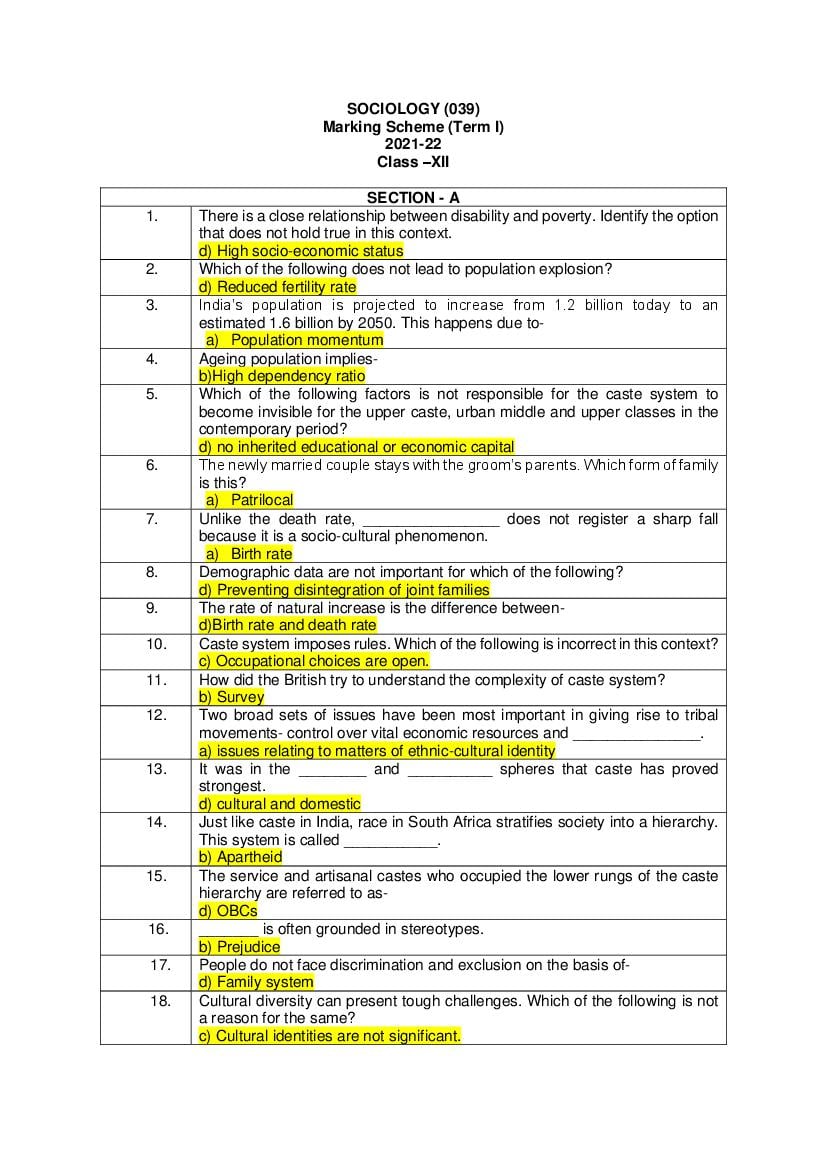
Page 1
Marking Scheme (Term I)
2021-22
Class –XII
SECTION - A
1. There is a close relationship between disability and poverty. Identify the option
that does not hold true in this context.
d) High socio-economic status
2. Which of the following does not lead to population explosion?
d) Reduced fertility rate
3. India’s population is projected to increase from 1.2 billion today to an
estimated 1.6 billion by 2050. This happens due to-
a) Population momentum
4. Ageing population implies-
b)High dependency ratio
5. Which of the following factors is not responsible for the caste system to
become invisible for the upper caste, urban middle and upper classes in the
contemporary period?
d) no inherited educational or economic capital
6. The newly married couple stays with the groom’s parents. Which form of family
is this?
a) Patrilocal
7. Unlike the death rate, ________________ does not register a sharp fall
because it is a socio-cultural phenomenon.
a) Birth rate
8. Demographic data are not important for which of the following?
d) Preventing disintegration of joint families
9. The rate of natural increase is the difference between-
d)Birth rate and death rate
10. Caste system imposes rules. Which of the following is incorrect in this context?
c) Occupational choices are open.
11. How did the British try to understand the complexity of caste system?
b) Survey
12. Two broad sets of issues have been most important in giving rise to tribal
movements- control over vital economic resources and _______________.
a) issues relating to matters of ethnic-cultural identity
13. It was in the ________ and __________ spheres that caste has proved
strongest.
d) cultural and domestic
14. Just like caste in India, race in South Africa stratifies society into a hierarchy.
This system is called ___________.
b) Apartheid
15. The service and artisanal castes who occupied the lower rungs of the caste
hierarchy are referred to as-
d) OBCs
16. _______ is often grounded in stereotypes.
b) Prejudice
17. People do not face discrimination and exclusion on the basis of-
d) Family system
18. Cultural diversity can present tough challenges. Which of the following is not
a reason for the same?
c) Cultural identities are not significant.
Page 2
which makes the state accountable to the nation and its people.-
c) RTI
20. Language coupled with ___________and _____________ have provided the
most powerful instrument for the formation of ethno-national identity in India.
b) regional, tribal identity
21. To be effective, the ideas of inclusive nationalism had to be built into the
____________.
a) Constitution
22. What criterion is used to define minority in the sociological sense?
c) Solidarity due to experience of disadvantage
23. ____________ states often limit or abolish civil liberties.
a) Authoritarian
24. Stree Purush Tulana, was written as a protest against the double standards
of a male dominated society. The author of this book was-
a) Tarabai Shinde
SECTION-B
25. Scholars have shown that the inequalities between men and women are
_______ rather than__________.
b) Social, Natural
26. Low child sex ratio cannot be attributed to which of the following factors-
d) Preference for girl child
27. The city offers anonymity which is an important reason for rural to urban
migration. Who enjoys this anonymity?
I. poorer sections of the socially dominant rural groups
II. Scheduled Castes and Scheduled Tribes
III. Women
IV. Children
a) I and II
28. Caste system can be understood as the combination of two sets of principles-
a) Wholism-hierarchy and difference and separation
29. ________________ process involving our significant others, is important in
developing a sense of community identity.
a) Socialisation
30. Assertion: The emergence of sociology and its successful establishment as
an academic discipline owed a lot to demography.
Reasoning: This happened due to the rise of nation-states and the emergence
of the modern science of statistics.
a) Both A and R are true and R is the correct explanation of A.
31. When the growth rate is 0, the population is said to have reached-
a) Replacement level
32. Which of the demographic indicators are not used to calculate total fertility
rate?
c) Sex ratio
33. Kerala is beginning to acquire an age structure like that of the developed
countries. Which of the following is true in this context?
b) Low birth rate and low death rate
34. A state like Tripura had the tribal share of its population halved within a single
decade, reducing them to a minority. Which of the following explains the given
statement?
a) heavy in-migration of non-tribals
35. Assertion: Sanskritisation usually accompanies or follows a rise in the
economic status of the caste attempting it.
Page 3
castes) of higher status raises the social status of the members of middle or
lower castes.
a) Both A and R are true and R is the correct explanation of A.
36. Among the Khasis, the family is-
b) Matrilocal
37. Which of the statements is not true for the Khasi tribes?
c) Men are more adversely affected than the women by the role conflict
among Khasis.
38. Which of the following is not true about the intervention of the colonial state
and its impact on the institution of caste?
c) Colonial state did not work for the welfare of the downtrodden.
39. Soviet Union explicitly recognised that the peoples it governed were of
different ‘nations’; the population of ‘non-resident’ Jamaicans exceeds that of
‘resident’ Jamaicans; Jewish Americans may be citizens of Israel as well as
the USA; which of the following do the given examples signify?.
c) Nations are easy to describe and hard to define.
40. Assertion: Most states feared that the recognition of cultural diversity would
lead to social fragmentation and prevent the creation of a harmonious society.
Reason: Accommodating these differences is not challenging.
C ) A is true and R is false.
41. Parsis or Sikhs are examples of anomalous minority groups because of which
of the following reasons?
a) They are religious minorities and economically well-off.
42. Which of the following factors is not responsible for generating plurality of
groups?
d) Assimilation and integration
43. Choose the incorrect statement about communalism.
d) A communalist is always a devout person.
44. Assertion: Ritually highest caste – the Brahmins were subordinated to the
secular power of kings and rulers belonging to the Kshatriya castes.
Reason: In strict scriptural terms, Brahmins were not supposed to amass
wealth.
a) Both A and R are true and R is the correct explanation of A.
45. Prolonged experience of discriminatory or insulting behaviour often produces
a reaction on the part of the excluded who then stop trying for inclusion. In this
context choose the incorrect statement.
C) social exclusion is voluntary.
The Independence of India in 1947 should have made life easier for adivasis
46. but this was not the case. This is because of-
a) Internal colonialism
State action alone cannot ensure social change for the Dalits. There are many
47. other ways to bring about social change. Which of the following is not the
correct option in this context?
d) Legislations only
48. A South American proverb says – “If hard labour were really such a good thing,
the rich would keep it all for themselves!” What does this proverb imply?
c) Presence of social stratification
SECTION-C
Read the given image and answer the questions 49, 50 and 51.
Page 4
49. When does the bottom of a population pyramid become narrow?
b) decrease in birth rate
50. Which kind of society is depicted in this pyramid?
b) Developed
51. This pyramid does not indicate which of the following?
d) High birth rate
(For Visually Impaired candidates)
Read the following passage and answer the questions 49, 50 and 51.
Several factors may be held responsible for the decline in the child sex ratio,
including severe neglect of girl babies in infancy, leading to higher death rates;
sex-specific abortions that prevent girl babies from being born; and female
infanticide (or the killing of girl babies due to religious or cultural beliefs). Each
of these reasons point to a serious social problem, and there is some evidence
that all of these have been at work in India. Practices of female infanticide
have been known to exist in many regions, while increasing importance is
being attached to modern medical techniques by which the sex of the baby
can be determined in the very early stages of pregnancy. The availability of
the sonogram (an x-ray like diagnostic device based on ultra-sound
technology), originally developed to identify genetic or other disorders in the
foetus, are used to identify and selectively abort female foetuses. The regional
pattern of low child sex ratios seems to support this argument. It is striking that
the lowest child sex ratios are found in the most prosperous regions of India.
(The Demographic Structure of the Indian Society pg. 31)
The problem of sex-selective abortion is not due to which of the following-
d) Cost of education
In the long run, the solution to the problem of sex-selective abortion lies in
______.
d) Change in social attitudes
Which of the following is not a reason for son preference?
d) Increasing number of nuclear families
Read the following passage and answer the questions 52, 53 and 54.
The present study…deals with a Muslim biradri (community) called the Multani
Lohars. ... Karkhanedar is a vernacular term used for a person engaged in the
business of manufacturing of which he is generally the owner…The karkhanas
under study operate in domestic conditions and, therefore, have certain
pervasive effects on the life of the karkhanedars who work in them. …The
following case illustrates this. Mahmood, aged forty years, was living with his
two younger brothers, one of whom was married. He had three children and
was the head of the complex household. …All the three brothers were
employed in various karkhanas and factories as skilled workers. Mahmood
successfully fabricated replica of a motor part the import of which had been
banned. This greatly encouraged him to start his own karkhana…Later it was
Page 5
One was to be owned by the two elder brothers, and the other by the youngest,
provided he set up a separate household. Rasheed set up an independent
household, consisting of his wife and unmarried children. Therefore, one
complex household, comprising three married brothers, gave birth to a simple
household as a result of new entrepreneurial opportunities. Excerpted from
S.M. Akram Rizvi, ‘Kinship and Industry among the Muslim Karkhanedars in
Delhi’, in Imtiaz Ahmad, ed. Family, Kinship and Marriage among Muslims in
India, New Delhi, Manohar, 1976, pp. 27-48
(Social Institutions: Continuity and Change; Box 3.2 pg. 57)
52. The given case states that the family type is-
b) Patriarchal
53. Along with family structures, which of the following has not undergone
change?
d) Hierarchical stratification in society
54. As per the given passage, a complex household implies which of the
following?
a) A household with more than one family
Read the following passage and answer the questions 55, 56 and 57.
Strictly speaking, the ‘untouchable’ castes are outside the caste hierarchy –
they are considered to be so ‘impure’ that their mere touch severely pollutes
members of all other castes, bringing terrible punishment for the former and
forcing the latter to perform elaborate purification rituals. In fact, notions of
‘distance pollution’ existed in many regions of India (particularly in the south)
such that even the mere presence or the shadow of an ‘untouchable’ person
is considered polluting.
(Patterns of Social Inequality and Exclusion, pg. 91)
55. Despite the limited literal meaning of the word, the institution of ‘untouchability’
refers not just to the avoidance or prohibition of physical contact but to a much
broader set of social sanctions. Which of the following is not such a sanction?
c) wearing clean clothes
56. The names used to refer to untouchables are all almost always-
a) derogatory
57. As per the understanding of distance pollution from the given passage, which
of the following qualify as sources of distance pollution?
I. Mere presence
II. Shadow
III. Pollution associated with women during menstruation
IV. Ceremonial pollution associated with death
a) I., II.
Read the following passage and answer the questions 58, 59 and 60.
Another set of complications is created by the tension between the Indian
state’s simultaneous commitment to secularism as well as the protection of
minorities. The protection of minorities requires that they be given special
consideration in a context where the normal working of the political system
places them at a disadvantage vis-à-vis the majority community. But providing
such protection immediately invites the accusation of favouritism or
‘appeasement’ of minorities. Opponents argue that secularism of this sort is
only an excuse to favour the minorities in return for their votes or other kinds
of support. Supporters argue that without such special protection, secularism
can turn into an excuse for imposing the majority community’s values and
norms on the minorities.
(The Challenges of Cultural Diversity, pg. 136)
58. As per the given passage, which of the following is true for India?
Page 6
meanings
59. The complication mentioned in the passage is not due to-
d) authoritarian state
60. Which of the following does not convey the meaning of secularisation?
c) conversion of religion to mandatory obligation as opposed to voluntary
practice
Document Details
| Board / Org | CBSE |
| Exam | Class 12 |
| Type | Solution |
| Pages | 6 |
| Updated | 30 Apr 2026 |