CBSE Class 12 Marking Scheme 2022 for Physics
Finished viewing? Save it for later —
Download CBSE Class 12 Marking Scheme 2022 for Physics (PDF · 18 pages)About CBSE Class 12 Marking Scheme 2022 for Physics
CBSE Class 12 Marking Scheme 2022 for Physics is available here for free download. Published by CBSE for Class 12, this marking scheme can be viewed online or downloaded as a PDF (18 pages). Candidates preparing for Class 12 can use CBSE Class 12 Marking Scheme 2022 for Physics to understand the exam pattern, the type of questions asked, and the overall difficulty level.
Frequently Asked Questions
How can I download CBSE Class 12 Marking Scheme 2022 for Physics?
Open this page and click the Download button to save CBSE Class 12 Marking Scheme 2022 for Physics as a PDF. It is completely free on AglaSem Docs.
Is CBSE Class 12 Marking Scheme 2022 for Physics free to download?
Yes. CBSE Class 12 Marking Scheme 2022 for Physics can be viewed online and downloaded as a PDF free of cost on AglaSem Docs.
How many pages does CBSE Class 12 Marking Scheme 2022 for Physics have?
CBSE Class 12 Marking Scheme 2022 for Physics contains 18 pages, which you can read online or download together as a single PDF.
Where can I find more Class 12 study material?
You can find more Class 12 question papers, sample papers, syllabus, and answer keys on AglaSem Docs.
CBSE Class 12 Marking Scheme 2022 for Physics – Text
Read the full text of this marking scheme below — useful to quickly search, copy and reference the content online without downloading the PDF.
📄 View text version (18 pages)
Page 1
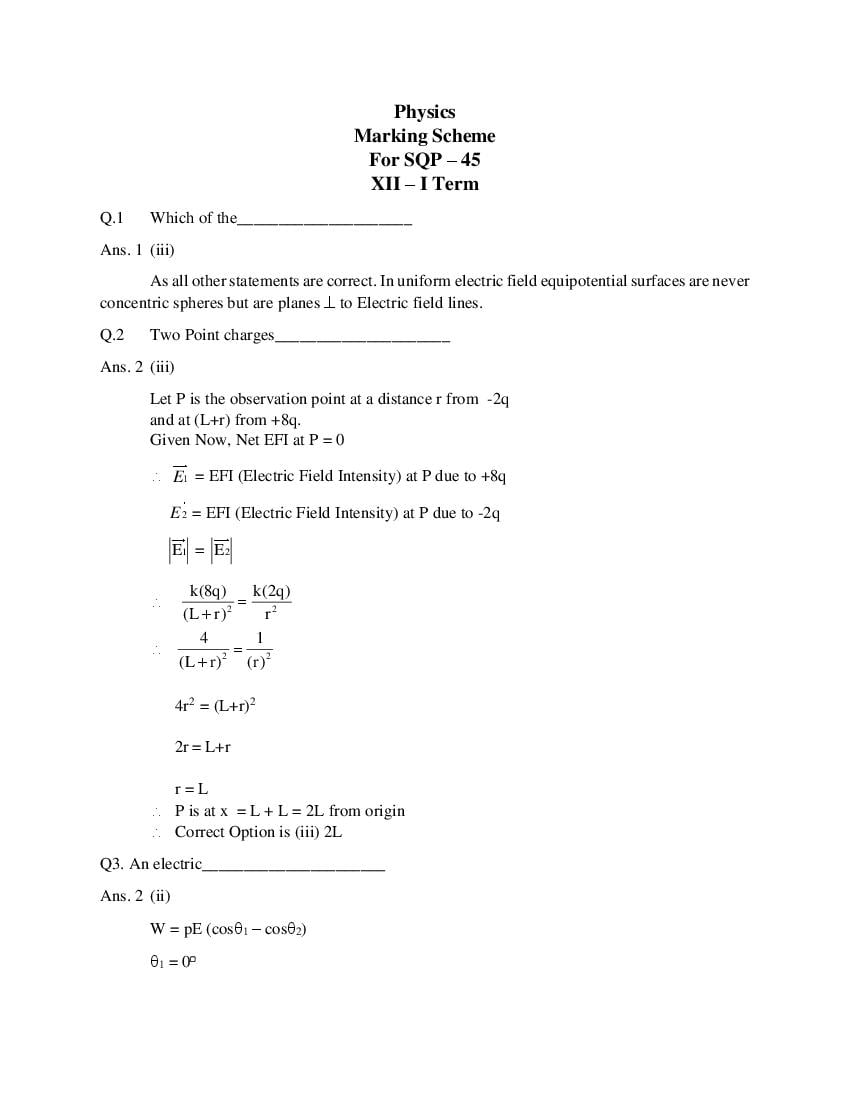
Marking Scheme
For SQP – 45
XII – I Term
Q.1 Which of the_____________________
Ans. 1 (iii)
As all other statements are correct. In uniform electric field equipotential surfaces are never
concentric spheres but are planes to Electric field lines.
Q.2 Two Point charges_____________________
Ans. 2 (iii)
Let P is the observation point at a distance r from -2q
and at (L+r) from +8q.
Given Now, Net EFI at P = 0
E1 = EFI (Electric Field Intensity) at P due to +8q
E 2 = EFI (Electric Field Intensity) at P due to -2q
E1 = E 2
k(8q) k(2q)
2
(L r) 2
r
4 1
2
(L r) 2
(r)
4r2 = (L+r)2
2r = L+r
r=L
P is at x = L + L = 2L from origin
Correct Option is (iii) 2L
Q3. An electric______________________
Ans. 2 (ii)
W = pE (cos1 – cos2)
1 = 0
Page 2
W = pE (cos 0 - cos 90)
= pE (1 – 0) = pE
Q4. Three Capacitors______________
Ans.4. (ii)
1 1 1 1
Cseries C1 C2 C3
1 1 1 1
Cseries 2 3 6
3+2+1 6
6 6
Cseries 1F
Q5. Two Point Charges___________________
Ans.5. (i)
Q2 1 Q1 Q2
r K=5 F
4ok r 2
Q2 Force in the charges in the air is
1 Q1 Q2
F
4o r 2
=K F
=5F
Q6. Which statement is true________________
Ans.6. (iv)
All other statements except (iv) are in correct
The electric field over the Gaussian surface remains continuous and uniform at every point.
Q7. A capacitor plates
Ans.7. (iii)
+ C
–
+ –
+ –
Battery is disconnected`ʹ
Page 3
–
+ –
+ – Q = Charge remains context
Cʹ = K C
Qʹ = Cʹ Vʹ
Q = Cʹ Vʹ
Q = K C Vʹ
𝑄 𝑉
Vʹ= 𝐾 𝐶 = 𝐾
Q.8. The best instrument for_________________
Ans.8. (i)
Potentiometer
Q9. An electric current___________________
Ans.9. (iii) 8:27
R1
l1 : l2 = 3 : 2
R2 r1 : r2 = 2 : 3
+ -
I1 : I2 = ?
l1
R1
r12
l2
R2 2
r 2
R1 l1 r 2 2 l1 r 22
=
R 2 l2 r12 l2 r12
2
3 3 (3)3 27
= =
2 2 (2) 3
8
I1 V / R1 R2
= = 8 / 27
I2 V / R2 R1
Q.10. By increasing the temperature___________________
Ans. 10. (iii) Specific resistance of a conductor increases and for a semiconductor decreases with
increase in temperature because for a conductor, a temperature.
Page 4
and for a semiconductor, = -ve
Q.11. We use alloys___________________
Ans. 11 (i) Alloys have low temperature coefficient of resistivity and high specific resistance. If
= low , the value of ‘R’ with temperature will not change much and specific resistance is high
then required length of the wire will be less.
Q.12. A constant Voltage___________________
Ans. 12. (iii)
l 2l
R R
A (2r) 2
l 2l
R = 2 R
r 4r 2
V2 V2
H
t & H 1t
R R
V = constant
H 2
V R t
H R V2 t
R l 2r 2
= 2
R r l
H 2
=
H 1
H 2H
Correct option is (iii)
Q.13. If the potential diff____________________
Ans.13. We know
eE
Vd
ml
V
=e
ml
If temperature is kept constant, relaxation time - will remain constant, and e, m are also constants.
Page 5
Vd 2V
Correct option is (ii)
Q.14. The equivalent resistance _________________
Ans. 14. (iii)
Redrawing the circuit, we get
3 8
6 B
30
3 & 6 are in parallel.
3 6 18
R1 2
3 6 9
Now R1 and 8 in series
R2 = R1 + 8 = 2 + 8 = 10
Now R2 and 30 in parallel
R 2 30 10 30
Rep =
R 2 30 10 30
300 30 15
=
40 4 2
= 7.5 (iii) correct option
Q.15. The SI unit of magnetic field intensity is ______________
Ans.15. We know
F
B
Il sin
N
SI Unit of B = NA 1m 1
Am
Correct option is (ii)
Q16. The coil of _____________________
Ans. (iv) Correct Option
The coil of a moving coil galvanometer is wound over metallic frame to provide electromagnetic
damping so it becomes dead beat galvanometer.
Page 6
Ans.17. Correct option (iii)
A B
l l
Square a r Circle
a
Area of a Square Area of a Circle
a2 r 2
Also here l = 4a Also here, 2r l
l l
a= r=
4 2
2
l2 l
Area = Now Area =
16 2
2
l l 2
A1 = A2 =
16 4
Now Magnetic moment = I A
M1 = IA, & M2 = I A 2
Since I (current) is same in both
M1 A1 l 2 4
= 2
M2 A2 16 l 4
M1 M2 = : 4
Correct option is (iii)
Q.18. The horizontal comp________________
Ans.18. Correct option (i)
Target law Bv = BH tan
Page 7
tan =
BH
Given BH = 3 Bv
Bv 1
tan =
3 Bv 3
= 300 or radians.
6
Q.19. The small___________________
Ans. 19. Correct option is Magnetic declination or Angle of declination. It is the small angle
between geographic axis & magnetic axis.
Q.20. Two coils___________________
Ans.20. Correct option is (ii)
Mutual inductance of a pair of two coils depends on the relative position and orientation of two
coils, other statements are incorrect.
Q.21. A conducting__________________
Ans. 21. Correct option is (iv)
lel
Current induced is I =
R
d
Now lel =
dt
But there is no change of flux with time, as B, A & all remain constant with time.
No current is induced
Q22. The magnetic flux___________
Ans.22.
5t 2 3t 16
d
e
dt
d
5t 2 3t 16
dt
10t + 3
e t=4 = 10(4)+3 = 43V
e = -43Volts
Correct option is (ii)
Page 8
Ans.23. Correct option is (iii)
V
I in Pure Capacitor
XC
V
= V 2fc
1
2fc
If f
Straight line paragraph
other parameters kept cosntant
Q24. A 20 Volt AC________________
Ans.24. Correct option is (i)
VR VL
VR = Effective Voltage across R
VR Ieff R
VL = Effective Voltage across L
VL Ieff L
Net V = VR 2 VL2
= Ieff 2 R 2 Ieff 2 L2
20 = (12)2 VL2
(20)2 (12)2 VL2
400 = 144 + VL2
VL = 400 144 = 256 16 Volts
Q25. The instantaneous_________________
Ans. 25.
E = E0 sin t
I = I0 sin t +
3
Correct option is (iv)
as I can lead the Voltage in RC and LCR circuit, so it can be RC or LCR circuit.
(iv) is correct option.
Page 9
Q26.
r
Correct option is (i)
Since –ve electric flux
l = + ve flux electric flux enclosed with a cylinder
here
Total Electric
Flux = 0.
Q27. Two Parallel______________________
Ans. 27. (iv) Correct option.
E
+ +
C
Surface Charge density, = 26.4 10 12
m2
E= +
20 20
2
= =
20 0
26.4 1012 N
=
8.85 1012 C
N
= 3
C
Correct option is (iv)
Q28. Consider__________________
+Q
-Q
+
Ans.28. Equal and Opposite charges appear on the nearby conductor due to
induction, but still net charge on the conductor is zero. Correct option (iv)
Page 10
Ans.29.
Net E F I at G O
Net Potential at G,
K2Q KQ
V=
r r r
E2 G r E2 KQ
-
r
r
=0
-q E1 -q
Correct option is (iii)
Q30. Two parallel______________
Ans.30.
k=2 A = Same
d = Same
Q = Same in Series
12V
0 A 20 A
Cx = Cy =
d d
2
Q Q2
Ux = Uy =
2Cx 2Cy
Ux Cy 2Cx 2
= =
Uy Cx Cx 1
Correct Option is (iii)
Q31. Which among_________________
Ans.31. Correct statement is option (iv) as Primary coil made of Thick Coper wire has very less
R. Therefore negligible power loss. Rest all options are reasons for power losses in a transformer.
Q32. An alternating Voltage_______________
Ans.32.
B C
V
Page 11
1 1
Xc i.e. Xc
2fc c
I Brightness of the bulb will .
Correct option is (ii)
Q.33. A solid Sphere______________
Ans.33. Correct option is (4)
As all other statements seem incorrect in context with the given figure.
Q. 34. A battery is connected …..
Ans. Correct option is (iv).
Rest all quantities change with area of cross-section of a conductor.
Q. 35. Three resistors……
R1 R2 R3
+ –
Ans.
Given
I = 2 A, R2 = 3 Ω, P3 = 6 W
Power across R3 = V3I
6 W = I2 R3
6 3
= R3 = = 1.5 Ω
4 2
V3 = I R3 = 2 (1.5) = 3 V
Correct option is (iii).
Q. 36. A straight line……
Ans. I = O, V = E, E = 5.6 V
E 5.6
r = 2.8
I 2.0
Correct option is (i).
Page 12
Ans. Let PQ is a potentiometer wore of length 10m,
E 5 5
I =
R R 480 20 500
1
= 0.01 A
100
VPQ = I RPQ = 0.01 × 20
= 0.2 V
If 10 m potentiometer wire balances 0.2 V
0.2
Then 1 m potentiometer wire balances V
10
0.2
Then 6 m potentiometer wire balances 6V
10
1.2
= 0.12 V
10
Correct option is (iv).
Q. 38. The current sensitivity……
20
Ans. Given, I g = I g Ig
100
120
= I g 1.2 I g
100
25 125
R = R R R
100 100
= 1.25 R
Vg = ?
I g 1.2 I g
Vg =
R 1.25 R
120 25
= Vg Vg
125 25
Page 13
% change = 100
Vg
24
Vg Vg
=
25 100
Vg
(24 25)
= 100
25
1
= 100 = 4%
25
Decrease by 4%. Correct option is (iv).
Q. 39. Three infinitely long parallel …..
F1
r r
F2 F2
2I I I
Ans. A B C
Let F1 is force per unit, length between A & C
0 2 I I
i.e. F1 =
4 2r
And F2 is force per unit, length between B & C
0 I I
F2 =
4 r
Now net force on ‘C’ is per unit length
I2
F1 F2 = (1 1)
4 r
20 I 2
= F (given)
4 r
Page 14
I I
1
F1
2I
1
F1
F21 F21
Now Fig. r r b
F1 = Repulsive force between A & C
0 2 I 2
=
4 2r
F2 = F2 = A reactive force between B & C
Net force on ‘C’ F1 F2 = 0
2I 2
F1 = F2 =
4 2r
Net Force on ‘C’ is zero.
Correct option is (i).
Q. 40. In a H-atom …….
Ans. R = 0.5 A°
= 10 rps = 10 × 2 rad/s
= 10 Hz
M = I A = e r2
= 1.6 × 10–19 × 10 × 3.14 × 0.5 × 0.5 × 10–10 × 10–10
= 1.256 × 10–38 Am2
Ans. (ii).
Q. 41. An air-cored solenoid …..
Ans. Magnetic field inside a solenoid
N
B = 0 I'
l
Flux linked with ‘N’ turns
N
Initial flux 1 = N B A = N 0 IA
l
Page 15
= 0 IA
l
4 107 800 800 2.5 2.5 104
=
0.30
= 16.74 × 10– 3 Wb
Final flux 2 = 0
d 16.74 103 0
Average back emf |e| = =
dt 103
= 16.74 V
Correct option is (ii).
Q. 42. Vo = 283 V, f = 50 Hz
R = 3 Ω, L = 25.48 mH
C = 796 F
P |at resonance = ?
Power dissipated P = I2 R
I0 1 283
I =
2 2 3
= 66.7 A
P = I2 R
= (66.7)2 3
= 13.35 kW
Correct option is (iii).
Q. 43. A circular loop …..
Ans. Let flux linked with smaller loop is 1 and with bigger loop is 2.
2 1 R1
I1
Fig.
Given R2 = 0.2 m
Page 16
x = 15 cm = 0.15 m
Now 1 = B2 A1
0 2 R22 I 2
R1
2
=
4 ( R22 x 2 )3 / 2
1 0 2 R22 R12
M =
I 2 4 ( R22 x 2 )3/ 2
Now 2 = M I1
0 2 R22 R12
= . I1
4 ( R22 x 2 )3/ 2
= 9.1 × 10⁻¹¹ Weber
Correct answer is (iv).
Q. 44. If both the no. of turns…..
N2
Ans. L = 0 A
l
(2 N )2
L = 0 A
2l
N2
= 20 A 2L
l
Correct answer is (ii). Doubted.
Q.45. Given below___________________
To increase the range
Ans. 45. Correct option is (iv) as both statements are false. To increase the range of an ammeter, suitable
low R (or shunt) should be connected in parallel to it. The ammeter with increased range has low
resistance.
Q.46. An electron____________________
Ans.46. Correct option is (iii)
Statements correct but reason is wrong because electrons move from a region of low potential to high
potential.
Q. 47. A magnetic needle ……..
Page 17
poles, magnetic needle orients itself vertically because horizontal components of earth’s field is zero
there. (correct option is (i))
Q. 48. A proton and an electron, …….
𝑚𝑣 2
Ans. we know 𝑟
= 𝐵𝑞𝑣𝑠𝑖𝑛 𝜃 = 𝐵𝑞𝑣 𝑆𝑖𝑛 𝜃
Centripetal force = magnetic Lorentz force
⃗ &𝐵
sin 𝜃 = sin 90𝜃 = 1 (∠ between 𝑉 ⃗ = 90°)
𝑚𝑣 2
= 𝐵𝑞𝑣
𝑟
𝑚𝑣
𝑟
= 𝐵𝑞
𝑚𝑣 𝑝 𝑙𝑖𝑛𝑒𝑎𝑟 𝑚𝑜𝑚𝑒𝑛𝑡𝑢𝑚
𝑟 = 𝐵𝑞 = 𝐵𝑞 = 𝐵𝑞
𝑝
Since 𝑟 =
𝐵𝑞
Given p, B are same
Also q for proton & electron is same except its sign
Radius is same. So statement is correct but
reason is not the correct explanation of the given assertion.
correct option is (ii)
Q. 49. On increasing…………..
Ans. 49. When we increase current sensitivity by increasing no. of turns, then resistance of coil also
increases. So increasing current sensitivity does not necessarily imply that voltage sensitivity will
𝐼𝑔
increase because 𝑉𝑔 = 𝑅
∴ if 𝐼𝑔 ↑ & 𝑅 ↑ by different amounts, then 𝑉𝑔 may increase or decrease.
Correct option is (i).
Q.50. A small object………
Ans. 50. Ans is (ii)
F𝑒 = 𝑚𝑔 𝑡𝑎𝑛𝜃
𝑞𝐸 = 𝑚𝑔 𝑡𝑎𝑛𝜃
𝑚𝑔
𝑞 = ( 𝐸 ) tan 𝜃
𝑒 𝐹
tan 𝜃 = 𝑚𝑔
Page 18
q
T qE
Correct ans. is (ii)
Q. 51. A free electron…………
Ans. 51. Correct ans. (ii) i.e. II only
∵ 𝐹𝑝 = 𝐹𝑒 ∵ 𝐹 = 𝑞𝐸
𝐸 = 𝑠𝑎𝑚𝑒
‘𝑞’ = 𝑠𝑎𝑚𝑒
Now, 𝑃𝜀 = 𝑞 𝑉(𝑟)
(𝑃. 𝜀)𝑝 > (𝑃. 𝜀)𝑒
Q. 52. Correct ans is (iv) i.e. step down transformer decreases the ac voltage.
Q.53. correct ans is (i)
𝑁𝑠 𝐸
i.e. = 𝑠
𝑁𝑝 𝐸𝑝
i.e. if no. of turns in secondary coil are more than no. of turns in primary, then voltage is increased or
stepped up in secondary, so called step up transformer.
Q.54 Correct ans. is (i).
i.e. current is reduced if voltage is stepped – up so corresponding 𝐼 2 𝑅 losses are cut down.
Q. 55. Correct ans is (iii)
Given 𝐸𝑖 = 2300𝑉
𝐸𝑜 = 230𝑉
𝑁𝑝 = 4000
𝑁𝑠 = ?
𝐸𝑖 𝑁
𝐸𝑜
= 𝑁𝑝
𝑠
2300 4000
230
= 𝑥
𝑥 = 400 = 𝑁𝑠 = No of turns in secondary coil
Document Details
| Board / Org | CBSE |
| Exam | Class 12 |
| Type | Solution |
| Pages | 18 |
| Updated | 30 Apr 2026 |