Edudel Syllabus Class 7 Maths
Finished viewing? Save it for later —
Download Edudel Syllabus Class 7 Maths (PDF · 7 pages)About Edudel Syllabus Class 7 Maths
Edudel Syllabus Class 7 Maths is available here for free download. Published by Delhi Board for Class 7, this syllabus can be viewed online or downloaded as a PDF (7 pages). Candidates preparing for Class 7 can use Edudel Syllabus Class 7 Maths to understand the exam pattern, the type of questions asked, and the overall difficulty level.
Frequently Asked Questions
How can I download Edudel Syllabus Class 7 Maths?
Open this page and click the Download button to save Edudel Syllabus Class 7 Maths as a PDF. It is completely free on AglaSem Docs.
Is Edudel Syllabus Class 7 Maths free to download?
Yes. Edudel Syllabus Class 7 Maths can be viewed online and downloaded as a PDF free of cost on AglaSem Docs.
How many pages does Edudel Syllabus Class 7 Maths have?
Edudel Syllabus Class 7 Maths contains 7 pages, which you can read online or download together as a single PDF.
Where can I find more Class 7 study material?
You can find more Class 7 question papers, sample papers, syllabus, and answer keys on AglaSem Docs.
Edudel Syllabus Class 7 Maths – Text
Read the full text of this syllabus below — useful to quickly search, copy and reference the content online without downloading the PDF.
📄 View text version (4 pages)
Page 1
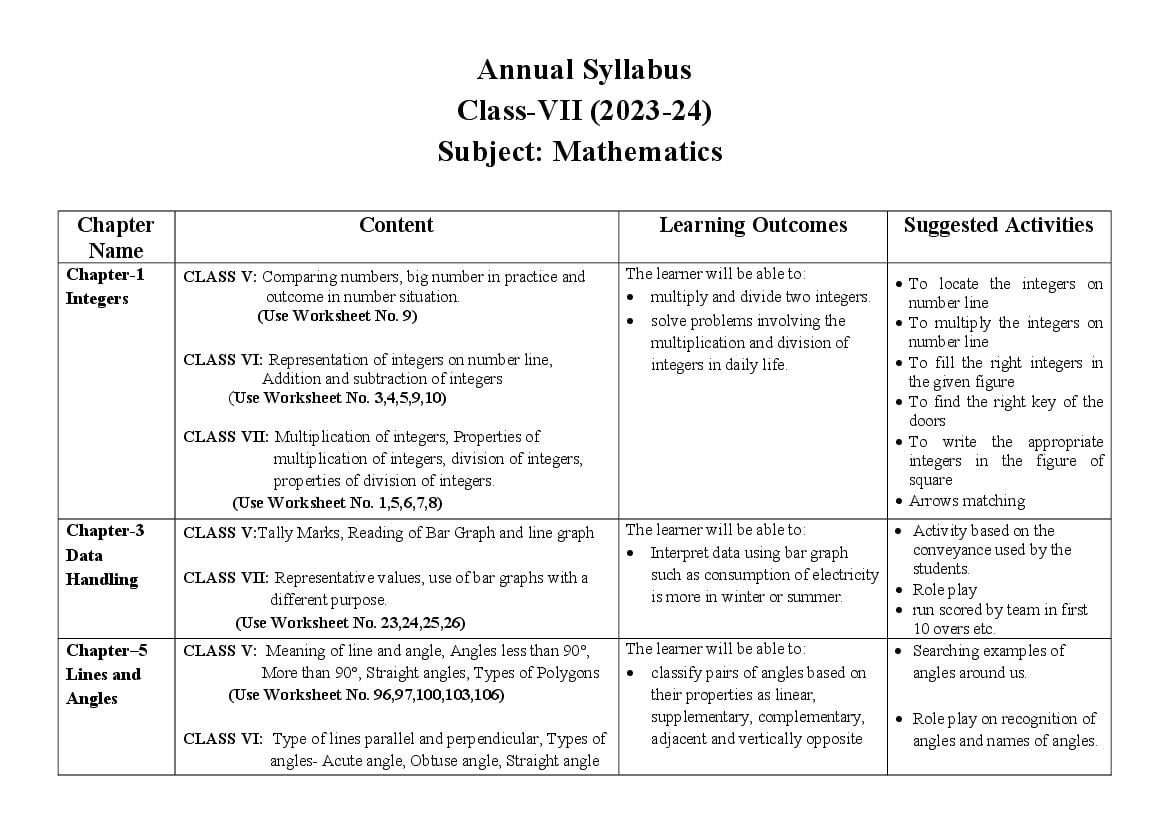
Class-VII (2023-24)
Subject: Mathematics
Chapter Content Learning Outcomes Suggested Activities
Name
Chapter-1 CLASS V: Comparing numbers, big number in practice and The learner will be able to:
To locate the integers on
Integers outcome in number situation. multiply and divide two integers. number line
(Use Worksheet No. 9) solve problems involving the To multiply the integers on
multiplication and division of number line
CLASS VI: Representation of integers on number line, integers in daily life. To fill the right integers in
Addition and subtraction of integers the given figure
(Use Worksheet No. 3,4,5,9,10) To find the right key of the
doors
CLASS VII: Multiplication of integers, Properties of To write the appropriate
multiplication of integers, division of integers, integers in the figure of
properties of division of integers. square
(Use Worksheet No. 1,5,6,7,8) Arrows matching
Chapter-3 CLASS V:Tally Marks, Reading of Bar Graph and line graph The learner will be able to: Activity based on the
Data Interpret data using bar graph conveyance used by the
such as consumption of electricity students.
Handling CLASS VII: Representative values, use of bar graphs with a
is more in winter or summer. Role play
different purpose.
run scored by team in first
(Use Worksheet No. 23,24,25,26) 10 overs etc.
Chapter–5 CLASS V: Meaning of line and angle, Angles less than 90°, The learner will be able to: Searching examples of
Lines and More than 90°, Straight angles, Types of Polygons classify pairs of angles based on angles around us.
Angles (Use Worksheet No. 96,97,100,103,106) their properties as linear,
supplementary, complementary, Role play on recognition of
CLASS VI: Type of lines parallel and perpendicular, Types of adjacent and vertically opposite angles and names of angles.
angles- Acute angle, Obtuse angle, Straight angle
Page 2
when the other angle is given. Pragati Book
CLASS VII: Introduction, related angles, pair of lines,
checking for parallel lines. (Use Worksheet No. 14,15)
Chapter-9 CLASS V: How many squares?, Area and its boundary The learner will be able to: In the given grid make
Perimeter (Use Worksheet No. 110,115,118,124,127,132) find out approximate area of rectangles of different sizes
closed shapes by using unit but same in area.
and Area
CLASS VII: Area of parallelograms, Area of triangles, square grid and graph sheet. Using method of cutting and
Area of circle pasting of paper find the
(Use Worksheet No. 3) calculate area of the region area of parallelogram.
enclosed in a rectangle, square, Finding Circumference with
triangle. the help of thread.
Chapter -12 CLASS V: Do you see the pattern? Does it look the same? The learner will be able to: Conversation on the idea of
Symmetry (Use Worksheet No. 84) identify symmetrical figures from symmetry: Artists,
their environment professionals, designers of
differentiate between Line clothing or jewellery…..
CLASS VI: Halves and quarters, Play with patterns
Symmetry and Rotational Punching game
Symmetry Copy the diagram
CLASS VII: Introduction, Lines of symmetry for regular about the mirror lines.
visualize and draw the mirror
polygons, Rotational Symmetry, Line Collect and write
image
Symmetry and Rotational Symmetry visualize the symmetry through examples of rotational
paper folding activity symmetry from real life.
The above syllabus is to be completed for Mid-Term Examination by 15th September, 2023.
Revision of syllabus for term examination
MID TERM EXAMINATION
Chapter-2 CLASS V: Equivalent fractions, mixed fractions without using The learner will be able to: Introduction using daily
Fraction and terms, Tenths, Hundredths. interpret the division and life examples.
Decimals (Use Worksheet No. 130,135,141,143) multiplication of fractions. Colouring/shading equal
apply algorithms to multiply and parts
CLASS VI: Proper and improper fractions, representation of
fractions on number line, Addition and Subtraction
divide fractions and decimals. Work on decimals with the
of fractions, Addition and Subtraction of decimals, comparing solve problems related to help of Dienes blocks and
decimals (Use Worksheet No.18,19,20,21) fractions and decimals in daily graph paper.
life.
Page 3
Multiplication of decimal numbers, division of
decimal numbers.(Use Worksheet No. 10,11,12,13)
Chapter-6 CLASS V: Triangle shape The learner will be able to:
Colouring activity to
The triangle differentiate between median and visualization of interior
and its CLASS VI: Triangle in basic geometrical concepts altitude and exterior parts of a
properties (Use Worksheet No. 110) relate exterior angle of a triangle triangle.
with its interior angle . Role play to understand
CLASS VII: Introduction, Medians of a triangle, altitudes find unknown angles of a triangle and its parts
of a triangle, Exterior angle of a triangle and its property, triangle when its two angles are Drawing different types
angle sum property of a triangle, equilateral and isosceles of triangles on dot paper.
known.
triangle, sum of the lengths of two sides of a triangle, right Paper folding activity
apply the Pythagoras theorem
angled triangles and Pythagoras property. Making triangles from
sticks.
(Use Worksheet No. 27,28,29,30)
Chapter-7 CLASS V: How big How heavy,comparing lengths The learner will be able to: Conversation between
Comparing and weights solve problems related to friends (Role play) to
Quantities conversion of percentage to understand profit loss,
CLASS VII: Percentage-another way of comparing fraction and decimal and vice % and interest.
quantities, use of percentages, prices related to an item or versa.
buying and selling, charge given on borrowed money or simple calculate profit/loss percent
interest. (Use Worksheet No. 31,32,33,34,35) and rate percent.
Chapter-10 CLASS VII: Introduction, How are expressions formed?, The learner will be able to: (Pragati)
Algebraic Terms of an expression, like and unlike terms, monomial, identify terms of expressions Shyana and Bob
classify different expressions conversation- role play in
Expressions binomial, trinomial, polynomial, finding the value of an
the introduction.
add and subtract algebraic
expression. expressions. Factor tree.
Chapter-11 CLASS V: Multiples and Factors The learner will be able to: Pragati
Exponents simplify problems involving Conversation between
and Powers Class VII: Introduction, exponents, laws of exponents, multiplication and division of Yogesh and Kavita
miscellaneous examples using the laws of exponents, large numbers by using Is your secret intact?
decimal number system, expressing large numbers in the exponential form of numbers.
standard form.
(Use Worksheet No. 16,17,18)
Page 4
Visualizing visualize solid shapes and can Nets for 3-D figures.
Solid CLASS VI: 2D and 3D shapes draw their nets To draw solid shapes on
Shapes recognize and draw the top, front graph paper.
CLASS VII: Introduction,: plane figures and solids figures, and side views of 3D objects. Oblique and isometric
faces, edges and vertices, nets for building 3D shapes, drawing sketches.
solids on a flat surface, viewing different sections of a solid
(Use Worksheet No. 21,22)
The whole syllabus is to be completed for Annual Examination by 31st January, 2024.
Revision of syllabus for Annual Examination
ANNUAL EXAMINATION
Note: The above said syllabus is for assessment purpose only and remaining topics/chapters may be taught as Subject
Learning Enrichment.
Document Details
| Board / Org | Delhi Board |
| Exam | Class 7 |
| Type | Syllabus |
| Pages | 7 |
| Updated | 09 Jun 2026 |