Edudel Syllabus Class 7 Science
Finished viewing? Save it for later —
Download Edudel Syllabus Class 7 Science (PDF · 5 pages)About Edudel Syllabus Class 7 Science
Edudel Syllabus Class 7 Science is available here for free download. Published by Delhi Board for Class 7, this syllabus can be viewed online or downloaded as a PDF (5 pages). Candidates preparing for Class 7 can use Edudel Syllabus Class 7 Science to understand the exam pattern, the type of questions asked, and the overall difficulty level.
Frequently Asked Questions
How can I download Edudel Syllabus Class 7 Science?
Open this page and click the Download button to save Edudel Syllabus Class 7 Science as a PDF. It is completely free on AglaSem Docs.
Is Edudel Syllabus Class 7 Science free to download?
Yes. Edudel Syllabus Class 7 Science can be viewed online and downloaded as a PDF free of cost on AglaSem Docs.
How many pages does Edudel Syllabus Class 7 Science have?
Edudel Syllabus Class 7 Science contains 5 pages, which you can read online or download together as a single PDF.
Where can I find more Class 7 study material?
You can find more Class 7 question papers, sample papers, syllabus, and answer keys on AglaSem Docs.
Edudel Syllabus Class 7 Science – Text
Read the full text of this syllabus below — useful to quickly search, copy and reference the content online without downloading the PDF.
📄 View text version (4 pages)
Page 1
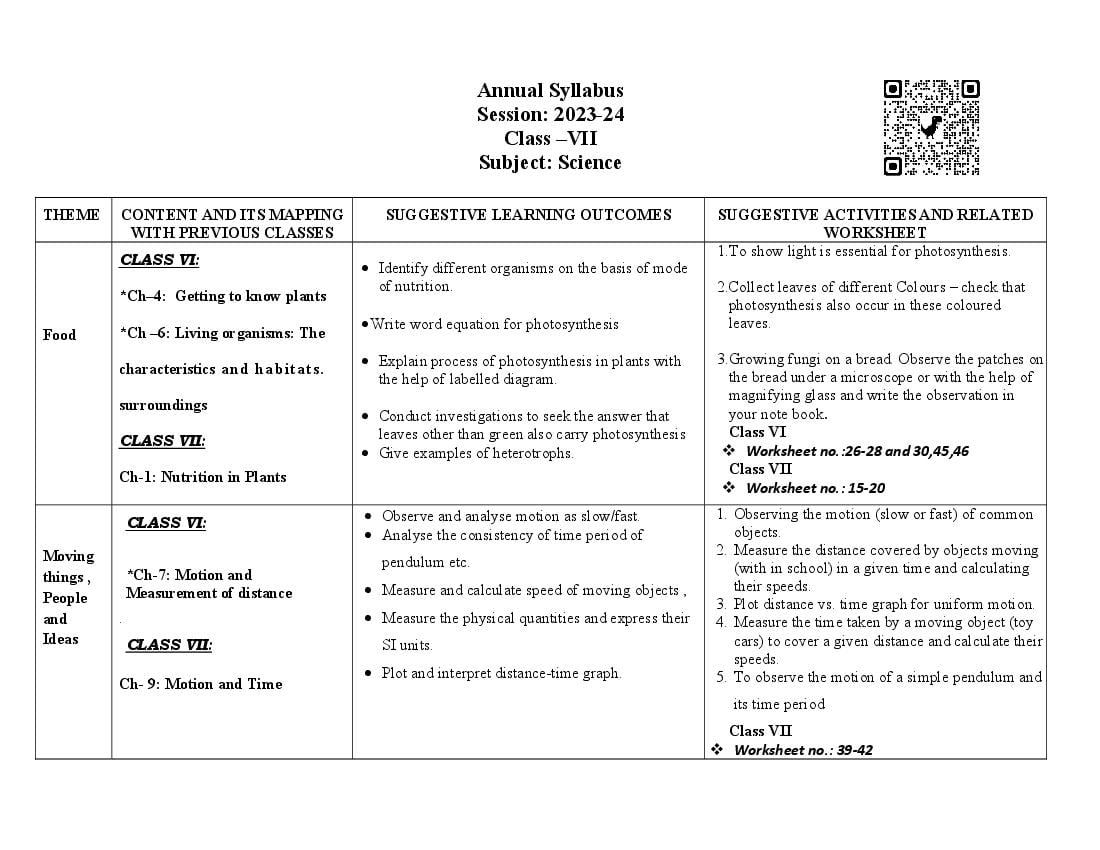
Session: 2023-24
Class –VII
Subject: Science
THEME CONTENT AND ITS MAPPING SUGGESTIVE LEARNING OUTCOMES SUGGESTIVE ACTIVITIES AND RELATED
WITH PREVIOUS CLASSES WORKSHEET
1.To show light is essential for photosynthesis.
CLASS VI:
Identify different organisms on the basis of mode
of nutrition. 2.Collect leaves of different Colours – check that
*Ch–4: Getting to know plants
photosynthesis also occur in these coloured
Write word equation for photosynthesis leaves.
Food *Ch –6: Living organisms: The
characteristics and habitats. Explain process of photosynthesis in plants with 3.Growing fungi on a bread. Observe the patches on
the help of labelled diagram. the bread under a microscope or with the help of
magnifying glass and write the observation in
surroundings
Conduct investigations to seek the answer that your note book.
leaves other than green also carry photosynthesis Class VI
CLASS VII:
Give examples of heterotrophs. Worksheet no.:26-28 and 30,45,46
Ch-1: Nutrition in Plants
Worksheet no.: 15-20
CLASS VI: Observe and analyse motion as slow/fast. 1. Observing the motion (slow or fast) of common
Analyse the consistency of time period of objects.
Moving 2. Measure the distance covered by objects moving
pendulum etc. (with in school) in a given time and calculating
things , *Ch-7: Motion and
Measurement of distance Measure and calculate speed of moving objects , their speeds.
People 3. Plot distance vs. time graph for uniform motion.
and . Measure the physical quantities and express their 4. Measure the time taken by a moving object (toy
Ideas CLASS VII: SI units. cars) to cover a given distance and calculate their
speeds.
Plot and interpret distance-time graph. 5. To observe the motion of a simple pendulum and
Ch- 9: Motion and Time
its time period
Worksheet no.: 39-42
Page 2
Labelled diagram.
*Ch -9: Electricity and Circuits conductivity like good and bad conductor of
electricity. 2. To make a battery by using three electric cells.
CLASS VII: Understand and relate the process of heating with 3.To demonstrate
Ch -10 : Electric Current and its electric current. a. heating effect of electric current.
Effects b. Magnetic effect of current.
Demonstrate the magnetic effects of electric
current . 4. To make a model of electromagnet .
Make electric circuit and Draw its labelled Class VI:
diagram by using symbols of electric components. Worksheet no.:18- 21
Apply learning of scientific concepts in daily life
like connecting two or more cells in proper order
in devices etc.
Make the model of electromagnet from the
resources available in their surroundings with
electric current.
The above content must be completed by 15th September 2023.
Revision of syllabus for Mid Term Examination.
MID TERM EXAMINATION-2023
THEME CONTENT AND ITS MAPPING SUGGESTIVE LEARNING OUTCOMES SUGGESTIVE ACTIVITIES
WITH PREVIOUS CLASSES
1.Effect of saliva on starch.
*CLASS VI:
Identify types of teeth 2.Study with suitable learning materials/aids
Food Differentiates organisms on the basis of the a. Human Digestive System,
Ch-1: Components of food
b.Different types of teeth and their arrangement
process of digestion ,
in mouth
Page 3
human d.Digestive system of Ruminant.
Ch-2 :Nutrition in Animals e. Permanent slide of Amoeba
Explain the process of digestion in Amoeba. 3.To find the position of taste buds with the help
Draw labelled diagram or flow charts of digestive of edible things brought by the students. (Salty,
system in human. Bitter, Sweet etc.)
Class VI
Worksheet no.:10-14, 16-17, 22-25
Worksheet no.: 8-14.
Material CLASS VI: Classify substances as acidic, basic and neutral 1. Testing solutions of common substances like
*Ch-1: Components of food substances. sugar, salt, vinegar, lime juice etc. with indicators
(Only Testing part of food Conduct simple investigation like –Extract of like Litmus ,Turmeric , China rose or any other.
components) coloured flowers be used as acid- base indicator. 2. To study neutralisation reaction.
Learn to handle experiments with care. 3. To prepare a card with Turmeric paste and soap
CLASS VII: Write word equation for Acid- Base reaction . solution.
Ch- 4: Acids, Bases and Salts Apply learning of scientific concept in day to day Class VI
Worksheet no.:10-17 , 22- 25
life – like dealing with Acidity, treating the
stings of ants etc.
Worksheet no.: 43,44
CLASS VI: Identify mirrors and lenses on the basis of their 1.Experiment to see the source of light through a
Natural *Ch–8: Light Shadows and straight and bent tube .
function . 2.Observation of reflection of light on wall or
Phenome Reflection
Differentiate images formed by mirrors and lenses white paper screen .
na
3. Images made by different objects and recording
CLASS VII: on the basis of its properties. the observations.
Ch-11: Light Conduct investigation like—Is white light 4.To identify and distinguish among plane ,
concave and convex mirrors, and also between
composed of many colours? concave and convex lenses
Page 4
when it rotates.
resources available in their surroundings.
Class VI:
Worksheet no.:33-38
Worksheet no.:28-38
How Classify changes around us in physical and1. Activities showing chemical changes like what
Things CLASS VII: chemical changes. gets deposited on a Tawa or Kadai when left in a
Work Write word equation for chemical reactionsmoist state.
Ch-5: Physical and Chemical 2. Experiments involving chemical reactions like
Changes involve in the chemical change.
rusting of iron, Neutralisation (vinegar and baking
Take measures to prevent corrosion by relating
cause with its effect. soda),Displacement of copper from copper sulphate
etc.
Apply learning of scientific concepts in day to
3. Make crystals of easily available substances
day life thus preventing corrosion and purify
substance by crystallisation. (sugar, salt and copper sulphate).
Describe the cause why iron objects gets 4. Burning of magnesium ribbon and compare it
with original product.
corroded, milky water turn white when carbon
dioxide gas is passed through it etc. Any other related activities.
List out the characteristics help in identifying the
change as chemical change
The entire syllabus must be completed by 31 January, 2024.
Revision of syllabus for Annual Examination. Annual examination will be based on complete annual syllabus.
Annual Examination-2023-24
Note: The above said syllabus is for assessment purpose only and remaining topics/chapters may be taught as Subject Learning Enrichment.
*Only related topics of these chapters that are aligned with present class content.
Document Details
| Board / Org | Delhi Board |
| Exam | Class 7 |
| Type | Syllabus |
| Pages | 5 |
| Updated | 22 Jul 2026 |