HBSE Class 11 Sample Paper 2027 Accountancy Marking Scheme
Finished viewing? Save it for later —
Download HBSE Class 11 Sample Paper 2027 Accountancy Marking Scheme (PDF · 20 pages)About HBSE Class 11 Sample Paper 2027 Accountancy Marking Scheme
HBSE Class 11 Sample Paper 2027 Accountancy Marking Scheme is available here for free download. Published by Haryana Board for Class 11, this answer key can be viewed online or downloaded as a PDF (20 pages). Candidates preparing for Class 11 can use HBSE Class 11 Sample Paper 2027 Accountancy Marking Scheme to understand the exam pattern, the type of questions asked, and the overall difficulty level.
Frequently Asked Questions
How can I download HBSE Class 11 Sample Paper 2027 Accountancy Marking Scheme?
Open this page and click the Download button to save HBSE Class 11 Sample Paper 2027 Accountancy Marking Scheme as a PDF. It is completely free on AglaSem Docs.
Is HBSE Class 11 Sample Paper 2027 Accountancy Marking Scheme free to download?
Yes. HBSE Class 11 Sample Paper 2027 Accountancy Marking Scheme can be viewed online and downloaded as a PDF free of cost on AglaSem Docs.
How many pages does HBSE Class 11 Sample Paper 2027 Accountancy Marking Scheme have?
HBSE Class 11 Sample Paper 2027 Accountancy Marking Scheme contains 20 pages, which you can read online or download together as a single PDF.
Where can I find more Class 11 study material?
You can find more Class 11 question papers, sample papers, syllabus, and answer keys on AglaSem Docs.
HBSE Class 11 Sample Paper 2027 Accountancy Marking Scheme – Text
Read the full text of this answer key below — useful to quickly search, copy and reference the content online without downloading the PDF.
📄 View text version (21 pages)
Page 1
HBSE Class 11 Sample
Paper 2027
Accountancy Marking
Scheme
EXAM YEAR TYPE SUBJECT
Haryana Class 11 2027 Answer Key Accountancy
Notes · Sample Papers · Previous Year Papers · Mock Tests
Page 2
m .co
m .co s e m
se g l a
a
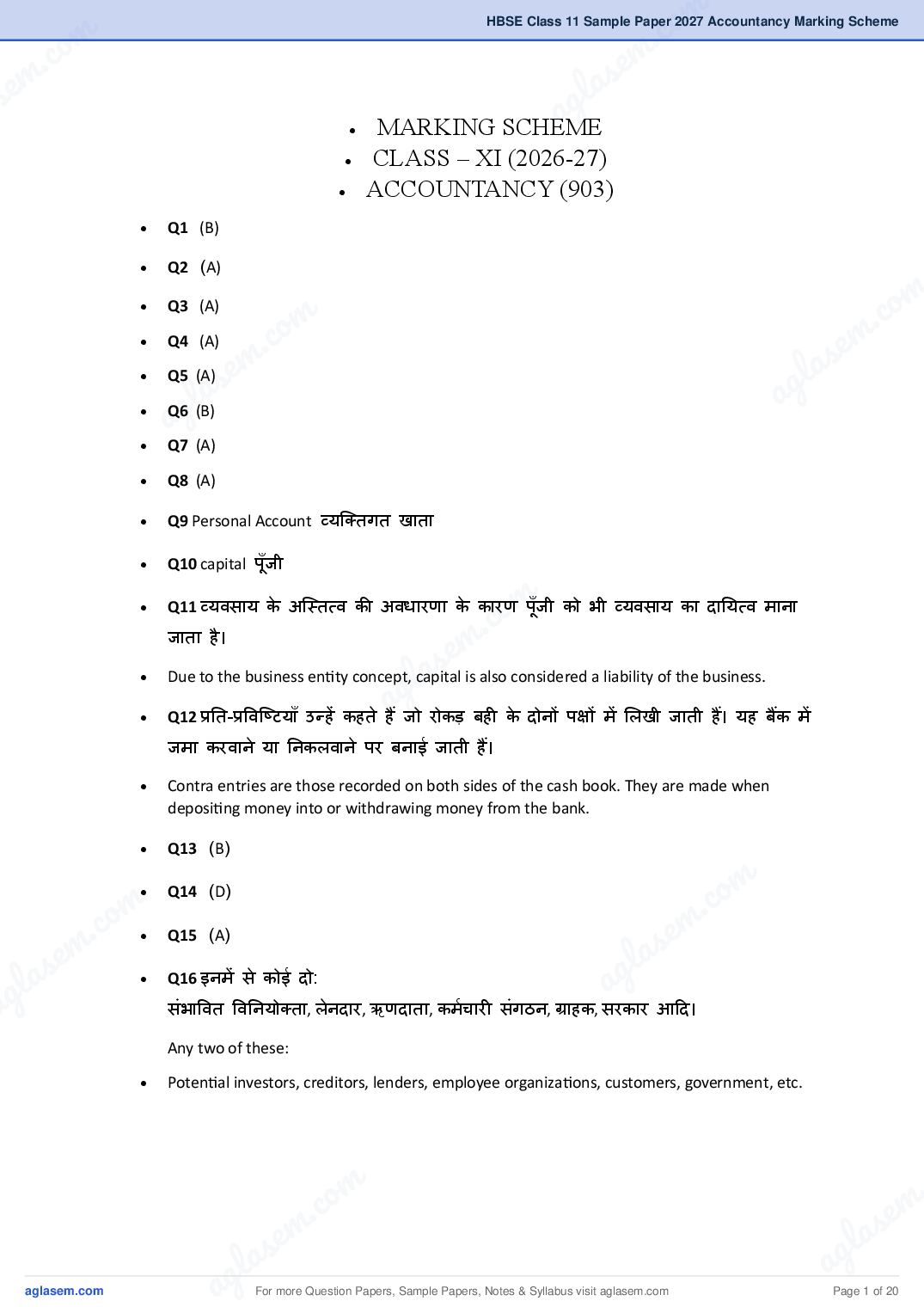
• MARKING SCHEME
• CLASS – XI (2026-27)
• ACCOUNTANCY (903)
• Q1 (B)
• Q2 (A)
m
.co
Q3 (A)
m
•
• Q4 (A)
m .co s e m
s e l a
ag
• Q5 (A)
• Q6gl
a
a (B)
• Q7 (A)
• Q8 (A)
• Q9 Personal Account व्यक्तिगि खािा
• Q10 capital पूँजी
m
.co
• Q11 व्यवसाय के अक्तित्व की अवधारणा के कारण पूँजी को भी व्यवसाय का दाययत्व माना
em
जािा है।
s
la is also considered a liability of the business.
• Due to the business entity concept, capital
a g
• Q12 ्ऺयि-्ऺववक्टियाूँ उन्हें कहिे हैं जो रोकड़ बही के दोनों प्षों में लिखी जािी हैं। यह बैंक में
जमा करवाने या यनकिवाने पर बनाई जािी हैं।
• Contra entries are those recorded on both sides of the cash book. They are made when
depositing money into or withdrawing money from the bank.
• Q13 (B)
m
.co
• Q14 (D)
m
c. o • Q15 (A) s e m
e m l a
las • Q16 इनमें से कोई दो:
ag
ag संभाववि ववयनयोतिा, िेनदार, ऋणदािा, कममचारी संगठन, ्ቇाहक, सरकार आदद।
Any two of these:
• Potential investors, creditors, lenders, employee organizations, customers, government, etc.
m .
.co s e m
s em l a
g la ag
a For more Question Papers, Sample Papers, Notes & Syllabus visit Page 1 of 20
Page 3
कहिािा है जबकक हायन से आशय ककसी अवधध के दौरान व्ययों के आगम पर आधधतय से
है।
• If the entire benefit of an expenditure is realized within a single year, it is termed an
'expense,' whereas a 'loss' refers to the excess of expenses over revenue during a specific
period.
• Q18 इस आधार में आयों का िेखांकन िब िक नहीं ककया जािा जब िक कक वह नकदी में
्ऺाप्ि न हो जाएूँ। इसी ्ऺकार, व्ययों का िेखांकन भी िभी ककया जािा है जब उनका नकदी
में भुगिान कर ददया जाए।
• Under this basis, income is not recorded until it is received in cash. Similarly, expenses are
recorded only when they are paid in cash.
• Q19 दोहरा लेखा ्ቚणाली के कोई 2 लाभ:
1. वै्ञायनक ्ऺणािी
2. िेन-दे न का पणम िेखा
3. परी्षा सची अथवा ििपि का यनमामण
4. व्यापाररक एवं िाभ-हायन खािे का यनमामण
(कोई 2)
Any 2 advantages of the double-entry system:
1. Scientific system
2. Complete record of transactions
3. Preparation of a trial balance
4. Preparation of Trading and Profit & Loss accounts
(Any 2)
• Q20 डेबिट ्ቚमाणक - यह उन िेन-दे नों के लिए िैयार ककए जािे हैं जो नकद भुगिानों से
सम्बक्न्धि हैं। जैसे:
o व्ययों के भुगिान के लिए
o माि के नकद ्ቅय के लिए
o तथायी सम्पवियों के नकद ्ቅय के लिए
o बैंक में नकद रालश जमा करने के लिए
OR
For more Question Papers, Sample Papers, Notes & Syllabus visit Page 2 of 20
Page 4
m .co
m .co s em
se g la
्ቅेडडट ्ቚमाणक - यह उन िेन-दे नों के लिए िैयार ककए जािे हैं जोaनकद ्ऺाक्प्ियों से सम्बक्न्धि हैं।
जैसे:
o आय की नकद ्ऺाक्प्ि के लिए
o माि के नकद वव्ቅय के लिए
o ववयनयोगों के नकद वव्ቅय के लिए
m
m .co
o
.co
दे नदारों से नकद ्ऺाक्प्ियों के लिए
e m
s em – These are prepared for transactions involving cash payments, such as: glas
• Debit Vouchers
a
• o l Payment of expenses
g a
a Cash purchase of goods
• o
• o Cash purchase of fixed assets
• o Depositing cash into the bank
• OR Credit Vouchers – These are prepared for transactions involving cash receipts, such as:
• o Cash receipt of income
m
• o Cash sale of goods
m .co
• o Cash sale of investments
s e
Cash receipts from debtors la
ag
• o
Q21
व्यापाररक खािे का उद्दे श्य (कोई 2)
• सकि िाभ या सकि हायन का पिा िगाना: यह ऑक़िस के ऊपरी व्यय से पहिे का िाभ
जानने के लिए शुद्ध वव्ቅय की िुिना बेचे गए सामान की िागि (COGS) से करिा है।
•
o m
्ऺत्य्ष व्यय का दहसाब रखना: यह उत्पादन और खरीद की िागिों, जैसे ़िैतिरी की मज़दरी,
m िाने का ककराया (्ऻेि/कैररज इनव्ऱमस) और ईंधन के बारे में जानकारी देिा है।m.
माि c
c. o e और अंयिम
e m • तिॉक ्ऺबंधन की जाूँच करना: यह इन्वें्ी के िेवि को मापने के लिएlas्ऺारक्म्भक
l as तिॉक की वैल्य को ररकॉर्म करिा है। a g
ag अथवा
िाभ हायन खािे का उद्दे श्य (कोई 2)
• शुद्ध िाभ या शुद्ध हायन का पिा िगाना: यह सभी अ्ऺत्य्ष व्यय को घिाकर और
अ्ऺत्य्ष आय को जोड़कर सकि िाभको समायोक्जि करिा है।
m .
.co s e m
s em l a
g la ag
a For more Question Papers, Sample Papers, Notes & Syllabus visit Page 3 of 20
Page 5
मल्य्ቩास और व्ऺंदिंग िागि जैसे गैर-़िैतिरी ऊपरी व्यय का मल्यांकन करने में मदद करिा है ।
• पूँजी खािे को अद्यिन करना: मालिक की इक्तविी को समायोक्जि करने के लिए अंयिम
शुद्ध िाभ/हायन को िुिन पि में तथानािररि ककया जािा है।
Purpose of the Trading Account (any 2)
• To ascertain Gross Profit or Gross Loss: It compares net sales against the Cost of Goods Sold
(COGS) to find the profit before ofÏce overheads.
• To keep track of Direct Expenses: It provides information on production and purchasing
costs like factory wages, freight/carriage inwards, and fuel.
• To check Stock Management: It records opening and closing stock values to measure
inventory levels
OR
Purpose of the Profit & Loss Account (any 2)
• To ascertain Net Profit or Net Loss: It adjusts the gross profit by deducting all indirect
expenses and adding indirect incomes.
• To control Indirect Expenses: It helps management evaluate non-factory overheads like
ofÏce rent, staff salaries, depreciation, and printing costs.
• To update the Capital Account: The final Net Profit/Loss is transferred to the Balance Sheet
to adjust the owner’s equity
Q22.
ममलान की अवधारणा (Matching Concept) :- यह अवधारणा शुद्ध िाभ (Net Profit) के सही
यनधामरण के लिए बहुि महत्वपणम है। इस अवधारणा के अनुसार, व्यावसाययक गयिववधधयों से
शुद्ध िाभ का यनधामरण करिे समय, उस अवधध के राजतव (Revenue/Income) पर िाग होने
वािी सभी िागिों (Costs/Expenses) को उस राजतव में से घिाया जाना चादहए। िदनुसार,
िागिों का राजतव से लमिान करने के लिए, पहिे राजतव की पहचान की जानी चादहए और
किर उस राजतव को अक्जमि करने के लिए की गई िागिों की पहचान की जानी चादहए।
Matching Concept :- This concept is very important for correct determination of net profit.
According to this concept, in determining the net profit from business operations, all costs
which are applicable to revenue of the period should be charged against that revenue.
Accordingly, for matching costs with revenue, first revenues should be recognised and then
costs incurred for generating that revenue should be recognised.
OR अथवा
मु्ቖा मापन की अवधारणा (Money Measurement Concept) :- िेखांकन (Accounting) में केवि
उन्हीं िेन-दे नों और घिनाओं को दजम ककया जािा है क्जन्हें मु्ቖा (पैसे) के रूप में व्यति
For more Question Papers, Sample Papers, Notes & Syllabus visit Page 4 of 20
Page 6
m .co
m .co s em
se g la
ककया जा सकिा है। कोई घिना, भिे ही वह व्यवसाय के aलिए बहुि महत्वपणम हो, व्यवसाय
की पुतिकों में िब िक दजम नहीं की जाएगी जब िक कक उसके ्ऺभाव को पयामप्ि सिीकिा
के साथ मु्ቖा के रूप में मापा न जा सके। उदाहरण के लिए, िेखांकन उत्पादन ्ऺबंधक
(Production Manager) और ्ऴब्ቅी ्ऺबंधक (Sales Manager) के बीच के झगड़े को दजम नहीं
करिा है; यह यह नहीं बिािा कक कोई हड़िाि शुरू हो रही है और न ही यह ्ऺकि करिा है
कक ककसी ्ऺयितपधी (Competitor) ने बाजार में एक बेहिर उत्पाद उिारा है । इन िथ्यों या
m
m
घिनाओं को मु्ቖा के रूप में व्यति नहीं ककया जा सकिा है और इसलिए इन्हें व्यावसाययक
.co
.co
पुतिकों में दजम नहीं ककया जािा है ।
s e m
Moneys em g l a
l a Measurement Concept:- Only those transactions and events are recorded in
a
ait gmay be very important for the business, will not be recorded in the books of the business
accounting which are capable of being expressed in terms of money. An event, even though
unless its effect can be measured in terms of money with a fair degree of accuracy. For
example, accounting does not record a quarrel between the production manager and sales
manager; it does not report that a strike is beginning and it does not reveal that a competitor
has placed a better product in the market. These facts or happenings cannot be expressed in
money terms and thus are not recorded in the books.
Q 23.
m
.co
ACCOUNTING EQUATION
s. Transaction
e m Assets Liabilities + Capital
no.
l as
1 Business start with cas Rs. a g
Cash + Stock + Debtors +Furniture
1,75,000 + 0 + 0 + 0 =0 +1,75,000
1,75,000
2 Purchase goods from rohit Rs. 0 + 50,000 + 0 + 0 =50,000 + 0
50,000
3 New Equation 1,75,000 + 50,000 + 0 + 0 =50,000 +1,75,000
Sold goods on credit to
Manish costing Rs. 17,500 for 0 (-) 17,500 + 20,000 + 0 =0 + 2,500
Rs. 20000
4 New Equation 1,75,000 + 32,500 + 20,000 + 0
m
= 50,000 + 1,77,500
m Purchase furniture Rs. 10,000 (-) 10,000+ 0 + 0 + 10,000
.co
=0 + 0
.c5o em
New Equation 1,65,000 + 32,500 + 20,000 + 10,000 = 50,000 + 1,77,500
e m Cash paid to Rohit in full (-) 48,500 + 0 + 0
la s + 0 (-)50,000 + 1,500
las settlement Rs. 48,500
1,16,500 + 32,500 + 20,000a + g10,000 = 0 + 1,79,000
ag 6 New Equation
Cash received from Manish Rs. 20,000 + 0 (-) 20,000 + 0 = 0 + 0
20,000
7 New Equation 1,36,500 + 32,500 + 0 + 10,000 =0 + 1,79,000
Rent paid Rs. 1,000 (-) 1,000 + 0 + 0 + 0 =0 (-) 1,000
8 New Equation 1,35,500 + 32,500 + 0 + 10,000 =0 + 1,78,000
Cash withdrew for personal (-) 3,000 + 0 + 0 + 0 =0 (-) 3,000
use Rs. 3,000
Final Equation 1,32,500 + 32,500 + 0 + 10,000 =0 + 1,75,000
m .
.co s e m
s em l a
g la ag
a For more Question Papers, Sample Papers, Notes & Syllabus visit Page 5 of 20
Page 7
JOURNAL OF MUKUL ROY & SONS
Date Particulars L.F. Amount Dr. (₹) Amount Cr. (₹)
2025 Purchases A/c …….. Dr. 1,50,000
Input CGST A/c ………Dr. 9,000
April 1
Input SGST A/c ………Dr. 9,000
To S. Banerjee 1,68,000
(Purchased goods on Credit)
April 6 Aditya Sangma ……….Dr. 2,80,000
To Sales A/c 2,50,000
To Output CGST A/c 15,000
To Output SGST A/c 15,000
(Sale of goods on Credit)
April 8 S. Banerjee …………Dr. 11,200
To Purchase Returns A/c 10,000
To Input CGST A/c 600
To Input SGST A/c 600
(Purchase returns)
April 15 Sales Returns A/c ……..Dr. 8,000
Output CGST A/c …….Dr. 480
Output SGST A/c …….Dr. 480
To Aditya Sangma 8,960
(Sales returns)
April 18 Printing & Stationery A/c ……Dr. 5,000
Input CGST A/c …….Dr. 300
Input SGST A/c …….Dr. 300
To Cash A/c 5,600
(Paid for printing and stationery)
C/F 4,73,760 4,73,760
JOURNAL ENTRIES (CONTINUED)
For more Question Papers, Sample Papers, Notes & Syllabus visit Page 6 of 20
Page 8
m .co
m .co s em
se g la
Date Particulars
a
L.F. Amount Dr. Amount Cr.
(₹) (₹)
B/F 4,73,760 4,73,760
April Drawings A/c ………..Dr. 22,400
24 To Purchases A/c 20,000
m
.co
To Input CGST A/c 1,200
m
.co m
To Input SGST A/c 1,200
(Goods withdrawn for personal use)
s e
s em l a
April
g la by Fire A/c
Loss ………Dr. 16,800 ag
27 a To Purchases A/c 15,000
To Input CGST A/c 900
To Input SGST A/c 900
(Goods destroyed by fire)
April Output CGST A/c ……..Dr. 14,520
30 Output SGST A/c ……….Dr. 14,520
To Input CGST A/c 6,600
To Input SGST A/c
. c om 6,600
To Bank A/c (₹7,920 + ₹7,920)
e m 15,840
amount) las
(Adjustment of GST and payment of balance
ag
Total ₹ 5,42,000 5,42,000
Q 25
m
mPURCHASE RETURN BOOK OR RETURN OUTWARD BOOK
c. oDate Particulars m Total .co
m s eInput
la IGST Amount
Debit L.F. Details Purchase Input Input
s e g
la
(Name of the Note (₹) Returns CGST SGST
g Supplier) No. (₹) (₹) a (₹) (₹) (₹)
a (Account to be
Debited)
2025
June Radha Krishan 140 20,000 18,000 1,080 1,080 — 20,160
15 & Sons, New 2,000
m .
.co s e m
s em l a
g la ag
a For more Question Papers, Sample Papers, Notes & Syllabus visit Page 7 of 20
Page 9
Less: Trade 1,080
Discount @ 1,080
10% 20,160
Add: CGST @
6%
SGST @
6%
June Gopal sons, 141 50,000 50,000 3,000 3,000 — 56,000
20 New Delhi 3,000
Add: CGST @ 3,000
6% 56,000
SGST @
6%
June Raghubir 145 10,000 10,000 600 600 — 11,200
25 Prashad, New 600
Delhi 600
Add: CGST @ 11,200
6%
SGST @
6%
Total 78,000 4,680 4,680 — 87,360
Q26.
BANK RECONCILIATION STATEMENT
as on 31st December, 2025
Particulars Plus Items Minus Items
₹ ₹
Balance as per Pass Book (Cr.) (Favourable) 7,000
(a) Cheque directly deposited by customer not entered in cash book 1,000
(b) Interest credited by bank 700
For more Question Papers, Sample Papers, Notes & Syllabus visit Page 8 of 20
Page 10
m .co
m .co s e m
se g l a
(c) Cheques issued but not presented for payment
a 2,000
7,000 3,700
Balance as per Cash Book (Dr.) 3,300
m
m .co
m .co OR अथवा
s e m
s e l a
a ag
BANK RECONCILIATION STATEMENT
g l as on 31st December, 2025
a
Particulars Plus Items Minus Items
₹ ₹
Balance as per Pass Book (Cr.) 50,000
m
.co
(a) Cheques of ₹2,000 and ₹5,000 were paid into bank 7,000
but not credited by bank
s em
(b) Cheque received, entered in cash book l
g a omitted to be banked
but 800
a
(c) Cheques issued but not presented for payment 10,000
(d) Interest on investment not recorded in Cash Book 1,000
57,800 11,000
m
.co
Balance as per Cash Book (Dr.) 46,800
m
.co
m Q27. s e m
s e g l a
g la a
a JOURNAL
Date Particulars L.F. Dr. (₹) Cr. (₹)
(a) Suspense A/c …..Dr. 11,000
To Rajat 5,000
To Kamal 6,000
m .
.co s e m
s em l a
g la ag
a For more Question Papers, Sample Papers, Notes & Syllabus visit Page 9 of 20
Page 11
₹6,000)
(b) Salaries A/c …….Dr. 2,000
To Personal A/c 1,200
To Suspense A/c 800
(Salaries paid ₹2,000 wrongly debited to personal account as
₹1,200)
(c) Sales A/c ……….Dr. 1,600
To Purchases A/c 1,000
To Suspense A/c 600
(Goods withdrawn for personal use ₹1,000 wrongly credited to sales
account as ₹1,600)
(d) Suspense A/c ………..Dr. 2,700
To Machinery A/c 2,700
(Lesser amount posted to Machinery, now corrected)
(e) Sales A/c ………Dr. 6,000
Suspense A/c ………..Dr. 4,000
To Car A/c 10,000
(Sale of car wrongly credited to sales account, now rectified)
Dr. SUSPENSE ACCOUNT Cr.
Particulars J.F. ₹ Particulars J.F. ₹
To Rajat 5,000 By Difference as per Trial 16,300
Balance
To Kamal 6,000 By Salaries A/c 800
To Machinery A/c 2,700 By Sales A/c 600
To Car A/c 4,000
17,700 17,700
For more Question Papers, Sample Papers, Notes & Syllabus visit Page 10 of 20
Page 12
m .co
m .co s e m
se g l a
Q 28. a
Dr. DOUBLE COLUMN CASH BOOK Cr.
Date Particulars L.F. Cash Bank Date Particulars L.F. Cash Bank
(₹) (₹) (₹) (₹)
2025 2025
m
m 50,000 — .co
.co m
July 1 To Capital A/c July 3 By Bank A/c C 30,000 —
m s e
s e l a
a ag
July 3 To Cash A/c C — 30,000 July 5 By Purchases 10,000 —
g l A/c
a
July To Sales A/c 8,000 — July By OfÏce 5,000 —
18 10 Equipment A/c
July To Cheques in — 7,000 July By Cartage A/c — 500
20 Hand A/c 22
mBy Drawings
c. o A/c
July 2,000 —
25
s em
g la July By Rent A/c — 1,000
a 30
July By Balance c/d 11,000 35,500
31
58,000 37,000 58,000 37,000
Aug. To Balance b/d 11,000 35,500 m
m
1
.co
.co s e m
s em Note : Cheque received for goods sold on July 15 will be recorded in Journalglasafollows :
g la a
a Cheque in Hand A/C ………Dr. 7,000
To Sales A/C 7,000
When the above Cheque is deposited into bank on July 20, it will be recorded in the Cash Book on
the debit side in bank column.
OR अथवा
m .
.co s e m
s em l a
g la ag
a For more Question Papers, Sample Papers, Notes & Syllabus visit Page 11 of 20
Page 13
(1) मुख्य कैलशयर के समय और ्ऺयास की बचि (Saving of Time and Efforts of Chief
Cashier) :— चंकक छोिे -मोिे खचों का भुगिान करने और उन्हें ररकॉर्म करने का सारा काम
पेिी कैलशयर ही संभाििा है , इसलिए मुख्य कैलशयर का कािी समय और ऊजाम बच जािी है।
उसे लसिम महीने के अंि में ऐसे खचों के कुि योग को केवि एक बार ररकॉर्म करना होिा है।
(2) खािा बही में पोक्तिं ग की आसानी (Easiness in Posting) :— खािा बही में ्ऺत्येक खचम के
केवि कुि योग की ही पोक्तिं ग की जािी है । इस ्ऺकार, कािी जगह बचिी है और पोक्तिं ग
करना बहुि सवु वधाजनक हो जािा है।
(3) रोकड़ पत
ु िके िैयार करने में आसानी (Easiness in preparing the Cash Book) :— चंकक हर
व्यवसाय में छोिे -मोिे भग
ु िानों की संख्या कािी अधधक होिी है और इन्हें पेिी कैश बुक में
ही ररकॉर्म ककया जािा है , इसलिए मख्
ु य कैश बुक पर ज्यादा बोझ नहीं पड़िा और उसका
िोिि आसानी से िगाया जा सकिा है ।
(4) छोिे खचों पर यनयंिण (Control on Petty Expenses) :— मख्
ु य कैलशयर समय-समय पर
पेिी कैश बक
ु की जांच करिा रहिा है , क्जससे ककसी भी अनावश्यक खचम पर उधचि रोक िग
जािी है।
(5) धोखाधड़ी की कम संभावना (Lesser chances of fraud) :— पेिी कैलशयर अपने द्वारा ककए
गए ्ऺत्येक भग
ु िान की रसीद ्ऺाप्ि करिा है और उनका उधचि ररकॉर्म रखिा है। पेिी
कैलशयर को रालश की ्ऺयिपयिम (ररइंबसम) करिे समय मख्
ु य कैलशयर द्वारा रसीदों पर ववधधवि
हतिा्षर ककए जािे हैं। इस ्ऺकार, इससे धोखाधड़ी की संभावना बहुि कम हो जािी है।
(6) सरि िरीका (Simple Method) :— पेिी कैश बुक के रख-रखाव के लिए अकाउं दिंग
(िेखांकन) के ककसी ववशेर् या गहन ्ञान की आवश्यकिा नहीं होिी है।
Advantages of Petty Cash Book (any five)
(1) Saving of Time and Efforts of Chief Cashier :— As petty cashier handles the work of making all
petty expenses and recording them as well, a lot of time and energy of the main cashier is saved. He
is to record only the total of such expenses and that too only once, at the end of each month.
(2) Easiness in Posting :— Only the total of each head of expense is posted into the Ledger. As such, a
lot of space is saved and the posting becomes very convenient.
(3) Easiness in preparing the Cash Book :— As the number of small payments in every business is
quite large and as these are recorded in the petty cash book itself, the main cash book is not
overburdened and can be more easily totalled.
For more Question Papers, Sample Papers, Notes & Syllabus visit Page 12 of 20
Page 14
m .co
m .co s em
se g la
a the petty cash book from time to
(4) Control on Petty Expenses :— The main cashier keeps checking
time and a proper check is put on any unnecessary expenditure.
(5) Lesser chances of fraud :— Petty Cashier obtains a receipt of every payment made by him and
keeps a proper record of them. The receipts are duly signed by the main cashier while reimbursing
the amount to the petty cashier. As such, it minimises the chances of fraud.
(6) Simple Method :— The maintenance of petty cash book does not require any specialised
knowledge of accounting.
m
m .co
Q 29
m .co s e m
s e l a
Dr.
g la MACHINERY ACCOUNT
agCr.
Date a Particulars Amount Date Particulars Amount
(₹) (₹)
2019 2019
April 01 To Balance b/d 1,86,875 Oct. 01 By Depreciation A/c 7,500
(on ₹1,00,000 for 6 months)
o m
c
Oct. 01 . By Machinery Disposal
em A/c (₹40,000 - ₹7,500)
32,500
las
g
a 2020
Mar. 31 By Depreciation A/c 37,500
(on ₹2,50,000 @ 15%)
Mar. 31 By Balance c/d 1,09,375
m
.co
1,86,875 1,86,875
m
.co
m Dr. s e m
s e MACHINERY DISPOSAL ACCOUNT
g l a Cr.
g la a
a Date Particulars Amount
(₹)
Date Particulars Amount
(₹)
2019 2019
Oct. 01 To Machinery A/c 32,500 Oct. 01 By Bank A/c 25,000
m .
.co s e m
s em l a
g la ag
a For more Question Papers, Sample Papers, Notes & Syllabus visit Page 13 of 20
Page 15
32,500 32,500
Working Notes :
(1) Original Cost of Ist Machinery as on 1st April, 2015 : 1,00,000
Less : Dep. @15% p.a. for 4 years 60,000
Book Value on 1st April, 2019 40,000
Original Cost of IInd Machinery on 1st July 2016 : 2,50,000
Less : Dep. @15% for 2 years 9 months 1,03,125 1,46,875
Book Value on 1st April, 2019 1,86,875
(2) As per Information provided in the question, provision for depreciation account is not maintained
by the firm.
OR अथवा
मूल्य्ቩास का अथथ (Meaning of Depreciation)
सरि शब्दों में, ककसी भी स्थायी संप्ति (Fixed Asset) जैस—
े मशीनरी, भवन, िनीचर, कंप्यिर, या वाहनों
के िगािार उपयोग, समय बीिने, या यघसावि के कारण उसके मल्य में आने वािी तथायी और धीरे -
धीरे होने वािी कमी को मूल्य्ቩास (Depreciation) कहिे हैं।
• एक लेखांकन अवधारणा के रूप में: यह संपवि की िागि को उसके उपयोगी जीवनकाि
(Useful Life) में ववभाक्जि करने की एक ्ऺक्ቅया है। यह व्यापार के लिए एक गैर-नकद व्यय
(Non-cash Expense) होिा है, क्जसे िाभ-हायन खािे (Profit & Loss A/c) के र्े्ऴबि प्ष में
ददखाया जािा है ।
यहाूँ क्षा 11वीं के पाठ्य्ቅम (CBSE/State Boards) के अनुसार मूल्य्ቩास (Depreciation) का एक सिीक
और व्यवक्तथि उिर ददया गया है:
मूल्य्ቩास का अथथ (Meaning of Depreciation)
सरि शब्दों में, ककसी भी स्थायी संप्ति (Fixed Asset) जैस—
े मशीनरी, भवन, िनीचर, कंप्यिर, या वाहनों
के िगािार उपयोग, समय बीिने, या यघसावि के कारण उसके मल्य में आने वािी तथायी और धीरे -
धीरे होने वािी कमी को मूल्य्ቩास (Depreciation) कहिे हैं।
• एक लेखांकन अवधारणा के रूप में: यह संपवि की िागि को उसके उपयोगी जीवनकाि
(Useful Life) में ववभाक्जि करने की एक ्ऺक्ቅया है। यह व्यापार के लिए एक गैर-नकद व्यय
For more Question Papers, Sample Papers, Notes & Syllabus visit Page 14 of 20
Page 16
m .co
m .co s em
se g la
(Non-cash Expense) होिा है, क्जसे िाभ-हायन खािे (Profita& Loss A/c) के र्े्ऴबि प्ष में
ददखाया जािा है ।
मूल्य्ቩास के ्तवमभन्न कारण (Causes of Depreciation)
मल्य्ቩास के मुख्य कारणों को यनम्नलिखखि है:
1. ननरं तर उपयोग के कारण निसावट (Wear and Tear due to Constant Use)
m
m .co
है। उदाहरण के लिए,
.co
जब ककसी संपवि का व्यवसाय में िगािार उपयोग ककया जािा है , िो उसमें भौयिक यघसावि आिी
mएक मशीनरी जैसे-जैसे चििी है, उसके पुजे पुराने और ढीिे होिे जािे हैं, क्जससेlas e m
s e g
l a
उसकी कायम्षमिा
g
और मल्य दोनों कम हो जािे हैं। a
a
2. समय का िीतना (EfÒuxion of Time / Passage of Time)
कुछ संपवियां ऐसी होिी हैं क्जनका उपयोग ककया जाए या न ककया जाए, केवि समय बीिने के साथ
ही उनका मल्य कम हो जािा है।
• उदाहरण: पट्िे (Lease) पर िी गई संपवि, पेिेंि (Patents), या कॉपीराइि। अगर कोई पट्िा 5
साि के लिए है, िो हर साि बीिने के साथ उसका मल्य अपने आप घििा चिा जाएगा।
m
3. अ्ቚचलन (Obsolescence)
m .co
s e
बाजार में नई और बेहिर िकनीक (Technology)
g l a आने के कारण पुरानी संपवि का मल्य अचानक कम
a ही वह भौयिक रूप से ्ऴबल्कुि ठीक हो।
हो जािा है या वह बेकार हो जािी है , भिे
• उदाहरण: िाइपराइिर की जगह कंप्यिर का आना, या 4G तमािम िोन्स के आने के बाद 3G िोंस
की कीमि का घि जाना।
4. ्ቚाकृनतक संसाधनों का समाप्त होना (Depletion)
यह कारण मुख्य रूप से ्ऺाकृयिक और ्षयकारी संपवियों (Wasting Assets) पर िाग होिा है । जैसे-
m
mजैसे इन संसाधनों से साम्ቇी यनकािी जािी है , इनका मल्य घििा जािा है ।
c. o • उदाहरण: कोयिे की खदानें, िेि के कुएं, या पत्थरों की खदानें। m.co
m s e
s e g l a
g la 5. दि
ु थटना (Accident) a
a यदद ककसी संपवि को ककसी अ्ऺत्यालशि घिना जैसे- आग िगना, बाढ़ आना, या एतसीर्ेंि होने के
कारण कोई नुकसान पहुंचिा है, िो उसके मल्य में भारी और परमानेंि धगरावि आ जािी है।
6. िाजार मूल्य में स्थायी गगरावट (Permanent Fall in Market Value)
कभी-कभी बाजार की पररक्तथयियों या मांग में बदिाव के कारण ककसी ववशेर् संपवि के बाजार मल्य
में तथायी रूप से कमी आ जािी है , जो मल्य्ቩास का कारण बनिी है ।
m .
.co s e m
s em l a
g la ag
a For more Question Papers, Sample Papers, Notes & Syllabus visit Page 15 of 20
Page 17
In simple words, Depreciation refers to the gradual, permanent, and continuous decrease in the
value of a fixed tangible asset (such as machinery, buildings, furniture, computers, or vehicles) due
to its constant use, passage of time, wear and tear, or obsolescence.
• As an Accounting Concept: It is a process of allocating the cost of a fixed asset over its
estimated useful life. It is treated as a non-cash business expense and is debited to the Profit
and Loss Account.
Causes of Depreciation
the primary causes of depreciation as follows:
1. Physical Wear and Tear (Constant Use)
When a fixed asset is continuously used in business operations, it undergoes physical deterioration.
For example, as machinery operates over time, its parts wear out, leading to a decline in both its
working efÏciency and its overall value.
2. EfÒuxion of Time (Passage of Time)
The value of certain assets decreases simply with the passage of time, regardless of whether they are
actively used or kept idle.
• Example: Intangible assets like Patents, Copyrights, or Leased assets. If a property is taken on
lease for 5 years, its value automatically drops by 1/5th each passing year.
3. Obsolescence
An asset becomes obsolete (outdated) when a new and technologically superior product enters the
market. Even if the old asset is physically in perfect working condition, its value drops dramatically
because it can no longer compete with newer technology.
• Example: Typewriters being replaced by computers, or the decline in the value of 4G
smartphones after the introduction of 5G technology.
4. Depletion
This cause applies specifically to natural or wasting assets. As the raw materials are continuously
extracted from these natural sources, their total remaining reserves shrink, reducing their total
value.
• Example: Coal mines, oil wells, timber forests, or stone quarries.
5. Accidents
If an asset suffers damage due to an unexpected accidental event—such as a fire outbreak, flood, or
physical collision—it experiences an immediate and permanent drop in its value and utility.
6. Permanent Fall in Market Value
Sometimes, a structural shift in market demand or general economic conditions leads to a
permanent decline in the market value of a specific category of asset.
For more Question Papers, Sample Papers, Notes & Syllabus visit Page 16 of 20
Page 18
m .co
m .co s e m
se g l a
Q30. a
लाभ और हानन खाता क्या है ? (What is Profit and Loss Account?)
िाभ और हायन खािा (P&L Account) एक वविीय वववरण (Financial Statement) है, क्जसे व्यवसाय के
िेखांकन वर्म (Accounting Year) के अंि में बनाया जािा है। इसका मुख्य उद्दे श्य व्यापार का शुद्ध
लाभ (Net Profit) या शुद्ध हानन (Net Loss) ्ञाि करना होिा है।
m
लाभ और हानन खाते के महቈኚव के चार बिंद ु (Four Points of Importance)
c o m m .co
1. शुद्ध लाभ या शुद्ध. हानन की जानकारी (Ascertainment of Net Profit or Net Loss) s e
s em g l a
इस खािे काla सबसे बड़ा महቈኚव यह है कक यह व्यवसायी को एक यनक्श्चि अवधध (आमिौर पर एक a
वर्म) के a
g
दौरान हुए वातिववक (शद्
ु ध) िाभ या हायन की सिीक जानकारी दे िा है। इससे पिा चििा है
कक सभी खचे घिाने के बाद व्यापार वातिव में कमा रहा है या नक
ु सान में चि रहा है।
2. अ्ቚत्य्ቌ व्ययों पर ननयं्ቔण (Control over Indirect Expenses)
िाभ और हायन खािे में सभी अ्ऺत्य्ष खचों (जैसे—्ऺशासयनक, ्ऴब्ቅी और वविरण व्यय) को अिग-
अिग ददखाया जािा है । वपछिे वर्ों के आंकड़ों से िि
ु ना करके ्ऺबंधक यह दे ख सकिे हैं कक कौन
m
.co
सा खचम अनावश्यक रूप से बढ़ रहा है और उसे यनयं्ऴिि करने के उपाय कर सकिे हैं।
3. व्यावसानयक तरक्की और तल em
ु ना में सहायक (Helpful in Comparison and Growth Analysis)
s
ु ध िाभ की g
la
यह खािा विममान वर्म के शद्
a िि
ु ना वपछिे वर्ों के शद्
ु ध िाभ से करने में मदद करिा
है। इससे व्यवसाय की परिॉमेंस का पिा चििा है कक व्यापार आगे बढ़ रहा है या पीछे जा रहा है ।
इसी के आधार पर भववटय की योजनाएं बनाई जािी हैं।
4. ्तवमभन्न प्ቌों के मलए उपयोगी (Useful for Various Stakeholders)
व्यवसाय से जड़
ु े ववलभन्न बाहरी प्षों के लिए यह खािा बहुि महत्वपणम होिा है:
m
.co
• िैंक और ऋणदाता: व्यापार की ऋण चुकाने की ्षमिा दे खने के लिए इसे चेक करिे हैं।
m
c. o • आयकर ्तवभाग: इसी शुद्ध िाभ के आधार पर व्यापार का िैतस (Tax Liability)
s e m यनधामररि
s em ककया जािा है ।
g l a
la a
ag • ननवेशक: व्यवसाय में पैसा िगाने से पहिे इसकी िाभ कमाने की ्षमिा जांचिे हैं।
What is a Profit and Loss Account?
A Profit and Loss Account (P&L Account) is a financial statement prepared at the end of a business's
accounting year. Its primary objective is to ascertain the Net Profit or Net Loss of the business.
Four Points of Importance of Profit and Loss Account
m .
.co s e m
s em l a
g la ag
a For more Question Papers, Sample Papers, Notes & Syllabus visit Page 17 of 20
Page 19
The greatest importance of this account is that it provides the businessman with accurate
information about the actual (net) profit or loss incurred during a specific period (usually one year).
It reveals whether the business is genuinely earning or running into a loss after deducting all
expenses.
2. Control over Indirect Expenses
In the Profit and Loss Account, all indirect expenses (such as administrative, selling, and distribution
expenses) are shown separately. By comparing these figures with previous years' data, managers can
identify which expenses are increasing unnecessarily and take measures to control them.
3. Helpful in Comparison and Growth Analysis
This account helps in comparing the current year's net profit with the net profits of previous years.
This shows the performance of the business—whether it is growing or declining—and forms the
basis for making future plans.
4. Useful for Various Stakeholders
This account is highly important for various external parties associated with the business:
• Banks and Lenders: They check this account to evaluate the debt-repaying capacity of the
business.
• Income Tax Department: The tax liability of the business is determined based on this net
profit.
• Investors: They assess the profit-earning capacity of the business before investing their
money.
OR अथवा
Trading A/c and Profit & Loss A/C
Dr. For the Year ended March31,2025 Cr.
Particulars Amount (Rs) Particulars Amount (Rs)
Opening stock 60,220 Sales 2,81,500
Purchases 1,99,080 Less:- Returns (1,870) 2,79,630
Less: returns (1,450) 1,97,630 Closing stock 70,000
Carriage 5,170
Gross profit c/d 86,610
3,49,630 3,49,630
Discount allowed 3,960 Gross profit b/d 86,610
Bank charges 100 Discount received 2,980
Salaries 6,420
For more Question Papers, Sample Papers, Notes & Syllabus visit Page 18 of 20
Page 20
m .co
m .co s e m
se g l a
Rent & taxes 7,680 a
General expenses 3,630
Insurance 750
Less:- Prepaid Insurance 50 700
Bad debts 1,250
m
.co
Add: New provision
m
For bad debts
c. o 8,274 s e m
e m
Less:- Old provision for
l a
bad debts l as ag
ag
4,650 4,874
Net profit (transferred to capital A/c) 62,226
89,590 89,590
Balance sheet as at March 31, 2025
m
Liabilities Amount
.co
Assets Amount
Creditors 18,670
s emCash 13,870
15,000 la
ag
Loan Book debts 82,740
Capital 1,50,000 Less:- reserve for bad debts 8,274 74,466
Add:- net profit 62,226 Bills receivable 1,860
Less:- drawings 6,300 2,05,926 Land and building 42,580
Furniture 5,130
Plant & machinery 31,640
m 50
m Insurance (prepaid)
.co
m .co Closing stock
s e m 70,000
s e 2,39,596
g l a 2,39,596
g la a
a
m .
.co s e m
s em l a
g la ag
a For more Question Papers, Sample Papers, Notes & Syllabus visit Page 19 of 20
Page 21
Document Details
| Board / Org | Haryana Board |
| Exam | Class 11 |
| Type | Answer Key |
| Pages | 20 |
| Updated | 03 Nov 2026 |