HBSE Class 11 Sample Paper 2027 Physics Marking Scheme
Finished viewing? Save it for later —
Download HBSE Class 11 Sample Paper 2027 Physics Marking Scheme (PDF · 9 pages)About HBSE Class 11 Sample Paper 2027 Physics Marking Scheme
HBSE Class 11 Sample Paper 2027 Physics Marking Scheme is available here for free download. Published by Haryana Board for Class 11, this answer key can be viewed online or downloaded as a PDF (9 pages). Candidates preparing for Class 11 can use HBSE Class 11 Sample Paper 2027 Physics Marking Scheme to understand the exam pattern, the type of questions asked, and the overall difficulty level.
Frequently Asked Questions
How can I download HBSE Class 11 Sample Paper 2027 Physics Marking Scheme?
Open this page and click the Download button to save HBSE Class 11 Sample Paper 2027 Physics Marking Scheme as a PDF. It is completely free on AglaSem Docs.
Is HBSE Class 11 Sample Paper 2027 Physics Marking Scheme free to download?
Yes. HBSE Class 11 Sample Paper 2027 Physics Marking Scheme can be viewed online and downloaded as a PDF free of cost on AglaSem Docs.
How many pages does HBSE Class 11 Sample Paper 2027 Physics Marking Scheme have?
HBSE Class 11 Sample Paper 2027 Physics Marking Scheme contains 9 pages, which you can read online or download together as a single PDF.
Where can I find more Class 11 study material?
You can find more Class 11 question papers, sample papers, syllabus, and answer keys on AglaSem Docs.
HBSE Class 11 Sample Paper 2027 Physics Marking Scheme – Text
Read the full text of this answer key below — useful to quickly search, copy and reference the content online without downloading the PDF.
📄 View text version (10 pages)
Page 1
HBSE Class 11 Sample
Paper 2027 Physics
Marking Scheme
EXAM YEAR TYPE SUBJECT
Haryana Class 11 2027 Answer Key Physics
Notes · Sample Papers · Previous Year Papers · Mock Tests
Page 2
m .co
m .co s e m
se g l a
a
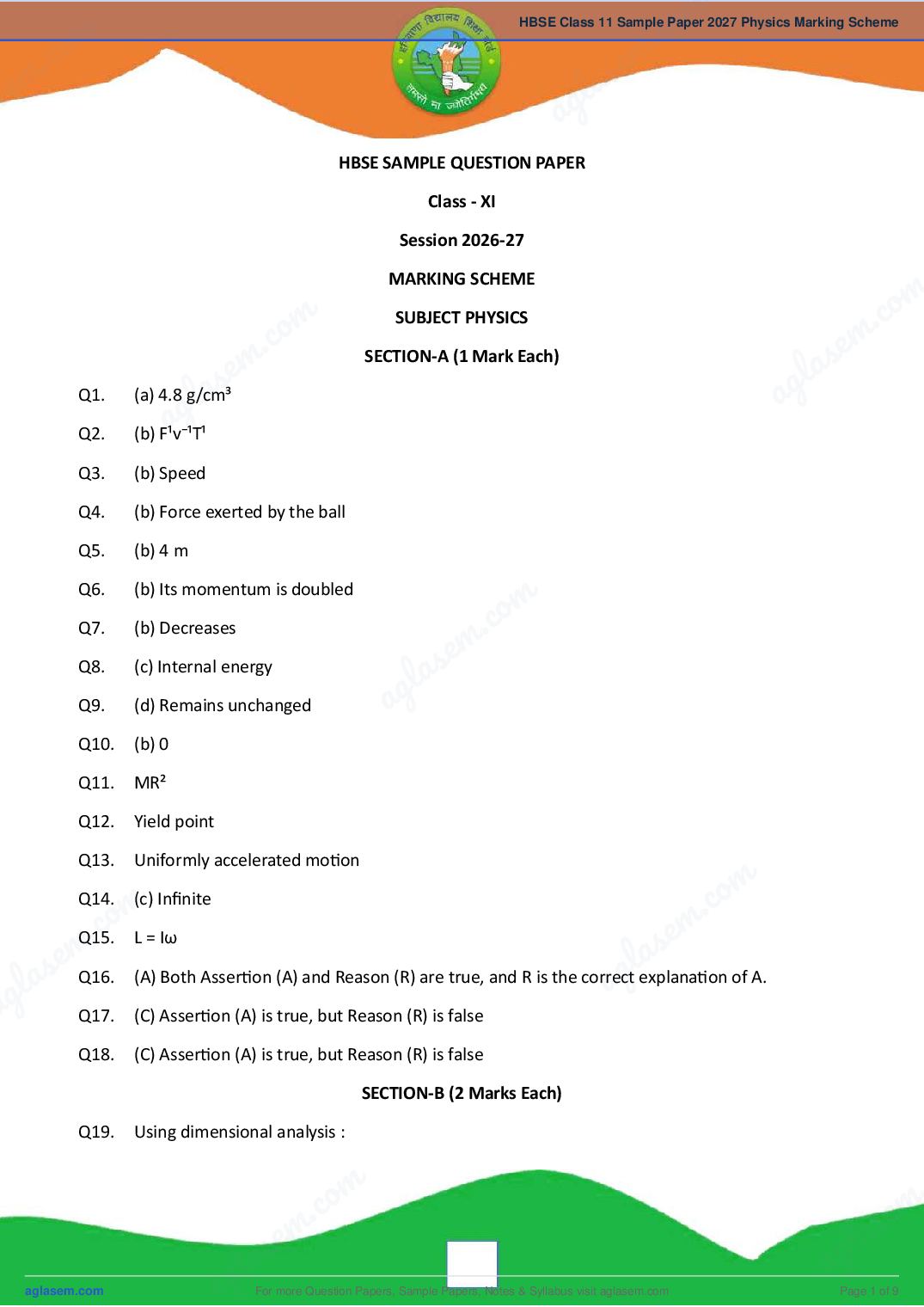
HBSE SAMPLE QUESTION PAPER
Class - XI
Session 2026-27
MARKING SCHEME
m
m SUBJECT PHYSICS .co
m .co s e m
s e
SECTION-A (1 Mark Each)
l a
Q1. l a
(a) 4.8 g/cm³
g ag
Q2. a
(b) F¹v⁻¹T¹
Q3. (b) Speed
Q4. (b) Force exerted by the ball
Q5. (b) 4 m
Q6. (b) Its momentum is doubled
m
Q7. (b) Decreases
m .co
s e
Q8. (c) Internal energy
g la
Q9. (d) Remains unchanged a
Q10. (b) 0
Q11. MR²
Q12. Yield point
Q13. Uniformly accelerated mo on
m
Q14.
o m (c) Infinite
.co
m
c
. L = Iω
Q15.
s em
s e g l a on of A.
g la Q16. (A) Both Asser on (A) and Reason (R) are true, and R is the
a
correct explana
a Q17. (C) Asser on (A) is true, but Reason (R) is false
Q18. (C) Asser on (A) is true, but Reason (R) is false
SECTION-B (2 Marks Each)
Q19. Using dimensional analysis :
m .
.co s e m
s em l a
g la ag
a For more Question Papers, Sample Papers, Notes & Syllabus visit Page 1 of 9
Page 3
Pu ng in the dimensions for each quan ty: [L] = [ML⁻³]ˣ[MT⁻³]ʸ[T⁻¹]ᶻ. 1
Equa ng powers of M, L, and T:
M: 0 = x + y ⇒ x = -y
L: 1 = -3x ⇒ x = -1/3. Therefore, y = 1/3. ½
T: 0 = -3y - z ⇒ z = -1
Therefore, d S1/3. Since the ques on states d S1/n, comparing the powers gives n = 3. ½
Q20. Limi ng Fric on: It is the maximum value of sta c fric on that comes into play when a body is
just on the verge of sliding over the surface of another body. 1
Laws of Limi ng Fric on (any two):
1. The magnitude of limi ng fric on is directly propor onal to the normal reac on between
the two surfaces. ½
2. It depends on the nature of the surfaces in contact (their roughness or smoothness). ½
OR
Given u = 10m/s, v = 0, = 0.4, g = 10m/s2.
Accelera on a = - g = -0.4 (10) = -4m/s2. ½
Using the equa on v2 - u2 = 2as: ½
0 - 102 = 2(-4)s or -100 = -8s or s = 12.5 m. 1
Q21. Given M = 5kg, m = 25 g = 0.025kg, v = 500m/s.
According to the conserva on of momentum: MV + mv = 0 1
5 V + 0.025 (500) = 0 or 5V + 12.5 = 0 or V = -2.5m/s.
The recoil velocity of the gun is 2.5m/s. 1
OR
Mass of each ball m = 0.05kg. Ini al veloci es: u1 = 16 m/s, u2 = -16 m/s.
Final veloci es a er rebound: v1 = -16 m/s, v2 = 16 m/s. ½
Impulse = Change in momentum = m(v1 - u1) ½
= 0.05(-16 - 16) = 0.05(-32) = -1.6 N.s or kg·m/s. 1
For more Question Papers, Sample Papers, Notes & Syllabus visit Page 2 of 9
Page 4
m .co
m .co s e m
se g l a
a
The magnitude of impulse imparted by each ball is 1.6N.s.
Q22. (i) Torque = Force x Perpendicular distance ½
= 2.5 (0.15) = 0.375 N·m. ½
(ii) Direc on: Upwards (according to the right-hand rule). ½
m
c o m
(iii) Type of rota on: An -clockwise (counter-clockwise) rota on.
m
½ .co
m . s e
Q23. Varia on of g with
the Earth. se l
g ½ a
depth: The accelera on due to gravity decreases linearly with depth inside
l a a
ag is g = g(1 – d/R), where d is the depth from the surface, R is the radius of the Earth,
The formula d
and g is the gravity at the surface. 1
At the center of the Earth (d = R), gd becomes zero. ½
Q24. Given T = 300K, V1 = 2 L, V2 = 10 L, R = 8.31 J/mol·K.
Work done during an isothermal expansion: W = nRT ln(V2/V1). ½
m
.co
W = 1 (8.31) (300) ln(10/2) = 2493 ln(5) 1
W = 2493 (1.609) = 4012J.
s em ½
Q25. Given displacement: x = A sin(t).
g la
a
Velocity (v): Differen a ng displacement with respect to me:
v = d/dt = d/dt(A sin(t)) = A cos(t). 1
Accelera on (a): Differen a ng velocity with respect to me:
a = dv/dt = d/dt(Acos(t)) = -A2 sin(t) = -2 x. 1
SECTION-C (3 Marks Each)
o m
Q26.om c
. to raise the
c. Specific m
Heat at Constant Pressure (C ): The amount of heat energy required
p
e constant.
e a s
m temperature of one mole of a gas by 1°C (or 1 K) while keeping its pressure 1
l required to raise the
l as a
Specific Heat at Constant Volume (C ): The amount of heat energy g
ag
v
temperature of one mole of a gas by 1°C (or 1 K) while keeping its volume constant. 1
Why Cp > Cv: At a constant volume, all the supplied heat is en rely u lized to increase the
internal energy of the gas. However, at a constant pressure, the supplied heat is used both to
increase the internal energy AND to do external work against the surrounding pressure as the
gas expands. Hence, more heat is needed at constant pressure. 1
m .
.co s e m
s em l a
g la ag
a For more Question Papers, Sample Papers, Notes & Syllabus visit Page 3 of 9
Page 5
of radius r moving with terminal velocity v through a fluid of viscosity η is given by F = 6πηrv. 1
Terminal Velocity calcula on:
Let the radius of a small drop be r. Volume of 2 drops = 2 × 4/3 πr³. Let the combined drop have
radius R.
4/3 πR³ = 2 × 4/3 πr³ ⇒ R = 2(1/3)r. 1
Since terminal velocity v ∝ r², the new terminal velocity V ∝ R².
V = (2(1/3))² × vini al = 2(2/3) × 20 ≈ 1.587 × 20 ≈ 31.75 cm/s. 1
OR
Using the capillary rise formula h = 2S cos θ / rρg. 1
Given: r = 0.025 mm = 2.5 × 10⁻⁵ m, ρ = 0.8 × 10³ kg/m³, S = 3.0 × 10⁻² N/m, cos θ = 0.3, g = 10
m/s².
h = (2 × (3.0 × 10⁻²) × 0.3) / ((2.5 × 10⁻⁵) × (0.8 × 10³) × 10) 1
= (1.8 × 10⁻²) / 0.2 = 0.09 m or 9 cm. 1
Q28. Degrees of Freedom: The total number of independent coordinates or independent ways in
which a dynamic system can absorb energy or move without viola ng any given constraint. 1
For a diatomic gas molecule at room temperature: The value is 5 (3 transla onal degrees of
freedom and 2 rota onal degrees of freedom).
Breakdown of Degrees of Freedom (f = 5) 1
Transla onal (3): Movement along the X, Y, and Z axes. ½
Rota onal (2): Rota on around two axes perpendicular to the molecular bond. ½
Q29. i) Radius of Gyra on (k): It is defined as the perpendicular distance from the axis of rota on to
a point where the en re mass of the body can be assumed to be concentrated, such that its
moment of iner a remains the same as the actual body (I = Mk²). 1
ii) Coefficient of Viscosity (η): The tangen al force required per unit area to maintain a unit
velocity gradient between two parallel fluid layers. 1
iii) Ra o of Speeds: The probable speed (vp), average speed (vavg), and root mean square speed
(vrms) for gas molecules are in the ra o: 1
√2 : √(8/π) : √3
For more Question Papers, Sample Papers, Notes & Syllabus visit Page 4 of 9
Page 6
m .co
m .co s e m
se g l a
a
Q30. Scalar (Dot) Product: The dot product of two vectors yields a scalar quan ty equivalent to the
product of their magnitudes and the cosine of the angle between them: A · B = AB cos θ. ½
Proper es: It is commuta ve ( A · B = B · A ) and distribu ve over vector addi on. ½+½
Vector (Cross) Product: The cross product yields a vector whose magnitude is AB sin θ and
m
direc on is perpendicular to the plane containing both vectors: A × B = (AB sin θ)n̂.
c o m m
½
.co
Proper es: It is an. -commuta ve ( A × B = -( B × A )) and its magnitude represents the areae
em formed by the two vectors. l as
l as
of the parallelogram
a g ½+½
ag OR
Law of Parallelogram: If two vectors ac ng simultaneously at a point can be represented in
magnitude and direc on by the adjacent sides of a parallelogram, their resultant is represented
completely by the diagonal passing through that point. 1
Resultant Force:
R = √(A² + B² + 2AB cos θ)
om
½
R = √(3² + 4² + 2(3)(4) cos(60°)) = √(9 + 16 + 24(0.5)) . c ½
e m
= √(25 + 12) = √37 ≈ 6.08 N.
las 1
g
a (5 Marks Each)
SECTION-D
Q31. A) Calculus Deriva on:
Second Equa on (s = ut + 1/2at2): Velocity v = ds/dt, ds = vdt.
Since v = u + at, we have ds = (u + at)dt. Integra ng both sides within limits 0 to t for me, and
0 to s for displacement: 1
m
.co
S t
m ds = (u + at) dt or s = ut + 1/2at2. 1
c. o 0 0
s em
e m la= v dv/ds.
las 2 2
ag
Third Equa on (v - u = 2as): Accelera on a = dv/dt = (dv/ds) (ds/dt) 1
ag Thus, ads = vdv. Integra ng both sides (limits 0 to s for displacement, and u to v for velocity):
S v
a ds = vdv or 2as = v2 - u2. 1
0 u
B) Projec le Problem :
Maximum horizontal range Rmax = u2/g = 160 m.
m .
.co s e m
s em l a
g la ag
a For more Question Papers, Sample Papers, Notes & Syllabus visit Page 5 of 9
Page 7
straight up (angle = 90°), which gives Hmax = u2/2g. ½
Since u2/g = 160, Hmax = 160/2 = 80 m. ½
OR
A) Graphical Deriva on : 1
Second Equa on: Displacement s = Area under v-t graph = Area of rectangle + Area of triangle
½
= ut + 1/2(t)(v - u). Since v - u = at, subs tu ng gives s = ut + 1/2at2. ½
**Third Equa on: Displacement s = Area of trapezium = 1/2(u + v)t. ½
From the first equa on of mo on, t = (v – u)/a. Subs tu ng this yields s = 1/2 (v + u)(v - u)/a
2as = v2 - u2. ½
B) Projec le Problem :
Given u = 19.6 m/s, = 300. (Using standard g = 9.8 m/s2).
Time of Flight: T = 2u sin g = 2(19.6) sin(300) / 9.8 = (39.2 x 0.5) / 9.8 = 2s. 1
Horizontal Distance (Range): R = u2 sin(2) / g = (19.6)2 sin(600) / 9.8 = 39.2 x 0.866 = 33.9 m. 1
Q32. A) Bernoulli's Theorem: It states that for the streamline flow of an ideal (incompressible and
non-viscous) fluid, the sum of pressure energy, kine c energy, and poten al energy per unit
volume is constant everywhere. Mathema cally: P + ½ v2 + gh = constant. 1
1
For more Question Papers, Sample Papers, Notes & Syllabus visit Page 6 of 9
Page 8
m .co
m .co s e m
se g l a
a
(Proof of P + ½ v2 + gh = constant (any method) involves calcula ng the net work done on a
fluid element in a pipe of varying cross-sec on and equa ng it to the change in its mechanical
energy via the work-energy theorem). 2
B) Reynolds Number: It is a dimensionless parameter that determines the nature of fluid flow
(laminar or turbulent) through a pipe. 1
m
o m OR .co
Pascal's Law: m . pressure applied to an enclosed, incompressible fluid is transmi edsem
c
s eto every por on of the fluid and the walls of the containing vessel. gla 1
The
la
undiminished
g a
Any a
one Applica on: Hydraulic li used to li heavy vehicles (Explana on). 1
1
m
Numerical: Given D1 = 5 cm, D2 = 60 cm, F1 = 50 N.
o
c
Using Pascal's Law: F / A = F / A or F = F (D. D )
m 1
2 2
e
1 1 2 2 2 1 2 1
= 50 (60 / 5 ) = 50 (144) = 7200 N.
2 2
l as 1
Q33. A) Ideal Simple Pendulum: An ideal
g
a simple pendulum consists of a heavy point mass (bob)
suspended by a perfectly inextensible, weightless, and perfectly flexible string from a rigid
support. 1
m
m .co
.co em
1
em Deriva on (Torque method): For a small angular displacement ,
l as
las ag
ag the restoring torque is =-mgL sin = -mgL. ½
Since = I α and I = mL2, we get mL2 α = -mgL. ½
-mgLθ ⇒ α = -(g/L)θ. This matches the SHM condi on α = -ω²θ where ω = √(g/L).
Time period T = 2π/ω = 2π√(L/g). 1
m .
.co s e m
s em l a
g la ag
a For more Question Papers, Sample Papers, Notes & Syllabus visit Page 7 of 9
Page 9
frequency is n₂ = n₁ ± n. 1
OR
A) Beats: The phenomenon of regular periodic varia on in the intensity of sound due to the
superposi on of two sound waves of slightly different frequencies traveling in the same
direc on. 1
1
(Graphically represented by two cons tuent waves forming a resultant wave with a pulsa ng
envelope).
B) Deriva on: Let equa ons of the two waves be y₁ = a sin(2πn₁t) and y₂ = a sin(2πn₂t).
Superposi on gives y = y₁ + y₂ = 2a cos(2π(n₁-n₂)/2 t) sin(2π(n₁+n₂)/2 t). 1
The amplitude modulates with frequency (n₁-n₂)/2, reaching maximum twice per cycle,
making the beat frequency n = n₁ - n₂. (Prove this using maxima and minima condi on.) 2
SECTION-E (Case Study - 4 Marks Each)
Q34. Elas c Collision
(i) C (Both momentum and kine c energy) 1
(ii) B (0) 1
(iii) They will perfectly exchange their veloci es (the moving body will come to rest, and the
res ng body will move with the ini al velocity of the first body). 1
(iv) The lost kine c energy appears primarily in the form of heat, sound, or deforma on energy
of the bodies. 1
Q35. Satellite Mo on
(i) B (Centripetal force) 1
(ii) B (8 km/s) 1
For more Question Papers, Sample Papers, Notes & Syllabus visit Page 8 of 9
Page 10
m .co
m .co s e m
se g l a
a
(iii) 24 hours (Matches Earth's rota on period) 1
(iv) The me period will increase. According to Kepler's Third Law (T² ∝ R³), as the orbital radius
(R) increases, the me period (T) also increases. 1
Here is the complete answer key for the Physics sample paper according to standard marking
schemes. m
m .co
m .co s e m
s e l a
g l a ag
a
m
m .co
s e
g la
a
m
m .co
m .co s e m
s e g l a
g la a
a
m .
.co s e m
s em l a
g la ag
a For more Question Papers, Sample Papers, Notes & Syllabus visit Page 9 of 9
Document Details
| Board / Org | Haryana Board |
| Exam | Class 11 |
| Type | Answer Key |
| Pages | 9 |
| Updated | 03 Nov 2026 |