HBSE Class 11 Sample Paper 2027 Mathematics Marking Scheme
Finished viewing? Save it for later —
Download HBSE Class 11 Sample Paper 2027 Mathematics Marking Scheme (PDF · 14 pages)About HBSE Class 11 Sample Paper 2027 Mathematics Marking Scheme
HBSE Class 11 Sample Paper 2027 Mathematics Marking Scheme is available here for free download. Published by Haryana Board for Class 11, this answer key can be viewed online or downloaded as a PDF (14 pages). Candidates preparing for Class 11 can use HBSE Class 11 Sample Paper 2027 Mathematics Marking Scheme to understand the exam pattern, the type of questions asked, and the overall difficulty level.
Frequently Asked Questions
How can I download HBSE Class 11 Sample Paper 2027 Mathematics Marking Scheme?
Open this page and click the Download button to save HBSE Class 11 Sample Paper 2027 Mathematics Marking Scheme as a PDF. It is completely free on AglaSem Docs.
Is HBSE Class 11 Sample Paper 2027 Mathematics Marking Scheme free to download?
Yes. HBSE Class 11 Sample Paper 2027 Mathematics Marking Scheme can be viewed online and downloaded as a PDF free of cost on AglaSem Docs.
How many pages does HBSE Class 11 Sample Paper 2027 Mathematics Marking Scheme have?
HBSE Class 11 Sample Paper 2027 Mathematics Marking Scheme contains 14 pages, which you can read online or download together as a single PDF.
Where can I find more Class 11 study material?
You can find more Class 11 question papers, sample papers, syllabus, and answer keys on AglaSem Docs.
HBSE Class 11 Sample Paper 2027 Mathematics Marking Scheme – Text
Read the full text of this answer key below — useful to quickly search, copy and reference the content online without downloading the PDF.
📄 View text version (15 pages)
Page 1
HBSE Class 11 Sample
Paper 2027
Mathematics Marking
Scheme
EXAM YEAR TYPE SUBJECT
Haryana Class 11 2027 Answer Key Maths
Notes · Sample Papers · Previous Year Papers · Mock Tests
Page 2
m .co
m .co s e m
se g l a
a
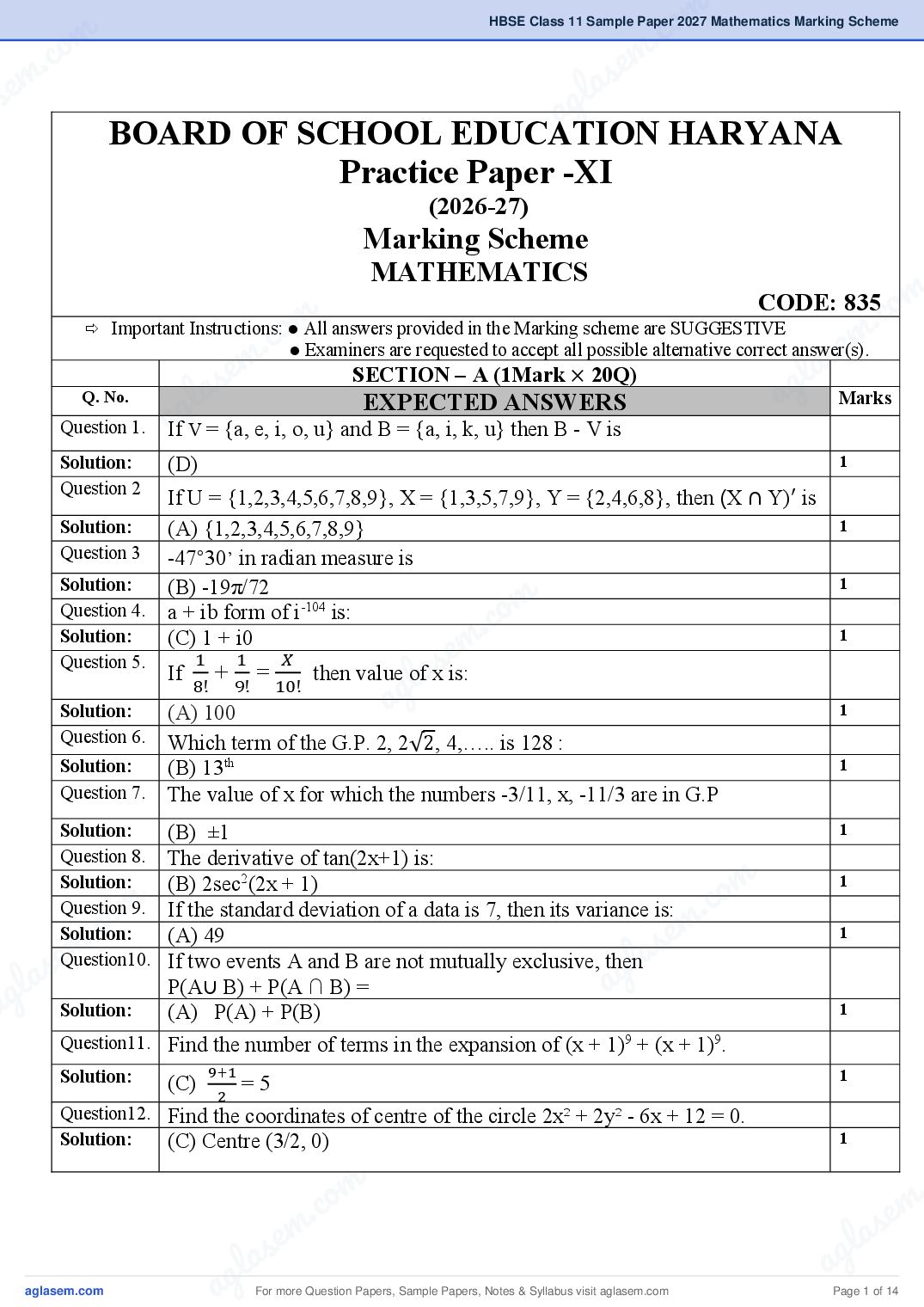
BOARD OF SCHOOL EDUCATION HARYANA
Practice Paper -XI
(2026-27)
Marking Scheme
MATHEMATICS
CODE: 835 om
o m . c
Important Instructions: ● All answers provided in the Marking scheme are SUGGESTIVE
e m
.c ● Examiners are requested to accept all possible alternative correct answer(s).
e m l as
l as SECTION – A (1Mark × 20Q)
g
a Marks
aIfgV = {a, e, i, o, u} and B = {a, i, k, u} then B - V is
Q. No. EXPECTED ANSWERS
Question 1.
Solution: (D) 1
Question 2
If U = {1,2,3,4,5,6,7,8,9}, X = {1,3,5,7,9}, Y = {2,4,6,8}, then (X ∩ Y)′ is
Solution: (A) {1,2,3,4,5,6,7,8,9} 1
Question 3 -47°30’ in radian measure is
m
Solution: (B) -19π/72 1
a + ib form of i-104 is:
.co
Question 4.
Solution: (C) 1 + i0
e m 1
Question 5. 1
If + =
1 𝑋
then value of s
lax is:
Solution:
8! 9! 10!
(A) 100 a g 1
Question 6. Which term of the G.P. 2, 2√2, 4,….. is 128 :
Solution: (B) 13th 1
Question 7. The value of x for which the numbers -3/11, x, -11/3 are in G.P
Solution: (B) ±1 1
Question 8. The derivative of tan(2x+1) is:
m
c. o
Solution: (B) 2sec2(2x + 1) 1
m
.co m
Question 9. If the standard deviation of a data is 7, then its variance is:
s e
em
Solution: (A) 49 1
s Question10. If two events A and B are not mutually exclusive, then
g l a
l a P(A∪ B) + P(A ∩ B) = a
ag Solution: (A) P(A) + P(B) 1
Question11. Find the number of terms in the expansion of (x + 1)9 + (x + 1)9.
Solution: 9+1 1
(C) 2 = 5
Question12. Find the coordinates of centre of the circle 2x² + 2y² - 6x + 12 = 0.
Solution: (C) Centre (3/2, 0) 1
m .
.co s e m
s em l a
g la ag
a For more Question Papers, Sample Papers, Notes & Syllabus visit Page 1 of 14
Page 3
Write the value of lim .
θ →0 θ
Solution: sin 2θ 2.sin 2θ sin 2θ 1
lim = lim = 2. lim =2
θ →0 θ θ →0 2θ θ →0 2θ
Question14. If v is the variance and 𝜎 is the standard deviation, then what is the relation
between v and 𝜎 .
Solution: v2 = 𝜎 1
Question15. Fill in the blank to make the statement true, U' ∩ A = ………….
Solution: U' ∩ A = ∅ 1
Question16. Range of sin 𝜃 is equal to …………….. .
Solution: Range of sin 𝜃 is [-1, 1] 1
Question17. If 5Cr = 5C2 , then either r = 2 or r = 3. (True/ False)
Solution: True 1
Question18. Let E and F be two events, then P (E' ∩ F') = 1 – P (E ∪ F). (True/ False)
Solution: True 1
Question19. Assertion (A): f(x) = 5x – 9x + 3 is an even function.
4 2
Reason (R): A function is said to be an even function if f(-x) = - f(x)
Solution: (C) Assertion (A) is true and Reason (R) is false. 1
Question20. Assertion (A): The point (-5, 0, 9) lies on the XY plane.
Reason (R): The coordinates of a point P(x, y, z) in XY plane are (0, 0, z).
Solution: (D) Assertion (A) is false and Reason (R) is true. 1
SECTION – B (2Marks × 5Q)
Question21. If A = {a, e, i, o, u }, B = {a, b, u, i}, C = {b, c, i}; find A ∩ (BUC)
Solution: BUC = { a, b, c, u, i } 1
Now, A ∩ (BUC) = {a, i, u } 1
Question22. Find the multiplicative inverse of 2 - 3i.
Solution: 1
Multiplicative Inverse of 2 - 3i =
2 + 3i
1 2− 3i
M.I. =
2 + 3i
× 2− 3i
2− 3i 1
= (2)2 − (3i)2
2− 3i
= 4 − 9i2
2− 3i 2 3i
= 4 + 9 = 13 − 13 1
OR Express ( 1 – i )4 in the form of a + ib.
Question22.
For more Question Papers, Sample Papers, Notes & Syllabus visit Page 2 of 14
Page 4
m .co
m .co s e m
se g l a
Solution: Given ( 1 – i )4 a
= (1 – i )2.( 1 – i )2
= (1 + i2 – 2i).( 1 + i2 – 2i) 1
= (1 –1 – 2i). ( 1 –1 – 2i)
= (– 2i). (– 2i)
= 4i2
= -4+i0 ; where a = - 4 and b = 0 1
m
m
Question23 Solve the inequality 7x + 3 < 5x + 9 and show the graph of the solution on
.co
. number line.
m .co s e m
s e l a
ag
Solution: We have 7x + 3 < 5x + 9
l a
7x – 5x < 9 – 3
g
a
2x < 6
x<3
x ∈ (-∝ , 3) 1
Graph of the solution on number line:
1
m
.co
Question24 Find the 12th term of a G.P.whose 8th term is 192 and the common ratio is
m
. 2.
s e
la
Solution: Here r = 2 and a8 = 192 of a G.P.
a.r7 = 192
a.(2)7 = 192 ag
192 3
a = 128 = 2 1
Now, a12 = a.r11
3
= ( 2). 211
= (3). 1024 = 3078 1
Question25 Find the equation of the parabola with focus (6, 0) and directrix x = - 6.
m
.co
.
m Since the focus is at (6, 0) which lies on x-axis.
.co m
Solution:
x-axis is the axis of the parabola.
s e
em a 𝟏
s Equation of the parabola is of the form y2 = 4ax or y2 = -4ax
g l 𝟐
g la Since the directrix is x = - 6 and the focus is (6, 0) a 𝟏
a
𝟐
The parabola is to be of the form y2 = 4ax with a = 6 𝟏
𝟐
y2 = 4(6)x 𝟏
y2 = 24x 𝟐
OR Find the equation of the ellipse, whose vertices are (0, ±13) and foci are
Question25 (0, ±5).
.
m .
.co s e m
s em l a
g la ag
a For more Question Papers, Sample Papers, Notes & Syllabus visit Page 3 of 14
Page 5
x2 y2
So equation of ellipse is of the form b2 + a2 = 1
Given that a = semi major axis = 13, and c = ±5 from foci (0, ±5) 1
And the relation c 2 = a2 − b2 , gives
52 = 132 − b2 i.e. b2 = 144
x2 y2
Therefore, the equation of the ellipse is 25 + =1 1
144
SECTION – C (3Marks × 6Q)
Question26 If L = {1, 2, 3, 4 }, M = {3, 4, 5, 6 } and N = { 1, 3, 5 }, then verify that L
. −(𝑀 ∪ 𝑁) = (𝐿 − 𝑀) ∩ ( 𝐿 − 𝑁 ).
Solution: Here 𝑀 ∪ 𝑁 = {1, 3, 4, 5, 6} 1/2
1/2
L −(𝑀 ∪ 𝑁) = {2}
𝐿 − 𝑀 = {1, 2} 1/2
𝐿 − 𝑁 = {2, 4} 1/2
(𝐿 − 𝑀) ∩ ( 𝐿 − 𝑁 ) = {2}
L −(𝑀 ∪ 𝑁) = (𝐿 − 𝑀) ∩ ( 𝐿 − 𝑁 ) Hence verified 1
Question27 Find the domain and Range of the function f(x) = − |𝑥| .
.
Solution: Here f(x) = − |𝑥|
f(x) will have real values for all real values of x
⇒ x∈R
⇒ x ∈ [ -∞, ∞] 1
Domain = [ -∞, ∞]
• By definition, the absolute value (modulus) function |x| is always non-
negative for any real number x.
∴ |𝑥| ≥ 0
• Multiplying both sides of the inequality by -1 reverses the inequality sign:
1
−|𝑥| ≤ 0
•
•
Since f(x) = -|x|, substituting this into the inequality gives:
𝑓(𝑥) ≤ 0
• This indicates that the output values of the function will never be positive.
The values will always be less than or equal to zero.
• Therefore, the range includes all negative real numbers and zero.
⸫ Range = (−∞, 0]. 1
Question28 Show that 9n+1 – 8n – 9 is divisible by 64, whenever n is a positive integer.
.
Solution: 9n+1 – 8n – 9 = 9.9n – 8n – 9
9.(1 + 8)n – 8n – 9 1/2
For more Question Papers, Sample Papers, Notes & Syllabus visit Page 4 of 14
Page 6
m .co
m .co s em
se g la
n(n − 1) n(n a
− 1)(n − 2)
We know (1 + x) = 1 + nx + n
x + x + ……..
2 3
2 6
n(n − 1) n(n − 1)(n − 2)
9.[ 1 + 8n + 82 + 83 + ……..] – 8n – 9 1
2 6
n(n − 1) n(n − 1)(n − 2)
[9 + 72n + 9. 2
82 + 9. 83 + ……..] – 8n – 9
6
n(n − 1) n(n − 1)(n − 2)
64n + 9. 2 82 + 9. 83 + …….. ½
6
Taking 82 common from right side, we have
m
.co
n(n − 1) n(n − 1)(n − 2) 2
8 + …….. ]
o m n(n − 1) n(n − 1)(n − 2)
82 .[8n + 9. 2 8 + 9. 6
m
64.[ 8n c
. + 9. 2 8 + 9. 6 8 + …….. ] 2
s e
Whichse
m l a
a ag 1
is multiple of 64 and hence divisible by 64.
g l
Question28 a
OR
5
Compute (102) .
.
Solution: (102)5 = (100 + 2)5 𝟏
Now (a + b)n = nC0 (a)n (b)0 + nC1 (a)n−1 (b)1 +…….+ nCn (a)0 (b)n 𝟐
(100 + 2)5 = 5C0 (100)5 (2)0 + 5C1 (100)4 (2)1 + 5C2 (100)3 (2)2 +
5
C3 (100)2 (2)3 + 5C4 (100)1 (2)4 + 5C5 (100)0 (2)5 1𝟏𝟐
= 1.(10000000000)(1) + 5.(100000000).2 + 10.(1000000).4 +
m
.co
10.(10000).8 + 5.(100).16 + 1.(1).32
= 10000000000 +1000000000 + 40000000 + 800000 + 8000 +32
= 11040808032
s em 1
Question29 Find the sum of the sequencela
ag
4, 44, 444, 4444, …….. to n terms.
.
Solution: This is not a GP., however, we can relate it to a GP. by writing the terms
as Sn = 4 + 44 + 444 + 4444 + ... to n terms
4
= 9 [ 9 + 99 + 999 + 9999 +... to n term] 1
4
= 9 [ (101 - 1) + (102 - 1) + (103 - 1) + (104 - 1) +...n terms]
4 1
= 9 [(10+102+103+...n terms) - (1+1+1+...n terms)]
m
.co
It is a G.P. where a = 10 and r = 10 > 1
m ⸫S=
.co
a(rn − 1)
n
s em
em
r−1
s
4 10(10n − 1)
= 9 [ 10 − 1 − n] = 9 [
4 10(10n − 1)
− n]
g la 1
g la OR a
9
+b n+1a n+1
a Question Find the value of n so that may be the geometric mean between
an + bn
29 a and b.
Solution: G.M. between a and b = √a. b 1/2
an+1 + bn+1
=> an + bn = a1/2. b1/2
=> an+1 + bn+1 = a1/2. b1/2 (an + bn )
1 1 1 1
=> an+1 + bn+1 = an+2 . b 2 + a2 . b n+2 1
m .
.co s e m
s em l a
g la ag
a For more Question Papers, Sample Papers, Notes & Syllabus visit Page 5 of 14
Page 7
n+1 n+2 n+2
=> a − a .b = a .b
2 2 − bn+1
1 1 1 1 1 1
=> an+2 (a2 − b 2 ) = b n+2 (a2 − b 2 )
1 1
=> an+2 = b n+2
1
a n+2
=> (b) =1 1
1
a n+2 a 0
=> (b) = (b)
1
=> n + 2 = 0
1
=> n = − 2
1/2
Question30 Verify that (0, 7, 10), (-1, 6, 6) and (-4, 9, 6) are the vertices of a right
. angled triangle.
Solution: Let the vertices be A(0, 7, 10), B(-1, 6, 6) and C(-4, 9, 6)
⸫ AB = √(−1 − 0)2 + (6 − 7)2 + (6 − 10)2
AB2 = (−1)2 + (−1)2 + (−4)2
AB2 = 18
Now BC = √(−4 + 1)2 + (9 − 6)2 + (6 − 6)2
BC2 = (−3)2 + (3)2 + (0)2 𝟏
BC2 = 18 1𝟐
Now CA = √(0 + 4)2 + (7 − 9)2 + (10 − 6)2
CA2 = (4)2 + (−2)2 + (4)2
CA2 = 36
Since AB2 + BC2 = CA2 the triangle satisfies the Pythagorean theorem. 1𝟏
Thus, the vertices form a right-angled triangle 𝟐
Question31 The probability that a student will pass the final examination in both
. English and Hindi is 0.5 and the probability of passing neither is 0.1. If the
probability of passing the English examination is 0.75, what is the
probability of passing the Hindi examination?
Solution: Let E be the event that the student passes the English examination and H
be the event that the student passes the Hindi examination.
• Probability of passing English, P(E) = 0.75
• Probability of passing both English and Hindi, P(E ∩ H) = 0.5
• Probability of passing neither exam, P(E' ∩ H') = 0.1 1
•
Using De Morgan's Law,
For more Question Papers, Sample Papers, Notes & Syllabus visit Page 6 of 14
Page 8
m .co
m .co s em
se g la
a = 1 - P(E ∪ H)
the probability of passing neither = P(E' ∩ H')
0.1 = 1 - P(E ∪ H) 1
P(E ∪ H) = 1 – 0.1 = 0.9
Now, P(E ∪ H) = P(E) + P(F) - P(E ∩ H)
0.9 = 0.75 + P(F) – 0.5 1
P(F) = 0.9 – 0.25
m
.co
P(F) = 0.65
m
.co m
SECTION – D (5Marks × 4Q)
s e
Question32
s em cos x + cos y
sin x − sin y x−y
l a
la ag
.(i) (i) Prove that: = tan
2
Solution:
g
asin x − sin y = tan x−y
(i)
cos x + cos y 2
sin x − sin y
L.H.S. =
cos x + cos y
C+D C−D
Using cosC + cosD = 2cos ( 2 ).cos ( 2 ) 1/2
C+D
m
C−D
c. o
and sinC - sinD = 2cos( 2 ).sin( ), 1/2
2
we have
e m
2cos(
x+y
las
).sin( 2 )
x−y
=
2
2cos ( ).cos ( )a
x+y g x−y
2 2
x−y
sin( ) 1
2
= x−y
cos ( )
2
x−y
= tan 𝟏
2 𝟐
L.H.S. = R. H.S.
m
m (ii) Prove that: 2cos 13 . cos 13 + cos 13 + cos 13 = 0 m .co
.co
Solution:3 π 9π 3π 5π
2(ii)
m s e
s eSolution:
2cos
π
. cos
9π
+ cos
3π
+ cos
5π
= 0
g l a
l a (ii) 13 13 13 13
a
ag
π 9π 3π 5π
L.H.S. = 2cos 13 . cos + cos 13 + cos 13
13
We know, 2cos A. cos B = cos (A +B) + cos (A – B) 1/2
π 9π π 9π 3π 5π
= cos ( 13 + 13 ) + cos ( 13 − 13 ) + cos 13 + cos 13 1/2
10π 8π 3π 5π
= cos ( 13 ) + cos ( − 13 ) + cos 13 + cos 13
3π 5π 3π 5π
= cos ( 𝜋 − ) + cos ( 𝜋 − ) + cos + cos 1
13 13 13 13
3π 5π 3π 5π
= − cos (13 ) − cos ( 13 ) + cos 13 + cos 13
m .
.co s e m
s em l a
g la ag
a For more Question Papers, Sample Papers, Notes & Syllabus visit Page 7 of 14
Page 9
1/2
L.H.S. = R. H.S.
OR Q32 π π 3
Prove that: cos2 x + cos2 ( x + ) + cos2 (x - ) =
3 3 2
Solution: π π 3
cos2 x + cos2 ( x + 3 ) + cos2 (x - 3 ) = 2
π π
L.H.S. = cos2 x + cos2 ( x + 3 ) + cos2 (x - 3 )
Multiply and divide by 2, we have
1 π π
= [ 2cos2 x + 2cos2 ( x + ) + 2cos2 (x - )] ½
2 3 3
Using 2.cos2A = 1 + cos 2A , we have ½
1 2π 2π
= 2 [ 1 + cos 2x + 1 + cos (2x + 3 ) + 1 + cos (2x − 3 ) ]
1 2π 2π 1
= 2 [ 3 + cos 2x + cos (2x + ) + cos (2x − 3 ) ] 1
3 2
Using cos (A + B) + cos ( A – B) = 2.cos A . cos B , we have ½
1 2π
= 2 [ 3 + cos 2x + 2.cos (2x).cos ( 3 ) ]
1 π
= 2 [ 3 + cos 2x + 2.cos (2x).cos (π − ) ] 1
3
1 π
= 2 [ 3 + cos 2x + 2.cos (2x).-cos (3)]
1 1
= 2 [ 3 + cos 2x + 2.cos (2x).(− 2)]
1
= [ 3 + cos 2x − cos (2x)]
2
3 1
=2
Question33 Find the coordinates of the foot of perpendicular from the point (-1, 3) to
. the line 3x – 4y – 16 = 0.
Solution: Given equation of line 3x – 4y – 16 =0 …(1)
Let the foot of perpendicular be (x, y) from (-1, 3).
Since line joining (x, y) and (-1, 3) and the given line 3x – 4y – 16 =0 are
perpendicular with each other
⸫ Equation of any line perpendicular to 3x – 4y – 16 = 0 is
4x + 3y + k = 0 …(2)
1
Now line (2) is passing through (-1, 3)
4(-1) + 3(3) + k = 0
k = -5
⸫ Equation of line passing through (-1, 3) and ┴ar to 3x – 4y – 16 = 0 is 𝟏
4x + 3y – 5 = 0 sss …(3) 1𝟐
Now solving equations (1) and (3)(any method), we obtain
3x – 4y = 16 …(4)
4x + 3y = 5 …(5)
For more Question Papers, Sample Papers, Notes & Syllabus visit Page 8 of 14
Page 10
m .co
m .co s e m
se g l a
a have
Multiply (4) by 3, (5) by 4 and then adding , we
68
25x = 68 => x = 25 using this value in (5), we have
68 272
4(25 ) + 3y = 5 => 3y = 5 -
25
125−272 −147
3y = => 3y =
25 25
−49
y = 25
m
.co
68 −49 𝟏
2𝟐
m
So foot of perpendicular is ( 25 , 25 )
OR
.co
Find the equation of the line passing through (-3, 5) and perpendicular to
s e m
em a
Question33 the line through the points (2, 5) and (-3, 6).
s l
layof−the ag
.
Solution:
g
Slope
am₁ = 2 y
line passing through the points A(2. 5) and B(-3, 6)
1
x2 − x1
6−5 1
m₁ = −3−2 = 𝟏
−5
1 𝟐
m1 = − 5
m
.co
s em
P(-3,5) A(2, 5) B(-3,6) gla
1
a from the point P(-3, 5), then consider its slope
If PL is perpendicular to AB
as m2 .
Lines PL and AB are mutually perpendicular if, 1
Slope of PL x Slope of AB = -1 => m1 × m2 = -1
1
In other words, m2 × (− 5) = -1
⸫ m2 = 5 1
The slope of PL is 5 and it passes through P(-3, 5), then the equation of PL
m
mis, ( y – y1 ) = m2 ( x – x1 )
.co
.co or ( y – 5 ) = 5 ( x + 3 )
s e m
em y – 5 = 5x + 15 a 𝟏
s g l 1𝟐
g la 5x – y + 20 = 0
a
a . Question34 Find the derivative of sin 2x from first principle.
Solution: Let f(x) = sin 2x , the
d(f(x)) f( x+h )− f( x )
= lim 1/2
dx h →0 h
sin(2 x+2h )− sin(2 x )
= lim 1
h →0 h
2x+2h+2x 2x+2h−2x
2co s( ) sin( )
= lim [ 2 2
] C+D C−D
[using sin C – sin D = 2 cos ( 2 ).sin ( 2 ) ]
h →0
m h
.
.co s e m
s em l a
g la ag
a For more Question Papers, Sample Papers, Notes & Syllabus visit Page 9 of 14
Page 11
= lim [ ] 𝟏
h →0 h 𝟏
sin h 𝟐
= lim [2 sin(2x + h) ] . lim [ h ]
h →0 h →0
= 2sin 2x . (1)
= 2.sin 2x 1
1
2
OR x − 1, 𝑥 ≤ 1
Find lim f(x) , if f(x) = {
Q34(i). x→1 −x 2 − 1, 𝑥 > 1
Solution: Here, limit exist at x → 1
i.e., LHL = RHL
LHL at x → 1
= lim f(x)
x→1−
= lim f(1 − h)
h→0
= lim [(1 − h)2 − 1] 𝟏
h→0 1𝟐
= 1 – 1= 0
RHL at x→ 1
= lim f(x)
x→1+
= lim f(1 + h)
h→0
= lim [ −(1 − h)2 − 1]
h→0
= -1 – 1 = - 2
LHL ≠ RHL 1
𝟏
∴ Limit does not exist at x = 1 𝟐
sin ax + bx
OR Evaluate: lim ax + sin bx a, b, a+b ≠ 0
Q34(ii). x →0
Solution: sin ax + bx
lim a, b, a+b ≠ 0
x →0 ax + sin bx
Dividing Num. and Deno. By x, we have
sin ax
x
+b 1/2
lim sin ax
x →0 a +
x
sin ax
lim ( x + b) 1/2
x →0 sin bx
lim ( a+ x )
x →0
a.sin ax
lim ( ax + b)
x →0
b.sin bx 1/2
lim ( a+ bx )
x →0
a.1+b a+b
a+b.1 = a+b = 1 1/2
For more Question Papers, Sample Papers, Notes & Syllabus visit Page 10 of 14
Page 12
m .co
m .co s em
se g la
Question: a the following data.
Calculate the mean deviation about median for
35
वर्ग 0-10 10-20 20-30 30-40 40-50 50-60
बारं बारता 6 7 15 16 4 2
Solution: From the given data, we construct the following table.
Class Frequency Cumula Midpoint |xi – Med.| fi .|x – Med.| i
fi tive xi
m
.co
Frequen
m
.co
cy
e m
e
0 – 10m
c.f.
l as
l as
10 – 20
6 6 5 23 138
ag
ag20 – 30
7
15
13
28
15
25
13
3
91
45
30 – 40 16 44 35 7 112
40 – 50 4 48 45 17 68
50 – 60 2 50 55 27 54
50 508 1
32
Nth
m
.co
The class interval containing 2 or 25th item is 20 – 30. Therefore, 20 –
30 is the median class.
s em − C
la = l + f × h
N
g
2 1/2
We know that Median
a h = 10 and N = 50
Here l = 20, C = 13, f = 15,
25−13
Therefore, Median = 20 + 15 × 10 = 20 + 8 = 28 1/2
Thus, mean Deviation about median is given by
1 1
M.D.(M) = N ∑6i=1 𝐟𝐢 . |𝐱𝐢 − 𝐌𝐞𝐝. | = × 508 = 10.16 1/2
50
OR Calculate mean, variance and standard deviation for the following
Q35.
m
distribution.
m .co
Classes 0- 10 10-20 20-30 30-40 40-50
. c o Frequency 5 8 15 16 6
e m
e m
Solution: From the given data, we construct the following table.
l as
las Class Frequen Midpoint fixi
ag
(xi - 𝐱̅ )2 fi(xi - 𝐱̅ )2
ag cy xi
fi
30 – 40 3 35 105 729 2187
40 – 50 7 45 315 289 2023
50 – 60 12 55 660 49 588
60 – 70 15 65 975 9 135
70 – 80 8 75 600 169 1352
80 – 90 3
m
85 255 529 1587
.
.co s e m
s em l a
g la ag
a For more Question Papers, Sample Papers, Notes & Syllabus visit Page 11 of 14
Page 13
50 3100 10050 3
𝟏
𝟐
1
Thus Mean x̅ = ∑𝑖=7
𝑖=1 𝑓𝑖 𝑥𝑖
N
3100
= = 62 1/2
50
1
Variance ( 𝜎 2 ) = ∑𝑖=7
𝑖=1 𝑓𝑖 (𝑥𝑖 − 𝑥̅ )
2
N
10050 1/2
= = 201
50
and Standard deviation(𝜎) = √201 = 14.18 1/2
SECTION – E (4Marks × 3Q)
Question36 Sudhir who is a student of class XI got a Maths assignment from his class
. 3
teacher. He did all the questions except a few. If the value of sin x = 5 ,
12
cos y = 13 , where x and y both lie in the second quadrant, then help Sudhir
in solving these questions.
(A) What will be the value of cos x ?
(a) 4/5 (b) - 3/5 (c) - 4/5 (d) 3/5
(B) What will be the value of sin y?
(a) 5/12 (b) - 12/13 (c) - 5/13 (d) 5/13
(C) Which of the following options is correct?
(a) sin(x - y) = sin x.cos y + cos x.sin y
(b) sin(x + y) = cos x.sin y - sin x.cos y
(c) sin(x + y) = sin x.cos y + cos x.sin y
(d) sin(x - y) = sin x.sin y - cos x.cos y
(D) The value of sin(x + y) is:
(a) - 56/65 (b) 56/65 (c) 55/67 (d) - 55/67
Solution: (i) (a) 4/5 1
1
(ii) (d) 5/13
1
(iii) (c) sin(x + y) = sin x.cos y + cos x.sin y
(iv) (b) 56/65 1
Question37 The A locker in a bank has a 3 digit lock. The digit at each place may vary
. from 0 to 9. Ravish has a locker in the bank where he has put all his
For more Question Papers, Sample Papers, Notes & Syllabus visit Page 12 of 14
Page 14
m .co
m .co s em
se g la
a he needs one of the
property papers and important documents. Once
document but he forgot his password and tried various combinations of
numbers to open the locker.
Based on the given information answer the following questions:
(i) How many permutations of 3 different digits are there, chosen from 0 to
9, both inclusive?
m
.co
(iii) In how many ways the lock will not open if digit can repeat ?
m
.co m
Solution: Total available digits from 0 to 9 = 10 digits. 1/2
(i)
s e
s em can be filled in 10 possible ways.
• First position
g l a
g l
• Second a position can be filled in 9 remaining ways (since digits cannotabe
arepeated). 1
• Third position can be filled in 8 remaining ways.
•
By the Fundamental Principle of Counting, the total number of
permutations (combinations) is: 10 × 9 × 8 = 720 1/2
If digits can repeat
m
(ii)
.co
• First position can be filled in 10 possible ways.
•
m
Second position can be filled in 10 remaining ways (since digits can be
e
repeated).
las
•
• ag
Third position can be filled in 10 remaining ways. 1
Therefore, Total no. of ways = 10 × 10 × 10 = 1000
• No. of correct way to open: 1 way
• Ways the lock will NOT open: 1000 −1 = 999 ways 1
Question The ceiling of a hall in a famous science museum is designed in a semi-
38. elliptical shape. It is known as a 'Whispering Gallery'. An ellipse possesses
a unique property: if a sound wave originates from one focus, it reflects off
m
.co
the ceiling and travels directly to the other focus. Consequently, if a person
m
.co
standing at one focus speaks in a very low voice (a whisper), a person
e m
e m
standing at the other focus can hear it clearly. The total length of the hall
l as
las (major axis) is 100 meters, and the maximum height of the ceiling from the
ag
g
center (semi-minor axis) is 40 meters.
a Answer the questions below based on the given information:
(i) Find the equation of this elliptical hall, assuming its center is at the
origin (0,0) and the major axis lies along the x-axis.
(ii) Find the eccentricity of the semi-elliptical shape.
OR
At what distance from the center (i.e., the distance of the two foci)
should the two individuals stand to hear the whisper clearly?
m .
.co s e m
s em l a
g la ag
a For more Question Papers, Sample Papers, Notes & Syllabus visit Page 13 of 14
Page 15
Solution(i):
• Length of the semi-minor axis (height) = b = 40meters.
• Since the major axis lies along the \(x\)-axis, the standard equation of the
ellipse is:
x2 y2
+ =1
a2 b 2
• Substituting the values:
x2 y2
+ =1
(50)2 (40)2
• =>
x2 y2
+ =1
2500 1600
Solution(ii) For eccentricity c2 = a2 – b2 1/2
:
c2 = (50)2 – (40)2
c2 = 2500 – 1600
c2 = 900
c = √900 = 30 1
c 30
Now Eccentricity e = a = 50 = 0.6
1/2
OR (ii) The distance from the center to the focus is c, given by the formula:
c 2 = a 2 – b2
c2 = (50)2 – (40)2
c2 = 2500 – 1600
c2 = 900 1
c = √900 = 30
Therefore, both individuals must stand at a distance of 30meters from the
1
center (one to the left and the other to the right) to hear the whisper clearly.
For more Question Papers, Sample Papers, Notes & Syllabus visit Page 14 of 14
Document Details
| Board / Org | Haryana Board |
| Exam | Class 11 |
| Type | Answer Key |
| Pages | 14 |
| Updated | 03 Nov 2026 |