HBSE Class 11 Sample Paper 2027 Agriculture Marking Scheme
Finished viewing? Save it for later —
Download HBSE Class 11 Sample Paper 2027 Agriculture Marking Scheme (PDF · 8 pages)About HBSE Class 11 Sample Paper 2027 Agriculture Marking Scheme
HBSE Class 11 Sample Paper 2027 Agriculture Marking Scheme is available here for free download. Published by Haryana Board for Class 11, this answer key can be viewed online or downloaded as a PDF (8 pages). Candidates preparing for Class 11 can use HBSE Class 11 Sample Paper 2027 Agriculture Marking Scheme to understand the exam pattern, the type of questions asked, and the overall difficulty level.
Frequently Asked Questions
How can I download HBSE Class 11 Sample Paper 2027 Agriculture Marking Scheme?
Open this page and click the Download button to save HBSE Class 11 Sample Paper 2027 Agriculture Marking Scheme as a PDF. It is completely free on AglaSem Docs.
Is HBSE Class 11 Sample Paper 2027 Agriculture Marking Scheme free to download?
Yes. HBSE Class 11 Sample Paper 2027 Agriculture Marking Scheme can be viewed online and downloaded as a PDF free of cost on AglaSem Docs.
How many pages does HBSE Class 11 Sample Paper 2027 Agriculture Marking Scheme have?
HBSE Class 11 Sample Paper 2027 Agriculture Marking Scheme contains 8 pages, which you can read online or download together as a single PDF.
Where can I find more Class 11 study material?
You can find more Class 11 question papers, sample papers, syllabus, and answer keys on AglaSem Docs.
HBSE Class 11 Sample Paper 2027 Agriculture Marking Scheme – Text
Read the full text of this answer key below — useful to quickly search, copy and reference the content online without downloading the PDF.
📄 View text version (9 pages)
Page 1
HBSE Class 11 Sample
Paper 2027 Agriculture
Marking Scheme
EXAM YEAR TYPE SUBJECT
Haryana Class 11 2027 Answer Key Agriculture
Notes · Sample Papers · Previous Year Papers · Mock Tests
Page 2
.co s e m
s em l a
a ag
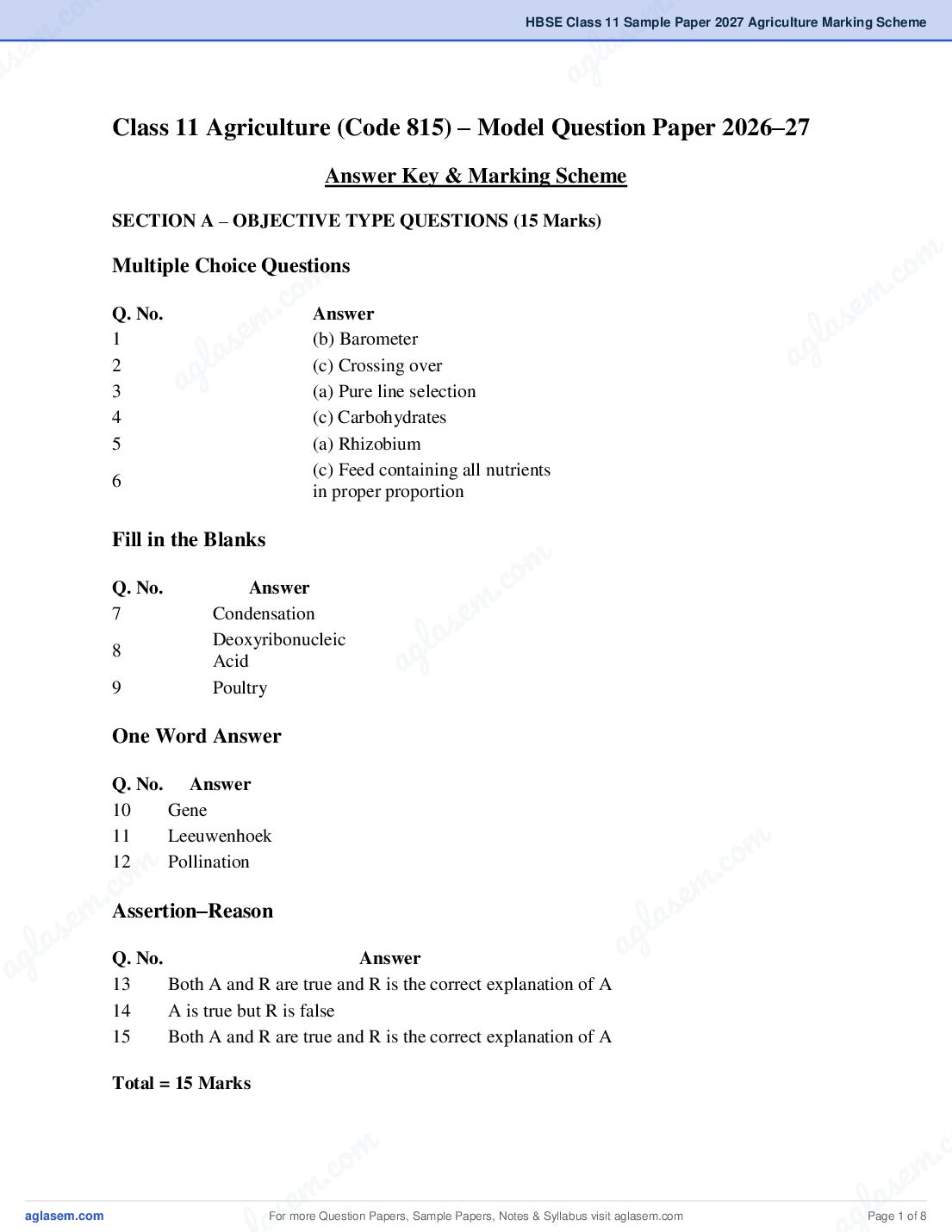
Class 11 Agriculture (Code 815) – Model Question Paper 2026–27
Answer Key & Marking Scheme
SECTION A – OBJECTIVE TYPE QUESTIONS (15 Marks)
m
Multiple Choice Questions
om . co
. c Answer em
Q. No.
e m l as
1
l as (b) Barometer
ag
2
3 ag (c) Crossing over
(a) Pure line selection
4 (c) Carbohydrates
5 (a) Rhizobium
(c) Feed containing all nutrients
6
in proper proportion
Fill in the Blanks
m
Q. No. Answer
m .co
7 Condensation
s e
l a
ag
Deoxyribonucleic
8
Acid
9 Poultry
One Word Answer
Q. No. Answer
10 Gene
11 Leeuwenhoek
m
12
om
Pollination
c.Assertion–Reason m.co
m s e
s e g la
g la a
a Q. No.
13
Answer
Both A and R are true and R is the correct explanation of A
14 A is true but R is false
15 Both A and R are true and R is the correct explanation of A
Total = 15 Marks
m . c
c. o s e m
s em
For more Question Papers, Sample Papers, Notes & Syllabus visit
gl a
Page 1 of 8
Page 3
Q16. Define lapse rate.
Answer: The rate at which atmospheric temperature decreases with increase in altitude is called
lapse rate.
OR
What is temperature inversion?
Temperature inversion is a condition in which temperature increases with height instead of
decreasing.
Q17. State any two Mendelian laws of inheritance.
Answer:
1. Law of Segregation.
2. Law of Independent Assortment.
OR
Differentiate between mitosis and meiosis.
Mitosis Meiosis
One division Two divisions
Produces two daughter cells Produces four daughter cells
Q18. What is apomixis?
Answer: Apomixis is seed formation without fertilization.
Advantage: Produces genetically identical plants.
OR
What is micropropagation?
Micropropagation is rapid multiplication of plants through tissue culture techniques.
For more Question Papers, Sample Papers, Notes & Syllabus visit Page 2 of 8
Page 4
.co s e m
s em l a
a ag
Q19. Define enzyme.
Answer: Enzymes are biological catalysts that accelerate biochemical reactions.
m
co
Function: Increase rate of metabolic reactions.
. c om em .
OR
e m l as
l as
What are amino acids?
ag
g
a are the basic structural units of proteins.
Amino acids
Q20. What is biofertilizer?
Answer: Biofertilizers are living microorganisms that enhance soil fertility.
m
.co
Example: Rhizobium.
e m
OR
l as
Define mycorrhiza. ag
Mycorrhiza is a symbiotic association between fungi and plant roots.
Q21. What is artificial insemination?
m
.co
Answer: Artificial insemination is the introduction of semen into the reproductive tract of a
om
female animal by artificial methods.
c.OR e m
e m las
las ag
ag Define balanced ration.
Balanced ration is a feed containing all nutrients in proper proportion to meet the animal's
requirements.
m . c
c. o s e m
s em
For more Question Papers, Sample Papers, Notes & Syllabus visit
gl a
Page 3 of 8
Page 5
Q22. Explain the importance of monsoon in Indian agriculture.
Answer:
1. Supplies water for crop growth.
2. Recharges groundwater resources.
3. Influences cropping pattern and productivity.
Q23. Describe mutation and its significance in crop improvement.
Answer: Mutation is a sudden heritable change in genetic material.
Importance:
1. Creates genetic variability.
2. Develops disease-resistant varieties.
3. Produces high-yielding crop varieties.
Q24. Explain any three applications of recombinant DNA technology.
Answer:
1. Development of transgenic crops.
2. Production of disease-resistant varieties.
3. Improvement of crop yield and quality.
OR
Explain somaclonal variation and its importance.
Answer:
Somaclonal variation refers to genetic variation among plants regenerated from tissue culture.
Importance:
1. Source of useful variability.
2. Disease resistance.
3. Stress tolerance improvement.
Q25. Discuss the classification of carbohydrates with examples.
For more Question Papers, Sample Papers, Notes & Syllabus visit Page 4 of 8
Page 6
.co s e m
s em l a
a ag
Answer:
1. Monosaccharides – Glucose.
2. Disaccharides – Sucrose.
3. Polysaccharides – Starch.
m
m . co
c. o of microorganisms in the nitrogen cycle.
Q26. Explain the role
s em
Answer: as
em g l a
g l a
a atmospheric nitrogen into usable forms.
1. Convert
2. Decompose organic matter.
3. Improve soil fertility.
Marking:
Any three points = 1 Mark each
m
.co
OR
e m
l as
Differentiate between symbiotic and asymbiotic nitrogen fixation.
Symbiotic ag
Asymbiotic
In association with plants Free living
Example: Rhizobium Example: Azotobacter
Q27. Describe the care and management of newly born calves.
Answer:
m
m 1. Feeding colostrum immediately after birth.
.co
.co m
2. Proper housing and hygiene.
m 3. Vaccination and disease prevention.
s e
s e g la
g la a
a SECTION D – ESSAY TYPE QUESTIONS (5 Marks Each)
Q28. Discuss the causes of climate change and its impact on agriculture.
Answer:
m . c
c. o s e m
s em
For more Question Papers, Sample Papers, Notes & Syllabus visit
gl a
Page 5 of 8
Page 7
1. Greenhouse gas emissions.
2. Deforestation.
3. Industrialization.
4. Burning of fossil fuels.
5. Urbanization.
Impact on Agriculture:
1. Reduced crop yield.
2. Increased pest incidence.
3. Drought and floods.
4. Change in cropping patterns.
5. Soil degradation.
OR
Explain different types of precipitation and their agricultural importance.
Answer: Types:
1. Rain
2. Snow
3. Sleet
4. Hail
Importance:
Provides water for crops.
Maintains soil moisture.
Recharges water resources.
Q29. Describe various methods of plant breeding used in self-pollinated and cross-
pollinated crops.
Answer: Self-pollinated crops:
1. Mass selection.
2. Pure line selection.
Cross-pollinated crops:
1. Recurrent selection.
2. Hybridization.
For more Question Papers, Sample Papers, Notes & Syllabus visit Page 6 of 8
Page 8
.co s e m
s em l a
a ag
3. Progeny testing.
OR
Explain the concept, scope and applications of plant biotechnology.
m
co
Marking Scheme:
m .
c. o
Concept = 1 Mark
s em
em= 2 Marks
Scope = 2 Marks
s g l a
la
Applications
g a
a
Key Points:
Tissue culture
Genetic engineering
Disease resistance
Crop improvement
Micropropagation
m
.co
Q30. Discuss the importance of livestock in Indian economy and explain principles of
animal nutrition and feeding practices.
e m
Answer:
l as
Importance: ag
1. Source of milk, meat and eggs.
2. Employment generation.
3. Contribution to GDP.
4. Source of manure.
Animal Nutrition:
m
m Balanced ration.
c. o 2.1. Adequate m.co
m
water supply.
s e
s e 3. Mineral supplementation.
g la
g la 4. Proper feeding schedule.
a
a OR
Describe important diseases of livestock and poultry, their symptoms and
management.
Expected Diseases:
m . c
c. o s e m
s em
For more Question Papers, Sample Papers, Notes & Syllabus visit
gl a
Page 7 of 8
Page 9
Mastitis
Ranikhet Disease
Coccidiosis
For more Question Papers, Sample Papers, Notes & Syllabus visit Page 8 of 8
Document Details
| Board / Org | Haryana Board |
| Exam | Class 11 |
| Type | Answer Key |
| Pages | 8 |
| Updated | 03 Nov 2026 |