HBSE Class 11 Sample Paper 2027 Biotechnology Marking Scheme
Finished viewing? Save it for later —
Download HBSE Class 11 Sample Paper 2027 Biotechnology Marking Scheme (PDF · 15 pages)About HBSE Class 11 Sample Paper 2027 Biotechnology Marking Scheme
HBSE Class 11 Sample Paper 2027 Biotechnology Marking Scheme is available here for free download. Published by Haryana Board for Class 11, this answer key can be viewed online or downloaded as a PDF (15 pages). Candidates preparing for Class 11 can use HBSE Class 11 Sample Paper 2027 Biotechnology Marking Scheme to understand the exam pattern, the type of questions asked, and the overall difficulty level.
Frequently Asked Questions
How can I download HBSE Class 11 Sample Paper 2027 Biotechnology Marking Scheme?
Open this page and click the Download button to save HBSE Class 11 Sample Paper 2027 Biotechnology Marking Scheme as a PDF. It is completely free on AglaSem Docs.
Is HBSE Class 11 Sample Paper 2027 Biotechnology Marking Scheme free to download?
Yes. HBSE Class 11 Sample Paper 2027 Biotechnology Marking Scheme can be viewed online and downloaded as a PDF free of cost on AglaSem Docs.
How many pages does HBSE Class 11 Sample Paper 2027 Biotechnology Marking Scheme have?
HBSE Class 11 Sample Paper 2027 Biotechnology Marking Scheme contains 15 pages, which you can read online or download together as a single PDF.
Where can I find more Class 11 study material?
You can find more Class 11 question papers, sample papers, syllabus, and answer keys on AglaSem Docs.
HBSE Class 11 Sample Paper 2027 Biotechnology Marking Scheme – Text
Read the full text of this answer key below — useful to quickly search, copy and reference the content online without downloading the PDF.
📄 View text version (16 pages)
Page 1
HBSE Class 11 Sample
Paper 2027
Biotechnology Marking
Scheme
EXAM YEAR TYPE SUBJECT
Haryana Class 11 2027 Answer Key Biotechnology
Notes · Sample Papers · Previous Year Papers · Mock Tests
Page 2
m .co
m .co s e m
se g l a
a
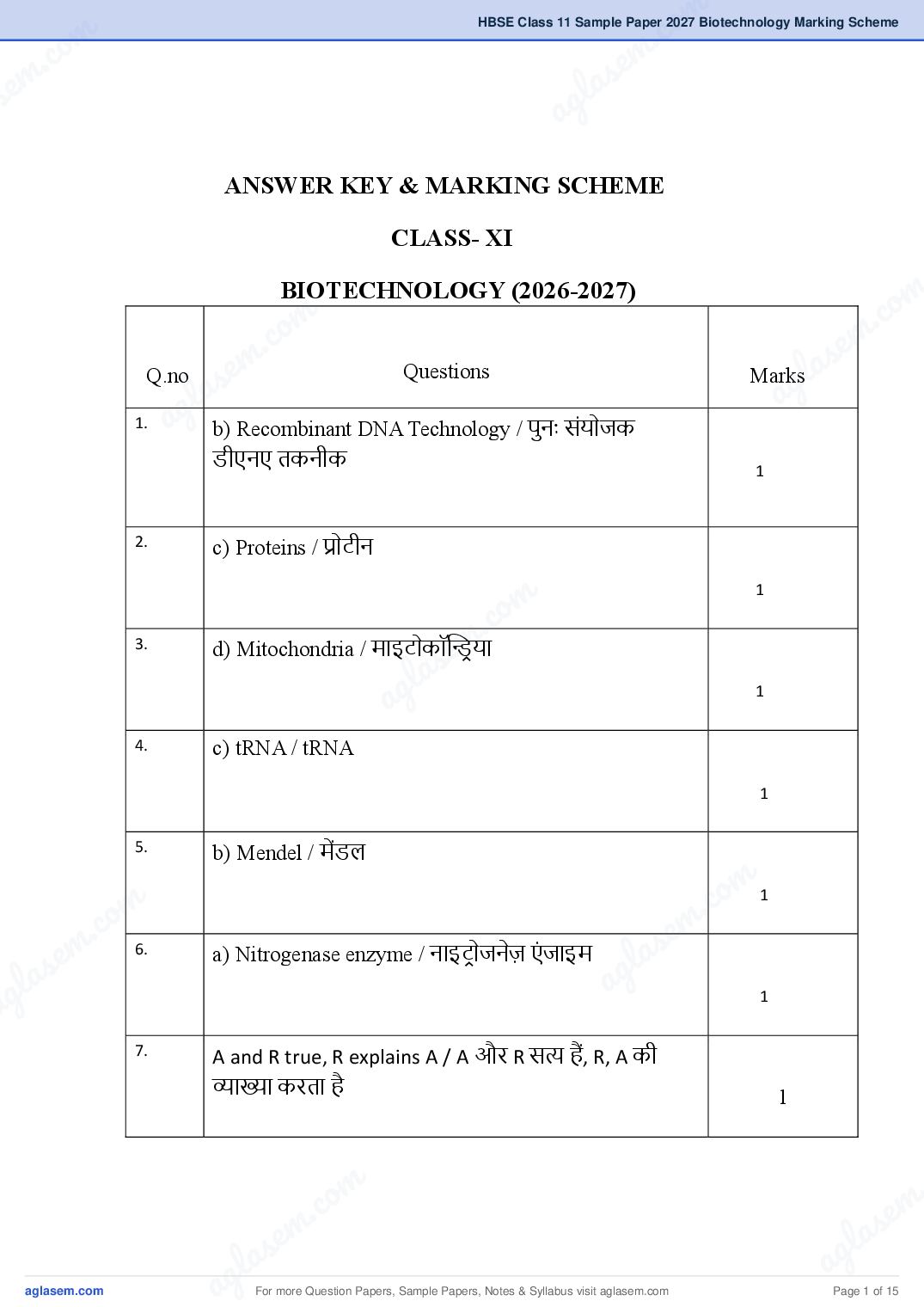
ANSWER KEY & MARKING SCHEME
CLASS- XI
BIOTECHNOLOGY (2026-2027) m
m .co
.co s e m
Q.no s em Questions Marksla
g la ag
1. a b) Recombinant DNA Technology / पुनः संयोजक
डीएनए तकनीक 1
2. c) Proteins / ्ቚोटीन
om
1
. c
3. d) Mitochondria / माइटोकॉऩ्रि या e m
las
ag 1
4. c) tRNA / tRNA
1
5. b) Mendel / मेंडल
m
m c. o 1
c. o 6. s e m
e m a) Nitrogenase enzyme / नाइटि ोजनेज़ एं जाइम l a
las ag
ag 1
7. A and R true, R explains A / A और R स्ቓ हैं , R, A की
्ቤा्ቅा करता है 1
m .
.co s e m
s em l a
g la ag
a For more Question Papers, Sample Papers, Notes & Syllabus visit Page 1 of 15
Page 3
्ቤा्ቅा करता है 1
9. A true, R false / A स्ቓ है , R अस्ቓ है
1
10. Polymerase Chain Reaction
1
11. Stroma / ኚि ोमा
1
12. Transcription / ्ቚततलेखन
1
13. DNA Ligase / डीएनए लाइगेज़
1
14. Centimorgan / सेंटीमॉगगन
1
15.
Plasma Membrane / कोतिका ति्ቤी
1
For more Question Papers, Sample Papers, Notes & Syllabus visit Page 2 of 15
Page 4
m .co
m .co s em
se g la
16. a
Biotechnology is the application of living organisms, cells
or biological systems to develop useful products and
processes.
Application (any one):
• Production of insulin
• Vaccine production
• Gene therapy 2
m
.co
• Tissue culture
o m m
c
. जीगवत जीवोों, कोगिकाओों या जैगवक ्ቚणागियोों का
जैव ्ቚौ्ቕोगिकी
s e
m
e करके उपयोिी उ्ाद और ्ቚगियाएों गवकगित करने की l a
a s
उपयोि
l ्ቚगिया है। ag
ag
अनु्ቚयोि (कोई एक):
• इों िुगिन का उ्ादन
• टीके का उ्ादन
• जीन गिगक्ቜा
m
• ऊतक िोंवर्धन
m .co
s e
g la
a
17. Coenzymes are non-protein organic molecules that
assist enzymes during biochemical reactions.
Examples:
• NAD+
• FAD
• Coenzyme A m
m OR .co
m .co A biosensor is an analytical device that combines a
s e m
s e biological component with a detector to measure
g l a
g la biological or chemical substances a
a
2
m .
.co s e m
s em l a
g la ag
a For more Question Papers, Sample Papers, Notes & Syllabus visit Page 3 of 15
Page 5
independently during gamete formation.
• Explains inheritance of two or more traits.
• Results in new combinations of characters.
कोएों जाइम िैर-्ቚोटीन कार्धगनक अणु होते हैं जो जैव रािायगनक
अगिगियाओों के दौरान एों जाइमोों की िहायता करते हैं ।
उदाहरण:
• NAD+
• FAD
• कोएों जाइम A
2
या
र्ायोिेंिर एक गव्ቨेषणा्ቒक उपकरण है जो जैगवक या रािायगनक
पदा्वों को मापने के गिए एक जैगवक घटक को गिटे ्ሴर के िा्व
जोड़ता है।
19. Mutation is a sudden heritable change in the genetic
material (DNA).
• May occur in genes or chromosomes.
• Can create genetic variation
उ्ररवतधन आनुवोंगिक िाम्ቇी (िीएनए) में होने वािा एक अिानक
और वोंिानुित पररवतधन है।
• यह जीन या िुणिूत्ोों में हो िकता है।
2
• इििे आनुवोंगिक गवगवर्ता उ््ቐ हो िकती है ।
For more Question Papers, Sample Papers, Notes & Syllabus visit Page 4 of 15
Page 6
m .co
m .co s e m
se g l a
20. Feature | Prokaryotic | Eukaryotic
a
Nucleus | Absent | Present
Membrane-bound organelles | Absent | Present
OR
Functions of Golgi Apparatus:
m
m
• Packaging of proteins. .co
.co m
2 marks
• Secretion of cellular products.
m s e
s e
• Formation of lysosomes. l a
g l a
• Modification of proteins. ag
a
गविेषताएँ | ्ቚोकैररयोगटक | यूकेररयोगटक
कें्ቖक | अनुप्ऽित | उप्ऽित
गि्ቤी-र््ቍ अोंिक | अनुप्ऽित | उप्ऽित
या
m
िो्ी तोंत् के कायध:
m .co
s e
• ्ቚोटीनोों का पररिापन।
g la
a
कोगिकीय उ्ादोों का ्ቨाव।
• िाइिोिोम का गनमाधण।
m
m .co
m .co • ्ቚोटीनोों का रूपाोंतरण।
s em
s e g la
g la 21. Pedigree analysis is a diagrammatic method used to studyainheritance
a of traits across generations.
Uses:
• Traces genetic disorders.
• Identifies carriers.
• Predicts inheritance patterns. 2 marks
OR
What are Stem Cells?
m .
.co s e m
s em l a
g la ag
a For more Question Papers, Sample Papers, Notes & Syllabus visit Page 5 of 15
Page 7
differentiation into specialized cells.
वोंिाविी गव्ቨेषण एक आरे खीय गवगर् है गजिका उपयोि पीग़ियोों में
ि्ቌणोों की वोंिािगत का अ्ቖयन करने के गिए गकया जाता है।
उपयोि:
• आनुवोंगिक गवकारोों का पता ििाना।
• वाहकोों की पहिान करना।
• वोंिािगत के पैटनध की िगव्ቦवाणी करना।
्े म कोगिकाएँ ्ቄा हैं?
्े म कोगिकाएँ अगविेगदत कोगिकाएँ होती हैं जो ्ቭयों को नवीनीकृत
करने और गवगि्ቖ कोगिकाओों में गविेगदत होने में ि्ቌम होती हैं।
For more Question Papers, Sample Papers, Notes & Syllabus visit Page 6 of 15
Page 8
m .co
m .co s e m
se g l a
22. a
Enzymes are biological catalysts that speed up biochemical reactions
without being consumed. They play an important role in 3 Marks
biotechnology because they make reactions faster, more specific and
energy efÏcient.
Role of enzymes in biotechnology:
• Restriction enzymes cut DNA at specific recognition sites and are used
in recombinant DNA technology.
m
.co
• DNA polymerase is used in Polymerase Chain Reaction (PCR) to
m
.co m
amplify DNA.
• Ligase enzyme joins DNA fragments together during gene cloning.
m s e
s e
• Industrial enzymes are used in food processing, detergent production l a
g l a
and pharmaceutical industries. ag
a एं जाइम जैतिक उ्ाेरक होते हैं जो ्ቭयं खपत हुए तिना जैि रासायतनक
अतितियाओं की गतत िढाते हैं । जैि ्ቚौ्ቕोतगकी में इनकी मह्पूर्ग िूतमका
होती है क्ोंतक ये अतितियाओं को ती्ብ, अतिक तिति्ቖ और ऊजाग -कुिल िनाते
हैं ।
जैि ्ቚौ्ቕोतगकी में एं जाइमों की िूतमका:
• ्ቚततिंि एं जाइम डीएनए को तिति्ቖ पहचान ्ቝलों पर काटते हैं और इनका
उपयोग पुनसंयोतजत डीएनए ्ቚौ्ቕोतगकी में तकया जाता है ।
m
.co
• डीएनए पॉलीमरे ज़ का उपयोग पॉलीमरे ज़ चेन ररए्ቋन (पीसीआर) में डीएनए
को ्ቚितिगत करने के तलए तकया जाता है।
s em
• लाइगेज़ एं जाइम जीन ्षोतनंग lकa
है । a g े दौरान डीएनए खंडों को आपस में जोड़ता
• औ्ቕोतगक एं जाइमों का उपयोग खा्ቕ ्ቚसं्ቍरर्, तडटजेंट उ्मादन और
औषति उ्ቕोगों में तकया जाता है ।
23 Carbohydrates are organic compounds composed of carbon, hydrogen
and oxygen. They are the most important source of energy for living
organisms.
m
m Structure:
.co
m .co • Basic unit is monosaccharide (glucose,
• Monosaccharides combine to form disaccharides and
fructose).
s e m
s e polysaccharides.
g l a 3 Marks
g la • General formula is (CH₂O)n. a
a Functions:
• Primary source of energy.
• Stored as starch in plants and glycogen in animals.
• Cellulose forms the cell wall of plants.
• Participate in cell recognition and signalling.
m .
.co s e m
s em l a
g la ag
a For more Question Papers, Sample Papers, Notes & Syllabus visit Page 7 of 15
Page 9
होते हैं। ये जीवित जीिों के लिए ऊजाब का स़्से महत्िपर्
ू ब ्ቨोत हैं।
संरचना:
• मूि इकाई मोनोसैकेराइड (ग्िूकोज, ्ऻक्टोज) है।
• मोनोसैकेराइड लमिकर डाइसैकेराइड और पॉिीसैकेराइड ़्नाते हैं।
• सामान्य सू्ቔ (CH₂O)n है।
कायब:
• ऊजाब का ्ऺाथलमक ्ቨोत।
• पौधों में स्टाचब और जानिरों में ग्िाइकोजन के रूप में सं्ቇहहत।
• सेल्युिोज पौधों की कोलिका लिवि ़्नाता है।
• कोलिका पहचान और संकेत दे ने में िाि िेते हैं।
24. Meselson and Stahl conducted an experiment in 1958 to prove the
mode of DNA replication.
Procedure:
• E. coli bacteria were grown in a medium containing heavy nitrogen
(N15).
• The bacteria were then transferred to a medium containing light
nitrogen (N14).
• DNA samples were collected after each generation and analysed by
density gradient centrifugation. 3 Marks
Observations:
• First generation produced hybrid DNA containing both N15 and N14.
• Second generation produced both hybrid and light DNA.
Conclusion:
DNA replication is semi-conservative in nature because each daughter
DNA molecule contains one parental strand and one newly synthesized
strand.
मेसेल्सन और स्टाि ने 1958 में डीएनए ्ऺनतकृनत की विगध को लसद्ध
करने के लिए एक ्ऺयोि ककया।
्ऺकिया:
For more Question Papers, Sample Papers, Notes & Syllabus visit Page 8 of 15
Page 10
m .co
m .co s em
se g la
a ु त माध्यम में
• ई. कोिाई ़्ैक्टीररया को िारी नाइ्ोजन (N15) यक्
उिाया िया।
• किर ़्ैक्टीररया को हल्के नाइ्ोजन (N14) युक्त माध्यम में
स्थानांतररत ककया िया।
m
c o m
• ्ऺत्येक पीढी के ़्ाद डीएनए के नमूने एक्ቔ ककए िए और घनत्ि
m .co
्ऺिर्ता .अपकें्ቖर् द्िारा उनका विश्िेषर् ककया िया। e
em l as
s
अििोकन:
la• पहिी पीढी ने N15 और N14 दोनों यक्ु त संकर डीएनए उत्पन्न ककया। ag
ag
• दस
ू री पीढी ने संकर और हल्के दोनों ्ऺकार के डीएनए उत्पन्न ककए।
ननष्कषब:
डीएनए ्ऺनतकृनत अधब-संर्ቌी ्ऺकृनत की होती है क्योंकक ्ऺत्येक पु्ቔी
डीएनए अर्ु में एक जनक स््ैंड और एक नि-संश्िेवषत स््ैंड होता है।
m
.co
25. Miosis Meiosis
s em
la
One nuclear division occurs Two successive nuclear divisions
g
एक कें्ቖकीय वििाजन होता है। a
occur.
दो ििातार कें्ቖकीय वििाजन 3 Marks
होते हैं।
Produces two daughter cells. Produces four daughter cells.
दो पु्ቔी कोलिकाएँ ़्नती हैं चार पु्ቔी कोलिकाएँ ़्नती हैं।
Occurs in somatic
o
cells Occurs in reproductive cells. m
m ्ቚजनन कोशिकाओं में होता है .c
.co
दै हहक कोलिकाओं में होता है
m s em
s e g la due
No genetic variation produced. Genetic variation produced
g la कोई आनि ु ंलिक लिन्नता to crossing a over.
a उत्पन्न नहीं होती
परासरर् के कारर् आनि
ु ंलिक
लिन्नता उत्पन्न होती है
m .
.co s e m
s em l a
g la ag
a For more Question Papers, Sample Papers, Notes & Syllabus visit Page 9 of 15
Page 11
Simple Tissues:
1. Parenchyma
• Storage of food and water.
• Photosynthesis in chlorenchyma.
2. Collenchyma
• Provides flexibility and support. 3 Marks
3. Sclerenchyma
• Provides mechanical strength.
Complex Tissues:
1. Xylem
• Conducts water and minerals from roots to aerial parts.
2. Phloem
• Conducts food from leaves to other parts of the plant.
पादप ऊतकों को सरि ऊतकों और जहटि ऊतकों में वििाजजत ककया
िया है।
सरि ऊतक:
1. पैरेन्काइमा
• िोजन और जि का िंडारर्।
क्िोरे न्काइमा में ्ऺकाि संश्िेषर्।
2. कोिेन्काइमा
• िचीिापन और सहारा ्ऺदान करता है।
3. स्क्िेरेन्काइमा
• यां्ऴ्ቔक मज़्ूती ्ऺदान करता है।
जहटि ऊतक:
1. जाइिम
• जडों से पौधे के ऊपरी िािों तक जि और खननज पदाथों का
पररिहन करता है।
2. फ्िोएम
• पवियों से पौधे के अन्य िािों तक िोजन का पररिहन करता है।
For more Question Papers, Sample Papers, Notes & Syllabus visit Page 10 of 15
Page 12
m .co
m .co s em
se g la
27. DNA (Deoxyribonucleic Acid) is the hereditaryamaterial of most
organisms.
Structure:
• DNA consists of two polynucleotide strands arranged in a double
helix.
• Each nucleotide contains a nitrogenous base, deoxyribose sugar and
phosphate group. 3 Marks
• Adenine pairs with Thymine and Guanine pairs with Cytosine.
m
.co
Functions:
m
.co m
• Stores genetic information.
• Controls protein synthesis.
s e
s em
• Transfers hereditary characters from parents to offspring. l a
g la
• Regulates cellular activities. ag
a डीएनए (डीऑक्सीराइ़्ोन्यूजक्िक एलसड) अगधकांि जीिों का
आनुिंलिक पदाथब है।
संरचना:
• डीएनए दो पॉिी न्यूजक्ियोटाइड स््ैंड से लमिकर ़्ना होता है जो एक
ड़्ि हे लिक्स में व्यिजस्थत होते हैं।
m
.co
• ्ऺत्येक न्यूजक्ियोटाइड में एक नाइ्ोजनयुक्त ्ቌार, डीऑक्सीराइ़्ोज
em
िकबरा और िॉस्िेट समूह होता है।
s
g la
a और िआ
• एडेननन थाइलमन के साथ ु ननन साइटोलसन के साथ यजु ग्मत
होता है।
कायब:
• आनुिंलिक जानकारी सं्ቇहहत करता है।
• ्ऺोटीन संश्िेषर् को ननयं्ऴ्ቔत करता है।
m
m .co
m .co • माता-वपता से संतान में आनुिंलिक ि्ቌर् स्थानांतररत करता है।
s e m
s e g l a
g la • कोलिकीय िनतविगधयों को ननयं्ऴ्ቔत करता है। a
a 28. DNA replication is the process by which DNA makes an identical copy of
itself before cell division.
Steps:
1. Initiation:
• DNA double helix unwinds with the help of helicase enzyme.
• Hydrogen bonds between base pairs break.
2. Template Formation:
• Each strand acts as a template for synthesis of a new strand.
m .
.co s e m
s em l a
g la ag
a For more Question Papers, Sample Papers, Notes & Syllabus visit Page 11 of 15
Page 13
• DNA polymerase adds complementary nucleotides. 5 Marks
• Adenine pairs with Thymine and Guanine pairs with Cytosine.
4. Leading and Lagging Strands:
• Leading strand is synthesized continuously.
• Lagging strand is synthesized discontinuously as Okazaki
fragments.
5. Termination:
• DNA ligase joins Okazaki fragments.
• Two identical DNA molecules are formed.
Conclusion:
DNA replication is semi-conservative because each daughter DNA
molecule contains one old and one new strand.
(Diagram: Replication Fork)
डीएनए ्ऺनतकृनत िह ्ऺकिया है जजसके द्िारा कोलिका वििाजन से पहिे
डीएनए अपनी एक समान ्ऺनतलिवप ़्नाता है।
चरर्:
1. आरं ि:
• हे लिकेज़ एंजाइम की सहायता से डीएनए ड़्ि हे लिक्स खुिता है।
• ्ቌार युग्मों के ़्ीच हाइ्ቑोजन ़्ंध टूटते हैं।
2. टे म्पिेट ननमाबर्:
• ्ऺत्येक स््ैंड एक नए स््ैंड के संश्िेषर् के लिए टे म्पिेट का कायब करता
है।
3. विस्तार:
• डीएनए पॉिीमरे ज़ परू क न्यूजक्ियोटाइड जोडता है।
• एडेननन थाइलमन के साथ और िुआननन साइटोलसन के साथ युजग्मत
होता है।
4. अ्ቇर्ी और वपछडी स््ैंड:
• अ्ቇर्ी स््ैंड का संश्िेषर् ननरं तर होता है।
For more Question Papers, Sample Papers, Notes & Syllabus visit Page 12 of 15
Page 14
m .co
m .co s em
se g la
a
• वपछडी स््ैंड का संश्िेषर् ओकाज़ाकी खंडों के रूप में रुक-रुक कर होता
है।
5. समापन:
• डीएनए िाइिेज़ ओकाज़ाकी खंडों को जोडता है।
m
m
• दो समान डीएनए अर्ु ़्नते हैं।
.co
.co s e m
em
ननष्कषब:
s l a
g laडीएनए ्ऺनतकृनत अधब-संर्ቌी होती है क्योंकक ्ऺत्येक पु्ቔी डीएनए अर्ु में ag
a एक परु ाना और एक नया स््ैंड होता है।
(आरे ख: ्ऺनतकृनत िोकब)
29. Mendelian inheritance refers to the transmission of traits from parents
to offspring according to the laws proposed by Gregor Mendel.
Mendel's Experiments:
• Conducted on pea plants
m
(Pisum sativum).
Laws of Inheritance:
m .co
• Studied contrasting characters such as tall/dwarf plants.
s e
la
1. Law of Dominance
2. Law
g
• One allele expresses itself in heterozygous condition.
a of Segregation
• Alleles separate during gamete formation.
3. Law of Independent Assortment 5 Marks
• Alleles of different genes assort independently.
Example:
Tall (TT) × Dwarf (tt)
F₁ Generation:
All Tall (Tt)
m
.co
F₂ Generation:
m
.co
Phenotypic Ratio = 3 Tall : 1 Dwarf
e m
e m
Genotypic Ratio = 1 TT : 2 Tt : 1 tt
Conclusion:
l as
las Mendel's laws explain the inheritance of characters from one
ag
ag generation to another.
मेंडेलियन िंिािनत का तात्पयब ्ቇेिर मेंडि द्िारा ्ऺस्तावित ननयमों के
अनस
ु ार माता-वपता से संतान में ि्ቌर्ों के संचरर् से है।
मेंडि के ्ऺयोि:
• मटर के पौधों (वपसम सैहटिम) पर ककए िए।
m .
.co s e m
s em l a
g la ag
a For more Question Papers, Sample Papers, Notes & Syllabus visit Page 13 of 15
Page 15
िंिािनत के ननयम:
1. ्ऺिाविता का ननयम
• एक एिीि विषमयुग्मजी अिस्था में स्ियं को व्यक्त करता है।
2. पथ
ृ क्करर् का ननयम
• युग्मक ननमाबर् के दौरान एिीि अिि हो जाते हैं।
3. स्ितं्ቔ ििीकरर् का ननयम
• विलिन्न जीनों के एिीि स्ितं्ቔ रूप से ििीकृत होते हैं।
उदाहरर्:
िं़्ा (TT) × ़्ौना (tt)
F₁ पीढी:
सिी िं़्े (Tt)
F₂ पीढी:
िीनोटाइवपक अनुपात = 3 िं़्े : 1 ़्ौना
जीनोटाइवपक अनप
ु ात = 1 TT : 2 Tt : 1 tt
ननष्कषब:
मेंडि के ननयम एक पीढी से दस
ू री पीढी में ि्ቌर्ों की िंिािनत की
व्याख्या करते हैं।
` The immune system is the body's defence mechanism against
pathogens such as bacteria, viruses and fungi.
Types of Immunity:
1. Innate Immunity
• Present from birth.
• Includes skin, mucous membrane and phagocytic cells.
2. Acquired Immunity
• Develops after infection or vaccination.
• Specific against particular pathogens.
Immune Response:
• Antigens enter the body. 5 Marks
• B-lymphocytes produce antibodies.
• T-lymphocytes destroy infected cells.
• Memory cells provide long-term protection.
For more Question Papers, Sample Papers, Notes & Syllabus visit Page 14 of 15
Page 16
m .co
m .co s e m
se g l a
Importance: a
• Protects the body against diseases.
• Forms the basis of vaccination.
्ऺनतर्ቌा ्ऺर्ािी िरीर की र्ቌा करने िािी िह ्ऺर्ािी है जो जीिार्ओ
ु ,ं
विषार्ुओं और किक जैसे रोिजनकों से सुर्ቌा ्ऺदान करती है।
्ऺनतर्ቌा के ्ऺकार:
1. जन्मजात ्ऺनतर्ቌा m
m .co
m .co
• जन्म से ही मौजूद।
s e m
s e l a
l a
• इसमें त्िचा, श्िेष्मा झिल्िी और िैिोसाइहटक कोलिकाएं िालमि हैं।
ag
ag
2. अजजबत ्ऺनतर्ቌा
• संिमर् या टीकाकरर् के ़्ाद विकलसत होती है।
• विलिष्ट रोिजनकों के विरुद्ध विलिष्ट होती है।
्ऺनतर्ቌा ्ऺनतकिया:
m
.co
• ्ऺनतजीि िरीर में ्ऺिेि करते हैं।
e m
las
• ़्ी-लिम्िोसाइट्स एंटी़्ॉडी का उत्पादन करते हैं।
ag
• टी-लिम्िोसाइट्स संिलमत कोलिकाओं को नष्ट करते हैं।
• मेमोरी कोलिकाएं दीघबकालिक सुर्ቌा ्ऺदान करती हैं।
महत्ि:
• िरीर को रोिों से ़्चाता है।
m
m .co
m .co • टीकाकरर् का आधार ़्नता है।
s e m
s e g l a
g la a
a
m .
.co s e m
s em l a
g la ag
a For more Question Papers, Sample Papers, Notes & Syllabus visit Page 15 of 15
Document Details
| Board / Org | Haryana Board |
| Exam | Class 11 |
| Type | Answer Key |
| Pages | 15 |
| Updated | 03 Nov 2026 |