HBSE Class 11 Sample Paper 2027 Physical Education Marking Scheme
Finished viewing? Save it for later —
Download HBSE Class 11 Sample Paper 2027 Physical Education Marking Scheme (PDF · 12 pages)About HBSE Class 11 Sample Paper 2027 Physical Education Marking Scheme
HBSE Class 11 Sample Paper 2027 Physical Education Marking Scheme is available here for free download. Published by Haryana Board for Class 11, this answer key can be viewed online or downloaded as a PDF (12 pages). Candidates preparing for Class 11 can use HBSE Class 11 Sample Paper 2027 Physical Education Marking Scheme to understand the exam pattern, the type of questions asked, and the overall difficulty level.
Frequently Asked Questions
How can I download HBSE Class 11 Sample Paper 2027 Physical Education Marking Scheme?
Open this page and click the Download button to save HBSE Class 11 Sample Paper 2027 Physical Education Marking Scheme as a PDF. It is completely free on AglaSem Docs.
Is HBSE Class 11 Sample Paper 2027 Physical Education Marking Scheme free to download?
Yes. HBSE Class 11 Sample Paper 2027 Physical Education Marking Scheme can be viewed online and downloaded as a PDF free of cost on AglaSem Docs.
How many pages does HBSE Class 11 Sample Paper 2027 Physical Education Marking Scheme have?
HBSE Class 11 Sample Paper 2027 Physical Education Marking Scheme contains 12 pages, which you can read online or download together as a single PDF.
Where can I find more Class 11 study material?
You can find more Class 11 question papers, sample papers, syllabus, and answer keys on AglaSem Docs.
HBSE Class 11 Sample Paper 2027 Physical Education Marking Scheme – Text
Read the full text of this answer key below — useful to quickly search, copy and reference the content online without downloading the PDF.
📄 View text version (13 pages)
Page 1
HBSE Class 11 Sample
Paper 2027 Physical
Education Marking
Scheme
EXAM YEAR TYPE SUBJECT
Haryana Class 11 2027 Answer Key Physical Education
Notes · Sample Papers · Previous Year Papers · Mock Tests
Page 2
.co s e m
s em l a
a ag
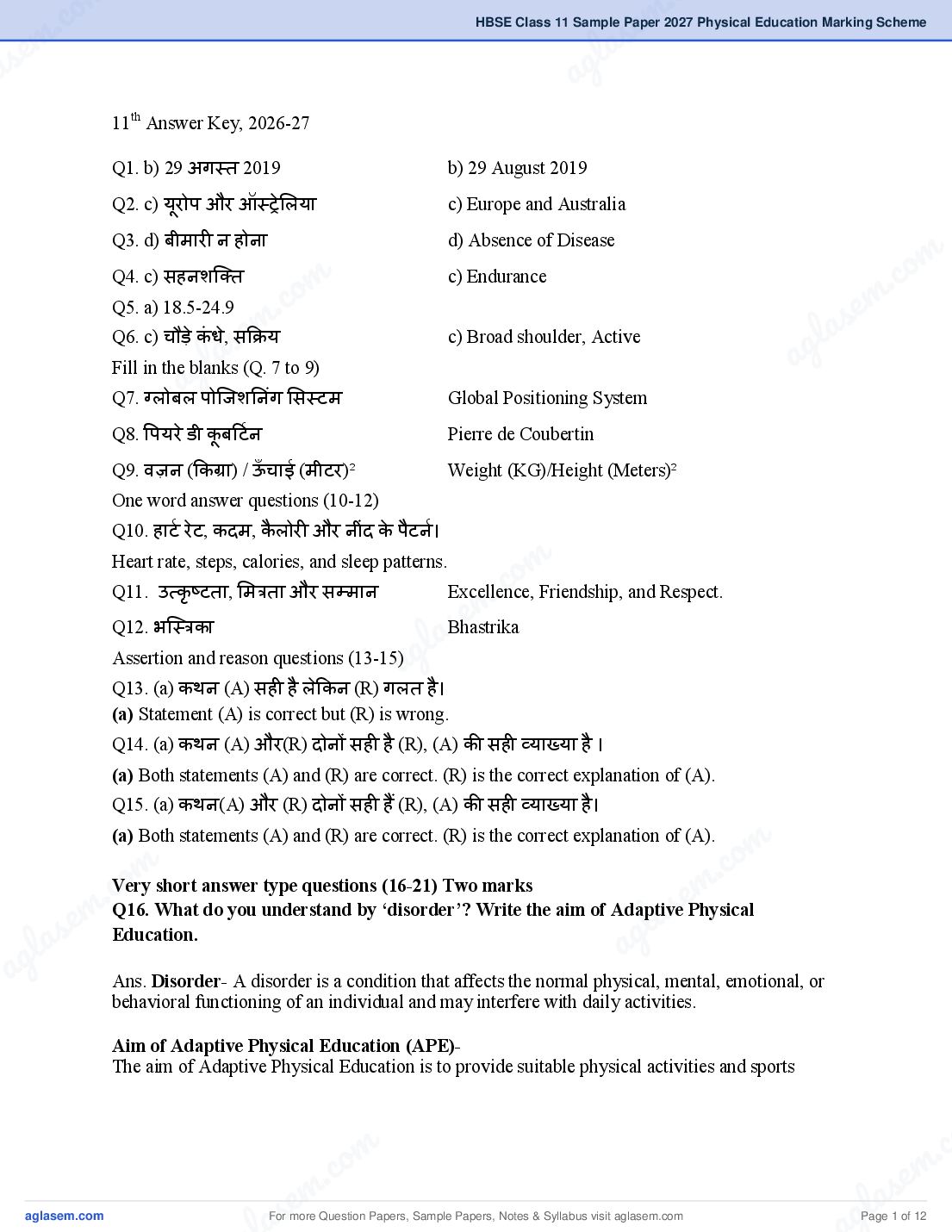
11th Answer Key, 2026-27
Q1. b) 29 अग त 2019 b) 29 August 2019
Q2. c) यरू ोप और ऑ े लया c) Europe and Australia
Q3. d) बीमार न होना d) Absence of Disease
m
Q4. c) सहनशि त
om
c) Endurance
. co
. c em
Q5. a) 18.5-24.9
eय m l as
as
Q6. c) चौड़े कंधे, स
l (Q. 7 to 9)
c) Broad shoulder, Active
ag
g
Fill in the blanks
a
Q7. लोबल पोिजश नंग स टम Global Positioning System
Q8. पयरे डी कूब टन Pierre de Coubertin
Q9. वज़न ( क ा) / ऊँचाई (मीटर)² Weight (KG)/Height (Meters)²
One word answer questions (10-12)
Q10. हाट रे ट, कदम, कैलोर और नींद के पैटन।
Heart rate, steps, calories, and sleep patterns.
o m
Q11. उ कृ टता, म ता और स मान c
. Friendship, and Respect.
Excellence,
e m
Q12. भि का
l as
Bhastrika
Assertion and reason questions (13-15) g
a
Q13. (a) कथन (A) सह है ले कन (R) गलत है ।
(a) Statement (A) is correct but (R) is wrong.
Q14. (a) कथन (A) और(R) दोन सह है (R), (A) क सह या या है ।
(a) Both statements (A) and (R) are correct. (R) is the correct explanation of (A).
Q15. (a) कथन(A) और (R) दोन सह ह (R), (A) क सह या या है ।
(a) Both statements (A) and (R) are correct. (R) is the correct explanation of (A).
m
m .co
m .co
Very short answer type questions (16-21) Two marks
s e m
e la
Q16. What do you understand by ‘disorder’? Write the aim of Adaptive Physical
las Education.
ag
ag Ans. Disorder- A disorder is a condition that affects the normal physical, mental, emotional, or
behavioral functioning of an individual and may interfere with daily activities.
Aim of Adaptive Physical Education (APE)-
The aim of Adaptive Physical Education is to provide suitable physical activities and sports
m . c
c. o s e m
s em
For more Question Papers, Sample Papers, Notes & Syllabus visit
gl a
Page 1 of 12
Page 3
fitness, motor skills, social adjustment, and overall development.
Or
Describe any two movements possible in human body.
Ans. Two movements possible in the human body are-
(i) Flexion:
Flexion is the bending movement that decreases the angle between two body parts, such as
bending the elbow or knee.
(ii) Extension:
Extension is the straightening movement that increases the angle between two body parts, such
as straightening the elbow or knee.
Other movements may be Abduction, Adduction, Circumduction, Elevation, Depression etc.
Q17. Define Physical Fitness. Explain any two components of Physical Fitness.
Ans. Physical Fitness:
Physical fitness is the ability of an individual to perform daily activities efficiently without undue
fatigue and with enough energy for leisure and emergencies.
Physical fitness is composed of health-related and skill-related components, each contributing to
overall body performance and well-being.
Components:
(i) Strength:
The ability of muscles to exert force against resistance.
(ii) Endurance:
The ability of the body to perform an activity for a long period without becoming tired.
Other components may be Speed, Flexibility, Agility, Coordination etc.
Or
What do you mean by learning? Name the primary laws of learning.
Ans. Learning- Learning is a relatively permanent change in behavior, knowledge, or skill that
occurs through practice and experience.
Primary Laws of Learning (Thorndike):
For more Question Papers, Sample Papers, Notes & Syllabus visit Page 2 of 12
Page 4
.co s e m
s em l a
a ag
1. Law of Readiness
2. Law of Exercise (Practice)
3. Law of Effect
Q18. Write the role of any two professionals for children with special needs (CWSN).
m
om
Ans. The role of any two professionals for Children With Special Needs (CWSN). . co
. c em
e
(i) Special Educator:m l as
a s
l learning needs of children. ag
g
Assesses
a individualized educational programs.
Designs
Helps children develop academic and social skills.
(ii) Physiotherapist:
Improves movement and motor abilities.
Enhances strength, balance, and coordination.
Helps children perform daily activities independently.
m
.co
Other professionals can be- Special Education Counsellor, Occupational Therapist, Physical
m
Education Teacher, Speech Therapist.
e
s in sports.
l a
ag
Q19. Explain the concept of test and measurement
Ans. Concept of test and measurement in sports.
Test- A test is a tool or procedure used to evaluate a player's skill, fitness, knowledge, or
performance.
Measurement- Measurement is the process of collecting numerical data from a test.
Concept- Test and measurement help coaches and teachers assess performance, identify m
m
strengths and weaknesses, monitor progress, and plan training programs effectively. .co
.co s e m
s em Q20. What do you understand by warming up and coolinggldown a in sports?
g la Ans. Warming Up- Warming up consists of light exercises performed a before sports activities to
a prepare the body for physical exertion. It increases body temperature, blood circulation, and
flexibility.
Cooling Down- Cooling down consists of light activities and stretching performed after exercise
to gradually return the body to its normal state. It helps reduce muscle soreness and prevents
sudden fatigue.
Q21. Explain growth and development with the help of two examples.
m . c
c. o s e m
s em
For more Question Papers, Sample Papers, Notes & Syllabus visit
gl a
Page 3 of 12
Page 5
Development- Development refers to progressive changes in abilities, functions, and skills of an
individual.
Examples- 1. An increase in a child's height and weight with age is growth.
2. Learning to walk, speak, or ride a bicycle is development.
Short answer type questions (22 to 27) Three marks
Q22. Explain the newly changing trends in the playing surface then the past
years?
Ans. Modern sports surfaces have changed significantly compared to traditional playing
surfaces-
1. Synthetic Turf or Astroturf- Artificial grass is widely used in football, hockey, and
other sports due to its durability and low maintenance.
2. Polyurethane Tracks- Modern athletics tracks are made of synthetic materials that
provide better grip, cushioning, and performance.
3. Shock-Absorbing Floors- Indoor courts use wooden or synthetic shock-absorbing
surfaces to reduce injuries.
4. Weather Resistance- Modern surfaces can withstand different weather conditions and
require less maintenance.
5. Eco-Friendly Materials- Many sports facilities now use sustainable and recyclable
materials.
Or
Astanga Yoga is an eight-limbed path of yoga described by Maharishi Patanjali in the Yoga
Sutras. It includes Yama, Niyama, Asana, Pranayama, Pratyahara, Dharana, Dhyana, and
Samadhi. The practice of Astanga Yoga helps in achieving physical health, mental peace, self-
discipline, and spiritual growth.
(i) What are the different types of asanas?
(ii) Explain the phases of Pranayama.
(iii) Non-violence a part of which limb of Ashtang Yoga?
Ans. (i) The different types of Asanas are-
1. Meditative Asanas – Used for concentration and meditation (e.g., Padmasana,
Sukhasana).
2. Relaxative Asanas – Used for relaxation and recovery (e.g., Shavasana, Makarasana).
3. Cultural Asanas – Improve strength, flexibility, and overall fitness (e.g., Bhujangasana,
Trikonasana).
(ii) The four phases of Pranayama are-
For more Question Papers, Sample Papers, Notes & Syllabus visit Page 4 of 12
Page 6
.co s e m
s em l a
a ag
1. Puraka – Inhalation of breath.
2. Antar Kumbhaka – Retention of breath after inhalation.
3. Rechaka – Exhalation of breath.
4. Bahya Kumbhaka – Retention of breath after exhalation.
(iii) Non-violence (Ahimsa) is a part of Yama, the first limb of Ashtanga Yoga described by
Patanjali.
o m
m . c
Q23. Write a short note
. co on Khelo India Program. s e m
em Programme was launched by the Ministry of Youth Affairs and Sportsglina
Ans. The KhelosIndia
g la sports culture and identify talented athletes across India.
2018 to promote a
a
Objectives are-
Encourage mass participation in sports.
Develop sports infrastructure.
Identify and nurture young talent.
Improve India's performance in international competitions.
Promote fitness and healthy lifestyles among youth.
m
Main Features-
m .co
s e
Khelo India Youth Games.
l a
ag
Khelo India University Games.
Financial support and scholarships for talented athletes.
Development of sports academies and training centers.
Or
Write short note on Indian Olympic Association.
Ans. The Indian Olympic Association (IOA) is the apex body responsible for managing
India's participation in the Olympic Games and other international sporting events. The IOA was
m
.co
established in 1927 and is affiliated with the International Olympic Committee.
m
.co
Functions:
s e m
s em Selects Indian teams for the Olympics, Asian Games, and Commonwealth
g l a Games.
g la Promotes Olympic values and sports development. a
a Coordinates with national sports federations.
Supports athletes and coaches for international competitions.
Q24. Briefly explain the importance of yoga in life.
m . c
c. o s e m
s em
For more Question Papers, Sample Papers, Notes & Syllabus visit
gl a
Page 5 of 12
Page 7
being. Importance of Yoga-
1. Improves flexibility and strength.
2. Enhances concentration and memory.
3. Reduces stress, anxiety, and depression.
4. Improves posture and balance.
5. Promotes better breathing and circulation.
6. Helps maintain a healthy lifestyle.
7. Increases self-discipline and self-awareness.
8. Contributes to overall wellness and quality of life.
Q25. Explain the difference between wellness and lifestyle with examples.
Ans.
Wellness Lifestyle
Wellness is a state of overall physical, mental, Lifestyle refers to the way a person lives and
and social well-being. behaves daily.
It is an outcome or condition of good health. It is a pattern of habits and choices.
Focuses on achieving optimum health. Focuses on daily activities and behaviors.
Example: A person who is physically fit,
Example: Regular exercise, balanced diet, and
mentally healthy, and socially active has good
adequate sleep constitute a healthy lifestyle.
wellness.
Example- Wellness: A student feels energetic, healthy, and emotionally balanced. And
Lifestyle: The same student follows regular exercise, healthy eating habits, and proper
sleep schedules to achieve wellness.
Q26. Draw a neat and clean labeled diagram of human respiratory system.
Ans. Function: The respiratory system helps in
breathing by taking in oxygen and removing carbon
dioxide from the body.
Nose / Nasal Cavity
Pharynx
Larynx
For more Question Papers, Sample Papers, Notes & Syllabus visit Page 6 of 12
Page 8
.co s e m
s em l a
a ag
Trachea
Right Bronchus Left Bronchus
Right Lung Left Lung
(Bronchioles) (Bronchioles)
Alveoli Alveoli
Diaphragm
m
om
Q27. What do you understand by Adolescence. Discuss any two problems faced
. co
. c
by Adolescence with their solution according to you. e m
m
e Adolescence is the transitional stage between childhood and adulthood, gl as
a s
l from 10 to 19 years of age. During this period, rapid physical, mental, a
Ans. Adolescence-
a g
generally ranging
emotional, and social changes occur.
Problems Faced by Adolescents and Their Solutions
1. Emotional Stress and Anxiety-
Pressure of studies and examinations.
Family and peer expectations.
m
.co
Mood swings due to hormonal changes.
e m
Solutions:
l a s
a g activities.
Practice yoga, meditation, and physical
Maintain open communication with parents and teachers.
Seek counseling when required.
2. Peer Pressure
Pressure to adopt unhealthy habits.
Desire to fit into a social group.
Influence of social media and friends.
m
m .co
.co
Solutions:
e m
e m Develop self-confidence and decision-making skills.
las
las
Choose positive friends and role models.
ag
ag Learn to say "No" to harmful activities.
Conclusion- Adolescence is a crucial stage of life. Proper guidance from parents, teachers, and
society helps adolescents overcome challenges and develop into healthy and responsible adults.
Long answer type questions (28 to 30) Five marks
m . c
c. o s e m
s em
For more Question Papers, Sample Papers, Notes & Syllabus visit
gl a
Page 7 of 12
Page 9
Ans. Disability is a physical, mental, sensory, or intellectual condition that limits a person's
ability to perform daily activities in the same way as others.
Causes of Disabilities
1. Genetic Causes
Disabilities caused by hereditary factors or chromosomal abnormalities.
Example: Down Syndrome.
2. Prenatal Causes (Before Birth)
Poor nutrition of the mother.
Infections during pregnancy.
Consumption of alcohol, tobacco, or drugs.
3. Perinatal Causes (During Birth)
Premature birth.
Lack of oxygen during delivery.
Birth injuries.
4. Postnatal Causes (After Birth)
Accidents and injuries.
Malnutrition.
Diseases such as polio, meningitis, or cerebral malaria.
5. Environmental Causes
Pollution.
Exposure to harmful chemicals.
Unsafe living conditions.
Conclusion- Disabilities may occur before birth, during birth, or after birth due to genetic,
medical, environmental, or accidental factors.
Or
Define the term 'Psychology'. Explain the role of Psychology in the field of Physical
Education and Sports?
Ans. Psychology is the scientific study of human behavior, mental processes, emotions, and
experiences.
Role of Psychology in Physical Education and Sports
1. Enhances Motivation- Helps athletes remain focused and dedicated to training.
2. Improves Learning of Skills- Assists in acquiring and mastering sports techniques.
3. Builds Self-Confidence- Increases belief in one's abilities and performance.
4. Controls Stress and Anxiety- Helps athletes manage competitive pressure.
For more Question Papers, Sample Papers, Notes & Syllabus visit Page 8 of 12
Page 10
.co s e m
s em l a
a ag
5. Develops Team Spirit- Improves cooperation and communication among players.
6. Improves Concentration- Helps athletes maintain focus during performance.
7. Enhances Performance- Mental training contributes to better sports achievements.
Q29. What is Sports Training? Explain the Principles of Sports Training with example.
o m
m . c
Ans. Sports training is aco m
. systematic and scientific process of preparing athletes to achieve
s e
s em
maximum performance through planned exercises and practice.
g l a
a Training
Principles oflSports
g a
a
1. Principle of Overload- The body improves when it is subjected to greater demands than
normal. Example: A runner gradually increases running distance.
2. Principle of Progression- Training load should increase gradually. Example: Increasing
weight from 5 kg to 10 kg over time.
3. Principle of Specificity- Training should be specific to the sport. Example: A swimmer
practices swimming drills rather than cycling.
o m
4. Principle of Individual Differences- Trainingm
. c
s e programs should suit individual abilities.
g a
l and advanced athletes.
Example: Different fitness plans for beginners
a
5. Principle of Continuity- Training should be regular and uninterrupted. Example: Daily
practice improves performance more than occasional training.
6. Principle of Reversibility- Fitness decreases when training stops. Example: An athlete loses
endurance after a long break.
Or
m
om
What is physiology? Explain the types of bones in detail.
c.Ans. m .co
m organisms and their body systems. s e
e Physiology is the branch of science that studies the normal functions
l aand activities of living
las ag
ag Types of Bones are-
1. Long Bones
Longer than they are wide.
Provide support and movement.
Examples: Femur, Humerus, Tibia.
m . c
c. o s e m
s em
For more Question Papers, Sample Papers, Notes & Syllabus visit
gl a
Page 9 of 12
Page 11
Nearly equal in length and width.
Provide stability and support.
Examples: Carpals and Tarsals.
3. Flat Bones
Thin and broad.
Protect internal organs.
Examples: Skull, Sternum, Ribs.
4. Irregular Bones
Have complex shapes.
Perform specialized functions.
Examples: Vertebrae, Hip Bones.
5. Sesamoid Bones
Embedded within tendons.
Reduce friction and improve movement.
Example: Patella (Kneecap).
Q30. What is Lever? Explain the types of Lever with suitable examples from daily life.
Ans. A lever is a rigid bar that rotates around a fixed point called the fulcrum to move a load
with the application of effort.
Components of a Lever- 1. Fulcrum (Pivot Point), 2. Effort (Applied Force) and 3. Load
(Resistance).
Types of Lever
1. First-Class Lever- Fulcrum lies between effort and load.
Examples- Seesaw, Scissors, Crowbar.
Human Body Example- Neck joint during head movement.
2. Second-Class Lever- Load lies between fulcrum and effort.
Examples- Wheelbarrow, Nutcracker and Bottle opener.
Human Body Example- Standing on toes.
For more Question Papers, Sample Papers, Notes & Syllabus visit Page 10 of 12
Page 12
.co s e m
s em l a
a ag
3. Third-Class Lever- Effort lies between fulcrum and load.
Examples- Tweezers, Fishing rod and Broom.
Human Body Example- Biceps curl at the elbow joint.
Or
o m
m . c
.
Explain about Shatkarmaco in detail. s e m
em
Ans. Shatkarmas (Shatkriya) refers to the six purification techniques of Hatha Yoga used to gl
a
cleanse theg la and prepare it for higher yogic practices.
body a
a
Six Shatkarmas are-
1. Neti- Cleaning of the nasal passages.
Types- Jal Neti, Sutra Neti, dugdh neti, Ghrit neti.
Benefits- Improves breathing, Prevents sinus problems.
m
2. Dhauti- Cleansing of the digestive tract.
m .co
s e
Benefits- Improves digestion, Removes toxins.
l a
ag
3. Basti- Yogic cleansing of the large intestine.
Benefits- Relieves constipation, Purifies the colon.
4. Nauli- Abdominal churning exercise.
Benefits- Strengthens abdominal muscles, Improves digestion.
m
.co
5. Kapalabhati- Forceful exhalation and passive inhalation.
m
.co
Benefits- Cleanses respiratory passages, Enhances lung efficiency.
m 6. Trataka- Steady gazing at a fixed object. s e m
s e g la
g la a
a Benefits- Improves concentration, Strengthens eye muscles.
Importance of Shatkarma
Purifies body and mind.
Improves health and immunity.
Prepares the practitioner for Pranayama and Meditation.
m . c
c. o s e m
s em
For more Question Papers, Sample Papers, Notes & Syllabus visit
gl a
Page 11 of 12
Page 13
----------------------------------------------------------------------------------------------------------------
References
NCERT Physical Education (Class XI & XII)
Richard M. Shaver, Introduction to Physical Education
Bucher & Wuest, Foundations of Physical Education and Sport
Thorndike's Theory of Learning
Adapted Physical Education National Standards (APENS)
Hatha Yoga Pradipika
Gheranda Samhita
Yoga Education Material of the Ministry of AYUSH
For more Question Papers, Sample Papers, Notes & Syllabus visit Page 12 of 12
Document Details
| Board / Org | Haryana Board |
| Exam | Class 11 |
| Type | Answer Key |
| Pages | 12 |
| Updated | 03 Nov 2026 |