HBSE Class 11 Sample Paper 2027 Economics Marking Scheme
Finished viewing? Save it for later —
Download HBSE Class 11 Sample Paper 2027 Economics Marking Scheme (PDF · 11 pages)About HBSE Class 11 Sample Paper 2027 Economics Marking Scheme
HBSE Class 11 Sample Paper 2027 Economics Marking Scheme is available here for free download. Published by Haryana Board for Class 11, this answer key can be viewed online or downloaded as a PDF (11 pages). Candidates preparing for Class 11 can use HBSE Class 11 Sample Paper 2027 Economics Marking Scheme to understand the exam pattern, the type of questions asked, and the overall difficulty level.
Frequently Asked Questions
How can I download HBSE Class 11 Sample Paper 2027 Economics Marking Scheme?
Open this page and click the Download button to save HBSE Class 11 Sample Paper 2027 Economics Marking Scheme as a PDF. It is completely free on AglaSem Docs.
Is HBSE Class 11 Sample Paper 2027 Economics Marking Scheme free to download?
Yes. HBSE Class 11 Sample Paper 2027 Economics Marking Scheme can be viewed online and downloaded as a PDF free of cost on AglaSem Docs.
How many pages does HBSE Class 11 Sample Paper 2027 Economics Marking Scheme have?
HBSE Class 11 Sample Paper 2027 Economics Marking Scheme contains 11 pages, which you can read online or download together as a single PDF.
Where can I find more Class 11 study material?
You can find more Class 11 question papers, sample papers, syllabus, and answer keys on AglaSem Docs.
HBSE Class 11 Sample Paper 2027 Economics Marking Scheme – Text
Read the full text of this answer key below — useful to quickly search, copy and reference the content online without downloading the PDF.
📄 View text version (12 pages)
Page 1
HBSE Class 11 Sample
Paper 2027 Economics
Marking Scheme
EXAM YEAR TYPE SUBJECT
Haryana Class 11 2027 Answer Key Economics
Notes · Sample Papers · Previous Year Papers · Mock Tests
Page 2
.co s e m
s em l a
a ag
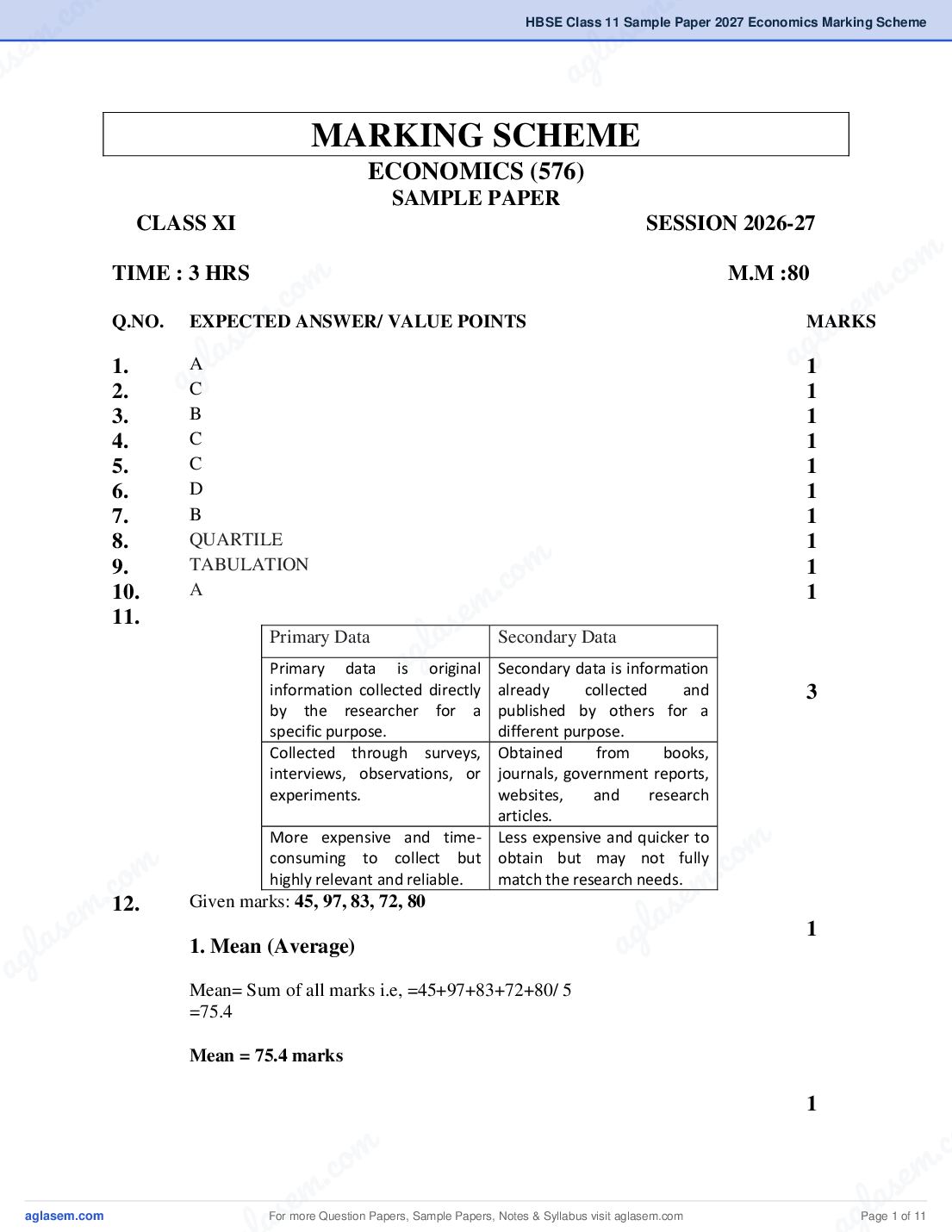
MARKING SCHEME
ECONOMICS (576)
SAMPLE PAPER
CLASS XI SESSION 2026-27
m
TIME : 3 HRS
om
M.M :80
. co
. c em
Q.NO.
em
EXPECTED ANSWER/ VALUE POINTS
l a
MARKSs
Al as g
a1
aCg
1.
2. 1
3. B 1
4. C 1
5. C 1
6. D 1
7. B 1
8. QUARTILE 1
m
.co
9. TABULATION 1
m
10. A 1
11. e
s Secondary Data
Primary Data
g l a
Primary data isa original Secondary data is information
information collected directlyalready collected and 3
by the researcher for a published by others for a
specific purpose. different purpose.
Collected through surveys, Obtained from books,
interviews, observations, or journals, government reports,
experiments. websites, and research
articles.
More expensive and time- Less expensive and quicker to
m
c.12.o
m consuming to collect but obtain but may not fully
m.co
e
highly relevant and reliable. match the research needs.
e m Given marks: 45, 97, 83, 72, 80
las
las ag 1
ag 1. Mean (Average)
Mean= Sum of all marks i.e, =45+97+83+72+80/ 5
=75.4
Mean = 75.4 marks
1
m . c
c. o s e m
s em
For more Question Papers, Sample Papers, Notes & Syllabus visit
gl a
Page 1 of 11
Page 3
Arrange the marks in ascending order:
45, 72, 80, 83, 97
Since there are 5 observations (odd number), the middle value is the median.
Median = 80 marks 1
3. Mode is the value that occurs most frequently.
Marks: 45, 97, 83, 72, 80
Since all values occur only once, there is no mode.
OR
Statistical Average:
A statistical average is a single value that represents the whole set of data. It 1+2
shows the central or typical value of a series and makes large data easy to
understand and compare.
Functions of Statistical Average:
Represents the entire data with one value.
Makes comparison between groups easy.
Simplifies large and complex data.
Helps in analysis and decision-making.
13. The scope of statistics is very wide. It is used to collect, organize, analyze, and
interpret data in many fields to make better decisions. 2+2
Key Points:
Used in business and economics.
Helps in government planning.
Useful in education and research.
Supports agriculture, banking, and industry.
Helps in decision-making and forecasting.
For more Question Papers, Sample Papers, Notes & Syllabus visit Page 2 of 11
Page 4
.co s e m
s em l a
a ag
14. 4
m
om . co
. c em
e m l as
l as ag
ag
OR
om
4
Qualities of a Good Questionnaire:
m .c
s
Uses simple and clear language.e
a
gl questions.
Covers all relevant information.
Avoids confusing or a biased
Questions are arranged in a logical order.
Helps collect accurate and reliable data.
Explain any four 1 marks each
15. 3
m
Goods Base Base Curre Current P0q0 P1q0 P0q1 P1q1
.co
year year nt year
m
.co m
pric quant year quantit
m
e P0 ity price y
s e
s e q0 P1 Q1 a
350 gl 300
g la A 5 50 7 60 250
a 420
a B 6 15 8 10 90 120 60 80
C 8 8 11 12 64 88 96 132
D 7 20 10 15 140 200 105 150
544 758 561 782
m . c
c. o s e m
s em
For more Question Papers, Sample Papers, Notes & Syllabus visit
gl a
Page 3 of 11
Page 5
3
OR
0.5*8=4
Main Components of a Table:
Table Number – Identifies the table.
Title – Explains the subject of the table.
Headnote – Gives additional information or units of measurement.
Captions – Column headings.
Stubs – Row headings.
Body – Contains the actual data or figures.
Footnote – Provides extra explanation or clarification.
Source – Mentions where the data was collected from.
Explain each point
For more Question Papers, Sample Papers, Notes & Syllabus visit Page 4 of 11
Page 6
.co s e m
s em l a
a ag
16. 6
m
om . co
. c em
e m l as
l as ag
ag
o m
. c
e m
OR
l as 3+3
ag
m
m .co
m .co s e m
s e g la
g la a
a
Primary Data:
17. 2+2+2
Primary data is the original data collected directly by the researcher for a
m . c
c. o s e m
s em
For more Question Papers, Sample Papers, Notes & Syllabus visit
gl a
Page 5 of 11
Page 7
interviews, observation, or questionnaires.
Explain the above methods in short.
Merits:
Easy to collect data from many people.
Low cost compared to personal interviews.
Saves time, especially in online surveys.
Respondents can answer at their convenience.
Demerits:
Some people may not return the questionnaire.
Answers may be incomplete or incorrect.
Cannot clarify doubts if questions are misunderstood.
Response rate may be low, affecting the quality of data.
OR 6
For more Question Papers, Sample Papers, Notes & Syllabus visit Page 6 of 11
Page 8
.co s e m
s em l a
a ag
SECTION - B
18 C 1
19 C 1
20 B 1
21 C 1
22 A 1 m
23 A
om
1 . co
24 FISCAL
. c 1
e m
25 em
DISGUISED UNEMPLOYMENT 1
l as
26
l as
PRIVATIZATION
ag1
27 ag
A 1
28 Global warming is the gradual increase in Earth’s temperature. It 3
happens mainly because of pollution from vehicles, factories, and
cutting trees. Gases like carbon dioxide trap heat in the atmosphere.
This leads to melting ice, rising sea levels, and climate change. It
can harm humans, animals, and the environment.
OR
o m
c
. natural resources wisely so
Sustainable development means using
m
e be used by future generations. 3
l as
that they are not finished and can
Key points: ag
Use resources carefully
Avoid over-exploitation
Protect environment
Balance present and future needs
Save resources for future generations
m
29om After independence, India and Pakistan adopted different development . co
. c e m 1
em
strategies.
l as
las a g
g
India:
a Mixed economy (public + private sector)
1
Planning through Five-Year Plans
Government control in key industries
Pakistan:
1
m . c
c. o s e m
s em
For more Question Papers, Sample Papers, Notes & Syllabus visit
gl a
Page 7 of 11
Page 9
Less strict planning than India
Support from foreign aid
Both aimed at economic growth and development.
30 On the eve of independence, the Indian economy had several weak features:
Key points:
1
Mainly agricultural economy
Low industrial development
High poverty and unemployment 1
Poor infrastructure (roads, railways)
Low literacy rate 1
Unequal distribution of wealth
1
Dependence on British rule
Explain any three points
OR
Principal Causes of the Backwardness of the Indian Economy During the 1+3
Colonial Period (100 Words)
Drain of Wealth: A large share of India's income was transferred to
Britain without adequate return.
Deindustrialization: Traditional cottage and handicraft industries
declined due to competition from British manufactured goods.
Exploitative Land Revenue System: High taxes burdened farmers,
causing poverty and indebtedness.
Neglect of Agriculture: Low investment in irrigation, technology, and
infrastructure reduced productivity.
Lack of Industrial Development: British policies discouraged modern
industries in India.
31 Rural development in India faces several emerging challenges. 1+3
Key points:
Unemployment: Lack of job opportunities in villages
Poverty: Many people still live below poverty line
Poor infrastructure: Weak roads, electricity, and water supply
Low education and health facilities
Migration: People moving to cities for work
For more Question Papers, Sample Papers, Notes & Syllabus visit Page 8 of 11
Page 10
.co s e m
s em l a
a ag
Agricultural problems: Low productivity and dependence on monsoon
Explain any 3 points.
OR
Organic Farming:
m
co
Organic farming is a method of farming in which crops are grown without using
om .
chemical fertilizers, pesticides, or harmful chemicals.
. c em
e m
Advantages:
l as
as
l Produces ag
g Improves soil fertility naturally
a Protects environment
healthy and safe food
and water
Reduces pollution
Saves biodiversity (plants and animals)
Gives better quality crops in long term
It is a sustainable and eco-friendly way of farming.
m
m .co
e
32 Unemployment: 1
as
Unemployment means a situation when a person is willing and able to work but
l
does not get any job.
a g
Types in India (Key points):
1
Seasonal unemployment: Work available only in certain seasons 1
(mainly agriculture) 1
Disguised unemployment: More people working than required in farms
Educated unemployment: Educated people not getting suitable jobs
Structural unemployment: Caused by lack of skills and slow industrial
growth
m
m .co
m 33. .co s em
s e Economic Reforms:
g lagrowth, 2+4
g la a
Economic reforms are changes in economic policies to improve
a efficiency, and development of a country. In India, reforms started in 1991 and
include liberalization, privatization, and globalization.
Need of Economic Reforms:
Low economic growth before 1991
High poverty and unemployment
m . c
c. o s e m
s em
For more Question Papers, Sample Papers, Notes & Syllabus visit
gl a
Page 9 of 11
Page 11
Heavy government control and inefficiency
Foreign exchange crisis
Need for global trade and investment
To improve productivity and competition
These reforms helped India to open its economy, increase growth, attract
foreign investment, and improve living standards.
Explain the above points
OR
Privatisation: 2+4
Privatisation means transfer of ownership, control, and management of public
sector enterprises (government companies) to private individuals or companies.
Measures adopted in 1991 :
Reduction in government control over industries
Sale of shares of public sector units to private people (disinvestment)
Dereservation of industries for private sector
Allowing private participation in many sectors
Improvement in efficiency and competition
34. Rural Development Measures in India: 2+4
The Government of India has taken many steps for rural development.
Bullet points:
Employment schemes: MGNREGA provides 100 days of work
Agriculture support: Subsidy on seeds, fertilizers, and irrigation
Credit facilities: Loans through banks and cooperatives
Infrastructure development: Roads, electricity, and drinking water
Education and health: Schools, hospitals, and awareness programs
Self-help groups (SHGs): Encourage women empowerment and
savings
Poverty reduction schemes: Food security and housing programs
Explain any 5 points given above
OR
For more Question Papers, Sample Papers, Notes & Syllabus visit Page 10 of 11
Page 12
.co s e m
s em l a
a ag
Main Problems of Human Capital Formation in India: 2+4
Human capital formation means improving people’s skills, education, and
health. In India, it faces several problems.
Important problems:
o m
m . c
co rate: Many people are still uneducated
Poor. health facilities: Lack of hospitals and medical services in rural
Low literacy
s e m
m
eareas l a
s
la Unemployment: ag
g Poverty: Families cannot afford education and training
a Brain drain: Skilled people move to other countries
Lack of proper job opportunities reduces skill use
Unequal access: Rural and poor areas get fewer facilities than urban
areas
Insufficient investment: Less government spending on education and
health
m
m .co
s e
l a
ag
m
m .co
m .co s e m
s e g la
g la a
a
m . c
c. o s e m
s em
For more Question Papers, Sample Papers, Notes & Syllabus visit
gl a
Page 11 of 11
Document Details
| Board / Org | Haryana Board |
| Exam | Class 11 |
| Type | Answer Key |
| Pages | 11 |
| Updated | 03 Nov 2026 |