CBSE Class 12 Marking Scheme 2022 for Applied Arts Term 2
Finished viewing? Save it for later —
Download CBSE Class 12 Marking Scheme 2022 for Applied Arts Term 2 (PDF · 3 pages)About CBSE Class 12 Marking Scheme 2022 for Applied Arts Term 2
CBSE Class 12 Marking Scheme 2022 for Applied Arts Term 2 is available here for free download. Published by CBSE for Class 12, this marking scheme can be viewed online or downloaded as a PDF (3 pages). Candidates preparing for Class 12 can use CBSE Class 12 Marking Scheme 2022 for Applied Arts Term 2 to understand the exam pattern, the type of questions asked, and the overall difficulty level.
Frequently Asked Questions
How can I download CBSE Class 12 Marking Scheme 2022 for Applied Arts Term 2?
Open this page and click the Download button to save CBSE Class 12 Marking Scheme 2022 for Applied Arts Term 2 as a PDF. It is completely free on AglaSem Docs.
Is CBSE Class 12 Marking Scheme 2022 for Applied Arts Term 2 free to download?
Yes. CBSE Class 12 Marking Scheme 2022 for Applied Arts Term 2 can be viewed online and downloaded as a PDF free of cost on AglaSem Docs.
How many pages does CBSE Class 12 Marking Scheme 2022 for Applied Arts Term 2 have?
CBSE Class 12 Marking Scheme 2022 for Applied Arts Term 2 contains 3 pages, which you can read online or download together as a single PDF.
Where can I find more Class 12 study material?
You can find more Class 12 question papers, sample papers, syllabus, and answer keys on AglaSem Docs.
CBSE Class 12 Marking Scheme 2022 for Applied Arts Term 2 – Text
Read the full text of this marking scheme below — useful to quickly search, copy and reference the content online without downloading the PDF.
📄 View text version (3 pages)
Page 1
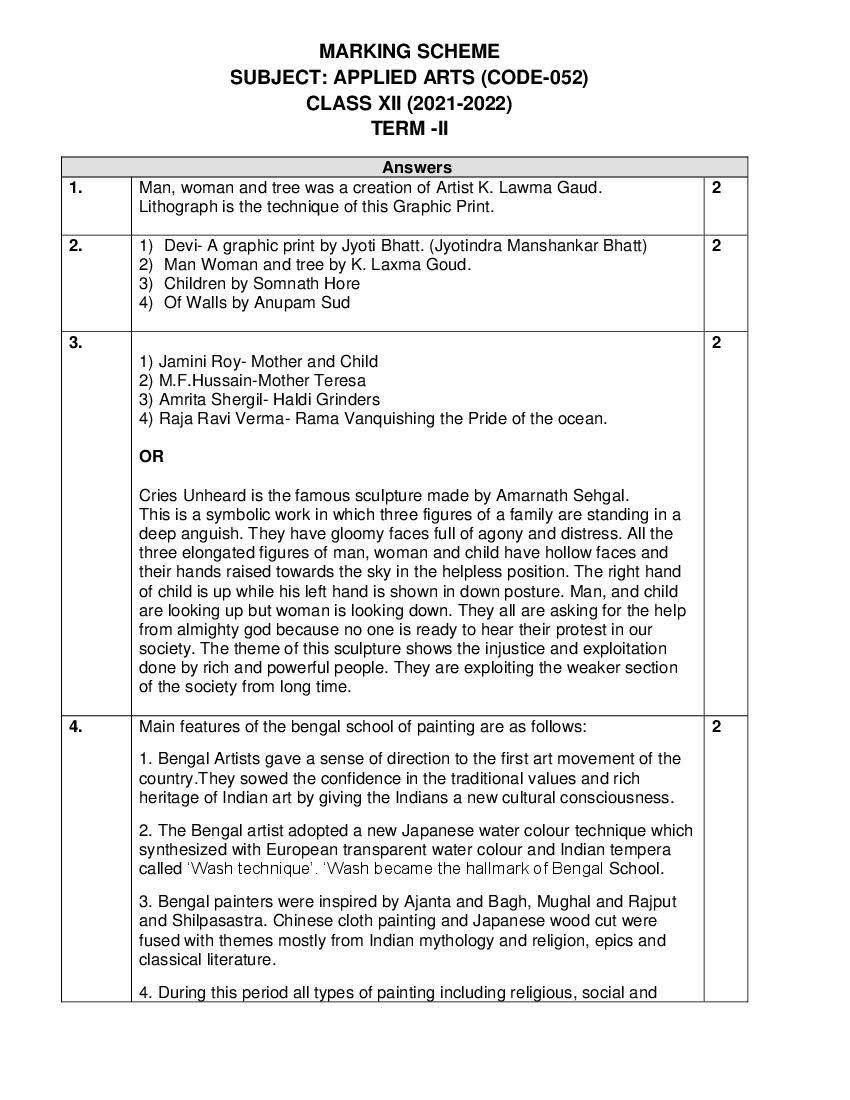
SUBJECT: APPLIED ARTS (CODE-052)
CLASS XII (2021-2022)
TERM -II
Answers
1. Man, woman and tree was a creation of Artist K. Lawma Gaud. 2
Lithograph is the technique of this Graphic Print.
2. 1) Devi- A graphic print by Jyoti Bhatt. (Jyotindra Manshankar Bhatt) 2
2) Man Woman and tree by K. Laxma Goud.
3) Children by Somnath Hore
4) Of Walls by Anupam Sud
3. 2
1) Jamini Roy- Mother and Child
2) M.F.Hussain-Mother Teresa
3) Amrita Shergil- Haldi Grinders
4) Raja Ravi Verma- Rama Vanquishing the Pride of the ocean.
OR
Cries Unheard is the famous sculpture made by Amarnath Sehgal.
This is a symbolic work in which three figures of a family are standing in a
deep anguish. They have gloomy faces full of agony and distress. All the
three elongated figures of man, woman and child have hollow faces and
their hands raised towards the sky in the helpless position. The right hand
of child is up while his left hand is shown in down posture. Man, and child
are looking up but woman is looking down. They all are asking for the help
from almighty god because no one is ready to hear their protest in our
society. The theme of this sculpture shows the injustice and exploitation
done by rich and powerful people. They are exploiting the weaker section
of the society from long time.
4. Main features of the bengal school of painting are as follows: 2
1. Bengal Artists gave a sense of direction to the first art movement of the
country.They sowed the confidence in the traditional values and rich
heritage of Indian art by giving the Indians a new cultural consciousness.
2. The Bengal artist adopted a new Japanese water colour technique which
synthesized with European transparent water colour and Indian tempera
called ‘Wash technique’. ‘Wash became the hallmark of Bengal School.
3. Bengal painters were inspired by Ajanta and Bagh, Mughal and Rajput
and Shilpasastra. Chinese cloth painting and Japanese wood cut were
fused with themes mostly from Indian mythology and religion, epics and
classical literature.
4. During this period all types of painting including religious, social and
Page 2
5. The colours are soft without shadow and conventional perspective giving
a mystic sense of space and atmosphere and diluting the impact of colour.
The Bengal painters introduced linear delicacy, rhythm and grace of Ajanta.
5. 3
(1) Shiva and sati is a beautiful painting by Nandlal Bose.
(2) It shows a mythological event of Lord Shiva and his wife Sati ( Parvati).
(3) This is a dramatic depiction on offset paper using yellow,
brown,violet,red colours in various shades and tones. In the background
of the picture, the light and dark combination of brown and yellow
colours have been used to show the sky which goes to merge with
earth’s surface looking undulating shape through violet, brown and
white colours.
(4) In the center of the picture, lord shiva and sati have been depicted
prominently in the sad mood.
(5) Shiva sits looking at sati’s faded face helplessly and stretching both
arms to support the body of Sati which is lying on his left knee in
unconscious state wearing necklaces, earings, armlets, bracelets and
light red colour saree.
(6) An aura of light yellow colour has been shown behind Shiva’s head. His
forehead looks bright and his hair are tied in a bun on top. He is wearing
necklace and a snake around his neck.The torso of Lord Shiva is
looking a little bulky.
(7) Foreground of the painting looks like a blurry vision.
OR
Journeys end was a famous painting made by Abanindranath Tagore.
1) Subject Matter: Loaded camel in the foreground is seen about to fall.
Impression of desert has a very mystical effect.
2) Composition: Red, brown and yellow, orange color for giving the sunset
with wash technique.
3) The artist has shown sufferings of the weak tired thirty and hungry
camel which has been shown his listless body by half opened eyes as
his journey has come to an end.
4) He depicts the animals exploitation and tyranny by his owner,but still the
animal remains faithful to his owner.
6. (1) Radhika is one of the beautiful wash paintings of M.A.R. CHUGHTAI. In 4
this painting, a very delicate Indian lady is shown coming out of her
room.
(2) Her face is profile, the head is down, eyes are in graceful look with sharp
eyebrows, her hairs are in black brown combination reaching up to her
back that looks so realistic and ornaments in her neck also with
earnings.
(3) Her left foot is in a forwarding Direction. She is holding Lotus flowers in
her both hands, her left hand is near her face and her right hand hanging
down holding the Lotus, the artist has also shown a honeybee on the
Page 3
rings in her fingers. She is wearing a light purple lehenga with dark blue
prints, red blouse, and yellow odhani with a brown border and also a
well-finished pearl necklace with pendant and thread necklace along with
a beautiful pendant.
(4) This means the artist has given every single detail of ornaments of the
lady and depicted it beautifully.
(5) In the background a lamp is painted by the artist along with a
lampshade, that looks like a royal golden lamp with every single details
(6) We can clearly see the flame and burning smoke. A small umbrella-
shaped jhumer is also painted by the artist on the lamp and a chain of
the lamp is hanging to the floor.
(7) The background is made Beautiful by the fusion of red yellow and black
colors. The whole composition is giving a beautiful impression due to its
rhythmic form and flexibility. Now it is a collection of National Gallery of
Modern Art New Delhi.
Document Details
| Board / Org | CBSE |
| Exam | Class 12 |
| Type | Solution |
| Pages | 3 |
| Updated | 30 Apr 2026 |