Page 1
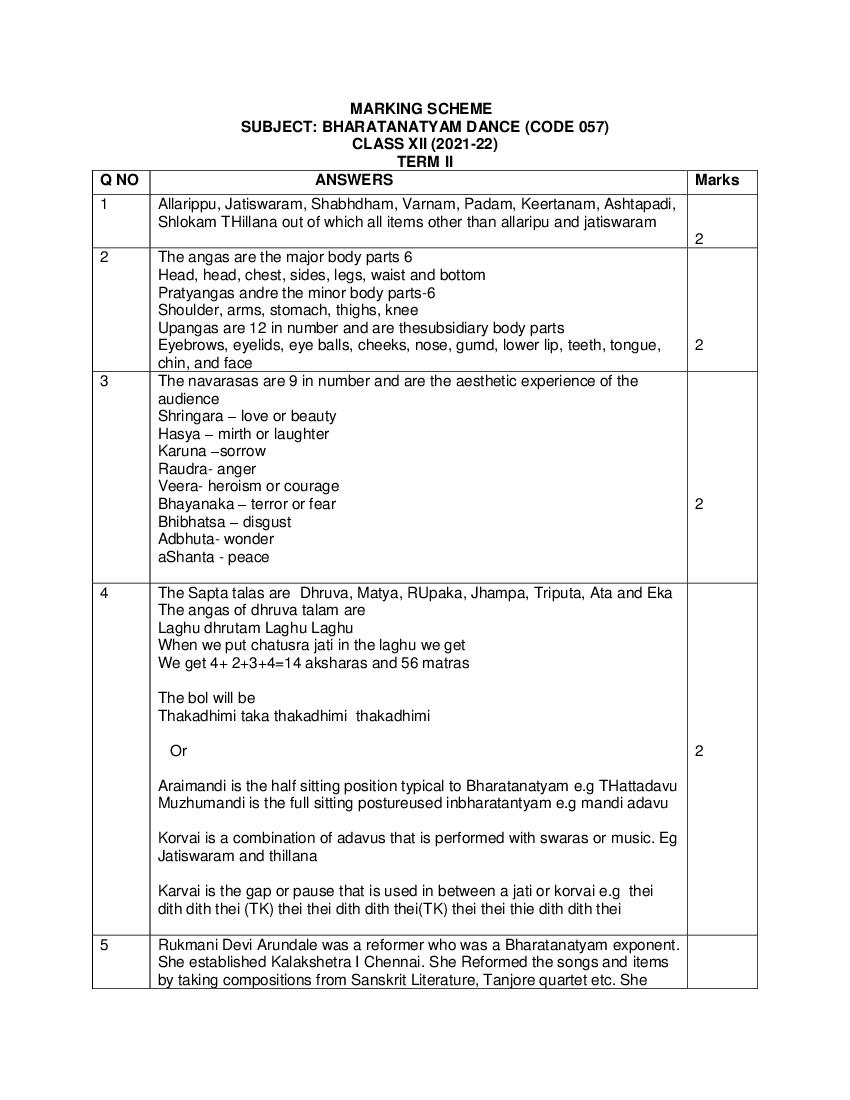
MARKING SCHEME SUBJECT: BHARATANATYAM DANCE (CODE 057) CLASS XII (2021-22) TERM II Q NO ANSWERS Marks 1 Allarippu, Jatiswaram, Shabhdham, Varnam, Padam, Keertanam, Ashtapadi, Shlokam THillana out of which all items other than allaripu and jatiswaram 2 2 The angas are the major body parts 6 Head, head, chest, sides, legs, waist and bottom Pratyangas andre the minor body parts-6 Shoulder, arms, stomach, thighs, knee Upangas are 12 in number and are thesubsidiary body parts Eyebrows, eyelids, eye balls, cheeks, nose, gumd, lower lip, teeth, tongue, 2 chin, and face 3 The navarasas are 9 in number and are the aesthetic experience of the audience Shringara – love or beauty Hasya – mirth or laughter Karuna –sorrow Raudra- anger Veera- heroism or courage Bhayanaka – terror or fear 2 Bhibhatsa – disgust Adbhuta- wonder aShanta - peace 4 The Sapta talas are Dhruva, Matya, RUpaka, Jhampa, Triputa, Ata and Eka The angas of dhruva talam are Laghu dhrutam Laghu Laghu When we put chatusra jati in the laghu we get We get 4+ 2+3+4=14 aksharas and 56 matras The bol will be Thakadhimi taka thakadhimi thakadhimi Or 2 Araimandi is the half sitting position typical to Bharatanatyam e.g THattadavu Muzhumandi is the full sitting postureused inbharatantyam e.g mandi adavu Korvai is a combination of adavus that is performed with swaras or music. Eg Jatiswaram and thillana Karvai is the gap or pause that is used in between a jati or korvai e.g thei dith dith thei (TK) thei thei dith dith thei(TK) thei thei thie dith dith thei 5 Rukmani Devi Arundale was a reformer who was a Bharatanatyam exponent. She established Kalakshetra I Chennai. She Reformed the songs and items by taking compositions from Sanskrit Literature, Tanjore quartet etc. She
Page 2
redesigned the Bharatanatyam costume and the temple jewellery. She choreogrpaed and presented 14 dance dramas including the Ramayana, Dasavatara . She also presented the Kuravanji. She made Bharatantyam into a respectable art form. Tanjore quartet were 4 brothers who lived in Tanjore . Their nameswere Ponniah, Chinnaih Sivanandam and Vadivelu. They were great musicians and composers. They set the padhati or system of the Margam in the pattern of Nritta, Nritya and Abhinaya. They set the adavu system. They gave many compositions for the Bharatanatyam Repetoire like Jatiswarams, Kavitvams, Varnams, Keertanamd and Thillanas. 3 Or The instruments which are played as an accompaniment to the Bharatanatyam dance is an indispensible part of this art. They ar e Stringed instruments: Veena, Violin Wind Instruments: flute Percussion instruments : Mridangam, Tavil Bronze instrument: Talam for Nattuvangam 6 The Abhinayadarpanam is a text that was authored by Acharya Nandikeswara about 1000 AD. It means Mirror of Gestures and discrines all aspects of Abhinaya . It consists of 3242 shlokas Dhyana Shlokam describing Shiva as a representation of all 4 abhinayas and the universe Natya Utpati Katha the origin of dance Natya Prashansa, Natya Prayoga Samaya, Natana bedas division into nritta, nritya, natya abhinaya, Natya rachna, sabhapati and Mantri lakshans Kinkini lakshanam Then in Natyakrama the parts of nritya and the famous shloka Yatho hasta statho drishti ------- is there Then the division of the body into anga, pratyanga and upanga is described Then come the shlokas defining chatur vidha abhinaya including satvika abhinaya 4 Then come the shlokas on 9 shiro bedas m 8 drishti bedas, 4 greva bedas, 28 asamyuta hastas, 23 samyuta hastas and their individual viniyogas. Then the devata hastas, dasavatara hastas, navagraha hastas, bandava andvarna hastas and nritta hastas are described Then finally come the 4 pada bedas mandalam , sthanakam, utplavan and chari and gati bedas The abhinayadarpanam is truly an encyclopedia for Bharatantyam dancers.