CBSE Class 12 Marking Scheme 2022 for Biology Term 2
Finished viewing? Save it for later —
Download CBSE Class 12 Marking Scheme 2022 for Biology Term 2 (PDF · 5 pages)About CBSE Class 12 Marking Scheme 2022 for Biology Term 2
CBSE Class 12 Marking Scheme 2022 for Biology Term 2 is available here for free download. Published by CBSE for Class 12, this marking scheme can be viewed online or downloaded as a PDF (5 pages). Candidates preparing for Class 12 can use CBSE Class 12 Marking Scheme 2022 for Biology Term 2 to understand the exam pattern, the type of questions asked, and the overall difficulty level.
Frequently Asked Questions
How can I download CBSE Class 12 Marking Scheme 2022 for Biology Term 2?
Open this page and click the Download button to save CBSE Class 12 Marking Scheme 2022 for Biology Term 2 as a PDF. It is completely free on AglaSem Docs.
Is CBSE Class 12 Marking Scheme 2022 for Biology Term 2 free to download?
Yes. CBSE Class 12 Marking Scheme 2022 for Biology Term 2 can be viewed online and downloaded as a PDF free of cost on AglaSem Docs.
How many pages does CBSE Class 12 Marking Scheme 2022 for Biology Term 2 have?
CBSE Class 12 Marking Scheme 2022 for Biology Term 2 contains 5 pages, which you can read online or download together as a single PDF.
Where can I find more Class 12 study material?
You can find more Class 12 question papers, sample papers, syllabus, and answer keys on AglaSem Docs.
CBSE Class 12 Marking Scheme 2022 for Biology Term 2 – Text
Read the full text of this marking scheme below — useful to quickly search, copy and reference the content online without downloading the PDF.
📄 View text version (5 pages)
Page 1
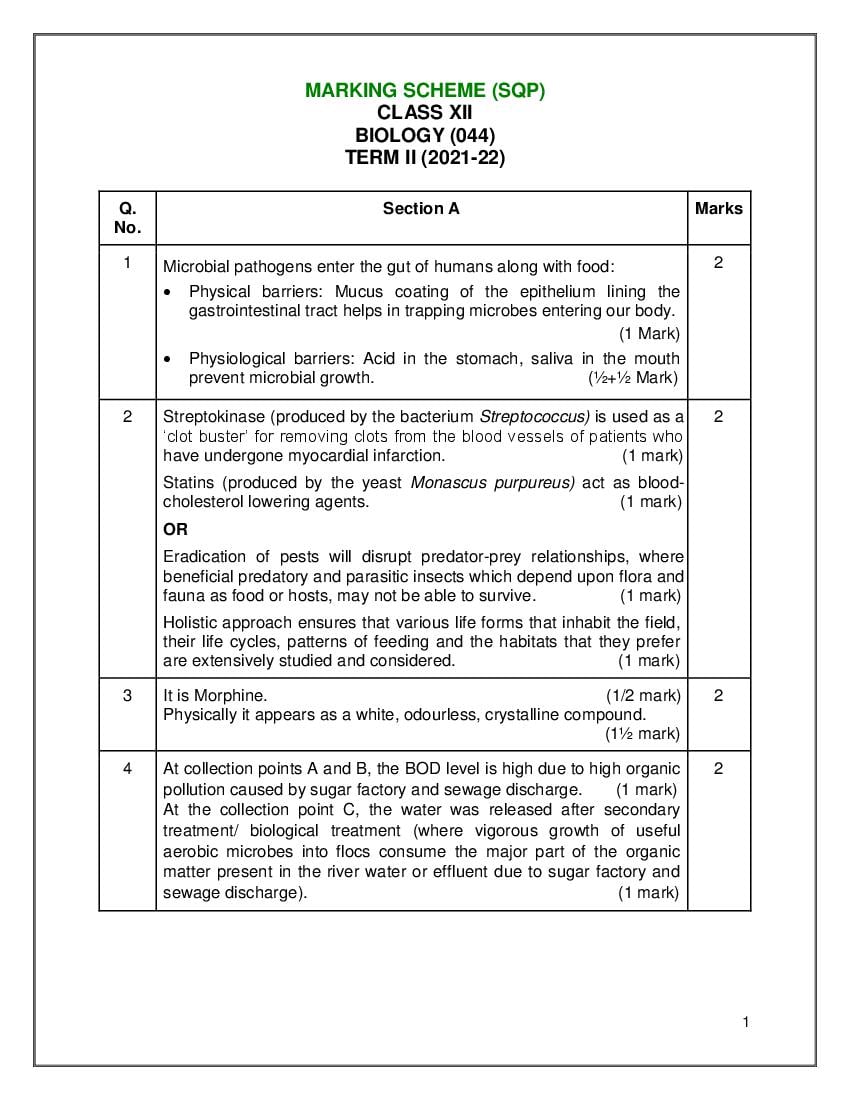
CLASS XII
BIOLOGY (044)
TERM II (2021-22)
Q. Section A Marks
No.
1 Microbial pathogens enter the gut of humans along with food: 2
Physical barriers: Mucus coating of the epithelium lining the
gastrointestinal tract helps in trapping microbes entering our body.
(1 Mark)
Physiological barriers: Acid in the stomach, saliva in the mouth
prevent microbial growth. (½+½ Mark)
2 Streptokinase (produced by the bacterium Streptococcus) is used as a 2
‘clot buster’ for removing clots from the blood vessels of patients who
have undergone myocardial infarction. (1 mark)
Statins (produced by the yeast Monascus purpureus) act as blood-
cholesterol lowering agents. (1 mark)
OR
Eradication of pests will disrupt predator-prey relationships, where
beneficial predatory and parasitic insects which depend upon flora and
fauna as food or hosts, may not be able to survive. (1 mark)
Holistic approach ensures that various life forms that inhabit the field,
their life cycles, patterns of feeding and the habitats that they prefer
are extensively studied and considered. (1 mark)
3 It is Morphine. (1/2 mark) 2
Physically it appears as a white, odourless, crystalline compound.
(1½ mark)
4 At collection points A and B, the BOD level is high due to high organic 2
pollution caused by sugar factory and sewage discharge. (1 mark)
At the collection point C, the water was released after secondary
treatment/ biological treatment (where vigorous growth of useful
aerobic microbes into flocs consume the major part of the organic
matter present in the river water or effluent due to sugar factory and
sewage discharge). (1 mark)
1
Page 2
population A,B and C for resources. Eventually the ‘fittest’ individuals
will survive and reproduce. (1 mark)
The resources for growth will become finite and limiting, and
population growth will become realistic. (1 mark)
6 The relationship between the plant and pollinator is called mutualism. 2
Fig depends on wasp for pollination, and wasp depends on fig for
food and shelter. (1 mark)
With the decline in population of figs, wasp loses its source of food
and shelter. (1 mark)
OR
Regulators;
Thermoregulation, Osmoregulation
Birds/mammals (any one) (½ x 4 Marks)
SECTION B
7 Transformation of normal cells into cancerous neoplastic cells may be 3
induced by following physical, chemical or biological agents causing
DNA damage:
● Ionising radiations like X-rays and gamma rays
● Non-ionizing radiations like UV.
● Chemical carcinogens present in tobacco smoke
● Cellular oncogenes (c-onc) or proto-oncogenes, when
activated under certain conditions cause cancer. Viruses with
oncogenes can transform normal cells to cancerous cells.
(any 3; 1 x 3 marks)
OR
If the person has sustained high fever (39° to 40°C), weakness,
stomach pain, constipation, headache and loss of appetite, it is
Typhoid. (1 mark)
If the person has fever, chills, cough and headache; and the lips and
fingernails turn gray to bluish, it is Pneumonia. (1 mark)
If the person has chills and high fever recurring every three to four
days then, it is Malaria. (1 mark)
8 ● When our body encounters an antigenic protein or a pathogen for 3
the first time it produces a response which is of low intensity and
our body retains memory of the first encounter. (1 mark)
● The subsequent encounter with the same pathogen elicits a
highly intensified response carried out with the help of two
special types of lymphocytes present in our blood, B-
2
Page 3
● The B-lymphocytes produce an army of proteins in response to
these pathogens into our blood to fight with them. These proteins
are called antibodies. The T-cells themselves do not secrete
antibodies but help B-cells produce them. (1 mark)
9 The flow chart shows the three steps involved in the process of PCR
showing the following 3
- Denaturation The DNA strands are treated with a temperature of
940C (Heat) and the strands are separated.
- Annealing The primers anneal to the complementary strands
- Extension The DNA polymerase facilitates the extension of the
strands. (1x3=3 marks)
OR
Diagram : Polymerase Chain Reaction
10 a. When a large habitat is broken into small fragments due to various 3
activities, mammals and birds requiring large territories and certain
animals with migratory habitats are badly affected, leading to
population decline. (1 mark)
b.
● Nile perch introduced in Lake Victoria eventually led to the
extinction of an ecologically unique assemblage of more than
200 species of cichild fish.
3
Page 4
damage and threat to our native species
● African catfish-Clarias gariepinus introduced for aquaculture
purposes is posing a threat to the indigenous catfishes in our
rivers. (Any one) (1 mark)
c. Yes; Humans have overexploited natural resources for their ‘greed’
rather than ‘need’ leading to extinction of these animals.
Sustainable harvesting could have prevented extinction of these
species. (1 mark)
11 a. India’s history of religious and cultural traditions emphasized the 3
protection of nature. In many cultures, tracts of forest are set
aside, all the trees and wildlife within are venerated and given total
protection. Sacred groves in many states are the last refuges for a
large number of rare and threatened plants. (2 marks)
b. Area A will have more species richness and a steeper slope.
(1 mark)
12 a. Band III corresponds to 2500 base pairs, and Band IV corresponds 3
to 100bp. (½ + ½ mark)
b. The fragments will resolve according to their size. The shorter
sequence fragments would move farthest from well as seen in
Band IV (100 bp) which is lighter as compared to Band III which is
heavier being 2500 base pairs. (1 mark)
The significance of electrophoresis is to purify the DNA fragments
for use in constructing recombinant DNA by joining them with
cloning vectors. (1 mark)
SECTION C
13 a. The two different DNA molecules will have compatible ends to 5
recombine. (½ mark)
b. Restriction enzyme cuts the DNA of the vector and then ligates the
gene of interest into the DNA of the vector. (1 mark)
c. 2 fragments (½ mark)
5’ ATTTTGAG 3’5’GATCCGTAATGTCCT 3’
3’ TAAAACTCCTAG 5’.3’GCATTACAGGA 5’ (1 mark)
d. BamH1 site will affect tetracycline antibiotic resistance gene,
hence the recombinant plasmids will lose tetracycline resistance
due to inactivation of the resistance gene. (1 mark)
Recombinants can be selected from non recombinants by plating
into a medium containing tetracycline, as the recombinants will not
grow in the medium because the tetracycline resistance gene is
cut. (1 mark)
4
Page 5
a. Farm Land II. (½ mark)
Bt crop. (½ mark)
Because the use of pesticides is highly reduced for Bt crop
// Decrease of pesticide used is also more significant for
Bt crop. (1 mark)
b. In Bt cotton a cry gene has been introduce from bacterium
Bacillus thuringiensis (Bt) which causes synthesis of a toxic
protein. This protein becomes active in the alkaline gut of
bollworm feeding on cotton, punching holes in the lining
causing death of the insect. (2 marks)
However; a Non Bt crop will have no effect on the cotton
bollworm/ the yield of cotton will decrease / non Bt will
succumb to pest attack. (1 mark)
***
5
Document Details
| Board / Org | CBSE |
| Exam | Class 12 |
| Type | Solution |
| Pages | 5 |
| Language | english |
| Updated | 30 Apr 2026 |