CBSE Class 12 Marking Scheme 2022 for Biotechnology Term 2
Finished viewing? Save it for later —
Download CBSE Class 12 Marking Scheme 2022 for Biotechnology Term 2 (PDF · 3 pages)About CBSE Class 12 Marking Scheme 2022 for Biotechnology Term 2
CBSE Class 12 Marking Scheme 2022 for Biotechnology Term 2 is available here for free download. Published by CBSE for Class 12, this marking scheme can be viewed online or downloaded as a PDF (3 pages). Candidates preparing for Class 12 can use CBSE Class 12 Marking Scheme 2022 for Biotechnology Term 2 to understand the exam pattern, the type of questions asked, and the overall difficulty level.
Frequently Asked Questions
How can I download CBSE Class 12 Marking Scheme 2022 for Biotechnology Term 2?
Open this page and click the Download button to save CBSE Class 12 Marking Scheme 2022 for Biotechnology Term 2 as a PDF. It is completely free on AglaSem Docs.
Is CBSE Class 12 Marking Scheme 2022 for Biotechnology Term 2 free to download?
Yes. CBSE Class 12 Marking Scheme 2022 for Biotechnology Term 2 can be viewed online and downloaded as a PDF free of cost on AglaSem Docs.
How many pages does CBSE Class 12 Marking Scheme 2022 for Biotechnology Term 2 have?
CBSE Class 12 Marking Scheme 2022 for Biotechnology Term 2 contains 3 pages, which you can read online or download together as a single PDF.
Where can I find more Class 12 study material?
You can find more Class 12 question papers, sample papers, syllabus, and answer keys on AglaSem Docs.
CBSE Class 12 Marking Scheme 2022 for Biotechnology Term 2 – Text
Read the full text of this marking scheme below — useful to quickly search, copy and reference the content online without downloading the PDF.
📄 View text version (3 pages)
Page 1
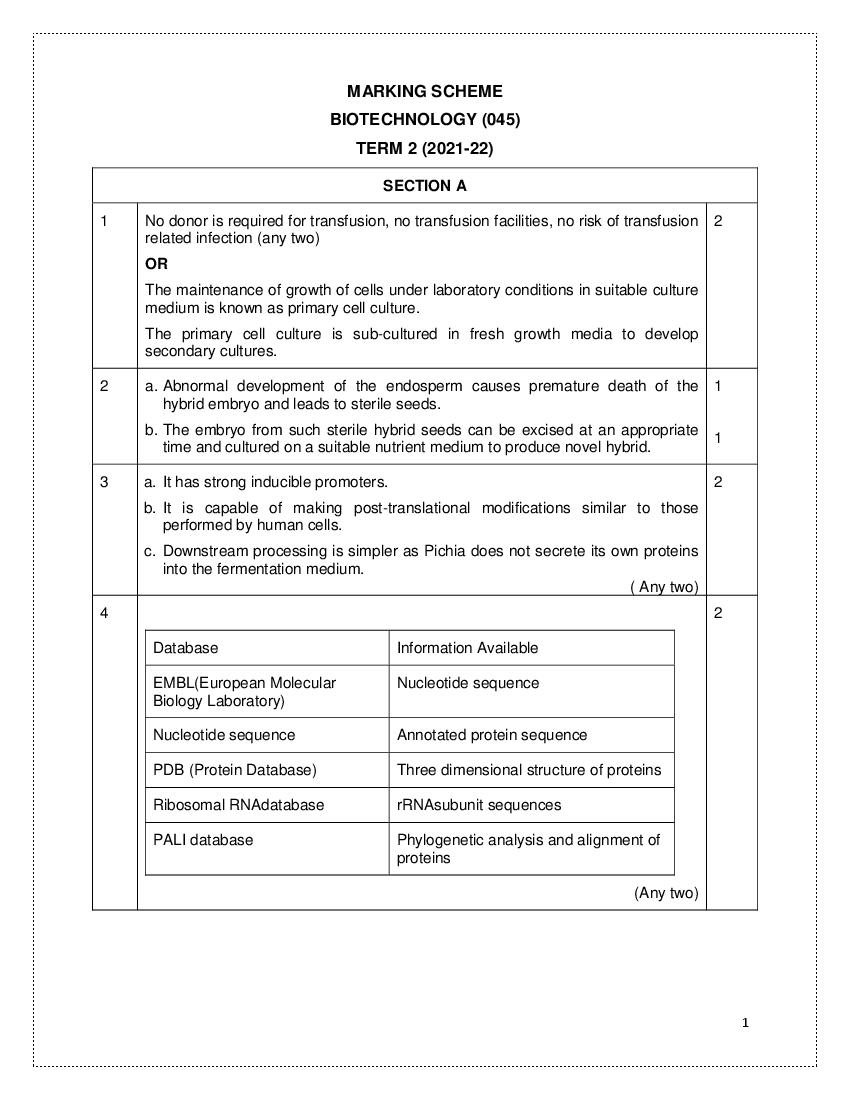
BIOTECHNOLOGY (045)
TERM 2 (2021-22)
SECTION A
1 No donor is required for transfusion, no transfusion facilities, no risk of transfusion 2
related infection (any two)
OR
The maintenance of growth of cells under laboratory conditions in suitable culture
medium is known as primary cell culture.
The primary cell culture is sub-cultured in fresh growth media to develop
secondary cultures.
2 a. Abnormal development of the endosperm causes premature death of the 1
hybrid embryo and leads to sterile seeds.
b. The embryo from such sterile hybrid seeds can be excised at an appropriate
1
time and cultured on a suitable nutrient medium to produce novel hybrid.
3 a. It has strong inducible promoters. 2
b. It is capable of making post-translational modifications similar to those
performed by human cells.
c. Downstream processing is simpler as Pichia does not secrete its own proteins
into the fermentation medium.
( Any two)
4 2
Database Information Available
EMBL(European Molecular Nucleotide sequence
Biology Laboratory)
Nucleotide sequence Annotated protein sequence
PDB (Protein Database) Three dimensional structure of proteins
Ribosomal RNAdatabase rRNAsubunit sequences
PALI database Phylogenetic analysis and alignment of
proteins
1
Page 2
1. Processing raw information: The experimentally determined sequence (raw
information) is processed using bioinformatics tools into genes, the proteins
encoded and their function, the regulatory sequences, and inferring
phylogenetic relationships.
2. Genes: Gene prediction can be done by using computer programs like Gene
Mark for bacterial genomes and GENSCAN for eukaryotes.
3. Proteins: Protein sequences can be inferred from the predicted genes by using
simple computer programs.
4. Regulatory sequences: Regulatory sequences can also be identified and
analysed by using bioinformatics tools.
5. Inferring phylogenetic relationships: Information regarding the relationships
between organisms can be obtained by aligning multiple sequences,
calculating evolutionary distance and constructing phylogenetic trees.
6. Making a Discovery: Using the bioinformatics tools and databases, the
functions of unknown genes can be predicted. (Any Two)
5 a. Somatic Hybrids 2
b. Cybrids ( Cytoplasmic hybrids )
c. Genetic trasformations
d. Metabolic studies
6 T-cells play a major role in rejection of foreign grafts and hence they are 1
responsible for the kidney transplant rejection.
OKT3 is a monoclonal antibody that targets CD3 surface markers (antigens)
1
present on mature T- cells and remove them from circulation and hence prevent
acute renal allograft rejection.
SECTION B
7 a. Gene knock out- selectively remove a gene. 1
b. Used to understand genetic basis of diseases, new diagnostic and 2
therapeutic modalities. (Any two)
8 a. Use of certain hormones can convert somatic cells into state similar to 1
embryos which are encapsulated to produce artificial seeds.
b. Artificial seeds are bigger in size/ long term storage/potential for automation.
2
9 The given sequence is compared with sequences in the database using 1
substitution matrices that specify scores to either 'reward' a match or
'penalize' a mismatch.
Top scoring matches are ranked according to set criteria that serve to 1
distinguish between a similarity due to ancestral relationship or due to
random chance.
True matches are further examined thoroughly with other details accessible
through Entrez and other tools available at NCBI. 1
2
Page 3
alcohol/ Production of secondary metabolites: antibiotics/ Biotransformation
reactions: enzymatic, steroids (Any one )
b. Strain improvement is done in order to maximize metabolite production by: 1
Mutant selection : There are two methods - Physical method; Chemical
Method
1
Genetic engineering
11 a. The genes encoding antigenic proteins can be isolated from pathogens and 3
expressed in plants. Such transgenic plants or their tissues producing
antigens can be eaten for vaccination / immunization. These are called edible
vaccines.
b. Edible vaccines offer following advantages over conventional vaccines.
Low cost
Alleviation of storage problems
Easy delivery system by feeding (any other relevant point)
(Any Two)
OR
Micropropagation using meristems.
No, these are not virus resistant.
Because meristems are virus-free but do not have resistance genes.
12 a. Using HAT medium 1
b. Monoclonal antibody which is used to treat early stages of breast cancer is 1
Herceptin (trastuzumab).
It works by attaching itself to HER2 receptors by blocking them from receiving
1
the growth signals.
SECTION C
a. The phase in which microbial cell specific growth rate is calculated is BC.
13 1
Log phase
b. n = 3.3 (log107-log104) 1
3.3(3) = 10 1
t = 240/10 = 24 min 1
Specific Growth rate constant = 0.693/1440 = 4.8x10 -4 /s
1
OR
a. The recombinant insulin is intracellular and to isolate it , we need to rupture
the cells as broth will be lacking the recombinant insulin.
b. Minimizing steps: Cost effective/ less denaturation of protein /higher yield.
c. Recombinant insulin
d. Antibiotics(term) /any example of antibiotics
e. Crude protein will have number of unwanted proteins which needs to
purified.
3
Document Details
| Board / Org | CBSE |
| Exam | Class 12 |
| Type | Solution |
| Pages | 3 |
| Language | english |
| Updated | 30 Apr 2026 |