aglasem.com
Schools Admission Mock Test Playground
ClassChoose class
StateSelect state

CBSE Class 12 Marking Scheme 2022 for Carnatic Music Percussion Term 2
Get here latest CBSE Class 10 Marking Scheme 2022 for Carnatic Music Percussion for Term 2 examination. It will help you check your answers after solving CBSE Sample Papers to prepare well for the Carnatic Music Percussion Term 2 examination. You can also download Term 2 Class 10 Carnatic Music Percussion Marking Scheme 2022 PDF. More Detail
CBSE Class 12 Marking Scheme 2022 for Carnatic Music Percussion Term 2 - Page 1 of 2

About CBSE Class 12 Marking Scheme 2022 for Carnatic Music Percussion Term 2

CBSE Class 12 Marking Scheme 2022 for Carnatic Music Percussion Term 2 is available here for free download. Published by CBSE for Class 12, this marking scheme can be viewed online or downloaded as a PDF (2 pages). Candidates preparing for Class 12 can use CBSE Class 12 Marking Scheme 2022 for Carnatic Music Percussion Term 2 to understand the exam pattern, the type of questions asked, and the overall difficulty level.

Frequently Asked Questions

How can I download CBSE Class 12 Marking Scheme 2022 for Carnatic Music Percussion Term 2?

Open this page and click the Download button to save CBSE Class 12 Marking Scheme 2022 for Carnatic Music Percussion Term 2 as a PDF. It is completely free on AglaSem Docs.

Is CBSE Class 12 Marking Scheme 2022 for Carnatic Music Percussion Term 2 free to download?

Yes. CBSE Class 12 Marking Scheme 2022 for Carnatic Music Percussion Term 2 can be viewed online and downloaded as a PDF free of cost on AglaSem Docs.

How many pages does CBSE Class 12 Marking Scheme 2022 for Carnatic Music Percussion Term 2 have?

CBSE Class 12 Marking Scheme 2022 for Carnatic Music Percussion Term 2 contains 2 pages, which you can read online or download together as a single PDF.

Where can I find more Class 12 study material?

You can find more Class 12 question papers, sample papers, syllabus, and answer keys on AglaSem Docs.

CBSE Class 12 Marking Scheme 2022 for Carnatic Music Percussion Term 2 – Text

Read the full text of this marking scheme below — useful to quickly search, copy and reference the content online without downloading the PDF.

📄 View text version (2 pages)

Page 1

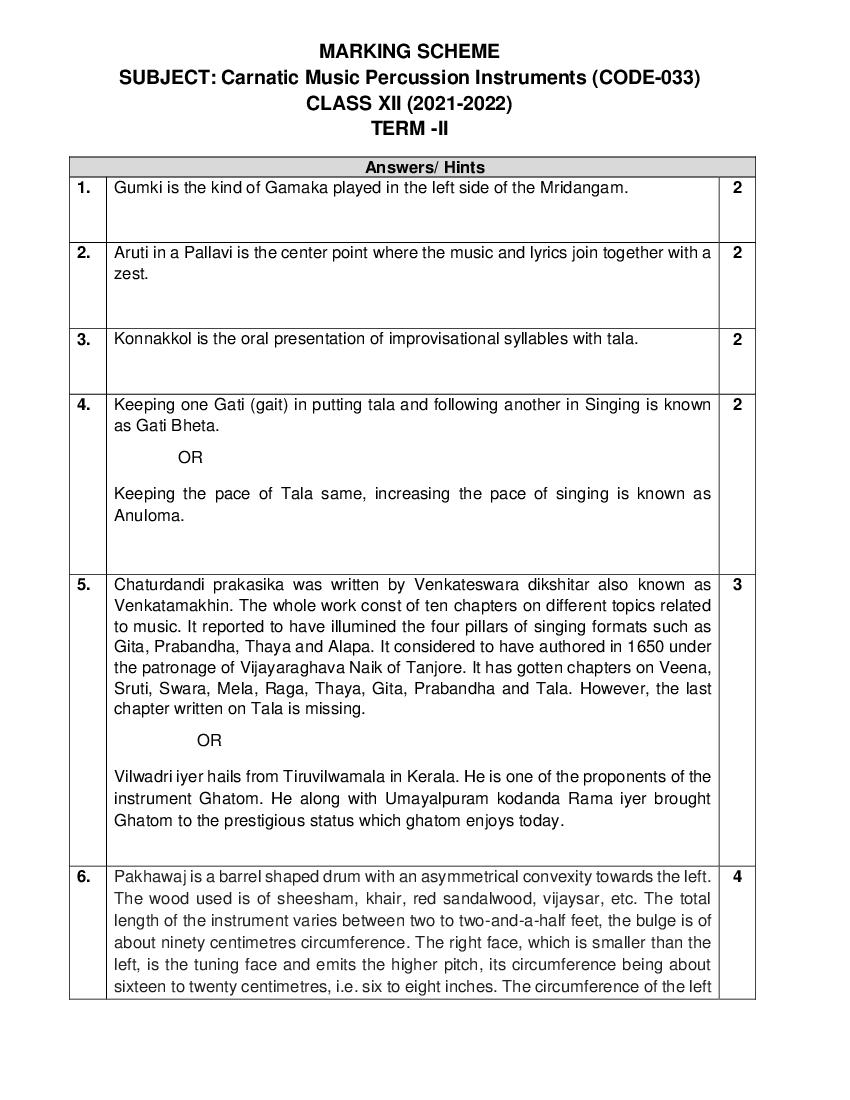
MARKING SCHEME SUBJECT: Carnatic Music Percussion Instruments (CODE-033) CLASS XII (2021-2022) TERM -II Answers/ Hints 1. Gumki is the kind of Gamaka played in the left side of the Mridangam. 2 2. Aruti in a Pallavi is the center point where the music and lyrics join together with a 2 zest. 3. Konnakkol is the oral presentation of improvisational syllables with tala. 2 4. Keeping one Gati (gait) in putting tala and following another in Singing is known 2 as Gati Bheta. OR Keeping the pace of Tala same, increasing the pace of singing is known as Anuloma. 5. Chaturdandi prakasika was written by Venkateswara dikshitar also known as 3 Venkatamakhin. The whole work const of ten chapters on different topics related to music. It reported to have illumined the four pillars of singing formats such as Gita, Prabandha, Thaya and Alapa. It considered to have authored in 1650 under the patronage of Vijayaraghava Naik of Tanjore. It has gotten chapters on Veena, Sruti, Swara, Mela, Raga, Thaya, Gita, Prabandha and Tala. However, the last chapter written on Tala is missing. OR Vilwadri iyer hails from Tiruvilwamala in Kerala. He is one of the proponents of the instrument Ghatom. He along with Umayalpuram kodanda Rama iyer brought Ghatom to the prestigious status which ghatom enjoys today. 6. Pakhawaj is a barrel shaped drum with an asymmetrical convexity towards the left. 4 The wood used is of sheesham, khair, red sandalwood, vijaysar, etc. The total length of the instrument varies between two to two-and-a-half feet, the bulge is of about ninety centimetres circumference. The right face, which is smaller than the left, is the tuning face and emits the higher pitch, its circumference being about sixteen to twenty centimetres, i.e. six to eight inches. The circumference of the left

Page 2

face is about twenty-five centimetres, i.e. around ten inches. The circumference of the two faces is variable and is always kept in relation to the size of the instrument. The parchment called 'Pudi' is prepared from two membranes, the inner complete skin and the outer peripheral ring. The two faces are held by braids and connected by leather straps, which are sixteen in number and called ghat or ghar. The skin used for pudi parchment is of goat, whereas the baddhi or the braces are made of buffalo leather. Between the braces there are eight tuning blocks. For tuning, the blocks are pushed with a hammer to the left or the right; the pitch can be raised or lowered by this process. The blocks used in pakhavaj are bigger than those used in tabla. There is no fixed weight or standard quantity of dough that should be applied, but the artist judges it by experience. The intention is to get the pitch of the left face just half of the right face, or if the half is not possible, it is reduced to one-third. The application of dough on the faces of percussion instruments is an old tradition, which is a very special characteristic of Indian drums. Till a few years ago the application of dough, as done on the left face of the pakhavaj, was also prevalent with the left drum of the tabla, but later it was substituted with a permanent mixture, i.e. 'syahi', which appeared more convenient. In some parts of Punjab, this is still prevalent in respect of the tabla. Application of the dough works in two ways, i.e. it controls the pitch of the left face and also gives depth and resonance to the tone, which leaves a majestic, sober impression on the listener.

Document Details

Board / OrgCBSE
ExamClass 12
TypeSolution
Pages2
Updated30 Apr 2026