Page 1
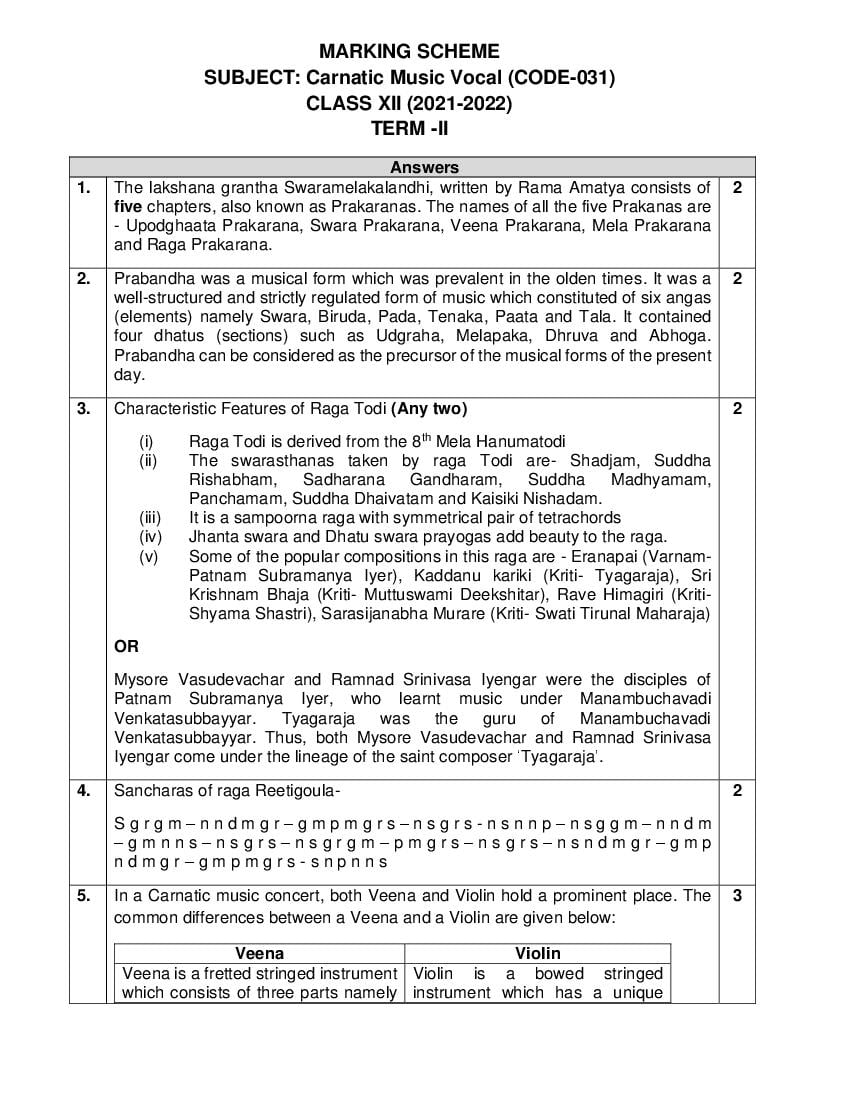
MARKING SCHEME SUBJECT: Carnatic Music Vocal (CODE-031) CLASS XII (2021-2022) TERM -II Answers 1. The lakshana grantha Swaramelakalandhi, written by Rama Amatya consists of 2 five chapters, also known as Prakaranas. The names of all the five Prakanas are - Upodghaata Prakarana, Swara Prakarana, Veena Prakarana, Mela Prakarana and Raga Prakarana. 2. Prabandha was a musical form which was prevalent in the olden times. It was a 2 well-structured and strictly regulated form of music which constituted of six angas (elements) namely Swara, Biruda, Pada, Tenaka, Paata and Tala. It contained four dhatus (sections) such as Udgraha, Melapaka, Dhruva and Abhoga. Prabandha can be considered as the precursor of the musical forms of the present day. 3. Characteristic Features of Raga Todi (Any two) 2 (i) Raga Todi is derived from the 8th Mela Hanumatodi (ii) The swarasthanas taken by raga Todi are- Shadjam, Suddha Rishabham, Sadharana Gandharam, Suddha Madhyamam, Panchamam, Suddha Dhaivatam and Kaisiki Nishadam. (iii) It is a sampoorna raga with symmetrical pair of tetrachords (iv) Jhanta swara and Dhatu swara prayogas add beauty to the raga. (v) Some of the popular compositions in this raga are - Eranapai (Varnam- Patnam Subramanya Iyer), Kaddanu kariki (Kriti- Tyagaraja), Sri Krishnam Bhaja (Kriti- Muttuswami Deekshitar), Rave Himagiri (Kriti- Shyama Shastri), Sarasijanabha Murare (Kriti- Swati Tirunal Maharaja) OR Mysore Vasudevachar and Ramnad Srinivasa Iyengar were the disciples of Patnam Subramanya Iyer, who learnt music under Manambuchavadi Venkatasubbayyar. Tyagaraja was the guru of Manambuchavadi Venkatasubbayyar. Thus, both Mysore Vasudevachar and Ramnad Srinivasa Iyengar come under the lineage of the saint composer ‘Tyagaraja’. 4. Sancharas of raga Reetigoula- 2 Sgrgm–nndmgr–gmpmgrs–nsgrs-nsnnp–nsggm–nndm –gmnns–nsgrs–nsgrgm–pmgrs–nsgrs–nsndmgr–gmp ndmgr–gmpmgrs-snpnns 5. In a Carnatic music concert, both Veena and Violin hold a prominent place. The 3 common differences between a Veena and a Violin are given below: Veena Violin Veena is a fretted stringed instrument Violin is a bowed stringed which consists of three parts namely instrument which has a unique
Page 2
Kudam, Dandi and Vyaali, having 4 shape similar to an hourglass, main strings and 3 side strings. having four strings in it. Veena is generally made of Jack Mostly, Violins are made of wood or Black wood. different types of woods like Maple, Ebony, Spruce, Rosewood etc. While playing the veena, the index While playing the Violin, the bow is and middle fingers of the right hand held in the right hand which moves are used to pluck the main string over the strings and at the same while the little finger is used to time, the fingers of the left hand reckon the tala. At the same time, are used to play the notes by the index and middle finger of the left moving up and down on the finger hand are used for playing the notes board. by gliding over the main strings which pass over the frets. OR While notating a Kriti, three important aspects such a Tala, duration of the swara and the Sthayi are indicated. 1. Tala – Two parallel vertical lines (ǁ) indicate the beginning and end of a tala whereas a single vertical line (│) is used to bifurcate the different angas within a tala. 2. Duration- Letters in small case (s) indicate a duration of one aksharakala while letters in upper case (S) are used for denoting two aksharakalas. Further, a coma placed after a swara (r ,) increases its duration by one aksharakala while a semi- colon placed after the swara ( g ;) increases its duration by two aksharakalas. 3. Sthayi- A dot placed above a swara indicates Taara Sthayi and a dot placed below a swara indicates that it belongs to the Mandra Sthayi. Swaras without any dots indicates that they belong to the Madhya Sthayi. 6. In a Carnatic music concert, a musician can exhibit his/her creativity through 4 different aspects of Manodharma sangeeta. In a Raga Alapana the musician improvises on the melodic aspect of the raga. In the next form of improvisation known as ‘Niraval’, the artist explores the different dimensions of a raga through one or two lines of lyrics, selected from the composition. ‘Swara Kalpana’ is another aspect of manodharma sangeeta wherein different swara patterns, according to the rhythmic structure of the composition, are beautifully weaved and presented, creating excitement in the listeners. The most important part of Manodharma Sangeeta is the presentation of ‘Ragam-Tanam-Pallavi’ in which the musician portrays the essence of a raga through Raga Alapana and Tanam exposition. Further, the musician composes a Pallavi having lyrics for one or two lines, with attractive lyrical and rhythmic structure. After improvising on that Pallavi with different melodic and rhythmic patterns, Niraval and Swara Kalpana are also presented. Lastly, Viruttam singing also forms a part of manodharma sangeeta, in which the singer delineates a verse or poetry by clothing it in beautiful melodic structure.