HBSE Class 11 Sample Paper 2026 Answers Biology
Finished viewing? Save it for later —
Download HBSE Class 11 Sample Paper 2026 Answers Biology (PDF · 11 pages)About HBSE Class 11 Sample Paper 2026 Answers Biology
HBSE Class 11 Sample Paper 2026 Answers Biology is available here for free download. Published by Haryana Board for Class 11, this answer key can be viewed online or downloaded as a PDF (11 pages). Candidates preparing for Class 11 can use HBSE Class 11 Sample Paper 2026 Answers Biology to understand the exam pattern, the type of questions asked, and the overall difficulty level.
Frequently Asked Questions
How can I download HBSE Class 11 Sample Paper 2026 Answers Biology?
Open this page and click the Download button to save HBSE Class 11 Sample Paper 2026 Answers Biology as a PDF. It is completely free on AglaSem Docs.
Is HBSE Class 11 Sample Paper 2026 Answers Biology free to download?
Yes. HBSE Class 11 Sample Paper 2026 Answers Biology can be viewed online and downloaded as a PDF free of cost on AglaSem Docs.
How many pages does HBSE Class 11 Sample Paper 2026 Answers Biology have?
HBSE Class 11 Sample Paper 2026 Answers Biology contains 11 pages, which you can read online or download together as a single PDF.
Where can I find more Class 11 study material?
You can find more Class 11 question papers, sample papers, syllabus, and answer keys on AglaSem Docs.
HBSE Class 11 Sample Paper 2026 Answers Biology – Text
Read the full text of this answer key below — useful to quickly search, copy and reference the content online without downloading the PDF.
📄 View text version (11 pages)
Page 1
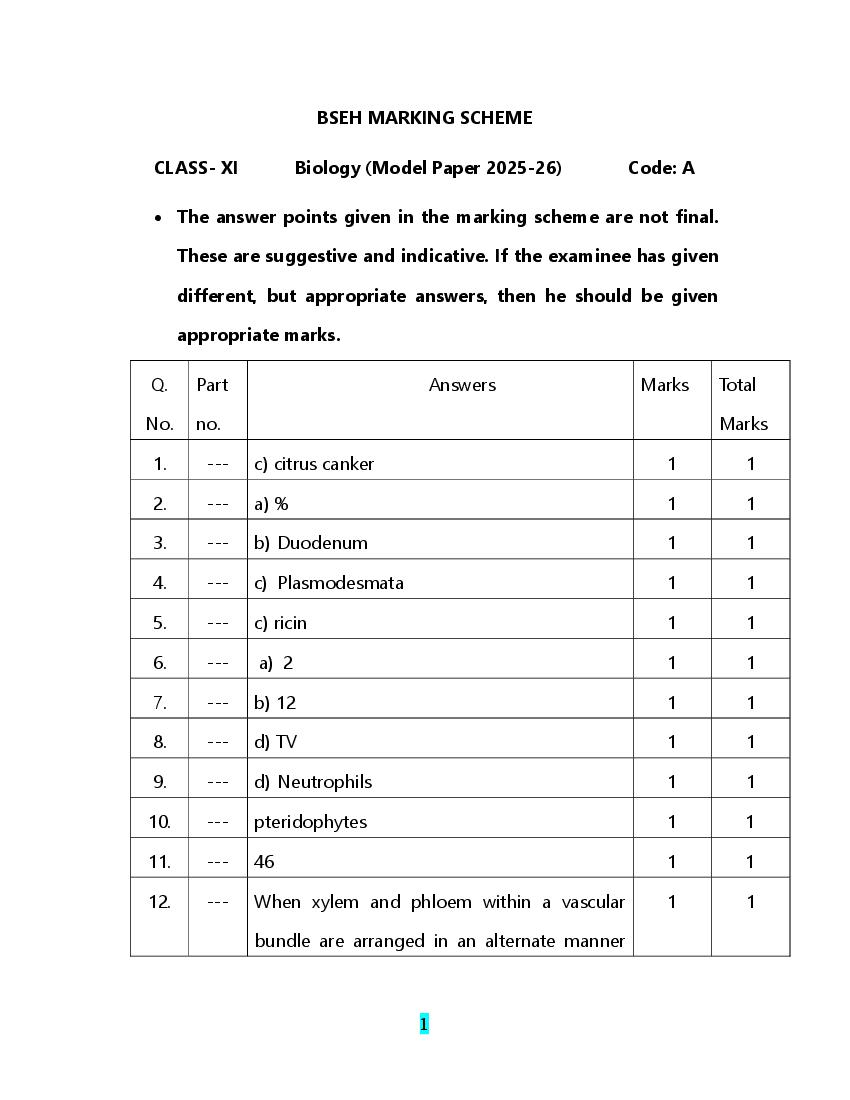
CLASS- XI Biology (Model Paper 2025-26) Code: A
The answer points given in the marking scheme are not final.
These are suggestive and indicative. If the examinee has given
different, but appropriate answers, then he should be given
appropriate marks.
Q. Part Answers Marks Total
No. no. Marks
1. --- c) citrus canker 1 1
2. --- a) % 1 1
3. --- b) Duodenum 1 1
4. --- c) Plasmodesmata 1 1
5. --- c) ricin 1 1
6. --- a) 2 1 1
7. --- b) 12 1 1
8. --- d) TV 1 1
9. --- d) Neutrophils 1 1
10. --- pteridophytes 1 1
11. --- 46 1 1
12. --- When xylem and phloem within a vascular 1 1
bundle are arranged in an alternate manner
1
Page 2
along the different radii, the arrangement is
called radial.
13. --- Four 1 1
14. --- Embryonic 1 1
15. --- ABA or Abscisic acid 1 1
16. --- d) A is false but R is true. 1 1
17. --- a) Both A and R are true, and R is the correct 1 1
explanation of A.
18. --- b) Both A and R are true, and R is not the 1 1
correct explanation of A.
19. Similar Taxon: 1 2
Kingdom-Plantae /
Division-Angiospermae
Different Taxon: ½+½
Species- indica and aestivum/
Genus- Mangifera and Triticum /
Family- Anacardiaceae and Poaceae /
Order – Sapindales and Poales/
Class – Dicotyledonae and Monocotyledonae
Or Or
Felis and Panthera
2
2
Biology Code: A
Page 3
20. Virus: DNA/RNA and Protein 1 2
Viroid: Only RNA ½
Prions: Only protein ½
21. Number of bones: 22 1
2
Fibrous Joints 1
22. Cutaneous Respiration – Skin ½+½
2
Pulmonary Respiration – Lungs ½+½
23. When stamens are attached to the petals, they 1
are epipetalous.
When stamens are attached to perianth, they 1
are epiphyllous.
Or Or 2
1. Veins provide rigidity to the leaf blade 1
2. Veins act as channels of transport for 1
water, minerals, and food materials.
24. 1. When the bulliform cells in the leaves 1
have absorbed water and are turgid, the
leaf surface is exposed.
2
2. When they are flaccid due to water 1
stress, they make the leaves curl inwards
to minimise water loss.
3
Biology Code: A
Page 4
25. Oils: Elaioplasts 1
Proteins: Aleuroplasts 1
Or 2
erythrocytes of many mammals 1
sieve tube cells of vascular plants 1
26. Notochord: Absent ½
Segmentation: Absent ½
Coelom: True coelom/present ½
3
Level of organisation: Organ-system level ½
Symmetry: Bilateral ½
Type of development: Indirect ½
27. i) Chondrichthyes / Cartilaginous fish 1
ii) Aves/ Birds 1 3
iii) Arthropoda 1
28. i. Renal calculi: Stone or insoluble mass of ½+½
crystallised salts formed within the kidney
ii. Glomerulonephritis: Inflammation of ½+½
glomeruli of kidney.
3
iii. Uremia: Malfunctioning of kidneys can ½+½
lead to accumulation of urea in blood
Or
i. Ammonotelic: bony fishes/ ½+½
4
Biology Code: A
Page 5
aquatic amphibians/ aquatic insects
ii. Ureotelic: Mammals/ ½+½
terrestrial amphibians/ marine fishes
iii. Uricotelic: Reptiles/ birds/ land snails ½+½
29. Feature C 3 Plants C 4 Plants
photorespiration Yes No 1
optimum 1
20-25 0 C 30-40 0 C
temperature
3
Phospho 1
primary CO2 glyceric Oxalo acetic
fixation product acid acid (OAA)
(PGA)
30. i. Green algae: Photosynthesis/ food 1
supplements
ii. Brown algae: Hydrocolloids like algin 1
iii. Red algae: Carrageen/ Agar as 1
hydrocolloids
3
Or
The first stage of gametophyte is the
protonema stage.
½+½
It develops directly from a spore.
5
Biology Code: A
Page 6
The second stage is the leafy stage, which
develops from the secondary protonema.
½+½
Sex organs antheridia and archegonia are
produced at the apex of the leafy shoots.
After fertilisation, the zygote develops into a
sporophyte, consisting of a foot, seta and
capsule.
½+½
The capsule contains spores which give rise to
gametophyte.
31. i) 20 1
ii) Insulin 1
Or
Enables glucose transport into cells
4
iii) Ribulose bisphosphate Carboxylase- 1
Oxygenase (RuBisCO)
iv) Because proteins has 20 different type of 1
monomers repeating ‘n’ number of times.
32. i) inner parts of cerebral hemispheres 1
amygdala ½
4
hippocampus ½
ii) dura mater 1
6
Biology Code: A
Page 7
iii) Cerebrum 1
Or
Mid brain
33. gastrin ½
secretin ½
cholecystokinin (CCK) ½
gastric inhibitory peptide (GIP) ½
i) Gastrin acts on the gastric glands and
stimulates the secretion of hydrochloric acid
and pepsinogen.
ii) Secretin acts on the exocrine pancreas and Any
stimulates secretion of water and bicarbonate three (1
ions. mark 5
iii) CCK acts on both pancreas and gall each)
bladder and stimulates the secretion of
pancreatic enzymes and bile juice,
respectively.
iv) GIP inhibits gastric secretion and motility.
Or
i) Thyroxine, Thyroid gland ½+½
ii) Insulin, Pancreas ½+½
iii) Anti-diuretic hormone (ADH), Pituitary Gland ½+½
7
Biology Code: A
Page 8
iv) Growth hormone, Pituitary Gland ½+½
v) Adrenaline, Adrenal gland ½+½
34. ½ mark
for
each
correct
step
5
Or
i. Pyruvate + CoA + NAD+ 1
Acetyl Co A + NADH + H++ CO2
ii. Citric Acid + NAD+ 1
α-ketoglutaric acid+ NADH + H++ CO2
iii. α-ketoglutaric acid+GDP + NAD+ 1
Succinic acid+GTP + NADH + H++ CO2
8
Biology Code: A
Page 9
iv. Succinic Acid + FAD+ 1
Malic acid+ FADH2
v. Malic Acid + NAD+ 1
Oxaloacetic acid+ NADH + H+
35. 2½
5
G1 Phase: the cell is metabolically active and ½
continuously grows but does not replicate its
DNA
S Phase: S or synthesis phase marks the period ½
during which DNA synthesis or replication
takes place.
G2 Phase: During the G2 phase, proteins are ½
synthesised in preparation for mitosis while
cell growth continues.
9
Biology Code: A
Page 10
M Phase: The M Phase represents the phase ½
when the actual cell division or mitosis occurs.
G0 Phase: cells that do not divide further exit ½
G1 phase to enter an inactive stage called
quiescent stage of the cell cycle. Cells in this
stage remain metabolically active but no
longer proliferate
Or
i. Leptotene: ½+½
the chromosomes become gradually visible
under the light microscope and compaction of
chromosomes continues throughout it.
ii. Zygotene: ½+½
During this stage chromosomes start pairing
together and this process of association is
called synapsis.
iii. Pachytene: ½+½
During this stage, the four chromatids of each
bivalent chromosomes becomes distinct and
clearly appears as tetrads and this stage is
characterised by the appearance of
recombination nodules, the sites at which
10
Biology Code: A
Page 11
crossing over occurs between non-sister
chromatids of the homologous chromosomes.
iv. Diplotene: ½+½
It is recognised by the dissolution of the
synaptonemal complex and the tendency of
the recombined homologous chromosomes of
the bivalents to separate from each other
except at the sites of crossovers.
v. Diakinesis: ½+½
During this phase the chromosomes are fully
condensed and the meiotic spindle is
assembled to prepare the homologous
chromosomes for separation.
11
Biology Code: A
Document Details
| Board / Org | Haryana Board |
| Exam | Class 11 |
| Type | Sample Paper |
| Pages | 11 |
| Updated | 24 Sep 2026 |