CBSE Class 12 Marking Scheme 2022 for Chemistry Term 2
Finished viewing? Save it for later —
Download CBSE Class 12 Marking Scheme 2022 for Chemistry Term 2 (PDF · 6 pages)About CBSE Class 12 Marking Scheme 2022 for Chemistry Term 2
CBSE Class 12 Marking Scheme 2022 for Chemistry Term 2 is available here for free download. Published by CBSE for Class 12, this marking scheme can be viewed online or downloaded as a PDF (6 pages). Candidates preparing for Class 12 can use CBSE Class 12 Marking Scheme 2022 for Chemistry Term 2 to understand the exam pattern, the type of questions asked, and the overall difficulty level.
Frequently Asked Questions
How can I download CBSE Class 12 Marking Scheme 2022 for Chemistry Term 2?
Open this page and click the Download button to save CBSE Class 12 Marking Scheme 2022 for Chemistry Term 2 as a PDF. It is completely free on AglaSem Docs.
Is CBSE Class 12 Marking Scheme 2022 for Chemistry Term 2 free to download?
Yes. CBSE Class 12 Marking Scheme 2022 for Chemistry Term 2 can be viewed online and downloaded as a PDF free of cost on AglaSem Docs.
How many pages does CBSE Class 12 Marking Scheme 2022 for Chemistry Term 2 have?
CBSE Class 12 Marking Scheme 2022 for Chemistry Term 2 contains 6 pages, which you can read online or download together as a single PDF.
Where can I find more Class 12 study material?
You can find more Class 12 question papers, sample papers, syllabus, and answer keys on AglaSem Docs.
CBSE Class 12 Marking Scheme 2022 for Chemistry Term 2 – Text
Read the full text of this marking scheme below — useful to quickly search, copy and reference the content online without downloading the PDF.
📄 View text version (6 pages)
Page 1
TERM – II
CHEMISTRY THEORY (043)
MM:35 Time: 2 Hours
1. (a)Picric acid < salicylic acid < benzoic acid <phenol 1
(b)Methyl tert – butyl ketone < acetone< Acetaldehyde 1
(c)ethanol <ethanoic acid < benzoic acid (boiling point of carboxylic acids is higher 1
than alcohols due to extensive hydrogen bonding , boiling point increases with
increase in molar mass)
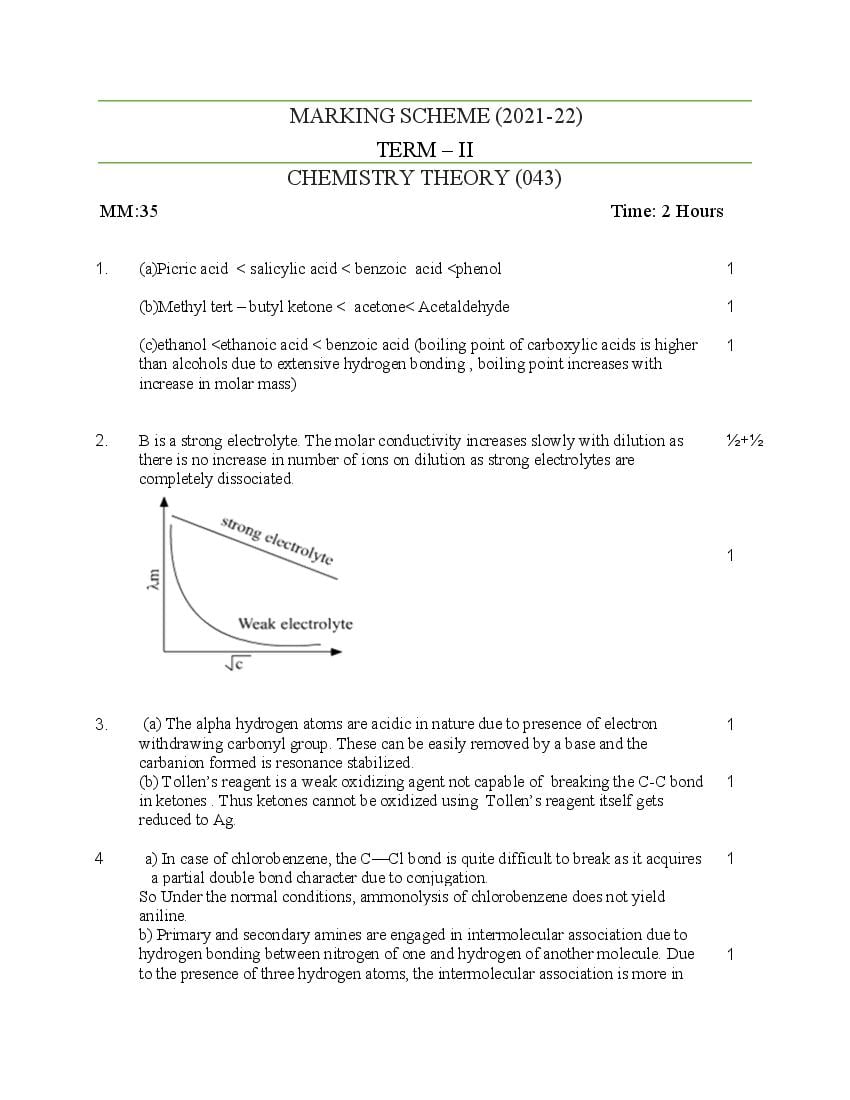
2. B is a strong electrolyte. The molar conductivity increases slowly with dilution as ½+½
there is no increase in number of ions on dilution as strong electrolytes are
completely dissociated.
1
3. (a) The alpha hydrogen atoms are acidic in nature due to presence of electron 1
withdrawing carbonyl group. These can be easily removed by a base and the
carbanion formed is resonance stabilized.
(b) Tollen’s reagent is a weak oxidizing agent not capable of breaking the C-C bond 1
in ketones . Thus ketones cannot be oxidized using Tollen’s reagent itself gets
reduced to Ag.
4 a) In case of chlorobenzene, the C—Cl bond is quite difficult to break as it acquires 1
a partial double bond character due to conjugation.
So Under the normal conditions, ammonolysis of chlorobenzene does not yield
aniline.
b) Primary and secondary amines are engaged in intermolecular association due to
hydrogen bonding between nitrogen of one and hydrogen of another molecule. Due 1
to the presence of three hydrogen atoms, the intermolecular association is more in
Page 2
for hydrogen bond formation in it.
c) During the acylation of aniline, stronger base pyridine is added. This done in order
to remove the HCl so formed during the reaction and to shift the equilibrium to the 1
right hand side.
OR
1
1
1
5 (a) The colour of coordination compound depends upon the type of ligand and d- 1
d transition taking place .
H2O is weak field ligand , which causes small splitting , leading to the d-d
transition corresponding green colour , however due to the presence of ( en )
which ia strong field ligand , the splitting is increased . Due to the change in
t2g -eg splitting the colouration of the compound changes from green to blue.
(b)Formula of the compound is [Co(H2NCH2CH2NH2 )3 ]2 (SO4 )3
The hybridisation of the compound is: d2sp3 1
Page 3
a)As the fourth electron enters one of the eg orbitals giving the configuration t2g3 eg1
,which indicates ∆o < P hence forms high spin complex.
1
b)
2
6 (a) Ti is having electronic configuration [Ar] 3d2 4s2. Ti (IV) is more stable as 1
Ti4+ acquires nearest noble gas configuration on loss of 4 e-.
(b)In case of transition elements, ions of the same charge in a given series show 1
progressive decrease in radius with increasing atomic number.
As the new electron enters a d orbital each time the nuclear charge increases by
unity. The shielding effect of a d electron is not that effective, hence the net
electrostatic attraction between the nuclear charge and the outermost electron
increases and the ionic radius decreases.
(c)Iron and Chromium are having high enthalpy of atomization due to the presence
of unpaired electrons, which accounts for their hardness. However, Zinc has low 1
enthalpy of atomization as it has no unpaired electron. Hence zinc is comparatively
a soft metal.
7 Compound A is an alkene, on ozonolysis it will give carbonyl compounds. As both
B and C have >C=O group,
B gives positive Fehling’s test so it is an aldehyde and it gives iodoform test so it is
so it has CH3C=O group. This means the aldehyde is acetaldehyde
C does not give Fehling’s test, so it is a ketone. It gives positive iodoform test so it is
a methyl ketone means it has CH3C=O group
Compound A (C5H10) on ozonlysis gives B (CH3CHO) + C (CH3COR)
So “C” is CH3COCH3 ½
CH3CH=C(CH3)2 (i)O3 (ii) Zn/H3O+ CH3CHO + CH3COCH3
Page 4
CH3COCH3 + 2Cu2+ + 5OH- No reaction ½
CH3CHO + 3I2 + 3 NaOH CHI3 (yellow ppt) + 3HI + HCOONa
CH3COCH3 + 3I2 + 3 NaOH CHI3 (yellow ppt) + 3HI + CH3COONa ½
A = CH3CH=C(CH3)2 ½
B = CH3CHO ½
C = CH3COCH3 ½
8 (a)electrodialysis 1
(b)purification of colloidal solution 1
(c)Yes. Dialysis is a very slow process to increase its speed electric field is applied ½+½
9 (a)When N-ethylethanamine reacts with benzenesulphonyl chloride , 1
N,N-diethylbenzenesulphonamide is formed.
b)When benzylchloride is treated with ammonia , Benzylamine is formed which on ½+½
reation with Chloromethane yields a secondary amine ,
N-methylbenzylamine .
c)When aniline reacts with chloroform in the presence of alcoholic potassium 1
hydroxide ,
phenyl isocyanides or phenyl isonitrile is formed .
OR
(i)
N-Ethyl-N-methylbenzenamine or N-Ethyl-N-ethylaniline 1
(ii) ½
each
10 Al(s) /Cd2+ (0.1M) // Al3+ (0.01M) /Cd(s) ½
2Al(s) + 3Cd2+ (0.1M) 3Cd (s) + 2Al3+ (0.01M)
Ecell = Eocell -0.059 log [Al3+]2 ½
n [Cd2+]3
Ecell= 1.26 – 0.059 log (0.01)2
6 (0.1)3 ½
Page 5
6
= 1.26+0.009 ½
= 1.269 V ans
unit
11
(a) The ability of fluorine to stabilize the highest oxidation state is attributed to 1
the higher lattice energy or high bond enthalpy.
1
(b) Co2+ has three unpaired electrons so it would be paramagnetic in nature, hence
Co2+ ion would be attracted to magnetic field.
(c) The transition elements of 5d series have intervening 4f orbitals. There is greater 1
effective nuclear charge acting on outer valence electrons due to the weak shielding
by 4f electrons. Hence first ionisation energy of 5 d series of transition elements are
higher than that of 3d and 4d series.
OR 1
a)Manganese is having lower melting point as compared to chromium , as it has
highest number of unpaired electrons , strong interatomic metal bonding , hence no
delocalisation of electrons .
b) There is much more frequent metal – metal bonding in compounds of the heavy 1
transition metals i.e 4d and 5d series , whixh accounts for lower melting point of 3d
series. 1
c) Tungsten
12 (a) Ratio of neutrons to protons is 2.3: 1 which is not the stable ratio of 1:1 1
(b)Age of fossils can be estimated by C-14 decay. All living organisms have C-14 1
which decays without being replaced back once the organism dies.
(c) carbon-14 atoms decay to stable nitrogen atoms and potassium-40 atoms decay to 1
stable calcium
(d)t = 2.303/ k log (Co/Ct) ½
Co = 20 g Ct = ?
t = 10320 years k = 0.693/6000 (half-life given in passage)
substituting in equation:
10320 = 2.303 / (0.693/6000) log 20/ Ct ½
0.517 = log 20 / Ct anlilog (0.517) = 20/Ct
3.289 = 20/Ct ½
Ct = 6.17 g ½
OR
t = 2.303/ k log (Co/Ct) ½
Co = 32 g Ct = 12
t = ? k = 0.693/6000 (half life given in passage)
substituting in equation:
t = 2.303 / (0.693/6000) log 32/ 12 ½
t = 2.303 x 60000 /0.693 log 2.667 ½
t = 2.303x6000x0.4260 /0.693
Page 6
Document Details
| Board / Org | CBSE |
| Exam | Class 12 |
| Type | Solution |
| Pages | 6 |
| Language | english |
| Updated | 30 Apr 2026 |