CBSE Class 12 Marking Scheme 2022 for Graphic Term 2
Finished viewing? Save it for later —
Download CBSE Class 12 Marking Scheme 2022 for Graphic Term 2 (PDF · 4 pages)About CBSE Class 12 Marking Scheme 2022 for Graphic Term 2
CBSE Class 12 Marking Scheme 2022 for Graphic Term 2 is available here for free download. Published by CBSE for Class 12, this marking scheme can be viewed online or downloaded as a PDF (4 pages). Candidates preparing for Class 12 can use CBSE Class 12 Marking Scheme 2022 for Graphic Term 2 to understand the exam pattern, the type of questions asked, and the overall difficulty level.
Frequently Asked Questions
How can I download CBSE Class 12 Marking Scheme 2022 for Graphic Term 2?
Open this page and click the Download button to save CBSE Class 12 Marking Scheme 2022 for Graphic Term 2 as a PDF. It is completely free on AglaSem Docs.
Is CBSE Class 12 Marking Scheme 2022 for Graphic Term 2 free to download?
Yes. CBSE Class 12 Marking Scheme 2022 for Graphic Term 2 can be viewed online and downloaded as a PDF free of cost on AglaSem Docs.
How many pages does CBSE Class 12 Marking Scheme 2022 for Graphic Term 2 have?
CBSE Class 12 Marking Scheme 2022 for Graphic Term 2 contains 4 pages, which you can read online or download together as a single PDF.
Where can I find more Class 12 study material?
You can find more Class 12 question papers, sample papers, syllabus, and answer keys on AglaSem Docs.
CBSE Class 12 Marking Scheme 2022 for Graphic Term 2 – Text
Read the full text of this marking scheme below — useful to quickly search, copy and reference the content online without downloading the PDF.
📄 View text version (4 pages)
Page 1
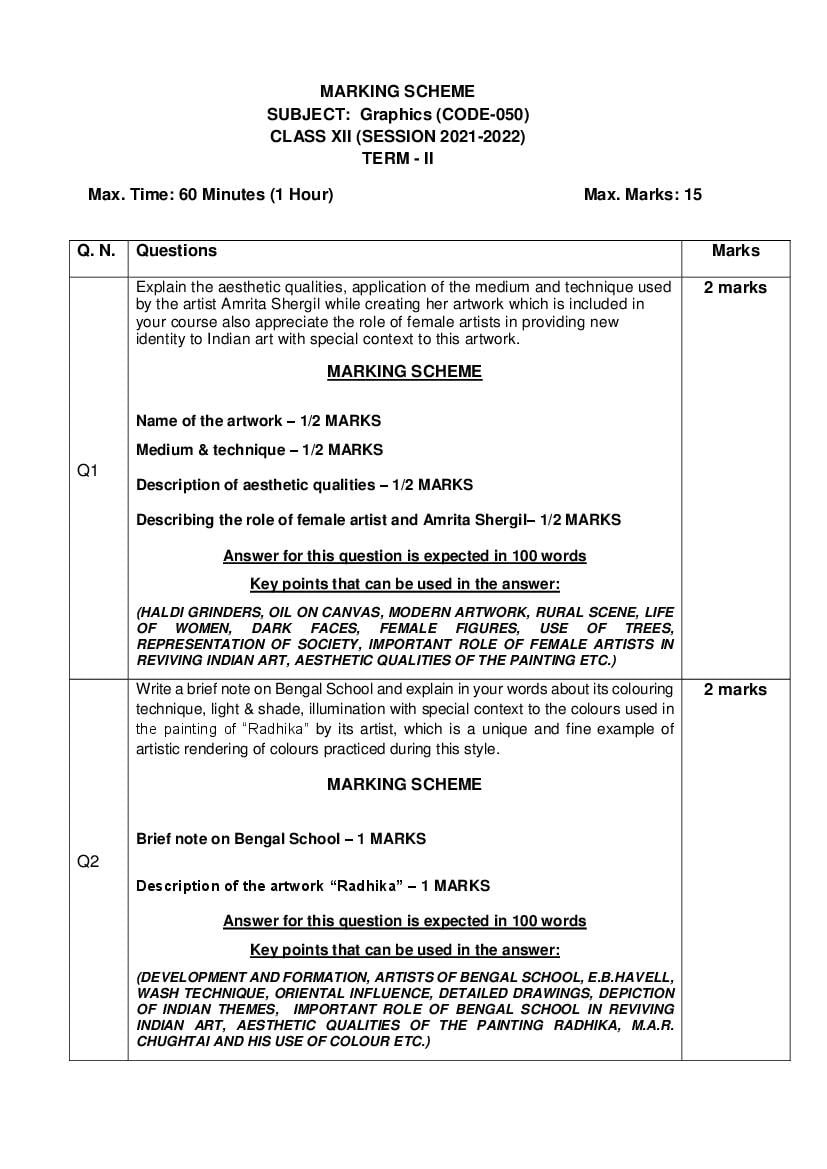
CLASS XII (SESSION 2021-2022)
TERM - II
Max. Time: 60 Minutes (1 Hour) Max. Marks: 15
Q. N. Questions Marks
Explain the aesthetic qualities, application of the medium and technique used 2 marks
by the artist Amrita Shergil while creating her artwork which is included in
your course also appreciate the role of female artists in providing new
identity to Indian art with special context to this artwork.
Name of the artwork – 1/2 MARKS
Medium & technique – 1/2 MARKS
Q1
Description of aesthetic qualities – 1/2 MARKS
Describing the role of female artist and Amrita Shergil– 1/2 MARKS
(HALDI GRINDERS, OIL ON CANVAS, MODERN ARTWORK, RURAL SCENE, LIFE
OF WOMEN, DARK FACES, FEMALE FIGURES, USE OF TREES,
REPRESENTATION OF SOCIETY, IMPORTANT ROLE OF FEMALE ARTISTS IN
REVIVING INDIAN ART, AESTHETIC QUALITIES OF THE PAINTING ETC.)
Write a brief note on Bengal School and explain in your words about its colouring 2 marks
technique, light & shade, illumination with special context to the colours used in
the painting of “Radhika” by its artist, which is a unique and fine example of
artistic rendering of colours practiced during this style.
Brief note on Bengal School – 1 MARKS
Q2
Description of the artwork “Radhika” – 1 MARKS
(DEVELOPMENT AND FORMATION, ARTISTS OF BENGAL SCHOOL, E.B.HAVELL,
WASH TECHNIQUE, ORIENTAL INFLUENCE, DETAILED DRAWINGS, DEPICTION
OF INDIAN THEMES, IMPORTANT ROLE OF BENGAL SCHOOL IN REVIVING
INDIAN ART, AESTHETIC QUALITIES OF THE PAINTING RADHIKA, M.A.R.
CHUGHTAI AND HIS USE OF COLOUR ETC.)
Page 2
The three dimensionality of the sculptures are complemented and supported by
the natural surroundings which can be appreciated in the sculpture named
“Santhal Family” & “Triumph of Labour” justify this statement in your words by
comparing artistic qualities of both the sculptures.
Description of the sculpture “Santhal Family” – 1 MARKS
Q3 Description of the sculpture “Triumph of Labour” – 1 MARKS
(MEDIUM OF SCULPTURE, NAME OF THE SCULPTORS, EMOTIONS DEPICTED,
USE OF NATURAL SURROUNDINGS, DEPICTION OF HUMAN FORMS, SUBJECT
MATTER AND COMPOSITION BASED COMPARISON OR EXPLANATION ETC.)
(a) Write a short note on the origin and development of the 2 marks
“Indian National Flag”.
(i) Throw light on the significance of its colours with special context to the
symbolic interpretation of tri colours.
(ii) The Ashoka chakra and the significance of its 24 spokes used in our flag.
Evolution and development of Flag – 1 MARKS
Significance of tri colours and Ashoka Chakra – 1 MARKS
Q4 Answer for this question is expected in 100 words
(EVOLUTION OF OUR FLAG, IMPORTANT CHANGE IN DESIGN, SIGNIFICANCE OF
COLOURS USED IN OUR FLAG, IMPORTANCE OF CHAKRA, 24 HOURS
COMMITMENT TO DUTY, SACRIFICE, COURAGE, PEACE, PROSPERITY, RATIO
OF THE FLAG ETC.)
OR
(b) How did the Indian artists through their paintings and artworks inspired and
evoked the feeling of Nationalism with in the masses during our freedom
struggle? Give your opinion on the revival of Indian art during the time of
independence and justify your answer with special context to the use of
Indian themes and connecting Indian art with the common people by the
master artist Raja Ravi Verma.
Page 3
Description about Paintings & artworks of Raja Ravi Verma – 1 MARKS
(USE OF PAINTINGS AS A MEDIUM OF INSPIRATIONAL COMMUNICATION FOR
FREEDOM STRUGGLE, PROMOTION OF INDIAN AND FOLK THEMES, MAKING
ART REACHABLE TO COMMON PEOPLE, OLEOGRAPHS, REPRODUCTION OF
ARTWORKS AS CALENDAR IMAGES, MYTHOLOGICAL CHARACTERS PAINTED
REALISTICALLY, OIL PAINTINGS, RAMA VANQUISHING PRIDE OF THE OCEAN,
ARTISTIC DETAILS OF THE ARTWORK ETC.)
3 marks
(a) A collapsed camel is shown in red background of dusk. The artist tried to
capture the portrait and narration with the help of symbolic aesthetics on
one hand and literary allusions on the other. The physical features of the
camel rendered appropriately in fine lines and delicate tones, and its
sensory texture leads us to the meaning of the painting.
(i) Identify the painting and the name of the artist.
(ii) In your view how far is the artist successful in creating empathy
through the use of colour tones in this artwork?
(iii) Explain in brief as to why do you like this particular artwork?
Name of the painting and artist – 1 MARKS
Justification of colour tones and emotions – 1 MARKS
Q5
Qualities and reason of liking the artwork– 1 MARKS
(JOURNEY’S END, ABNINDRANATH TAGORE, WASH & TEMPERA, EMPATHY,
EMOTIONS, USE OF COLOURS, APPRECIATION OF THE ARTWORK ON THE
BASIS OF AESTHETIC AND ARTISTIC PARAMETERS ETC.)
OR
(b) The sacred place and divinity of female womb carrying human figure is
shown by the printmaker, the kundalini and the nervous system is
depicted in a flow with red dot on the forehead which adds to the grace
of this print.
(i) Identify the printmaker and name of the graphic print.
(ii) What is the significance of the red dot made in this print?
(iii) Identify few aesthetic qualities that you admire in this graphic print.
Page 4
Compositional arrangement and significance of colours – 1 MARKS
Description of aesthetic qualities in the artwork– 1 MARKS
(DEVI, JYOTI BHATT, GRAPHIC PRINT, ETCHING, LINE DRAWINGS, FOLK
MOTIFS, APPRECIATION OF THE GRAPHIC PRINT ON THE BASIS OF AESTHETIC
QUALITIES, COMPOSITION AND USE OF COLOURS ETC.)
4 marks
How far is the print maker successful in visually communicating and expressing
their emotions and feelings with the masses through her graphic print. elucidate
and justify your point of view by explaining in detail about graphic print
Q6
“Of Walls” included in your course on the below given parameters.
Name of the printmaker and technique based on methods and material
used while making this wonderful print
Compositional arrangement
Subject matter
Artistic qualities that you admire in this graphic print
Name of the printmaker and technique – 1 MARKS
Compositional arrangement – 1 MARKS
Subject matter – 1 MARKS
Description of emotions and artistic qualities– 1 MARKS
Answer for this question is expected in 200 words
(ANUPAM SOOD, ETCHING AND LITHOGRAPH, MONOCHROMATIC TONES,
SADNESS, PITY, HOLLOW FACE, DETAILED DRAWING, DESCRIPTION OF ITS
SUBJECT MATTER, COMPOSITION AND PLACEMENT OF FIGURE, USE OF LIGHT
AND DARK TONES, ARTISTIC QUALITIES THAT CAN BE APPRECIATED IN THIS
GRAPHIC PRINT ETC.)
Document Details
| Board / Org | CBSE |
| Exam | Class 12 |
| Type | Solution |
| Pages | 4 |
| Language | english |
| Updated | 30 Apr 2026 |