HBSE Class 11 Sample Paper 2026 Answers Physical Education
Finished viewing? Save it for later —
Download HBSE Class 11 Sample Paper 2026 Answers Physical Education (PDF · 24 pages)About HBSE Class 11 Sample Paper 2026 Answers Physical Education
HBSE Class 11 Sample Paper 2026 Answers Physical Education is available here for free download. Published by Haryana Board for Class 11, this answer key can be viewed online or downloaded as a PDF (24 pages). Candidates preparing for Class 11 can use HBSE Class 11 Sample Paper 2026 Answers Physical Education to understand the exam pattern, the type of questions asked, and the overall difficulty level.
Frequently Asked Questions
How can I download HBSE Class 11 Sample Paper 2026 Answers Physical Education?
Open this page and click the Download button to save HBSE Class 11 Sample Paper 2026 Answers Physical Education as a PDF. It is completely free on AglaSem Docs.
Is HBSE Class 11 Sample Paper 2026 Answers Physical Education free to download?
Yes. HBSE Class 11 Sample Paper 2026 Answers Physical Education can be viewed online and downloaded as a PDF free of cost on AglaSem Docs.
How many pages does HBSE Class 11 Sample Paper 2026 Answers Physical Education have?
HBSE Class 11 Sample Paper 2026 Answers Physical Education contains 24 pages, which you can read online or download together as a single PDF.
Where can I find more Class 11 study material?
You can find more Class 11 question papers, sample papers, syllabus, and answer keys on AglaSem Docs.
HBSE Class 11 Sample Paper 2026 Answers Physical Education – Text
Read the full text of this answer key below — useful to quickly search, copy and reference the content online without downloading the PDF.
📄 View text version (24 pages)
Page 1
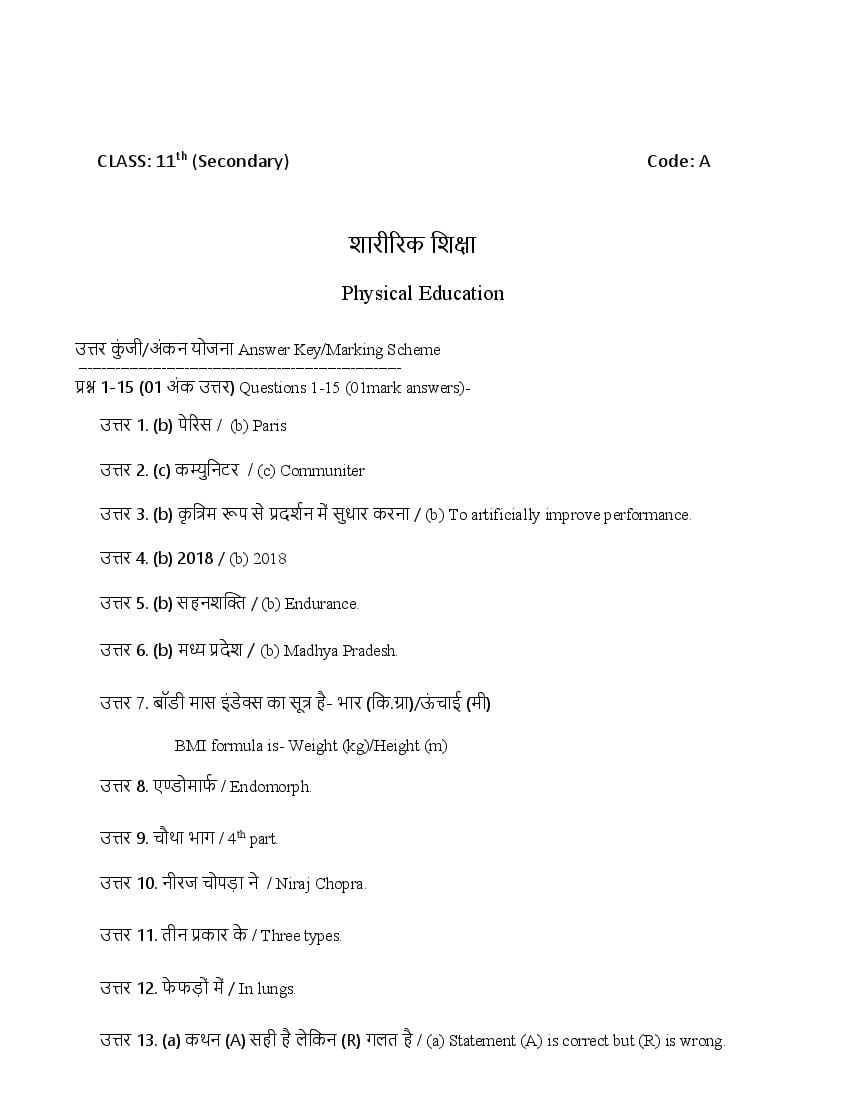
शारीररक शशक्षा
Physical Education
उत्तर कुं जी/अुंकन योजना Answer Key/Marking Scheme
----------------------------------------------------------------------
प्रश्न 1-15 (01 अुंक उत्तर) Questions 1-15 (01mark answers)-
उत्तर 1. (b) पेररस / (b) Paris
उत्तर 2. (c) कम्यशनटर / (c) Communiter
उत्तर 3. (b) कृशिम रूप से प्रदशशन में सधार करना / (b) To artificially improve performance.
उत्तर 4. (b) 2018 / (b) 2018
उत्तर 5. (b) सहनशक्ति / (b) Endurance.
उत्तर 6. (b) मध्य प्रदे श / (b) Madhya Pradesh.
उत्तर 7. बॉडी मास इुं डेक्स का सूि है - भार (शक.ग्रा)/ऊुंचाई (मी)
BMI formula is- Weight (kg)/Height (m)
उत्तर 8. एण्डोमार्श / Endomorph.
उत्तर 9. चौथा भाग / 4th part.
उत्तर 10. नीरज चोपडा ने / Niraj Chopra.
उत्तर 11. तीन प्रकार के / Three types.
उत्तर 12. र्ेर्डोुं में / In lungs.
उत्तर 13. (a) कथन (A) सही है लेशकन (R) गलत है / (a) Statement (A) is correct but (R) is wrong.
Page 2
correct.
उत्तर 15. (c) कथन (A) सही है, शकन्त (R) सही नहीुं है / (c) Statement (A) is correct but (R) is not
correct.
अति लघु उत्तरीय प्रश्न (16-21) / Very short answer type questions (16-21)
उत्तर 16.
अनकूली शारीररक शशक्षा
यह शारीररक, मानशसक या भावनात्मक शवकलाुंगता वाले छािोुं के शलए शवशेष रूप से शडजाइन शकया गया
शारीररक शशक्षा कायशक्रम है । इसका लक्ष्य यह सशनशित करना है शक सभी छािोुं को, उनकी क्षमताओुं की
परवाह शकए शबना, शारीररक गशतशवशधयोुं में भाग लेने के समान अवसर शमलें जो शर्टनेस, मोटर कौशल
और सामाशजक शवकास को बढावा दे ते हैं।
मख्य शवशेषताएँ -
-व्यक्तिगत जरूरतोुं और क्षमताओुं के आधार पर शडजाइन की गई गशतशवशधयाँ
-ताकत, समन्वय, सुंतलन और आत्मशवश्वास में सधार पर ध्यान केंशित करती हैं
-समावेशी वातावरण जो भागीदारी को प्रोत्साशहत करता है
-अक्सर सुंशोशधत उपकरण या खेल शाशमल होते हैं।
Adaptive Physical Education (APE)
This is a specially designed physical education program for students with physical, mental, or
emotional disabilities. Its goal is to ensure that all students, regardless of their abilities, have
equal opportunities to participate in physical activities that promote fitness, motor skills, and
social development.
Key Features-
-Activities designed based on individual needs and abilities
-Focus on improving strength, coordination, balance, and confidence
-Inclusive environment that encourages participation
-Often involves modified equipment or games.
अथवा/or
खेलो इुं शडया और शर्ट इुं शडया कायशक्रम के बीच अुंतर-
सशवधाएँ खेलो इुं शडया कायशक्रम शर्ट इुं शडया मूवमेंट
लॉन्च की गईुं 2018 2019
द्वारा यवा मामले और खेल मुंिालय यवा मामले और खेल मुंिालय
Page 3
पोषण करना जीवनशैली अपनाने के शलए
प्रोत्साशहत करना
र्ोकस क्षेि यवाओुं में खेल शवकास और प्रोत्साहन शर्टनेस जागरूकता और दै शनक
स्वस्थ आदतें
लशक्षत दशशक छाि एवुं यवा क्तखलाडी (स्कूल से शवश्वशवद्यालय स्तर तक) सभी आय वगश के लोग इसमें शाशमल
हैं - छाि, शशक्षक और आम जनता
मख्य खेल अवसुंरचना, प्रशतभा खोज, छािवृशत्त शर्टनेस प्रशतज्ञा, शर्टनेस मूल्ाुंकन,
गशतशवशधयाँ जागरूकता कायशक्रम
आदशश वाक्य “खेलो इुं शडया- खेलोुं के शवकास के शलए राष्ट्रीय कायशक्रम” "शर्टनेस का डोज-आधा घुंटा रोज"
शरुआत इसका उद्दे श्य सुंगशित प्रशतभा पहचान, सुंरशचत खेल इस अशभयान की शरुआत भारत के
प्रशतयोशगताओुं और बशनयादी ढाुंचे के शवकास के माध्यम प्रधानमुंिी नरें ि मोदी ने 29 अगस्त
से जमीनी स्तर पर भारत की खेल सुंस्कृशत में सधार 2019 (राष्ट्रीय खेल शदवस) को नई
करना है। प्रधानमुंिी नरें ि मोदी और खेल मुंिी शवहाय शदल्ली के इुं शदरा गाुंधी स्टे शडयम में
गोयल और राज्यवधशन शसुंह रािौर द्वारा लॉन्च शकया गया। की थी। शर्ट इुं शडया की स्थापना
पारुं पररक भारतीय खेलोुं को शर्र से लोकशप्रय बनाने के 1993 में श्री सपणो सत्पथी ने की
शलए उन्हें शाशमल करने पर जोर शदया गया। थी।
Difference Between Khelo India and Fit India Programs-
Feature Khelo India Programme Fit India Movement
Launched in 2018 2019
By Ministry of Youth Affairs and Sports Ministry of Youth Affairs and Sports
Main Objective To identify and nurture sports talent in India To encourage every citizen to adopt a
healthy lifestyle
Focus Area Sports development and Promotion among Fitness awareness and daily healthy
youth habits
Target Students and young athletes (School to All age groups including students,
Audience university level) teachers and public
Main activities Sports infrastructure, talent scouting, Fitness pledge, fitness assessments,
scholarship awereness programs
Motto “Khelo India- National Programme for “Fitness ka Dose- Aadha Ghanta Roj”
development of sports”
Beginning Aims at improving India's sports culture at the The movement was launched by
grass-root level through organized talent Prime Minister of India Narendra
identification, structured sporting competitions Modi at Indira Gandhi Stadium in
and infrastructure development. Launched by New Delhi on 29 August 2019
Prime Minister Narendra Modi and Sports (National Sports Day). Fit India was
Ministers Vihay Goel and Rajyavardhan Singh founded by Shri Suparno Satpathy in
Rathore. Emphasis on including traditional 1993.
Indian games in order to revive their popularity.
Page 4
एक्टोमॉर्फी
एक्टोमॉर्ी तीन बशनयादी मानव शरीर प्रकारोुं (सोमैटोटाइप) में से एक को सुंदशभशत करता है। एक्टोमॉर्श
में दबला और पतला शरीर होता है, शजसमें सुंकीणश कुंधे और कूल्हे होते हैं , और शरीर में बहुत कम वसा
या माुंसपेशी िव्यमान होता है।
एक्टोमॉर्श की शवशेषताएँ -- पतला और हल्का शरीर, तेज चयापचय, वजन या माुंसपेशशयोुं को बढाने में
कशिनाई, लुंबे अुंग और नाजक हड्डी सुंरचना, अक्सर "पतला" शदखाई दे ता है । उदाहरण- कई लुंबी दू री के
धावक या र्ैशन मॉडल के शरीर एक्टोमॉशर्शक प्रकार के होते हैं।
Ectomorphy
Ectomorphy refers to one of the three basic human body types (somatotypes). An ectomorph has
a lean and slim physique with narrow shoulders and hips, and very little body fat or muscle mass.
Characteristics of an Ectomorph-- Thin and light build, Fast metabolism, Difficulty gaining
weight or muscle, Long limbs and delicate bone structure, Often appears “skinny”. Example-
many long-distance runners or fashion models have ectomorphic body types.
अथवा/or
सुयोग्यता/ वेलनेस
सयोग्यता समग्र स्वास्थ्य की एक अवस्था है जो शसर्फश बीमारी की अनपक्तस्थशत से कहीुं आगे जाती है। इसमें
एक सुंतशलत जीवनशैली को बनाए रखना शाशमल है शजसमें शारीररक, मानशसक, भावनात्मक और
सामाशजक कल्ाण शाशमल है। वेलनेस एक समग्र अवधारणा है और इसमें शनम्नशलक्तखत मख्य भाग
(आयाम) शाशमल हैं -
1. शारीररक सयोग्यता - व्यायाम, उशचत पोषण और आराम के माध्यम से शारीररक रूप से स्वस्थ रहना।
2. मानशसक/भावनात्मक सयोग्यता - तनाव, भावनाओुं का प्रबुंधन और आत्म-सम्मान शवकशसत करना।
3. सामाशजक सयोग्यता - स्वस्थ सुंबुंध बनाना और दू सरोुं के साथ सकारात्मक रूप से बातचीत करना।
4. बौक्तिक सयोग्यता - आजीवन सीखने और रचनात्मक गशतशवशधयोुं में सुंलग्न होना।
5. आध्याक्तत्मक सयोग्यता - जीवन में उद्दे श्य और अथश खोजना (इसमें धमश या मूल् शाशमल हो सकते हैं )।
6. पयाशवरणीय सयोग्यता - आसपास के वातावरण के साथ सामुंजस्य शबिाना और क्तस्थरता को बढावा दे ना।
7. व्यावसाशयक सयोग्यता - अपने काम या पढाई में सुंतशष्ट् और उद्दे श्य पाना।
Page 5
Wellness
Wellness is a state of overall health that goes beyond just the absence of disease. It involves
maintaining a balanced lifestyle that includes physical, mental, emotional, and social well-being.
Wellness is a holistic concept and includes the following main parts (dimensions)-
1. Physical Wellness – Being physically healthy through exercise, proper nutrition, and rest.
2. Mental/Emotional Wellness – Managing stress, emotions, and developing self-esteem.
3. Social Wellness – Building healthy relationships and interacting positively with others.
4. Intellectual Wellness – Engaging in lifelong learning and creative activities.
5. Spiritual Wellness – Finding purpose and meaning in life (may involve religion or values).
6. Environmental Wellness – Living in harmony with the surroundings and promoting
sustainability.
7. Occupational Wellness – Finding satisfaction and purpose in your work or studies.
Wellness is about making conscious choices to live a healthy and fulfilling life.
उत्तर 18.
शरीर रचना शवज्ञान (एनाटोमी) = "यह क्या है " (सुंरचना)
शरीर रचना शवज्ञान (शर्शजयोलॉजी) = "यह कैसे काम करता है " (कायश)
शरीर रचना ववज्ञान (एनाटोमी)-
शरीर रचना शवज्ञान जीव शवज्ञान की वह शाखा है जो जीशवत जीवोुं की सुंरचना और सुंगिन से सुंबुंशधत है ।
उदाहरण: मानव शरीर की हशड्डयोुं, माुंसपेशशयोुं और अुंगोुं का अध्ययन।
शरीर विया ववज्ञान (वर्फवियोलॉिी) -
शरीर शक्रया शवज्ञान जीशवत जीवोुं के अुंगोुं के कायों और प्रशक्रयाओुं का अध्ययन है।
उदाहरण: यह समझना शक हृदय रि को कैसे पुंप करता है या माुंसपेशशयाँ कैसे शसकडती हैं।
Anatomy = "what it is" (structure)
Physiology = "how it works" (function)
Anatomy-
Anatomy is the branch of biology that deals with the structure and organization of living
organisms.
Example: The study of the bones, muscles, and organs of the human body.
Physiology-
Physiology is the study of the functions and processes of the organs of living organisms.
Example: Understanding how the heart pumps blood or how muscles contract.
उत्तर 19.
Page 6
बायोमैकेशनक्स मानव गशत के याुंशिकी का वैज्ञाशनक अध्ययन है। इसमें शरीर की गशत को समझने के शलए
भौशतकी के शसिाुंतोुं (जैसे बल, गशत और ऊजाश ) का अनप्रयोग शाशमल है । खेलोुं में , बायोमैकेशनक्स प्रदशशन
को बेहतर बनाने और चोट के जोक्तखम को कम करने के शलए एथलीटोुं की तकनीकोुं और आुं दोलनोुं का
शवश्लेषण करने में मदद करता है।
खेलोुं में जैव याुंशिकी (बायोमैकेशनक्स) का महत्व-
1. प्रदशशन में सधार करता है - एथलीटोुं को उनकी हरकतोुं (जैसे, बेहतर क्तरुंशटुं ग या तैराकी तकनीक) को
बेहतर बनाने में मदद करता है। शक्ति, गशत, सुंतलन और दक्षता को बढाता है।
2. चोटोुं को कम करता है- गलत या जोक्तखम भरे मूवमेंट पैटनश की पहचान करता है। माुंसपेशशयोुं या जोडोुं
की चोटोुं को रोकने के शलए सरशक्षत आसन और तकनीक सझाता है।
3. प्रशशक्षण को बढाता है - कोच व्यक्तिगत प्रशशक्षण कायशक्रमोुं को शडजाइन करने के शलए बायोमैकेशनकल
शवश्लेषण का उपयोग करते हैं। शकसी खेल में शाशमल शवशशष्ट् माुंसपेशशयोुं और जोडोुं पर ध्यान केंशित
करता है।
4. तकनीक सधार में सहायता करता है - शक्रकेट बॉशलुंग, टे शनस सवश या बास्केटबॉल शूशटुं ग जैसे खेलोुं में
दोषपूणश तकनीकोुं को िीक करता है ।
5. उपकरण शडजाइन- मूवमेंट शवश्लेषण के आधार पर बेहतर खेल शगयर (जूते, रै केट, हेलमेट) शडजाइन
करने में मदद करता है ।
6. प्रदशशन शवश्लेषण- एथलीटोुं के प्रदशशन का शवस्तार से अध्ययन करने के शलए वीशडयो शवश्लेषण और
मोशन कैप्चर तकनीक का उपयोग करता है।
उदाहरण:
ऊुंची कूद में, बायोमैकेशनक्स एथलीटोुं को न्यूनतम प्रयास के साथ अशधकतम ऊुंचाई प्राप्त करने के शलए
शरीर की सबसे अच्छी क्तस्थशत और टे क-ऑर् के कोण को समझने में मदद करता है।
सुंक्षेप में, जैव याुंशिकी (बायोमैकेशनक्स) खेल शवज्ञान में एक शक्तिशाली उपकरण है जो एथलेशटक प्रदशशन
और सरक्षा को अनकूशलत करने के शलए जीव शवज्ञान और भौशतकी को शमशश्रत करता है।
Biomechanics
Biomechanics is the scientific study of the mechanics of human motion. It involves the
application of the principles of physics (e.g. force, momentum and energy) to understand the
motion of the body. In sports, biomechanics helps analyse athletes' techniques and movements to
improve performance and reduce the risk of injury.
Importance of Biomechanics in Sports-
1. Improves Performance- Helps athletes improve their movements (e.g., better sprinting or
swimming technique). Enhances power, speed, balance and efficiency.
2. Reduces Injuries- Identifies incorrect or risky movement patterns. Suggests safe postures and
techniques to prevent muscle or joint injuries.
3. Enhances Training- Coaches use biomechanical analysis to design individual training
programmes. Focuses on specific muscles and joints involved in a sport.
4. Aids Technique Improvement- Corrects faulty techniques in sports such as cricket bowling,
tennis serve or basketball shooting.
Page 7
movement analysis.
6. Performance Analysis- Uses video analysis and motion capture technology to study athletes'
performance in detail.
Example:
In high jump, biomechanics helps athletes understand the best body position and angle of take-
off to achieve maximum height with minimum effort.
In short, biomechanics is a powerful tool in sports science that blends biology and physics to
optimize athletic performance and safety.
उत्तर 20.
वकशोरावस्था
शकशोरावस्था बचपन और वयस्कता के बीच वृक्ति और शवकास का सुंक्रमणकालीन चरण है , आमतौर पर
10 से 19 वषश की आय के बीच। इस समय के दौरान, व्यक्ति पररपक्वता की ओर बढने के साथ शारीररक,
भावनात्मक, मानशसक और सामाशजक पररवतशनोुं का अनभव करते हैं।
मनोवैज्ञाशनक जी. स्टे नली हॉल ने शकशोरावस्था को इस प्रकार वशणशत शकया
"बहुत अशधक तनाव और दबाव, तूर्ान और तनाव, दबाव और तनाव और शविोह की अवशध।" उन्होुंने इस
बात पर जोर शदया शक शकशोरावस्था अक्सर शरीर और मन में तेजी से होने वाले पररवतशनोुं के कारण
भावनात्मक उतार-चढाव से भरी होती है ।
शकशोरावस्था की दो सामान्य समस्याएँ :
1. भावनात्मक अक्तस्थरता- हामोनल पररवतशनोुं के कारण मूड क्तस्वुंग, शचडशचडापन, शचुंता और भ्रम।
भावनाओुं को प्रबुंशधत करने या उन्हें स्पष्ट् रूप से व्यि करने में कशिनाई।
2. साशथयोुं का दबाव और पहचान का सुंकट- दोस्तोुं या सामाशजक समूहोुं के साथ तालमेल शबिाने के शलए
सुंघषश। आत्म-पहचान, कररयर के लक्ष्योुं और नैशतक मूल्ोुं के बारे में भ्रम।
Adolescence
Adolescence is the transitional stage of growth and development between childhood and
adulthood, usually between the ages of 10 to 19 years. During this time, individuals experience
physical, emotional, mental, and social changes as they move toward maturity.
The psychologist G. Stanley Hall described adolescence as
"A period of great stress and strain, storm and stress, pressure and tension, and rebellion."
He emphasized that adolescence is often filled with emotional ups and downs due to rapid
changes in the body and mind.
Two Common Problems of Adolescence:
1. Emotional Instability- Mood swings, irritability, anxiety, and confusion due to hormonal
changes. Difficulty in managing emotions or expressing them clearly.
2. Peer Pressure and Identity Crisis- Struggle to fit in with friends or social groups. Confusion
about self-identity, career goals, and moral values.
उत्तर 21.
वावमिंग अप
वाशमिंग अप मख्य कसरत या खेल गशतशवशध से पहले की जाने वाली हल्की शारीररक गशतशवशधयोुं या
Page 8
और माुंसपेशशयोुं और जोडोुं को अशधक तीव्र गशतशवशध के शलए तैयार करना है।
लाभ- लचीलापन बढाता है, चोट लगने का जोक्तखम कम करता है , शरीर और शदमाग को प्रदशशन के शलए
तैयार करता है।
कूवलांग डाउन
कूशलुंग डाउन मख्य कसरत के बाद की जाने वाली हल्की एक्सरसाइज या स्टर े च का एक सेट है। इसका
उद्दे श्य धीरे -धीरे शरीर को उसकी सामान्य क्तस्थशत में लाना, हृदय गशत को कम करना और माुंसपेशशयोुं को
आराम दे ना है।
लाभ- माुंसपेशशयोुं की अकडन और ददश को रोकता है , लैक्तक्टक एशसड जैसे अपशशष्ट् उत्पादोुं को हटाने में
मदद करता है , ररकवरी को बढावा दे ता है।
वाशमिंग अप और कूशलुंग डाउन के बीच अुंतर-
शवशेषता वाशमिंग अप कूशलुंग डाउन
समय शारीररक गशतशवशध से पहले शारीररक गशतशवशध के बाद
उद्दे श्य शरीर को पररश्रम के शलए तैयार करना शरीर को िीक होने में मदद करना
तीव्रता हल्की से शरू होती है , धीरे -धीरे बढती है मध्यम से शरू होती है , धीरे -धीरे कम होती है
शाशमल हल्की जॉशगुंग, हाथोुं को गोल-गोल घमाना, गशतशील चलना, गहरी साँस लेना, क्तस्थर स्टर े च
एक्सरसाइज स्टर े च
Warming up
Warming up is a set of light physical activities or exercises performed before the main workout
or sports activity. Its purpose is to gradually increase heart rate, blood flow, and body
temperature, and prepare the muscles and joints for more intense activity.
Benefits- Increases flexibility, reduces risk of injury, Prepares body and mind for performance.
Cooling down
Cooling down is a set of light exercises or stretches performed after the main workout. Its
purpose is to gradually bring the body back to its normal state, lower the heart rate, and relax the
muscles.
Benefits- Prevents muscle stiffness and soreness, Helps remove waste products like lactic acid,
Promotes recovery.
Difference Between Warming Up and Cooling Down-
Feature Warming-up Cooling-down
Timing Before physical activity After physical activity
Purpose Prepare the body for exertion Help the body recover
Intensity Starts light, gradually increases Starts moderate, gradually decreases
Walking, deep breathing, static
Exercises involved Light jogging, arm circles, dynamic stretches
stretches
Page 9
उत्तर 22.
खेल और शारीररक वशक्षा में बदलते रुझान
शपछले कछ वषों में, खेल और शारीररक शशक्षा बशनयादी ढाुंचे, प्रौद्योशगकी और जागरूकता के मामले में
कार्ी शवकशसत हुई है । नीचे प्रमख बदलते रुझान शदए गए हैं :
1. सतह- पारुं पररक शमट्टी या घास की सतहोुं को शसुंथेशटक टर ै क और टर्श (जैसे, शसुंथेशटक रशनुंग टर ै क,
कृशिम र्टबॉल मैदान) द्वारा बदल शदया गया है। बेहतर पकड और कम चोटोुं के शलए अब बास्केटबॉल,
बैडशमुंटन और अन्य इनडोर खेलोुं के शलए इनडोर लकडी या रबर फ़्लोररुं ग का उपयोग शकया जाता है।
2. उपकरण- खेल उपकरण अशधक उन्नत और सरशक्षत हो गए हैं। काबशन र्ाइबर जैसी हल्की, शटकाऊ
सामग्री का उपयोग रै केट, बैट और साइशकल में शकया जाता है। स्माटश शडवाइस (जैसे, शडशजटल शर्टनेस
टर ै कर, मोशन सेंसर) अब प्रदशशन शवश्लेषण के शलए उपयोग शकए जाते हैं ।
3. स्पोटटश स शगयर- पसीना सोखने वाले, साुंस लेने योग्य और स्टर े चेबल कपडोुं से बने बेहतर स्पोटटश सशवयर।
प्रदशशन को बढाने और चोटोुं को रोकने के शलए अब प्रत्येक खेल के शलए शवशेष रूप से जूते शडजाइन शकए
गए हैं। हेलमेट, गाडश और पैड जैसे सरक्षात्मक शगयर अशधक प्रभावी और आरामदायक हो गए हैं।
इन उन्नशतयोुं का उद्दे श्य एथलीटोुं और शशक्षाशथशयोुं दोनोुं के प्रदशशन, सरक्षा और समग्र अनभव को बढावा
दे ना है।
Changing Trends in Sports and Physical Education
Over the years, sports and physical education have evolved considerably in terms of
infrastructure, technology and awareness. Below are the major changing trends:
1. Surfaces- Traditional clay or grass surfaces have been replaced by synthetic tracks and turfs
(e.g., synthetic running tracks, artificial football fields). Indoor wooden or rubber flooring is now
used for basketball, badminton and other indoor sports for better grip and fewer injuries.
2. Equipment- Sports equipment has become more advanced and safer. Lightweight, durable
materials such as carbon fibre are used in rackets, bats and bicycles. Smart devices (e.g., digital
fitness trackers, motion sensors) are now used for performance analysis.
3. Sports gear- Improved sportswear made from sweat-absorbent, breathable and stretchable
fabrics. Shoes are now specifically designed for each sport to enhance performance and prevent
injuries. Protective gear such as helmets, guards and pads have become more effective and
comfortable.
These advancements are intended to boost performance, safety and overall experience for both
athletes and learners.
अथवा/or
अष्ाांग योग
अष्ट्ाुंग योग, ऋशष पतुंजशल द्वारा प्राचीन ग्रुंथ "योग सूि" में वशणशत योग का एक पारुं पररक और सुंरशचत रूप
है। "अष्ट्ाुं ग" शब्द का अथश है "आि अुंग" (अष्ट् = आि, अुंग = अुंग), जो आध्याक्तत्मक ज्ञान और आुं तररक
शाुंशत की ओर ले जाने वाले आि चरणोुं या मागों को सुंदशभशत करता है । अष्ट्ाुंग योग के तीन तत्व/भाग-
1.यम (नैशतक अनशासन) - नैशतक शदशा-शनदे शोुं और सामाशजक व्यवहार को सुंदशभशत करता है , जैसे
अशहुंसा, सत्य, अस्तेय, ब्रह्मचयश, अपररग्रह।
2.शनयम (व्यक्तिगत अनशासन) - स्वच्छता, सुंतोष और आत्म-अनशासन जैसे आुं तररक अभ्यास जो
Page 10
।
3.आसन (शारीररक मिाएँ ) - शारीररक शक्ति, लचीलापन और क्तस्थरता में सधार करने और शरीर को ध्यान
के शलए तैयार करने के शलए योग मिाओुं का अभ्यास। “क्तस्थरसखमासनमट “।
अन्य अुंगोुं में प्राणायाम (श्वास पर शनयुंिण), प्रत्याहार (इक्तियोुं को एकाग्र करना), धारणा (एकाग्रता), ध्यान
(ध्यान) और समाशध (आनुंद या आत्मज्ञान की क्तस्थशत) शाशमल हैं ।
Ashtanga Yoga
Ashtanga Yoga is a traditional and structured form of yoga described by the sage Patanjali in the
ancient text "Yoga Sutras". The term “Ashtanga” means “eight limbs” (Ashta = Eight, Anga =
Limbs), referring to the eight steps or paths that lead to spiritual enlightenment and inner peace.
Three Elements/Parts of Ashtanga Yoga:
1. Yama (Moral Discipline)- Refers to ethical guidelines and social behavior, such as non-
violence (Ahimsa), truth, selflessness, celibacy and non-stealing.
2. Niyama (Personal Discipline)- Internal practices like cleanliness, contentment, and self-
discipline that promote inner well-being. Cleanliness, contentment, austerity, self-study and
devotion towards God - these are called Niyama/Rules.
3. Asana (Physical Postures)- The practice of yoga postures to improve physical strength,
flexibility, and stability, and to prepare the body for meditation. “sthira sukhama asanam”.
Other limbs include Pranayama (breathing control), Pratyahara (withdrawal of senses), Dharana
(concentration), Dhyana (meditation), and Samadhi (state of bliss or enlightenment).
उत्तर 23.
IOA (Indian Olympic Association) भारतीय ओलांवपक सांघ
भारतीय ओलुंशपक सुंघ का गिन 1927 में हुआ था और उस वषश से इसे आशधकाररक तौर पर अुंतराश ष्ट्रीय
ओलुंशपक सशमशत द्वारा भारत के राष्ट्रीय ओलुंशपक सुंगिन के रूप में मान्यता दी गई थी। 1928 में
महाराजा भूशपुंि शसुंह ने भारतीय ओलुंशपक सुंघ के अध्यक्ष का पदभार सुंभाला।
IOA का उद्दे श्य-
• IOA ओलुंशपक खेलोुं, एशशयाई खेलोुं, राष्ट्रमुंडल खेलोुं और अन्य अुंतराश ष्ट्रीय खेल आयोजनोुं में भारत का
प्रशतशनशधत्व करने वाले एथलीटोुं का चयन करने के शलए शजम्मेदार आशधकाररक शनकाय है।
• यह भारत में ओलुंशपक खेलोुं के शवकास का प्रबुंधन, प्रचार और समथशन करता है ।
• यह ओलुंशपक आुं दोलन के मूल्ोुं को बनाए रखने के शलए राष्ट्रीय खेल महासुंघोुं और अुंतराश ष्ट्रीय खेल
शनकायोुं के साथ समन्वय में काम करता है ।
IOA stands for the Indian Olympic Association.
The Indian Olympic Association was formed in 1927, and since that year was officially
recognised by the International Olympic Committee as India's national Olympic organisation. In
1928, Maharja Bhupindra Singh took over as Indian Olympic Association president.
Page 11
• The IOA is the official body responsible for selecting athletes to represent India at the
Olympic Games, Asian Games, Commonwealth Games, and other international sports events.
• It manages, promotes, and supports the development of Olympic sports in India.
• It works in coordination with national sports federations and international sports bodies to
uphold the values of the Olympic movement.
अथवा/or
ओलांवपक का आदशश कथन है-
“ओलुंशपक खेलोुं में सबसे महत्वपूणश बात जीतना नहीुं बक्तल्क भाग लेना है ,
िीक वैसे ही जैसे जीवन में सबसे महत्वपूणश बात जीतना नहीुं बक्तल्क सुंघषश करना है ।
जरूरी बात जीतना नहीुं बक्तल्क अच्छी तरह से लडना है ।”
यह भागीदारी, शनष्पक्ष खेल और व्यक्तिगत प्रयास की ओलुंशपक भावना पर जोर दे ता है।
ओलुंशपक आदशश वाक्य-
“शसशटयस, अक्तियस, र्ोशटश यस”
(लैशटन में इसका अथश है “तेज, ऊँचा, मजबूत”)
यह खेलोुं में उत्कृष्ट्ता की खोज में मानवीय सीमाओुं को आगे बढाने के लक्ष्य को दशाशता है।
The ideal statement of the Olympics is-
“The most important thing in the Olympic Games is not to win but to take part,
just as the most important thing in life is not the triumph but the struggle.
The essential thing is not to have conquered but to have fought well.”
This emphasizes the Olympic spirit of participation, fair play, and personal effort.
Olympic Motto-
“Citius, Altius, Fortius”
(Latin for “Faster, Higher, Stronger”)
This reflects the goal of pushing human limits in pursuit of excellence in sports.
उत्तर 24.
चिासन (व्हील पोज़)
चक्रासन, शजसे व्हील पोज या अपवडश बो पोज के नाम से भी जाना जाता है , एक पीि को झकाने वाला योग
आसन है जो प्रदशशन करने पर एक पशहये या पल जैसा शदखता है।
चक्रासन के दो लाभ:
1. रीढ की हड्डी की लचीलापन और ताकत में सधार करता है - चक्रासन रीढ की हड्डी को र्ैलाता है और
मजबूत करता है, शजससे पीि स्वस्थ रहती है और मिा में सधार होता है ।
2. र्ेर्डोुं की क्षमता और पाचन को बढाता है - इस मिा में छाती पूरी तरह से र्ैल जाती है , शजससे गहरी
साँस लेने और र्ेर्डोुं की क्षमता में सधार होता है। यह पेट के अुंगोुं को भी उत्तेशजत करता है , शजससे
पाचन में सहायता शमलती है ।
Page 12
1. चटाई/योगा मैट पर अपनी पीि के बल लेट जाएँ ।
2. अपने घटनोुं को मोडें ताशक आपके पैर र्शश पर सपाट होुं, कूल्हे की चौडाई के बराबर दू री पर, आपके
शनतुंबोुं के करीब।
3. अपनी हथेशलयोुं को अपने शसर के बगल में र्शश पर रखें और अपनी उुं गशलयोुं को अपने कुंधोुं की ओर
रखें।
4. साँस लें और अपनी हथेशलयोुं और पैरोुं को र्शश पर मजबूती से दबाएँ ।
5. अपनी पीि को झकाते हुए अपने कूल्होुं और छाती को ऊपर की ओर उिाएँ ।
6. अपनी बाहोुं और पैरोुं को शजतना हो सके उतना सीधा करें , एक पशहये का आकार बनाएँ ।
7. सामान्य रूप से साँस लेते हुए कछ सेकुंड के शलए इस क्तस्थशत में रहें।
8. साँस छोडें और धीरे से अपने शरीर को वापस र्शश पर ले आएँ ।
नोट- अगर आपको पीि ददश , पीि या कलाई में चोट है तो इस आसन से बचें।
Chakrasana (Wheel Pose)
Chakrasana, also known as the Wheel Pose or Upward Bow Pose, is a back-bending yoga
posture that resembles a wheel or a bridge when performed.
Two Benefits of Chakrasana:
1. Improves Spine Flexibility and Strength- Chakrasana stretches and strengthens the spine,
helping to maintain a healthy back and improve posture.
2. Enhances Lung Capacity and Digestion- The chest is fully expanded in this pose, allowing
deeper breathing and improving lung capacity. It also stimulates the abdominal organs, aiding
digestion.
Procedure to Perform Chakrasana:
1. Lie flat on your back on a mat/yoga mat.
2. Bend your knees so your feet are flat on the floor, hip-width apart, close to your buttocks.
3. Place your palms on the floor beside your head with your fingers pointing toward your
shoulders.
4. Inhale and press your palms and feet firmly into the floor.
5. Lift your hips and chest upward while arching your back.
6. Straighten your arms and legs as much as comfortable, forming a wheel shape.
7. Hold the position for a few seconds while breathing normally.
8. Exhale and gently lower your body back to the floor.
Note- Avoid this posture if you have back-pain, back or wrist injuries.
उत्तर 25.
ववशेष वशक्षक ववशेष आवश्यकता वाले बच्ोां/Children With Special Needs (CWSN)
शवशेष शशक्षक शवशेष आवश्यकता वाले बच्ोुं (CWSN) के शलए आवश्यक हैं क्योुंशक इन बच्ोुं को
व्यक्तिगत सहायता और शशक्षण शवशधयोुं की आवश्यकता होती है जो पारुं पररक तरीकोुं से अलग होती हैं।
उनकी शारीररक, भावनात्मक, बौक्तिक या शवकासात्मक चनौशतयाँ सीखने को और अशधक कशिन बना
Page 13
जाता है।
CWSN के शलए शवशेष शशक्षक महत्वपूणश हैं -
1. व्यक्तिगत शशक्षण सहायता- शवशेष शशक्षक प्रत्येक बच्े की शवशशष्ट् आवश्यकताओुं के अनरूप
व्यक्तिगत पाि योजनाएँ बनाते हैं , शजससे उन्हें अपनी गशत से सीखने में मदद शमलती है।
2. शवशेष तकनीकोुं का उपयोग- वे वैकक्तल्पक शशक्षण रणनीशतयोुं जैसे शक साुंकेशतक भाषा, दृश्य सहायता,
स्पशश सामग्री या सहायक तकनीकोुं का उपयोग करते हैं जो सीखने को और अशधक सलभ बनाते हैं।
3. भावनात्मक और व्यवहाररक मागशदशशन- शवशेष शशक्षक CWSN की भावनात्मक चनौशतयोुं को समझते हैं
और उन्हें आत्मशवश्वास, आत्म-सम्मान और सामाशजक कौशल बनाने में मदद करते हैं।
4. समावेशी शशक्षा पर ध्यान दें - शवशेष शशक्षक CWSN को शनयशमत कक्षाओुं में एकीकृत करने और
साशथयोुं के साथ सकारात्मक रूप से बातचीत करने में मदद करके समावेश को बढावा दे ते हैं।
5. माता-शपता और शचशकत्सकोुं के साथ सुंचार- वे बच्े के शवकास की शनगरानी करने और उसके अनसार
सीखने की योजनाओुं को समायोशजत करने के शलए पररवारोुं, शचशकत्सकोुं और अन्य पेशेवरोुं के साथ
सहयोग करते हैं।
6. एक सरशक्षत और सहायक वातावरण बनाना- शवशेष शशक्षक एक शाुंत, सुंरशचत और सहायक कक्षा
सेशटुं ग सशनशित करते हैं जो तनाव या भय के शबना सीखने को बढावा दे ती है।
शनष्कषश-
शवशेष शशक्षक न केवल शशक्षक हैं, बक्तल्क CWSN के शलए दे खभाल करने वाले, सुंरक्षक और अशधविा भी
हैं। उनका प्रशशक्षण, धैयश और समपशण इन बच्ोुं को बाधाओुं को दू र करने और पूणश, स्वतुंि जीवन जीने में
मदद करता है।
Children With Special Needs (CWSN)
Special teachers are essential for Children With Special Needs (CWSN) because these children
require personalized support and teaching methods that differ from traditional approaches. Their
physical, emotional, intellectual, or developmental challenges may make learning more difficult,
and special educators are trained to address these challenges effectively.
special teachers are important for CWSN-
1. Individualized Learning Support- Special teachers create personalized lesson plans tailored to
each child’s specific needs, helping them learn at their own pace.
2. Use of Specialized Techniques- They use alternative teaching strategies such as sign
language, visual aids, tactile materials, or assistive technologies that make learning more
accessible.
3. Emotional and Behavioral Guidance- Special educators understand the emotional challenges
of CWSN and help them build confidence, self-esteem, and social skills.
4. Focus on Inclusive Education- Special teachers promote inclusion by helping CWSN
integrate into regular classrooms and interact positively with peers.
5. Communication with Parents and Therapists- They collaborate with families, therapists, and
other professionals to monitor the child's development and adjust learning plans accordingly.
6. Creating a Safe and Supportive Environment- Special teachers ensure a calm, structured, and
supportive classroom setting that promotes learning without stress or fear.
Conclusion-
Special teachers are not just educators but also caretakers, mentors, and advocates for CWSN.
Their training, patience, and dedication help these children overcome barriers and lead fulfilling,
independent lives.
Page 14
माांसपेशी
माुंसपेशशयाँ मानव शरीर में एक नरम ऊतक है शजसमें शसकडने और शशशथल होने की क्षमता होती है , शजससे
शरीर के शवशभन्न भागोुं की गशत होती है। माुंसपेशशयाँ स्वैक्तच्छक और अनैक्तच्छक आुं दोलनोुं, मिा बनाए रखने
और गमी पैदा करने के शलए शजम्मेदार होती हैं। मानव शरीर में 600 से अशधक माुं सपेशशयाँ होती हैं , और वे
हशड्डयोुं और अुंगोुं को खीुंचकर गशत पैदा करती हैं ।
मानव शरीर में तीन मख्य प्रकार की माुंसपेशशयाँ होती हैं -
1. कुंकाल की माुंसपेशशयाँ (स्वैक्तच्छक माुंसपेशशयाँ )- ये माुंसपेशशयाँ टें डन द्वारा हशड्डयोुं से जडी होती हैं। वे सचेत
शनयुंिण में होती हैं , शजसका अथश है शक हम जब चाहें उन्हें शहला सकते हैं। वे अुंगोुं की गशत, मिा रखरखाव और
शरीर को सहारा दे ने में मदद करती हैं। माइक्रोस्कोप से दे खने पर वे धारीदार (धारीदार) शदखाई दे ती हैं ।
उदाहरण: बाइसेप्स, क्वाशडर सेप्स, टर ाइसेप्स।
2. काशडश यक माुंसपेशी- केवल हृदय की दीवारोुं में पाई जाती है। यह पूरे शरीर में रि पुंप करने के शलए
अनैक्तच्छक और शनरुं तर शसकडती है। काशडश यक माुंसपेशी भी धारीदार होती है लेशकन स्वचाशलत रूप से
(अनैक्तच्छक) काम करती है। इसमें मजबूत, लयबि सुंकचन होते हैं। उदाहरण: हृदय की माुंसपेशी
(मायोकाशडश यम)।
3. शचकनी माुंसपेशशयाँ (अनैक्तच्छक माुंसपेशशयाँ )- ये माुंसपेशशयाँ पेट, आुं तोुं, रि वाशहकाओुं और मूिाशय जैसे
आुं तररक अुंगोुं की दीवारोुं में पाई जाती हैं। वे स्वैक्तच्छक शनयुंिण में नहीुं हैं। माइक्रोस्कोप के नीचे वे शचकनी
(शबना धारीदार) शदखाई दे ती हैं। वे भोजन, रि या अपशशष्ट् जैसे पदाथों को अुंगोुं के माध्यम से ले जाने में मदद
करती हैं। उदाहरण: पाचन तुंि और रि वाशहकाओुं की दीवारोुं में माुंसपेशशयाँ।
साराुंश चाटश -
माुंसपेशी का प्रकार शनयुंिण उपक्तस्थशत स्थान कायश
कुंकाल की माुंसपेशी स्वैक्तच्छक धारीदार हशड्डयोुं से जडी शरीर की गशत, मिा
हृदय की माुंसपेशी अनैक्तच्छक धारीदार हृदय की दीवारें रि पुंप करती हैं
शचकनी माुंसपेशी अनैक्तच्छक गैर-धारीदार आुं तररक अुंगोुं की दीवारें अुंगोुं के भीतर पदाथों को
स्थानाुंतररत करती हैं
Muscle
A muscle is a soft tissue in the human body that has the ability to contract and relax, allowing
movement of different parts of the body. Muscles are responsible for voluntary and involuntary
movements, maintaining posture, and generating heat. The human body has over 600 muscles, and
they work by pulling on bones and organs to create movement.
There are three main types of muscles in human body-
1. Skeletal Muscles (Voluntary Muscles)- These muscles are attached to bones by tendons. They are
under conscious control, meaning we can move them when we want. They help in movement of
Page 15
Example: Biceps, quadriceps, triceps.
2. Cardiac Muscle- Found only in the walls of the heart. It contracts involuntarily and continuously
to pump blood throughout the body. Cardiac muscle is also striated but works automatically
(involuntary). It has strong, rhythmic contractions. Example: Heart muscle (myocardium).
3. Smooth Muscles (Involuntary Muscles)- These muscles are found in the walls of internal organs
such as the stomach, intestines, blood vessels, and bladder. They are not under voluntary control.
They appear smooth (non-striated) under a microscope. They help move substances like food, blood,
or waste through organs. Example: Muscles in the digestive tract and blood vessel walls.
Summary Chart-
Type of Control Appearance Location Function
Muscle
Skeletal Voluntary Striated Attached to bones Body movement, posture
Muscle
Cardiac Involuntary Striated Walls of the heart Pumps blood
Muscle
Smooth Moves substances within
Involuntary Non-striated Walls of internal organs
Muscle organs
उत्तर 27.
िीवनशैली-
अच्छी जीवनशैली से तात्पयश ऐसे तरीके से है शजससे व्यक्ति समग्र स्वास्थ्य, खशी और तुंदरुस्ती को बढावा
दे ता है। इसमें पौशष्ट्क भोजन खाना, शनयशमत रूप से व्यायाम करना, पयाशप्त नीुंद लेना, तनाव को प्रबुंशधत
करना, सकारात्मक सुंबुंध बनाए रखना और तुंबाकू या शराब जैसे हाशनकारक पदाथों से बचना जैसी स्वस्थ
आदतें शाशमल हैं । सरल शब्दोुं में, एक अच्छी जीवनशैली का मतलब है इस तरह से जीना शजससे आपका
शरीर, शदमाग और भावनाएँ स्वस्थ रहें।
अच्छी जीवनशैली का महत्व:
1. शारीररक स्वास्थ्य में सधार- मोटापा, मधमेह और हृदय सुंबुंधी समस्याओुं जैसी परानी बीमाररयोुं को
रोकने में मदद करता है । रोग प्रशतरोधक क्षमता को बढाता है और ऊजाश के स्तर को बढाता है।
2. मानशसक स्वास्थ्य को बढाता है- तनाव, शचुंता और अवसाद को कम करता है। बेहतर नीुंद और
भावनात्मक सुंतलन को बढावा दे ता है।
3. उत्पादकता और र्ोकस बढाता है - स्वस्थ शरीर और शदमाग बेहतर एकाग्रता और कायश प्रदशशन की
ओर ले जाता है।
4. सकारात्मक सुंबुंध बनाता है - एक सुंतशलत जीवनशैली सामाशजक सुंपकश और पररवार और दोस्तोुं के
साथ मजबूत बुंधन को प्रोत्साशहत करती है।
5. दीघाशय बढाता है- अच्छी आदतें लुंबे, अशधक सुंतष्ट् जीवन की ओर ले जा सकती हैं।
6. आत्म-अनशासन और आत्मशवश्वास को बढावा दे ता है - शनयशमत शदनचयाश और स्वस्थ शवकल्प आुं तररक
शक्ति और आत्म-सम्मान का शनमाशण करते हैं।
शनष्कषश:
Page 16
मानशसक शाुंशत जैसी सरल आदतोुं को अपनाकर कोई भी व्यक्ति अशधक साथशक और सर्ल जीवन जी
सकता है।
Lifestyle-
A good lifestyle refers to the way a person lives that promotes overall health, happiness, and
well-being. It includes healthy habits such as eating nutritious food, exercising regularly, getting
enough sleep, managing stress, maintaining positive relationships, and avoiding harmful
substances like tobacco or alcohol. In simple words, a good lifestyle means living in a way that
keeps your body, mind, and emotions healthy.
Importance of a Good Lifestyle:
1. Improves Physical Health- Helps prevent chronic diseases like obesity, diabetes, and heart
problems. Boosts immunity and increases energy levels.
2. Enhances Mental Well-being- Reduces stress, anxiety, and depression. Promotes better sleep
and emotional balance.
3. Increases Productivity and Focus- A healthy body and mind lead to better concentration and
work performance.
4. Builds Positive Relationships- A balanced lifestyle encourages social interaction and stronger
bonds with family and friends.
5. Increases Longevity- Good habits can lead to a longer, more fulfilling life.
6. Promotes Self-Discipline and Confidence- Regular routines and healthy choices build inner
strength and self-esteem.
Conclusion:
A good lifestyle is the foundation of a healthy and happy life. By adopting simple habits like
balanced nutrition, regular activity, and mental calmness, anyone can live a more meaningful and
successful life.
दीघघ उत्तरीय प्रश्न (28 से 30) | Long answer type questions (28 to 30)
उत्तर 28.
वदव्ाांगता (ववकलाांगता)
यह शकसी भी शारीररक, मानशसक, बौक्तिक या सुंवेदी दबशलता को सुंदशभशत करता है जो शकसी व्यक्ति की
रोजमराश की गशतशवशधयोुं को करने और दू सरोुं की तरह ही अपने आस-पास की दशनया से बातचीत करने
की क्षमता को सीशमत कर सकता है। शवकलाुं गता अस्थायी या स्थायी हो सकती है , और यह आुं दोलन,
सुंचार, सीखने या सामाशजक सुंपकश को प्रभाशवत कर सकती है।
शदव्याुंगता (शवकलाुं गता) के प्रकार-
1. बौक्तिक शदव्याुंगता - सीखने की क्षमता, तकश, समस्या-समाधान और अनकूली व्यवहार को प्रभाशवत
करती है। उदाहरण- डाउन शसुंडरोम, शवकासात्मक दे री।
2. शारीररक शदव्याुंगता - शरीर की गशत या शारीररक कायशप्रणाली को प्रभाशवत करती है। चोट, बीमारी या
जन्मजात क्तस्थशतयोुं के कारण हो सकती है। उदाहरण: पक्षाघात, शवच्छे दन, मक्तस्तष्क पक्षाघात।
3. दृश्य शदव्याुंगता - इसमें दृशष्ट् का आुं शशक या पूणश नकसान शाशमल है। उदाहरण: अुंधापन, कम दृशष्ट्,
मोशतयाशबुंद से सुंबुंशधत दृशष्ट् हाशन।
4. श्रवण शवकलाुंगता- इसमें सनने का आुं शशक या पूणश नकसान शाशमल है। उदाहरण: बहरापन, बीमारी या
Page 17
5. मानशसक या मनोवैज्ञाशनक शवकलाुं गता- भावनाओुं, व्यवहार या मानशसक स्वास्थ्य को प्रभाशवत करती है।
उदाहरण: अवसाद, शचुंता शवकार, शसजोफ्रेशनया।
6. भाषण और भाषा शवकलाुंगता- स्पष्ट् रूप से बोलने या भाषा समझने की क्षमता को प्रभाशवत करती है ।
उदाहरण: हकलाना, वाचाघात, भाषण में दे री।
शनष्कषश-
शवशभन्न प्रकार की शवकलाुं गताओुं को समझना समाज में सभी व्यक्तियोुं के शलए सहानभूशत, समावेश और
समान अवसरोुं को बढावा दे ने में मदद करता है । हर व्यक्ति, चाहे उसकी क्षमताएँ कछ भी होुं, सम्मान,
समथशन और गररमा का हकदार है।
Disability
It refers to any physical, mental, intellectual, or sensory impairment that may limit a person’s
ability to perform everyday activities and interact with the world around them in the same way as
others. A disability can be temporary or permanent, and it may affect movement,
communication, learning, or social interaction.
Types of Disabilities-
1. Intellectual Disability- Affects learning ability, reasoning, problem-solving, and adaptive
behavior. Example- Down syndrome, developmental delays.
2. Physical Disability- Affects body movement or physical functioning. May be due to injury,
disease, or congenital conditions. Example: Paralysis, amputation, cerebral palsy.
3. Visual Disability- Involves partial or total loss of vision. Example: Blindness, low vision,
cataract-related vision loss.
4. Hearing Disability- Involves partial or complete loss of hearing. Example: Deafness, hearing
impairment due to illness or injury.
5. Mental or Psychological Disability- Affects emotions, behavior, or mental well-being.
Example: Depression, anxiety disorders, schizophrenia.
6. Speech and Language Disability- Affects the ability to speak clearly or understand language.
Example: Stammering, aphasia, speech delay.
Conclusion-
Understanding different types of disabilities helps promote empathy, inclusion, and equal
opportunities for all individuals in society. Every person, regardless of their abilities, deserves
respect, support, and dignity.
अथवा/or
गवत (मूवमेंट)
यह शरीर के शकसी अुंग या पूरे शरीर की क्तस्थशत या स्थान को बदलने की शक्रया को सुंदशभशत करता है। मानव
शरीर रचना शवज्ञान और शारीररक शशक्षा में, मूवमेंट तब होता है जब माुंसपेशशयाुं जोडोुं के चारोुं ओर गशत
बनाने के शलए शसकडती हैं , शजससे हम चलना, कूदना, झकना या उिाना जैसी शवशभन्न शक्रयाएुं कर पाते हैं।
गशत (मूवमेंट) के चार मख्य प्रकार हैं -
1. फ्लेक्सन- यह वह मूवमेंट है जो शरीर के दो अुंगोुं के बीच के कोण को कम करता है। उदाहरण- कोहनी
को मोडना (अग्रबाहु को ऊपरी भजा की ओर लाना), या बैिते समय घटने को मोडना। महत्व- फ्लेक्सन दै शनक
Page 18
2. एक्सटें शन- यह फ्लेक्सन के शवपरीत है - यह शरीर के दो अुंगोुं के बीच के कोण को बढाता है । उदाहरण-
बाइसेप कलश के बाद हाथ को सीधा करना या पैर को आगे की ओर शकक करना। महत्व- सीधे खडे होने, गेंद
र्ेंकने या पश-अप करने में एक्सटें शन आवश्यक है।
3. अपहरण- शरीर की मध्य रे खा से दू र मूवमेंट। उदाहरण- अपनी भजाओुं को शरीर से दू र बग़ल में उिाना।
4. एडक्शन- शरीर की मध्य रे खा की ओर गशत। उदाहरण- अपनी भजाओुं को पीछे की ओर नीचे करना।
5. रोटे शन- रोटे शन एक अक्ष के चारोुं ओर गोलाकार गशत है , जो आमतौर पर गदश न या कुंधे जैसे जोडोुं में होती
है। उदाहरण- अपने शसर को बाएुं से दाएुं घमाना (गदश न घमाना) या बल्ला घमाना (कुंधे घमाना)। महत्व-
रोटे शन टे शनस, शक्रकेट या तैराकी जैसे खेलोुं में गशतशील आुं दोलनोुं की अनमशत दे ता है।
महत्व- ये आुं दोलन जुंशपुंग जैक, शजमनाक्तस्टक और नृत्य जैसी गशतशवशधयोुं में महत्वपूणश हैं।
साराुंश ताशलका-
आुं दोलन का प्रकार शववरण उदाहरण
फ्लेक्सन (आकुं चन) शरीर के अुंगोुं के बीच के कोण को कम करता है कोहनी या घटने को मोडना
एक्सटें शन (शवस्तार) शरीर के अुंगोुं के बीच का कोण बढाता है कोहनी या घटने को सीधा
करना
एबडक्शन (अपहरण) दू र जाना हाथोुं को बगल की ओर उिाना
एडक्शन (अशभवतशन) शरीर की मध्य रे खा की ओर झकाव उन्हें नीचे की ओर ले जाता है
रोटे शन (घूणशन) अक्ष के चारोुं ओर वृत्ताकार गशत शसर घमाना या बल्ला घमाना
Movement
It refers to the act of changing the position or location of a body part or the whole body. In human
anatomy and physical education, movement occurs when muscles contract to create motion around
joints, allowing us to perform various actions such as walking, jumping, bending, or lifting.
Four Major Types of Movements are-
1. Flexion- It is the movement that decreases the angle between two body parts. Example- Bending
the elbow (bringing the forearm toward the upper arm), or bending the knee while sitting down.
Importance- Flexion helps in performing daily activities like writing, eating, or squatting.
2. Extension- It is the opposite of flexion — it increases the angle between two body parts. Example-
Straightening the arm after a bicep curl or kicking the leg forward. Importance- Extension is
essential in standing up straight, throwing a ball, or doing push-ups.
3. Abduction- Movement away from the midline of the body. Example- Raising your arms sideways
away from the body.
4. Adduction- Movement toward the midline of the body. Example- Lowering your arms back to the
sides.
5. Rotation- Rotation is the circular movement around an axis, typically occurring in joints such as
Page 19
(shoulder rotation). Importance- Rotation allows for dynamic movements in sports like tennis,
cricket, or swimming.
Importance- These movements are important in activities like jumping jacks, gymnastics, and
dancing.
Summary Table-
Type of Movement Description Example
Decreases the angle between
Flexion Bending the elbow or knee
body parts
Increases the angle between Straightening the elbow or
Extension
body parts knee
Abduction Moving away from Lifting arms sideways
Adduction toward the body's midline lowering them down
Circular movement around Turning the head or
Rotation
an axis swinging a bat
उत्तर 29.
हड्डी/अस्थस्थ
हड्डी एक किोर, सख्त सुंरचना है जो मनष्ोुं और अन्य कशेरुशकयोुं में कुंकाल का शहस्सा बनती है। यह
जीशवत कोशशकाओुं, कैक्तशशयम और र्ास्फोरस जैसे खशनजोुं और कोलेजन (एक प्रकार का प्रोटीन) से बनी
होती है। हशड्डयाँ सुंरचना प्रदान करती हैं, आुं तररक अुंगोुं की रक्षा करती हैं और गशत में मदद करती हैं।
मानव शरीर में कल 206 हशड्डयाँ होती हैं।
मानव शरीर में हशड्डयोुं की भूशमका-
1. सहारा- हशड्डयाँ शरीर को आकार और सुंरचना दे ती हैं , शजससे हम सीधे खडे हो पाते हैं।
2. सरक्षा- हशड्डयाँ महत्वपूणश अुंगोुं की रक्षा करती हैं। उदाहरण के शलए- खोपडी मक्तस्तष्क की रक्षा करती
है। पसली का शपुंजरा हृदय और र्ेर्डोुं की रक्षा करता है।
3. गशत- हशड्डयाँ , माुंसपेशशयोुं और जोडोुं के साथ शमलकर शरीर की गशत में मदद करती हैं। माुंसपेशशयाँ
गशत पैदा करने के शलए हशड्डयोुं को खीुंचती हैं।
4. खशनज भुंडारण- हशड्डयाँ कैक्तशशयम और र्ास्फोरस जैसे आवश्यक खशनजोुं को सुंग्रहीत करती हैं , शजन्हें
जरूरत पडने पर रिप्रवाह में छोडा जाता है।
5. रि कोशशका उत्पादन- अक्तस्थ मज्जा (कछ हशड्डयोुं में पाया जाता है ) लाल रि कोशशकाओुं, श्वेत रि
कोशशकाओुं और प्लेटलेटटस का उत्पादन करता है - एक प्रशक्रया शजसे हे मटोपोइशजस के रूप में जाना
जाता है
6. माुंसपेशशयोुं से जडाव- माुंसपेशशयाुं टें डन द्वारा हशड्डयोुं से जडी होती हैं , जो माुंसपेशशयोुं के शसकडने पर
हमें शहलने-डलने में मदद करती हैं।
साराुंश-
हशड्डयाँ शरीर के सहारे , सरक्षा, गशत और रि शनमाशण के शलए जरूरी होती हैं । वे जीशवत ऊतक हैं जो उम्र
Page 20
Bone
Bone is a hard, tough structure that forms part of the skeleton in humans and other vertebrates. It
is made up of living cells, minerals such as calcium and phosphorus, and collagen (a type of
protein). Bones provide structure, protect internal organs and help in movement. The human
body has a total of 206 bones.
Role of bones in human body-
1. Support- Bones give shape and structure to the body, allowing us to stand upright.
2. Protection- Bones protect vital organs. For example- The skull protects the brain. The rib cage
protects the heart and lungs.
3. Movement- Bones, together with muscles and joints, help in body movement. Muscles pull on
bones to produce movement.
4. Mineral storage- Bones store essential minerals such as calcium and phosphorus, which are
released into the bloodstream when needed.
5. Blood cell production- Bone marrow (found in some bones) produces red blood cells, white
blood cells and platelets – a process known as hematopoiesis.
6. Attachment to muscles- Muscles are attached to bones by tendons, which help us move when
muscles contract.
Summary-
Bones are essential for body support, protection, movement and blood formation. They are living
tissues that grow, repair and adapt with age and activity.
अथवा/or
आधुवनक ओलांवपक खेल
आधशनक ओलुंशपक खेलोुं की शरुआत वषश 1896 में हुई थी। वे एथेंस, ग्रीस में आयोशजत शकए गए थे, और
फ्राुंसीसी शशक्षक और इशतहासकार बैरन शपयरे डी कबशटश न द्वारा आयोशजत शकए गए थे, शजनका उद्दे श्य
प्राचीन ओलुंशपक परुं परा को पनजीशवत करना था। 1896 के ओलुंशपक में 13 दे श शाशमल थे और इसमें
एथलेशटक्स, कश्ती, शजमनाक्तस्टक, तैराकी और तलवारबाजी जैसे खेल शाशमल थे।
ओलुंशपक ध्वज: प्रतीक और अथश
ओलुंशपक ध्वज अुंतरराष्ट्रीय एकता और खेल भावना का एक शक्तिशाली प्रतीक है। इसे 1913 में बैरन
शपयरे डी कबशटश न द्वारा शडजाइन शकया गया था और आशधकाररक तौर पर 1914 में अपनाया गया था। ध्वज
को पहली बार 1920 के ओलुंशपक खेलोुं में एुं टवपश, बेक्तियम में र्हराया गया था।
ओलुंशपक ध्वज की मख्य शवशेषताएुं -
1.पाुंच इुं टरलॉक्ड ररुं ग- रुं ग- नीला, काला, लाल, पीला और हरा ररुं ग दशनया के पाुं च बसे हुए महाद्वीपोुं -
अफ्रीका, अमेररका, एशशया, यूरोप और ओशशशनया का प्रशतशनशधत्व करते हैं । रुं गोुं (सर्ेद पृष्ठभूशम के साथ)
को इसशलए चना गया क्योुंशक दशनया के हर दे श के झुंडे में कम से कम एक रुं ग तो होता ही है।
2. एकता का प्रतीक- आपस में जडे छल्ले दोस्ती और शाुंशत से प्रशतस्पधाश करने के शलए दशनया भर के
एथलीटोुं के एक साथ आने को दशाशते हैं।
3. सर्ेद पृष्ठभूशम- सर्ेद पृष्ठभूशम शाुंशत और पशविता का प्रतीक है।
Page 21
छल्लोुं वाला ओलुंशपक ध्वज, पाुंच महाद्वीपोुं की एकता और अुंतरराष्ट्रीय शमिता और प्रशतस्पधाश की भावना
का प्रतीक है।
Modern Olympic Games
The modern Olympic Games began in the year 1896. They were held in Athens, Greece, and
organized by Baron Pierre de Coubertin, a French educator and historian who aimed to revive the
ancient Olympic tradition. The 1896 Olympics included 13 countries and featured sports such as
athletics, wrestling, gymnastics, swimming, and fencing.
The Olympic Flag: Symbol and Meaning
The Olympic flag is a powerful symbol of international unity and sportsmanship. It was designed
by Baron Pierre de Coubertin in 1913 and was officially adopted in 1914. The flag was first
flown at the 1920 Olympic Games in Antwerp, Belgium.
Key Features of the Olympic Flag-
1. Five Interlocked Rings- Colors- Blue, Black, Red, Yellow, and Green The rings represent the
five inhabited continents of the world — Africa, the Americas, Asia, Europe, and Oceania. The
colors (along with the white background) were chosen because every nation’s flag in the world
contains at least one of them.
2. Symbol of Unity- The interlocked rings show the coming together of athletes from all over the
world to compete in friendship and peace.
3. White Background- The white background symbolizes peace and purity.
Summary- Modern Olympics began in 1896 in Athens, Greece. The Olympic flag, with five
colored rings on a white background, symbolizes the unity of the five continents and the spirit of
international friendship and competition.
उत्तर 30.
शारीररक वशक्षा में व्वसाय (कररयर) ववकल्प
शारीररक शशक्षा (Physical Education) केवल खेल और खेलोुं के बारे में नहीुं है ; यह एक बढता हुआ
पेशेवर क्षेि है जो स्वास्थ्य, शर्टनेस, खेल और शशक्षा में कररयर के कई अवसर प्रदान करता है। जैसे-जैसे
लोग शारीररक शर्टनेस और तुंदरुस्ती के महत्व के बारे में अशधक जागरूक होते जा रहे हैं , इस क्षेि में
कशल पेशेवरोुं की माुंग बढती जा रही है ।
1. शारीररक शशक्षा शशक्षक- स्कूलोुं या कॉलेजोुं में छािोुं को शारीररक शर्टनेस, खेल शनयमोुं और व्यायाम
तकनीकोुं के बारे में शसखाता है। योग्यता- बी.पी.एड (बैचलर ऑर् शर्शजकल एजकेशन) या एम.पी.एड,
बी.एड. कायशस्थल- स्कूल, कॉलेज, शवश्वशवद्यालय।
2. कोच या टर े नर- प्रदशशन को बेहतर बनाने के शलए शकसी शवशेष खेल में एथलीटोुं या टीमोुं को प्रशशशक्षत
करता है। योग्यता- कोशचुंग में शडप्लोमा (एनआईएस), मान्यता प्राप्त खेल प्राशधकरणोुं से प्रमाणपि।
कायशस्थल- खेल अकादशमयाँ , स्कूल, राष्ट्रीय टीम, क्लब।
3. शर्टनेस टर े नर/पसशनल टर े नर- वकशआउट प्लान तैयार करता है , एक-एक शर्टनेस प्रशशक्षण दे ता है और
व्यायाम के दौरान सरक्षा सशनशित करता है। योग्यता- व्यक्तिगत प्रशशक्षण में प्रमाणपि (जैसे, ACE, NSCA,
ISSA)। कायशस्थल- शजम, स्वास्थ्य क्लब, कॉपोरे ट शर्टनेस सेंटर।
4. शर्शजयोथेरेशपस्ट (खेल)- एथलीटोुं को चोटोुं से उबरने और गशतशीलता में सधार करने में मदद करता
Page 22
केंि।
5. काइनेशसयोलॉशजस्ट या बायोमैकेशनस्ट- प्रदशशन को बेहतर बनाने और चोट के जोक्तखम को कम करने के
शलए मानव आुं दोलन का अध्ययन करता है। योग्यता- काइनेशसयोलॉजी, बायोमैकेशनक्स या शर्शजकल
थेरेपी में शडग्री। कायशस्थल- अनसुंधान प्रयोगशालाएुं , शवश्वशवद्यालय, खेल सुंगिन।
6. खेल मनोवैज्ञाशनक- एथलीटोुं को मानशसक प्रशशक्षण के माध्यम से ध्यान केंशित करने, तनाव से शनपटने
और प्रदशशन को बढाने में मदद करता है। योग्यता- खेल मनोशवज्ञान में शवशेषज्ञता के साथ मनोशवज्ञान में
शडग्री। कायशस्थल- खेल टीमें , अकादशमयाँ , अनसुंधान केंि।
अन्य व्यवसाय शवकल्प हैं- खेल अशधकारी या रे र्री, एडवेंचर और आउटडोर शशक्षक, खेल पिकाररता में
कररयर, खेल प्रबुंधन में कररयर आशद।
शनष्कषश-
शारीररक शशक्षा एक शवशवधतापूणश और शवस्ताररत क्षेि है जो गशतशील कैररयर के अवसर प्रदान करता है।
चाहे आप शशक्षण, शर्टनेस, स्वास्थ्य, अनसुंधान या खेल व्यवसाय में रुशच रखते होुं, आपके शलए एक
परस्कृत कैररयर मागश है।
Career Options in Physical Education
Physical Education (PE) is not just about sports and games; it is a growing professional field
offering a wide range of career opportunities in health, fitness, sports, and education. As people
become more aware of the importance of physical fitness and wellness, the demand for skilled
professionals in this domain continues to rise.
1. Physical Education Teacher- Teaches students about physical fitness, sports rules, and
exercise techniques in schools or colleges. Qualifications- B.P.Ed (Bachelor of Physical
Education) or M.P.Ed, B.Ed. Workplaces- Schools, colleges, universities.
2. Coach or Trainer- Trains athletes or teams in a particular sport to improve performance.
Qualifications- Diploma in Coaching (NIS), certifications from recognized sports authorities.
Workplaces- Sports academies, schools, national teams, clubs.
3. Fitness Trainer/Personal Trainer- Designs workout plans, provides one-on-one fitness training,
and ensures safety during exercises. Qualifications- Certificate in Personal Training (e.g., ACE,
NSCA, ISSA). Workplaces- Gyms, health clubs, corporate fitness centers.
4. Physiotherapist (Sports)- Helps athletes recover from injuries and improve mobility.
Qualifications- Bachelor’s/Master’s in Physiotherapy (BPT/MPT). Workplaces- Hospitals, sports
teams, rehab centers.
5. Kinesiologist or Biomechanist- Studies human movement to improve performance and reduce
injury risk. Qualifications- Degree in kinesiology, biomechanics, or physical therapy.
Workplaces- Research labs, universities, sports organizations.
6. Sports Psychologist- Helps athletes improve focus, deal with stress, and enhance performance
through mental training. Qualifications- Degree in psychology with specialization in sports
psychology. Workplace- Sports teams, academies, research centers.
Others career options are- Sports Official or Referee, Adventure and Outdoor Educator, Career
in Sports Journalism, Career in Sports Management etc.
Conclusion-
Physical Education is a diverse and expanding field that offers dynamic career opportunities.
Whether you’re interested in teaching, fitness, health, research, or sports business, there's a
rewarding career path for you.
Page 23
सीखना
यह वह प्रशक्रया है शजसके माध्यम से हम अनभव, अध्ययन या शशक्षण के माध्यम से नया ज्ञान, कौशल, व्यवहार,
दृशष्ट्कोण या समझ प्राप्त करते हैं। यह अभ्यास या प्रदशशन के कारण व्यवहार या मानशसक जडाव में
अपेक्षाकृत स्थायी पररवतशन की ओर ले जाता है । सरल शब्दोुं में, सीखना वह तरीका है शजससे हम जानकारी
प्राप्त करके और उसे लागू करके बौक्तिक, सामाशजक, भावनात्मक और शारीररक रूप से शवकशसत होते हैं ।
सीखने के प्राथशमक शसिाुंत-
1. तत्परता का शसिाुंत- सीखना तब प्रभावी होता है जब सीखने वाला मानशसक और शारीररक रूप से तैयार
होता है। एक प्रेररत और शजज्ञास शदमाग तेजी से सीखता है और बेहतर तरीके से याद रखता है।
2. अभ्यास का शसिाुंत- दोहराव और अभ्यास सीखने को मजबूत बनाता है। "अभ्यास पररपूणश बनाता है " -
शजतना अशधक कोई शक्रया या अवधारणा दोहराई जाती है , सीखना उतना ही मजबूत होता है।
3. प्रभाव का शसिाुंत- सीखना तब मजबूत होता है जब यह सकारात्मक भावनाओुं या पररणामोुं से जडा होता
है। यशद कोई छाि सर्ल और प्रोत्साशहत महसूस करता है , तो उनके व्यवहार को दोहराने की अशधक
सुंभावना होती है।
सीखने के शद्वतीयक शसिाुंत-
4. नवीनता का शसिाुंत- सबसे हाल ही में सीखी गई जानकारी सबसे अच्छी तरह याद रहती है। इसशलए परीक्षा
से पहले त्वररत सुंशोधन अक्सर प्रभावी होता है।
5. तीव्रता का शसिाुंत- अशधक तीव्र या रोमाुंचक अनभव कमजोर या नीरस अनभवोुं की तलना में बेहतर याद
शकए जाते हैं । सशक्रय भागीदारी से गहन सीख शमलती है।
6. एसोशसएशन का शसिाुंत- नया सीखना तब बेहतर तरीके से जडता है जब यह पूवश ज्ञान से सुंबुंशधत होता है।
नए तथ्ोुं को पररशचत अवधारणाओुं से जोडने से याददाश्त और समझ बढती है।
7. स्थानाुंतरण का शसिाुंत- एक सुंदभश में सीखे गए ज्ञान को दू सरे सुंदभश में स्थानाुंतररत और लागू शकया जा
सकता है। उदाहरण के शलए, गशणत में सीखे गए समस्या-समाधान कौशल का उपयोग शवज्ञान या वास्तशवक
जीवन में शकया जा सकता है।
साराुंश-
सीखना एक सतत प्रशक्रया है जो तत्परता, अभ्यास, प्रशतशक्रया और भावनात्मक जडाव से प्रभाशवत होती है । इन
शसिाुंतोुं का पालन करना सशनशित करता है शक सीखना साथशक, दीघशकाशलक और लागू हो।
Learning
It is the process through which we acquire new knowledge, skills, behaviors, attitudes, or
understanding through experience, study, or teaching. It leads to a relatively permanent change in
behavior or mental associations due to practice or exposure. In simple terms, learning is how we
grow intellectually, socially, emotionally, and physically by gaining information and applying it.
Primary Principles of Learning-
1. Principle of Readiness- Learning becomes effective when the learner is mentally and physically
prepared. A motivated and curious mind learns faster and retains better.
2. Principle of Exercise (Practice)- Repetition and practice strengthen learning. "Practice makes
perfect" — the more an action or concept is repeated, the stronger the learning.
3. Principle of Effect- Learning is strengthened when it is associated with positive emotions or
outcomes. If a student feels successful and encouraged, they are more likely to repeat the behavior.
Secondary Principles of Learning-
4. Principle of Recency- The most recently learned information is remembered best. That’s why
quick revision before exams is often effective.
5. Principle of Intensity- More intense or exciting experiences are better remembered than weak or
dull ones. Active participation leads to deeper learning.
Page 24
new facts to familiar concepts enhances memory and understanding.
7. Principle of Transfer- Learning in one context can be transferred and applied to another. For
example, problem-solving skills learned in math can be used in science or real life.
Summary-
Learning is a continuous process influenced by readiness, practice, feedback, and emotional
connection. Following these principles ensures that learning is meaningful, long-lasting, and
applicable.
Document Details
| Board / Org | Haryana Board |
| Exam | Class 11 |
| Type | Sample Paper |
| Pages | 24 |
| Updated | 24 Sep 2026 |