HBSE Class 11 Sample Paper 2026 Answers Public Administration
Finished viewing? Save it for later —
Download HBSE Class 11 Sample Paper 2026 Answers Public Administration (PDF · 10 pages)About HBSE Class 11 Sample Paper 2026 Answers Public Administration
HBSE Class 11 Sample Paper 2026 Answers Public Administration is available here for free download. Published by Haryana Board for Class 11, this answer key can be viewed online or downloaded as a PDF (10 pages). Candidates preparing for Class 11 can use HBSE Class 11 Sample Paper 2026 Answers Public Administration to understand the exam pattern, the type of questions asked, and the overall difficulty level.
Frequently Asked Questions
How can I download HBSE Class 11 Sample Paper 2026 Answers Public Administration?
Open this page and click the Download button to save HBSE Class 11 Sample Paper 2026 Answers Public Administration as a PDF. It is completely free on AglaSem Docs.
Is HBSE Class 11 Sample Paper 2026 Answers Public Administration free to download?
Yes. HBSE Class 11 Sample Paper 2026 Answers Public Administration can be viewed online and downloaded as a PDF free of cost on AglaSem Docs.
How many pages does HBSE Class 11 Sample Paper 2026 Answers Public Administration have?
HBSE Class 11 Sample Paper 2026 Answers Public Administration contains 10 pages, which you can read online or download together as a single PDF.
Where can I find more Class 11 study material?
You can find more Class 11 question papers, sample papers, syllabus, and answer keys on AglaSem Docs.
HBSE Class 11 Sample Paper 2026 Answers Public Administration – Text
Read the full text of this answer key below — useful to quickly search, copy and reference the content online without downloading the PDF.
📄 View text version (10 pages)
Page 1
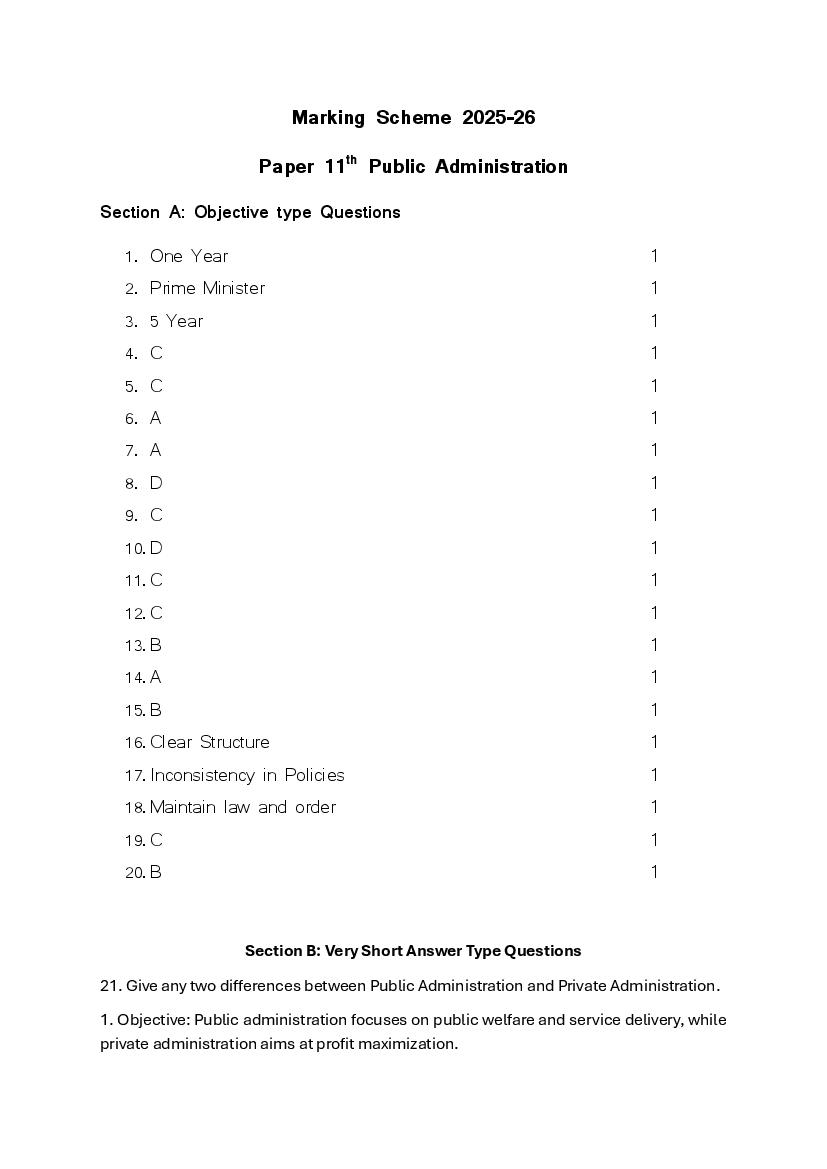
Paper 11th Public Administration
Section A: Objective type Questions
1. One Year 1
2. Prime Minister 1
3. 5 Year 1
4. C 1
5. C 1
6. A 1
7. A 1
8. D 1
9. C 1
10. D 1
11. C 1
12. C 1
13. B 1
14. A 1
15. B 1
16. Clear Structure 1
17. Inconsistency in Policies 1
18. Maintain law and order 1
19. C 1
20. B 1
Section B: Very Short Answer Type Questions
21. Give any two differences between Public Administration and Private Administration.
1. Objective: Public administration focuses on public welfare and service delivery, while
private administration aims at profit maximization.
Page 2
whereas private administration is accountable to shareholders or owners. 2
22. When and where did the origin of Public Administration as a discipline occur?
Public Administration as a discipline originated in the late 19th century in the United
States, notably with Woodrow Wilson’s 1887 essay, "The Study of Administration," which
emphasized the need for a systematic study of public administration. 2
23. Write any two functions of district administration.
1. Law and Order: Maintaining peace and security through coordination with police and
other agencies.
2. Revenue Collection: Administering land revenue, taxes, and maintaining land records.
2
24. Explain the meaning and definition of Budget.
A budget is a financial plan outlining estimated revenues and expenditures for a specific
period, typically a year, to achieve organizational or governmental objectives. It serves as
a tool for resource allocation and fiscal management. 2
25. Give any two differences between Public Administration and Economics.
1. Focus: Public administration focuses on implementing policies and managing public
services, while economics studies resource allocation, production, and consumption.
2. Methodology: Public administration uses administrative and managerial approaches,
whereas economics relies on quantitative models and theories. 2
OR:
Give any two differences between Public Administration and History.
1. Nature: Public administration is a practical discipline focused on governance and
management, while history is an analytical study of past events.
2. Purpose: Public administration aims to improve administrative efficiency, whereas
history seeks to understand and interpret past societal developments. 2
26. Write any two features of Organization.
1. Structure: Organizations have a defined hierarchy and division of roles to achieve
goals.
2. Coordination: Organizations ensure coordinated efforts among individuals or
departments to accomplish objectives. 2
Page 3
What do you understand by organization?
An organization is a structured group of individuals working together in a coordinated
manner to achieve common goals, characterized by a defined hierarchy, division of
labour, and rules or procedures. 2
27. Write any two features of Local Government.
1. Decentralization: Local governments have autonomy to make decisions on local
issues within the framework of national laws.
2. Community Participation: They encourage citizen involvement in governance through
elections and public consultations. 2
OR:
What are the three levels of local government in India?
1. Gram Panchayat (village level)
2. Panchayat Samiti (block level)
3. Zila Parishad (district level) 2
28. Write the meaning of Budget.
A budget is a financial plan detailing expected income and expenditure for a specific
period, used to manage resources and achieve organizational or governmental goals. 2
29. Write any two functions of Public Accounts Committee.
1. Audit Scrutiny: Examines government expenditure to ensure it aligns with approved
budgets and parliamentary sanctions.
2. Financial Accountability: Investigates irregularities in public spending and ensures
transparency in financial management. 2
Section C: Short Answer Type Questions
30. Discuss the importance of Public Administration.
Public Administration is crucial for effective governance and societal development. It
ensures the implementation of government policies, delivering public services like
healthcare, education, and infrastructure. It maintains law and order, promotes
economic development, and ensures equitable resource distribution. Public
administration fosters transparency, accountability, and citizen participation,
strengthening democratic governance. It also adapts to societal changes, addressing
Page 4
efforts. 4
31. Give any four differences between Public Administration and Private Administration.
1. Objective: Public administration prioritizes public welfare, while private administration
focuses on profit.
2. Accountability: Public administration is accountable to the public and government,
whereas private administration answers to owners or shareholders.
3. Scope: Public administration covers broader societal issues like policy
implementation, while private administration focuses on organizational goals.
4. Regulation: Public administration operates under strict legal and governmental
regulations, while private administration has more operational flexibility within legal
limits. 4
32. Discuss the principles of organization.
The principles of organization provide a framework for efficient management and
functioning. Key principles include:
1. Hierarchy: A clear chain of command ensures authority and responsibility flow
systematically.
2. Division of Work: Tasks are divided among individuals or units based on specialization
to enhance efficiency.
3. Coordination: Ensures seamless collaboration among departments to achieve
common goals.
4. Unity of Command: Each employee reports to one supervisor to avoid confusion and
ensure clarity in instructions. 4
33. Write the functions of Public Accounts Committee.
The Public Accounts Committee (PAC) oversees government financial activities to ensure
accountability. Its functions include:
1. Audit Review: Examines audit reports from the Comptroller and Auditor General to
check government expenditure.
2. Financial Oversight: Ensures public funds are used appropriately as per parliamentary
approvals.
3. Investigating Irregularities: Probes financial mismanagement or wasteful expenditure.
Page 5
measures. 4
OR:
Write the functions of Estimates Committee.
The Estimates Committee monitors government expenditure estimates. Its functions
include:
1. Budget Scrutiny: Examines budget estimates to ensure they are realistic and justified.
2. Efficiency Evaluation: Assesses whether proposed expenditures align with policy
objectives.
3. Economy Suggestions: Recommends ways to reduce wasteful spending and improve
financial efficiency.
4. Reporting: Submits reports to Parliament with suggestions for better resource
utilization. 4
34. Give any four functions of Panchayat Samiti.
1. Development Planning: Formulates and implements development plans for
agriculture, irrigation, and rural infrastructure.
2. Coordination: Acts as a link between Gram Panchayats and Zila Parishad, ensuring
coordinated development efforts.
3. Resource Allocation: Distributes funds and resources for local projects like schools
and health canters.
4. Monitoring: Oversees the implementation of government schemes and programs at
the block level. 4
OR:
Write four sources of income of Gram Panchayat.
1. Taxes: Local taxes like property tax, water tax, and professional tax.
2. Grants: Funds from state or central government for development schemes.
3. Fees and Fines: Revenue from licenses, permits, and penalties for violations.
4. Local Resources: Income from community assets like markets, ponds, or community
halls. 4
Page 6
1. Property Tax: Taxes levied on residential and commercial properties.
2. Grants: Financial assistance from state or central government for urban projects.
3. User Charges: Fees for services like water supply, sanitation, and waste management.
4. Licenses and Permits: Revenue from trade licenses, building permits, and
advertisements. 4
OR:
Write any four functions of Municipal Bodies.
1. Urban Infrastructure: Maintains roads, street lighting, and public utilities.
2. Public Health: Ensures sanitation, waste management, and water supply.
3. Urban Planning: Regulates land use, building construction, and urban development.
4. Social Services: Provides education, healthcare, and support for marginalized
communities. 4
Section D: Essay Type Questions
36. Describe the appointment and powers of Governor.
The Governor of an Indian state is a constitutional head appointed by the President of
India under Article 153 of the Constitution. The appointment is typically for a term of five
years, though the President can remove or transfer the Governor at any time. The
eligibility criteria include being an Indian citizen above 35 years of age, with no specific
qualifications mandated, though appointees are often senior politicians or bureaucrats.
Powers and Functions:
1. Executive Powers: The Governor appoints the Chief Minister and Council of Ministers,
who must enjoy the confidence of the state legislature. They also appoint key officials like
the Advocate General and members of the State Public Service Commission.
2. Legislative Powers: The Governor summons, prorogues, and dissolves the state
legislature. They can address the legislature, assent to bills (or withhold assent/send for
reconsideration), and promulgate ordinances when the legislature is not in session.
3. Financial Powers: The Governor ensures the state budget is presented to the legislature
and approves money bills. They also control the state’s contingency fund.
4. Discretionary Powers: Under Article 356, the Governor can recommend President’s
Rule if the state government cannot function constitutionally. They also have special
powers in certain states (e.g., Sixth Schedule areas) over tribal affairs.
Page 7
offenses under state laws.
The Governor acts as a link between the state and the central government, balancing
ceremonial and constitutional roles. However, their discretionary powers, especially in
hung assemblies or dismissing state governments, can be controversial. 6
OR:
Discuss the powers and functions of Chief Minister.
The Chief Minister is the head of the state government in India, appointed by the Governor
based on the majority support in the state legislative assembly. They are the real
executive authority, leading the Council of Ministers.
Powers and Functions:
1. Formation of Government: The Chief Minister advises the Governor on the
appointment of ministers and allocates portfolios to them.
2. Policy Formulation: They lead the state government in formulating policies on
development, welfare, and governance, ensuring alignment with public needs.
3. Legislative Leadership: The Chief Minister guides the legislative agenda, introduces key
bills, and ensures their passage in the state assembly.
4. Administrative Control: They oversee the state bureaucracy, ensuring efficient
implementation of policies and coordination among departments.
5. Financial Management: The Chief Minister plays a key role in preparing the state budget
and prioritizing resource allocation.
6. Central-State Relations: They represent the state in interactions with the central
government, advocating for state interests in forums like the National Development
Council.
The Chief Minister’s effectiveness depends on their political influence, majority support,
and ability to coordinate with the central government and bureaucracy, making them
pivotal in state governance. 6
37. What is the power and function of Superintendent of Police?
The Superintendent of Police (SP) is a senior officer in the Indian Police Service,
responsible for maintaining law and order at the district level under the state
government’s Home Department.
Page 8
1. Law and Order Maintenance: The SP ensures public safety by preventing and
investigating crimes, managing riots, and maintaining peace during events like elections
or protests.
2. Supervision of Police Force: They oversee police stations in the district, supervise
subordinate officers, and ensure discipline and efficiency in the force.
3. Crime Investigation: The SP monitors major criminal cases, coordinates investigations,
and ensures compliance with legal procedures.
4. Coordination with Administration: They work closely with the Deputy Commissioner to
implement government policies on security and public safety.
5. Public Safety Measures: The SP implements traffic management, disaster response,
and community policing initiatives to enhance public trust.
6. Reporting: They submit reports on law and order to the state government and senior
police authorities like the Inspector General.
The SP’s role is critical in ensuring district-level security, requiring both administrative
acumen and operational leadership. 6
OR:
Discuss the power and functions of Deputy Commissioner.
The Deputy Commissioner (DC), also known as the District Collector or District
Magistrate, is the chief administrative officer of a district in India, typically from the Indian
Administrative Service (IAS).
Powers and Functions:
1. Revenue Administration: The DC oversees land revenue collection, maintains land
records, and resolves disputes related to land ownership.
2. Law and Order: As District Magistrate, they coordinate with the SP to maintain public
safety, issue prohibitory orders, and manage crises like riots or natural disasters.
3. Development Administration: The DC implements government schemes, such as rural
development, education, and health programs, ensuring effective delivery at the
grassroots level.
4. Coordination: They act as a link between state government departments and local
bodies, ensuring inter-departmental coordination for district governance.
Page 9
polling, and election conduct.
6. Disaster Management: They lead disaster preparedness and relief efforts, coordinating
with agencies during floods, earthquakes, or other calamities.
The DC is a pivotal figure in district administration, balancing revenue, law and order, and
developmental roles with significant decision-making authority. 6
38. Describe the qualities of a good Public Relations Officer.
A Public Relations Officer (PRO) plays a crucial role in managing communication
between an organization and the public. The qualities of a good PRO include:
1. Communication Skills: A PRO must have excellent verbal and written communication
skills to convey messages clearly and persuasively to diverse audiences.
2. Interpersonal Skills: They should build trust and maintain positive relationships with
stakeholders, media, and the public through empathy and diplomacy.
3. Crisis Management: A good PRO remains calm under pressure, handling crises by
crafting appropriate responses to mitigate negative publicity.
4. Knowledge of Media: They must understand media operations, including digital and
traditional platforms, to effectively disseminate information and manage public
perception.
5. Adaptability: A PRO adapts to changing public sentiments, emerging trends, and
organizational needs to maintain relevance and effectiveness.
6. Ethical Conduct: Integrity and transparency are essential to maintain credibility and
public trust.
A good PRO combines strategic thinking, creativity, and professionalism to enhance the
organization’s image and foster public goodwill. 6
OR
What is the role of Public Relations in Democratic Administration?
Public Relations (PR) in democratic administration is vital for fostering transparency,
accountability, and public trust in governance. Its roles include:
1. Information Dissemination: PR ensures citizens are informed about government
policies, programs, and achievements through press releases, social media, and public
campaigns.
Page 10
actions, PR strengthens trust between the administration and citizens.
3. Facilitating Dialogue: PR creates channels for two-way communication, allowing
citizens to voice concerns and governments to respond, enhancing participatory
democracy.
4. Crisis Communication: During crises (e.g., natural disasters or policy controversies),
PR manages public perception by providing timely and accurate information to prevent
misinformation.
5. Promoting Transparency: PR ensures government actions are communicated openly,
reinforcing democratic values of accountability and openness.
6. Public Awareness: It educates citizens about their rights, government schemes, and
civic responsibilities, encouraging active participation in governance.
In a democratic setup, PR bridges the gap between the government and the public,
ensuring informed citizenry and responsive administration, which are cornerstones of
democracy. 6
Document Details
| Board / Org | Haryana Board |
| Exam | Class 11 |
| Type | Sample Paper |
| Pages | 10 |
| Updated | 24 Sep 2026 |