CBSE Class 12 Marking Scheme 2022 for Maths Term 2
Finished viewing? Save it for later —
Download CBSE Class 12 Marking Scheme 2022 for Maths Term 2 (PDF · 7 pages)About CBSE Class 12 Marking Scheme 2022 for Maths Term 2
CBSE Class 12 Marking Scheme 2022 for Maths Term 2 is available here for free download. Published by CBSE for Class 12, this marking scheme can be viewed online or downloaded as a PDF (7 pages). Candidates preparing for Class 12 can use CBSE Class 12 Marking Scheme 2022 for Maths Term 2 to understand the exam pattern, the type of questions asked, and the overall difficulty level.
Frequently Asked Questions
How can I download CBSE Class 12 Marking Scheme 2022 for Maths Term 2?
Open this page and click the Download button to save CBSE Class 12 Marking Scheme 2022 for Maths Term 2 as a PDF. It is completely free on AglaSem Docs.
Is CBSE Class 12 Marking Scheme 2022 for Maths Term 2 free to download?
Yes. CBSE Class 12 Marking Scheme 2022 for Maths Term 2 can be viewed online and downloaded as a PDF free of cost on AglaSem Docs.
How many pages does CBSE Class 12 Marking Scheme 2022 for Maths Term 2 have?
CBSE Class 12 Marking Scheme 2022 for Maths Term 2 contains 7 pages, which you can read online or download together as a single PDF.
Where can I find more Class 12 study material?
You can find more Class 12 question papers, sample papers, syllabus, and answer keys on AglaSem Docs.
CBSE Class 12 Marking Scheme 2022 for Maths Term 2 – Text
Read the full text of this marking scheme below — useful to quickly search, copy and reference the content online without downloading the PDF.
📄 View text version (7 pages)
Page 1
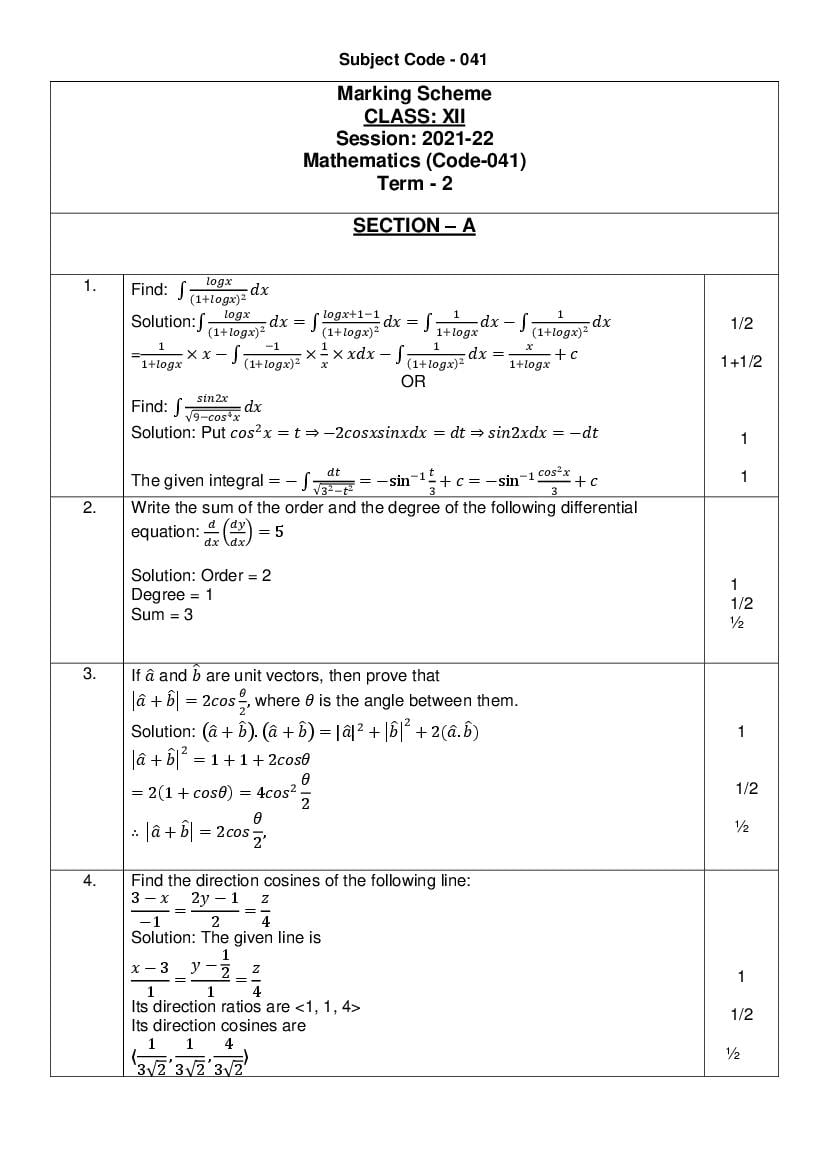
Marking Scheme
CLASS: XII
Session: 2021-22
Mathematics (Code-041)
Term - 2
SECTION – A
1. 𝑙𝑜𝑔𝑥
Find: ∫ (1+𝑙𝑜𝑔𝑥)2 𝑑𝑥
𝑙𝑜𝑔𝑥 𝑙𝑜𝑔𝑥+1−1 1 1
Solution:∫ (1+𝑙𝑜𝑔𝑥)2 𝑑𝑥 = ∫ (1+𝑙𝑜𝑔𝑥)2 𝑑𝑥 = ∫ 1+𝑙𝑜𝑔𝑥 𝑑𝑥 − ∫ (1+𝑙𝑜𝑔𝑥)2 𝑑𝑥 1/2
1 −1 1 1 𝑥
= × 𝑥 − ∫ (1+𝑙𝑜𝑔𝑥)2 × × 𝑥𝑑𝑥 − ∫ (1+𝑙𝑜𝑔𝑥)2 𝑑𝑥 = +𝑐 1+1/2
1+𝑙𝑜𝑔𝑥 𝑥 1+𝑙𝑜𝑔𝑥
OR
𝑠𝑖𝑛2𝑥
Find: ∫ √9−𝑐𝑜𝑠4 𝑑𝑥
𝑥
Solution: Put 𝑐𝑜𝑠 2 𝑥 = 𝑡 ⇒ −2𝑐𝑜𝑠𝑥𝑠𝑖𝑛𝑥𝑑𝑥 = 𝑑𝑡 ⇒ 𝑠𝑖𝑛2𝑥𝑑𝑥 = −𝑑𝑡 1
𝑑𝑡 𝑡 𝑐𝑜𝑠2 𝑥
The given integral = − ∫ √32 = −sin−1 3 + 𝑐 = −sin−1 +𝑐 1
−𝑡 2 3
2. Write the sum of the order and the degree of the following differential
𝑑 𝑑𝑦
equation: 𝑑𝑥 (𝑑𝑥 ) = 5
Solution: Order = 2
1
Degree = 1
1/2
Sum = 3
½
3. If 𝑎̂ and 𝑏̂ are unit vectors, then prove that
𝜃
|𝑎̂ + 𝑏̂| = 2𝑐𝑜𝑠 , where 𝜃 is the angle between them.
2
2
Solution: (𝑎̂ + 𝑏̂). (𝑎̂ + 𝑏̂) = |𝑎̂|2 + |𝑏̂| + 2(𝑎̂. 𝑏̂ ) 1
2
|𝑎̂ + 𝑏̂| = 1 + 1 + 2𝑐𝑜𝑠𝜃
𝜃
= 2(1 + 𝑐𝑜𝑠𝜃) = 4𝑐𝑜𝑠 2 1/2
2
𝜃
∴ |𝑎̂ + 𝑏̂| = 2𝑐𝑜𝑠 , ½
2
4. Find the direction cosines of the following line:
3 − 𝑥 2𝑦 − 1 𝑧
= =
−1 2 4
Solution: The given line is
1
𝑥−3 𝑦−2 𝑧
= = 1
1 1 4
Its direction ratios are <1, 1, 4> 1/2
Its direction cosines are
1 1 4
〈 , , 〉 ½
3√2 3√2 3√2
Page 2
number of red balls if 2 balls are drawn at random from the bag one-by-one
without replacement.
Solution: Let X be the random variable defined as the number of red balls.
Then X = 0, 1 1/2
3 2 6 1 1/2
P(X=0) = 4 × 3 = 12 = 2
1 3 3 1 6 1
P(X=1) =4 × 3 + 4 × 3 = 12 = 2 1/2
Probability Distribution Table:
X 0 1
P(X) 1 1 ½
2 2
6. Two cards are drawn at random from a pack of 52 cards one-by-one without
replacement. What is the probability of getting first card red and second card
Jack?
Solution: The required probability = P((The first is a red jack card and The
second is a jack card) or (The first is a red non-jack card and The second is 1
a jack card))
2 3 24 4 1 1
=52 × 51 + 52 × 51 = 26
SECTION – B
𝑥+1
7. Find: ∫ (𝑥 2 +1)𝑥 𝑑𝑥
𝑥+1 𝐴𝑥+𝐵 𝐶 (𝐴𝑥+𝐵)𝑥+𝐶(𝑥 2 +1)
Solution: Let (𝑥 2 +1)𝑥 = 𝑥 2 +1 + 𝑥 = 1/2
(𝑥 2 +1)𝑥
2
⇒ 𝑥 + 1 = (𝐴𝑥 + 𝐵)𝑥 + 𝐶(𝑥 + 1) (An identity)
Equating the coefficients, we get
B = 1, C = 1, A + C = 0
Hence, A = -1, B = 1, C = 1 ½
−𝑥+1 1
The given integral = ∫ 𝑥 2 +1 𝑑𝑥 + ∫ 𝑥 𝑑𝑥
−1 2𝑥 − 2 1 1/2
= ∫ 2 𝑑𝑥 + ∫ 𝑑𝑥
2 𝑥 +1 𝑥
−1 2𝑥 1 1
= ∫ 2 𝑑𝑥 + ∫ 2 𝑑𝑥 + ∫ 𝑑𝑥
2 𝑥 +1 𝑥 +1 𝑥
−1 1+1/2
= log(𝑥 2 + 1) + tan−1 𝑥 + 𝑙𝑜𝑔|𝑥| + 𝑐
2
8. Find the general solution of the following differential equation:
𝑑𝑦 𝑦
𝑥 = 𝑦 − 𝑥𝑠𝑖𝑛( )
𝑑𝑥 𝑥
Solution: We have the differential equation:
𝑑𝑦 𝑦 𝑦
= − 𝑠𝑖𝑛( )
𝑑𝑥 𝑥 𝑥
The equation is a homogeneous differential equation.
𝑑𝑦 𝑑𝑣 1
Putting 𝑦 = 𝑣𝑥 ⇒ 𝑑𝑥 = 𝑣 + 𝑥 𝑑𝑥
The differential equation becomes
𝑑𝑣
𝑣+𝑥 = 𝑣 − 𝑠𝑖𝑛𝑣
𝑑𝑥
𝑑𝑣 𝑑𝑥 𝑑𝑥
⇒ =− ⇒ 𝑐𝑜𝑠𝑒𝑐𝑣𝑑𝑣 = − ½
𝑠𝑖𝑛𝑣 𝑥 𝑥
Integrating both sides, we get
Page 3
constant.) 1
⇒ 𝑙𝑜𝑔|(𝑐𝑜𝑠𝑒𝑐𝑣 − 𝑐𝑜𝑡𝑣)𝑥| = 𝑙𝑜𝑔𝐾
⇒ |(𝑐𝑜𝑠𝑒𝑐𝑣 − 𝑐𝑜𝑡𝑣)𝑥| = 𝐾
⇒ (𝑐𝑜𝑠𝑒𝑐𝑣 − 𝑐𝑜𝑡𝑣)𝑥 = ±𝐾
𝑦 𝑦 ½
⇒ (𝑐𝑜𝑠𝑒𝑐 𝑥 − 𝑐𝑜𝑡 𝑥 ) 𝑥 = 𝐶, which is the required general solution.
OR
Find the particular solution of the following differential equation, given that y
𝜋
= 0 when x = 4 :
𝑑𝑦 2
+ 𝑦𝑐𝑜𝑡𝑥 =
𝑑𝑥 1 + 𝑠𝑖𝑛𝑥
Solution:
The differential equation is a linear differential equation
I F = 𝑒 ∫ 𝑐𝑜𝑡𝑥𝑑𝑥 = 𝑒 𝑙𝑜𝑔𝑠𝑖𝑛𝑥 = 𝑠𝑖𝑛𝑥 1
The general solution is given by
𝑠𝑖𝑛𝑥
𝑦𝑠𝑖𝑛𝑥 = ∫ 2 𝑑𝑥 ½
1 + 𝑠𝑖𝑛𝑥
𝑠𝑖𝑛𝑥 + 1 − 1 1
⇒ 𝑦𝑠𝑖𝑛𝑥 = 2 ∫ 𝑑𝑥 = 2 ∫[1 − ]𝑑𝑥
1 + 𝑠𝑖𝑛𝑥 1 + 𝑠𝑖𝑛𝑥
1
⇒ 𝑦𝑠𝑖𝑛𝑥 = 2 ∫[1 − 𝜋 ]𝑑𝑥
1 + cos (2 − 𝑥)
1
⇒ 𝑦𝑠𝑖𝑛𝑥 = 2 ∫[1 − 𝜋 𝑥 ]𝑑𝑥
2𝑐𝑜𝑠 2 ( 4 − 2)
1 𝜋 𝑥
⇒ 𝑦𝑠𝑖𝑛𝑥 = 2 ∫[1 − 𝑠𝑒𝑐 2 ( − )]𝑑𝑥
2 4 2
𝜋 𝑥
⇒ 𝑦𝑠𝑖𝑛𝑥 = 2[𝑥 + tan ( − )] + 𝑐
4 2𝜋 1
Given that y = 0, when x = 4 ,
𝜋 𝜋
Hence, 0 = 2[ 4 + 𝑡𝑎𝑛 8 ] + 𝑐
𝜋 𝜋
⇒ 𝑐 = − − 2𝑡𝑎𝑛
2 8
Hence, the particular solution is
𝜋 𝑥 𝜋 𝜋
𝑦 = 𝑐𝑜𝑠𝑒𝑐𝑥[2 {𝑥 + tan ( − )} − ( + 2𝑡𝑎𝑛 )] ½
4 2 2 8
9. 0, 𝑎⃗. 𝑏⃗⃗ = 𝑎⃗. 𝑐⃗, 𝑎⃗ × 𝑏⃗⃗ = 𝑎⃗ × 𝑐⃗, then show that 𝑏⃗⃗ = 𝑐⃗.
If 𝑎⃗ ≠ ⃗⃗⃗
Solution: We have 𝑎⃗. (𝑏⃗⃗ − 𝑐⃗) = 0
⇒ (𝑏⃗⃗ − 𝑐⃗) = ⃗0⃗ or 𝑎⃗ ⊥ (𝑏⃗⃗ − 𝑐⃗)
⇒ 𝑏⃗⃗ = 𝑐⃗ or 𝑎⃗ ⊥ (𝑏⃗⃗ − 𝑐⃗) 1
Also, 𝑎⃗ × (𝑏⃗⃗ − 𝑐⃗) = ⃗0⃗
⇒ (𝑏⃗⃗ − 𝑐⃗) = ⃗0⃗ or 𝑎⃗ ∥ (𝑏⃗⃗ − 𝑐⃗)
⇒ 𝑏⃗⃗ = 𝑐⃗ or 𝑎⃗ ∥ (𝑏⃗⃗ − 𝑐⃗) 1
𝑎⃗ 𝑐𝑎𝑛 𝑛𝑜𝑡 𝑏𝑒 𝑏𝑜𝑡ℎ 𝑝𝑒𝑟𝑝𝑒𝑛𝑑𝑖𝑐𝑢𝑙𝑎𝑟 𝑡𝑜 (𝑏⃗⃗ − 𝑐⃗) 𝑎𝑛𝑑 𝑝𝑎𝑟𝑎𝑙𝑙𝑒𝑙 𝑡𝑜 (𝑏⃗⃗ − 𝑐⃗)
Hence, 𝑏⃗⃗ = 𝑐⃗. 1
10. Find the shortest distance between the following lines:
𝑟⃗ = (𝑖̂ + 𝑗̂ − 𝑘̂) + 𝑠(2𝑖̂ + 𝑗̂ + 𝑘̂ )
𝑟⃗ = (𝑖̂ + 𝑗̂ + 2𝑘̂) + 𝑡(4𝑖̂ + 2𝑗̂ + 2𝑘̂)
Page 4
⃗⃗⃗⃗⃗⃗−𝑎 ⃗⃗|
2 ⃗⃗⃗⃗⃗⃗)×𝑏
1
Solution: Here, the lines are parallel. The shortest distance = ⃗⃗|
|𝑏
|(3𝑘̂) × (2𝑖̂ + 𝑗̂ + 𝑘̂)| 1+1/2
=
√4 + 1 + 1
𝑖̂ 𝑗̂ 𝑘̂
̂ ̂
(3𝑘) × (2𝑖̂ + 𝑗̂ + 𝑘 ) = |0 0 3| = −3𝑖̂ + 6𝑗̂ 1
2 1 1
3√5 ½
Hence, the required shortest distance = units
√6
OR
Find the vector and the cartesian equations of the plane containing the point
𝑖̂ + 2𝑗̂ − 𝑘̂ and parallel to the lines 𝑟⃗ = (𝑖̂ + 2𝑗̂ + 2𝑘̂) + 𝑠(2𝑖̂ − 3𝑗̂ + 2𝑘̂) = 0
and 𝑟⃗ = (3𝑖̂ + 𝑗̂ − 2𝑘̂) + 𝑡(𝑖̂ − 3𝑗̂ + 𝑘̂ ) = 0
Solution: Since, the plane is parallel to the given lines, the cross product of
the vectors 2𝑖̂ − 3𝑗̂ + 2𝑘̂ and 𝑖̂ − 3𝑗̂ + 𝑘̂ will be a normal to the plane
𝑖̂ 𝑗̂ 𝑘̂
(2𝑖̂ − 3𝑗̂ + 2𝑘̂ ) × (𝑖̂ − 3𝑗̂ + 𝑘̂) = |2 −3 2| = 3𝑖̂ − 3𝑘̂ 1
1 −3 1
The vector equation of the plane is 𝑟⃗. (3𝑖̂ − 3𝑘̂) =(𝑖̂ + 2𝑗̂ − 𝑘̂). (3𝑖̂ − 3𝑘) ̂
1
or, 𝑟⃗. (𝑖̂ − 𝑘̂) = 2
and the cartesian equation of the plane is x – z – 2 = 0 1
SECTION – C
11. 2
Evaluate: ∫−1|𝑥 3 − 3𝑥 2 + 2𝑥|𝑑𝑥
2
Solution: The given definite integral = ∫−1|𝑥(𝑥 − 1)(𝑥 − 2)|𝑑𝑥
0 1 2
= ∫ |𝑥(𝑥 − 1)(𝑥 − 2)|𝑑𝑥 + ∫ |𝑥(𝑥 − 1)(𝑥 − 2)|𝑑𝑥 + ∫ |𝑥(𝑥 − 1)(𝑥 − 2)|𝑑𝑥 1+1/2
−1 0 1
0 1 2
= − ∫ (𝑥 3 − 3𝑥 2 + 2𝑥)𝑑𝑥 + ∫ (𝑥 3 − 3𝑥 2 + 2𝑥)𝑑𝑥 − ∫ (𝑥 3 − 3𝑥 2 + 2𝑥)𝑑𝑥 1/2
−1 0 1
4
𝑥 2 0
𝑥4 𝑥4
= −[ − 𝑥 + 𝑥 ]−1 + [ − 𝑥 + 𝑥 ]0 − [ − 𝑥 3 + 𝑥 2 ]12
3 3 2 1
4 4 4
9 1 1 11 2
= + + =
4 4 4 4
Page 5
the line x + y = 2, the parabola y 2 = x and the x-axis.
Solution: Solving x + y = 2 and y 2 = x simultaneously, we get the points of
intersection as (1, 1) and (4, -2). 1
1
Fig 1
1 2
The required area = the shaded area = ∫0 √𝑥 𝑑𝑥 + ∫1 (2 − 𝑥)𝑑𝑥 1
3
2 𝑥2
= 3 [𝑥 ]0 + [2𝑥 − 2 ]12
2 1
2 1 7
= 3 + 2 = 6 square units 1
OR
Using integration, find the area of the region: {(𝑥, 𝑦): 0 ≤ 𝑦 ≤ √3𝑥, 𝑥 2 + 𝑦 2 ≤
4}
Solution: Solving 𝑦 = √3𝑥 𝑎𝑛𝑑 𝑥 2 + 𝑦 2 = 4 , we get the points of intersection
as (1, √3) and (-1, −√3)
1
Fig 2
1
Page 6
The required area = the shaded area = ∫0 √3𝑥 𝑑𝑥 + ∫1 √4 − 𝑥 2 𝑑𝑥
1
√3 2 1 1 𝑥2
= [𝑥 ]0 + [𝑥 √4 − 𝑥 2 + 4 sin−1 ]
2 2 21
√3 1 𝜋
= + [2𝜋 − √3 − 2 ]
2 2 3
2𝜋
= 3 square units 1
13. Find the foot of the perpendicular from the point (1, 2, 0) upon the plane
x – 3y + 2z = 9. Hence, find the distance of the point (1, 2, 0) from the given
plane.
Solution: The equation of the line perpendicular to the plane and passing
through the point (1, 2, 0) is
𝑥−1 𝑦−2 𝑧 1
= =
1 −3 2
The coordinates of the foot of the perpendicular are (𝜇 + 1, −3𝜇 + 2,2𝜇) for ½
some 𝜇
These coordinates will satisfy the equation of the plane. Hence, we have
𝜇 + 1 − 3(−3𝜇 + 2) + 2(2𝜇) = 9
⇒𝜇=1 1
The foot of the perpendicular is (2, -1, 2). ½
Hence, the required distance = √(1 − 2)2 + (2 + 1)2 + (0 − 2)2 = √14 𝑢𝑛𝑖𝑡𝑠 1
Page 7
Fig 3
An insurance company believes that people can be divided into two classes: those who are
accident prone and those who are not. The company’s statistics show that an accident-prone
person will have an accident at sometime within a fixed one-year period with probability 0.6,
whereas this probability is 0.2 for a person who is not accident prone. The company knows that
20 percent of the population is accident prone.
Based on the given information, answer the following questions.
(i)what is the probability that a new policyholder will have an accident within a
year of purchasing a policy?
(ii) Suppose that a new policyholder has an accident within a year of purchasing a
policy. What is the probability that he or she is accident prone?
Solution: Let E1 = The policy holder is accident prone.
E2 = The policy holder is not accident prone.
E = The new policy holder has an accident within a year of purchasing a
policy.
(i) P(E)= P(E1)× P(E∕E1) + P(E2)× P(E∕E2) 1
20 6 80 2 7 1
=100 × 10 + 100 × 10 = 25
𝑃(𝐸1 )×𝑃(𝐸/𝐸1 )
(ii) By Bayes’ Theorem, 𝑃(𝐸1⁄𝐸) = 1
𝑃(𝐸)
20 6
× 3
100 10
= 280 =7 1
1000
---------------------------
Document Details
| Board / Org | CBSE |
| Exam | Class 12 |
| Type | Solution |
| Pages | 7 |
| Language | english |
| Updated | 30 Apr 2026 |