CBSE Class 12 Marking Scheme 2022 for NCC Term 2
Finished viewing? Save it for later —
Download CBSE Class 12 Marking Scheme 2022 for NCC Term 2 (PDF · 9 pages)About CBSE Class 12 Marking Scheme 2022 for NCC Term 2
CBSE Class 12 Marking Scheme 2022 for NCC Term 2 is available here for free download. Published by CBSE for Class 12, this marking scheme can be viewed online or downloaded as a PDF (9 pages). Candidates preparing for Class 12 can use CBSE Class 12 Marking Scheme 2022 for NCC Term 2 to understand the exam pattern, the type of questions asked, and the overall difficulty level.
Frequently Asked Questions
How can I download CBSE Class 12 Marking Scheme 2022 for NCC Term 2?
Open this page and click the Download button to save CBSE Class 12 Marking Scheme 2022 for NCC Term 2 as a PDF. It is completely free on AglaSem Docs.
Is CBSE Class 12 Marking Scheme 2022 for NCC Term 2 free to download?
Yes. CBSE Class 12 Marking Scheme 2022 for NCC Term 2 can be viewed online and downloaded as a PDF free of cost on AglaSem Docs.
How many pages does CBSE Class 12 Marking Scheme 2022 for NCC Term 2 have?
CBSE Class 12 Marking Scheme 2022 for NCC Term 2 contains 9 pages, which you can read online or download together as a single PDF.
Where can I find more Class 12 study material?
You can find more Class 12 question papers, sample papers, syllabus, and answer keys on AglaSem Docs.
CBSE Class 12 Marking Scheme 2022 for NCC Term 2 – Text
Read the full text of this marking scheme below — useful to quickly search, copy and reference the content online without downloading the PDF.
📄 View text version (9 pages)
Page 1
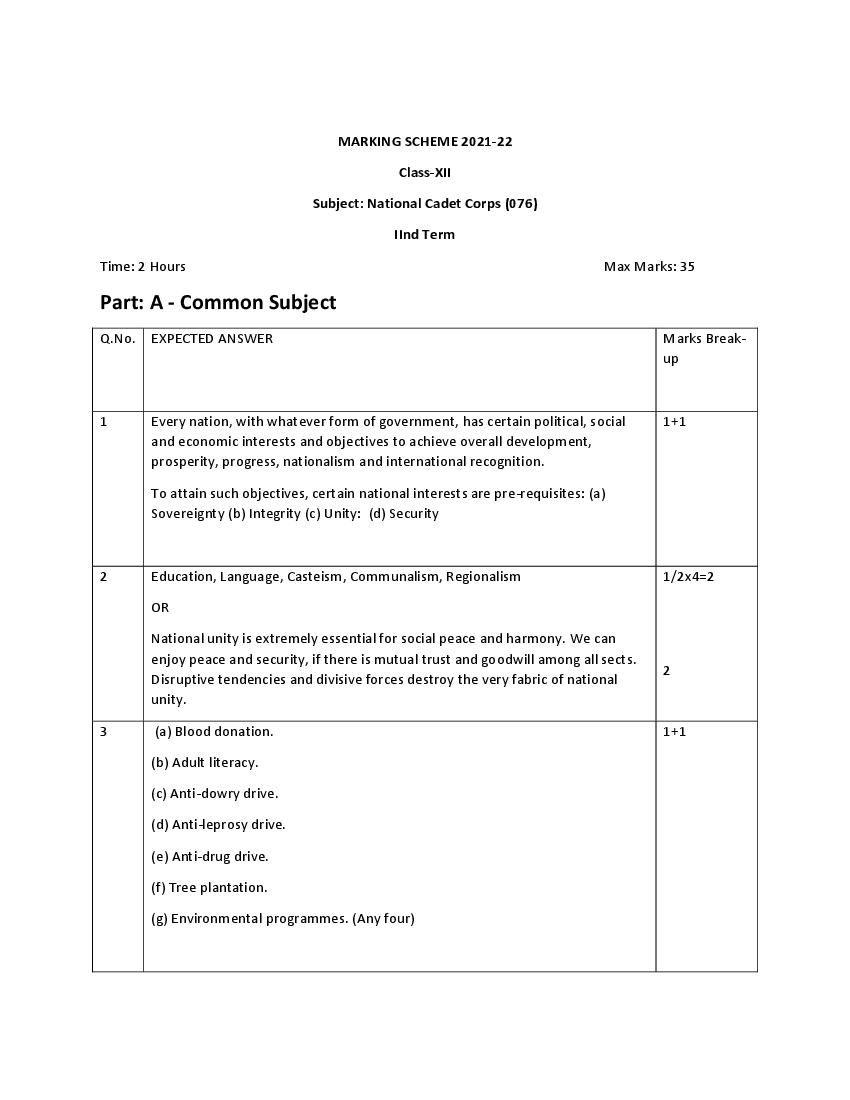
Class-XII
Subject: National Cadet Corps (076)
IInd Term
Time: 2 Hours Max Marks: 35
Part: A - Common Subject
Q.No. EXPECTED ANSWER Marks Break-
up
1 Every nation, with whatever form of government, has certain political, social 1+1
and economic interests and objectives to achieve overall development,
prosperity, progress, nationalism and international recognition.
To attain such objectives, certain national interests are pre-requisites: (a)
Sovereignty (b) Integrity (c) Unity: (d) Security
2 Education, Language, Casteism, Communalism, Regionalism 1/2x4=2
OR
National unity is extremely essential for social peace and harmony. We can
enjoy peace and security, if there is mutual trust and goodwill among all sects.
2
Disruptive tendencies and divisive forces destroy the very fabric of national
unity.
3 (a) Blood donation. 1+1
(b) Adult literacy.
(c) Anti-dowry drive.
(d) Anti-leprosy drive.
(e) Anti-drug drive.
(f) Tree plantation.
(g) Environmental programmes. (Any four)
Page 2
relationship.
Attraction between individuals brings them close and eventually results in a
strong interpersonal relationship. Communication is said to be the basis of
every interpersonal relationship. Infact, effective communication is the key to a
healthy and long lasting relationship and if individuals do not, problems are
bound to come. Communication plays a pivotal role in strengthening the bonds
of friendship among individuals. A relationship loses its charm if individuals do
not express and reciprocate their feelings through various modes of
communication. A healthy interaction is essential for a healthy relationship.
It is not always that an individual needs to talk to express his /her feelings.
Feelings can be expressed through non-verbal modes of communication as well.
Lack of communication breeds problems in relationships. We tend to assume
that others know what we want or how we feel.
5 Telephone/Mobile Phone 1+1+1=3
b) Visitors
c) Paper
d) Lack of Planning:
e) Socializing: As far as possible, one must avoid extended tea-breaks, regular
social lunch-hours, and chat in the corridors. Better to do it outside of work
time.
f) Indecision: This is caused by ignorance, fear, or lack of confidence in the facts.
Improve fact-finding procedures, and listen to your intuition. If you make
decisions quickly, you can save time. Successful people make decisions quickly.
g) Television: Can be a huge time-waster.
h) Procrastination (Explain any Two)
OR
Be Yourself
Be Responsible
Be Open and Approachable
Be Attentive
1/2x6=3
Be Polite
Page 3
Be Cautious
6 Control over cultivation of opium and all matters relating to narcotic drugs and 1x3=3
psychotropic substances are regulated by the Narcotic Drugs and Psychotropic
Substances (NDPS) Act and Rules, which provide for:-
(a) Punishment of upto 20 years rigorous imprisonment (RI) and fine up to
rupees two lakhs for indulging in trafficking of narcotic drugs and psychotropic
substances.
(b) Death sentence in case of repeat of this offence.
(c) Forfeiture of property of smugglers.
(d) Regulating of legitimate trade and commerce of NDPS for medicinal and
scientific purposes. The Prevention of Illicit Trafficking in Narcotic Drugs and
Psychotropic Substances (PITNDPS), provides for the detention of persons
indulging in trafficking of narcotic drugs for 1 to 2 years by an executive order.
7 Effects: 1x3=3
(a) Skewed sex ratio
(b) Female trafficking
(c) Increase in rape and assault
(d) Population decline (or any other reason which you think better with
explanation)
OR
In India, while driving a motor vehicle, if a person has a Blood Alcohol Level
(BAC) exceeding 30 mg of intake per 100 ml of blood detected by a
breathalyzer, he or she is booked under ‘first offense’. 1+1/2x4=3
The most common violators by drunken driving have been identified as under:
(a) Children between 16-25 years of age.
(b) Most truck drivers.
© Most people returning from parties in cities.
(d) After New Year parties or festival celebrations.
8 (a) Licensing 1/2x6=3
Page 4
(c) High Winds
(d) Visibility
(e) Passenger Age and Weight Restrictions
(f) Types of Equipment
(g) Altitude
(h) Ask Questions
(i) Release Form (or any other safety precaution with detail) ( any six)
9 Types of Style ( one mark) 1+3=4
a) Aggressive
b) Passive
c) Assertive
(Explanation of each consists 1 mark each )
Specialized Subjects
a) ARMY
10 Alertness, Courage and Decisiveness( 1 mark for each explanation) 1+1=2
OR
The study of military history is important in knowing the causes, social and 2
cultural foundations of war, how military doctrine, logistics, leadership,
technology and strategy have been used on each side, and how these have
changed over time.
11 Portable/Light in weight, operation easy, 128 channels can be operated, Can 1/2x4=2
select required zone, Option of selecting call facilities (Any four points)
12 An individual should be able to judge distance accurately with his eyes so that 1x3=3
the individual can decide on the following:-
(a) Know when to open fire.
(b) Know which weapon to be used.
(c) Can indicate targets to other men in his section
Page 5
( with explanation)
OR
Distances are overestimated when:-
(i) Light is bad.
(ii) The sun is in the observer’s eye. 1/2x6=3
(iii) The object is small in relation to its surroundings.
(iv) Looking through a valley of narrow lane e.g. street.
(v) Lying down.
(vi) Looking from top to bottom
13 Field signals are alternate means of giving orders and control troops when voice 1x3=3
control is not possible like.
Battle Noises.
Need for silence.
Intervening distances are too large.
(Explain points)
Specialized Subjects
b) NAVY
10 Hold Water. This is the order to reduce or stop the way of the boat by holding 1+1=2
the oars at right angles to the boat and with their blades in water.
Precautions while Pulling. Following is to be ensured during boat pulling: -
(a) Ensure the boat is clear of water.
(b) Adequate number of oars & crutches are boarded along with spare.
(c) Life jacket is worn by all crew.
(d) Check the boat plug is installed.
(e) First aid kit is available.
(f) Availability of loud hailer, drinking water, sufficient ropes, bailer, anchor, life
Page 6
(g) Only swimmers and physically fit should participate.
(h) Knowledge of local weather and tidal conditions.
(j) Rudder, tiller & towing bollard should be properly secured.
11 Types of Models - Models are of different types like Solid Model, Working 1+1= 2
Model or a Sailing Model as explained below:-
(a) Solid Model. A solid model is one made with solid block of wood including
the appendages and additional parts attached post preparation of the basic
structure. The solid models are basically scaled to originally planned ship for
purposes of show and testing / trials.
(b) Working Model. Working Model for the boat is a scaled model with all parts
moving with mechanical or electrical support. The working model is designed to
project the actual working of the boat.
(c) Sailing Model. Sailing models are generally scaled models with sails and
motor fitted for control of the sail model remotely.
OR
1+1= 2
Therefore, repair and maintenance work must be carried out in accordance
with preventive maintenance schedules as under: -
(a) Polythene/ canvas dust covers are to be used to cover the machines and
equipment when not in use to protect them against dust and moisture.
(b) The user should be instructed to clean the machine after use with a hand
brush. Slide ways are to be oiled to avoid condensation of moisture and then to
cover the machine with dustcover.
(c) Each machine must have its tool cup-board for keeping all the accessories
required for use.
(d) Cadets should be taught the use of the various controls and the correct
manipulation of the machine before the commencement of any skill training of
the machine.
(e) A check list/ store list showing all the items kept in the tool cup-board is to
be displayed in a prominent place inside the cup-board.
12 TYPES OF COMPASS 2+1= 3
The navigational compass is an instrument that gives the necessary datum line
from which courses and bearings can be measured. Compass helps us to find
the direction of the ship at sea.
Page 7
(a) Magnetic compass. It is a magnet freely suspended in a horizontal plane
which settles with one end pointing approximately to the true north. The
reading obtained does not give us the true north due to various external factors
such as earth’s magnetism and ships magnetic property. The north direction
obtained is called the Compass North.
(b) Gyro Compass. This instrument is a rapidly spinning wheel or gyroscope, the
axis of which is made to point along the meridian towards true north. Courses
and bearings, which are measured using a gyrocompass, are true provided
there is no error in the compass. It is measured clockwise from 000 to360.
13 Semaphore. Semaphore is a method of communication when within visual 1+1+1= 3
range and where radio or vocal communication is inappropriate. It is carried out
with the help of two flags and arms outstretched. Semaphore symbols are as
given below.
OR
Phonetic Alphabets. When the letters of the alphabet are read out it will be
observed that some of them sound very similar especially on radio telephone.
This can cause confusion when important messages are being passed. In order
to eliminate the ambiguity phonetic alphabets are used so as to ensure clarity
and exactness of messages.
3. The Phonetic alphabets are given below.
A– Alfa J -Juliet S - Sierra
B– Bravo K – Kilo T - Tango
C– Charlie L –Lima U -Uniform
D - Delta M – Mike V - Victor
Page 8
F - Foxtrot O – Oscar X – X ray
G - Golf P – Papa Y - Yankee
H – Hotel Q – Quebec Z - Zulu
I – India R – Romeo
Specialized Subject C) Air Force
10 The types of Aero-models are : (any two) 1+1=2
(a) Static models
(b) Control line models
(c) Radio Control (RC) models
(d) Gliders
OR
The following are the general safety code to be followed:- (any two)
(a) Not to fly model aircraft in competition or the presence of spectators
until it has been proven to be airworthy by having been previously
successfully flight-tested. 1+1= 2
(b) Not to fly model aircraft higher than approximately 400 feet within 3
miles of an airport without notifying the airport operator.
(c) Give right of way to, and avoid flying in the proximity of full-scale
aircraft. Where necessary an observer shall be utilized to supervise flying
to avoid having models fly in the proximity of full-scale aircraft.
(d) Where established, abide by the safety rules for the flying site and
willfully and deliberately not to fly my models in a careless, reckless,
and/or dangerous manner.
11 Radar is an object detection system that uses radio waves to determine 1+1= 2
the range, altitude, direction, or speed of objects. It can be used to detect
aircraft, ships, spacecraft, guided missiles, motor vehicles, weather
formations, and terrain.
In aviation, aircraft are equipped with radar devices that warn of
obstacles in or approaching their path and give accurate altitude
readings.
12 a) Operation Safed Sagar was the codename assigned to the Indian Air 1+1+1= 3
Page 9
aimed to flush out Regular and Irregular troops of the Pakistani Army from
vacated Indian Positions in the Kargil sector along the Line of Control.
b) The East Pakistan Rifles and East Bengal Regiment became the Mukti
Fauj.
c) The angle between the chord line and the longitudinal axis of the aircraft is
called angle of Incidence
13 The following are the forces acting on an aircraft in flight: - (any three) 1+1+1= 3
(a) Lift is a positive force caused by the difference in air pressure under and
above a wing. The higher air pressure beneath a wing creates lift and is affected
by the shape of the wing. Changing a wing's angle of attack affects the speed of
the air flowing over the wing and the amount of lift that the wing creates.
(b) Thrust is the force that propels an object forward. An engine spinning a
propeller or a jet engine expelling hot air out the tailpipe are examples of
thrust. In bats, thrust is created by muscles making the wings flap.
(c) Drag is the resistance of the air to anything moving through it. Different wing
shapes greatly affect drag. Air divides smoothly around a wing's rounded
leading edge, and flows neatly off its tapered trailing edge this is called
streamlining.
(d) Weight is the force that causes objects to fall downwards. In-flight, the force
of the weight is countered by the forces of lift and thrust.
OR
a) Total reaction: It is one single force representing all the pressures (force per 1+1+1= 3
unit area) over the surface of the Aerofoil. It acts through the center of
pressure which is situated on the chord line.
b) Angle of Attack: It is the angle between the chord line and the relative
airflow undisturbed by the presence of Aerofoil.
c) Aerofoil: It is a body designed to produce more lift than drag. A typical
Aerofoil section is cambered on a top surface and is more or less straight at the
bottom.
Document Details
| Board / Org | CBSE |
| Exam | Class 12 |
| Type | Solution |
| Pages | 9 |
| Language | english |
| Updated | 09 Jun 2026 |