HBSE Class 11 Sample Paper 2026 Answers Political Science
Finished viewing? Save it for later —
Download HBSE Class 11 Sample Paper 2026 Answers Political Science (PDF · 25 pages)About HBSE Class 11 Sample Paper 2026 Answers Political Science
HBSE Class 11 Sample Paper 2026 Answers Political Science is available here for free download. Published by Haryana Board for Class 11, this answer key can be viewed online or downloaded as a PDF (25 pages). Candidates preparing for Class 11 can use HBSE Class 11 Sample Paper 2026 Answers Political Science to understand the exam pattern, the type of questions asked, and the overall difficulty level.
Frequently Asked Questions
How can I download HBSE Class 11 Sample Paper 2026 Answers Political Science?
Open this page and click the Download button to save HBSE Class 11 Sample Paper 2026 Answers Political Science as a PDF. It is completely free on AglaSem Docs.
Is HBSE Class 11 Sample Paper 2026 Answers Political Science free to download?
Yes. HBSE Class 11 Sample Paper 2026 Answers Political Science can be viewed online and downloaded as a PDF free of cost on AglaSem Docs.
How many pages does HBSE Class 11 Sample Paper 2026 Answers Political Science have?
HBSE Class 11 Sample Paper 2026 Answers Political Science contains 25 pages, which you can read online or download together as a single PDF.
Where can I find more Class 11 study material?
You can find more Class 11 question papers, sample papers, syllabus, and answer keys on AglaSem Docs.
HBSE Class 11 Sample Paper 2026 Answers Political Science – Text
Read the full text of this answer key below — useful to quickly search, copy and reference the content online without downloading the PDF.
📄 View text version (24 pages)
Page 1
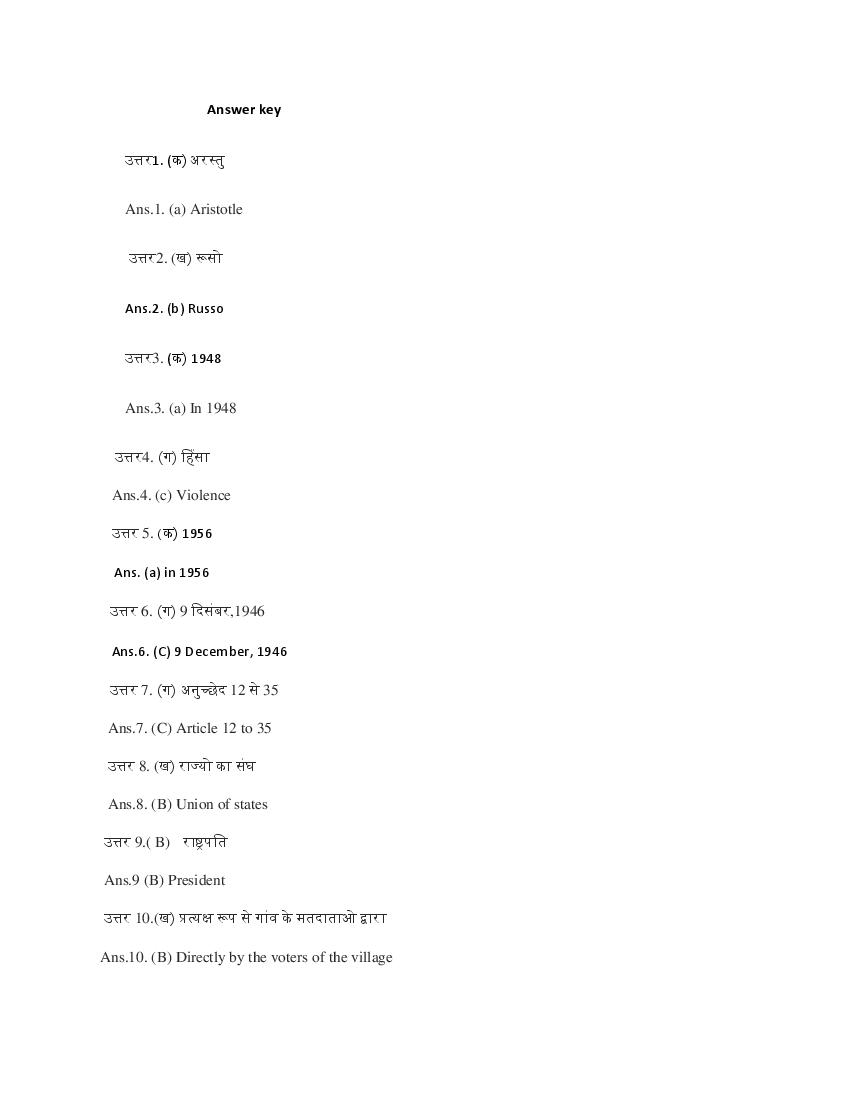
उत्तर1. (क) अरस्तु
Ans.1. (a) Aristotle
उत्तर2. (ख) रूसो
Ans.2. (b) Russo
उत्तर3. (क) 1948
Ans.3. (a) In 1948
उत्तर4. (ग) ह स
िं ा
Ans.4. (c) Violence
उत्तर 5.(क) 1956
Ans. (a) in 1956
उत्तर 6. (ग) 9 दिसिंबर,1946
Ans.6. (C) 9 December, 1946
उत्तर 7. (ग) अनुच्छे ि 12 से 35
Ans.7. (C) Article 12 to 35
उत्तर 8. (ख) राज्यो का सिंघ
Ans.8. (B) Union of states
उत्तर 9.( B) राष्ट्रपतत
Ans.9 (B) President
उत्तर 10.(ख) प्रत्यक्ष रूप से गािंव के मतिाताओ द्वारा
Ans.10. (B) Directly by the voters of the village
Page 2
Ans.11. Legal right
उत्तर 12. (a) 61वा सिंशोिन
Ans.12. (a) 61th Amendment
उत्तर 13. नोटा
Ans. 13.Nota
उत्तर 14. अनुच्छे ि 368
Ans. Article 368
उत्तर 15:- 11
Ans. 15. Eleven
उत्तर 16. जॉन रोल्स
Ans. John Rolls
उत्तर 17. माशशल द्वारा
Ans. By Marshal
उत्तर 18. श्री जगिीप िनखड़
Ans. Sh.Jagdeep Dhankhar
उत्तर 19. (c) अतिकथन (A) सत्य ,ै लेदकन कारण (R) असत्य ।ै
Ans.19 (c) Assertion (A) is true but Reason (R) is false.
उत्तर 20. (b)िोनों कथन सत्य ,ैं लेदकन कारण, अतिकथन(A) की स ी व्याख्या न ीं ।ै
Ans. (b) Both the statements are true, but Reason is not the correct explanation of Assertion (A).
उत्तर 21.
1. परमप्रवािी तवचारक राजनीतत शास्त्र को तवज्ञान मानते ।ैं
Page 3
क्या ?ै अथाशथश व राजनीतत मूलो, नैततक व सातत्वक तवचारो पर अतिक बल िेते ।ैं इसमे कल्पना अतिक |ै
Ans. 21. 1. The absolutist thinkers consider political science as a science.
2. The absolutist thinkers are idealists. Have you seen what should be? They are not concerned with what
is? Meaning they lay more emphasis on political principles, moral and virtuous thoughts. There is more imag-
ination in this.
उत्तर 22. नागररक असमानता को कानूनी असमानता िी क ा जाता ।ै इसमें नागररकों को अतिकार समान रूप से प्राप्त न ीं
ोते। इसमें सिी लोगों को जीवन, स्वतिंत्रता, पररवार और िमश आदि से सिंबिंतित अतिकार असुरतक्षत ोते ।ैं अतिकार प्रिान
करते समय नागररकों में रिं ग, जातत, िमश या हलिंग के आिार पर िेििाव दकया जाता ।ै
Ans. Civil inequality is also called legal inequality. In this, citizens do not get rights equally. In this, the rights
related to life, freedom, family and religion etc. of all people are insecure. While granting rights, citizens are
discriminated against on the basis of colour, caste, religion or.
उत्तर 23. उत्तर-कानून के समक्ष समानता का अथश ै दक सब पर एक से कानून लागू ों और कानून की िृति में सब समान ों,
कोई छोटा-बड़ा न ो, जातत, विंश, रिं ग व हलिंग आदि के आिार पर कानून िेििाव न करता ो अथाशत बड़े-से-बड़ा अतिकारी व
छोटे-से-छोटे कमशचारी कानून के सामने समान ।ै िेश में सिी के तलए एक-सा कानून लागू ोता ।ै
Ans. The meaning of uniformity of law is that same law should be applicable on everyone and everyone
should be equal in its eyes, no one should be big or small, there should be no discrimination in the law on the
basis of caste, lineage, colour and sex etc. That is, the biggest officer and the smallest employee are equal be-
fore the law. The same law applies to everyone in the country.
उत्तर 24. 1. नागररक को अपने राज्य के प्रतत तनष्ठावान ोना चात ए।
Page 4
1. A citizen must be loyal to his state.
2. He must obey the laws made by the government.
अथवा(or)
अतिकार या कतशव्य साथ-साथ चलते ,ैं इसतलए अतिकार या कतशव्य एक ी तसक्के के िो पक्ष बताए गए ।ैं वाइल्ड क ते ,ैं
"के वल कतशव्यों की िुतनया में ी अतिकारों का कोई मूल्य ।ै " कतशव्य के तबना कोई िी अतिकार व्यव ाररक रूप लागू न ीं ो
सकता।
Rights and duties go hand in hand, so rights and duties are said to be two sides of the same coin.
Wilde says, "Only in the world of duties do rights have any value." Without duty, no right can be
practically implemented.Rights and duties go hand in hand, hence rights and duties are said to be
two sides of the same coin.
उत्तर 25.
जाततवाि (Caste):
जाततवाि एक बड़ी बािा ै जो िारत में राष्ट्रवाि को कमजोर करती ै। जातत के आिार पर िेििाव और सामातजक
असमानता राष्ट्रीय एकता के तलए एक गिंिीर चुनौती .ै
साम्प्प्रिातयकता (Communalism):
िारत एक िमशतनरपेक्ष िेश ै, लेदकन साम्प्प्रिातयकता लोगों को उनके िमश के आिार पर तविातजत करती ै , तजससे
राष्ट्रीय एकता को नुकसान ोता ै.
Ans.
Casteism:
Page 5
on the basis of caste is a serious challenge to national unity.
Communalism:
India is a secular country, but communalism divides people on the basis of their religion,
which harms national unity.
उत्तर 26. :-
सिंतविान उन्न मोतलक तनयमो, तसद्ािंतो तथा परमपराओं का सिंघर्श ोता ,ै तजनके अनुरूप राज्य की सरकार का गठबिंिन,
सरकार के कायश, नागररकों के अतिकार तथा नागररको या सरकार के बीच सिंबिंिो को तनतित दकया जाता ।ै
Ans. 26. Constitution is a set of fundamental rules, principles and traditions by which the form of
government of a state, the functions of government, the rights of citizens and the relations between
citizens and government are determined.
अथवा(or)
पिंतडत जवा रलाल ने रू, सरिार पटेल, डॉ. अब्िुल कलाम आजाि, डॉ. राजेंद्र प्रसाि, सीता रामैया, गोहविंि वल्लि पिंत,
डॉ. अम्प्बड
े कर, एन.वी. आयिंगर, के एम मुश
िं ी, अय्यर और सत्यनारायण तसन् ा सत त कु ल 11 सिसयो को सिंतविान सिा
के आिंतररक वगश में शातमल दकया जाता था।
A total of 11 members including Pandit Jawaharlal Nehru, Sardar Patel, Dr. Abdul Kalam Azad,
Dr. Rajendra Prasad, Sita Ramaiya, Govind Vallabh Pant, Dr. Ambedkar, N.V. Iyengar, KM Mun-
shi, Iyer and Satyanarayan Sinha were included in the inner circle of the Constituent Assembly.
उत्तर 27. तवत्त आयोग की तनयुति अनुच्छे ि 280 के अिंतगशत राष्ट्रपतत करता ।ै तवत्त आयोग िेश की तवत्तीय व्यवस्था का
परीक्षण करता ै और कें द्र और राज्य के बीच तवत्त सिंबिंिो के बारे में िी तसफररशे करता ।ै
Page 6
mission examines the financial system of the country and also makes recommendations regarding
financial relations between the center and the state.
अथवा(or)
सरकाररया आयोग की िो मुख्य तसफाररशें थीं- 1. कें द्र को राज्यों में कें द्रीय पुतलस बल तनयुि करने का अतिकार दिया
जाना चात ए। 2. अिंतराशज्यीय पुतलस बल की स्थापना की जानी चात ए।
The Sarkariya Commission had two main recommendations- 1. The Centre should be given the power to
appoint central police forces in the states.
2. An inter-state police force should be established.
उत्तर 28. 1. इस सिंतविान सिंशोिन के अनुसर तीन सत्रीय नगर सिंस्थानों को प ली बार सिंवैिातनक मान्यता प्रिान की
गई।
2. छोटे नगरों के तलए नगर पररर्ि और बड़े नगरों के तलए नगर तनगम की स्थापना की गई।
Ans. 1. According to this constitutional amendment, three sessional city institutions were given con-
stitutional recognition for the first time.
2. Municipal councils were established for small cities and municipal corporations for big cities.
उत्तर 29.1 स्वशासन की क्षमता ,ै
2. शासन करने, कानून बनाने
3. राष्ट्र राज्य की िलाई के तलए कानून बनाने की क्षमता ,ै
4. चा े दकसी बा री राज्य या सिंगठन के त तों की परवा दकए तबना।
Page 7
1. The capacity to self-govern,
2. To govern, to make laws
3. The capacity to make laws for the good of the nation state
4. Regardless of the interests of any outside state or organisation.
अथवा (or)
स्वतिंत्रता की िो सिंरक्षण इस प्रकार -ैं
1. लोकतिंत्र की व्यवस्था- के वल लोकतािंतत्रक व्यवस्था में ी लोगों को लिंबे समय तक या अतिकतम मात्रा में
स्वतिंत्रता और अतिकार तमल सकते ।ैं स्वतिंत्रता लोकतिंत्र का एक आिार ै या पररवतशन लोगों का त स्सा बनने
के तलए स्वतिंत्रता को आसानी से नि न ीं कर सकते ।ैं
2. मौतलक अतिकारों की घोर्णा- अतिकारों के नन की सिंिावना राज्य की ओर से अतिक ोती ।ै मौतलक
अतिकार सिंतविान में तलखे ोते ।ैं इस कारण राज्य या दकसी व्यति द्वारा अतिकारों का नन न ीं दकया जा
सकता। अतिकारों की घोर्णा स्वतिंत्रता की रक्षा करती ।ै
The two protections of freedom are as follows-
1. Democratic system- Only in a democratic system can people get freedom and rights for a long
time or in maximum amount. Freedom is a foundation of democracy or change cannot easily de-
stroy the freedom to be a part of the people.
Page 8
of the state. Fundamental rights are written in the constitution. Due to this, rights cannot be violated
by the state or any person. Declaration of rights protects freedom.
उत्तर 30.
न्याय के आिारिूत तत्व ैं तनष्पक्षता, समानता, और समानता के तसद्ािंत के अनुसार सिी के समान अतिकार। न्याय
एक नैततक और सामातजक अविारणा ै जो कानून के त त लोगों के साथ उतचत व्यव ार करने से सिंबिंतित ।ै
1. तनष्पक्षता: न्याय में सिी के साथ समान व्यव ार करना और दकसी को िी पक्षपात या िेििाव का तशकार न ोना
शातमल ।ै
2. समानता: न्याय का अथश ै दक सिी लोगों को समान अवसर और अतिकार प्राप्त ों।
3. समान अतिकार: न्याय का तसद्ािंत सिी को बुतनयािी स्वतिंत्रताओं का समान अतिकार ोना चात ए।
4. कानून का शासन: न्याय में य िी शातमल ै दक कानून सिी के तलए लागू ो और दकसी को िी कानून से ऊपर न ीं
माना जाना चात ए।
Ans. 30
The fundamental elements of justice are fairness, equality, and equal rights for all according to
the principle of equity. Justice is a moral and social concept that deals with the fair treatment of
people under the law.
1. Fairness: Justice involves treating everyone equally and no one being a victim of bias or dis-
crimination.
2. Equality: Justice means that all people have equal opportunities and rights.
3. Equal rights: The principle of justice is that everyone should have equal rights to basic free-
doms.
Page 9
be considered above the law.
उत्तर 31.
1. राज्य और राष्ट्र के तत्व अलग-अलग :ैं
राज्य के चार तत्व -ैं जनसिंख्या, क्षेत्र, सरकार और सिंप्रिुता। इनमें से दकसी एक तत्व के अिाव में राज्य वास्तव में राज्य
न ीं ो सकता। राज्य की तवशेर्ता मेशा इन चारों तत्वों से ोती ।ै इसके तवपरीत, राष्ट्र लोगों का एक समू ोता ै
तजसमें एकता और सामान्य चेतना की प्रबल िावना ोती ।ै
2. सिंप्रिुता राज्य के तलए आवश्यक ,ै राष्ट्र के तलए न ीं
3. राज्य अपनी एकता और अखिंडता को बनाए रखने के तलए पुतलस शति (बल) का उपयोग करता ै, राष्ट्र
मजबूत सािंस्कृ ततक और ऐतत ातसक सिंबिंिों से बिंिा :ै
Ans. 31. 1. The elements of state and nation are different:
There are four elements of a state- population, territory, government and sovereignty. In the absence of
any one of these elements, a state cannot really be a state. A state is always characterized by these four
elements. In contrast, a nation is a group of people with a strong sense of unity and common conscious-
ness.
2..Sovereignty is essential for a state, not a nation
Page 10
cultural and historical ties:
उत्तर 32. ााँ, िारत एक िमशतनरपेक्ष राज्य ।ै इसका मतलब ै दक राज्य का कोई आतिकाररक िमश न ीं ै, और सिी
नागररकों को दकसी िी िमश को मानने या न मानने, और दकसी िी िमश का पालन करने की पूणश स्वतिंत्रता ।ै 1.िारतीय
सिंतविान िमशतनरपेक्षता के तसद्ािंत को िी मानता ।ै
िारतीय सिंतविान की प्रस्तावना में िमशतनरपेक्षता को एक प्रमुख तसद्ािंत के रूप में शातमल दकया गया ।ै
2.िारतीय सिंतविान के अनुच्छेि 25 में सिी नागररकों को िार्मशक स्वतिंत्रता का अतिकार प्रिान दकया गया ,ै तजसमें
िमश के पालन, प्रचार, और प्रचार करने का अतिकार शातमल ।ै
Ans.32. Yes, India is a secular state. This means that the state has no official religion, and all citizens
have complete freedom to believe or not believe in any religion, and to practice any religion.
1.The Indian Constitution also follows the principle of secularism.
Secularism has been included as a major principle in the Preamble of the Indian Constitution.
2. Article 25 of the Indian Constitution guarantees all citizens the right to freedom of religion, which in-
cludes the right to practice, propagate and profess religion.
अथवा (or)
एक िमशतनरपेक्ष राज्य की चार तवशेर्ताएिं इस प्रकार :ैं
1. राज्य का कोई आतिकाररक िमश न ीं :ै
2. िार्मशक स्वतिंत्रता:
राज्य सिी नागररकों को अपनी िार्मशक मान्यताओं का पालन करने, पूजा करने और उसका प्रचार करने की स्वतिंत्रता
प्रिान करता .ै
Page 11
िमशतनरपेक्ष राज्य सिी िमों को समान सम्प्मान िेता ै और दकसी िी िमश को िूसरे िमश पर तरजी न ीं िेता .ै
4. िार्मशक तशक्षा:
िार्मशक तशक्षा के मामले में, िमशतनरपेक्ष राज्य उन सिंस्थानों में िार्मशक तशक्षा पर प्रततबिंि न ीं लगाता ै जो सरकारी
स ायता प्राप्त न ीं करते .ैं
The four characteristics of a secular state are as follows:
1. The state has no official religion:
2. 2. Religious Freedom:
The state provides freedom to all citizens to practice, worship and propagate their religious beliefs.
3. Equal treatment to all religions:
The secular state gives equal respect to all religions and does not give preference to any religion
over the other.
4. Religious Education:
In the case of religious education, the secular state does not prohibit religious education in institutions
which do not receive government aid.
उत्तर 33.
मौतलक अतिकार वे बुतनयािी अतिकार ैं जो प्रत्येक नागररक को जन्म से ी प्राप्त ोते ैं और सिंतविान द्वारा गारिं टीकृ त
ोते ।ैं िारतीय सिंतविान के िाग III में, अनुच्छे ि 12 से 35 तक, छ मौतलक अतिकारों का वणशन दकया गया ।ै
ये मौतलक अतिकार :ैं
समानता का अतिकार
स्वतिंत्रता का अतिकार
Page 12
िार्मशक स्वतिंत्रता का अतिकार
सािंस्कृ ततक और शैतक्षक अतिकार
सिंवैिातनक उपचारों का अतिकार
Ans.33. Fundamental rights are the basic rights that every citizen has by birth and are guaranteed by the
Constitution. In Part III of the Indian Constitution, from Articles 12 to 35, six fundamental rights are de-
scribed.
These fundamental rights are:
Right to equality
Right to freedom
Right against exploitation
Right to religious freedom
Cultural and educational rights
Right to constitutional remedies
उत्तर 34.
तविानपातलका, तजसे तविानमिंडल िी क ते ,ैं लोकतािंतत्रक सरकारों में एक म त्वपूणश अिंग ।ै इसके मुख्य कायश :ैं कानून
बनाना, नीतत तनिाशरण करना, और सरकार पर तनगरानी रखना।
1. कानून बनाना:
तविानमिंडल का सबसे म त्वपूणश कायश कानून बनाना ।ै य तवतिन्न तविायी प्रदियाओं के माध्यम से कानून बनाता
,ै जैसे दक तविेयक पेश करना, चचाश करना, और पाररत करना.
Page 13
तविानमिंडल सरकार की नीततयों को तनिाशररत करने में म त्वपूणश िूतमका तनिाता ।ै य नीततयों पर चचाश करता
,ै सुझाव िेता ,ै और उन् ें अिंततम रूप िेता .ै
3. सरकार पर तनगरानी:
तविानमिंडल सरकार की गतततवतियों पर तनगरानी रखता ।ै य सरकार के कामकाज को जािंचता ै, प्रश्न पूछता ,ै
और सरकार को जवाबिे बनाता .ै
Ans.34. The legislature, also known as the Legislature, is an important organ in democratic govern-
ments. Its main functions are: making laws, setting policy, and monitoring the government.
1. Lawmaking:
The most important function of the legislature is lawmaking. It makes laws through various legisla-
tive processes, such as introducing, discussing, and passing a bill.
2. Policy making:
The legislature plays an important role in determining the policies of the government. It discusses,
suggests, and finalises policies.
3. Monitoring the Government:
The legislature monitors the activities of the government. It scrutinises the performance of the
government, asks questions, and holds the government accountable.
अथवा (or)
लोकसिा अध्यक्ष के मुख्य कायश:-
1.सिन की कायशवा ी की अध्यक्षता करना:
2. कोरम लागू करना और अनुशासनात्मक कारश वाई
Page 14
4.व तनणशय करता ै दक कोई तविेयक, िन तविेयक ै या न ीं।
उत्तर 35.
न्यायपातलका की स्वतिंत्रता:
न्यायािीशों की तनयुति योग्य व्यतियों से की जाए,
उनका कायशकाल सुरतक्षत ो,
उन् ें दकसी िी बा री िबाव से मुि रखा जाए,
उनकी तवत्तीय स्वतिंत्रता सुतनतित ो।
Ans.35.
Independence of Judiciary:
Judges should be staffed with competent people,
Their contracts should be secure,
They should be kept free from any external pressure,
Their financial independence should be ensured.
उत्तर 36. . िारतीय सिंतविान की प्रस्तावना की मुख्य तवशेर्ताएिं:-
यह भारत के संविधान के शासन के प्रकार को पररभावित करता है ।
प्रस्तािना में न्याय, स्वतं त्रता, समानता और बं धुत्व जै से शब्ों का उल्ले ख है , जो भारत के सं विधान के मू ल
वसद्ां तों को दशाा ते हैं ।
प्रस्तािना का लक्ष्य दे श की एकता और अखं डता को बनाए रखना है।
प्रस्तािना भारत के सं विधान के उद्दे श्ों को स्पष्ट करती है , जै से वक सभी नागररकों के वलए न्याय, स्वतं त्रता,
समानता सु वनवित करना।
Page 15
• It defines the type of governance of the Constitution of India.
• The preamble mentions words like justice, liberty, equality and fraternity, which reflect the basic
principles of the Constitution of India.
• The aim of the preamble is to maintain the unity and integrity of the country.
• The Preamble states the objectives of the Constitution of India, such as ensuring justice, liberty,
equality for all citizens.
उत्तर 37. अतिकार व्यति के तलए अत्यिंत आवश्यक ।ैं वे उसे सम्प्मान और गररमा के साथ जीवन जीने, अपनी स्वतिंत्रता
और स्वायत्तता का उपयोग करने, और समाज में सदिय रूप से िाग लेने की अनुमतत िेते ।ैं वे व्यति को राज्य के द्वारा
मनमाने ढिंग से िेििाव और अत्याचार से िी बचाते ।ैं
य ािं कु छ कारण दिए गए ैं दक अतिकार व्यति के तलए क्यों आवश्यक :ैं
स्वतिंत्रता और स्वायत्तता:
अतिकार व्यति को अपनी पसिंि के अनुसार जीवन जीने और अपने तनणशय लेने की स्वतिंत्रता प्रिान करते ैं।
समानता और तनष्पक्षता:
अतिकार सुतनतित करते ैं दक सिी व्यतियों को समान अवसर प्राप्त ों और उन् ें दकसी िी रूप में िेििाव का तशकार
न ीं ोना चात ए।
सुरक्षा:
अतिकार व्यति को राज्य के द्वारा मनमाने ढिंग से िेििाव और अत्याचार से बचाते ैं और उन् ें सुरक्षा प्रिान करते ैं।
तवकास:
अतिकार व्यति को अपने व्यतित्व और क्षमताओं को तवकतसत करने में मिि करते ैं।
Page 16
अतिकार व्यति को सम्प्मान और गररमा के साथ जीवन जीने की अनुमतत िेते ैं।
Ans. 37. Rights are vital for an individual. They allow him to live with respect and dignity, exercise his
freedom and autonomy, and participate actively in society. They also protect the individual from arbitrary
discrimination and oppression by the state.
Here are some reasons why rights are important for an individual:
• Freedom and Autonomy:
Rights provide an individual with the freedom to live his life the way he wants and make his own deci-
sions.
• Equality and fairness:
Rights ensure that all individuals have equal opportunities and should not be subjected to any form of dis-
crimination.
• Protection:
Rights protect and grant protection to the individual from arbitrary discrimination and oppression by the
state.
• Development:
Rights help a person to develop his or her personality and abilities.
• Dignity:
Rights allow a person to live life with respect and dignity.
अथवा (or)
अतिकार (Rights):
अतिकार वे िावे ैं जो दकसी व्यति को समाज द्वारा दिए जाते ैं। ये अतिकार व्यति को कु छ तवशेर् कायश करने या न
करने की स्वतिंत्रता प्रिान करते ैं।
कतशव्य (Duties):
Page 17
कु छ तवशेर् कायश करने या न करने के तलए बाध्य करते ैं।
सिंबि
िं :
अतिकार और कतशव्य एक-िूसरे के पूरक ैं। अतिकार तिी प्राप्त ोते ैं जब व्यति अपने कतशव्यों का पालन करता
ै। यदि कोई अपने कतशव्यों का पालन न ीं करता ै, तो व अपने अतिकारों का आनिंि न ीं ले सकता ै। उिा रण के
तलए, दकसी को बोलने का अतिकार ै, लेदकन उसका कतशव्य ै दक व ऐसा करते समय िूसरों के अतिकारों का सम्प्मान
करे ।
• Rights:
Rights are claims that are given to a person by society. These rights provide a person with the freedom to
do or not to do certain actions
• Duties:
Duties are responsibilities that a person has to bear towards the society or towards other individuals.
These duties oblige a person to do or not to do certain tasks.
• Relation:
Rights and duties complement each other. Rights are obtained only when a person performs his duties. If
someone does not perform his duties, he cannot enjoy his rights. For example, one has a right to speak,
but one has a duty to respect the rights of others when doing so.
उत्तर 38. एक आिशश नागररक में 5 मुख्य गुण ोने चात ए: कानून का पालन करना, िूसरों का सम्प्मान करना, सामातजक
कायों में िाग लेना, िेश के प्रतत तनष्ठावान र ना, और मतिान करना.
य ािं इन गुणों का तवस्तार से वणशन दिया गया :ै
1. कानून का पालन करना:
एक आिशश नागररक को िेश के कानूनों का पालन करना चात ए और दकसी िी तनयम का उल्लिंघन न ीं करना चात ए.
Page 18
एक आिशश नागररक को सिी के साथ सम्प्मान और सत ष्णुता से पेश आना चात ए, चा े उनकी जातत, िमश या हलिंग कु छ
िी ो.
3. सामातजक कायों में िाग लेना:
एक आिशश नागररक को सामातजक कायों में िाग लेना चात ए और अपने समुिाय की िलाई के तलए प्रयास करना
चात ए, जैसे दक सफाई अतियान, तशक्षा कायशिम, आदि.
4. िेश के प्रतत तनष्ठावान र ना:
एक आिशश नागररक को अपने िेश के प्रतत तनष्ठावान र ना चात ए और िेश की रक्षा के तलए अपनी जान िी िेने को
तैयार र ना चात ए.
Ans.38. An ideal citizen should have 5 main qualities: follow the law, respect others, participate in social
work, be loyal to the country, and vote.
Here are the detailed description of these qualities:
1. Law abiding:
An ideal citizen should follow the laws of the country and should not violate any rules.
2. Respecting others:
An ideal citizen should treat everyone with respect and tolerance, regardless of their caste, religion or
gender.
3. Participate in social work:
An ideal citizen should participate in social work and work for the betterment of his community, such as
cleanliness drives, education programs, etc.
4. Being loyal to the country:
An ideal citizen should be loyal to his country and should be ready to sacrifice his life to protect the coun-
try.
Page 19
आिशश नागररक बनने में प्रमुख बािाएिं ये :ैं
1. नागररक तशक्षा की कमी:
नागररक तशक्षा, नागररकता के कतशव्यों और अतिकारों के बारे में जानकारी का अिाव आिशश नागररक बनने की प्रदिया
को बातित करता ै।
2. भ्रिाचार और उिासीनता:
भ्रिाचार और नागररकों की उिासीनता िी आिशश नागररकता के मागश में बािा डालते ,ैं क्योंदक वे लोगों को कानून का
पालन करने और सामातजक तजम्प्मेिारी तनिाने से रोकते .ैं
3. गरीबी, असमानता और सामातजक अन्याय:
गरीबी, असमानता और सामातजक अन्याय जैसे कारक लोगों को समाज में सदिय रूप से िाग लेने और आिशश नागररक
बनने की अपनी क्षमता को तवकतसत करने से रोक सकते ैं.
4. उग्र राष्ट्रीयता:
उग्र राष्ट्रीयता, जो दकसी एक राष्ट्र के प्रतत अत्यतिक प्रेम और अन्य िेशों से घृणा पर आिाररत ोती ै , आिशश
नागररकता के मागश में बािा डालती ै, क्योंदक य समाज में तविाजन और असिंतोर् पैिा करती .ै
The major obstacles in becoming an ideal citizen are:
1. Lack of civic education:
Lack of information about civic education, duties and rights of citizenship hinders the process of becom-
ing an ideal citizen.
2. Corruption and Apathy: Corruption and apathy of citizens also hinder the path of ideal citizen-
ship, as they prevent people from obeying the law and fulfilling social responsibility.
3. Poverty, inequality and social injustice:
Page 20
to participate actively in society and become ideal citizens.
4. Extreme Nationalism:
Extreme nationalism, which is based on excessive love for one nation and hatred for other nations, is an
obstacle in the path of ideal citizenship as it creates division and discontent in the society.
उत्तर 39. िारतीय चुनाव प्रणाली की मुख्य तवशेर्ताएाँ इस प्रकार बताई जा सकती :ैं -
एक मुि एविं तनष्पक्ष चुनाव प्रणाली
एक मुि एविं तनष्पक्ष चुनाव आयोग
जन -िागीिारी
कई दिनों तक चलने वाली एक व्यापक चुनाव प्रदिया
अप्रत्यक्ष और प्रत्यक्ष िोनों प्रकार की चुनाव प्रणाली का तमश्रण
आरक्षण के रूप में प्रतततनतित्व
सावशिौम वयस्क मतातिकार
सिी को चुनाव लड़ने का अतिकार
Ans.39. The main features of the Indian election system can be described as follows:-
• A free and fair election system
• A free and impartial Election Commission
• Public participation
• An extensive election process lasting several days
• Mixture of both indirect and direct election system
• Representation in the form of reservation
• Universal adult franchise
Page 21
अथवा(or)
िारतीय चुनाव प्रणाली में कई िोर् ैं जो इसकी प्रिावशीलता और तनष्पक्षता को प्रिातवत करते ।ैं इनमें से प्रमुख िोर्
तनम्नतलतखत :ैं
-अल्पमत का प्रतततनतित्व: िारतीय चुनाव प्रणाली में एक सिस्यीय तनवाशचन क्षेत्र ोते ,ैं ज ािं तजस प्रत्याशी को
सवाशतिक मत प्राप्त ोते ,ैं उसे तवजयी घोतर्त दकया जाता ।ै लेदकन अक्सर ऐसा िेखा जाता ै दक तवजयी प्रत्याशी को
कु ल मतों का एक छोटा सा त स्सा ी तमलता ,ै तजससे अल्पमत के प्रतततनति चुने जाते ।ैं
- चुनाव में िन का प्रिाव: चुनाव में िन का िुरुपयोग एक बड़ा िोर् ।ै िनवान उम्प्मीिवार अतिक प्रचार और तवज्ञापन
कर सकते ,ैं तजससे उनकी जीत की सिंिावना बढ़ जाती ।ै इससे योग्य और ईमानिार उम्प्मीिवारों को नुकसान ोता ।ै
- गुण्डागिी और बूथ कै प्चररिं ग: चुनाव के िौरान गुड
िं ागिी और बूथ कै प्चररिं ग जैसी घटनाएिं आम ।ैं इससे मतिान प्रदिया
प्रिातवत ोती ै और तनष्पक्ष चुनाव न ीं ो पाता।
- सत्तारूढ़ िल द्वारा सत्ता का िुरुपयोग: सत्तारूढ़ िल अक्सर अपने प्रिाव और सिंसािनों का उपयोग करके चुनाव में
अनुतचत लाि प्राप्त करते ।ैं इससे तवपक्षी िलों को समान अवसर न ीं तमलता।
There are many flaws in the Indian election system which affect its effectiveness and fairness. The major
flaws are as follows:
Minority Representation: The Indian electoral system has single-member constituencies, where the can-
didate who gets the most votes is declared the winner. But it is often seen that the winning candidate gets
only a small portion of the total votes, due to which minority representatives are elected.
- Influence of money in elections: Misuse of money in elections is a big flaw. Wealthy candidates can do
more campaigning and advertising, which increases their chances of winning. This harms qualified and
honest candidates.
- Hooliganism and booth capturing: Incidents like hooliganism and booth capturing are common during
elections. This affects the voting process and fair elections cannot be held.
Page 22
their influence and resources. This does not give a level playing field to opposition parties
उत्तर 40. िारत के प्रिानमिंत्री की िूतमका बहुत म त्वपूणश ,ै और उनके कायश तनम्नतलतखत :ै
प्रिानमिंत्री की मुख्य िूतमकाएिं:
- कायशपालक प्रातिकारी: प्रिानमिंत्री कें द्र सरकार का प्रमुख ोता ै और मिंतत्रपररर्ि पर कायशकारी अतिकार का प्रयोग
करता ।ै
- नीतत तनमाशण एविं दिशा : प्रिानमिंत्री सरकार की नीतत दिशा तनिाशररत करते ैं और राष्ट्र के तलए िृति और दिशा प्रिान
करते ।ैं
- सिंकट प्रबिंिन और तनणशय लेना : प्रिानमिंत्री सिंकटों के प्रबिंिन और आपात तस्थतत में म त्वपूणश तनणशय लेने में म त्वपूणश
िूतमका तनिाते ।ैं
- सला कार िूतमका : पीएमओ नीततगत मुद्दों, घरे लू और अिंतराशष्ट्रीय मामलों पर प्रिानमिंत्री को सला और तसफाररशें
प्रिान करता ।ै
- समन्वय : पीएमओ तवतिन्न सरकारी मिंत्रालयों और तविागों के बीच एक समन्वय तनकाय के रूप में कायश करता ।ै
- तविेशी कायश : पीएमओ िारत की तविेश नीतत को तैयार करने और दियातन्वत करने में म त्वपूणश िूतमका तनिाता ।ै
Ans.40.
The role of the Prime Minister of India is very important, and his functions are as follows:
Main roles of Prime Minister:
- Executive authority : The Prime Minister is the head of the central government and exer-
cises executive authority over the Council of Ministers.
Page 23
and provides vision and direction for the nation.
- Crisis Management and Decision Making : The Prime Minister plays a key role in managing crises
and taking important decisions in emergencies.
- Foreign work
: The PMO plays a key role in formulating and implementing India's foreign policy.
Advisory role : The PMO provides advice and recommendations to the Prime Minister on policy issues,
domestic and international affairs.
- Coordination : The PMO acts as a coordinating body between various government ministries and de-
partments.
अथवा(or)
िारत में राष्ट्रपतत की वास्ततवक तस्थतत नाममात्र की ोती ।ै राष्ट्रपतत को राज्य का सिंवैिातनक प्रमुख माना जाता ,ै
लेदकन व कायशपातलका का प्रमुख न ीं ोता ।ै राष्ट्रपतत की शतियााँ प्रिानमिंत्री और मिंतत्रपररर्ि द्वारा उपयोग की
जाती ।ैं
तवस्तार से:
सिंवि
ै ातनक प्रमुख:
राष्ट्रपतत िारत का सिंवैिातनक प्रमुख ै, जो राष्ट्र का प्रतततनतित्व करता ै लेदकन शासन न ीं करता।
कायशपातलका:
राष्ट्रपतत के पास सिंघ की कायशपातलका शति ोती ै, लेदकन व इसे प्रिानमिंत्री और मिंतत्रपररर्ि की सला से उपयोग
करता ै।
नाममात्र की शति:
Page 24
ैं।
राजनीततक प्रमुख:
ालािंदक राष्ट्रपतत औपचाररक रूप से राज्य का प्रमुख ै, लेदकन व राजनीततक रूप से उतना म त्वपूणश न ीं ै तजतना
दक प्रिानमिंत्री और मिंतत्रपररर्ि।
The actual position of the President in India is nominal. The President is considered the constitutional
head of the state, but he is not the head of the executive. The powers of the President are exercised by the
Prime Minister and the Council of Ministers.
In detail:
• Constitutional Head:
The President is the constitutional head of India, who represents the nation but does not rule.
• Executive:
The President has the executive power of the Union but exercises it with the advice of the Prime Minister
and the Council of Ministers.
Nominal Power:
Most of the President's powers are nominal and are actually exercised by the Prime Minister and the
Council of Ministers.
Political head:
Although the President is formally the head of state, he is not as politically important as the Prime Minis-
ter and the Council of Ministers.
Document Details
| Board / Org | Haryana Board |
| Exam | Class 11 |
| Type | Sample Paper |
| Pages | 25 |
| Updated | 24 Sep 2026 |