HBSE Class 11 Sample Paper 2027 English Elective Marking Scheme
Finished viewing? Save it for later —
Download HBSE Class 11 Sample Paper 2027 English Elective Marking Scheme (PDF · 15 pages)About HBSE Class 11 Sample Paper 2027 English Elective Marking Scheme
HBSE Class 11 Sample Paper 2027 English Elective Marking Scheme is available here for free download. Published by Haryana Board for Class 11, this answer key can be viewed online or downloaded as a PDF (15 pages). Candidates preparing for Class 11 can use HBSE Class 11 Sample Paper 2027 English Elective Marking Scheme to understand the exam pattern, the type of questions asked, and the overall difficulty level.
Frequently Asked Questions
How can I download HBSE Class 11 Sample Paper 2027 English Elective Marking Scheme?
Open this page and click the Download button to save HBSE Class 11 Sample Paper 2027 English Elective Marking Scheme as a PDF. It is completely free on AglaSem Docs.
Is HBSE Class 11 Sample Paper 2027 English Elective Marking Scheme free to download?
Yes. HBSE Class 11 Sample Paper 2027 English Elective Marking Scheme can be viewed online and downloaded as a PDF free of cost on AglaSem Docs.
How many pages does HBSE Class 11 Sample Paper 2027 English Elective Marking Scheme have?
HBSE Class 11 Sample Paper 2027 English Elective Marking Scheme contains 15 pages, which you can read online or download together as a single PDF.
Where can I find more Class 11 study material?
You can find more Class 11 question papers, sample papers, syllabus, and answer keys on AglaSem Docs.
HBSE Class 11 Sample Paper 2027 English Elective Marking Scheme – Text
Read the full text of this answer key below — useful to quickly search, copy and reference the content online without downloading the PDF.
📄 View text version (16 pages)
Page 1
HBSE Class 11 Sample
Paper 2027 English
Elective Marking
Scheme
EXAM YEAR TYPE SUBJECT
Haryana Class 11 2027 Answer Key English
Notes · Sample Papers · Previous Year Papers · Mock Tests
Page 2
m .co
m .co s em
la
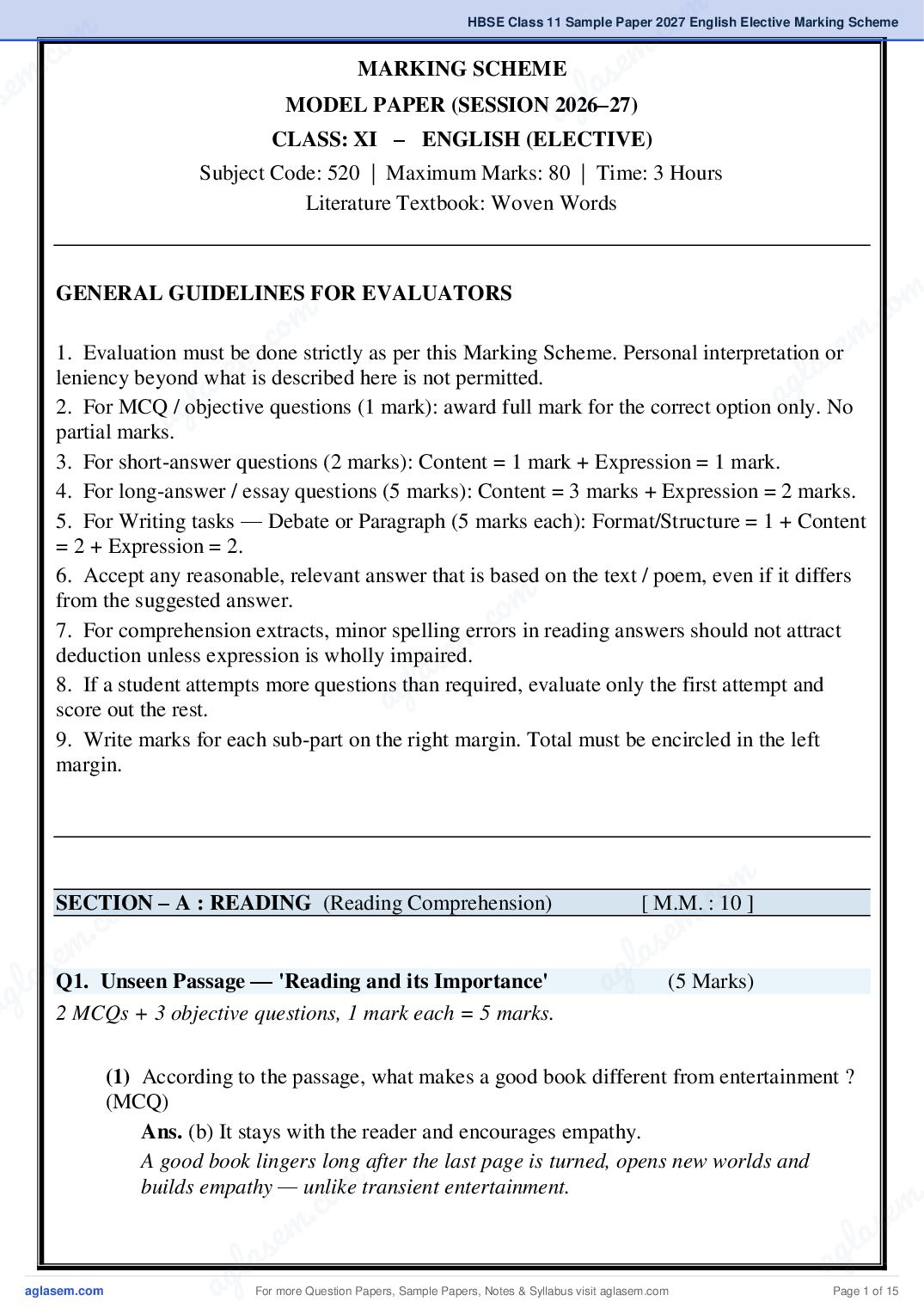
MARKING SCHEME
se a g
MODEL PAPER (SESSION 2026–27)
CLASS: XI – ENGLISH (ELECTIVE)
Subject Code: 520 | Maximum Marks: 80 | Time: 3 Hours
Literature Textbook: Woven Words
m
.co
GENERAL GUIDELINES FOR EVALUATORS
o m m
. c s e
emis described here is not permitted. a
1. Evaluation must be done strictly as per this Marking Scheme. Personal interpretation or
s l
la questions (1 mark): award full mark for the correct option only. ag No
leniency beyond what
2. For MCQ / gobjective
partial marks.a
3. For short-answer questions (2 marks): Content = 1 mark + Expression = 1 mark.
4. For long-answer / essay questions (5 marks): Content = 3 marks + Expression = 2 marks.
5. For Writing tasks — Debate or Paragraph (5 marks each): Format/Structure = 1 + Content
= 2 + Expression = 2.
6. Accept any reasonable, relevant answer that is based on the text / poem, even if it differs
m
.co
from the suggested answer.
m
7. For comprehension extracts, minor spelling errors in reading answers should not attract
e
deduction unless expression is wholly impaired.
las
score out the rest. ag
8. If a student attempts more questions than required, evaluate only the first attempt and
9. Write marks for each sub-part on the right margin. Total must be encircled in the left
margin.
m
m
SECTION – A : READING (Reading Comprehension) .co
.co
[ M.M. : 10 ]
s em
s em g la (5 Marks)
g la Q1. Unseen Passage — 'Reading and its Importance' a
a 2 MCQs + 3 objective questions, 1 mark each = 5 marks.
(1) According to the passage, what makes a good book different from entertainment ?
(MCQ)
Ans. (b) It stays with the reader and encourages empathy.
A good book lingers long after the last page is turned, opens new worlds and
m
builds empathy — unlike transient entertainment. .
.co s e m
s em l a
g la ag
a For more Question Papers, Sample Papers, Notes & Syllabus visit Page 1 of 15
Page 3
Ans. (c) They have better vocabulary, concentration, and analytical skills.
(3) What is the main concern about modern youth expressed in the passage ?
Ans. The main concern is that the habit of reading is gradually declining among
young people, largely due to short video clips and social media scrolling.
(4) Mention any two ways suggested in the passage to cultivate a reading culture.
Ans. (i) Introducing reading programmes in schools. (ii) Maintaining well-stocked
libraries. (iii) Setting aside daily reading time. (Accept any two.)
(5) What does the phrase 'a nation of readers is a nation of thinkers' suggest ?
Ans. The phrase suggests that reading develops critical thinking and intellectual
ability. A society that reads widely will be intellectually stronger, more creative,
and better equipped to solve problems.
Total: 5 Marks (2 MCQ × 1 + 3 objective × 1)
Q2. Unseen Poem — 'The River's Journey' (5 Marks)
2 MCQs + 3 objective questions, 1 mark each = 5 marks.
(1) What does the river symbolize in the poem ? (MCQ)
Ans. (b) The journey of life – from birth to rebirth.
The river begins as a small trickle, grows, serves others, merges with the sea, and
returns as rain — mirroring the cycle of life, death and renewal.
(2) Which poetic device is used in 'A trickle shy' ? (MCQ)
Ans. (c) Personification.
The trickle (water) is given the human quality of being 'shy'. It is not a simile (no
like/as), not alliteration (no repeated consonant), and not a metaphor.
(3) Where does the river ultimately pour itself into ?
Ans. The river ultimately pours itself into the sea.
(4) What does the poet say happens to the river after it merges with the sea ?
Ans. After merging with the sea, the river does not truly die. It transforms into
cloud, rain, and morning dew, and eventually returns to the mountains to begin its
journey anew.
(5) In one word, describe the tone of the poem.
For more Question Papers, Sample Papers, Notes & Syllabus visit Page 2 of 15
Page 4
m .co
m .co s e
Ans. Hopeful / Optimistic / Serene / Philosophical. (Accept any one appropriate m
se word.)
g l a
a
Total: 5 Marks (2 MCQ × 1 + 3 objective × 1)
SECTION – B : WRITING SKILLS AND GRAMMAR (Writing Skills and Grammar)
[ M.M. : 20 ]
m
m .co
.co
Q3. Debate Writing — Attempt any ONE of two
m
(5 Marks)
s e m
s e l a
ag
Marks: Format/Structure = 1, Content = 2, Expression = 2. Word limit: 150–200 words.
g l a
a
Component Marks Criteria for Award
Format / 1 Proper salutation to chair ('Respected
Structure Chairperson…'); clear 'For' or 'Against'
stance stated; logical paragraphing;
concluding statement.
m
.co
Content 2 At least 3–4 relevant, well-developed
em
arguments supporting the chosen stance
s
with examples or evidence. Arguments
la
g
must be coherent and on-topic.
a
Expression 2 Formal debating language; persuasive
tone; varied sentence structures; correct
grammar and spelling; smooth
transitions between points.
Option (a): 'Scientific Progress Has Brought More Harm Than Benefit to
m
m
Humanity'
.co
m .co For (supporting) key points: nuclear weapons, environmental pollution, bioweapons,
s e m
s e e-waste, digital addiction, job displacement, climate change caused by
g l a
g la industrialization.
a
a Against (opposing) key points: medical breakthroughs, communication, space
exploration, improved living standards, renewable energy, eradication of diseases.
Option (b): 'City Life is Far Superior to Village Life'
For key points: better education, healthcare, employment, infrastructure, connectivity,
entertainment, opportunities.
m
Against key points: pollution, stress, high cost of living, loss of community values,
.
.co
nature, slower pace of village life.
s e m
s em l a
g la ag
a For more Question Papers, Sample Papers, Notes & Syllabus visit Page 3 of 15
Page 5
Q4. Paragraph Writing — Attempt any ONE of two (5 Marks)
Marks: Title/Format = 1, Content = 2, Expression = 2. Word limit: 120–150 words.
Component Marks Criteria for Award
Title / Format 1 Appropriate title given; written as a
unified paragraph (not bullet points or
sub-headings).
Content 2 Clear central idea; 3–4 logically
developed supporting points relevant to
the topic; appropriate conclusion or
closing thought.
Expression 2 Coherent flow; varied and correct
sentence structures; appropriate
vocabulary; minimal grammatical
errors.
Option (a): 'The Role of Youth in Nation Building'
Expected content: youth as agents of change; education and skill development; social
awareness; environmental responsibility; political participation; innovation; examples
from history or present.
Option (b): 'My Favourite Season and Why I Love It'
Expected content: description of the season (any — winter, monsoon, spring, etc.);
sensory details; personal connection; activities enjoyed; emotional effect of the season.
Total: 5 Marks
Q5. Integrated Grammar — 12 MCQs (1 mark each) (10 Marks)
Note: The paper contains 12 MCQs. Students answer all 12 but the section carries 10 marks.
Award marks for the best 10 correct answers OR for all 12 (whichever is specified in the
exam instructions). Each correct answer = 1 mark.
[ MODALS ]
(1) The doctor said she _______ take complete bed rest for a week.
Ans. (b) must
For more Question Papers, Sample Papers, Notes & Syllabus visit Page 4 of 15
Page 6
m .co
m .co s e m
a
'Must' indicates strong obligation/necessity on doctor's order.
se ag l
(2) You _______ wear your seat belt while driving.
Ans. (b) must
'Must' conveys a legal and safety obligation. 'Should' is also acceptable.
(3) He _______ have left the keys inside – the door is still unlocked.
Ans. (c) might
m
m
'Might' expresses possibility / deduction about a past action without certainty.
.co
m .co s e m
s e l a
a ag
[ ARTICLES ]
g l
a
(4) She has _______ MA degree in English Literature.
Ans. (a) a
'MA' is pronounced 'em-ay' which begins with a vowel sound. Wait — 'em' starts
with vowel sound /e/, so 'an' is correct. Ans: (b) an.
Correct answer: (b) an. Reason: 'MA' is pronounced 'em-ay'; the sound begins
with a vowel /e/, so 'an' is used before it.
m
m .co
e
(5) We visited _______ historical monument during our school trip.
s
Ans. (a) a
g la
a
'Historical' begins with an aspirated /h/ sound (the 'h' is pronounced), so 'a' is
used. ('A historic / a historical' — aspirated h takes 'a'.)
(6) _______ honesty is the most valued quality in a leader.
Ans. (d) no article
Abstract nouns used in a general sense (honesty, courage, beauty) do not take an
article. m
m
c. [oTENSES ] m.co
m s e
s e g l a
g la a
a (7) By the time the ambulance arrived, the patient _______ already.
Ans. (c) had died
'By the time' + simple past = Past Perfect in the other clause. The patient's death
happened before the ambulance arrived.
(8) She _______ in this school since she was six years old.
Ans. (b) has been studying m .
.co
'Since she was six' shows an action that started in the past and continues to the
s e m
s em l a
ag
present = Present Perfect Continuous.
g la
a For more Question Papers, Sample Papers, Notes & Syllabus visit Page 5 of 15
Page 7
(9) The new bridge _______ by the Chief Minister last Monday.
Ans. (b) was inaugurated
'Last Monday' = simple past. Passive of Simple Past: was/were + past participle.
Subject 'bridge' is singular → was inaugurated.
(10) _______ the letter posted by you ?
Ans. (b) Was the letter posted by you ?
The active sentence is 'Did you post the letter?' → Passive: 'Was the letter posted
by you?' (Simple Past Passive interrogative.)
[ NARRATION ]
(11) He said, "I will call you tomorrow."
Ans. (b) He said that he would call me the next day.
Rules applied: reporting verb past → 'will' becomes 'would'; 'I' → 'he'; 'you' →
'me'; 'tomorrow' → 'the next day'.
(12) The teacher said to the students, "Work hard and you will succeed."
Ans. (c) The teacher advised the students to work hard and assured them that they
would succeed.
Imperative + conditional in direct speech → 'advised to…' + 'assured them
that…would…' in indirect speech.
Total: 10 Marks (best 10 of 12 × 1 mark each)
SECTION – C : LITERATURE – WOVEN WORDS (Short Stories, Poetry and Essays)
[ M.M. : 50 ]
Q6. Comprehension — Short Story Extract (5 Marks)
2 MCQs + 3 Very Short Answer questions, 1 mark each = 5 marks.
Extract: Based on a landlord-tenant / zamindar theme — characters: Sohrab, Baren Babu.
(1) What did Sohrab request from Baren Babu ? (MCQ)
Ans. (b) A loan to save his fields.
For more Question Papers, Sample Papers, Notes & Syllabus visit Page 6 of 15
Page 8
m .co
m .co s em
se g la
a
(2) Why did Baren Babu refuse Sohrab's request ? (MCQ)
Ans. (c) He lacked courage to oppose the moneylender who controlled the whole
village.
The extract explicitly states: 'He was not a cruel man by nature; he simply lacked
the courage to oppose the moneylender.'
(3) What does Sohrab's bowed head suggest about his state of mind ?
m
.co
Ans. Sohrab's bowed head suggests deep dejection, helplessness, and silent
m
.co m
despair. He has received a refusal that offers him no hope, and he leaves without
s e
em
protest — a picture of quiet resignation.
s g l a
l a a
agdoes the author convey the wife's anxiety without making her speak ?
(4) How
Ans. The author uses a powerful image: 'her eyes asking what her tongue dared
not.' The wife's eyes do the speaking — she is too afraid to ask aloud but her
anxiety is written plainly on her face.
(5) What does the phrase 'he only sat behind his accounts' tell us about Baren Babu ?
m
Ans. It suggests that Baren Babu has retreated into indifference and self-interest.
.co
Once kind, he now hides behind paperwork and financial calculations, distancing
em
himself from the human suffering around him.
s
g la Total: 5 Marks (2 MCQ × 1 + 3 VSA × 1)
a
Q7. Comprehension — Poetry Stanza (Philip Larkin, 'Coming' / similar)(5 Marks)
2 MCQs + 3 Very Short Answer questions, 1 mark each = 5 marks.
(1) What does 'the evening coming in' most likely symbolize ? (MCQ)
m
m Ans. (b) The approach of old age or death.
.co
m .co e
The evening that 'lights no lamps', that 'brings no comfort' despite seeming 'silken'
s
m
s e l a
from a distance, is a classic symbol of the close of life / death's quiet arrival.
g
g la a
a (2) Which poetic device is used in 'Silken it seems at a distance' ? (MCQ)
Ans. (b) Alliteration.
Repetition of the consonant sound /s/ in 'Silken', 'seems' creates alliteration. (Note:
'Silken' is also a metaphor, but alliteration is the device asked about in this line
specifically.)
m .
.co
(3) What does the poet mean by 'it brings no comfort' ?
e m
em l as
las ag
ag For more Question Papers, Sample Papers, Notes & Syllabus visit Page 7 of 15
Page 9
(symbolizing death or old age) offers no warmth, solace, or reassurance when it
actually arrives and closes in on the speaker.
(4) What is the significance of the missing tree in the stanza ?
Ans. The tree, which once connected 'Earth to the sky', represents a lost anchor —
perhaps a sense of meaning, connection to life, or stability. Its disappearance
reflects the speaker's growing sense of loss and disorientation.
(5) What feeling does the speaker experience in the final two lines ?
Ans. The speaker feels a profound numbness and loss of sensation — 'What is
under my hands, / That I cannot feel?' suggests a fading grip on reality, possibly
the numbness that precedes death or deep emotional emptiness.
Total: 5 Marks (2 MCQ × 1 + 3 VSA × 1)
Q8. Comprehension — Essay Extract ('Patterns of Creativity' — S. Chandrasekhar)
(5 Marks)
2 MCQs + 3 Very Short Answer questions, 1 mark each = 5 marks.
(1) What is the truest test of civilization ? (MCQ)
Ans. (b) The kind of people the country produces.
The extract explicitly states: 'the truest test of civilization is… the kind of man the
country turns out.'
(2) What distinguishes a creative mind from a merely clever one ? (MCQ)
Ans. (c) The ability to see new relationships and connections.
'A creative mind is not simply one that produces novelties; it is one that sees
relationships and connections where others see only isolated facts.'
(3) Name any two types of creative individuals mentioned in the passage.
Ans. (i) The scientist (who discovers a new element). (ii) The artist (who reveals a
hidden emotion in paint or stone). (iii) The poet (who strikes an unexpected chord
of memory). — Accept any two.
(4) What common activity does the passage say all creative people share ?
Ans. All creative people — scientists, artists, poets — share the fundamental act of
'seeing anew': discovering fresh connections, relationships, or meanings that others
overlook.
(5) What does the phrase 'strikes an unexpected chord of memory' mean ?
For more Question Papers, Sample Papers, Notes & Syllabus visit Page 8 of 15
Page 10
m .co
m .co s e
Ans. The phrase means the poet's words trigger a sudden, surprising resonance in m
se l a
the reader's memory — something unlooked-for that connects deeply with personal
g
experience or forgotten feeling. a
Total: 5 Marks (2 MCQ × 1 + 3 VSA × 1)
Q9. Essay-Type — Short Stories (any ONE of two) (5 Marks)
Marks: Content = 3, Expression = 2. Word limit: 150–200 words.
m
c o m m .co
(a) Iona Potapov's. grief — 'The Lament' (Chekhov) e
em l as
l as a g
ag
Value Points — Content (3 marks):
• Iona Potapov is a sledge-driver who has just lost his son. He is consumed by an
overwhelming grief he desperately needs to share.
• Throughout the story, he tries to tell his sorrow to his passengers — a military
officer, three merrymakers, a yard-keeper — but none listens. They are
indifferent or dismissive.
• Chekhov shows the tragedy of isolation: in a crowded city, Iona finds no human
ear willing to hear him. His grief has no outlet.
m
.co
• The story reaches its devastating climax when Iona, unable to find any human
m
e
listener, tells his story to his little mare — the only creature that seems to 'listen'.
s
la
• Chekhov's central theme: the terrifying loneliness of grief in a society too busy
g
a
and self-absorbed to notice others' pain.
Expression (2 marks):
• 2 marks: coherent, well-organized, fluent answer with accurate references to the
story.
• 1 mark: ideas present but poorly organized or expressed with significant errors.
• 0 marks: irrelevant or no answer.
m
m .co
.co s e m
em (b) Significance of title 'Glory at Twilight' — Bhabani Bhattacharya
OR
s g l a
g la a
a
Value Points — Content (3 marks):
• 'Twilight' refers literally to the fading light at the end of the day — symbolically,
to the closing years of a man's life.
• Srijut Sovan Lal is an ageing, forgotten moneylender. His life has been marked by
frustration and a desperate hunger for social respect and recognition.
• His 'glory' arrives only at the very end — when he distributes all his money to the
m .
.co m
poor during a famine, finally winning the love and gratitude he had always
s e
em
craved.
s l a
g la ag
a For more Question Papers, Sample Papers, Notes & Syllabus visit Page 9 of 15
Page 11
end of life — it is never too late for a true human moment.
• Bhattacharya uses Sovan Lal to explore how the desire for respect drives human
behaviour, and how redemption is possible at any point.
Expression (2 marks):
• Award as above.
Total: 5 Marks
Q10. Essay-Type — Poetry (any ONE of two) (5 Marks)
Marks: Content = 3, Expression = 2. Word limit: 150–200 words.
(a) 'Refugee Blues' — W. H. Auden
Value Points — Content (3 marks):
• Auden portrays the plight of Jewish refugees fleeing Nazi Germany, unable to
find a country that will accept them.
• Key images of helplessness: 'Ten thousand soldiers marched to and fro / Looking
for you and me' — the state machinery hunts them; the consul's dismissal —
'Come back next year'; the committee's hollow sympathy; the bird that has a
home while the refugee does not.
• The poem's blues structure (AAB rhyme scheme, repetition, refrain-like stanzas)
mirrors the monotonous, relentless suffering of displacement.
• Repetition of 'my dear' throughout creates intimacy but also emphasizes the
helplessness shared between the two speakers.
• The contrast between nature's freedom (fish, bird) and the refugees' trapped
condition intensifies the reader's sympathy.
Expression (2 marks):
• Award as above.
OR
(b) 'Felling of the Banyan Tree' — Dilip Chitre
Value Points — Content (3 marks):
• The banyan tree being felled is the central symbol of the poem — it represents
deep cultural roots, ancestral memory, family continuity, and belonging.
• The speaker watches the tree being cut down, methodically, branch by branch —
mirroring the systematic dismantling of a traditional way of life.
For more Question Papers, Sample Papers, Notes & Syllabus visit Page 10 of 15
Page 12
m .co
m .co s
• The roots of the tree — described as 'deeper' and harder to remove — suggeste m
se how cultural identity clings even when the surface is destroyed.
g l a
a
• The poem reflects the poet's own displacement from his traditional Maharashtrian
home in Baroda — the tree's felling is also the felling of personal and cultural
identity.
• Chitre uses concrete, visual imagery to show that uprooting is violent and
irreversible, even when done calmly and practically.
Expression (2 marks):
m
• Award as above. m .co
m .co s e m
s e a
Total: 5 lMarks
g l a ag
a
Q11. Essay-Type — Essays (any ONE of two) (5 Marks)
Marks: Content = 3, Expression = 2. Word limit: 150–200 words.
(a) Bertrand Russell's 'My Three Passions'
Value Points — Content (3 marks): m
.co
• Russell identifies three governing passions: (1) Longing for love, (2) Search for
m
s e
knowledge, (3) Unbearable pity for human suffering.
g la
• Love brought him ecstasy and relief from loneliness; it showed him what life
could be at its most beautiful. a
• Search for knowledge led him to mathematics, the natural sciences, and
understanding of human psychology — a lifetime of intellectual pursuit.
• Pity for suffering was not abstract — he felt it viscerally, seeing children starving,
victims of oppression, and the lonely aged.
• Students may argue any one passion is 'most significant' with reasoning — award
marks for a well-argued personal response.
m
om
c. Expression m.co
m
(2 marks):
s e
s e • Award as above.
g l a
g la a
a OR
(b) E. M. Forster — 'The Story' (story vs. plot)
Value Points — Content (3 marks):
• Forster's key distinction: a story is a narrative of events arranged in time sequence
m
('The king died, and then the queen died'); a plot is a narrative of events with a
.
.co
causal relationship ('The king died, and then the queen died of grief').
s e m
s em l a
g la ag
a For more Question Papers, Sample Papers, Notes & Syllabus visit Page 11 of 15
Page 13
happens next, the cave-man instinct of 'and then? and then?'.
• Plot demands intelligence and memory — it rewards the reader who notices
connections, causes, and consequences.
• Forster does not dismiss the story; he sees it as the foundation upon which plot is
built.
• The essay is drawn from Forster's 'Aspects of the Novel' — a key work of literary
criticism.
Expression (2 marks):
• Award as above.
Total: 5 Marks
Q12. Short Answers — Short Stories (any FOUR of five) (8 Marks)
Each answer carries 2 marks: Content = 1, Expression = 1. Word limit: 40–50 words.
(a) Paul's obsession — 'The Rocking-horse Winner' (D. H. Lawrence)
Ans. Paul rides the rocking-horse in a frenzied state to achieve 'luck' and win
money, hoping this will finally make his mother love him. Lawrence shows that in
a house haunted by greed, a child mistakes money for love — a deeply tragic
equation.
(b) Sherlock Holmes exposes Nathan Garrideb — 'The Adventure of the Three
Garridebs'
Ans. Holmes is suspicious from the start because the name 'Garrideb' is too
convenient. He discovers that 'Nathan Garrideb' is in fact 'Killer Evans', an
American criminal, by tracing his identity through old records and confronting him
at the crucial moment.
(c) Narrator's 'quiet revenge' — 'The Luncheon' (Maugham)
Ans. The narrator was once financially ruined by paying for an extravagant lunch
ordered by a woman who claimed to eat very little. His 'revenge' comes twenty
years later when he meets her again — enormously fat — a living irony of her past
pretensions.
(d) Pappachi's discovery — 'Pappachi's Moth' (Arundhati Roy)
Ans. Pappachi discovers a new species of moth but is denied recognition during his
lifetime. His frustrated ambition turns into a festering bitterness that he takes out
on his wife Mammachi, whom he beats regularly — his domestic violence rooted
in professional humiliation.
For more Question Papers, Sample Papers, Notes & Syllabus visit Page 12 of 15
Page 14
m .co
m .co (e) Mrs. Croft — 'The Third and Final Continent' (Jhumpa Lahiri) s e m
se g l a
Ans. Mrs. Croft, a 103-year-old American landlady, represents old-world dignity,
a
moral propriety, and quiet strength. Through her, Lahiri suggests that America,
beneath its modernity, holds its own deep traditions — and that human connection
bridges all cultural distances.
Total: 2 × 4 = 8 Marks
m
Q13. Short Answers — Essays (any FOUR of five)
m (8 Marks)
.co
.co
Each answer carries 2 marks: Content = 1, Expression = 1. Word limit: 40–50 words.
s e m
s em l a
a — oral vs. written literary traditions ('Tribal Verse')
(a) G. N.glDevy ag
a Devy argues that oral traditions are dynamic, community-centred, and rooted
Ans.
in lived experience, while written traditions tend to be fixed, individual, and often
shaped by elite cultural standards. Tribal oral literature carries a wisdom and
vitality that written forms frequently cannot replicate or preserve.
(b) John Ruskin — qualities of a 'good book' ('What is a Good Book?')
m
.co
Ans. Ruskin argues a truly good book is written by a master of his craft for a
lasting purpose — it demands effort from the reader, speaks truth, and enriches the
e m
(permanently valuable). las
mind. He distinguishes 'books of the hour' (ephemeral) from 'books of all time'
ag
(c) Mark Twain's humour in 'My Watch'
Ans. Twain uses self-deprecating humour to describe how every repairman he
visits makes his watch worse rather than better. Each 'expert' confidently diagnoses
a new problem, and the watch descends from being merely inaccurate to being
completely useless — a comic portrait of misplaced expertise.
m
m
(d) Kumudini Lakhia — 'Bridges' .co
m .co Ans. For Lakhia, 'bridges' are connections built between people, cultures, and
s e m
s e experiences through art — especially dance. Art transcends language, geography,
g l a
g la a
and social boundaries, creating a shared human space. A true artist, she argues, is
a always building bridges rather than walls.
(e) S. Chandrasekhar — 'Patterns of Creativity'
Ans. Chandrasekhar classifies creative minds into those who make one or two
great discoveries and stop (like Newton's disciples), those who have a single grand
vision (like Newton himself), and those with lifelong, sustained creativity across
m
many areas. Each type contributes differently to human progress.
.
.co s e m
s em l
Total: 2 × 4 = 8 Marks a
g la ag
a For more Question Papers, Sample Papers, Notes & Syllabus visit Page 13 of 15
Page 15
Each answer carries 2 marks: Content = 1, Expression = 1. Word limit: 40–50 words.
(a) Hawk's attitude — 'Hawk Roosting' (Ted Hughes)
Ans. The hawk presents itself as the absolute master of the world — it kills at will,
holds all creation in its foot, and sees no need to argue or justify. Hughes uses the
hawk's arrogant voice to reflect the nature of totalitarian power: self-righteous,
unquestioning, and lethal.
(b) Humour and irony in 'Telephone Conversation' (Wole Soyinka)
Ans. Soyinka uses dry humour and irony to expose the absurdity of racial
prejudice. When the white landlady asks the poet to describe the shade of his skin
('How dark? Are you light or very dark?'), the polite bureaucracy of racism is made
grotesque. The poet's witty responses highlight the landlady's ignorance.
(c) Wordsworth's lament — 'The World is Too Much With Us'
Ans. Wordsworth laments that modern humanity, consumed by materialism and
commerce, has lost its connection to nature. He contrasts the rich spiritual life
offered by nature — the sea, the winds, pagan gods — with the 'getting and
spending' that deadens human souls to beauty and meaning.
Total: 2 × 2 = 4 Marks
For more Question Papers, Sample Papers, Notes & Syllabus visit Page 14 of 15
Page 16
m .co
m .co s e m
a
MARKS SUMMARY
se Q. Section / Content a
Marks Choice g l
No.
Q1 Section A — Unseen 5 Attempt all 5
Passage (2 MCQ + 3
objective)
Q2 Section A — Unseen 5 Attempt all 5
Poem (2 MCQ + 3
m
objective)
m .co
Q3 .co
Section B — Debate 5 Any 1 out of 2
s e m
s
Writing em l a
g la B — Paragraph ag
Q4
a
Section
Writing
5 Any 1 out of 2
Q5 Section B — Grammar 10 Best 10 of 12
MCQs (12 Qs)
Q6 Section C — Short Story 5 Attempt all 5
Extract (2 MCQ + 3
VSA)
m
Q7 Section C — Poetry 5 c. oAttempt all 5
Stanza (2 MCQ + 3 VSA)
e m
Section C — Essay
s
la 5
Q8
Extract (2 MCQ + 3 ag Attempt all 5
VSA)
Q9 Section C — Essay-Type: 5 Any 1 out of 2
Short Stories
Q10 Section C — Essay-Type: 5 Any 1 out of 2
Poetry
m
.co
Q11 Section C — Essay-Type: 5 Any 1 out of 2
m
.co m
Essays
m s e
s e Q12 Section C — Short 2×4=8 Any 4 out of 5
g l a
g la Answers: Short Stories
a
a (any 4/5)
Q13 Section C — Short 2×4=8 Any 4 out of 5
Answers: Essays (any
4/5)
Q14 Section C — Short 2×2=4 Any 2 out of 3
Answers: Poetry (any 2/3)
GRAND TOTAL
o m 80
m .
S —.cEnd of Marking Scheme — S s e
s em l a
g la ag
a For more Question Papers, Sample Papers, Notes & Syllabus visit Page 15 of 15
Document Details
| Board / Org | Haryana Board |
| Exam | Class 11 |
| Type | Answer Key |
| Pages | 15 |
| Updated | 03 Nov 2026 |