CBSE Class 12 Economics Question Paper 2020 Set 58-3-1 Solutions
Finished viewing? Save it for later —
Download CBSE Class 12 Economics Question Paper 2020 Set 58-3-1 Solutions (PDF · 12 pages)About CBSE Class 12 Economics Question Paper 2020 Set 58-3-1 Solutions
CBSE Class 12 Economics Question Paper 2020 Set 58-3-1 Solutions is available here for free download. Published by CBSE for Class 12, this solution can be viewed online or downloaded as a PDF (12 pages). Candidates preparing for Class 12 can use CBSE Class 12 Economics Question Paper 2020 Set 58-3-1 Solutions to understand the exam pattern, the type of questions asked, and the overall difficulty level.
Frequently Asked Questions
How can I download CBSE Class 12 Economics Question Paper 2020 Set 58-3-1 Solutions?
Open this page and click the Download button to save CBSE Class 12 Economics Question Paper 2020 Set 58-3-1 Solutions as a PDF. It is completely free on AglaSem Docs.
Is CBSE Class 12 Economics Question Paper 2020 Set 58-3-1 Solutions free to download?
Yes. CBSE Class 12 Economics Question Paper 2020 Set 58-3-1 Solutions can be viewed online and downloaded as a PDF free of cost on AglaSem Docs.
How many pages does CBSE Class 12 Economics Question Paper 2020 Set 58-3-1 Solutions have?
CBSE Class 12 Economics Question Paper 2020 Set 58-3-1 Solutions contains 12 pages, which you can read online or download together as a single PDF.
Where can I find more Class 12 study material?
You can find more Class 12 question papers, sample papers, syllabus, and answer keys on AglaSem Docs.
CBSE Class 12 Economics Question Paper 2020 Set 58-3-1 Solutions – Text
Read the full text of this solution below — useful to quickly search, copy and reference the content online without downloading the PDF.
📄 View text version (12 pages)
Page 1
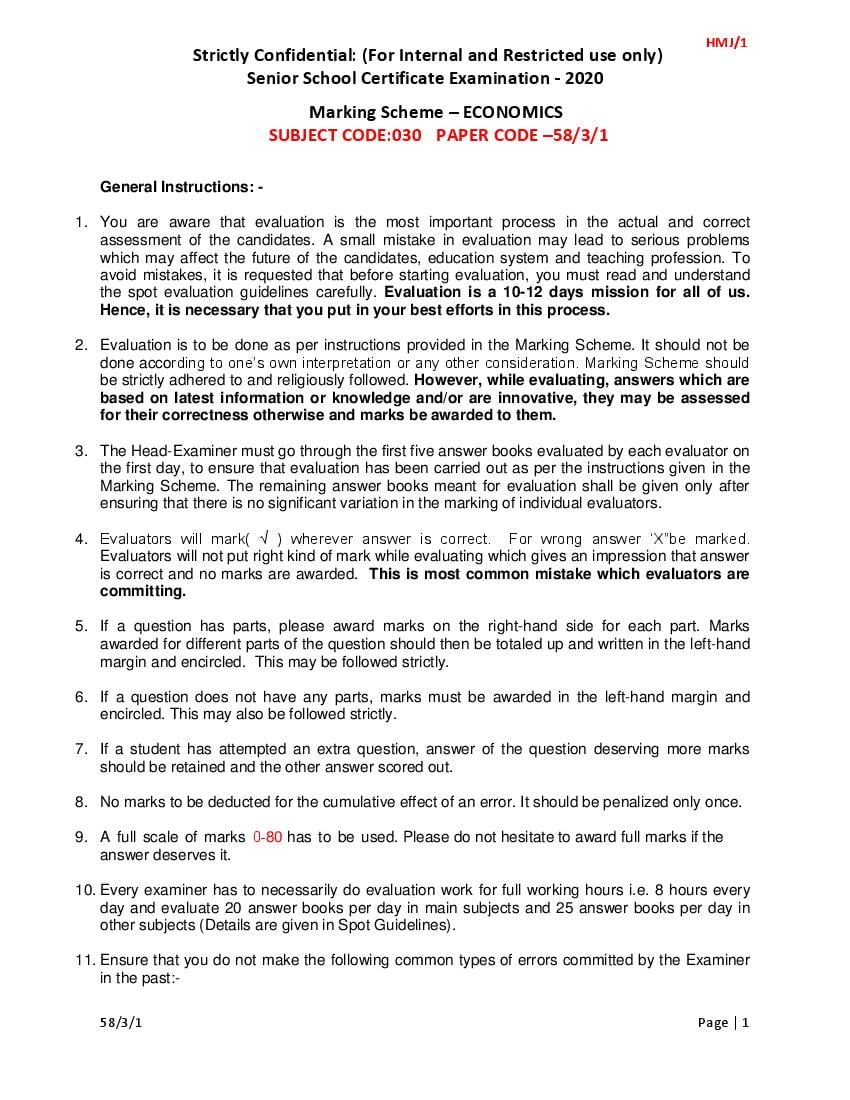
Strictly Confidential: (For Internal and Restricted use only)
Senior School Certificate Examination - 2020
Marking Scheme – ECONOMICS
SUBJECT CODE:030 PAPER CODE –58/3/1
General Instructions: -
1. You are aware that evaluation is the most important process in the actual and correct
assessment of the candidates. A small mistake in evaluation may lead to serious problems
which may affect the future of the candidates, education system and teaching profession. To
avoid mistakes, it is requested that before starting evaluation, you must read and understand
the spot evaluation guidelines carefully. Evaluation is a 10-12 days mission for all of us.
Hence, it is necessary that you put in your best efforts in this process.
2. Evaluation is to be done as per instructions provided in the Marking Scheme. It should not be
done according to one’s own interpretation or any other consideration. Marking Scheme should
be strictly adhered to and religiously followed. However, while evaluating, answers which are
based on latest information or knowledge and/or are innovative, they may be assessed
for their correctness otherwise and marks be awarded to them.
3. The Head-Examiner must go through the first five answer books evaluated by each evaluator on
the first day, to ensure that evaluation has been carried out as per the instructions given in the
Marking Scheme. The remaining answer books meant for evaluation shall be given only after
ensuring that there is no significant variation in the marking of individual evaluators.
4. Evaluators will mark( √ ) wherever answer is correct. For wrong answer ‘X”be marked.
Evaluators will not put right kind of mark while evaluating which gives an impression that answer
is correct and no marks are awarded. This is most common mistake which evaluators are
committing.
5. If a question has parts, please award marks on the right-hand side for each part. Marks
awarded for different parts of the question should then be totaled up and written in the left-hand
margin and encircled. This may be followed strictly.
6. If a question does not have any parts, marks must be awarded in the left-hand margin and
encircled. This may also be followed strictly.
7. If a student has attempted an extra question, answer of the question deserving more marks
should be retained and the other answer scored out.
8. No marks to be deducted for the cumulative effect of an error. It should be penalized only once.
9. A full scale of marks 0-80 has to be used. Please do not hesitate to award full marks if the
answer deserves it.
10. Every examiner has to necessarily do evaluation work for full working hours i.e. 8 hours every
day and evaluate 20 answer books per day in main subjects and 25 answer books per day in
other subjects (Details are given in Spot Guidelines).
11. Ensure that you do not make the following common types of errors committed by the Examiner
in the past:-
58/3/1 Page | 1
Page 2
Giving more marks for an answer than assigned to it.
Wrong totaling of marks awarded on a reply.
Wrong transfer of marks from the inside pages of the answer book to the title page.
Wrong question wise totaling on the title page.
Wrong totaling of marks of the two columns on the title page.
Wrong grand total.
Marks in words and figures not tallying.
Wrong transfer of marks from the answer book to online award list.
Answers marked as correct, but marks not awarded. (Ensure that the right tick mark is correctly
and clearly indicated. It should merely be a line. Same is with the X for incorrect answer.)
Half or a part of answer marked correct and the rest as wrong, but no marks awarded.
12. While evaluating the answer books if the answer is found to be totally incorrect, it should be
marked as cross (X) and awarded zero (0)Marks.
13. Any unassessed portion, non-carrying over of marks to the title page, or totaling error detected
by the candidate shall damage the prestige of all the personnel engaged in the evaluation work
as also of the Board. Hence, in order to uphold the prestige of all concerned, it is again
reiterated that the instructions be followed meticulously and judiciously.
14. The Examiners should acquaint themselves with the guidelines given in the Guidelines for spot
Evaluation before starting the actual evaluation.
15. Every Examiner shall also ensure that all the answers are evaluated, marks carried over to the
title page, correctly totalled and written in figures and words.
The Board permits candidates to obtain photocopy of the Answer Book on request in an RTI
application and also separately as a part of the re-evaluation process on payment of the
processing charges.
58/3/1 Page | 2
Page 3
Q.
Marks
NO.
EXPECTED ANSWER
Question: Which of the following is not a non-tax revenue receipt? (Choose the correct alternative)
(A) Goods and Services tax (C) Dividends and profits
1
(B) External grants (D) Disinvestment
1
Answer- (A) Goods and Services tax
2 Question: Deflationary gap indicates__________(excess/deficient) demand in an economy.
(Fill in the blank with correct answer)
Answer- deficient 1
3 Question: State, whether the following statement is true or false:
“Government budget is an annual statement showing actual receipts and actual payments
of the government for the last fiscal year.”
1
Answer- False
4 Question: Name the components of money supply.
Answer- 1) Currency held with public. 2) Demand deposits of commercial banks. ½+½
5 Question: If the exchange rate of the home currency rises, the value of exports of the
economy is likely to_______. (Fill in the blank with correct answer)
Answer- fall. 1
6
Question: State the meaning of Involuntary Unemployment.
Answer- Involuntary Unemployment refers to a situation in which all those people who are
willing and able to work at the existing wage rate do not get work. 1
OR
Question- Average Propensity to Save (APS) is the ratio of _______ and_________.
(Fill in the blank with correct answer)
Answer- total savings and total income
½+½
7 Question: State, whether the following statement is true or false:
“The official reserve transactions are taken as the accommodating item in Balance of
Payment (BOP).”
1
Answer- True
58/3/1 Page | 3
Page 4
fraction of ________ in the form of liquid assets.
(A) Total deposits (C) Total demand and term deposits
(B) Term deposits (D) Current deposits
1
Answer- (A) Total deposits or (C) Total demand and term deposits
(one mark should be allotted to any of the two)
9 Question: Define ‘Foreign Exchange Rate’.
Answer- Foreign Exchange Rate is the rate at which the currency of one country is 1
exchanged with the currency of another country.
Question: Primary deficit can be zero if_________. (Fill in the blank with correct
10
alternative)
(A) Fiscal deficit= Interest payments (C) Fiscal deficit> Interest payments
(B) Fiscal deficit< Interest payments (D) Revenue deficit< Fiscal deficit 1
Answer-(A) Fiscal Deficit = Interest Payments
11 Question: Distinguish between a ‘Current account deficit’ and a ‘Trade deficit’.
Answer- Current Account Deficit (CAD) refers to excess of payments for value of import of
visible items, invisible items and unilateral transfers over the receipts from value of 1½
export of visible items, invisible items and unilateral transfers. Whereas;
Trade deficit refers to the excess of the payments for value of import of visible items over 1½
the value of receipts of export of visible items.
OR
Question: “Balance of payment (BOP) is always balanced in the accounting sense”. Defend
or refute the given statement with valid reasons.
Answer-The given statement is defended, as Balance of payment (BOP) is based on the 3
principles of double entry book keeping system. Any deficit/ surplus created through
autonomous transactions are corrected by the corresponding surplus/deficit in
accommodating transaction by monetary authority.
12 Question: From the following data, calculate (a) Revenue deficit and (b) Fiscal deficit:
Particulars Amount (in ₹ crores)
(i) Tax Revenue 1,000
(ii) Revenue Expenditure 3,821
(iii) Non-tax Revenue 2,000
58/3/1 Page | 4
Page 5
(v) Capital Expenditure 574
(vi) Disinvestment 100
(vii) Interest Payments 1,013
Answer- Revenue Deficit= [(ii)-{ (i)+(iii) }]
½
=3821-(1000+2000)
½
= ₹ 821 crores
½
Fiscal deficit = [ { (ii) +(v) }- { (iii) +(i) +(iv) +(vi) } ]
½
= [(3821+574)- (2000+1000+100+135)]
½
=[(4395)-(3235)] = ₹1160 crores
½
13 Question-In the given figure, what does the gap ‘KT’ represent? State and discuss any two
fiscal measures to correct the situation.
Answer- KT’ represents inflationary gap
1
Two fiscal measures are –
a) Increase in Taxes - To curb the inflationary gap the government may increase the
taxes. This may reduce the purchasing power in the hands of the public which in
1½
turn may reduce the Aggregate Demand in the economy to bring it equal to the
Aggregate Supply.
b) Reduction in Government Expenditure- To curb the inflationary gap the government
may reduce its non developmental expenditure. This may reduce the purchasing
power in the hands of the people which in turn will reduce the Aggregate Demand
1½
in the economy to bring it equal to the Aggregate Supply.
For visually Impaired Candidates:
Question - What is meant by deflationary gap? State and discuss any two fiscal measures to
correct the situation of deflationary gap.
Answer- Deflationary gap is that situation when Aggregate Demand is lesser than
Aggregate Supply corresponding to full employment level. 1
58/3/1 Page | 5
Page 6
a) Decrease in Taxes - To curb the deflationary gap the government may decrease the
taxes. This may increase the purchasing power in the hands of the people which in
turn may increase the Aggregate Demand in the economy to bring it equal to the
1½
Aggregate Supply.
b) Increase in Government Expenditure- To curb the deflationary gap the government
may increase its expenditure. This may increase the purchasing power in the hands
of the people which in turn may increase the Aggregate Demand in the economy to
1½
bring it equal to the Aggregate Supply.
Question: “To boost the falling demand in the economy, the Reserve Bank of India recently
14
reduced Repo rate.” Elaborate the rationale behind the steps taken by the Central Bank.
Answer - Repo rate is the rate at which Reserve Bank of India lends funds to the
commercial banks for a short period of time. A decline in repo rate may induce commercial
banks to reduce the lending rates. This may encourage demand for loans in the market
leading to greater funds at the disposal of general public. This may lead to creation of 4
higher Aggregate Demand in the economy. (to be marked as a whole)
15 Question:Calculate Gross Value Added at Market price (GVAMP) from the following data:
Particulars Amount(in ₹ lakhs)
(i) Depreciation 20
(ii) Domestic sales 200
(iii) Change in Stock (-) 10
(iv) Exports 10
(v) Single Use Producer Goods 120
(vi) Net Indirect Taxes 20
Answer-GVA MP = [(ii)+(iii)+(iv)]-(v) 2
= [200+(-)10+10]-120
1
=200-120 ½
= ₹80 lakhs
½
OR
Question: The value of the Nominal Gross National Product (GNP) of an economy was ₹
2,500 crores in a particular year. The value of GNP of that country during the same year,
evaluated at the price of base year was ₹ 3,000 crores.
Calculate the value of GNP deflator of the year in percentage terms. Has the price level
risen between the base year and the year under consideration?
Answer- Given that Nominal GNP = ₹2500 crores and Real GNP = ₹ 3000,
𝑁𝑜𝑚𝑖𝑛𝑎𝑙 𝐺𝑁𝑃
GNP Deflator = Real GNP x100
2
2500
= x 100 ½
3000
= 83.33 % ½
No, the price level has reduced from base year to current year by 16.67%. 1
58/3/1 Page | 6
Page 7
(i) Planned investment = ₹ 100 crore (ii) C = 50+ 0.5 Y
(a) Determine the equilibrium level of income.
(b) Calculate the saving and consumption expenditure at equilibrium level of National
Income.
ANSWER- (a)At equilibrium level of income, Y = C +I 1
Y = (50 + 0.5Y) +100 1
Y- 0.5Y= 150 ½
Y= 150/0.5 = ₹ 300 crores ½
Equilibrium level of income = ₹ 300 crores
(b) S= - C +( 1-b) Y ½
= - 50 + (1-0.5) (300) ½
= ₹ 100 crores ½
Y = C+S ½
300 = C + 100 ½
C = 300-100 = ₹ 200 crores ½
17 Question: Define the problem of double counting in the estimation of National Income.
Discuss two approaches to correct the problem of double counting.
Answer- Problem of double counting in the estimation of National Income arises due to 2
counting the value of commodities more than once. This leads to overestimation of the
value of goods and services produced in the economy.
Two approaches to correct the problem of double counting are-
(i) i) Final Output Method: According to this method, value of only the final goods and
services should be added to determine the national income. 2
(ii)
(iii) ii) Value Added Method: According to this method, sum total of the value added by
each producing unit should only be taken in consideration. It means the value of 2
intermediate consumption should not be considered.
(iv)
(v) OR
Question: Define the following:
a) Capital Goods
b) Gross Domestic Product
c) Flow Variables
d) Income from property and entrepreneurship
58/3/1 Page | 7
Page 8
a) Capital Goods are those final goods which help in further production of other goods
and services. e.g. machinery 1½
b) Gross Domestic Product is the sum total of market value of all the final goods and
services produces within the domestic territory of a country during a year.
c) Flow Variables are those economic variables which is measured over a period of 1½
time e.g. national income
d) Income from property and entrepreneurship is the income which arises from 1½
ownership of physical/financial/intellectual property and reward to the
entrepreneur for his contribution to the production of goods and services in the
1½
form rent, royalty, interest and profit.
SECTION- B INDIAN ECONOMIC DEVELOPMENT
18 Question:_____________ is one of the taxes eliminated after implementation of Goods and
Services Tax (GST). (Fill in the blank with correct answer)
Answer-Value Added Tax (Any other valid example) 1
19 Question:_________ and _______ currency notes of old Mahatma Gandhi series were
banned as legal tender money on 8th November, 2016. (Choose the correct alternative)
(A) ₹ 50 and ₹ 100
(B) ₹ 500 and ₹ 1000
(C) ₹ 500 and ₹ 2000
(D) ₹ 500 and ₹ 200
Answer-(B) ₹ 500 and ₹ 1000 1
20 Question:Fixing of maximum land holding (ownership) for an individual is known
as_______. (Fill in the blank with correct answer)
Answer- land ceiling 1
21 Question: Central Pollution Control Board (CPCB) has identified____ categories of large and
medium industries as polluting industries. (Choose the correct alternative)
(A) 15 (B) 17 (C) 19 (D) 13
Answer- (B) 17 1
22 Question:“Google in India has hired 4000 graduate students.” (Pick the correct type of
employment)
The given statement deals with formal sector/ informal sector employment. 1
Answer- formal sector
58/3/1 Page | 8
Page 9
year__________ (Choose the correct alternative)
(A) 1948 (C)1954
(B) 1950 (D)1956
Answer- (A) 1948 1
24 Question: State the meaning of Cooperative Marketing.
Answer-Cooperative Marketing is a system in which the farmers pool their marketable
surplus of crops and distribute the sale proceeds on the basis of each individual share. 1
25 Question: Define ‘Human Capital Formation’.
Answer- Human Capital Formation refers to the process of addition made to the stock of
1
skilled and capable people in the country over a period of time. (any other valid definition)
OR
Question: Identify the correct sequence of alternatives given in column II by matching them
with their respective years in column I:
Column I Column II
a. Jan DhanYojana (i) 2005
b. Task Force on projections of the (ii) 1962
Minimum Needs and Effective
Consumption Demand
c. Mahatma Gandhi National Rural (iii) 1979
Employment Guarantee Act
d. Study Group formed by the (iv) 2014
Planning Commission for
Poverty
Choose the correct alternative from following:
(A) a-(iv), b-(i), c-(ii), d-(iii)
(B) a-(iv), b-(ii), c-(i), d-(iii)
(C) a-(iv), b-(iii), c-(i),d-(ii)
(D) a-(iv), b-(ii), c-(iii), d-(i)
Answer- (C) a-(iv), b-(iii), c-(i),d-(ii) 1
26 Question: State the meaning of ‘Commune’.
Answer- Commune refers to a system of collective farming under which people were made
to cultivate farm land in China under Great Proletarian Cultural Revolution. 1
Question:Arrange the following events in chronological order and choose the correct
27
alternative:
(i) Establishment of people’s Republic of China
(ii) Creation of Pakistan
(iii) First Five-Year Plan of India
(iv) First Five –Year plan of China
Alternatives:
58/3/1 Page | 9
Page 10
(B) (iii),(ii),(i),(iv)
(C) (ii),(i),(iii),(iv)
(D) (iv),(iii),(ii),(i) 1
Answer- (C) (ii),(i),(iii),(iv)
28 Question: “It is necessary to create employment in the formal sector rather than in the
informal sector.” Defend or refute the given statement with valid arguments.
Answer- The given statement is true and can be defended on the following arguments: 1½
(i) Formal sector of employment provides greater job security as compared to
informal sector of employment.
(ii) Under the formal sector of employment people are entitled to better social 1½
security benefits. (Marks are to be awarded to any other valid argument)
OR
Question: State and discuss any two challenges in the Power sector of India.
Answer- The challenges of the power sector in India are-
(i) India’s installed capacity to generate electricity is inadequate and remains
1½
underutilised. The operational efficiency of power projects which is reflected by
the Plant Load Factor (PLF) is low in India.
(ii) State Electricity Boards (SEBs) are suffering due to transmission and distribution 1½
losses, wrong pricing of electricity and other inefficiencies.
(Marks are to be awarded to any other valid point)
Question: “Rapid increase in economic growth surely trickles down to the people under the
29
absolutely poor category.” Defend or refute the given statements with valid arguments.
Answer- This statement is refuted because-
(i) Population growth has resulted in a very low growth in per capita income 1
(ii) The Green Revolution has increased the regional disparity and also the gap
between the rich and the poor farmers. 1
(iii) The gains of economic growth have been grabbed by the rich. 1
(any other valid argument to be awarded marks)
30 Question: “Agriculture sector appears to be adversely affected by the economic reform
process.” Explain the given statement.
Answer- The agricultural sector was adversely affected by the reform process in the
following manner-
(i) Public investment in agriculture sector especially in infrastructure like irrigation,
power etc. has been reduced in the reform period 1
(ii) Removal of fertilizer subsidy has increased the cost of production affecting
thereby the small and marginal farmers 1
(iii) Increased international competitiveness due to liberalisation and reduction of
import duties. 1
(iv) Shift from food crops to cash crops due to export-oriented policy in agriculture 1
led to a rise in prices of food-grains
OR
58/3/1 Page | 10
Page 11
prime reasons for this name given to India.
Answer- Reasons for India as outsourcing destination-
(i) Availability of skilled manpower- India has vast skilled manpower which 2
enhances the faith of MNCs.
(ii) Favourable Government policies- MNCs get various types of lucrative offers from
the Indian government such as tax holidays, tax concessions etc. 2
(any other valid argument should be allotted marks)
Question: “India, China and Pakistan have travelled more than seven decades of
31
developmental path with varied results.” Explain the given statement with valid arguments.
Answers-
i. Till the late 1970s, all the three countries were maintaining the same level of low
development.
ii. Over the last three decades, the three countries have taken different levels of
development
India has performed moderately over the years. Majority of its people still depend
on agriculture. Infrastructure is lacking and more than one fourth of its population
live below poverty line.
Pakistan performed low because of political instability, overdependence on 4
remittances and foreign aid along with volatile performance of agriculture.
China has used the market system to succeed in raising the rate of growth in
economy with stress on alleviation of poverty. (to be marked as a whole)
(any other valid argument should be allotted marks)
Question: Discuss briefly the rationale behind choosing ‘Self-reliance’ as a planning
32
objective for the Indian economy.
Answers- The objective behind self-reliance were-
i. To reduce foreign dependence: Planning objective of ‘Self-reliance’ targeted to
promote economic growth and modernisation, the Indian five year plans in the
early years of post independence era stressed on the use of domestic resources in 2
order to reduce our dependence on foreign countries.
ii. To avoid foreign interference: In the post independence era it was feared that the
2
dependence on the imported food supplies, foreign technology and foreign capital
may increase foreign interference in the policies of our country.
Question:
33
(a) State the meaning of ‘Poverty Line’.
(b) Define the following:
(i) Carrying capacity of environment (ii) Absorptive capacity of environment
Answers-
(a) Poverty Line is the cut off point on the line distribution which divides the population
of the country as poor and the non-poor. It can be determined in terms of calorie 2
intake and monthly per capita expenditure (MPCE).
b) (i) Carrying capacity of environment – It implies that the resources extraction is not
2
above the rate of regeneration of the resources and wastes generated are within
58/3/1 Page | 11
Page 12
(ii) Absorptive capacity of the environment- It means the ability of the environment to 2
absorb degradation without causing environmental damage.
(any other relevant definitions should be allotted marks)
Question: (a) “Ujjwala Yojana has been a game changer for rural India.” State any three
34
conventional fuels being targeted under the LPG cylinder distribution scheme (Ujjwala
Yojana).
Answer- a) The conventional sources of energy causes environmental pollution therefore
the government have introduced the ‘Ujjwala Yojna’ as a game changer for rural India by
providing free LPG gas cylinders (cleaner fuel) to rural households.
The three conventional fuels targeted under Ujjawala Yojana are:
(i) Agricultural waste and dried dung 1
(ii) Firewood 1
(iii) Coal (or any other valid example) 1
Question: (a) “The Indian Health System needs a stronger does of public expenditure to
cure itself.” Justify the given statements with valid arguments.
Answer- (b) The statement is defended as the improvement in the health system in India
has been unreasonably slow since independence. Indian health system has been a
victim of a relatively low public expenditure.
The health expenditure as a percentage of GDP is abysmally low as compared to
some of the major developing countries. It stood at around 4.7% of the total GDP in 3
the year 2014-15. Thus, actually Indian health system needs the increased dose of
public expenditure to cure itself. (to be marked as a whole)
(any other relevant point is to be marked)
OR
Question- (a) Why are less women found in regular salaried employment?
(b) Analyse the recent trends in sectoral distribution of workforce in India:
Trends in Employment Pattern (Sector wise), 1983-2012(in %)
Sector 1993-94 1999-2000 2011-2012
Primary 64 60.4 24.3
Secondary 16 15.8 24.3
Services 20 23.8 26.8
Answer- a) (i) Lesser women are found in regular salaried employment in India, as such 1½
jobs require skills and high level of literacy.
(ii) Lack of mobility among women in India due to social constraints. 1½
(b) The given data indicates that over the given period, the proportion of workforce in
primary sector has gone down rapidly. Whereas, the employment share of both
secondary sector and the services sector has increased. While the share of
secondary sector has gone up by approximately 9% recently, the corresponding 3
figure for services sector has gone up by approximately 7%.
(to be marked as a whole)
58/3/1 Page | 12
Document Details
| Board / Org | CBSE |
| Exam | Class 12 |
| Type | Solution |
| Pages | 12 |
| Updated | 22 Jul 2026 |