CBSE Class 12 Political Science Question Paper 2020 Set 59-5-1 Solutions
Finished viewing? Save it for later —
Download CBSE Class 12 Political Science Question Paper 2020 Set 59-5-1 Solutions (PDF · 16 pages)About CBSE Class 12 Political Science Question Paper 2020 Set 59-5-1 Solutions
CBSE Class 12 Political Science Question Paper 2020 Set 59-5-1 Solutions is available here for free download. Published by CBSE for Class 12, this solution can be viewed online or downloaded as a PDF (16 pages). Candidates preparing for Class 12 can use CBSE Class 12 Political Science Question Paper 2020 Set 59-5-1 Solutions to understand the exam pattern, the type of questions asked, and the overall difficulty level.
Frequently Asked Questions
How can I download CBSE Class 12 Political Science Question Paper 2020 Set 59-5-1 Solutions?
Open this page and click the Download button to save CBSE Class 12 Political Science Question Paper 2020 Set 59-5-1 Solutions as a PDF. It is completely free on AglaSem Docs.
Is CBSE Class 12 Political Science Question Paper 2020 Set 59-5-1 Solutions free to download?
Yes. CBSE Class 12 Political Science Question Paper 2020 Set 59-5-1 Solutions can be viewed online and downloaded as a PDF free of cost on AglaSem Docs.
How many pages does CBSE Class 12 Political Science Question Paper 2020 Set 59-5-1 Solutions have?
CBSE Class 12 Political Science Question Paper 2020 Set 59-5-1 Solutions contains 16 pages, which you can read online or download together as a single PDF.
Where can I find more Class 12 study material?
You can find more Class 12 question papers, sample papers, syllabus, and answer keys on AglaSem Docs.
CBSE Class 12 Political Science Question Paper 2020 Set 59-5-1 Solutions – Text
Read the full text of this solution below — useful to quickly search, copy and reference the content online without downloading the PDF.
📄 View text version (16 pages)
Page 1
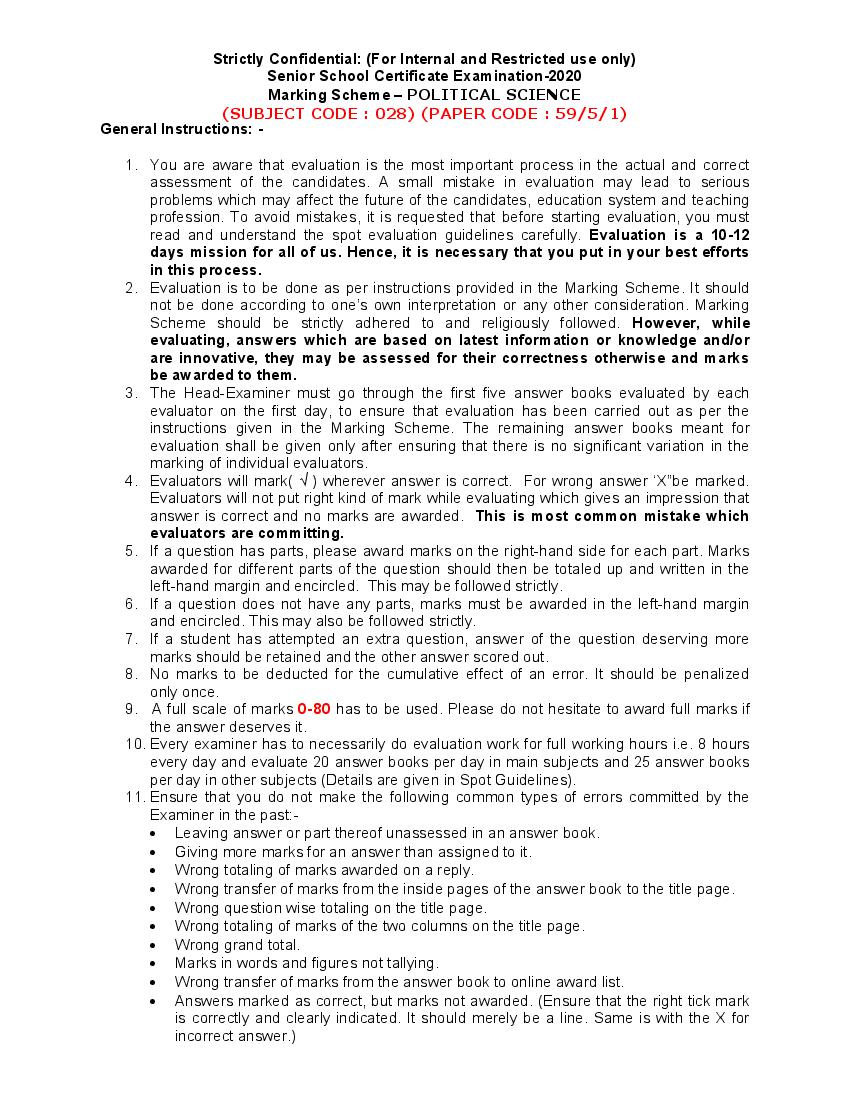
Senior School Certificate Examination-2020
Marking Scheme – POLITICAL SCIENCE
(SUBJECT CODE : 028) (PAPER CODE : 59/5/1)
General Instructions: -
1. You are aware that evaluation is the most important process in the actual and correct
assessment of the candidates. A small mistake in evaluation may lead to serious
problems which may affect the future of the candidates, education system and teaching
profession. To avoid mistakes, it is requested that before starting evaluation, you must
read and understand the spot evaluation guidelines carefully. Evaluation is a 10-12
days mission for all of us. Hence, it is necessary that you put in your best efforts
in this process.
2. Evaluation is to be done as per instructions provided in the Marking Scheme. It should
not be done according to one’s own interpretation or any other consideration. Marking
Scheme should be strictly adhered to and religiously followed. However, while
evaluating, answers which are based on latest information or knowledge and/or
are innovative, they may be assessed for their correctness otherwise and marks
be awarded to them.
3. The Head-Examiner must go through the first five answer books evaluated by each
evaluator on the first day, to ensure that evaluation has been carried out as per the
instructions given in the Marking Scheme. The remaining answer books meant for
evaluation shall be given only after ensuring that there is no significant variation in the
marking of individual evaluators.
4. Evaluators will mark( √ ) wherever answer is correct. For wrong answer ‘X”be marked.
Evaluators will not put right kind of mark while evaluating which gives an impression that
answer is correct and no marks are awarded. This is most common mistake which
evaluators are committing.
5. If a question has parts, please award marks on the right-hand side for each part. Marks
awarded for different parts of the question should then be totaled up and written in the
left-hand margin and encircled. This may be followed strictly.
6. If a question does not have any parts, marks must be awarded in the left-hand margin
and encircled. This may also be followed strictly.
7. If a student has attempted an extra question, answer of the question deserving more
marks should be retained and the other answer scored out.
8. No marks to be deducted for the cumulative effect of an error. It should be penalized
only once.
9. A full scale of marks 0-80 has to be used. Please do not hesitate to award full marks if
the answer deserves it.
10. Every examiner has to necessarily do evaluation work for full working hours i.e. 8 hours
every day and evaluate 20 answer books per day in main subjects and 25 answer books
per day in other subjects (Details are given in Spot Guidelines).
11. Ensure that you do not make the following common types of errors committed by the
Examiner in the past:-
Leaving answer or part thereof unassessed in an answer book.
Giving more marks for an answer than assigned to it.
Wrong totaling of marks awarded on a reply.
Wrong transfer of marks from the inside pages of the answer book to the title page.
Wrong question wise totaling on the title page.
Wrong totaling of marks of the two columns on the title page.
Wrong grand total.
Marks in words and figures not tallying.
Wrong transfer of marks from the answer book to online award list.
Answers marked as correct, but marks not awarded. (Ensure that the right tick mark
is correctly and clearly indicated. It should merely be a line. Same is with the X for
incorrect answer.)
Page 2
awarded.
12. While evaluating the answer books if the answer is found to be totally incorrect, it should
be marked as cross (X) and awarded zero (0)Marks.
13. Any unassessed portion, non-carrying over of marks to the title page, or totaling error
detected by the candidate shall damage the prestige of all the personnel engaged in the
evaluation work as also of the Board. Hence, in order to uphold the prestige of all
concerned, it is again reiterated that the instructions be followed meticulously and
judiciously.
14. The Examiners should acquaint themselves with the guidelines given in the Guidelines
for spot Evaluation before starting the actual evaluation.
15. Every Examiner shall also ensure that all the answers are evaluated, marks carried over
to the title page, correctly totaled and written in figures and words.
16. The Board permits candidates to obtain photocopy of the Answer Book on request in an
RTI application and also separately as a part of the re-evaluation process on payment of
the processing charges.
Page 3
Q1. Complete the following sentence in a meaningful way.
The second world war ended when the United States dropped two
atomic bombs on the Japanese cities of_____and________
OR
The Russian Revolution of 1917 was inspired by the ideals of
_______as opposed to capitalism and the need for an
________society.
Ans Hiroshima and Nagasaki ½X Pg 3
. ½=1
Or
Socialism……… egalitarian(Equal) society 2X½=1 Pg 19
Q2. Who emerged as a national hero in opposing the coup that took
place in the USSR in 1991 ?
Ans Boris Yeltsin 1 Pg 19
.
Q3. Which one of the following was NOT a consequence of
disintegration of the USSR ?
(a) Many new states emerged.
(b) Russia emerged as a new superpower.
(c) Power relations in world politics changed.
(d) The capitalist system emerged as the winner.
Ans (b) Russia emerged as a new superpower 1 Pg 23
.
Q4. Identify any two fields in which the Soviet Union lagged behind the
West.
Ans (i) Technology ½+½ Pg 19
. (ii) Infrastructure =1
(iii) In fulfilling the aspirations of the people
(iv) Lack of new ideas and information from the West
(v) Lack of democracy and absence of freedoms
or any other relevant. (any two)
Q5. Fill in the blanks to make the given sentence meaningful.
Internet is an example of Global______ ______.
Ans Global Public Goods ½*½= Pg 40
. Any other relevant answer 1
Q6. Name any two founder members of ASEAN.
Ans Malaysia,Singapore,Philippines,Indonesia,Thailand 2*½=1 Pg 56
. ( any two)
Page 1
Page 4
why? Working against the Hegemon or Working with the Hegemon.
Ans The candidates may give their opinion on any of the alternatives but 1 Pg47
. must support it with relevant reasons.
Candidates may give following reasons for
Working with the Hegemon
Example:
• Instead of engaging in activities opposed to the hegemonic
power, it may be advisable to extract benefits by operating within
the hegemonic system.
Pg 45
• Mutual convergence of interest will help India further its national
interest.
(or any other relevant point) (any one)
OR
Reasons for working against the Hegemon;
Working against Hegemon
• India should maintain its aloofness from hegemon and focus on
increasing its own national power.
• Through NA India should work for unity and cooperation among
Third world countries.
Q8. Explain the main objective of the United Nations.
Ans • To prevent international conflict 1 Pg 86
.
• To facilitate cooperation among States
Or any other relevant point (Any one Point).
Q9. Correct and rewrite the following statement in your answer book.
"India signed and ratified the Kyoto Protocol in 2002 and was
compelled to meet the requirements of theKyoto Protocol because
the emission of greenhousegases in India was not significant."
Ans India signed …………. in 2002 was exempted (not compelled ) to meet 1 Pg
. the requirements of ……….. 123
Q10 Choose the correct option that has significantly contributed to the
. process of 'Globalization'.
(a) Fear of war
(b) Security threats
(c) Advancement of technology
(d) Achievements of the United Nations
Ans (c) Advancement of technology 1 Pg
. 138
Q11 Name any two important leaders of the Bharatiya Jana Sangh
Page 2
Page 5
Ans (i) Shyama Prasad Mukherjee 2*½=1 Pg 39
. (ii) Deen Dayal Upadhyay
(iii) Balraj Madhok
(iv) Atal Bihari Vajpayee
(v) Lal Krishan Advani
(any two)
Q12 Which one of the following leaders played an important rolein the
. integration of princely states with India ?
(a) Jawaharlal Nehru
(b) Sardar Vallabhbhai Patel
(c) C. Rajagopalachari
(d) B.R. Ambedkar
Ans (b)Sardar Vallabhbhai Patel 1 Pg 17
.
Q13 According to the guidelines of the Second Five Year Plan, how did
. the government try to protect the domestic industries?
Ans (i) The government imposed substantial trade tariff on imports 1 Pg 53
. (ii) The government adopted protectionism to protect domestic
industries.
(iii) Import substitution
( or any other relevant point ) (any one)
Q14 Which one of the following statements related to the Indo-China
. War(1962) is correct?
(a)China could not cross the line of control.
(b) The Soviet Union remained neutral during the conflict
(c) The Soviet Union helped China against India.
(d) The Chinese forces did not withdraw their troops to earlier
position.
Ans (b) The Soviet Union remained neutral during the conflict 1 Pg 72
.
Q15 Why had India refuse to sign the Nuclear Non-proliferation Treaty
. (NPT)?
Ans Because India considered the Nuclear Non- Proliferation Treaty as 1 Pg 78
. discriminatory.
Q16 What main objective did Indira Gandhi want to achieve by
launching a series of initiatives under the Ten Point Programme in
1967?
Ans (i) She wanted to give the government policy a left orientation 1 Pg 92
Page 3
Page 6
(iii) She slowly wanted to sideline the syndicate and create her
own support base with a trusted group of advisors from
outside the party.
(iv) To regain the ground that Congress had lost in the 1967
elections
(v) She wanted to implement the Ten Point Programme which
included social control of banks ,nationalization of General
Insurance ,ceiling on urban property and income ,public
distribution of food grains ,land reforms and provision of home
sites to the rural poor.
(any one)
Q17 Analyse the root cause of the fall of the government headed by
. Morarji Desai.
Ans (i) Janata Party lacked direction, leadership and a common programme. 1 Pg
. 123
(ii) The Janata party government could not bring about a fundamental
change in policies from those pursued by the Congress.
(iii) There was inparty fighting and power struggle within the Janata
party.
( any one)
Q18 Why did the Janata Party government appoint a Commission of
. Inquiry headed by Justice J.C. Shah in May 1977 ?
Ans (i) To enquire into several allegations of the abuse of authorities by 1 Pg
. the Indira Gandhi government 113
(ii) The excess and malpractices committed
(iii) The actions taken in the wake of emergency
( any one)
Q19 Explain any one reason for the movement against outsiders in
Assam.
Ans (i) The fear of indigenous Assamese being reduced to minority. 1 Pg16
. 5
(ii) The fear of losing jobs, land and spread of poverty
(iii) Against the cultural domination of Bengalis and other outsiders
(iv)Against faulty voters registers that included the names of lack of
immigrants.
( or any other relevant point) (any one)
Q20 Who is considered to be the proponent of Bahujan Empowerment
. and Founder of Bahujan Samaj Party?
Ans Kanshi Ram 1 Pg
. 183
SECTION -B
Page 4
Page 7
Ans (i) Poland 4x 1/2 Pg 5
. (ii) Bulgaria =2
(iii) Romania
(iv) Hungary
(v) East Germany
(vi)Czechoslovakia
(vii) USSR
( any four )
Q22 Explain the difference between refugees and migrants.
Ans Migrants- are those people who voluntarily leave their home countries 1+1=2
. and move to some other country.
Refugees -are those people who flee their countries because of war,
natural disaster or political persecution and take shelter elsewhere.
Q23 Match correctly the following in column 'A' with those in column
'B'
Column 'A' Column 'B'
(a)First Prime Minister belonging (i) GeorgeFernandes
to a non-Congress Party
(b) The leader who led people's (ii) MorarjiDesai
march to the Parliament in 1975
(c)The Presidential candidate (iii)Jayaprakash
who defeated the official Narayan
candidate of the Congress Party
in 1969
(d) The leader associated with the (iv) V.V. Giri
Railway strike of 1974
Ans a---ii 4x1/2
. b---iii =2
c---iv
d---i
SECTION - C
Q24 "European Union is a highly influential regional organization."
. Justify the statement with any four suitable arguments.
Ans (i) European Union is the world's biggest economy . 4x1=4 Pg 53
. (ii) Its currency Euro, can pose threat to US dollar.
(iii) Its share in world trade is three times larger than that of US
(iv) Two of its members are the permanent members of Security
Council of UN .
Page 5
Page 8
institutions like the World Trade Organisation.
(vi) EU uses diplomacy, economic investments and negotiations
as in the case of dialogue with China on human rights and
environmental degradation.
(vii) Militarily EU combined forces are the second largest in the
world.
(viii) Two EU members -Britain and France are also nuclear power
states
(ix) The EU is world's second most important source of space and
Communication Technology.
( Any Four Points)
Q25 Describe any four features of the Communist Party of India.
.
Ans Four features of Communist Party of India - 4x1=4 Pg 37
. i. Initially it encouraged violent uprising
ii. It was inspired by the Bolshevik revolution in Russia
iii. It advocated socialism as the solution to problems affecting the
country .
iv. Later it abandoned the path of violence and participated in the
general election after independence.
v. It worked within the Congress from 1935-1941.
vi. It emerged as the second largest party in the first general
election with 16 seats.
vii. For the first time a communist Party came to power through
democratic election in Kerala in 1957.
Or Any other relevant point
Q26 Explain any two reasons that led to National Jubilation in India
. after the 1971 war with Pakistan.
OR
Explain with the help of any two examples from India that foreign
policy is always dictated by ideas of national interest.
Ans After 1971 War with Pakistan-
. i. India emerged as a decisive winner. Pakistan army had to
surrender before the Indian Army. 2x2=4 Pg 76
ii. It was a clear victory of India's military powers
iii. Pakistan got divided and East Pakistan emerged as a new
country- Bangladesh
iv. India and Pakistan signed the Shimla Agreement and Kashmir
became a bilateral issue.
(Brief explanation of any two points)
OR
Examples :-
i. When USSR invaded Hungary, India did not join the public
condemnation due to its national interest by not annoying USSR. 2x2=4 Pg 67
ii. India conceded China's claim over Tibet inspite of the
Panchsheel agreement .
Page 6
Page 9
to promote rapid economic development.
iv. Promotion to Non- Alignment policy in the face of Cold War.
v. India led the world protest against British attack on Egypt over
Suez Canal against neo-colonial invasion.
vi. India signed 20 year Treaty of Peace and Friendship with Soviet
Union 1971.
vii. India had a pro-USSR tilt 1977, Janta Party announced genuine
Non-alignment.
viii. In 1991 India adopted the new economic reforms leading to a
pro-US tilt.
( any two )
Q27 Assess the impact of coalition governments on the politics of
. India.
Ans Impact of coalition government on the politics of India 4 Pg
. i. Different political parties shared the power and the conflict in 177
ideology was kept away.
ii. Most of the regional parties got a chance to partner in decision
making.
iii. Unstable governments /political instability became common
iv. Parties supported by dalit and backward castes emerged as
important political parties.
v. The steady loss of Congress Party’s Dominance
vi. Helps to avoid the dominance of a single party.
(Or any other relevant point )
SECTION- D
Q28 Study the cartoon given below carefully and answer the following
. questions :
(a) What is the significance of bicycles in a large country like China
?
(b) Highlight the message being given by the symbols shown in
the two wheels of the bicycle.
(c) Show with the help of any two examples how China has opened
its economy to other countries.
Ans a. China is the largest user /manufacturer of bicycles in the world 1+2+2= Pg59-
. b. Existence of duality in today's China Strong state control of the 5 60
Communist Party has opened the door to privatization and
capitalism.
c. (i) China has privatised agriculture in 1982
(ii) It privatized industries in 1998
Page 7
Page 10
(iv) Special Economic Zones (SEZs) have been created in China
(v) China has become an important destination for Foreign Direct
Investments (FDI) anywhere in the world.
(vi) It has large foreign exchange reserves that allow it to make
big investments in other countries.
(vii) China's accession to WTO in 2001 is a step in its opening to
outside world .
(OR any other relevant point.) (any two)
Q28 Note: The following questions are for the visually impaired
. candidates only in lieu of question number 28.
(28.1) What measure was adopted by China to overcome the
shortage of foreign exchange under its earlier model of economy ?
(28.2) Highlight any two reasons for China to open its economy to
other countries.
(28.3) Highlight any two reforms made by China to grow its
economy.
Ans 28.1 In order to overcome the shortage of foreign exchange China 1+2+2
. decided to substitute imports by domestic goods =5
28.2 (i) To get rid of stagnation in its economy.
(ii) To get benefits of the world market.
(iii) For economic development
28.3 (i) Privatization of agriculture in 1982.
(ii) Trade barriers were eliminated in SEZ.
(iii) “Open door Policy” and economic development
(iv) Relations with US improved after 1972
(v) Started ‘four modernizations’-
agriculture,industry,science and technology and military.
(vi) Privatisation of industry
(vii) It allowed Foreign Direct Investment(FDI)
(viii) It became a member of WTO- World Trade Organisation
Q29 Study the passage given below carefully and answer the questions
. that follow :
The UN is an imperfect body, but without it the world would be
worse off. Given the growing connections and links between
societies and issues – what we often call 'interdependence' - it is
hard to imagine how more than seven billion people would live
together without an organization such as the UN. Technology
promises to increase planetary interdependence, and, therefore,
the importance of the UN will only increase. Peoples and
governments will have to find ways of supporting and using the
UN and other international organisations in ways that are
Page 8
Page 11
international community more broadly.
(i) Identify any two limitations of the United Nations that make it an
imperfect body.
(ii) How would the world be worse off, if there were no United
Nations? Explain.
(iii) Give any one example of planetary interdependence.
Ans (i) (a) It has no forces of its own. 2+2+1= Pg
. (b) Financially it is dependent on its member nations. 5 82,83
(c) It is dominated by big power or big permanent members of the ,95
Security Council.
(d) It cannot take an independent action against any country.
(e) Represents Western value and interests.
Or any other limitation (any two )
(ii) If there were no United Nations, the world would definitely be worse
off because:
(a) UN has served to bring US and the rest of the world into
dialogue and discussions over international issues.
( b) UN serves as an organisation to bring its member states
on a single platform in dealing with conflict and social and
economic development.
(c) UN provides an arena to modify US attributes and policies .
(d) UN helps in the matters of War and Peace
(e) It provides mechanisms, rules and bureaucracy to help
member states to cooperate.
(f) UN helps in solving challenging issues that can be dealt only
when member states work together.
(any two points)
(iii) Example of planetary interdependence - Technology,
Environmental issues, Epidemics
or any other relevant example .
Q30 Read the given passage carefully and answer the questions that
. follow :
The opposition to Emergency could keep the Janata Party together
only for a while. Its critics felt that the Janata Party lacked
direction, leadership, and a common programme. The Janata Party
Government could not bring about a fundamental change in
policies from those pursued by the Congress. The Janata Party
split and the government which was led by Morarji Desai lost its
majority in less than 18 months. Another government headed by
Charan Singh was formed on the assurance of the support of the
Congress party.
(i) In which year did the Janata Party government come to
power?
(ii) Analyse any two reasons responsible for the split of the
Page 9
Page 12
(iii) Why could the Charan Singh government remain in
power for just about four months only ?
Ans (i) 1977 1+2+2= Pg12
. (ii) (a) Janata party lacked direction, leadership and 5 3
common Ideology and programme
(b) It could not bring a fundamental change in its policies which
were in any way different from that of the Congress.
(c) There was power struggling within the Janata Party .
(any two)
(iii) Because the Congress party withdrew its support and the Charan
Singh government fell / Lost majority.
Q31
.
In the given political outline map of India, five states have been
marked as (A), (B), (C), (D) and (E). Identify these states on the
basis of information given below and write their correct names in
your answer book along with the respective serial number of the
information used and the concerned alphabet given in the map as
per the following format.
Sr. No. of the Concerned Name of the
Information used Alphabet State
(i)
(ii)
(iii)
(iv)
(v)
(i) The State from which Haryana was carved out. (ii) The State
which was created in 1963.
(iii) The State from which Jharkhand was carved out.
(iv) The State which was formed by separating Telugu speaking
areas from Madras (now Tamil Nadu).
(v) The State where the Communist Party Government was formed
in 1957.
Page 10
Page 13
. (ii) A Nagaland
(iii) C Bihar
(iv) D Andhra Pradesh
(v) B Kerala
Q31 Note: The following questions are for Visually impaired candidates
. only in lieu of(Map Question) :
(31.1) Name the State where the Congress Party could not win
majority in 1967 Assembly elections.
(31.2) Which State was formed in December 1952?
(31.3) From which State was Jharkhand carved out?
(31.4) Name the State which had been earlier part of Andhra
Pradesh.
(31.5) Lal-Denga was the leader of which Indian State ?
Ans For visually impaired candidates only 5x1=5
.
(31.1) Kerala/Punjab/Haryana/Uttar Pradesh/Madhya
Pradesh/Bihar/West Bengal/Orissa/Madras state
(31.2) Andhra Pradesh
(31.3) Bihar
(31.4) Telangana
(31.5) Mizoram
SECTION –E
Q32 Why did superpowers need any allies? Explain any four reasons.
. OR
Explain any four factors that were responsible for thedisintegration
of the USSR.
Ans i. To gain access to vital resources such as oil and minerals . 4x1 ½ Pg 7
. ii. To gain access to the territory from where the superpowers could =6
launch their weapons and troops .
iii. Locations from where they could spy on each other .
iv. To get economic support in case smaller countries pay for the
military expenses.
v. There were ideological reasons also. The loyalty of allies
suggested that the superpowers were winning the war of Ideas
and that liberal democracy or capitalism were better than
socialism and communism or vice versa.
(Any four)
or any other relevant answer (to be explained)
OR
i. USSR political and economic Institutions failed to meet the
Pg
Page 11
Page 14
ii. The Soviet economy used much of its resources for maintaining =6
arsenal and the development of satellites.
iii. The system had become stagnant.
iv. The ruling party was not accountable to the people .
v. Corruption was rampant and USSR was unwilling to open its
economy.
vi. Reforms by Gorbachev accelerated the expectations and
loosened the administration.
vii. The rise of nationalism and the desire for sovereignty within
various republics .
OR any other relevant points( any four)
Q33 Describe India's stand on global environmental issues.
. OR
Describe any six consequences of globalization.
Ans India's stand— 6 x 1=6 Pg
. 125-
• India signed and ratified the 1997 Kyoto Protocol in 2002 . 126
• India is of the view that per capita emission rates of the
developing countries are a tiny fraction of those in the developed
world.
• India is of the view that the developed countries are responsible
for most of the historical and current green house gas emissions
and emphasizes that the economic and social developments are
the first and overriding priority of the developing countries.
• Developed countries must help developing countries to meet
their commitments .
• India is also of the view that the SAARC countries should adopt
a common position on major global environment issues.
• Indian government is participating in global efforts through a
number of programmes like National auto fuel policy mandates
cleaner fuels for vehicles .
• The Energy Conservation Act (2001 )aims to improve Energy
efficiency .
• Electricity Act (2003) encourages use of renewable energy .
• India is importing natural gas and encourages adoption of clean
fuel policy.
• Indian Government is keen to launch National Mission of
Biodiesel.
• India has one of the largest renewable energy programme in the
world.
(any six points)
OR
Consequences of Globalisation
Page 12
Page 15
to a more minimal state.
(ii) It does not affect state capacity as the govt. continues to perform
the same function
(iii) It enhances state capacity with the help of technology.
(iv) It has affected the sovereignty of the countries.
(v) It has widened the choice of the customers leading to cultural
hetrogeneity.
(vi) It has led to the qualitative change in the goods and
commodities.
(vii) It has helped the economic growth of various developing
countries.
(viii) Homogeneous culture is developing.
(ix) Indigenous culture of various countries is facing challenges and
threats.
(x) Eating habits, dress sense and interest in music and films has
undergone a change.
or any other relevant point ( any six points )
Q34 Do you agree that popular movements go a long way in
. strengthening democracy? Justify your answer by giving any three
suitable arguments.
OR
The Assam Movement from 1979 to 1985 is the best example of the
movements against ‘outsiders’. Support the statement with
suitable arguments.
Ans i. Popular movements help the government to know about the 3 x 2=6 Pg14
. problems, aspirations and demands of the people. 2&14
ii. Expressing the demands and participating in the democratic 5
criticism of the government reduce the chance of revolution and
violence.
iii. Collective actions and assertions also lead to social unity .
iv. These movements train the people in the leadership movement
to project some leaders.
v. Movements also lead to develop consensus in different sections
and groups of the people .
vi. Making people aware of their rights,responsibilies and
expectations from democratic institutions.
vii. Popular movements perform an educative task and contribute to
expansion of democracy rather than causing disruptions.
or any other relevant point( any three)
Note :If a candidate does not agree with the statement, he/ she has to
give three arguments to support his/ her answer.
OR
• It is said to be the best example because the movement started
Page 13
Page 16
after 1951 should be sent back.
• They fear that the indigenous Assamese will be reduced to a
minority.
• They fear losing jobs and spread of poverty. 6x1=6 Pg
165
• They are against the cultural domination of Bengalis and other
outsiders.
• They are against the faulty voters registers that included the
names of lakhs of immigrants.
• The agitation followed various methods and mobilized all
sections of Assamese people.
• After 6 years of turmoil, the Rajiv Gandhi led government entered
into negotiations with the AASU leaders in 1985.
• A mutual Accord was signed.
• After this, AASU organised themselves as original political party
and came to power with the promise to resolve their problems
and build a ' Golden Assam'
(To be assessed as a whole)
Page 14
Document Details
| Board / Org | CBSE |
| Exam | Class 12 |
| Type | Solution |
| Pages | 16 |
| Updated | 22 Jul 2026 |